8 Best Back Braces for Lower Back Pain of 2026
Dr. David Taylor reviews the best back braces for lower back pain. Compare top-rated lumbar supports by support level, fit, and condition.
Updated

Lower back pain is one of the most prevalent musculoskeletal conditions in the United States, affecting an estimated 80% of adults at some point in their lives and accounting for more physician visits and lost workdays than nearly any other complaint. For many people, a well-chosen lumbar support brace provides meaningful relief during the acute phase of an injury, during physically demanding work, or as part of a broader rehabilitation program. The challenge is navigating a crowded market where dozens of products make similar claims with wildly different construction quality and clinical appropriateness.
In 2026, we reviewed eight of the best-selling back braces on Amazon — seven lumbar supports for lower back pain plus a dedicated upper-back posture corrector — covering flexible compression belts, semi-rigid stay-based designs, the clinical-grade inelastic options used in outpatient rehabilitation, and posture correction. Our selections draw on Dr. David Taylor’s clinical experience evaluating durable medical equipment, analysis of thousands of verified Amazon user reviews, and a careful review of the orthopedic literature on lumbar orthoses. We focused specifically on products appropriate for consumer purchase, meaning braces that can be fitted at home without a specialist and that cover the most common lower back presentations: muscle strain, disc herniation, sciatica, and non-specific chronic lumbar pain.
Find the Best Back Brace for Your Need
Jump straight to the pick that matches how you need support:
- Best back braces overall — our lumbar picks reviewed
- Best back brace for posture
- Best back brace for work and heavy lifting
- Best back brace for women
- More use cases — sciatica, scoliosis, office wear
Understanding Back Brace Support Levels
Before comparing specific products, it helps to understand the three broad categories of lumbar support. Flexible braces use elastic materials to provide compression and act as a postural reminder without significantly restricting spinal movement — appropriate for mild pain, desk work, and light activity. Semi-rigid braces add plastic or metal stays to the back panel, limiting motion in specific directions while still allowing walking, sitting, and most daily activities. These are the most commonly purchased category and are appropriate for the majority of acute and chronic lower back conditions. Rigid or inelastic braces — such as the Aspen pulley-style systems used in clinical settings — substantially restrict trunk flexion and are typically prescribed after spinal fractures, surgery, or severe acute disc herniation where controlled immobilization is part of the treatment plan.
Understanding which category applies to your situation determines the appropriate product before any other factor is considered. The lumbar braces reviewed here span all three categories, and we add a dedicated posture corrector for readers searching for upper-back support.
How We Selected These Back Braces
Our selection process prioritized products with at least 2,400 verified Amazon ratings, a demonstrated track record across multiple user populations, and meaningful differentiation in design or clinical application. One pick is a deliberate exception to the ratings floor: the ASPEN lumbar brace is a clinician-fitted product sold mainly through medical channels, so its Amazon review pool is small by nature rather than by weakness, and it earns its place on clinical evidence and hospital use instead of review volume. Where a listing has been rebuilt by its manufacturer and lost its review history, we treat the new, smaller pool as the honest number and re-check the pick against it rather than quoting the count the old listing used to carry. We included both consumer-oriented designs aimed at daily wear and clinical-grade options available through Amazon for users who need the level of support typically found in a medical supply context. Products were assessed on construction quality, sizing accuracy (based on user-reported feedback, not just stated ranges), breathability for extended wear, and the clinical relevance of the support mechanism — not just marketing language about pain relief.
For the October 2026 update we re-read all eight listings on Amazon. Every pick is still in stock, and the review counts and prices on this page are the ones Amazon showed on October 25. Two of the larger counts grew sharply because Amazon now pools reviews across each brace’s sizes and colors, so those figures describe the same product in every size, not a different model.
Best Back Braces Overall
These are the eight back braces that earned a place in this guide, each reviewed in full below. The Sparthos is my best overall lumbar pick for everyday lower back pain; the use-case sections after the reviews then match a specific need — posture, work and heavy lifting, and women’s fit — to the right brace from this same lineup.
1. Sparthos Back Brace for Lower Back Pain — Best Overall
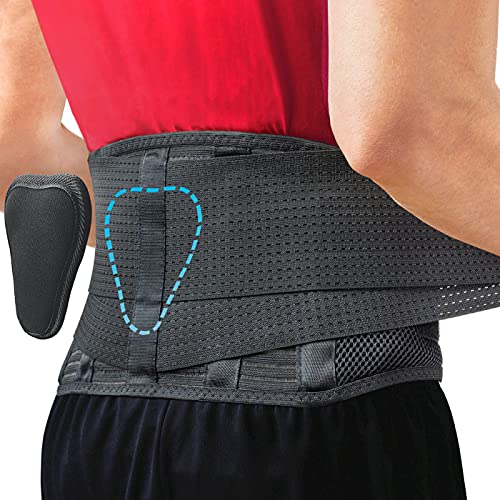
The Sparthos back brace is the most consistently well-reviewed lumbar support belt on Amazon among braces with a removable lumbar pad, and its design reflects careful attention to real-world usability. The inner anti-skid silicone strip pattern is a feature that distinguishes it from cheaper alternatives: on most basic neoprene belts, the brace shifts upward during bending and activity, defeating its purpose. The silicone lining anchors the brace to the skin surface so the lumbar pad stays aligned over the L4-L5 region throughout the day.
The removable pad is a practical detail with clinical value. Users experiencing localized pain at a specific spinal level benefit from the focused compression the pad provides; users with diffuse lumbar fatigue or mild muscle guarding can remove the pad for a lighter, more flexible feel. This adaptability makes the Sparthos appropriate across a wide spectrum of presentations — from the construction worker managing a chronic L5-S1 issue to the desk worker dealing with end-of-day lumbar fatigue. The sizing issue noted in reviews is real: if your waist measurement puts you at the upper end of a size, order down.
Sparthos Back Brace for Lower Back Pain
by Sparthos
The same Sparthos bestseller under its current SKU — 67,000+ reviews, removable lumbar pad, breathable all-day fit.
Pros
- Removable adjustable lumbar pad targets the L4-L5 region — reviewers with sciatica and herniated discs cite this most
- Breathable mesh manages heat and moisture for genuine all-day wear
- Wide hook-and-loop closure fits XS–XXL without rolling or sagging
- 67,000+ ratings — the strongest durability signal of any lumbar brace on Amazon
Cons
- Sizing runs slightly large — reviewers consistently recommend ordering one size down
- Velcro grip weakens after repeated machine washing without a laundry bag
2. Mueller Sports Medicine Adjustable Back Brace — Budget Pick
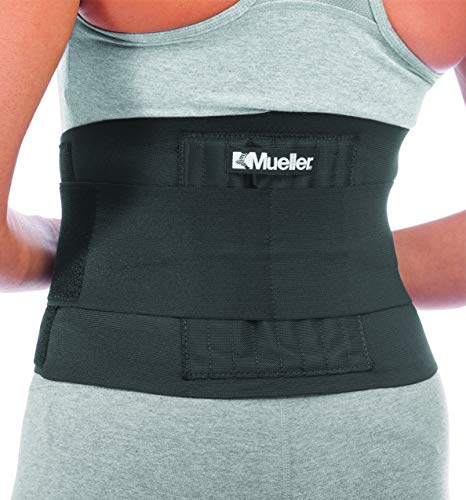
Mueller Sports Medicine has been producing athletic and orthopedic supports for over 60 years, and its adjustable lumbar brace is the one I point people to when cost is the deciding factor. It is the least expensive brace in this guide by a clear margin, and the specification that makes that surprising is the stay configuration: eight steel springs distributed across the back panel, paired with a molded anti-roll panel, rather than the two flexible stays that most braces at this price settle for. The dual-layer wraparound closure covers waists from 28 to 50 inches and lets you set the outer layer tighter than the inner one, which is how you get targeted compression out of a one-size design.
For buyers managing mild to moderate chronic back pain on a limited budget, this is the appropriate starting point. Eight steel springs provide enough rigidity to meaningfully limit harmful motion during bending and lifting, which is what separates it from the elastic belts that dominate the bottom of the category, and reviewers using it for actual lifting work say so directly. The mesh is breathable and odor-treated, so unlike a nylon-shelled brace it holds up through a warm day. Two honest caveats: the fit feedback is genuinely mixed, with some reviewers finding the stated size snug, and the steel spring inserts mean this is a hand-wash item rather than a machine-wash one. For users who need real bracing at a desk, in a vehicle, or during physical work, it delivers clinically appropriate support at a price that removes the cost barrier to trying bracing as a pain management strategy.
Mueller Sports Medicine Adjustable Back Brace with 8 Steel Springs
by Mueller Sports Medicine
The reliable, affordable standard — Mueller's eight-spring lumbar brace at the lowest price on this page.
Pros
- The lowest price in this guide, from a sports medicine brand with a 60-year track record
- Eight steel springs deliver firm, targeted compression — genuine lifting support, not just an elastic wrap
- Dual-layer wraparound straps let you dial compression tighter or looser through the day
- Breathable odor-treated mesh that reviewers specifically say does not overheat during long wear
Cons
- One-size design is less precise than a sized brace at the extremes of the waist range
- Fit feedback is mixed — some reviewers find it snug at the stated size
- Steel spring inserts mean hand washing, not machine washing
3. AVESTON Back Support Lower Back Brace with 6 Rigid Ribs
The AVESTON solves a problem most braces force you to accept: rigid support and a thin profile are usually mutually exclusive, and here they are not. Six wide reinforced ribs run across the back panel, spanning roughly T12 to S1, which is a broader vertical footprint than the two-stay belts that dominate this price bracket. Because those ribs are reinforced polymer rather than steel, the whole brace is lighter than an equivalent metal-stay design, and it does not have to come off for airport security or an MRI — a small thing until it is your third scan of the year.
The construction is three thin layers of firm elastic rather than a padded neoprene shell, and the practical result is that it disappears under a fitted shirt in a way the Sparthos and the FREETOO do not. Side compression panels let you set tension across the width of the brace independently of the main closure, so you can load the side that hurts without cranking the whole belt tighter. Two honest cautions. Sizing is by belly circumference measured at the navel, not by trouser size, and getting that wrong is far and away the most common complaint in the review pool. And the ribs are genuinely rigid, so if you are coming from a soft elastic belt, expect a few wears before it feels normal. For anyone who needs real bracing but has to look unbraced at work, this is the one.

AVESTON Back Support Lower Back Brace with 6 Rigid Ribs
by AVESTON
Rigid T12-to-S1 support in a genuinely thin profile — the brace to wear under clothes when you still need real bracing.
Pros
- Six wide reinforced ribs deliver rigid support across a broad T12 to S1 span, not just the midline
- Plastic ribs rather than metal stays mean no removal for airport security or an MRI
- Patented thin three-layer construction disappears under fitted clothing where bulkier braces do not
- Side compression panels let you tune tightness across the width of the brace independently
Cons
- Sized by belly circumference at the navel, not by trouser size — measuring wrong is the top complaint
- Rigid ribs are firmer than a flexible belt and take a few wears to get used to
4. FREETOO Back Brace for Lower Back Pain Relief with 6 Stays — Runner-Up
The FREETOO brace occupies a distinctive position in the market: it delivers six-stay construction — four memory-aluminum plus two spring steel — at a price point normally associated with basic two-stay designs. Memory-aluminum stays have a higher modulus than polypropylene and maintain their formed shape under load, providing a more consistent level of support throughout the day than spring stays, which deflect under load and gradually return to shape. The four-stay coverage across the full lumbar panel means that lateral motion is also limited, not just forward flexion — relevant for users who perform rotational movements at work or in daily activity.
The anti-skid silicone lining shared with the Sparthos solves the common complaint of braces riding up during activity. The air-mesh construction keeps the brace wearable during physically demanding work without the heat buildup that defeats compliance in solid neoprene designs. For tradespeople, warehouse workers, and anyone who performs regular physical labor and needs a brace that stays in place under load, the FREETOO’s six-stay construction offers measurably more structural support than the standard category.

FREETOO Back Brace for Lower Back Pain Relief with 6 Stays
by FREETOO
Six-stay engineering with memory-aluminum construction — a step above standard spring-stay braces for workers and active users.
Pros
- 6-stay system (4 memory-aluminum + 2 spring steel) delivers 4x more rigidity than standard PP plastic stays
- Anti-skid silicone lining prevents the brace from shifting during bending, lifting, and walking
- Air-mesh construction maintains breathability even during physical work or exercise
- Available in 7 sizes with detailed measurement guidance to eliminate the guessing common on one-size designs
Cons
- Memory-aluminum stays may feel unfamiliar compared to spring steel — firmer and less forgiving on initial wear
- Waistband can bunch slightly on very lean body types in the lower size range
5. ASPEN Lumbar Support Back Brace with Patented Pulley System — Upgrade Pick
The Aspen lumbar brace is in a different product category from the consumer-grade braces above. Aspen Medical Products designs and manufactures clinical spine orthoses used in orthopedic surgery recovery programs, physical therapy clinics, and hospital discharge protocols. The patented inelastic pulley system achieves something elastic velcro designs cannot: consistent, measurable trunk-motion restriction that does not relax as the brace stretches throughout the day. Inelastic design has been shown in peer-reviewed literature to be significantly more effective than elastic alternatives at reducing lumbar range of motion — the mechanism through which bracing provides clinical benefit in post-acute recovery.
The Aspen is appropriate for buyers with a specific clinical presentation: herniated disc requiring activity restriction, lumbar sprain with instability, or post-procedural recovery where their physician has recommended a lumbar orthosis. It is not a better everyday brace for mild pain than the Sparthos or Mueller — it is a different tool for a higher-acuity application. If you are unsure whether your condition warrants this level of support, consult your physician before purchasing.

ASPEN Lumbar Support Back Brace with Patented Pulley System
by Aspen Medical Products
Clinical-grade inelastic brace used in rehab settings — the strongest motion-limiting option available on Amazon.
Pros
- Patented inelastic pulley system applies consistent, targeted compression not achievable with elastic velcro alone
- Clinically used in hospital and outpatient rehab settings — not just a consumer-grade product
- Inelastic design is significantly more effective at limiting trunk flexion than elastic alternatives, per clinical studies
- Available in 6 sizes including XXL for higher weight and larger torso accommodations
Cons
- Sizes run small — ordering one size up is strongly advised based on user feedback
- Inelastic motion restriction is more support than mild or occasional back discomfort requires — best reserved for acute injury or post-surgical recovery
- Pulley system requires a learning curve to apply tightly and correctly on first use
6. Copper Fit X-Back Brace for Lower Back Pain
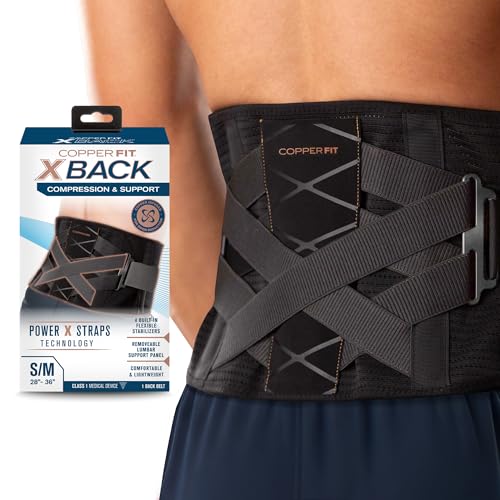
The Copper Fit X-Back uses a crossed upper strap configuration that distributes compression across the full lumbar panel in a pattern that mirrors a support taping technique used in sports medicine. By crossing the straps, the brace applies horizontal as well as vertical compression, which can reduce the tendency of vertical-only elastic belts to feel like they are squeezing rather than supporting. The copper-infused fabric is primarily a marketing feature — clinical evidence for topical copper’s therapeutic benefit is limited — but it does meaningfully reduce odor accumulation during extended wear, which is a practical quality-of-life benefit for all-day users.
The X-Back’s primary limitation is the absence of any rigid stay system. It provides compression and postural feedback only, making it appropriate for mild pain, sedentary work environments, and travel — not for heavy lifting, active labor, or the management of structural spinal pathology. Buyers who need even semi-rigid support should evaluate the Sparthos or FREETOO instead. For the office worker, frequent traveler, or anyone seeking a very low-profile everyday lumbar reminder, the X-Back is comfortable and easy to wear without the bulk of a stay-based brace.
Copper Fit X-Back Brace for Lower Back Pain
by Copper Fit
Slim, wearable-under-clothing back support with a unique cross-strap compression design — best for office and light activity use.
Pros
- Power X-strap system crosses the back and distributes compression across the full lumbar region, not just the midline
- Copper-infused vented fabric promotes airflow and may reduce odor buildup during extended wear
- Lightweight and low-profile under clothing — appropriate for office and travel use
- Over 4,000 verified ratings at 4.4 stars across a premium-priced brace, where most rivals sell on price
Cons
- X-strap design provides less targeted lumbar compression than pad-based brace systems
- Copper infusion benefit for pain relief is not clinically established — primarily serves odor control
- Hand wash only — not machine washable despite the lightweight design
7. BraceUP Back Brace for Men and Women Lower Back
The BraceUP belt is one of the highest-volume lumbar supports on Amazon, a top-15 seller in the Back Braces category with more than 25,000 ratings pooled across its sizes, and its appeal comes from a configuration that sits between a pure elastic belt and a stay-heavy semi-rigid design. Rather than relying on compression alone, BraceUP embeds eight flexible support stays across the back panel, which distributes pressure more evenly than the two-stay elastic belts that dominate this price range. The result is a belt that feels supportive across the full lumbar width rather than concentrating force along the midline.
Four anti-slip silicone strips along the inner panel address the most common complaint with thin lumbar belts — riding up during bending and lifting — and keep the brace seated through a normal day of movement. The low-profile build fits discreetly under work clothes, and reviewers repeatedly note that it is well-proportioned for smaller frames, making it a practical choice for women who find many unisex braces oversized. It offers general rather than targeted compression — there is no removable lumbar pad — and the three-size range trades some fit precision for simplicity. For buyers who want broad, even support for everyday lower back pain without the bulk or learning curve of a multi-strap brace, BraceUP is a dependable, widely validated option.

BraceUP Back Brace for Men and Women Lower Back
by BraceUP
High-volume flexible lumbar belt (#9 in Back Braces, 14,000+ ratings) — slim profile, strong all-day support.
Pros
- 8 firm support stays distribute compression more evenly than 2-stay elastic belts
- Four anti-slip silicone strips prevent the brace from riding up during bending and lifting
- Low-profile design fits discreetly under work clothes without visible bulk
- Well-proportioned for smaller frames — reviewers note a good fit for women
Cons
- No removable lumbar pad — provides general rather than targeted compression
- Only three sizes means less fit precision than 7-size designs
8. ComfyBrace Posture Corrector — Best for Posture
The ComfyBrace is the one product in this guide that is not a lumbar belt. Where the other seven braces wrap the lower back to support the lumbar spine, the ComfyBrace is an upper-back, clavicle-style posture corrector — shoulder loops and a back panel that gently draw the shoulders back to counter the forward-rounded posture that drives so much desk-related upper-back and neck tension. I include it because “back brace for posture” is one of the most common searches readers bring to this page, and the answer is genuinely a different device than a lumbar support.
With more than 46,000 ratings and a standing position as the #1 best seller in Amazon’s Back Braces category, the ComfyBrace is the most consumer-validated posture corrector available. The breathable stretch-mesh construction and one-size adjustable straps make it easy to wear discreetly under a shirt during the workday, and the incremental adjustment lets you increase the corrective pull as your upper-back musculature adapts. A posture corrector is a retraining tool, not an all-day brace — the clinical consensus, reflected in the ComfyBrace’s own guidance, is to start with short 5–10 minute sessions and build up gradually, using the brace to cue the shoulders back while you strengthen the postural muscles that ultimately hold the position on their own. The fit runs tight under the arms for some larger-chested users, and it is not meant for continuous wear, but as a targeted answer to rounded-shoulder desk posture it is the clear category leader.

ComfyBrace Posture Corrector - Back Brace for Men and Women
by ComfyBrace
The best-reviewed clavicle-style posture corrector on Amazon — a breathable, adjustable brace that pulls the shoulders back for desk-bound slouchers, best used in scheduled retraining sessions rather than all-day wear.
Pros
- One of the most-reviewed upper-back posture correctors on Amazon (47,000+ ratings, #1 Best Seller in Back Braces) — the strongest social-proof signal in the posture category
- Clavicle-style shoulder loops and back panel physically draw the shoulders back to counter desk slouch, training upper-back posture rather than compressing the lumbar spine
- Breathable stretch-mesh, one-size design that reviewers say hides easily under a shirt for discreet daytime wear
- Fully adjustable straps let you increase the corrective pull incrementally as your posture improves, and it carries a lifetime warranty
Cons
- Fit runs tight under the arms for some users — larger-chested frames in particular report pressure at the underarm straps
- Not designed for continuous all-day wear; a subset of reviewers find it restrictive over long sessions, and posture correctors are meant for scheduled retraining, not constant use
- One-size fit (chest 30"–43") leaves petite and plus-size frames outside the ideal range
Best Back Brace for Posture
“Back brace for posture” splits into two genuinely different products: a true upper-back posture corrector that pulls the shoulders back, and a lumbar brace whose compression acts as a postural reminder while you sit. Pick based on where your problem is — rounded shoulders and upper-back slouch call for a corrector, while lower-back fatigue from prolonged sitting is better served by a low-profile lumbar support.
| Product | Price | Buy |
|---|---|---|
| ComfyBrace Posture Corrector - Back Brace for Men and WomenBest posture corrector A clavicle-style corrector that physically draws the shoulders back to retrain rounded upper-back posture — the right tool for slouch, not lumbar pain | $26.97 | View on Amazon |
| AVESTON Back Support Lower Back Brace with 6 Rigid RibsBest lumbar brace with posture support Six rigid ribs spanning T12 to S1 hold the lumbar spine in its natural curve under load, reinforcing upright posture while supporting the lower back | $24.99 | View on Amazon |
| Copper Fit X-Back Brace for Lower Back PainBest low-profile for desk wear The slim copper X-back sits invisibly under clothing and delivers a gentle postural reminder for all-day desk and travel wear | $54.99 | View on Amazon |
Best Back Brace for Work and Heavy Lifting
Occupational back braces have one job: support the lumbar spine during repetitive bending and lifting, and remind you of proper mechanics. The priorities are firm stays that resist flexion under load, anti-slip retention so the brace stays put through a shift, and breathability for all-day wear. Use it for high-risk tasks rather than continuously, and pair it with good lifting technique.
| Product | Price | Buy |
|---|---|---|
| FREETOO Back Brace for Lower Back Pain Relief with 6 StaysBest for heavy lifting Six stays (4 memory-aluminum + 2 spring steel) and an anti-skid lining resist flexion and stay put under load — built for warehouse and trade work | $34.99 | View on Amazon |
| Mueller Sports Medicine Adjustable Back Brace with 8 Steel SpringsBest budget work brace Mueller's eight-spring steel-stay brace covers waists to 50" and delivers firm, reliable lifting support at the lowest price on this page | $16.97 | View on Amazon |
| AVESTON Back Support Lower Back Brace with 6 Rigid RibsBest for all-day work compression Independent side compression pulls tune tightness across the brace width, and the thin three-layer elastic stays cool across a full shift for workers who wear a brace all day | $24.99 | View on Amazon |
Best Back Brace for Women
The best back brace for a woman comes down to fit: braces proportioned for smaller frames sit correctly at the waist without riding up or digging in, and lumbar picks that address the specific presentation — sciatica, postpartum lower-back pain, or everyday strain — matter more than a “women’s” label. All three below are sized or shaped to fit female frames well.
| Product | Price | Buy |
|---|---|---|
| BraceUP Back Brace for Men and Women Lower BackBest overall for women Reviewers repeatedly note the low-profile BraceUP is well-proportioned for smaller frames and sits discreetly under clothing | $23.39 | View on Amazon |
| Sparthos Back Brace for Lower Back PainBest for women with sciatica The Sparthos removable lumbar pad targets the L4-L5 region reviewers with sciatica cite most, and it fits from XS | $26.97 | View on Amazon |
| FREETOO Back Brace for Lower Back Pain Relief with 6 StaysBest sized fit for smaller frames FREETOO's seven-size range with detailed measurement guidance dials in fit for lean and petite frames better than one-size belts | $34.99 | View on Amazon |
Best Back Braces by Use Case
Beyond the categories above, these picks match the most common specific situations readers ask about. Each links straight to Amazon for current pricing and availability.
| Product | Price | Buy |
|---|---|---|
| ASPEN Lumbar Support Back Brace with Patented Pulley SystemBest for herniated disc & sciatica The Aspen inelastic pulley brace limits trunk flexion the way clinical bracing does — appropriate for a herniated disc or acute sciatica under physician guidance | $43.40 | View on Amazon |
| AVESTON Back Support Lower Back Brace with 6 Rigid RibsBest for mild scoliosis support Six rigid ribs across a broad T12-to-S1 span support the spinal curve for mild postural scoliosis (structural scoliosis needs a clinician-fitted brace) | $24.99 | View on Amazon |
| Copper Fit X-Back Brace for Lower Back PainBest for sitting & office wear The slim copper X-back is low-profile and breathable for all-day desk and travel wear | $54.99 | View on Amazon |
| Mueller Sports Medicine Adjustable Back Brace with 8 Steel SpringsBest everyday budget brace Mueller's proven eight-spring lumbar brace covers the basics at the lowest price here for everyday support | $16.97 | View on Amazon |
| Sparthos Back Brace for Lower Back PainBest for chronic all-day pain The Sparthos removable-pad brace with anti-skid lining is built for genuine all-day chronic-pain wear | $26.97 | View on Amazon |
How to Choose the Best Back Brace
The buyer’s guide factors above are the core decision criteria. One additional layer worth addressing is the distinction between acute and chronic presentations. For an acute injury — a sudden muscle strain from lifting, a sports injury, or the onset of a disc herniation — a back brace provides valuable support during the healing phase while normal tissue repair occurs. In this context, the brace is a temporary tool that should be gradually phased out as symptoms resolve, replaced by targeted strengthening to prevent recurrence.
For chronic lower back pain that has been present for months or years, bracing plays a different role: it manages symptoms during high-risk activities while a more comprehensive rehabilitation program addresses the underlying dysfunction. Using a brace as the only intervention for chronic pain without concurrent physical therapy and core strengthening is not a clinically sound approach and may delay recovery by reducing the demand on the muscles the brace is compensating for.
The workplace context also matters. Occupational back braces used for injury prevention in lifting-intensive environments have a mixed evidence base — some studies show reduced injury rates, others do not — but practical experience in industrial settings suggests that braces are most effective when combined with proper lifting technique training and are used for high-risk tasks specifically rather than worn all day. If you are selecting a brace for an occupational application, involve your employer’s occupational health program if one is available.
Buyer's Guide
Choosing a back brace requires matching the support level and fit to your specific diagnosis, activity level, and daily routine — the wrong brace can be uncomfortable, ineffective, or even counterproductive.
Support Level
Back braces fall into three categories: flexible (elastic compression only), semi-rigid (stays that limit some motion), and rigid/inelastic (maximum motion restriction for post-surgical or fracture cases). For muscle strains and general chronic pain, a semi-rigid brace with removable stays is appropriate for most people. For herniated discs or acute instability, a more rigid or semi-rigid design with metal stays is worth considering. Rigid braces should be prescribed and fitted by a clinician.
Fit and Sizing
A poorly fitting brace provides no benefit and may cause skin irritation or increased pain. Measure your waist at the level of the navel before purchasing and compare against the manufacturer's size chart — not generic small/medium/large labels. Many brands run small; verified user reviews frequently mention this. If you are between sizes, size up for comfort and use the adjustment straps to dial in compression. A properly fitted brace should feel snug over the lower back without causing numbness, tingling, or restriction of breathing.
Stay Configuration
Stays are the rigid or semi-rigid inserts embedded in the back panel of a brace. Standard stays are polypropylene plastic — effective for mild support. Spring steel stays provide more rigidity and flex with movement rather than holding a fixed position. Memory-aluminum stays are the firmest non-rigid option, retaining their shape under load. Wide reinforced polymer ribs, as used in the AVESTON, spread rigid support across a broad vertical span of the spine rather than concentrating it along the midline, and unlike metal stays they do not have to be removed for airport security or an MRI. More stays generally mean more support but also more weight and bulk.
Breathability and Material
If you will wear the brace for more than two to three hours at a time, breathability is a clinical comfort factor — heat and moisture buildup can cause skin irritation and non-compliance with the brace prescription. Mesh and 3D-knit fabrics significantly outperform solid neoprene for extended wear. Neoprene offers therapeutic warmth that can reduce muscle spasm but becomes uncomfortable in warm environments. For desk workers and those in climate-controlled settings, neoprene is acceptable; for outdoor workers or active users, mesh is strongly preferred.
Adjustability
The ability to fine-tune compression throughout the day matters more than most buyers anticipate. Lower back discomfort typically worsens with prolonged sitting and improves with movement — the ideal compression level at your desk is different from what you need when lifting. Braces with dual-pull straps or multi-strap systems allow this adjustment without removing the brace entirely. Single-strap designs are simpler to apply but less adaptable to changing activity levels throughout the day.
Condition-Specific Design
Not all back braces are designed for the same conditions. General lumbar belts target the L3-L5 region and are appropriate for most acute and chronic lower back pain. Lumbosacral (LSO) braces extend lower to cover the sacrum and are used for sacroiliac joint dysfunction and hip-radiating pain. Sacroiliac belts are narrower and specifically target SI joint instability. If you have a formal diagnosis — herniated disc, spondylolisthesis, spinal stenosis, or post-surgical recovery — ask your physician or physical therapist which brace design is clinically appropriate before purchasing.
Final Verdict
For most buyers managing everyday lower back pain — whether from a recent strain, a disc condition, or chronic lumbar fatigue — the Sparthos Back Brace is our best overall pick. Its combination of a removable lumbar pad, anti-skid inner lining, and genuine all-day wearability has earned it one of the largest verified review pools in the category, and the user feedback is consistent: it stays in place, it fits a wide range of body types, and it delivers meaningful relief during daily activity.
For buyers who want a trusted name at a lower price point, the Mueller adjustable back brace is the right choice — eight steel springs and a clinician-trusted brand at the lowest price on this page, without unnecessary complexity. And for users managing a diagnosed spinal condition who need clinical-grade support, the ASPEN Lumbar Support offers a level of motion restriction that consumer-grade elastic and stay-based braces simply cannot match.
As with all orthopedic supports, the most effective back brace is the one that fits correctly, is worn consistently, and is part of a treatment plan that includes professional guidance. Consult your physician or physical therapist for personalized recommendations based on your specific diagnosis and functional goals.
Frequently Asked Questions
Do back braces actually help with lower back pain?
How long should I wear a back brace each day?
What is the difference between a flexible and a rigid back brace?
Can I wear a back brace while sleeping?
Is a back brace or a posture corrector better for bad posture?
Can a back brace help with scoliosis?
Will insurance or Medicare cover a back brace?
Related Articles
About the Reviewer

Dr. David Taylor, MD, PhD
Drexel University College of Medicine (MD), Indiana University School of Medicine (PhD)
Dr. David Taylor is a licensed physician and medical researcher who founded BestRatedDocs in 2016. With an MD from Drexel University and a PhD from Indiana University School of Medicine, he combines clinical expertise with a passion for health technology to provide evidence-based product recommendations. Dr. Taylor specializes in health informatics and regularly evaluates medical devices, diagnostic equipment, and therapeutic products to help healthcare professionals and patients make informed decisions.