7 Best Bed Rails for Elderly of 2026
Dr. David Taylor reviews the best bed rails for elderly adults on Amazon after the 2024-2026 CPSC recall wave. Only ASTM F3186-17 tested rails, compared by weight capacity, mattress thickness, and entrapment safety.
Updated

Falls are the leading cause of injury and accidental death in adults over 65, and the bedroom is the second-highest-risk room in the house after the bathroom. The CDC reports that one in four adults aged 65 and older falls each year, and the moments around the bed — sitting up at 3 a.m. for a bathroom trip, lowering legs onto a dark floor, pivoting from sitting to standing on a soft mattress edge — account for a meaningful share of those falls. A properly selected and installed bed rail can catch a sit-to-stand transfer before it becomes a fall, and can stop a sleeping user rolling off the bed entirely.
I have to be blunt about the rest, though, because this guide has changed substantially since its last revision. Adult portable bed rails are now one of the most heavily recalled product categories the Consumer Product Safety Commission oversees. The agency links this category to 18 reported deaths since 2021, has recalled more than three million units, and in 2025 published a standing consumer safety alert about portable bed rails as a whole. The recalls have kept coming through 2026. Two of the products this guide previously recommended have been caught by that wave, and I have removed them — the reasoning is set out in full below, because if you bought from an earlier version of this page you need to know.
In this review I evaluate seven bed rails for elderly adults available on Amazon in 2026, drawn from three structurally distinct categories: compact stand-assist handles for sit-to-stand transfers, floor-supported assist rails with legs that reach the ground for lateral stability, and full-length guard rails designed to stop a user rolling out during sleep. The selection rule is now much harsher than it was: independent ASTM F3186-17 testing is a gate, not a feature, and a brand that merely asserts compliance in a bullet point cannot hold a headline pick. The recommendations are calibrated for adult children buying for an aging parent, seniors managing their own purchase after a near-fall, occupational therapists building a discharge equipment list, and family caregivers planning bedroom safety upgrades. If you are building a broader fall-prevention plan, this guide pairs naturally with our reviews of the best grab bars for bathroom safety, the best bath lifts for users who can no longer step over the tub rim safely, and the best medical alert systems for the falls a rail still cannot prevent.
Our top picks at a glance: the Stander EZ Adjust earns Best Overall, because it is one of the few rails on Amazon that has actually passed independent ASTM F3186-17 testing rather than simply claiming it, and it folds flat so caregivers keep using it. The Able Life Bedside Safety Handle wins Best Budget as an independently tested rail at well under half the price of the Best Overall pick, with a short geometry that sidesteps the entrapment failure mode entirely. For a bedside where a caregiver works daily, the Stander Wonder Pivot is the Best Upgrade, giving the longest roll-out coverage on this list with a rail that swings down a full 180 degrees.
What Changed in 2026: The Bed Rail Recall Wave
I removed three products from this guide in August 2026. Two of them for safety, and you should read why before you buy anything in this category.
The Medline Bed Assist Bar has been recalled. In May 2024 the CPSC and Medline announced the recall of about 1.5 million Bed Assist Bar adult portable bed rails, models MDS6800BA and MDS6800BAH, after two entrapment deaths: a 76-year-old woman at an Iowa nursing facility in 2019 and an 87-year-old woman at a South Carolina residential care facility in 2023. The remedy is a full refund. This product was previously our Best Budget pick, and the Amazon listing it was bought through remains active and in stock at the time of writing. If you own a Medline bed assist bar, check the label on the support frame for the model number printed next to the letters REF, stop using it if it matches, and contact Medline for the refund. Federal law prohibits reselling a recalled product, so do not pass it on.
KingPavonini’s bed rails have been recalled. In November 2025 the CPSC recalled about 81,050 KingPavonini adult portable bed rails — models BC-CBJ-X, BC-CBJ, BC-LDFS-X, LDFS-SSK, 04-BC-LDFS, and BC-LDFS — for violating the mandatory standard and for lacking the required hazard warning labels. The specific model this guide previously ranked first, the BM03-1, is not on that recall list. I removed it anyway. A brand under active recall for entrapment and asphyxiation in exactly this product category is not something I am willing to put at the top of a page that older adults and their families rely on, and the distinction between one model number and its siblings is a thinner safety argument than it looks.
And I dropped a third pick for a different reason. The PELEGON compact handle carried a strong rating on a very small review base, and a product in this category with a couple of dozen reviews has not been used enough by enough people for that rating to mean anything. In a category with this failure mode, thin evidence is a reason to wait.
The pattern behind all of this is worth understanding, because it will help you evaluate rails I have not reviewed. Almost every recall in this wave has followed the same shape: a generic rail imported by a marketplace seller, an Amazon listing asserting ASTM compliance, no published test report, and a recall notice citing violation of the mandatory standard. Several of these sellers have quietly removed the brand name from their product titles while keeping the same listing live — which means that if you later search a recall database for the name you remember, you will not find it. Write down the model number stamped on your rail’s frame. That is the number that matters.
Find the Best Bed Rail for Your Need
Jump straight to the pick that matches your situation:
- Best bed rails overall — our seven picks reviewed
- Adjustable bed rails for elderly adults
- Full-length bed rails for elderly adults
- Rails for adjustable bed frames (Sleep Number, Tempur-Pedic)
How We Selected These Bed Rails
The selection criteria changed this year. Independent ASTM F3186-17 testing is now a gate rather than a scoring factor: a rail either has a published, independently verified pass or it does not, and the ones that do not cannot hold the best, budget, or upgrade slot no matter how well they otherwise perform. After that gate I weighed weight capacity against the user’s body weight plus safety margin, mattress-thickness compatibility, rail style matched to the actual use case, handle ergonomics, caregiver usability, and — new this year — brand accountability, meaning whether there is a named manufacturer with a real service channel who could be reached if a recall were ever issued.
That last criterion did most of the work. It is why four of the seven picks come from Stander and its Able Life line, which is a concentration I would normally avoid and want to name plainly: Able Life products are manufactured by Stander, so buying one instead of the other is not brand diversification. I kept them anyway because they are the rails that publish independent test results, and in a category with 18 deaths behind it I would rather over-index on the manufacturers doing the testing than manufacture variety for its own sake. The three non-Stander picks each earn their place on a specific strength the Stander line does not cover: a motion light for the nighttime bathroom trip, a spinnable floor foot for uneven floors, and a narrow handle that leaves room for a walker.
Before deciding which rail to install, it is worth scoring overall fall risk using the CDC’s 12-question Stay Independent screener — this surfaces the household risk factors (medications, balance, vision, footwear, home hazards) that deserve attention alongside the rail itself. A rail addresses one specific failure mode; a comprehensive plan addresses the rest. For users whose mobility limitations extend beyond the bed, pair the rail with the right wheelchair or the comparison guide for manual versus electric models, and review the bathroom safety equipment that completes the nightly transfer chain.
Best Bed Rails Overall
These are the seven rails that survived the selection gate, each evaluated in full below. The Stander EZ Adjust is our best overall pick for the widest range of users; the use-case sections after the reviews then match specific situations — height-adjustable handles and full-length sleep protection — to the right pick from this same lineup.
Stander EZ Adjust Bed Rail — Best Overall
The EZ Adjust is the rail I now recommend first, and the reason is the one thing this category has been failing at. Stander states that it is one of the only adult bed rails to have passed ASTM F3186-17, independently tested against the entrapment dimensions rather than self-certified against them. In a year when the CPSC has recalled rail after rail specifically for violating that standard, a published pass is not a marketing bullet, it is the whole product.
What you get for that is a genuine guard rail rather than a transfer handle. The rail length adjusts from 20 to 30 inches along the side of the mattress, which is enough lateral coverage to catch a user rolling toward the edge — the failure mode a compact handle cannot address at any price. It doubles as a stand-assist handle for the sit-to-stand transfer, so for many users it is the only rail on the bed. The multi-pocket organizer pouch keeps a phone, glasses, and water within reach without a nightstand, which sounds trivial and is not: a user who has to twist and stretch for a water glass at 3 a.m. is a user doing an unassisted transfer you were trying to prevent.
The fold-down is the feature I would not give up. The rail folds 180 degrees flat to the bed frame, so a caregiver can strip the bed and help the user in without unanchoring anything. Every rail that has to be fully removed for bed-making ends up, by about week three, not being reinstalled — and a rail in the closet prevents no falls. Worse, each removal and refit is another chance to set the under-mattress anchor wrong and open a gap.
The honest limits: the mattress range is 10 to 14 inches, narrower than the Able Life Extend-A-Rail, so measure with any topper compressed before ordering. And it costs roughly twice what a compact handle does. That premium is worth paying only if roll-out protection is the actual problem; if the user simply needs help standing up, buy the Able Life handle and spend the difference on a motion-sensor night light.

Stander EZ Adjust Bed Rail, Adjustable Senior Bedrail and Safety Assist Railing for Elderly Adults with Organizer Pouch, ASTM Safety Approved Guard-Rail, Black
by Stander
The rail I now recommend first. It is one of the few on Amazon that has actually passed ASTM F3186-17 testing, it gives real guard-rail coverage rather than a transfer handle alone, and it folds flat so caregivers keep using it.
Pros
- One of the few adult portable bed rails independently tested and passed against ASTM F3186-17 — the entrapment-dimension standard that the 2024-2026 recall wave was issued for violating
- Adjustable guard-rail length extends from 20 to 30 inches, giving real lateral coverage against rolling out of bed rather than transfer support alone
- Folds 180 degrees flat to the bed frame so a caregiver can change sheets without unanchoring the rail — the single biggest predictor of whether a rail is still installed a month later
- Stander has built mobility equipment for over two decades and remains a named, contactable US manufacturer with a parts and service channel
Cons
- Fits mattresses 10 to 14 inches thick only — measure with a topper compressed before ordering, because pillow-tops routinely exceed this
- Roughly twice the price of a compact transfer handle, which is only justified if roll-out protection is genuinely the problem you are solving
Able Life Bedside Safety Handle — Best Budget
This is the rail I recommend when cost matters. Two rails further down cost less, but each is built for a narrower job; this is the general-purpose handle, and the reason I trust it is the same as the best pick: Able Life publishes that it passed ASTM F3186-17 testing, and its listing says plainly that buyers should only use bedrails that have been tested and certified. That sentence is doing more work than it appears to. Nearly every rail recalled in the past two years carried an ASTM claim in its bullet points; almost none of them had a test to point at.
The padded handle adjusts from 13 to 20 inches above the mattress, the widest user-height range of any compact handle here, and the padding matters more than buyers expect. For a user with arthritic hands, or with fragile skin from long-term corticosteroids or anticoagulants, a bare metal handle is genuinely unpleasant to grip — and a rail that is unpleasant to grip is a rail that gets used less often than it should. The four-pocket organizer is the most bedside storage of any product reviewed here.
There is a structural safety argument for this design too. A short half-rail creates no long enclosed span alongside the mattress, which means it does not create the rail-to-mattress gap that every entrapment recall in this category turns on. If the user has no history of rolling out of bed, this geometry solves the real problem while avoiding the risk entirely — and that, rather than the price, is the strongest reason to buy it.
Two honest limitations. It is stand-assist only and offers no roll-out protection whatsoever; a user who has rolled out of bed before needs the Wonder Pivot instead. And it is manufactured by Stander, the same company behind our best and upgrade picks, so choosing it is not the brand diversification it might appear to be.

Able Life Bedside Safety Handle, Padded Stand Assist Railing for Seniors, Height Adjustable Bed Rail with Pouch for Elderly Adults, Fits King, Queen, Full and Twin Beds, ASTM Safety Approved Bedrail
by Able Life
The best-value general-purpose rail here; the two rails that cost less are built for narrower jobs. It is ASTM F3186-17 tested, the padded handle covers the widest height range here, and its short geometry sidesteps the entrapment failure mode entirely.
Pros
- Passed ASTM F3186-17 testing, which is the gate that separates it from the sub-forty-dollar marketplace rails that keep being recalled
- Padded handle adjusts from 13 to 20 inches above the mattress, the widest user-height range of any compact handle here
- Low-profile half-rail geometry has no long enclosed span, so it does not create the rail-to-mattress gap that entrapment recalls turn on
- Compact enough to pack in a carry-on, so a senior visiting family can take familiar bedroom safety equipment with them
Cons
- Stand-assist only — it offers no protection at all against rolling out of bed during sleep
- Made by Stander, the same manufacturer as our best and upgrade picks, so buying it is not brand diversification
Stander Wonder Pivot Bed Rail — Best Upgrade
The Wonder Pivot is the rail to buy when a caregiver works at the bedside every day. It is independently tested to ASTM F3186-17 like the rest of the Stander line, and it extends to 26, 32, or 38.5 inches — the longest roll-out coverage on this list, and enough rail to make a real difference for a user with restless sleep, Parkinson’s-related nighttime movement, or post-stroke balance problems.
The pivot is what justifies the price. The rail swings down a full 180 degrees and comes to rest against the side of the bed rather than folding into the frame, which clears the entire mattress edge for a hands-on transfer. If you are lifting or steadying someone into bed, that clearance is the difference between working around the rail and working with the bed. It also doubles as a stand-assist handle in the raised position, so a single rail covers both jobs and there is no second product to buy for the other side.
Its 8-to-12-inch mattress range also covers the thinner platform-bed setups the EZ Adjust cannot, which matters because platform beds have quietly become the default in most bedrooms and a lot of rails in this category still assume a box spring.
The honest trade-offs are availability and price. It usually ships within one to four weeks rather than from local stock, so it is the wrong choice if you are equipping a bedroom before a hospital discharge next Tuesday — buy the EZ Adjust for that. And it is the most expensive rail here; the pivot mechanism earns its keep when someone is working at the bedside daily, and not otherwise.
One caveat on the star rating. Amazon pools ratings across the whole Stander rail family, so the Wonder Pivot and the EZ Adjust both display the same 4.6 average over the same review count — that figure describes the Stander line, not this specific rail. The Wonder Pivot is a newer product with far less Amazon-specific feedback behind it than the shared number suggests, so weigh the ASTM test result and the mattress-range fit more heavily than the stars when comparing the two.

Stander Wonder Pivot Bed Rail, Adjustable Safety Assist Railing with Swing Down Guardrail for Elderly Adults, Fits Mattresses 8 to 12 Inches Thick, ASTM Safety Approved Bedrail, Black
by Stander
The rail to buy when a caregiver is at the bedside every day. It gives the longest roll-out coverage here and swings down 180 degrees for sheet changes and transfers, so it stays installed instead of ending up in a closet.
Pros
- Passed ASTM F3186-17 testing and extends to 26, 32, or 38.5 inches — the longest roll-out coverage on this list
- Pivots down a full 180 degrees and rests against the side of the bed, which makes bed-making and hands-on caregiver transfers genuinely easier than a fixed rail
- Doubles as a stand-assist handle, so one rail covers both the transfer and the roll-out job for users who need both
- Fits 8 to 12 inch mattresses, covering the thinner platform-bed setups the EZ Adjust cannot
Cons
- Usually ships within one to four weeks rather than from local stock — not the pick if the need is urgent after a hospital discharge
- The most expensive rail here, and the pivot mechanism is only worth paying for when a caregiver works at the bedside daily
Able Life Bedside Extend-A-Rail — Best for Thick Mattresses
The Extend-A-Rail solves the problem that quietly disqualifies most rails in this category: modern mattresses are thicker than the rails were designed for. At 8 to 15 inches it has the widest tested mattress compatibility here, which covers the pillow-tops and hybrids that a lot of buyers discover, after delivery, their new rail will not grip.
Its second trick is the push-button length adjustment from 20 to 30 inches, done in a moment without tools and without disturbing the under-mattress anchor. In practice that means one rail can sit short as a transfer handle during the day and extend to partial guard-rail length overnight, which is a genuinely useful thing for a user whose needs differ between a nap and a full night’s sleep. It supports 300 lbs, fits Twin through California King, and like the rest of the Able Life line it is ASTM F3186-17 tested.
The limits are worth being precise about. Thirty inches makes it a partial guard rail, not a full one — for a user with a documented history of rolling out of bed, buy the Wonder Pivot and its 38.5 inches instead. And like every mattress-tuck rail here it is unsuitable for adjustable bases and for very soft mattresses, where the anchor cannot get a reliable grip.

Able Life Bedside Extend-A-Rail, Adjustable Senior Bed Safety Railing and Stand Assist Grab Bar, Extendable Guardrail for Seniors and Elderly Adults, ASTM Safety Approved Bedrail
by Able Life
The tested rail with the widest mattress range here. Push-button extension from 20 to 30 inches lets it work as a transfer handle by day and a partial guard rail at night, which suits a thick modern mattress better than anything else on this list.
Pros
- Passed ASTM F3186-17 testing, with a push-button length adjustment from 20 to 30 inches that needs no tools and no re-anchoring
- Widest mattress compatibility of the tested rails here at 8 to 15 inches, which covers most modern pillow-tops and hybrids
- Extends on demand, so it can sit short as a transfer handle by day and long as a partial guard rail overnight
- Supports 300 lbs and fits Twin through California King frames
Cons
- Extends to 30 inches, so it is a partial guard rail — a user with a documented roll-out history needs the Wonder Pivot instead
- Not for adjustable bases or very soft mattresses, where the under-mattress anchor cannot hold
Lunderg Bed Assist Rail with Motion Light — Best for Nighttime
The Lunderg addresses a part of the fall chain that no rail can reach. The single highest-risk transfer of the day for most seniors is the 2 a.m. bathroom trip: the user is groggy, the room is dark, vision is reduced, and balance is compromised by orthostatic hypotension from rising too quickly. A rail catches the sit-to-stand portion. The floor still has to be navigated in the dark, and that is where the motion-activated LED earns its place, lighting the floor as the user moves toward the edge of the bed so there is a visual reference before a foot lands on a shoe, a pet, or the edge of a rug. The light is directional and dim enough not to wake a partner.
It also has the highest customer rating on this list at 4.7 stars, across a review base of more than 2,700 — a combination of rating and depth that no other rail here matches. The partially pre-assembled design installs in about five minutes, which matters more than it sounds: a fiddly install is the reason a lot of bed rails sit boxed in a hallway for a fortnight after delivery. The included bed-frame safety strap adds lateral anchoring beyond the standard under-mattress tuck.
Two honest limitations, and the first is why this is a runner-up rather than a headline pick. Lunderg states ASTM approval on the listing, but does not publish the independent F3186-17 test result the way Stander and Able Life do. That is not evidence of a problem, and the design is a short handle rather than a long-span rail, so it carries less inherent entrapment risk in any case — but under this year’s selection rule an unpublished claim cannot hold a top slot. Beyond that: no storage pocket, and the 7-to-13-inch mattress range rules out thick pillow-tops.

Lunderg Bed Assist Rail for Seniors with Motion-Activated Light & Non-Slip Grab Bar
by Lunderg
The pick when the 2 a.m. bathroom trip is the real risk. The motion light covers the part of the fall chain a rail cannot — seeing the floor — and it has the highest rating here, though its ASTM claim is self-reported rather than independently published.
Pros
- Motion-activated LED lights the floor as the user moves toward the edge of the bed, addressing the misstep that a rail alone cannot catch
- Highest customer rating on this list at 4.7 stars across a review base of more than 2,700
- Partially pre-assembled, so it installs in about five minutes rather than sitting in the box for a fortnight
- Includes a bed-frame safety strap that adds lateral anchoring beyond the under-mattress tuck
Cons
- The listing states ASTM approval but Lunderg does not publish the independent F3186-17 test report that Stander and Able Life do
- No storage pocket, and the 7 to 13 inch mattress range rules out thick pillow-tops
BigDolphin GS07 Bed Rail — Best for Stability
The BigDolphin earns its place on one specific strength. Where most under-mattress bed canes rely solely on body weight pressing the frame against the mattress, this one adds a floor-support leg — and the leg ends in a spinnable foot. Rotating the foot closes the gap between leg and floor, which eliminates the wobble that develops when a floor leg meets an uneven surface, a thick rug, or a slightly bowed floorboard. For a senior who loads the rail hard during a transfer, and for a post-surgical patient in the first weeks of recovery, that adjustable floor contact is the difference between a confident pull and a tentative one.
The rest is built for daily use. The 350 lb capacity is above the 300 lb category standard, giving margin for larger adults and for the dynamic load of a sudden grab during a near-fall. The 30-degree ergonomic curve keeps the wrist near neutral through the sit-to-stand pull, which reduces pain for users with arthritis and, more to the point, makes them more willing to use the rail every day. Setup is tool-free, there is a storage pocket, and it is FSA and HSA eligible.
Where it lands short is evidence and accountability. Its review base is a little over 600, which is respectable but well below the Stander and Able Life picks, and there is no published independent ASTM test report behind its compliance claim. Note also that this listing now shows its model as GS07 and the brand name no longer appears in the product title, which is the pattern I flagged earlier in this guide; record the model number from the frame if you buy it. On mattresses thicker than about 12 inches the usable handle height above the mattress shrinks noticeably, so measure first.
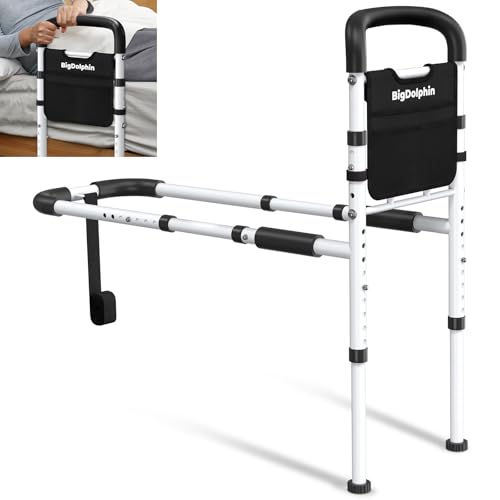
BigDolphin Bed Rails for Elderly Adults Safety, 350 LB Capacity, Model GS07 | ASTM Approved, Adjustable Bed Cane with Non-Slip Grip & Storage Bag, Tool-Free Bed Assist Rails for Seniors & Post Surgery
by BigDolphin
The most stable compact handle here thanks to a spinnable floor foot that kills wobble on an uneven floor. It is a marketplace brand with self-reported certification, so it stays a runner-up rather than a headline pick.
Pros
- 350 lb capacity is above the 300 lb category standard, giving margin for larger adults and for the dynamic load of a sudden grab
- Floor-support leg with a spinnable foot closes the gap on uneven floors, thick rugs, and bowed boards where a fixed leg would wobble
- 30-degree ergonomic curved handle keeps the wrist in a neutral angle during the sit-to-stand pull
- Tool-free setup with a securing strap and a storage bag, and it is FSA and HSA eligible
Cons
- A marketplace brand with a review base of a little over 600 and no published independent ASTM test report — held to runner-up for that reason alone
- On mattresses thicker than about 12 inches the usable handle height above the mattress shrinks noticeably
Vaunn Medical Bed Rail — Best for Walker and Wheelchair Transfers
The Vaunn is here for a specific bedside geometry problem. Most assist rails are 20 inches or wider at the handle, and that width is exactly where a walker or a wheelchair needs to come alongside the mattress. The Vaunn’s handle is 13 inches wide, deliberately, which leaves the approach clear while still giving a grip for the transfer. If the user’s daily routine is bed to walker to bathroom, that clearance changes the whole movement.
It also makes the strongest certification claim of any compact handle in this review: Vaunn states compliance with both ASTM F3186-17 and the CPSC safety standard for adult portable bed rails, naming the federal standard specifically rather than gesturing at ASTM alone. Vaunn is an established home-medical-equipment brand with a catalog spanning transfer benches, walkers, and commodes, not a marketplace-only seller — which, in the current climate, is a meaningful part of what you are buying. The design pairs a slip-resistant padded handle with horizontal stabilizer bars and rubber-gripped floor-standing legs.
The honest limitation is the evidence base, and it is easy to misread. Amazon now sells this 13-inch Space Saver on one listing with a larger Vaunn rail, and the star rating it shows is pooled across both sizes. When the Space Saver was listed on its own it had a short review history and a lower average than any other rail here, so read the headline rating as the family’s record rather than this model’s. I have included it because the certification claim and the brand are sound and the narrow-handle use case is genuinely unserved by anything else in this review, but a buyer who does not specifically need walker clearance is better served by the Able Life handle. The same narrow handle that clears the bedside also gives less to grab for a user with a weak or imprecise grip.
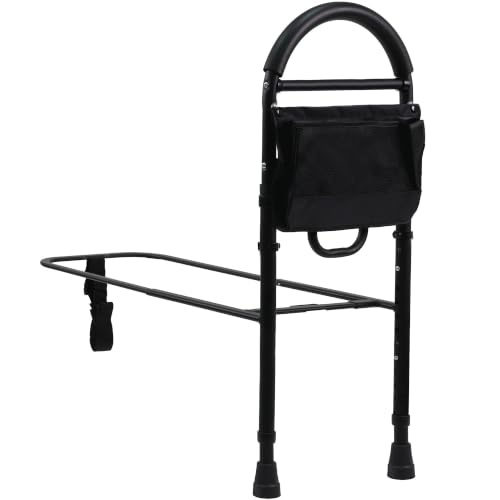
Vaunn Medical Space Saver Bed Rail for Elderly Adults Safety, ASTM F3186-17 Certified, Adjustable Bed Assist Handle and Grab Bar for Seniors, 300 lb, Tool-Free Assembly
by Vaunn Medical
The pick when a walker or wheelchair has to come alongside the bed — a 13-inch handle leaves room the wider rails do not. It carries the strongest certification claim of any compact handle here, though this size has a short review history of its own.
Pros
- States compliance with both ASTM F3186-17 and the CPSC safety standard for adult portable bed rails, which is the strictest claim any compact handle here makes
- Narrow 13-inch handle width keeps the bedside clear for a walker or wheelchair transfer
- Slip-resistant padded handle, horizontal stabilizer bars, and rubber-gripped floor-standing legs
- Vaunn is an established home-medical-equipment brand rather than a marketplace-only seller
Cons
- The Amazon rating is pooled with a larger Vaunn rail on the same listing; this 13-inch size has a much shorter review history of its own
- The narrow handle that keeps the bedside clear also gives less to grab for a user with a weak or imprecise grip
Adjustable Bed Rails for Elderly Adults
Buyers searching for an adjustable bed rail usually mean one of two things, and they need different products. If you want a rail whose height or length adjusts to match the user and the mattress — the more common need — every pick below adjusts tool-free, and the right choice comes down to what is adjusting: the Able Life handle moves through 13 to 20 inches of handle height, the Extend-A-Rail changes its length from 20 to 30 inches at the push of a button, and the Wonder Pivot steps its rail length through 26, 32, and 38.5 inches. If instead you have an adjustable bed frame — Sleep Number, Tempur-Pedic Ergo, or any powered base — none of these mattress-tuck rails is compatible; see the adjustable-bed compatibility guidance below for what works.
| Product | Price | Buy |
|---|---|---|
| Able Life Bedside Safety Handle, Padded Stand Assist Railing for Seniors, Height Adjustable Bed Rail with Pouch for Elderly Adults, Fits King, Queen, Full and Twin Beds, ASTM Safety Approved BedrailBest adjustable compact handle Padded handle covers 13 to 20 inches, the widest user-height range here | $49.99 | View on Amazon |
| Able Life Bedside Extend-A-Rail, Adjustable Senior Bed Safety Railing and Stand Assist Grab Bar, Extendable Guardrail for Seniors and Elderly Adults, ASTM Safety Approved BedrailBest adjustable length Push-button extension from 20 to 30 inches with the widest mattress fit | $89.00 | View on Amazon |
| Stander Wonder Pivot Bed Rail, Adjustable Safety Assist Railing with Swing Down Guardrail for Elderly Adults, Fits Mattresses 8 to 12 Inches Thick, ASTM Safety Approved Bedrail, BlackWidest length range Steps through 26, 32, and 38.5 inches and pivots down for caregivers | $149.99 | View on Amazon |
Full-Length Bed Rails for Elderly Adults
A full-length rail exists for one job: keeping a sleeping user from rolling out of bed. Compact handles stop at around 22 inches of coverage, which is enough to pull yourself up on and not enough to catch a body rolling toward the edge at 3 a.m. Both full-length picks here are independently ASTM F3186-17 tested, and after the year this category has had I would not consider an untested rail at this length — the long span alongside the mattress is precisely where the entrapment recalls have concentrated. The Wonder Pivot reaches 38.5 inches and swings down 180 degrees for caregiver access; the EZ Adjust covers 20 to 30 inches and folds flat for sheet changes; the Extend-A-Rail is the part-length option for a user who needs some roll protection but not a full guard. If the user has a documented history of rolling out of bed, choose the longest tested rail, not a compromise. For hospital beds, use only the bed’s own manufacturer-engineered rails (see the hospital rail guidance below).
| Product | Price | Buy |
|---|---|---|
| Stander Wonder Pivot Bed Rail, Adjustable Safety Assist Railing with Swing Down Guardrail for Elderly Adults, Fits Mattresses 8 to 12 Inches Thick, ASTM Safety Approved Bedrail, BlackLongest roll-out coverage Reaches 38.5 inches and pivots down 180 degrees against the bed side | $149.99 | View on Amazon |
| Stander EZ Adjust Bed Rail, Adjustable Senior Bedrail and Safety Assist Railing for Elderly Adults with Organizer Pouch, ASTM Safety Approved Guard-Rail, BlackBest all-round guard rail 20 to 30 inches, folds flat to the frame, ships from stock | $113.54 | View on Amazon |
| Able Life Bedside Extend-A-Rail, Adjustable Senior Bed Safety Railing and Stand Assist Grab Bar, Extendable Guardrail for Seniors and Elderly Adults, ASTM Safety Approved BedrailBest part-length option Extends to 30 inches on demand and fits the thickest mattresses here | $89.00 | View on Amazon |
Buyer's Guide
A bed rail is a load-bearing safety device used at the moments of highest fall risk in the bedroom — getting out of bed in the morning, transferring to a walker for a nighttime bathroom trip, repositioning during sleep. It is also, as of 2026, one of the most heavily recalled product categories the CPSC oversees. Choosing well means treating independent certification as a gate rather than a feature, then matching weight capacity, mattress fit, and rail style to the user's actual problem. The wrong rail is genuinely more dangerous than no rail at all.
Independent ASTM F3186-17 Testing
This is the gate, and everything else is secondary to it. ASTM F3186-17 is the US safety standard for portable adult bed rails, and it sets the dimensional limits that prevent the seven entrapment zones the FDA identified in its 2006 Hospital Bed System Dimensional Guidance — gaps within the rail, between rail and mattress, between rail ends and the headboard, and under rail edges. What changed between the last edition of this guide and this one is that CPSC has been recalling rail after rail specifically for violating that standard, and nearly every recalled product had an Amazon listing claiming ASTM compliance. A claim in a bullet point is not a test result. Stander and Able Life publish that their rails passed independent F3186-17 testing and describe themselves as among the few that have; that is the language to look for. Where a brand only asserts compliance without evidence, we say so in its review and it does not hold a headline pick. Price is never a reason to bypass this.
Brand Accountability and Recall Exposure
This category has a brand-continuity problem that directly affects your safety. The recalls issued through 2025 and 2026 have overwhelmingly hit marketplace sellers importing generic rails, and the remedy in several cases required the consumer to email a photo of the destroyed product to a Gmail or Outlook address to get a refund. A named manufacturer with a US service channel is worth real money here, because a recall is only useful if there is a company left to honour it. We have also watched sellers in this category quietly strip the brand name out of their Amazon titles while keeping the same listing, which makes a later recall search fail. Buy from a manufacturer you can telephone, and write the model number down somewhere that is not the rail itself.
Mattress Compatibility and the Gap Test
Mattress incompatibility is the most common installation failure in this category, and it is also the entrapment mechanism. Measure your mattress thickness with a tape measure, top to bottom, with any topper compressed under normal body weight, before ordering. Then match the rail: the Stander EZ Adjust fits 10 to 14 inches, the Wonder Pivot 8 to 12, the Able Life Extend-A-Rail 8 to 15 which is the widest tested range here, and the Lunderg 7 to 13. Pillow-top and memory-foam mattresses are routinely thicker than buyers expect. Once installed, run the gap test: press down on the mattress beside the rail as a sleeping body would, and check the space between rail and mattress. If a closed fist passes into that gap, the rail is wrong for that mattress. Re-run the test after any mattress change and every few weeks in normal use, because straps loosen.
Transfer Support vs. Fall Prevention
Bed rails do two different jobs and the right one depends on which problem you actually have. Transfer support — helping the user go from lying to seated to standing — is the more common need and is best served by a short handle of 13 to 22 inches: the Able Life Bedside Safety Handle, Lunderg Motion Light, BigDolphin GS07, and Vaunn Medical rail are all transfer designs. Fall prevention during sleep needs a longer rail running along the mattress edge: the Stander EZ Adjust at 20 to 30 inches, the Wonder Pivot at up to 38.5 inches, and the Able Life Extend-A-Rail as a part-length option. There is a safety asymmetry worth knowing: entrapment risk lives in the long designs, because a long rail creates a long gap. If the user has no history of rolling out of bed, a short handle solves the real problem and avoids the risk. Do not buy guard-rail length you do not need.
Fold-Down and Caregiver Usability
This sounds like convenience and is actually a safety factor. When a rail folds flat to the bed frame — 180 degrees on both the Stander EZ Adjust and the Wonder Pivot — a caregiver can change sheets and help the user into bed without unanchoring it. A rail that must be fully removed for bed-making is, in practice, a rail that stops being reinstalled by about week three, and a rail in the closet prevents no falls. Worse, repeated removal and refitting is when the under-mattress anchor gets set wrong and the gap opens up. If anyone other than the user makes that bed, treat fold-down as a requirement rather than a nicety.
Bed Frame Compatibility
Bed frame type decides which rails can work at all. On a standard innerspring mattress with a box spring and traditional frame, any rail in this review fits. On a platform bed with no box spring, the anchor has less to grip: the Wonder Pivot's 8-inch minimum is the most accommodating of the tested rails, and a floor-supported handle like the BigDolphin or Vaunn is often the more reliable answer. On an adjustable bed such as a Sleep Number FlexFit or Tempur-Pedic Ergo, no mattress-tuck rail in this review is compatible; those users need the bed manufacturer's approved rail SKU or a freestanding floor-to-ceiling pole. On a hospital bed, use only the bed's own manufacturer-engineered side rails, which are FDA-regulated as part of the device — adding an aftermarket portable rail creates new entrapment zones exactly at the boundary between the two systems. Confirm frame type before ordering and call the manufacturer if you are uncertain.
How to Choose the Best Bed Rail
The buyer’s guide factors above cover the six most important variables. The single most actionable piece of advice I give caregivers is to define the primary problem before selecting any specific product, because there are two distinct jobs a bed rail can do and buying for the wrong one is both wasteful and, in this category, an avoidable safety risk.
If the primary problem is sit-to-stand transfer support — the user has good sleep stability but struggles to get from lying to seated to standing in the morning or during nighttime bathroom trips — choose a compact handle: the Able Life Bedside Safety Handle, Lunderg Motion Light, BigDolphin GS07, or Vaunn Medical rail. These are short, low-profile, and engineered for the specific arc of motion involved in sitting up and pivoting to standing. They also create no long gap alongside the mattress, which means the entrapment mechanism behind this category’s recalls does not apply to them. If a short handle solves your problem, it is not a compromise, it is the safer buy.
If the primary problem is fall prevention during sleep — the user has rolled out of bed before, has restless sleep behavior, or has a neurological condition such as Parkinson’s disease, post-stroke spasticity, or REM sleep behavior disorder that produces significant nighttime movement — you need guard-rail length, and you need it from a manufacturer that publishes an independent F3186-17 pass. That means the Stander Wonder Pivot or the EZ Adjust. Do not economize here.
Many users benefit from both: a compact handle on one side for transfers, a guard rail on the other to prevent rolling out. The configuration should follow an occupational-therapy assessment of the user’s actual nighttime behavior — observation over several nights, ideally with a caregiver present or a bed-monitoring camera, reveals whether the rail needs to be on the dominant-hand side, the bathroom-route side, or both.
Condition-Specific Clinical Guidance
The right bed rail configuration depends substantially on the user’s specific medical history. A few patterns I see often enough to call out individually.
Post-hip-replacement. The orthopedic standard is no hip flexion past 90 degrees during the first six to twelve weeks post-surgery. This makes the standard supine-to-seated transfer at a low mattress genuinely high-risk, because the patient must flex the hip to swing the legs over the edge. The right configuration is a higher bed — a 4-to-6-inch bed riser brings the mattress to a height where the patient can sit up without flexing past 90 degrees — paired with a floor-supported handle such as the BigDolphin or the Vaunn that adjusts to the new mattress height and braces against the floor. Confirm any bed-height change with the orthopedic surgeon’s physical-therapy team before installation.
Post-knee-replacement. Knee replacement patients can use any rail in this review, but the specific concern is the pivot-to-standing motion at the edge of the bed. A handle that lets the patient pull straight up rather than rotating the torso reduces strain on the replaced knee during the first six weeks. The BigDolphin’s 30-degree curved handle suits this well, since the curve encourages a vertical pull rather than a twist. The Lunderg’s motion light is also valuable here, because nighttime bathroom trips are frequent during recovery and gait is less stable than before surgery.
Post-stroke. Mount the rail on the user’s strong, unaffected side. Stroke patients typically have unilateral weakness, and a strong-side rail lets them pull up with the preserved muscle group; mounting on the affected side asks the weaker arm to do the load-bearing work and can increase fall risk. Confirm with the patient’s occupational therapist before installation. If the patient has any history of hemispatial neglect — a documented post-stroke phenomenon in which the patient does not perceive the affected side of the body — pair the rail with a bed alarm so a caregiver is notified if they attempt to rise unassisted.
Parkinson’s disease. Parkinson’s patients often have significant nighttime movement related to REM sleep behavior disorder, restless legs, or freezing of gait on rising. This is the population that genuinely needs guard-rail length, so the Stander Wonder Pivot is the right rail — and because entrapment risk rises with rail length, it is also the population for whom the independent F3186-17 test result matters most. Pair the rail with a medical alert system worn overnight; even with a guard rail, Parkinson’s-related falls occur and the alert system reduces response time. Compact half-rail handles do not address the primary failure mode for these users.
Dementia. I will repeat the warning from the FAQ above, because it is the most important clinical point in this review and the recall data has made it more urgent rather than less. For moderate-to-severe dementia the default answer is no rail. The risks are agitation and climbing — the user perceives the rail as a restraint, climbs it, and falls from a greater height than rolling out would have produced — and entrapment, where the user lacks the cognitive capacity to extract themselves from a gap. That second mechanism is exactly what killed people in the cases behind this year’s recalls. CMS explicitly classifies inappropriate bed rail use in dementia as a form of restraint with documented negative outcomes. The alternatives geriatric occupational therapists recommend are lowering the bed, thick floor mats beside it, a bed alarm, and in some cases an enclosure system rather than open rails. Do not buy a bed rail for a patient with significant dementia without professional consultation.
Understanding ASTM F3186-17 and Entrapment Risk
The history of bed rail safety in the United States is the reason ASTM F3186-17 exists, and the past three years are the reason it now decides which products appear on this page. Between 2002 and 2012 the FDA and CPSC documented at least 155 entrapment deaths involving bed rails, almost all in older adults. The FDA’s 2006 Hospital Bed System Dimensional Guidance identified seven specific entrapment zones — gaps within rails, between rails and the mattress, between rail ends and the headboard or footboard, under rail edges, and at rail intersections — where a body can become wedged. Any gap larger than 4.75 inches is documented as a hazard, with smaller gaps presenting risk for slimmer users.
ASTM F3186-17 was published in 2017 as the consumer-product equivalent of that hospital-bed guidance, setting dimensional requirements designed to eliminate those seven zones in portable home rails. What has changed since is enforcement. The standard is now the benchmark CPSC recalls against, and recall notice after recall notice through 2025 and 2026 uses the same sentence: the rails violate the mandatory standard for adult portable bed rails because users can become entrapped within the rail or between the rail and the side of the mattress. Many also failed to carry the required hazard warning labels.
The practical lesson is that an ASTM claim on a product listing and an ASTM test are different things, and in this category the gap between them has been fatal. Nearly every recalled rail claimed compliance. What distinguishes the rails I recommend is that their manufacturers state they submitted to independent F3186-17 testing and passed, and describe themselves as among the few on the market that have. When evaluating any rail not in this review, look for that specific language, look for a named manufacturer you could telephone, and treat a bare compliance bullet on a marketplace listing as unverified. Note too that F3186-17 began as a voluntary consensus standard; CPSC’s adoption of a mandatory rule for adult portable bed rails is what gives the current recalls their legal force.
Hospital Bed Rails vs. Portable Home Rails
A common point of confusion is the difference between rails sold for home use and rails attached to hospital beds. They are different regulated products with different engineering and different safety profiles. Hospital bed rails are FDA Class II medical devices, regulated as part of the complete hospital bed system and engineered to the dimensions in the FDA’s 2006 guidance. They are typically permanently attached to the frame, hinged for lowering during transfers, and rated for higher loads. Portable home bed rails — every product in this review — are consumer products that tuck under a residential mattress and use the user’s body weight or floor-standing legs as the anchor.
The practical implication is firm: do not add an aftermarket portable rail to a hospital bed. The hospital bed comes with manufacturer-engineered side rails that are part of the FDA-cleared device. Adding a portable rail can interfere with the bed’s motorized adjustment, void the warranty, and — most importantly — create new entrapment zones exactly at the boundary between the two rail systems, which is precisely the geometry the standard exists to prevent. Conversely, do not install a hospital-style rail on a residential bed unless the manufacturer specifically supports the configuration.
Adjustable Beds, Sleep Number, and Tempur-Pedic Ergo Compatibility
Mattress-tuck bed rails — every product in this review — are generally not compatible with adjustable beds. The Sleep Number FlexFit, Tempur-Pedic Ergo, Reverie, and similar models flex the mattress when raising or lowering the head and foot, and that flexing displaces the under-mattress frame or strap holding a portable rail in place. The rail can lose anchoring or shift unexpectedly, which in the worst case opens the rail-to-mattress gap that entrapment recalls turn on. Several manufacturers, Sleep Number among them, also warn that under-mattress rails void the warranty on the adjustable base motor by interfering with the lift mechanism.
The right alternatives are bed-frame-clamp rails that bolt directly to the frame rather than tucking under the mattress, hospital-style adjustable beds that ship with manufacturer-engineered side rails as part of the device, or freestanding floor-based assist poles that never contact the mattress. Floor-to-ceiling tension poles work particularly well for adjustable-bed users precisely because they are entirely independent of the mattress and frame.
If the user has an adjustable bed and needs a rail, the sequence is: call the bed manufacturer’s customer service and ask for the approved compatible rail SKU or accessory; if no approved option exists, consult an occupational therapist about a freestanding pole or a frame-mounted hospital-style rail; and do not order a mattress-tuck portable rail on the assumption it will work, because it will not and the safety risk is real.
What Caregivers Need to Know
A few practical notes for the caregiver — adult child, spouse, in-home aide — installing or maintaining a bed rail.
Run the gap test, not just the pull test. After installation, press down on the mattress beside the rail the way a sleeping body would, and look at the space between rail and mattress. If a closed fist passes into that gap, the rail is wrong for that mattress and must come off, regardless of what the box says. Then do the pull test: grip the rail and pull hard in the direction the user will load it. If it shifts at all, re-tuck the frame and tighten the strap. Repeat both tests weekly for the first month and monthly thereafter, and again after any mattress change — under-mattress anchors loosen with normal use, and a rail is only as safe as its current anchoring.
Write down the model number. Take it from the label on the rail’s support frame, not from the Amazon listing title, and keep it with your household records. Sellers in this category have removed brand names from listings while keeping the products live, so the title you bought under may not be searchable later. The frame number is what a recall notice will name.
Check the CPSC database once a year. Search by brand and model at cpsc.gov. It takes two minutes and this category has produced recalls at a rate of several per year. If your rail appears, stop using it that day, contact the company for the remedy, and do not resell or donate it.
Combine the rail with night lighting. A rail catches the sit-to-stand transfer; a light catches the misstep onto a dark floor. Pair the rail with either the Lunderg’s built-in motion light or a separate plug-in motion-activated night light positioned along the path from bed to bathroom. Rail plus light prevents meaningfully more nighttime falls than either alone.
Add a bed alarm for dementia, post-stroke neglect, or high fall risk. A bed alarm sounds when the user attempts to rise unassisted, letting a caregiver provide hands-on help for the transfer. For users whose cognitive status makes independent transfers genuinely dangerous, this complements — and in some cases replaces — the rail.
Have a fall plan independent of the rail. Even a well-selected, well-installed rail cannot prevent every fall. Pair it with a medical alert system worn overnight, a first-aid kit accessible from the bedside, and a clear nighttime route to the bathroom with no obstacles or loose rugs. For users with significant mobility limitations, that route may also need a bath safety plan for the destination itself.
Final Verdict
For most buyers, the Stander EZ Adjust is the right choice. It is one of the few adult bed rails on Amazon with an independently verified ASTM F3186-17 pass rather than a claim, it gives real guard-rail coverage from 20 to 30 inches instead of transfer support alone, and it folds flat so caregivers keep it installed. In a category where the CPSC has recalled more than three million units for entrapment, buying from a manufacturer that publishes its test results is the single highest-value decision you can make.
For budget-constrained buyers, the Able Life Bedside Safety Handle is the rail I would recommend without qualification at its price. It is F3186-17 tested, its padded handle covers the widest user-height range in this review, and its short geometry means the entrapment failure mode behind this year’s recalls does not apply to it at all. If the user simply needs help standing up, this is not a compromise, it is the safer product. For a bedside where a caregiver works daily, the Stander Wonder Pivot is worth its premium: the longest tested roll-out coverage here, and a rail that swings down a full 180 degrees to clear the mattress edge for hands-on transfers.
For specific situations: the Able Life Extend-A-Rail is the answer for thick pillow-top and hybrid mattresses that other rails cannot grip; the Lunderg Motion Light is the smartest choice when the nighttime bathroom trip is the real risk; the BigDolphin GS07 is the most stable compact handle on an uneven floor; and the Vaunn Medical rail is the one to buy when a walker or wheelchair has to come alongside the bed.
As with all medical equipment, consult your physician, occupational therapist, or physical therapist for a personalized recommendation based on the user’s specific diagnosis, mobility limitations, sleep behavior, and bedroom layout. And two closing points I would not normally have to make in a product review. First, if you own a bed rail bought before 2026, check it against the CPSC database this week — this guide previously recommended a product that has since been recalled, and that is exactly the situation this paragraph exists for. Second, for users with dementia, do not purchase any bed rail without professional consultation; the entrapment and climbing risks in that population routinely outweigh the benefit, and alternatives like a lowered bed, floor mats, and a bed alarm are usually the better answer. A bed rail is a high-value safety investment for the right user — but only when it is a tested rail, properly installed, and combined with a broader fall-prevention plan that includes bathroom grab bars, a medical alert system, and the appropriate mobility equipment for daytime needs.
Frequently Asked Questions
Are bed rails safe for elderly adults?
How do I check whether my bed rail has been recalled?
Does Medicare pay for bed rails for seniors?
What is the difference between a bed rail and a bed assist handle?
Are bed rails safe for someone with dementia?
Can bed rails be used with adjustable beds and Sleep Number mattresses?
Related Articles
About the Reviewer

Dr. David Taylor, MD, PhD
Drexel University College of Medicine (MD), Indiana University School of Medicine (PhD)
Dr. David Taylor is a licensed physician and medical researcher who founded BestRatedDocs in 2016. With an MD from Drexel University and a PhD from Indiana University School of Medicine, he combines clinical expertise with a passion for health technology to provide evidence-based product recommendations. Dr. Taylor specializes in health informatics and regularly evaluates medical devices, diagnostic equipment, and therapeutic products to help healthcare professionals and patients make informed decisions.