10 Best Orthotic Insoles for Running of 2026
Dr. David Taylor, MD, reviews the best orthotic insoles for running. Arch support inserts compared by arch profile, shell stiffness and shoe volume, with what the evidence actually shows.
Updated
Runners buy insoles for one of two reasons: something already hurts, or they have been told an insert will stop something from hurting later. Those are different problems, and the evidence behind them is not equally strong. The best available synthesis, a 2017 systematic review and meta-analysis in the British Journal of Sports Medicine, found that foot orthoses reduced overall injuries and stress fractures, but showed no significant effect on soft-tissue injuries. Plain shock-absorbing insoles, the kind sold purely on cushioning, did not reduce injuries at all. That is the honest frame for this category, and it is the one I have used to choose these picks.
I have written before about orthotic insoles for general daily wear, and much of that advice carries over. Running changes the emphasis in three ways. Load arrives faster and repeats for hours, so shell stiffness and heel geometry matter more than they do at walking pace. Shoe volume is tight, so a thick orthotic that is fine in a work boot can make a running shoe unwearable. And arch height becomes a fitting decision rather than a preference, which is why the best running insoles are sold in multiple arch profiles instead of one universal shape.
The ten picks below cover neutral running, overpronation, flat feet, high arches, trail, tight racing shoes, heavier runners, and the carbon-plate performance category. Every product here was checked on Amazon on the day of publication for a live listing and an in-stock new offer. Where a pick is not marketed for running by its own maker, I say so rather than pretending otherwise.
Find the Best Running Insole for Your Need
Jump straight to the situation that matches yours.
- Overall best running insole
- Best running insoles for flat feet and low arches
- Best running insoles for high arches
- Best running insoles for overpronation
- Best insoles for trail running
- Best insoles for long distance and marathon running
- More use cases
How We Chose These Running Insoles
This is a research-based roundup, not a wear-test panel, and I want to be precise about that distinction because several competing pages imply a testing programme they do not describe. What I did do is verify every listing directly on Amazon for a live, in-stock new offer, read the manufacturer’s own specifications rather than retailer summaries, and cross-check each product’s claims against its review base for recurring complaints.
Selection weighted four things: whether the insole is engineered for running specifically rather than adapted from a general orthotic, whether arch support is offered as a fitted profile rather than a single averaged shape, whether the shell stiffness matches the stated use case, and whether the product’s real-world durability signal holds up across a meaningful number of ratings. Where the category has a genuine gap, I have said so instead of filling it with a product that does not belong.
Best Orthotic Insoles for Running Overall
Ten picks, each reviewed once below, ordered so the most broadly useful comes first.
CURREX RunPro Insoles: Best Overall
Most insoles are sold as a single shape and left to average across every foot that buys one. CURREX sells the RunPro in three arch profiles, and that one decision resolves the most common failure in this category. An insole whose arch peak sits in the wrong place either does nothing, because the foot never contacts it, or creates a pressure point under the midfoot that shows up as arch ache around the hour mark.
The construction is built around running rather than adapted to it. The heel cup is decoupled, so the rearfoot gets stability at footstrike without the forefoot being locked into the same structure, and the insole folds where the shoe folds instead of resisting it. The rebound foam is aimed at propulsion rather than pure softness, which is the right priority for a shoe you will be pushing off in thousands of times per run.
The trade-off is honest enough: the maker specifies a replacement window, so this is a consumable rather than a one-time purchase, and you have to identify your arch profile correctly before you buy. Get that right and it is the most complete running insole here.
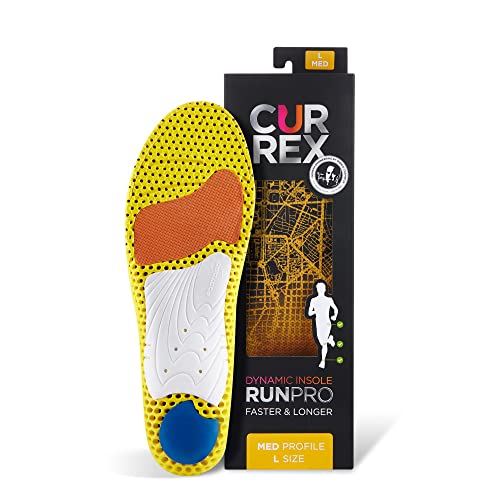
CURREX RunPro Insoles for Running Shoes, Arch Support Inserts to Help Reduce Fatigue and Boost Performance for Men & Women
by CURREX
The most running-specific insole in this roundup, and the only one that lets you choose arch height rather than accept an average.
Pros
- Sold in three arch profiles (low, medium, high) rather than one universal shape, so arch height is matched to your foot instead of averaged
- Decoupled heel cup stabilises the rearfoot at footstrike without locking down the forefoot
- Folds at the shoe's own flex point, so it works with the shoe's geometry rather than against it
- Built and sold specifically for running shoes rather than a general orthotic repurposed for athletics
Cons
- The maker specifies replacement at 500 miles or 12 months, so it is a recurring cost on high mileage
- You must identify your arch profile correctly at purchase, and the wrong profile is the wrong insole
- Among the pricier builds here for a foam and polymer construction
Dr. Scholl’s Run Active Comfort Insoles: Best Budget
The budget slot in this category is usually filled by a generic foam cushion with a running photo on the box. This one is at least aimed at runners by its own maker, which bullets it for runner’s knee, shin splints and plantar fasciitis rather than general comfort.
What you are buying is cushioning and a reinforced arch zone, not motion control. There is no rigid shell, so if your arch collapses under load this will compress along with it rather than resist it. For a neutral runner who simply wants more underfoot than the shoe’s factory liner offers, that is a reasonable trade at this price, and the trim-to-fit outline handles shoes that fall between stock sizes.
Expect it to wear out faster than the shelled options here. That is the actual cost of the low entry price, and for a runner adding modest weekly mileage it is often still the right call as a first insole before committing to something more structured.

Dr. Scholl's Run Active Comfort Insoles, Men's, Trim to Fit
by Dr. Scholl's
A genuinely running-engineered insole at drugstore pricing, rather than a general cushion insole sold as one.
Pros
- Bulleted by its maker for runner's knee, shin splints and plantar fasciitis rather than generic comfort
- Trim-to-fit outline works across shoes that fall between stock sizes
- Polygiene odor-control treatment on the top cover, uncommon at this price
- Sold widely enough that replacing a worn pair is trivial
Cons
- Foam construction with no rigid shell, so it cushions rather than controls motion
- Wears out faster than the shelled orthotics here under the same weekly mileage
- One arch shape only, with no low or high profile option
VKTRY Gold Sport Insoles: Upgrade Pick
This is the only product here that is not really an orthotic. It is a carbon-fiber baseplate tuned by sport and by body weight, designed to store and return energy at push-off rather than to support an arch.
The performance case is better documented than most in this category, resting on independent university testing rather than in-house claims alone. But read what it is actually built for. The maker’s own material describes explosiveness, sprinting and jumping, which makes this a speed-session and interval tool rather than a marathon comfort upgrade. Runners who buy it expecting plush long-run cushioning are the ones who write the disappointed reviews, and its rating is the lowest here partly for that reason.
It also cannot be trimmed. Cutting a carbon baseplate destroys the structure that makes it work, so sizing has to be right the first time. Recommended narrowly, for the runner who wants a performance plate and knows that is what they are buying.

VKTRY Gold Sport Insoles for Non-Cleated Shoes, Carbon Fiber Insole
by VKTRY
A genuine carbon-fiber performance plate, best understood as speed-session equipment rather than a comfort upgrade.
Pros
- A full carbon-fiber baseplate rather than a foam insole with a stiffening insert, which is a genuinely different construction
- Tailored by sport and by body weight rather than sold in a single stiffness
- Energy-return design suits interval and tempo sessions where push-off matters most
- Backed by independent university testing rather than in-house marketing claims alone
Cons
- Built for explosiveness rather than endurance comfort, so it is the wrong tool for long slow mileage
- Cannot be trimmed, so an incorrect size cannot be corrected after purchase
- Carries the lowest star rating in this roundup, with fit precision the recurring complaint
PowerStep Pinnacle Maxx Orthotic Insoles: Runner-Up
If your problem is heel pain, this is the most direct answer on the page. The deep heel cradle is the feature that matters, holding the fat pad under the calcaneus where it belongs instead of letting it splay on impact, which is precisely the mechanism that makes the first steps of a morning so unpleasant with plantar fasciitis.
It comes with the largest ratings base of any PowerStep product here, which is worth something specific: durability complaints in this category tend to surface only after months of use, and a very large pool of ratings is the only practical way to see them. The angled heel post also addresses overpronation, though as a consequence of the same geometry rather than as its headline purpose.
Two caveats. Its own listing is written for general orthotic use and never addresses running, so you are extrapolating. And it is the thickest insole in its family, which means the shoe’s factory liner has to come out and a snug running shoe may still object. If you are chasing heel pain specifically, our plantar fasciitis insole roundup covers more options built around that one problem.

PowerStep Pinnacle Maxx Orthotic Insoles, Firm & Flexible Angled Heel, Flat Feet & Overpronation, Made in USA
by PowerStep
The heel-pain specialist of the group, built around a deep cradle and backed by a very large ratings base.
Pros
- Deep heel cradle aimed squarely at heel pain, the complaint that sidelines most runners with plantar fasciitis
- Nearly twenty thousand ratings give an unusually strong read on long-term durability
- Angled heel post addresses overpronation as a secondary effect of the same geometry
- FSA and HSA eligible, and made in the USA
Cons
- Marketed as a general orthotic, so its own listing never addresses running specifically
- The thickest insole in the Pinnacle family, so the shoe's factory liner has to come out first
- Sized rather than trim-to-fit, so an in-between shoe size has no adjustment path
PowerStep Pulse Maxx Running Insoles: Best for Overpronation
Where the Pinnacle Maxx treats overpronation as a side effect, the Pulse Maxx is aimed at it. The angled heel post gives a collapsing rearfoot something to work against through midstance, and unlike most of the PowerStep range this one is written for running shoes by its own maker.
The shell is rigid, and that is the point. A soft insole under a foot that genuinely overpronates simply compresses and changes nothing. The dual-layer cushioning sitting over the shell is what keeps the correction tolerable rather than punishing, but you should still expect the shell to announce itself for the first week or two.
Volume is the thing to watch. This is a bulkier insole than a neutral one, and in a narrow running shoe it can crowd the fit enough to cause problems of its own. In a roomy daily trainer it is the most effective motion-control option here.
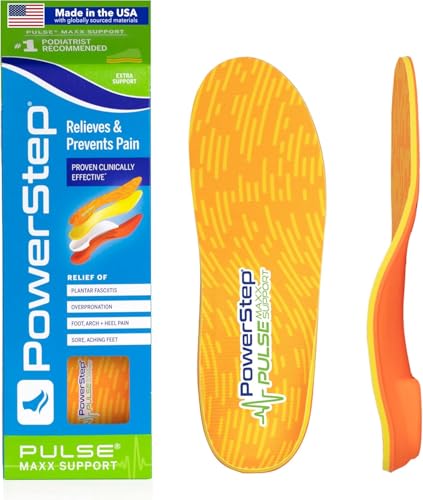
PowerStep Pulse Maxx Running Insoles, Overpronation Corrective Orthotic Inserts
by PowerStep
PowerStep's dedicated running-shoe motion-control insole, and the most direct answer here to a collapsing arch.
Pros
- Angled heel post is aimed directly at overpronation rather than treating it as a side effect
- Written for running shoes specifically, unlike the general-orthotic Pinnacle line
- Dual-layer cushioning sits over the shell, so the correction does not come at the cost of all comfort
- Made in the USA with a 30-day money-back guarantee
Cons
- The rigid shell needs a genuine break-in period before it stops announcing itself
- Sized with no trim option, so the shoe size has to match exactly
- Bulkier than neutral insoles and can crowd a narrow running shoe
Superfeet Run Cushion High Arch Insoles: Best for High Arches
High-arched runners are routinely handed the wrong advice. The standing recommendation to buy a firm supportive orthotic is written for collapsing arches, and under a high rigid arch a stiff shell often just creates a pressure ridge under the midfoot.
A high arch is a poor shock absorber. Load concentrates at the heel and forefoot because the midfoot never flattens to share it, so the job of the insole is to fill that gap and add cushioning, not to correct a collapse that is not happening. This is built to exactly that brief: a high-arch profile with cushioned EVA rather than a rigid corrective shell.
The listing itself is unusually unhelpful, mostly explaining that the product was renamed from the ADAPT Run Max line rather than describing what it does. The product underneath is the same one that earned Superfeet its running reputation, but you will not learn much from the Amazon page alone.

Superfeet Run Cushion High Arch Insoles, Cushioned Orthotic Inserts for Runners
by Superfeet
A high-arch running insole that supports the arch without the rigidity high-arched runners usually reject.
Pros
- A purpose-built high-arch running profile rather than the brand's general all-purpose shape
- Cushioned EVA pairs shock absorption with structure, which suits high arches that tolerate rigidity poorly
- Carries over the running heritage of the ADAPT Run Max line it replaced
- Moisture-wicking top cover holds up to sweat on long efforts
Cons
- The Amazon listing is thin on detail, largely explaining the rename rather than the product
- Sized only, with no trim-to-fit adjustment for in-between sizes
- A modest ratings base next to the category's biggest sellers
VALSOLE Heavy Duty Support Orthotics: Best for Heavier Runners
Most insoles are designed around an average build and simply scaled up. This one is engineered from the start around sustained load from runners over 220 pounds, and the difference shows in the shell: hard TPU that holds its shape where softer foam flattens within weeks.
It carries by a wide margin the largest ratings base on this page, which for a durability-driven purchase is the most useful signal available. Heavier runners are also the group for whom the stress-fracture evidence behind orthoses is most relevant, since bone stress scales with load, and a shell that keeps working under that load is doing the thing the research actually supports.
Be clear-eyed about two things. Its marketing addresses work boots and standing occupations as much as running, so the running case is one you are making yourself. And the rigid shell has a genuine break-in period that dominates its more critical reviews.
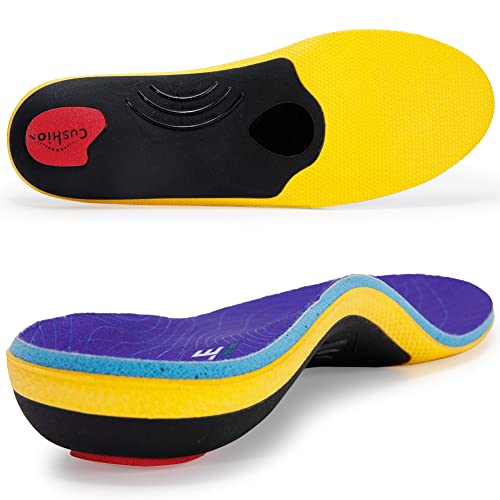
VALSOLE Heavy Duty Support Orthotics for 220+ lbs, High Arch Support Insoles for Men and Women
by VALSOLE
The load-bearing pick, with a rigid shell and by a wide margin the deepest ratings base on this page.
Pros
- Engineered around sustained load from runners over 220 pounds rather than scaled up from an average build
- The largest ratings base of any insole in this roundup
- Hard TPU shell holds its shape under a load that flattens softer foam insoles
- Trim-to-fit, so it adapts across running shoes and trainers alike
Cons
- The rigid shell demands a real break-in period, which is the recurring theme in its reviews
- Written for work boots and standing as much as for running, so the running case is yours to make
- Reviews run more mixed than the PowerStep and Superfeet options here, largely on break-in comfort
PowerStep Pulse Performance Insole: Best for Tight Racing Shoes
Racing shoes and lightweight trainers have almost no spare internal volume, which rules out most of this list. Drop a thick shelled orthotic into a performance shoe and you raise the heel, tighten the toe box, and change the fit the shoe was designed around.
This is PowerStep’s answer to that: total-contact support in a substantially lower-profile body. You give up some of the corrective authority of the Maxx shells and get back a shoe that still fits. The full-length metatarsal cushioning is a sensible touch for faster sessions, where forefoot loading is highest.
It is neutral only, so it is not a motion-control solution in a thinner package. And for a genuinely tight racing flat it may still be more insole than there is room for. For the broad middle ground of performance trainers, it is the most practical structured option here.

PowerStep Pulse Performance Insole, Neutral Arch
by PowerStep
The lowest-profile shelled insole here, for runners whose shoes have no room for a thick orthotic.
Pros
- Total-contact support in a lower-profile body that fits performance shoes the Maxx shells crowd out
- Full-length metatarsal cushioning relieves the forefoot on faster sessions
- Explicitly written for running by its own maker
- Backed by a 60-day guarantee plus a lifetime warranty on the arch shell
Cons
- Still firmer and thicker than a true race-day liner for very tight racing flats
- Sized with no trim option
- Neutral only, so it does nothing for a runner who needs motion control
Superfeet Hike Support Insoles: Best for Trail Running
A note on honesty first: there is no dedicated trail-running insole on Amazon today. I looked, and the category simply does not exist as its own product. What does exist is a hiking insole whose design brief overlaps almost exactly with what a trail runner needs.
That brief is stability on uneven ground. The EVOLyte carbon-fiber blend shell resists the lateral deflection that comes from landing on a rock or a root at an angle, which is the trail runner’s actual failure mode rather than the straight-line repetitive loading that road running produces. Trim-to-fit matters more here than on the road too, because trail shoe lasts vary considerably between brands.
The compromise is underfoot feel. This is firmer than a dedicated road-running foam, which on technical terrain is arguably correct and on smooth fire road is simply less comfortable.

Superfeet Hike Support Insoles
by Superfeet
The best rough-terrain insole available, honestly labelled: it is a hiking product that trail runners have adopted.
Pros
- EVOLyte carbon-fiber blend shell is built for stability on uneven ground, which is the trail runner's actual problem
- A ratings base in the thousands, which is unusual for a rough-terrain insole
- Trim-to-fit, which matters because trail shoe lasts vary more than road shoe lasts
- Moisture-wicking top cover suits wet and muddy conditions
Cons
- Marketed to hikers rather than runners, because no dedicated trail-running insole exists on Amazon today
- Medium cushioning is firmer underfoot than a dedicated road-running foam
- Trim-to-fit means a cutting mistake is permanent
Sof Sole ATHLETE Performance Insoles: Best Neutral Cushioning
Not every runner needs correcting. If your feet are structurally fine and you simply want more cushioning than the factory liner provides, a shelled orthotic is solving a problem you do not have, and it will feel intrusive for no benefit.
This is the cushioning-first option. Gel pads sit at the heel and forefoot, which is where a running footstrike concentrates load, and the whole thing is light and low-bulk enough that it does not change how the shoe fits. That last point is underrated: the most common reason a runner abandons an insole is that it altered a fit they were happy with.
It is neutral arch only, with no corrective version, and gel-and-foam construction compresses faster under high weekly mileage than a shelled insole. Note also that this particular listing is men’s sizing, with women’s sizes sold separately.

SOF SOLE ATHLETE Performance Men's Insoles, PU Foam & Gel Inserts
by Sof Sole
A cushioning-first insole for runners whose feet are fine and simply want more under the heel and forefoot.
Pros
- Gel pads at heel and forefoot sit exactly where a running footstrike loads hardest
- Lightweight and low-bulk, so it adds cushioning without changing how a shoe fits
- Hydrologix top cover manages sweat over long efforts
- A very large ratings base for a cushioning insole at this price
Cons
- Neutral arch only, with no corrective option for overpronators
- Gel and foam compress faster under high weekly mileage than a shelled orthotic
- This listing is the men's sizing, so women's sizes come from a separate listing
Best Running Insoles for Flat Feet and Low Arches
A flat arch is a normal foot shape, not a defect, and if it causes you no pain there is nothing here you need. Where insoles earn their place is when a collapsing arch produces symptoms: arch or heel ache, medial shin pain, or a knee that complains only on longer runs. The feature that matters is not a tall arch bump but an angled heel post, which gives the rearfoot something to resist against through midstance. Match the arch profile to a low foot rather than buying the highest support available, since an arch peak your foot never reaches does nothing at all.
| Product | Price | Buy |
|---|---|---|
| PowerStep Pulse Maxx Running Insoles, Overpronation Corrective Orthotic InsertsBest for flat feet Angled heel post is aimed directly at a collapsing rearfoot, in a running-specific build | $59.95 | View on Amazon |
| CURREX RunPro Insoles for Running Shoes, Arch Support Inserts to Help Reduce Fatigue and Boost Performance for Men & WomenBest fitted low-arch option Sold in a low arch profile, so the support is fitted to a flat foot rather than averaged | $59.95 | View on Amazon |
| VALSOLE Heavy Duty Support Orthotics for 220+ lbs, High Arch Support Insoles for Men and WomenBest for flat feet under load Rigid TPU shell keeps its shape under heavier load where softer insoles flatten | $23.99 | View on Amazon |
Best Running Insoles for High Arches
High arches need the opposite of what flat feet need. A rigid, well-formed arch does not collapse, so there is nothing to correct; the problem is that it distributes load poorly, concentrating it at the heel and forefoot because the midfoot never flattens to take a share. The goal is contact and shock absorption, filling the space under the arch so the midfoot carries its portion. This is why high-arched runners so often find firm corrective orthotics uncomfortable and conclude insoles are not for them, when they were simply handed the wrong category.
| Product | Price | Buy |
|---|---|---|
| Superfeet Run Cushion High Arch Insoles, Cushioned Orthotic Inserts for RunnersBest for high arches Purpose-built high-arch profile with cushioned EVA rather than a rigid corrective shell | $59.95 | View on Amazon |
| CURREX RunPro Insoles for Running Shoes, Arch Support Inserts to Help Reduce Fatigue and Boost Performance for Men & WomenBest fitted high-arch option Available in a high arch profile, fitted rather than averaged | $59.95 | View on Amazon |
| SOF SOLE ATHLETE Performance Men's Insoles, PU Foam & Gel InsertsBest cushioning-first option Gel at heel and forefoot targets exactly where a high arch concentrates load | $21.99 | View on Amazon |
Best Running Insoles for Overpronation
Overpronation is a movement pattern, not a foot shape, and it is worth treating it as one. Plenty of flat-footed runners do not overpronate and plenty of neutral-arched runners do. What an insole can do is slow the rate at which the rearfoot rolls inward through midstance, and the component that does that work is a firm shell with an angled heel post. Cushioning alone accomplishes nothing here: a soft insole under a pronating foot compresses along the same path the foot was already taking.
| Product | Price | Buy |
|---|---|---|
| PowerStep Pulse Maxx Running Insoles, Overpronation Corrective Orthotic InsertsBest for overpronation Rigid shell and angled heel post, built for running shoes specifically | $59.95 | View on Amazon |
| PowerStep Pinnacle Maxx Orthotic Insoles, Firm & Flexible Angled Heel, Flat Feet & Overpronation, Made in USABest if heel pain comes with it Deep heel cradle addresses heel pain while the heel post handles the roll | $50.49 | View on Amazon |
| VALSOLE Heavy Duty Support Orthotics for 220+ lbs, High Arch Support Insoles for Men and WomenBest for heavier overpronators Hard TPU shell resists a pronating load that compresses softer insoles | $23.99 | View on Amazon |
Best Insoles for Trail Running
Trail running asks a different question of an insole. Road running is repetitive loading in a straight line; trail running is unpredictable lateral loading, where the foot lands angled on a rock or rolls off the edge of a root. Torsional stability matters more than cushioning, and a shell that resists twisting is worth more than soft foam. As noted above, no dedicated trail-running insole currently exists on Amazon, so the honest recommendation is a hiking insole whose design brief matches, paired with a fitted road option for runners who mix surfaces.
| Product | Price | Buy |
|---|---|---|
| Superfeet Hike Support InsolesBest for trail running Carbon-blend shell resists lateral deflection on uneven ground, and trims to fit varied trail lasts | $59.95 | View on Amazon |
| CURREX RunPro Insoles for Running Shoes, Arch Support Inserts to Help Reduce Fatigue and Boost Performance for Men & WomenBest for mixed road and trail Fitted arch profile and a flexible shell that suits runners splitting mileage between surfaces | $59.95 | View on Amazon |
Best Insoles for Long Distance and Marathon Running
Over marathon distance the variable that decides comfort is not peak cushioning but whether support holds up. An insole that feels excellent for an hour and then bottoms out has failed at exactly the point it mattered. Look for a structured shell that resists compression rather than the softest foam available, and account for foot swelling over long efforts, which is a real effect and means an insole that feels perfectly snug at the start can feel tight at thirty kilometres. Replace on mileage rather than appearance, since the arch flattens long before the top cover looks worn.
| Product | Price | Buy |
|---|---|---|
| CURREX RunPro Insoles for Running Shoes, Arch Support Inserts to Help Reduce Fatigue and Boost Performance for Men & WomenBest for marathon distance Rebound foam aimed at propulsion, with a published replacement interval to plan around | $59.95 | View on Amazon |
| PowerStep Pinnacle Maxx Orthotic Insoles, Firm & Flexible Angled Heel, Flat Feet & Overpronation, Made in USABest if heel pain builds late Deep cradle and premium dual-layer cushioning for heel pain that appears deep into a long run | $50.49 | View on Amazon |
| SOF SOLE ATHLETE Performance Men's Insoles, PU Foam & Gel InsertsBest lightweight cushioning Low bulk and gel underfoot for runners who want cushioning without added structure | $21.99 | View on Amazon |
Best Running Insoles by Use Case
A few more situations that come up often enough to be worth naming directly.
| Product | Price | Buy |
|---|---|---|
| VKTRY Gold Sport Insoles for Non-Cleated Shoes, Carbon Fiber InsoleBest carbon fiber insole for running A true carbon baseplate tuned by sport and body weight, for speed work rather than long slow mileage | $149.00 | View on Amazon |
| PowerStep Pulse Performance Insole, Neutral ArchBest for narrow and racing shoes Low-profile shelled support that fits performance shoes without changing how they fit | $54.95 | View on Amazon |
| Dr. Scholl's Run Active Comfort Insoles, Men's, Trim to FitBest first insole on a budget Running-specific features at drugstore pricing, and a sensible place to start before committing | $21.00 | View on Amazon |
Buyer's Guide
An insole is a fit decision before it is a comfort one. Most disappointment in this category comes not from buying a bad insole but from buying one whose arch height, stiffness, or volume does not match the foot and the shoe it has to live in. These six factors are the ones that decide whether an insole helps.
Match the arch profile to your foot, not to a diagnosis
The single most common reason an insole fails is an arch height that does not match the foot. CURREX and Superfeet both sell the same running insole in different arch profiles precisely because one shape cannot serve every foot. Wet-footprint tests are crude but directionally useful, and a running shop that does a proper foot assessment is better. Buying a high-arch insole because a friend recommended it is how a good product becomes an uncomfortable one.
Decide whether you need control or cushioning
These are different jobs and they pull in opposite directions. A collapsing arch that produces symptoms wants a firm shell and an angled heel post to resist it. A high, rigid arch wants contact and shock absorption because it does not distribute load well on its own. A firm corrective orthotic under a high arch is often actively uncomfortable, and a soft cushioning insole under a badly overpronating foot simply compresses. Identify which problem you have before you shop.
Account for insole volume against your shoe
Every insole displaces space the shoe already allocated. Thick shelled orthotics raise the foot in the heel counter and tighten the toe box, which is why a pair that feels fine in a roomy daily trainer can make a racing shoe unwearable. Always remove the factory liner first rather than stacking. If your shoe is snug, a low-profile insole is not a compromise, it is the only version that will work. This applies whatever shoe you run in, including replacing the stock liner in Brooks, Hoka, or Saucony trainers.
Understand trim-to-fit versus pre-sized
Trim-to-fit insoles forgive in-between shoe sizes and adapt across different shoes, at the cost of one irreversible cutting step. Use the old liner as a template and cut conservatively, because you can always remove more. Pre-sized insoles skip that risk entirely but demand that your shoe size match a size the maker actually offers. Carbon plates must never be trimmed at all, since cutting the baseplate destroys the structure that makes them work.
Expect a break-in period on anything rigid
Moving from a soft factory liner to a firm shell changes how your foot is loaded, and the first week usually feels like it. Reviewers across every rigid option here describe discomfort that resolves within two to three weeks. Introduce a new orthotic over short easy runs rather than a long one, and do not judge it on the first outing. Pain that sharpens rather than settles over that window is a signal to stop and reassess, not to push through.
Know when the answer is a clinician, not a product
Over-the-counter insoles handle a large share of ordinary running foot complaints, and a custom orthotic is not automatically better for a runner with no structural pathology. But some presentations need assessment rather than shopping: pain that wakes you at night, numbness or pins and needles, a sudden change in foot shape, pain that localises to one point on a bone, or any symptom that has not improved after several weeks of sensible load management. Localised bone pain after a training-load increase in particular deserves evaluation for a stress injury before you spend anything on an insole.
How to Choose the Best Running Insoles
Work through it in this order. First decide whether you need control or cushioning, because they are opposite jobs and getting this backwards accounts for most of the disappointment in this category: firm shells for arches that collapse and produce symptoms, cushioned profiles for high rigid arches that do not. Second, match the arch profile to your actual foot rather than to a category label, and prefer brands that offer more than one height. Third, check the insole against the shoe it has to live in, remove the factory liner rather than stacking, and drop to a lower profile if the shoe is snug.
Then give it time. Anything rigid will feel wrong for a week or two while your foot adapts to being loaded differently, and that is expected rather than a sign of a bad purchase. What is not expected is pain that sharpens instead of settling, or pain that localises to a single point on a bone. That is a reason to stop and get assessed, not to persist. Runners managing pain more broadly may also find our guides to foot massagers and compression socks useful alongside an insole.
Final Verdict
The CURREX RunPro is the pick I would put in front of most runners, because it solves the problem that actually determines whether an insole works: it is sold in three arch profiles rather than one averaged shape, and it is engineered for running shoes rather than adapted from a general orthotic. For a runner who wants to spend less, the Dr. Scholl’s Run Active Comfort is a genuine running-specific product at drugstore pricing, with the honest limitation that it cushions rather than corrects.
Beyond that, let the situation choose. Overpronation points to the PowerStep Pulse Maxx, high arches to the Superfeet Run Cushion, heavier runners to the VALSOLE, tight shoes to the Pulse Performance, and trail to the Superfeet Hike Support. Keep the evidence in proportion while you decide: orthoses have real support behind them for reducing stress fractures and for easing pain in a runner who already has symptoms, and considerably weaker support as general injury insurance for a runner who feels fine. An insole is a good tool for a specific problem and a poor substitute for sensible training load. If something hurts persistently, see a clinician before you see a checkout page, and if you are weighing broader support options our orthotic insole guide covers the non-running side of the category.
Frequently Asked Questions
Do running insoles actually prevent injuries?
Are the best running insoles for Achilles tendonitis different from regular running insoles?
Should I wear insoles for flat feet when running?
Do runners with high arches need arch support?
How often should running insoles be replaced?
Related Articles
About the Reviewer

Dr. David Taylor, MD, PhD
Drexel University College of Medicine (MD), Indiana University School of Medicine (PhD)
Dr. David Taylor is a licensed physician and medical researcher who founded BestRatedDocs in 2016. With an MD from Drexel University and a PhD from Indiana University School of Medicine, he combines clinical expertise with a passion for health technology to provide evidence-based product recommendations. Dr. Taylor specializes in health informatics and regularly evaluates medical devices, diagnostic equipment, and therapeutic products to help healthcare professionals and patients make informed decisions.