9 Best Compression Socks for Pregnancy in 2026
Dr. David Taylor reviews the best compression socks for pregnancy on Amazon — compared by compression level, calf sizing, and ease of donning, with picks for swelling, edema, swollen feet, leg cramps, restless legs, and flying.
Updated
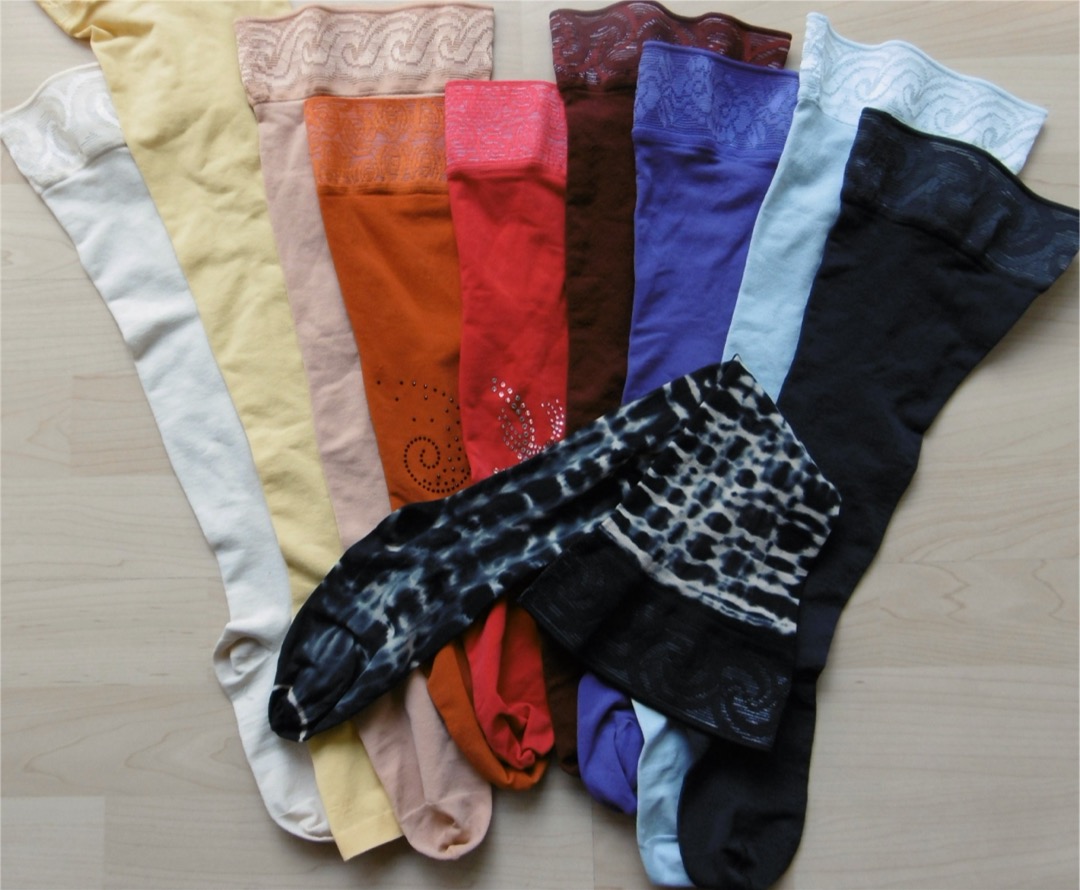
By the end of a pregnancy your body is circulating close to half again as much blood as it started with, your progesterone-relaxed veins are holding more of it at lower pressure, and a uterus the size of a watermelon is pressing on the pelvic veins that drain your legs. Those three things happen to every pregnancy, and together they explain why your ankles disappear somewhere in the third trimester and why the shoes that fit in March do not fit in July.
Graduated compression is the intervention that addresses this directly, and it is unusual among pregnancy products in that the mechanism is entirely mechanical. Nothing is absorbed, nothing crosses the placenta, and there is no ingredient to research. The sock is tightest at the ankle, delivering its full stated pressure there, and eases progressively up the calf. That gradient pushes venous blood in the direction it needs to go and keeps flow velocity up in veins that pregnancy has made slow and wide. It is the same physics that makes compression work for nurses on twelve-hour shifts, applied to a body doing something considerably harder.
The socks below were all checked live on Amazon in August 2026 for price, stock, and current rating. If you want the general case rather than the pregnancy one, our best compression socks roundup covers it, and our beginner’s guide to compression therapy starts from scratch.
Find the Best Pregnancy Compression Sock for Your Situation
Jump straight to the section that matches what your legs are doing:
- Best compression socks for pregnancy overall — all nine reviewed
- Best compression socks for pregnancy swelling and edema
- Best compression socks for swollen feet and ankles during pregnancy
- Best compression socks for leg cramps during pregnancy
- Best compression socks for restless legs during pregnancy
- Best 15-20 mmHg compression socks for pregnancy
- Best compression socks for flying while pregnant
- More situations: varicose veins, wide calves, postpartum
Why Pregnancy Swells Your Legs, and What Compression Actually Does
The veins in your legs have no pump of their own. They rely on the calf muscles squeezing the deep veins with each step, and on one-way valves that stop blood falling back down between squeezes. Pregnancy attacks that system from three directions at once. Plasma volume rises by roughly forty to fifty percent, so there is more fluid in the circuit. Progesterone relaxes smooth muscle throughout the body, including the walls of the veins, so they dilate and the valves that were designed for a narrower vessel no longer meet properly in the middle. And from around the second trimester the growing uterus compresses the inferior vena cava and the iliac veins, raising the pressure everything below has to push against.
The result is predictable. Venous pressure at the ankle rises, plasma leaks out through the capillary walls into the surrounding tissue, and by evening you have pitting oedema around the ankles and over the shin. It is uncomfortable rather than dangerous in its ordinary form, and it resolves within days of delivery.
Graduated compression supplies from the outside what the calf pump is struggling to supply from the inside. Narrowing the vein diameter raises flow velocity, the ankle-to-knee pressure gradient encourages blood upward rather than letting it pool, and the external pressure on the tissue opposes the capillary leak that produces the swelling. There is a second reason obstetricians like them, less visible but more important: pregnancy raises the risk of venous thromboembolism several-fold above baseline, and stasis in dilated leg veins is one of the three classical contributors to clot formation. Compression addresses the stasis.
Two consequences follow that most pregnancy roundups skip. The sock must be knee-high, because there is no calf over which an ankle sock could build a gradient. And the fit must match your leg rather than your shoe size, because the stated mmHg assumes a specific knit tension across a specific circumference. Stretch that knit over a larger calf and the pressure at the top drops while the ankle stays tight, which distorts the gradient the garment exists to create.
How I Chose These Nine Socks
Every product here was opened directly on Amazon and checked for live availability, current price, star rating, and review count rather than pulled from a cached feed. That matters in this category more than most: compression sock listings rotate constantly, and roundups that have not been re-verified in a year are usually half dead links.
Beyond that, the selection was built around a specific observation. Most socks marketed for pregnancy are ordinary graduated compression socks with a pregnancy keyword in the listing, and a few genuinely design for the pregnant body. Both categories can be the right buy, so this guide includes both and says which is which rather than pretending maternity branding is a clinical distinction. The line that actually matters is the pressure level and the fit.
I weighted the lineup toward 15-20 mmHg because that is what uncomplicated pregnancy swelling calls for, and included two firmer options clearly labelled as clinical rather than premium. I also deliberately covered the fits that standard socks handle badly during pregnancy — wide calves, swollen feet, and the third-trimester reality that you cannot reach your own feet — because those are the reasons compression socks get bought and then abandoned. Three picks here carry small review pools; each earns its place on a design advantage, and I have flagged the limitation in its review rather than hiding it.
Before ordering anything, run your measurements through our free compression sock size chart, which cross-references sizing across eight major brands.
Best Compression Socks for Pregnancy Overall
The nine socks below each earned a place for a specific pregnancy reason. The SONORAN maternity sock is the best starting point for most pregnancies; the sections after the reviews then match particular situations — swelling, swollen feet, cramps, restless legs, flying — to the right pick from this same lineup.
1. SONORAN Compression Socks for Pregnant Women 15-20 mmHg — Best Overall
This is the sock I would hand to a patient at her twenty-week appointment who has started noticing her ankles. It gets the three things right that matter most and does not charge a premium for a maternity label.
The compression level is correct. At 15-20 mmHg it sits precisely where guidance for uncomplicated pregnancy swelling points, firm enough to assist the calf pump meaningfully but light enough that you will still be able to get it on in month eight. This is the trade-off that decides whether compression socks help you or sit in a drawer, and firmer genuinely is not better here.
The fabric choice reflects an understanding of who is wearing it. Bamboo viscose stretches more forgivingly than tight nylon at the same rated pressure, which makes donning materially easier, and it breathes better than the copper-treated synthetics — worth something when pregnancy has already raised your baseline temperature. The knit is soft against skin that many women find has become more reactive.
The detail that separates it from everything else in this guide is the non-slip sole. Compression socks are smooth by design, pregnancy shifts your centre of gravity forward, and hard floors in socked feet are a genuine fall hazard in the third trimester. Almost no maternity compression sock addresses this. This one does.
The honest limitation is evidence. At around 300 ratings the feedback pool is a fraction of the mass-market multipacks below, and it is a newer listing earning its place on design rather than volume. A two-pair pack also means laundry every other day if you wear compression daily, so budget for two packs if this is going to be your everyday sock.

SONORAN Compression Socks for Pregnant Women 15-20 mmHg (2 Pairs)
by SONORAN
The right compression level, a knit soft enough to actually put on late in pregnancy, and a grip sole most maternity socks leave out.
Pros
- Sits at 15-20 mmHg, the level obstetric guidance points to first for uncomplicated pregnancy swelling
- Bamboo viscose knit is soft and stretchy enough to get on without a fight in the third trimester
- Non-slip grip sole addresses a real pregnancy hazard — smooth compression socks on hard floors are a fall risk
- Purpose-built for pregnancy rather than a general athletic sock with maternity added to the listing
Cons
- Around 300 verified ratings, a far shallower feedback pool than the mass-market multipacks here
- Two-pair pack means laundry every other day if you wear compression daily
2. Wakefeet Pregnancy Compression Socks 15-20 mmHg — Budget Pick
The useful thing about this sock is what it proves: a correct, graduated, maternity-sized 15-20 mmHg knee-high does not need to be expensive. It costs less than either of the other pregnancy-designed pairs in this guide and it does not cut the specification to get there.
It also rates higher than both of the other pregnancy-specific pairs reviewed here, from women using them for exactly what they were bought for — standing shifts, third-trimester swelling, and the everyday leg heaviness that arrives in the second trimester. The knit is thin enough to disappear under work trousers, which is not a trivial consideration if you are wearing compression through a workday and would rather not announce it.
The trade-offs are the ones you would expect. The review pool is thin at just over 200 ratings, and the listing is recent enough that long-term durability is unproven — with compression socks that matters, because the elastic gradient degrades with washing and a sock that has lost its stretch is doing nothing regardless of how it looks. And you get none of the extras the pricier maternity socks add: no grip sole, no cushioning, plain colours only.
For a first pair, when you are not yet sure whether you will get on with compression at all, that is a reasonable place to start. If it works and you move to wearing compression daily, the eight-pack below covers a full week for less than two packs of these.
Wakefeet Pregnancy Compression Socks 15-20 mmHg (2 Pairs)
by Wakefeet
Proof that a correct 15-20 mmHg graduated maternity sock does not have to be expensive. Priced below the other two pregnancy-designed pairs here, and a sensible first pair.
Pros
- Costs less than either of the other two pregnancy-specific pairs here, and still a true graduated 15-20 mmHg
- Rates higher than both of the other pregnancy-specific pairs reviewed here
- Listing is sized for pregnancy swelling rather than converted from a men's athletic chart
- Thin enough to wear under work trousers through a standing shift without visible bulk
Cons
- Fewer than 300 ratings — the evidence base is thin and the listing is recent
- Plain colourways only, with none of the cushioning or grip features the pricier maternity socks add
3. Kindred Bravely Maternity Compression Socks — Upgrade Pick
Kindred Bravely is the maternity brand that shows up in essentially every serious pregnancy compression roundup, and one design decision explains why: the socks are sized by calf circumference, in two bands, rather than by shoe size. That is how compression hosiery is supposed to be sized, and it is the input that determines whether the garment delivers its gradient. Almost every mass-market listing keys sizing to shoe size, which tells you nothing about the leg the sock has to compress.
The construction is the softest here, at roughly sixty percent bamboo-derived viscose with a high elastane content, and the cushioned sole is a genuinely thoughtful addition for late pregnancy — the foot ache from carrying an extra thirty pounds on a changed gait is a separate complaint from the leg swelling, and this addresses both in one garment.
Two honest problems, and the first is significant. The Amazon listing describes the socks only as “high compression” and never prints an mmHg figure anywhere. For a product whose entire specification is a number, that is a real omission; the brand states 20-30 mmHg on its own site, which is Class 2 territory and more compression than an uncomplicated pregnancy needs. Treat this as a firm-compression garment and raise it with your obstetrician rather than assuming it is an everyday sock. Second, this has the smallest evidence base in this guide, and the two calf bands stop at 19 inches, which leaves anyone above that range unserved.

Kindred Bravely Maternity Compression Socks for Pregnancy Knee High (2 Pairs)
by Kindred Bravely
The premium maternity pick, and the only one here sized the way a compression garment should be — but confirm the level with your obstetrician before you rely on it.
Pros
- Sized by calf circumference in two bands rather than by shoe size, which is the correct input for compression
- Cushioned sole targets the foot ache that late pregnancy and standing produce together
- Bamboo-derived knit at roughly 60 percent viscose is the softest fabric of any sock in this guide
- From a maternity brand that designs around the pregnant body rather than adapting a medical garment
Cons
- The Amazon listing says only 'high compression' and never prints an mmHg figure, which is a real problem for a garment where the number is the specification
- The smallest ratings pool here, and the two calf bands leave anyone above 19 inches unserved
4. CHARMKING Compression Socks 15-20 mmHg, 8 Pairs — Runner-Up, Best Value
Set the maternity branding aside for a moment and look at what daily compression actually requires. If you are wearing socks every day from the morning you get up until bedtime, you need a clean pair every day, which means either laundry every night or enough pairs to get through the week. Eight pairs solves that in one purchase, at a per-pair cost the single-pair maternity options cannot approach.
The evidence base is the other argument. Roughly 90,000 verified ratings at 4.5 stars, with an Amazon’s Choice badge, is a depth of feedback no maternity-specific sock in this category comes close to. When a listing has been bought and reviewed that many times, sizing problems and durability failures surface clearly rather than hiding in a pool of two hundred reviews. The compression is a true graduated 15-20 mmHg, the same level as the maternity picks above.
What you give up is everything that makes a sock specifically pregnant-friendly. There is no grip sole, no cushioned footbed, and no maternity calf sizing — this is a general circulation sock with pregnancy listed among its uses. The copper-treated nylon also holds heat, which is the wrong direction if you are already running hot in the third trimester. If you want the pregnancy-designed features, buy the SONORAN; if you want an open-toe rotation of correct-level socks at a low cost per pair, buy these.

CHARMKING Compression Socks 15-20 mmHg (8 Pairs)
by CHARMKING
The value and evidence benchmark: eight pairs of genuine 15-20 mmHg graduated socks, backed by a review pool nothing else here comes close to.
Pros
- Roughly 90,000 verified ratings at 4.5 stars, by far the deepest evidence base of any sock in this guide
- Eight pairs means a clean pair every day of the week without daily laundry, which is what daily compression actually requires
- Carries an Amazon's Choice badge for compression socks and sizes generously through L/XL
- True graduated 15-20 mmHg, the same level as the maternity-branded picks at a fraction of the per-pair cost
Cons
- A general circulation sock with pregnancy in the listing, not a maternity design — no grip sole, no cushioning, no maternity calf sizing
- Copper-treated nylon runs warm, which is unwelcome if you are already overheating in the third trimester
5. LEVSOX Wide Calf Compression Socks Plus Size 15-20 mmHg
Sizing up a standard compression sock to fit a larger calf does not work, and the reason is worth understanding because it comes up constantly in pregnancy. The rated mmHg assumes the knit is stretched to a particular tension across a particular circumference. Stretch it further and the pressure at the calf falls while the ankle stays tight, which distorts the gradient into something closer to a tourniquet at the bottom. The over-stretched top band is also exactly what starts rolling down an hour into the day, and a rolled band is a constricting ring.
This one is knitted wide from the start, which is the distinction that matters. It also solves a mismatch that pregnancy produces routinely and standard plus-size socks handle badly: a calf that has grown substantially paired with a foot that has not, where a conventionally sized-up sock leaves loose fabric bunching past the toes.
With more than 7,000 ratings it is unusually well evidenced for a plus-size compression garment. The costs are real, though — it is sold as a single pair at close to the price of the eight-pack, so a full rotation gets expensive, and it runs long enough that reviewers under about five foot five report folding the top band below the knee.

LEVSOX Wide Calf Compression Socks Plus Size 15-20 mmHg
by LEVSOX
The answer when a standard compression sock cuts in at the calf — built wide from the start, so the gradient still works.
Pros
- Knitted wide rather than sized up, so the pressure gradient survives a large calf instead of being stretched flat
- Accommodates the calf circumference that third-trimester fluid retention produces, which standard socks simply cannot
- More than 7,000 ratings, an unusually deep pool for a plus-size compression garment
- Pairs a wide calf with a normal foot opening, avoiding the loose flapping fabric of a sized-up standard sock
Cons
- Sold as a single pair at a price close to the eight-pack, so building a rotation is expensive
- Runs long — reviewers under about five foot five report having to fold the top band below the knee
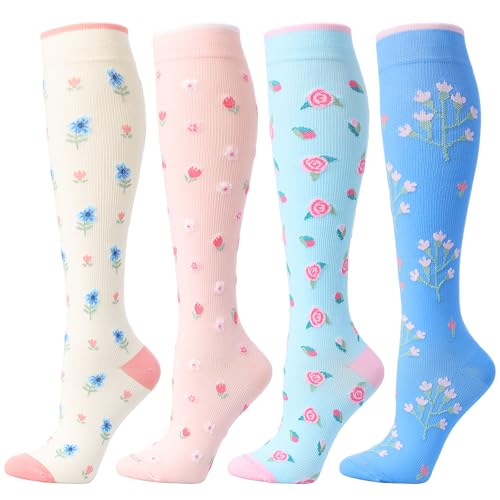
6. LEVSOX Compression Socks 20-30 mmHg
This is the pick for pregnancies where firm compression has actually been recommended, and it should be read that way rather than as a general upgrade. At a true 20-30 mmHg this is Class 2 compression, the range clinicians use for significant varicose veins, chronic venous insufficiency, established lymphoedema, and the management of women with a personal or family history of venous thromboembolism.
Two things make it the right choice within that category. The first is evidence: more than 15,000 verified ratings is by a wide margin the deepest pool of any firm-compression sock reviewed here, and because the listing is marketed heavily to pregnancy and nursing, the accumulated sizing feedback is unusually specific about how it fits a changing leg. The second is fabric. Firm compression in a stiff synthetic becomes intolerable by mid-afternoon; the bamboo viscose knit here stays wearable across a full day, which is the difference between a garment you use and one you own.
Two warnings, both important. If your obstetrician has not asked for this level, it is more compression than you need, and more is not better — 15-20 mmHg is the correct choice for uncomplicated pregnancy swelling. And 20-30 mmHg socks are hard to pull on even without a bump in the way. Put them on in bed before you stand up, and read the donning notes in the buyer’s guide below before you order.
LEVSOX Compression Socks 20-30 mmHg
by LEVSOX
The pick when firm compression has been recommended for varicose veins, a clot history, or severe oedema — not a general upgrade.
Pros
- A true, clearly stated 20-30 mmHg for the pregnancies where a clinician has asked for firm compression
- More than 15,000 ratings, the deepest evidence base of any firm-compression sock reviewed here
- Bamboo viscose knit stays tolerable across a full day, which stiff synthetics at this level do not
- Listing is marketed heavily to pregnancy, so the accumulated sizing feedback is unusually detailed
Cons
- More compression than an uncomplicated pregnancy needs — this is a clinical indication, not an upgrade
- Genuinely difficult to pull on at this level, and that difficulty peaks exactly when your bump makes bending hardest
7. bropite Copper Toeless Compression Socks 15-20 mmHg, 3 Pairs
Not every pregnancy swells the same way. Plenty of women find the calf tolerable while the feet and toes take the brunt, and for them a closed-toe sock compresses precisely the part that is most tender. The open-toe cut solves that: the calf still receives the full graduated gradient, and the toes are left alone.
There is a second, more clinical reason to like an open toe during pregnancy. If your feet are swelling enough that anyone is monitoring them, being able to see your toes — their colour, how quickly they pink up after pressure — is genuinely useful information that a closed sock hides. And in practical terms, the toeless cut is easier to get on than a closed toe at the same pressure, because the hardest part of donning is working the heel through a closed foot.
Three pairs at this price makes a rotation affordable, and with over 3,000 ratings the evidence base is solid for a specialty design. Two caveats: the toe band can dig into the ball of the foot if the sock is even slightly short for your leg, so measure rather than guess, and open-toe compression looks unmistakably medical in shoes, which some wearers mind more than others.

bropite Copper Toeless Compression Socks 15-20 mmHg (3 Pairs)
by bropite
The open-toe option for pregnancies where the feet swell more than the calves, and for anyone who wants to keep an eye on their toes.
Pros
- Open toe leaves swollen toes uncompressed while the calf still gets the full graduated gradient
- Lets you see your toes to check colour and capillary refill, which matters when swelling is being monitored
- Three pairs makes a rotation affordable, and the toeless cut suits sandals in late-pregnancy summer
- Over 3,000 ratings, a solid evidence base for an open-toe design
Cons
- The toe band can dig into the ball of the foot if the sock is even slightly short for your leg
- Open-toe compression looks unmistakably medical, which some wearers dislike with shoes
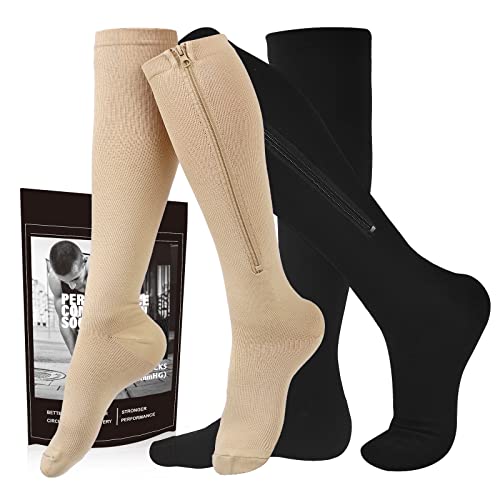
8. cerpite Zipper Compression Socks 15-20 mmHg, 2 Pairs
Ask women why they stopped wearing the compression socks they bought and the answer is rarely that the socks did not work. It is that by the third trimester they could not get them on. Bending forward far enough to work a tight knit over your heel becomes first awkward and then genuinely impossible, and the socks migrate to a drawer somewhere around thirty-two weeks — which is precisely when the swelling is at its worst.
A side zipper removes that problem rather than working around it. You position the sock loosely, close the zipper, and the full graduated 15-20 mmHg is delivered without ever having to haul a tight knit up a swollen leg. This is not a reduced-pressure convenience product; the compression is the same as the conventional socks above.
The trade-off is mechanical. A zipper is a moving part on a garment that gets stretched every day and washed constantly, and reviewers report separations and snagging over months of use — buy a spare pair rather than relying on one, which is partly why the two-pack framing suits it. The zipper track also sits as a visible ridge under close-fitting trousers. Neither of those outweighs being able to dress yourself in month nine.
cerpite Zipper Compression Socks 15-20 mmHg (2 Pairs)
by cerpite
The practical answer to the third-trimester problem nobody warns you about: you cannot reach your own feet.
Pros
- The side zipper removes the single biggest reason pregnant women abandon compression — not being able to reach their feet
- Lets you get the sock positioned loosely and then close it, instead of hauling a tight knit up a swollen leg
- Full 15-20 mmHg graduated compression once zipped, not a reduced-pressure convenience product
- Over 3,600 ratings, deep for a specialty design
Cons
- The zipper is the failure point — reviewers report separations and snagging on the seam over months of use
- The zipper track sits as a visible ridge under close-fitting trousers
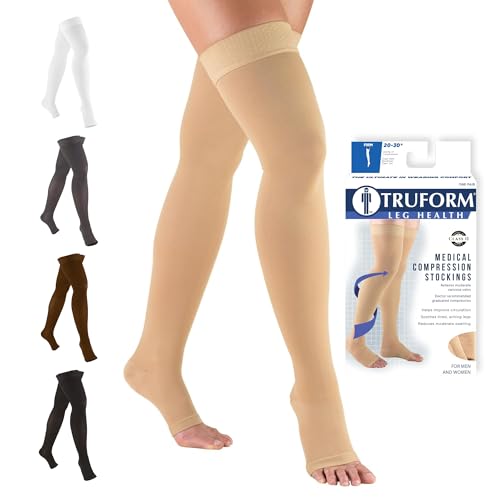
9. Truform 20-30 mmHg Compression Stockings, Thigh High, Open Toe
Knee-highs handle the great majority of pregnancy compression, but they stop at the knee, and pregnancy produces two problems that sit above it. Thigh varicosities are common as the dilated pelvic and femoral veins take the load, and vulvar varicosities — uncomfortable, poorly discussed, and genuinely miserable — are entirely out of reach of a knee-high.
Truform is an established medical hosiery manufacturer rather than a marketplace label, and the construction shows it: a properly graduated 20-30 mmHg over the full leg, an open toe that makes an otherwise very difficult garment somewhat easier to don, and a silicone dot top band that grips the thigh so the stocking does not migrate down over a day.
Be realistic about the difficulties. Thigh-highs roll and slide on a pregnant body far more than knee-highs do, because the thigh circumference is changing and the top band has nothing structural to sit against. A thigh-high that has rolled into a band at mid-thigh is constricting rather than helping, and you should take it off rather than push it back up. At 20-30 mmHg over a full leg this is also the hardest garment in this guide to put on unaided. Buy it for a specific above-knee problem, on clinical advice, and not as a general upgrade over a knee-high.
Truform 20-30 mmHg Compression Stockings, Thigh High, Open Toe
by Truform
For pregnancy varicose veins that sit above the knee, where a knee-high stops short of the problem — and only on clinical advice.
Pros
- Thigh-high coverage reaches varicosities above the knee that a knee-high physically cannot touch
- Truform is an established medical hosiery manufacturer rather than a marketplace label
- Silicone dot top grips the thigh so the stocking does not migrate down over a day
- Open toe eases donning and keeps swollen toes free
Cons
- Thigh-highs roll and slide on a changing pregnant body far more than knee-highs do
- At 20-30 mmHg over a full leg, this is the hardest garment here to put on unaided
Best Compression Socks for Pregnancy Swelling and Edema
Ordinary pregnancy oedema is bilateral, gradual, worst in the evening, and better after a night lying flat. That is the version compression is for, and the level to start at is 15-20 mmHg rather than the firmest number you can find. Step up only if a clinician has said to, or if 15-20 mmHg genuinely has not touched it after a few weeks of consistent daily wear.
| Product | Price | Buy |
|---|---|---|
| SONORAN Compression Socks for Pregnant Women 15-20 mmHg (2 Pairs)Best for everyday swelling 15-20 mmHg in a soft bamboo knit, the right first choice for bilateral evening swelling | $19.95 | View on Amazon |
| CHARMKING Compression Socks 15-20 mmHg (8 Pairs)Best value for daily wear Eight pairs at the same 15-20 mmHg, so you can wear compression every day without nightly laundry | $16.14 | View on Amazon |
| LEVSOX Compression Socks 20-30 mmHgBest for severe oedema True 20-30 mmHg for oedema that has not responded to moderate compression, on obstetric advice | $17.99 | View on Amazon |
Best Compression Socks for Swollen Feet and Ankles During Pregnancy
When the swelling concentrates below the ankle rather than through the calf, two things change. A closed toe presses on exactly the tissue that is most tender, and a cushioned sole starts to matter as much as the compression itself — swollen feet ache from the pressure of standing, not just from the fluid.
| Product | Price | Buy |
|---|---|---|
| bropite Copper Toeless Compression Socks 15-20 mmHg (3 Pairs)Best for swollen toes Open toe leaves tender toes uncompressed while the calf still gets the full gradient | $13.99 | View on Amazon |
| Kindred Bravely Maternity Compression Socks for Pregnancy Knee High (2 Pairs)Best cushioned option Cushioned sole addresses the ache of standing on swollen feet, not just the fluid | $29.99 | View on Amazon |
| SONORAN Compression Socks for Pregnant Women 15-20 mmHg (2 Pairs)Best all-round for feet and calves Grip sole plus moderate compression for women whose feet and calves swell together | $19.95 | View on Amazon |
Best Compression Socks for Leg Cramps During Pregnancy
Nocturnal calf cramps affect a large share of pregnancies, usually from the second trimester on, and the honest position is that the cause is not fully settled — circulatory changes, altered calcium and magnesium handling, and the mechanical load on the calf all plausibly contribute. Compression during the day helps a proportion of women by improving venous return and reducing the fluid load the calf muscle is working through, and it is a low-risk thing to try. What it is not is a guaranteed fix. If cramps are severe, discuss them at your next appointment alongside your prenatal vitamins, because mineral intake is part of the same conversation.
| Product | Price | Buy |
|---|---|---|
| SONORAN Compression Socks for Pregnant Women 15-20 mmHg (2 Pairs)Best for daytime cramp prevention Soft bamboo knit at 15-20 mmHg, comfortable enough to keep on through a full day of standing | $19.95 | View on Amazon |
| CHARMKING Compression Socks 15-20 mmHg (8 Pairs)Best for wearing every day Enough pairs to wear compression consistently, which is what makes any difference to cramps | $16.14 | View on Amazon |
Best Compression Socks for Restless Legs During Pregnancy
Restless legs syndrome is markedly more common in pregnancy than outside it, peaking in the third trimester, and it is worth knowing that iron deficiency is one of its best-established contributors — which is why a ferritin check is a reasonable request if restless legs are keeping you awake, and why our guide to the best iron supplements is relevant reading. Compression is not a treatment for restless legs, but daytime compression reduces the leg heaviness and evening fluid load that make the evening symptoms worse for some women. Wear it during the day; take it off at night, when lying flat does the work instead.
| Product | Price | Buy |
|---|---|---|
| SONORAN Compression Socks for Pregnant Women 15-20 mmHg (2 Pairs)Best for daytime relief Moderate compression through the day reduces the evening leg heaviness that worsens symptoms | $19.95 | View on Amazon |
| cerpite Zipper Compression Socks 15-20 mmHg (2 Pairs)Best if evenings are when you struggle to dress Zip closure means you can still get compression on late in the day without bending to your feet | $16.99 | View on Amazon |
Best 15-20 mmHg Compression Socks for Pregnancy
If you have read anywhere that pregnancy calls for a specific number, this is it. Fifteen to twenty millimetres of mercury at the ankle is the level that mainstream obstetric guidance converges on for uncomplicated swelling, and all three socks below deliver it in a genuinely graduated gradient. The choice between them is about fit and budget rather than about pressure. Our compression levels guide explains how the classes above and below this one differ.
| Product | Price | Buy |
|---|---|---|
| SONORAN Compression Socks for Pregnant Women 15-20 mmHg (2 Pairs)Best 15-20 mmHg overall Pregnancy-designed with a grip sole, in a knit soft enough to don late in pregnancy | $19.95 | View on Amazon |
| Wakefeet Pregnancy Compression Socks 15-20 mmHg (2 Pairs)Cheapest 15-20 mmHg maternity pair The lowest-cost maternity-designed way to try correct-level compression before committing to a rotation | $14.99 | View on Amazon |
| LEVSOX Wide Calf Compression Socks Plus Size 15-20 mmHgBest 15-20 mmHg for wide calves Knitted wide so the gradient survives the calf circumference late pregnancy produces | $27.99 | View on Amazon |
Best Compression Socks for Flying While Pregnant
Pregnancy is an independent risk factor for venous thromboembolism, and a long flight adds several hours of enforced stasis on top of it. That combination moves compression from a comfort purchase to something worth raising with your obstetrician or midwife before you travel, particularly beyond about four hours in the air. Start with a maternity fit at 15-20 mmHg; move to firm compression only on clinical advice. Our compression socks for travel guide covers the flight-specific decisions in more depth.
| Product | Price | Buy |
|---|---|---|
| SONORAN Compression Socks for Pregnant Women 15-20 mmHg (2 Pairs)Best for most pregnant flyers 15-20 mmHg is the level flight-swelling research uses, and the grip sole helps on cabin floors | $19.95 | View on Amazon |
| LEVSOX Compression Socks 20-30 mmHgBest if you have clot risk factors True 20-30 mmHg for a prior clot, thrombophilia, or a physician's specific recommendation | $17.99 | View on Amazon |
Best Compression Socks by Pregnancy Situation
A few more situations come up repeatedly. Each pick below is drawn from the same nine socks reviewed above, with a live Amazon link so you can check the current price.
| Product | Price | Buy |
|---|---|---|
| Truform 20-30 mmHg Compression Stockings, Thigh High, Open ToeBest for varicose veins above the knee Thigh-high coverage reaches thigh and vulvar varicosities a knee-high cannot touch, on clinical advice | $22.21 | View on Amazon |
| LEVSOX Wide Calf Compression Socks Plus Size 15-20 mmHgBest for wide calves and plus size Knitted wide rather than stretched, so a large calf still gets a working gradient | $27.99 | View on Amazon |
| cerpite Zipper Compression Socks 15-20 mmHg (2 Pairs)Best for the third trimester The zip closure is the answer when you can no longer reach your own feet | $16.99 | View on Amazon |
| CHARMKING Compression Socks 15-20 mmHg (8 Pairs)Best for postpartum recovery Swelling often peaks in the days after delivery — a multipack covers the postpartum weeks too | $16.14 | View on Amazon |
How to Choose Compression Socks for Pregnancy
The six factors below cover the decision in detail, but the short version is worth stating plainly: buy 15-20 mmHg unless a clinician has told you otherwise, size by your calf measurement rather than your shoe size, re-measure at the start of the third trimester, and make sure you can physically get the sock on by yourself. Those four decisions matter more than which brand is on the label.
One more point specific to pregnancy. Compression socks lose their elastic gradient in roughly three to six months of regular wear, which is almost exactly the length of time you will be wearing them. A pair bought at twenty weeks and worn daily is measurably weaker by thirty-six weeks, right when you need it most. Test it the simple way: if the sock slides on easily and does not resist, it has stopped working.
Buyer's Guide
Compression socks are one of the few pregnancy purchases where the specification genuinely matters more than the brand. Get the pressure level and the fit right and almost any well-constructed graduated sock will help; get either wrong and the most expensive maternity sock on the market will sit unworn in a drawer.
Compression Level: Start at 15-20 mmHg
This is the single decision that matters most, and the instinct to buy the firmest number available is the most common mistake. For uncomplicated pregnancy swelling, 15-20 mmHg is the target — enough pressure at the ankle to assist venous return meaningfully, light enough that you can get the sock on and will therefore keep wearing it. Step up to 20-30 mmHg only when there is a reason: significant varicose veins, a personal or family clot history, diagnosed venous insufficiency, or oedema that has not responded to 15-20 mmHg. That step should be a conversation with your obstetrician or midwife, not a purchase decision, because at 20-30 mmHg the difficulty of donning rises sharply at exactly the point in pregnancy when bending is hardest. Below 15 mmHg you have bought comfortable socks rather than a working intervention.
Measure Your Calf, and Measure It Again Later
Graduated compression only delivers its stated gradient if the sock matches the leg it is on, and every credible brand sizes to ankle and calf circumference rather than shoe size. Measure your ankle at its narrowest point just above the bone and your calf at its widest, first thing in the morning before the day's swelling arrives. Then accept the part that is specific to pregnancy: the leg you measure at sixteen weeks is not the leg you will have at thirty-six. Plan to re-measure at the start of the third trimester, and buy the second set of socks then rather than sizing up optimistically in advance. A sock that is too large delivers no gradient at all, and one that is too small becomes a tourniquet at the calf, which is worse than wearing nothing.
Getting Them On When You Cannot Reach Your Feet
Nobody warns you about this and it is the reason most abandoned compression socks get abandoned. By the third trimester, bending forward far enough to work a tight knit over your heel ranges from awkward to impossible, and a sock you cannot put on unaided is a sock you will stop wearing. Three things help. Put them on in bed before you stand up, when your legs are at their least swollen and you can lie back rather than fold forward. Use a pair of rubber washing-up gloves — the grip they add is transformative and they cost almost nothing. And if those are not enough, buy the problem away: the zippered design in this guide lets you position the sock loosely and close it, and a donning frame or sock aid does the same job for a conventional sock.
Knee-High, Thigh-High, or Maternity Tights
Knee-high is the right default and covers the great majority of pregnancies. Graduated compression works by building a pressure gradient along the calf that assists the muscle pump, so the calf is where the work happens — which is also why an ankle-length compression sock does nothing useful. Go above the knee for a specific reason rather than for more coverage: varicosities that sit on the thigh, or vulvar varicosities, which knee-highs cannot reach at all. Be aware of the trade-off before you buy: thigh-highs and maternity compression tights slide and roll far more on a changing pregnant body, and a thigh-high that has rolled into a band at mid-thigh is actively constricting rather than helping. If it will not stay up, a knee-high that stays put is the better garment.
Fabric, Heat, and Skin That Has Become Sensitive
Pregnancy raises your baseline metabolic rate and most women run warm through the second and third trimesters, which makes fabric a bigger factor than it looks on a spec sheet. Copper-treated nylon multipacks are excellent value and thoroughly proven, but they hold heat; bamboo viscose blends breathe considerably better and feel softer against skin that pregnancy has often made more reactive than usual. If you have developed itching in pregnancy, choose the softer natural-fiber blends and avoid anything with a coarse seam across the toe. One caution worth stating plainly: itching that is intense, worst on the palms and soles, and worse at night is not a fabric problem. That pattern warrants a call to your midwife or obstetrician the same day, because it can signal a liver condition of pregnancy.
Knowing When Swelling Is Not Just Pregnancy
This is the factor no product page will tell you, and it matters more than any of the others. Ordinary pregnancy oedema is gradual, affects both legs roughly equally, is worst at the end of the day, and improves overnight with elevation. Compression socks are the right answer to that. Three patterns are not that, and no sock addresses them. Swelling in one leg only, particularly with calf pain, warmth, or tenderness, needs same-day assessment for a clot, because pregnancy raises clot risk several-fold. Swelling that appears suddenly in the face or hands, or that arrives with headache, visual disturbance, or pain under the ribs on the right, needs urgent assessment for preeclampsia. And swelling accompanied by breathlessness at rest or chest pain is an emergency. Buy the socks for the ordinary version, and know the three exceptions.
Final Verdict
For most pregnancies, the SONORAN maternity sock is the right buy. It is at 15-20 mmHg, which is where uncomplicated pregnancy swelling belongs, the bamboo knit is soft and forgiving enough that you will still manage to put it on in month eight, and the non-slip sole addresses a fall risk almost every other maternity compression sock ignores.
If you want to try compression before committing, the Wakefeet pair is the cheapest correct-level maternity option here. If you are going to wear compression every single day, buy the CHARMKING eight-pack instead and stop thinking about it — same 15-20 mmHg, roughly 90,000 verified ratings behind it, and enough pairs to get through a week without laundry. If you want the pregnancy-designed premium version, the Kindred Bravely socks are sized by calf measurement the way compression hosiery should be, though you should confirm the compression level with your obstetrician since the listing never prints one.
Three situations call for something else. If your calves have outgrown standard sizing, the LEVSOX wide-calf version is knitted for the job rather than stretched into it. If you cannot reach your feet any more — and by the third trimester most women cannot — the cerpite zipper socks solve that outright. And if a clinician has asked for firm compression, the LEVSOX 20-30 mmHg is the best-evidenced Class 2 option here, with the Truform thigh-high reserved for varicosities that sit above the knee.
One closing note that matters more than any of the picks. Compression socks are for the ordinary, gradual, both-legs swelling that pregnancy produces in almost everyone. They are not the answer to swelling that comes on suddenly in your face or hands, to swelling in one leg with calf pain or tenderness, or to swelling that arrives with a headache, visual changes, or pain under your right ribs. Those three patterns need a phone call to your midwife or obstetrician the same day, not a better sock.
Frequently Asked Questions
Are compression socks safe during pregnancy?
What level of compression socks should I wear while pregnant?
When should I start wearing compression socks in pregnancy?
How long should I wear compression socks each day, and can I sleep in them?
Can I get compression socks for pregnancy covered by insurance?
Related Articles
8 Best Compression Socks for Travel in 2026
orthopedic-supports
8 Best Compression Socks of 2026
orthopedic-supports
A Beginner's Guide to Compression Therapy: What It Is, How It Works, and How to Start Safely
orthopedic-supports
Understanding Compression Levels: 15-20 vs 20-30 mmHg (Physician Guide)
orthopedic-supports
7 Best Prenatal Vitamins of 2026
supplements
About the Reviewer

Dr. David Taylor, MD, PhD
Drexel University College of Medicine (MD), Indiana University School of Medicine (PhD)
Dr. David Taylor is a licensed physician and medical researcher who founded BestRatedDocs in 2016. With an MD from Drexel University and a PhD from Indiana University School of Medicine, he combines clinical expertise with a passion for health technology to provide evidence-based product recommendations. Dr. Taylor specializes in health informatics and regularly evaluates medical devices, diagnostic equipment, and therapeutic products to help healthcare professionals and patients make informed decisions.