7 Best Prenatal Vitamins of 2026
Dr. David Taylor reviews the best prenatal vitamins of 2026. Compare methylfolate vs folic acid, chelated iron, DHA, and third-party tested picks for every stage.
Updated
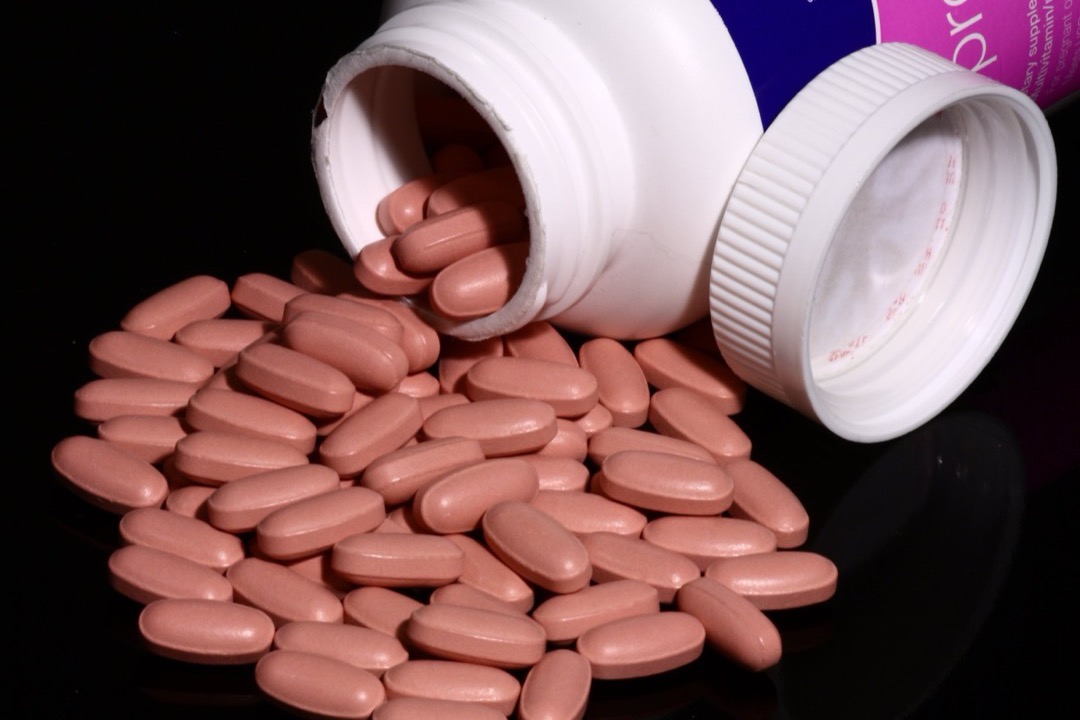
Prenatal vitamins occupy a unique place in preventive medicine — they are one of the few supplements with rigorous evidence for a specific clinical outcome (neural tube defect prevention), and one of the few that major medical bodies universally recommend for a specific population. The ACOG, CDC, and USPSTF all endorse daily folate supplementation for any woman of reproductive age who could become pregnant, ideally beginning one to three months before conception. What those recommendations do not tell you is which product to choose — and the prenatal vitamin category is crowded, heavily marketed, and full of meaningful formulation differences that matter clinically.
As a physician, I approach prenatal vitamin reviews differently than the average product roundup. The formulation details I focus on — folate form, iron chelation, DHA source, third-party testing — are the same variables I consider when advising patients. Roughly 40-50% of women carry MTHFR gene variants that reduce their ability to convert synthetic folic acid into the active methylated form. Iron requirements nearly double during pregnancy. Choline is underdosed in virtually every product on the market. Fish oil DHA triggers nausea in a meaningful subset of women. Each of these variables has implications for which prenatal you should actually take, and each gets lost in the generic “top 10 prenatals” content that dominates search results.
The seven prenatal vitamins reviewed here represent the strongest options across capsules, tablets, gummies, and whole-food formulas — spanning price points, tolerability profiles, and formulation philosophies. We analyzed each product against ACOG nutrient targets, evaluated third-party testing credentials, and cross-referenced real-world adherence feedback across more than 76,000 verified Amazon reviews. For women supplementing broader nutritional needs alongside pregnancy, our guides to iron supplements, calcium supplements, and B12 supplements cover adjacent deficiencies that frequently co-occur during the reproductive years.
| Product | Price | Buy |
|---|---|---|
| Ritual Essential Prenatal Multivitamin (60 Capsules)Best Overall | $42.98 | View on Amazon |
| Nature Made Prenatal Multi with Folic Acid (250 Tablets)Budget Pick | $26.99 | View on Amazon |
| Garden of Life Organics Prenatal Once Daily (30 Tablets)Premium Pick | $32.19 | View on Amazon |
| vitafusion PreNatal Gummy Vitamins with DHA & Folic AcidRunner-Up | $11.59 | View on Amazon |
| Thorne Basic Prenatal (90 Capsules)Runner-Up | $37.00 | View on Amazon |
| OLLY The Essential Prenatal Multivitamin GummyRunner-Up | $12.86 | View on Amazon |
| New Chapter Advanced Perfect Prenatal Multivitamin (192 Tablets)Runner-Up | $54.97 | View on Amazon |
Find the Right Prenatal for Your Situation
Jump straight to the pick that matches how you need to take it:
- Best prenatal vitamins overall — our seven picks reviewed
- Best for nausea and morning sickness
- Best vegan prenatal vitamins
- Best prenatal vitamins with DHA
- Best organic prenatal vitamins
- Best prenatal gummies (iron-free)
How We Chose These Prenatal Vitamins
Our selection process began with three non-negotiable criteria: verified Amazon listings with meaningful review volume (at minimum 5,000 reviews), transparent labeling of folate form, iron type, and DHA content, and at least one credible quality signal — whether USP or NSF verification, Non-GMO Project certification, GMP manufacturing, or HCP-channel clinical recognition. From a longer candidate list that included more than two dozen popular prenatals, we selected seven products spanning the clinical decision space: a premium capsule with methylated folate and algal DHA, a USP-verified once-daily tablet at budget pricing, a USDA-organic once-daily option, two iron-free gummies for severe morning sickness, a high-potency practitioner-grade capsule for MTHFR variants or confirmed iron deficiency, and a fermented whole-food formula with built-in anti-nausea botanicals. Every ASIN was verified in-stock at time of writing.
Best Prenatal Vitamins Overall
These are the seven prenatals that earned a place in this guide, each reviewed in full below. Ritual is my best overall pick for most women; the use-case sections after the reviews then match specific situations — morning sickness, vegan or organic requirements, DHA content, and gummy iron-free formats — to the right pick from this same lineup.
Ritual Essential Prenatal Multivitamin — Best Overall
Ritual Essential Prenatal earns the Best Overall designation because it gets the three most consequential formulation decisions right in a single product. The folate is methylated (1,000 mcg DFE of L-5-MTHF), meaning it works equally well for women with MTHFR gene variants and women without — no genotype gamble required. The iron is chelated bisglycinate at 18 mg, the gentlest tolerability profile available, which matters enormously in the first trimester when iron-triggered nausea is the single most common reason women stop taking their prenatal. And the DHA is sourced from microalgae at a clinically meaningful 350 mg dose, which meets the ACOG 200 mg recommendation with margin and avoids both the fishy aftertaste of marine oils and any heavy-metal exposure risk associated with fish-sourced omega-3s.
The delayed-release capsule design is not a marketing flourish. It is engineered to pass through the acidic environment of the stomach intact and dissolve in the small intestine, which materially reduces the nausea profile of the supplement. Combined with the proprietary citrus-scent tab tucked into each bottle, Ritual has clearly studied the tolerability problem more carefully than any other prenatal brand in the mass market. Ingredient traceability is also industry-leading — every nutrient is disclosed by country of origin, and the product carries NSF Non-GMO verification alongside third-party contaminant testing.
The honest limitations: Ritual delivers only 55 mg of choline, well below the 450 mg pregnancy target. That is not a flaw unique to Ritual — no prenatal on this list, or on the market, reaches the full choline target in a single daily dose, because choline requires too much physical bulk. Plan to cover choline through whole eggs (two eggs deliver roughly 300 mg) or a dedicated choline supplement. Ritual also omits calcium, which is appropriate for most women who get adequate dairy intake, but worth noting for those on dairy-free diets. For women who want to understand their full nutritional picture before conception, our guide to fiber supplements also covers complementary GI health during the pregnancy-planning phase, when iron-related constipation often emerges.

Ritual Essential Prenatal Multivitamin (60 Capsules)
by Ritual
The best all-around prenatal for most women in 2026 — methylated folate, chelated iron, vegan DHA, and a delayed-release capsule designed around morning-sickness tolerability, with transparency most competitors cannot match.
Pros
- Methylated folate (1,000 mcg DFE 5-MTHF) bypasses the MTHFR conversion step — the single most important formulation distinction in a prenatal
- Vegan DHA sourced from microalgae (350 mg) delivers the ACOG-recommended omega-3 without fish oil aftertaste or marine heavy-metal exposure
- Delayed-release capsule with citrus-scent tab is specifically engineered for nausea tolerance — the capsule opens in the small intestine, not the stomach
- Full ingredient traceability with country-of-origin disclosure and NSF Non-GMO verification — a transparency standard no major drugstore brand matches
Cons
- Choline is only 55 mg per dose — well below the 450 mg daily pregnancy target, so you will need eggs or a separate choline supplement
- No calcium included — most prenatals omit calcium to keep pill count down, but it is worth noting for women with low dairy intake
Nature Made Prenatal Multi with Folic Acid — Best Budget
Nature Made Prenatal is the only mass-market prenatal that holds USP Verification at a price point that genuinely supports long-term daily use. USP Verified is not a soft credential — it means the US Pharmacopeial Convention has independently tested finished-product batches to confirm that the dose on the label matches the dose in the tablet, that the tablet dissolves within specified windows, and that the product is free of harmful levels of heavy metals including lead, cadmium, mercury, and arsenic. For a product you will take every day for nine or more months, that level of independent verification is the single most meaningful quality signal available in the US supplement market.
The 250-tablet bottle, paired with a single once-daily dose, delivers over eight months of continuous supplementation at roughly eleven cents a day — the lowest per-day cost in our entire lineup by a substantial margin. The formulation itself covers the ACOG-recommended core nutrients: 800 mcg folic acid, 27 mg ferrous fumarate iron, calcium, iodine, and vitamin D3. The once-daily tablet format is also a genuine adherence advantage during first-trimester nausea, when multi-pill regimens become difficult to keep down.
The trade-offs are honest. The folate is synthetic folic acid rather than methylated 5-MTHF, which means roughly 40-50% of women with MTHFR variants will convert it less efficiently. And there is no DHA included, so a separate omega-3 is required to meet the 200 mg ACOG recommendation. For women without known MTHFR variants who simply want a well-verified, broadly recommended, genuinely affordable prenatal, this remains the strongest budget option available — and the pharmacist-recommended choice in the US pharmacy channel.

Nature Made Prenatal Multi with Folic Acid (250 Tablets)
by Nature Made
The best-value prenatal on the market — USP-verified, pharmacist-recommended, and genuinely affordable for eight months of daily supplementation if folic acid rather than methylfolate fits your needs.
Pros
- USP Verified for purity, potency, and label accuracy — the only mass-market prenatal at this price point with independent batch-level verification
- 250-tablet bottle provides over eight months of daily supplementation — the lowest per-day cost of any prenatal in our lineup at roughly eleven cents per day
- Single tablet once daily eliminates pill burden — a meaningful adherence advantage in the first trimester when nausea is worst
- Includes 27 mg iron, 800 mcg folic acid, calcium, iodine, and vitamin D3 — covers the core ACOG-recommended nutrients in a minimalist formula
Cons
- Folic acid is the synthetic, non-methylated form — women with MTHFR variants (roughly 40-50% of the population) convert it less efficiently
- Contains no DHA — you will need a separate omega-3 supplement to hit the 200 mg ACOG recommendation
Garden of Life Organics Prenatal Once Daily — Upgrade Pick
Garden of Life Organics Prenatal Once Daily is the only once-daily prenatal in our lineup that simultaneously carries USDA Certified Organic, Non-GMO Project Verified, and Certified Vegan designations. Each of those certifications is independently audited — USDA Organic by the National Organic Program, Non-GMO Project through their own verification process, and Certified Vegan by Vegan Action. Stacking all three on a once-daily prenatal tablet is genuinely difficult from a sourcing perspective, and Garden of Life is the rare brand that has built the supply chain to support it.
The folate here comes from organic lemon peel rather than an isolated synthetic ingredient, which is easier on the stomach for women who react badly to high-dose isolated nutrients. Note the distinction carefully: Garden of Life labels this as food-based folate, not as 5-MTHF. If you are choosing a prenatal specifically to bypass an MTHFR conversion step, a labelled methylfolate product is the safer pick. The iron is a whole-food form rather than ferrous sulfate, and review feedback consistently reports better GI tolerance than conventional prenatals, though Garden of Life publishes no head-to-head trial to that effect. Constipation is the single most common reason women switch prenatals mid-pregnancy, so a once-daily tablet that most women keep taking is worth something even on reviewer evidence alone.
Added vitamin B6 (25 mg) is the other notable formulation choice. B6 is a first-line anti-nausea intervention in obstetric practice — it is the active ingredient in the prescription pregnancy anti-nausea medication Diclegis at 10 mg per tablet. The 25 mg dose in this prenatal approaches therapeutic levels and provides meaningful symptom support for women in the first trimester. The limitation, as with several others in this review, is the absence of DHA — you will need a separate omega-3 supplement. Otherwise, for women who want USDA-organic, methylated, once-daily simplicity with genuine nausea support built in, this is the clear upgrade choice.

Garden of Life Organics Prenatal Once Daily (30 Tablets)
by Garden of Life
The best upgrade pick for women who want USDA-organic, methylated, once-daily simplicity — whole-food sourcing, gentler whole-food iron, and built-in B6 nausea support in a single vegan tablet.
Pros
- USDA Certified Organic, Non-GMO Project Verified, and Certified Vegan — the only once-daily prenatal in our lineup carrying all three certifications
- Food-based folate sourced from organic lemon peel — delivered in a food-matrix form that many women find gentler on the stomach than an isolated synthetic dose
- Whole-food iron at 18 mg in a single daily tablet — reviewers report better GI tolerance than standard ferrous forms, which is the #1 reason women switch prenatals mid-pregnancy
- Added vitamin B6 (25 mg) provides meaningful nausea support — B6 is a first-line anti-nausea intervention in obstetric practice
Cons
- Contains no DHA — a separate algal or fish-oil omega-3 supplement is required to meet omega-3 targets
- Earthy whole-food taste noted by a minority of reviewers — less neutral than a standard isolate-based prenatal
vitafusion PreNatal Gummy Vitamins with DHA & Folic Acid — Runner-Up
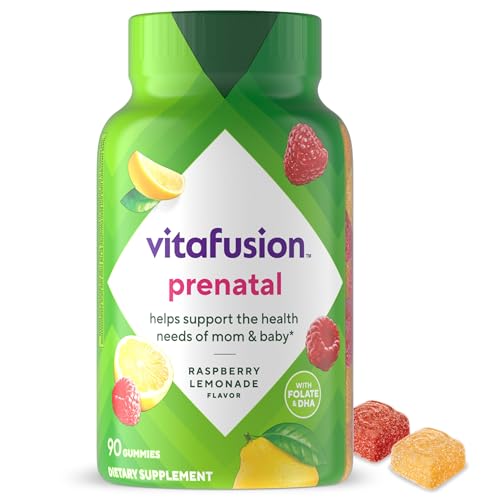
vitafusion PreNatal holds the position of most-reviewed prenatal gummy on Amazon at over 23,000 verified reviews, and the consistent theme across that feedback is palatability. For women experiencing hyperemesis gravidarum or severe first-trimester nausea, the raspberry-lemonade flavor is the most likely to stay down of any prenatal we evaluated. That matters clinically: a prenatal that is inconsistently tolerated produces inconsistent folate intake, which defeats the purpose of taking one in the first place. For women who genuinely cannot tolerate capsules or tablets, the gummy format is a real clinical option — not a compromise.
The formulation includes 50 mg of DHA from fish oil, which is modest relative to the 200 mg ACOG target but more than most gummy prenatals deliver. The folate dose is at the recommended 800 mcg of synthetic folic acid, vitamin D3 is included at 1,000 IU, and the product is FSA- and HSA-eligible — a practical advantage for women using pre-tax health accounts to offset pregnancy supplement costs. GreenCircle carbon certification is a sustainability credential not common in the drugstore supplement aisle.
The critical caveat — and this applies to every prenatal gummy on the US market — is that vitafusion contains zero iron. Iron cannot be formulated stably into a gummy matrix at therapeutic doses because it oxidizes, tastes metallic, and cannot reach the 18-27 mg range without making the gummy unpalatable. This is not a vitafusion issue; it is a gummy-format issue. If you choose this product, you must plan to supplement iron separately, particularly after the first trimester when iron requirements rise. Our iron supplements guide covers chelated low-dose options well-suited to this use case.
vitafusion PreNatal Gummy Vitamins with DHA & Folic Acid
by vitafusion
The best prenatal gummy for women who cannot tolerate capsules or tablets — palatable, DHA-inclusive, and widely reviewed, with the critical caveat that iron must be supplemented separately.
Pros
- Raspberry-lemonade flavor is the most palatable prenatal we evaluated — a serious adherence advantage for women with hyperemesis or severe first-trimester nausea
- Includes 50 mg DHA — modest, but more than most gummy prenatals deliver, and with no fishy aftertaste
- Most-reviewed prenatal gummy on Amazon at over 23,000 verified reviews — the most extensive real-world tolerability dataset in the category
- FSA and HSA eligible, GreenCircle carbon-certified — practical and sustainability-credentialed at an entry-level price
Cons
- Contains no iron — you must supplement iron separately, which is a critical omission most buyers do not realize until they read the label
- Gummies can arrive partially melted or clumped in warm-weather shipping — check reviews seasonally before ordering in summer
Thorne Basic Prenatal — Runner-Up (Clinical/High Iron)
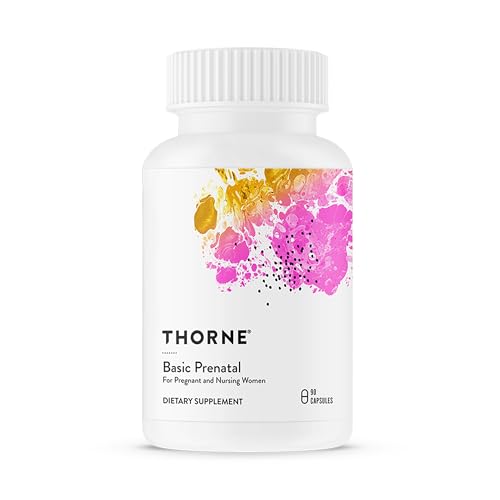
Thorne Basic Prenatal is the product I most often see prescribed by integrative and functional medicine OB-GYNs, and for good reason — it is the most clinically aggressive formulation in our lineup. The methylated folate is delivered at 1 mg (1,000 mcg) of 5-MTHF, which is the upper end of the range used for women with confirmed MTHFR C677T or A1298C variants, and it is paired with methylcobalamin (methylated B12) and the full methylated B-complex to support the entire one-carbon metabolism pathway rather than just the folate step.
The iron dose is 45 mg of Ferrochel iron bisglycinate — the highest iron content in our review and the most bioavailable chelated form available. For women entering pregnancy with pre-existing iron deficiency, for women with heavy menstrual history, or for women with documented low ferritin, this is the dose profile that standard prenatals cannot match without adding a separate iron pill. The chelated form maintains tolerability even at the higher dose, which is the specific clinical problem Thorne’s formulation solves.
Thorne was ranked the #1 HCP-recommended supplement brand in the 2023 Practitioner Preferences survey, and the brand’s reputation in clinical practice is well-earned. The honest complaint across 6,400+ reviews, though, is the smell — when you open a bottle of Thorne Basic Prenatal, the aroma is distinctly metallic, which some reviewers describe as blood-like. This does not reflect a formulation flaw; it reflects the sheer concentration of iron and methylated B-vitamins. Three capsules per day is also a significant pill burden, particularly during first-trimester nausea — most women split the dose morning and evening. And as with several other picks, there is no DHA included, so a separate omega-3 is required.
Thorne Basic Prenatal (90 Capsules)
by Thorne
The clinical workhorse prenatal — highest methylfolate dose, highest chelated iron, and the brand OB-GYNs reach for when a patient has MTHFR variants, confirmed iron deficiency, or needs a practitioner-grade formula.
Pros
- Highest-potency methylated folate (1 mg 5-MTHF) in our lineup — the top choice for women with confirmed MTHFR C677T or A1298C variants
- 45 mg Ferrochel iron bisglycinate is both the highest iron dose here and the gentlest chelated form — ideal for women with pre-existing iron deficiency
- #1 HCP-recommended supplement brand in 2023 — routinely prescribed by integrative and functional medicine OB-GYNs
- Methylated B12 (methylcobalamin) and full B-complex support — not just methylfolate, but the full methylation pathway
Cons
- Strong metallic or blood-like smell when the bottle is opened — the single most common complaint across more than 6,600 reviews
- Three capsules per day is a high pill burden, particularly during first-trimester nausea
- Contains no DHA — a separate omega-3 is required
OLLY The Essential Prenatal Multivitamin Gummy — Runner-Up (Morning Sickness)
OLLY The Essential Prenatal has become the most commonly recommended prenatal for severe morning sickness for two reasons that emerge consistently across its 13,000+ reviews: the sweet-citrus flavor stays down when almost nothing else will, and the texture is softer and easier on the stomach than competing gummies. Women describe it as the only prenatal they could reliably take during weeks 6-14, the peak window for first-trimester nausea and hyperemesis gravidarum. For the subset of patients experiencing genuine hyperemesis, this kind of tolerability is a clinical lifeline.
The formulation also includes 200 mg of DHA from fish oil — the full ACOG-recommended omega-3 dose — which is unusually high for a gummy prenatal. That alone makes OLLY functionally complete on omega-3s in a way vitafusion’s 50 mg dose is not. Folate is included at 600 mcg of synthetic folic acid, vitamin D3 at 1,000 IU, and the product is Non-GMO and gluten-free. OLLY carries more than 14,000 Amazon ratings — extraordinary real-world validation for a gummy prenatal.
The limitations are real and mirror the vitafusion caveat: there is no iron, and iron must be supplemented separately, particularly after the first trimester. Batch texture variation is a minor recurring complaint in recent reviews — some bottles arrive softer than others, a common issue across the gummy supplement category. For women whose primary prenatal challenge is keeping anything down at all, OLLY is the strongest option available — the nausea profile and palatability together make this the pragmatic choice for the first trimester, with a plan to reassess after symptoms improve.

OLLY The Essential Prenatal Multivitamin Gummy
by OLLY
The best prenatal for severe morning sickness — the most palatable citrus-flavored gummy in our lineup, uniquely gentle on the stomach, with the highest gummy-format DHA dose available.
Pros
- Sweet-citrus flavor is consistently rated as the easiest prenatal to keep down during hyperemesis — the single most common reason women switch to OLLY
- Confirmed gentle on stomach across thousands of severe-nausea reviews — uniquely relevant in the first trimester
- Includes 200 mg DHA — among the highest omega-3 doses in any prenatal gummy, and meets the ACOG recommendation on its own
- #4 bestselling prenatal on Amazon overall — extensive real-world feedback across a large and diverse user base
Cons
- Contains no iron — same iron caveat as vitafusion; a separate low-dose iron supplement is required
- Gummy texture and firmness vary batch-to-batch — a minor but consistent complaint in recent reviews
New Chapter Advanced Perfect Prenatal Multivitamin — Runner-Up (Whole Food)
New Chapter Advanced Perfect Prenatal takes a fundamentally different formulation approach than anything else on this list. The nutrients are fermented with probiotics and delivered in a whole-food matrix rather than as isolated synthetic ingredients, which changes both how they are absorbed and how well they are tolerated. Fermented iron in particular represents the gentlest delivery method we have seen in a prenatal — some women who cannot tolerate standard chelated bisglycinate report no issues with the fermented form, and the consistency of that feedback across 5,000+ reviews is striking.
The genuinely distinctive feature is the addition of organic ginger. Ginger is one of the few herbal anti-nausea interventions with randomized controlled trial evidence for pregnancy-related nausea — several studies have shown reductions in nausea severity at doses of 500-1,000 mg daily. New Chapter’s inclusion of fermented ginger within the prenatal itself is the only product in our lineup that builds this intervention into the daily formula. For women who experience first-trimester nausea but want to avoid separate anti-nausea products, this creates genuine clinical value.
The trade-offs to weigh: three tablets per day is a meaningful pill burden, on par with Thorne, and most women split the dose across morning and evening. There is no DHA, so a separate omega-3 remains required. And the premium price point reflects the fermented manufacturing process and organic sourcing. If morning sickness, GI sensitivity, and whole-food preference all matter to you, and budget is not the primary constraint, this is a genuinely differentiated product worth the premium. For complementary prenatal nutrition support, our collagen supplements guide covers skin and connective tissue support relevant during pregnancy weight and body composition changes.

New Chapter Advanced Perfect Prenatal Multivitamin (192 Tablets)
by New Chapter
The best whole-food prenatal for women with severe morning sickness or pre-existing GI sensitivity — fermented delivery, built-in ginger, and a formula designed to be tolerated on an empty stomach.
Pros
- Fermented whole-food formula with added organic ginger — the only prenatal in our lineup that builds in a clinically studied anti-nausea botanical
- Fermented iron delivery is the gentlest in the category — even more GI-friendly than standard chelated bisglycinate for women with severe iron intolerance
- Can be taken on an empty stomach without nausea — an unusual claim that reviewer feedback consistently supports
- 4.7-star rating across 5,000+ reviews with strongly positive sentiment on tolerability and digestive comfort
Cons
- Three tablets per day is a high pill burden, on par with Thorne — most women split the dose across morning and evening
- Contains no DHA — a separate algal or fish-oil omega-3 is required
- Premium price point — the highest bottle price in our seven picks, though the 192-tablet bottle lasts about two months
Best Prenatal Vitamins for Nausea and Morning Sickness
For the six-to-fourteen-week window when nausea peaks, the best prenatal is simply the one you can keep down — a complete formula you vomit back up delivers nothing. Three of our picks are engineered around this problem from different angles. The OLLY gummy is the most palatable in the lineup and the one women with hyperemesis most often say stays down; it also carries a full 200 mg of DHA, unusual for a gummy. The New Chapter tablets build in fermented organic ginger — the one anti-nausea botanical with real trial evidence — and are designed to be tolerated on an empty stomach. If you prefer a capsule, Ritual’s delayed-release design opens in the intestine rather than the stomach, sidestepping the most common nausea trigger. Remember that the two gummies contain no iron, so pair them with a separate low-dose iron supplement once you can tolerate it.
| Product | Price | Buy |
|---|---|---|
| OLLY The Essential Prenatal Multivitamin GummyBest gummy for nausea Most palatable in the lineup with a full 200 mg DHA — no iron, so supplement separately | $12.86 | View on Amazon |
| New Chapter Advanced Perfect Prenatal Multivitamin (192 Tablets)Best with built-in ginger Fermented whole-food formula with ginger, tolerated on an empty stomach | $54.97 | View on Amazon |
| Ritual Essential Prenatal Multivitamin (60 Capsules)Best capsule for nausea Delayed-release capsule dissolves in the intestine, not the stomach | $42.98 | View on Amazon |
Best Vegan Prenatal Vitamins
A vegan prenatal has to solve two problems most formulas quietly rely on animal sources for: DHA (usually fish oil) and vitamin D3 (usually lanolin from wool). Both of our vegan picks source DHA and D3 from plants. Ritual uses microalgae DHA at 350 mg — the only pick here with a meaningful vegan omega-3 dose built in — plus lichen-free D and methylated folate, and it is the stronger choice if you want DHA covered in one product. Garden of Life Organics is Certified Vegan alongside USDA Organic and Non-GMO, with food-based folate and lichen-sourced D3 in a once-daily tablet, though you will need a separate algal DHA. Vegans should also plan for B12 and choline, which plant diets run low on.
| Product | Price | Buy |
|---|---|---|
| Ritual Essential Prenatal Multivitamin (60 Capsules)Best vegan overall Microalgae DHA (350 mg) + methylfolate — the only vegan pick with omega-3 built in | $42.98 | View on Amazon |
| Garden of Life Organics Prenatal Once Daily (30 Tablets)Best vegan once-daily Certified Vegan + USDA Organic once-daily tablet; add a separate algal DHA | $32.19 | View on Amazon |
Best Prenatal Vitamins with DHA
ACOG recommends 200 mg of DHA daily for fetal brain and eye development, yet most prenatals include none — leaving you to add a separate fish-oil capsule. Two of our picks cover it in the prenatal itself. Ritual leads with 350 mg of vegan microalgae DHA, clearing the ACOG target with margin and no fishy aftertaste. The OLLY gummy delivers a full 200 mg from fish oil while staying palatable, which makes it the DHA-complete option for women who can’t swallow capsules. If your prenatal has no DHA (Nature Made, Garden of Life, Thorne, New Chapter all omit it), an algal or fish-oil omega-3 alongside it is the fix.
| Product | Price | Buy |
|---|---|---|
| Ritual Essential Prenatal Multivitamin (60 Capsules)Highest DHA (vegan) 350 mg microalgae DHA — highest in the lineup, clears ACOG with margin | $42.98 | View on Amazon |
| OLLY The Essential Prenatal Multivitamin GummyBest DHA gummy Full 200 mg fish-oil DHA in the most palatable gummy here (no iron) | $12.86 | View on Amazon |
Best Organic Prenatal Vitamins
Organic certification matters most in the prenatal category as a proxy for sourcing scrutiny — the same supply-chain discipline that earns USDA Organic also tends to keep heavy-metal contamination low, which independent testing has flagged in several conventional prenatals. Garden of Life Organics is the standout: USDA Certified Organic, Non-GMO Project Verified, and Certified Vegan in a single once-daily tablet with food-based folate sourced from organic lemon peel. New Chapter is built from certified-organic fermented whole foods with added organic ginger, in a gentler three-tablet dose for women who prioritize whole-food form and GI tolerability over pill count. Both omit DHA, so add an omega-3.
| Product | Price | Buy |
|---|---|---|
| Garden of Life Organics Prenatal Once Daily (30 Tablets)Best organic once-daily USDA Organic + Non-GMO + Vegan in one daily tablet with methylfolate | $32.19 | View on Amazon |
| New Chapter Advanced Perfect Prenatal Multivitamin (192 Tablets)Best organic whole-food Fermented organic whole-food formula with ginger for nausea support | $54.97 | View on Amazon |
Best Prenatal Gummies (Iron-Free)
Gummies win on one thing: you will actually take them. When capsules and tablets come back up, a raspberry or citrus gummy is the format that keeps folate and DHA going in. The tradeoff is structural and applies to every prenatal gummy on the market — iron cannot be stably formulated into a gummy at pregnancy doses, so both of our gummy picks contain zero iron. That is fine if your ferritin is adequate or you add a separate iron supplement, which most women will need after the first trimester. Between them, OLLY carries far more DHA (200 mg vs 50 mg) and is the softer, more nausea-friendly texture; vitafusion is the lowest-cost, most-reviewed option. Confirm your iron status with your OB before relying on either alone.
| Product | Price | Buy |
|---|---|---|
| OLLY The Essential Prenatal Multivitamin GummyBest gummy overall 200 mg DHA and the most nausea-friendly texture — add iron separately | $12.86 | View on Amazon |
| vitafusion PreNatal Gummy Vitamins with DHA & Folic AcidBest value gummy Most-reviewed prenatal gummy at the lowest cost — add iron separately | $11.59 | View on Amazon |
Buyer's Guide
Choosing a prenatal vitamin is not a brand-preference decision — it is a formulation decision. The folate form, iron type, DHA content, and third-party testing profile all vary significantly across products, and each variable has a clinical rationale worth understanding before you spend nine months taking the same pill every day.
Folate Form (Folic Acid vs. Methylfolate / 5-MTHF)
Folate prevents neural tube defects — that much is settled. What is less widely discussed is that synthetic folic acid requires enzymatic conversion to the active form, 5-methyltetrahydrofolate, and roughly 40-50% of women carry MTHFR gene variants that reduce this conversion efficiency by 30-70%. Methylated folate (look for L-5-MTHF, Metafolin, or Quatrefolic on the label) bypasses this conversion entirely and is the form naturally present in leafy greens. For women with known MTHFR variants, recurrent pregnancy loss, elevated homocysteine, or a prior NTD pregnancy, methylfolate is clinically preferable. For women without these risk factors, folic acid remains evidence-based and effective at the RDA dose of 400-800 mcg. When in doubt, methylfolate is the universally compatible choice.
Iron Form and Dose
Iron requirements rise from 18 mg to 27 mg daily during pregnancy, and iron deficiency anemia is associated with preterm delivery and low birth weight. The form of iron matters as much as the dose. Ferrous sulfate delivers the most elemental iron per milligram but causes constipation, nausea, or stomach upset in 20-40% of pregnant women. Iron bisglycinate (sometimes labeled Ferrochel) is a chelated form that binds iron to the amino acid glycine, dramatically improving tolerability through a different absorption pathway. For women with confirmed iron deficiency, the higher-dose Thorne formula (45 mg bisglycinate) or a separate iron supplement is appropriate. For maintenance during a healthy pregnancy, 18-27 mg of chelated iron is sufficient. Iron-free prenatals are a real option for women with adequate iron status — but require separate iron supplementation or documented lab confirmation.
DHA / Omega-3 Inclusion
ACOG recommends 200 mg of DHA daily during pregnancy to support fetal brain and retinal development, and some OBs recommend up to 800 mg based on recent evidence suggesting higher doses may reduce preterm birth risk. Most prenatals include 0 to 350 mg of DHA. Fish-oil DHA is the most common source, but fishy aftertaste is a meaningful nausea trigger for many women. Algal DHA (from microalgae) is functionally equivalent, vegan, and avoids marine heavy-metal exposure — Ritual uses this form. If your prenatal does not include DHA (Nature Made, Garden of Life, Thorne, New Chapter), you will need a separate omega-3 supplement to meet ACOG recommendations.
Choline Content
Choline is the most underdosed nutrient in the prenatal category. The pregnancy target is 450 mg daily, and choline has been linked to fetal brain development and long-term cognitive outcomes in multiple prospective studies. Only about 8% of pregnant women meet the target through diet alone — eggs are the richest dietary source. Most prenatals supply less than 100 mg of choline, well under 25% of the target. This is a structural limitation: at doses meaningful enough to matter, choline adds significant bulk to a capsule or tablet. Plan to cover choline through diet (two whole eggs provide roughly 300 mg) or a dedicated choline supplement, particularly if you follow a vegetarian or vegan diet. No prenatal in this lineup — including Ritual's industry-leading 55 mg — reaches the full target on its own.
Third-Party Testing (USP, NSF, Non-GMO Project)
The supplement industry in the United States operates under limited FDA oversight — products are not required to prove safety or efficacy before reaching market. For a product you will take daily for 9 to 18 months (through pregnancy and breastfeeding), third-party verification matters more than any marketing claim. USP Verified (Nature Made) means an independent laboratory has confirmed label accuracy, dissolution, and absence of harmful contaminants including heavy metals. NSF and NSF Certified for Sport add further screening. Non-GMO Project Verified confirms ingredient sourcing. For prenatal vitamins specifically, heavy metal contamination — particularly lead, cadmium, and arsenic — has been identified in independent testing of several brands. Prioritize third-party verification, not marketing language.
Format and Pill Burden (Capsule, Tablet, Gummy; 1/day vs. 3/day)
Pill burden matters more during the first trimester than at any other point in life. Morning sickness can make even a single tablet intolerable, and a three-capsule daily regimen (Thorne, New Chapter) may be impossible to keep down during hyperemesis. Once-daily tablets (Nature Made, Garden of Life) minimize exposure; delayed-release capsules (Ritual) dissolve in the intestine rather than the stomach to reduce nausea; gummies (vitafusion, OLLY) eliminate pill swallowing entirely but drop iron. Match your format to your worst-case tolerability scenario rather than your best day — consistent adherence at a smaller dose will beat sporadic adherence at a complete dose every time.
How to Choose the Best Prenatal Vitamin
The right prenatal depends on three personal variables more than any brand’s marketing: your folate-conversion genotype (methylated vs. folic acid), your iron tolerability (chelated vs. standard vs. iron-free), and your nausea severity (capsule vs. tablet vs. gummy). Match your selection to those variables first.
If you have a confirmed MTHFR variant, a history of recurrent pregnancy loss, or a prior neural tube defect pregnancy: Choose a prenatal that names methylfolate (5-MTHF) on the label. Ritual, Thorne, and New Chapter all qualify. Thorne delivers the highest methylfolate dose for the strongest clinical case. Garden of Life’s food-based folate is not labelled as 5-MTHF, so it is not the pick for this scenario.
If iron-triggered constipation or nausea has caused you to stop prenatals previously: Prioritize chelated iron (Ritual, Thorne), fermented iron (New Chapter), or whole-food iron (Garden of Life) rather than standard ferrous forms. The chelated bisglycinate structure and the fermented whole-food form both bypass the gut-irritation mechanism that drives ferrous-sulfate side effects.
If you are experiencing severe morning sickness or hyperemesis: Choose a gummy format (OLLY, vitafusion) for maximum palatability, or the delayed-release Ritual capsule for intestinal-release nausea avoidance. Plan iron supplementation separately if you choose a gummy.
If budget and USP verification are your priorities: Nature Made is the clear answer — the only USP-verified prenatal on this list, at the lowest per-day cost.
A universal note: no prenatal in this review — or on the market — provides the full 450 mg choline target in a single daily dose. Plan to cover choline through diet (two whole eggs deliver roughly 300 mg) or a separate choline supplement, particularly if you follow a vegetarian or vegan diet. Consult your OB-GYN before changing prenatals mid-pregnancy, and always confirm iron dosing against your actual ferritin and hemoglobin levels rather than general recommendations.
Final Verdict
For most women planning or early in pregnancy, Ritual Essential Prenatal is our strongest single recommendation. It delivers methylated folate, chelated iron, and vegan algal DHA in a single delayed-release capsule engineered around nausea tolerability, with ingredient traceability and third-party testing standards that no mass-market competitor matches. It is the prenatal that gets the most consequential formulation decisions right simultaneously, and it is the product I would hand a patient who walks in planning to conceive in the next year.
For budget-conscious women, Nature Made Prenatal provides USP-verified, once-daily, pharmacist-recommended coverage at roughly eleven cents a day — a level of independent quality verification at a price point the premium brands cannot match. For women with confirmed MTHFR variants, pre-existing iron deficiency, or a desire for practitioner-grade formulation, Thorne Basic Prenatal remains the clinical workhorse. For severe first-trimester morning sickness, the OLLY and vitafusion gummies offer genuine adherence advantages — with the non-negotiable caveat that iron must be supplemented separately.
Whichever product you choose, the single most important variable is consistency. Daily adherence from preconception through breastfeeding drives outcomes — the difference between the #1 and #7 product in this review is meaningful but small compared to the difference between any of them and sporadic supplementation. Pair your prenatal with adequate dietary protein, whole eggs for choline, leafy greens for natural folate, and our electrolyte powders guide for first-trimester hydration support. As always, discuss prenatal selection with your OB-GYN — particularly if you have pre-existing conditions, medications, or a history of pregnancy complications that warrant individualized dosing.
Frequently Asked Questions
When should I start taking a prenatal vitamin?
Folic acid vs. methylfolate — which do I need?
Is it safe to take a prenatal vitamin without iron?
Do prenatal gummies have everything I need?
Do prenatal vitamins help hair growth?
Should I keep taking a prenatal while breastfeeding?
Related Articles
About the Reviewer

Dr. David Taylor, MD, PhD
Drexel University College of Medicine (MD), Indiana University School of Medicine (PhD)
Dr. David Taylor is a licensed physician and medical researcher who founded BestRatedDocs in 2016. With an MD from Drexel University and a PhD from Indiana University School of Medicine, he combines clinical expertise with a passion for health technology to provide evidence-based product recommendations. Dr. Taylor specializes in health informatics and regularly evaluates medical devices, diagnostic equipment, and therapeutic products to help healthcare professionals and patients make informed decisions.