Rollator vs Walker: An MD's Guide to Choosing the Right Mobility Aid
Dr. David Taylor compares rollators and walkers — clinical differences, who should use each, Medicare coverage, proper fitting, and when to transition between them.
Updated
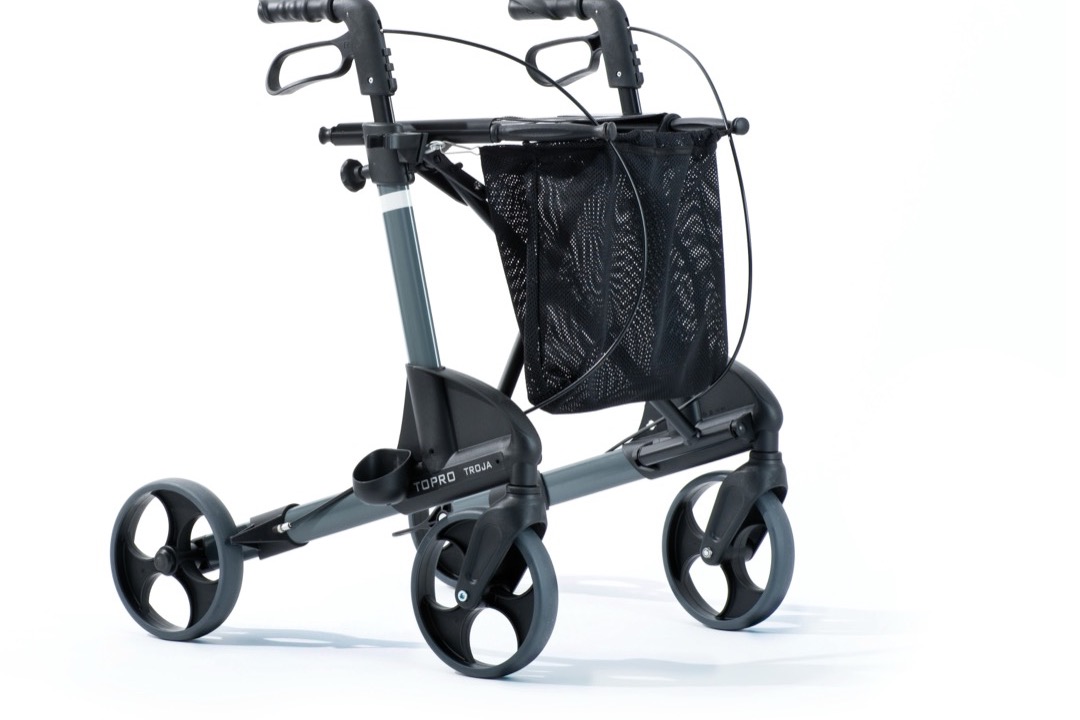
As a physician, the question I hear most often from patients preparing for discharge or managing a new mobility limitation is a simple one: “Do I need a walker or a rollator?” It sounds like a straightforward product question, but the answer has real clinical implications for fall risk, cardiovascular strain, surgical recovery, and long-term functional independence. Choosing the wrong device — or having a patient switch too soon — can directly contribute to falls, delayed recovery, and avoidable hospitalizations.
In 2026, the U.S. market offers more mobility aid options than ever, from basic aluminum walkers to sophisticated upright rollators with ergonomic forearm supports. The proliferation of choices has, if anything, made the decision more confusing for patients and caregivers alike. This guide applies the same clinical framework I use in my practice to help you understand what each device does, who it is designed for, and how to make the right choice for your specific situation — or that of a family member you are helping.
Before diving into the comparison, one framing point: if you are managing a condition that limits your knee function post-surgery, it is worth reading our guide to best knee braces alongside this one, since orthopedic support and mobility aid selection often go hand-in-hand in recovery planning.
The Core Difference at a Glance
The table below summarizes the key clinical and practical distinctions before we examine each category in depth.
| Feature | Standard Walker | Rollator |
|---|---|---|
| Wheels | None (rubber tips) or 2 front wheels | 3 or 4 wheels |
| Advancement | Lifted and placed forward each step | Rolls continuously with user |
| Brakes | None | Hand-operated squeeze brakes |
| Built-in seat | No | Yes (most models) |
| Weight-bearing support | Full — can offload limb completely | Partial — requires some lower-limb stability |
| Gait pattern supported | Slow, deliberate, step-to or step-through | More natural, continuous walking cadence |
| Upper-body demand | Higher — lift + support body weight | Lower — push forward, no lifting |
| Cardiovascular demand | Higher (slower pace, more exertion per step) | Lower (efficient gait, rest seat available) |
| Terrain suitability | Indoor and smooth outdoor | Indoor and outdoor (wheel-size dependent) |
| Cognitive requirement | Minimal — lift and step | Moderate — must remember to brake before sitting |
| Medicare classification | DME E0130 (standard) / E0141 (wheeled) | DME E0143–E0149 |
| Typical weight capacity | 250–350 lbs (standard) | 250–400 lbs (bariatric available) |
| Typical cost | Lower | Higher |
What Is a Walker?
A walker is a four-legged metal frame — almost always lightweight aluminum — that the user holds with both hands and advances with each step. Unlike a rollator, a standard walker has no wheels; its rubber-tipped feet sit flush on the floor, providing a completely stationary platform for each supported step. This design makes the walker the most stable of all walking aids, capable of supporting substantial body weight through the arms with each forward advance.
Standard Walker
The classic standard walker — also called a pickup walker or basic walker — requires the user to lift the entire frame off the ground and place it approximately one stride’s length ahead, then step into it. This creates a distinctive three-beat gait: lift the walker, step with the affected or weaker leg, step with the stronger leg. For patients on non-weight-bearing or partial-weight-bearing restrictions following surgery, or for those with profound lower-extremity weakness, this device provides the greatest stability of any ambulatory aid short of immobility. The primary limitation is pace and energy expenditure: lifting and placing the walker with each step is physically demanding and creates a much slower, more fatiguing gait than continuous walking.
Front-Wheeled Walker
The front-wheeled walker (also called a two-wheeled walker or rolling walker) adds wheels to the two front legs while maintaining stationary rubber tips on the rear legs. This modification allows the user to push the walker forward rather than lifting it completely, which reduces upper-body exertion and allows a slightly more natural gait. The rear rubber tips still drag slightly, providing resistance that prevents the walker from rolling away. Front-wheeled walkers are the most commonly prescribed transitional device — they offer most of the stability of a standard walker with meaningfully reduced energy demand. They are particularly well-suited to patients with moderate weakness or balance impairment who find the full-lift of a standard walker too exhausting.
Hemi Walker
The hemi walker, sometimes called a side walker or quad cane substitute, is designed for one-handed use by patients who have significant weakness or paralysis on one side of the body — most commonly following a stroke. It is wider than a cane but narrower than a standard two-handed walker, providing a broader base of support that a single cane cannot offer. Hemi walkers are a specialized device outside the rollator-vs-walker decision for most patients, but important to know if unilateral weakness is part of the clinical picture.
What Is a Rollator?
A rollator is a wheeled walking frame that rolls continuously as the user walks, rather than being lifted and placed. All rollators have hand-operated brakes — squeeze levers on the handles that engage friction pads or a parking lock against the wheels — and virtually all include a padded seat and a basket or pouch for carrying items. Because rollators roll rather than lift, they require some degree of active balance control from the user; the device does not provide the same passive stability as a stationary walker.
Four-Wheel Rollator
The standard four-wheel rollator is the most widely prescribed rollator configuration. Four wheels provide better lateral stability than three-wheel models and the flat surface allows the device to roll in a straight line with minimal steering effort. Most four-wheel rollators fold compactly for car transport and storage. Wheel diameter varies from 5 to 8 inches on standard models, with larger wheels providing better outdoor performance. Weight capacity ranges from 250 to 400 pounds depending on the frame, and weight of the device itself is typically 13 to 18 pounds. For patients with COPD, heart failure, or other conditions limiting walking endurance, the built-in seat allows rest at any moment without searching for a chair — a feature that extends functional community mobility meaningfully.
Three-Wheel Rollator
Three-wheel rollators (sometimes called tri-walkers) have a single front wheel on a swivel and two rear wheels, creating a triangular footprint that is narrower and more maneuverable than four-wheel models. This makes them better suited to tight spaces — small kitchens, narrow hallways, public bathrooms. The trade-off is reduced lateral stability: the triangular base is more prone to tipping sideways than a four-point base, and most three-wheel models do not include a built-in seat. Three-wheel rollators are best for users who have good balance and primarily need walking support for endurance or mild instability, not for users who rely heavily on the seat feature.
Upright (Forearm) Rollator
Upright rollators, also called forearm rollators or Parkinson’s walkers, are designed for patients who cannot safely lean forward onto a standard rollator handle due to posture issues, severe arthritis in the wrists and hands, or neurological conditions that benefit from a more upright gait posture. Instead of downward-facing grip handles, these devices have forearm platforms and vertical grip bars that allow the user to bear weight through the forearms rather than the palms. Clinical evidence specifically supports upright rollators for Parkinson’s disease, where the more erect posture they enforce has been shown to reduce festination and improve gait velocity. They are bulkier and heavier than standard rollators but meaningfully superior for the right patient.
Bariatric Rollator
Bariatric rollators share the same basic design as standard four-wheel rollators but are engineered with reinforced frames, wider seats, and weight capacities of 400 to 700 pounds. The seat and frame width are increased proportionally, and the hardware — axles, wheels, brake levers — is heavy-duty rated. Standard rollators with 250-pound capacity ratings are contraindicated for bariatric patients; using an undersized device poses collapse and fall risks. For bariatric patients who need power-assisted mobility rather than a rollator, our guide to best electric wheelchairs covers powered options appropriate for higher weight classes.
Key Clinical Differences
Understanding the mechanistic differences between walkers and rollators helps clarify which is appropriate for a given patient — and prevents the common mistake of choosing based on aesthetics or convenience rather than clinical fit.
Weight-bearing and offloading. Walkers can accept substantial downward body weight through the handles because the legs are rigid and stationary. This is why walkers are prescribed for non-weight-bearing and partial-weight-bearing restrictions: the patient can physically push down and forward, offloading force from the surgical or injured limb with each step. Rollators cannot safely serve this function — pushing down on a rollator handle while the wheels are unlocked will cause it to roll forward, potentially causing a fall. If your surgeon or physical therapist has prescribed “non-weight-bearing” or “partial weight-bearing” status on a limb, a standard walker (or crutches for single-limb restrictions) is the appropriate device.
Braking mechanism and cognitive demand. The most underappreciated clinical difference between walkers and rollators is the cognitive load of the rollator’s brake system. Before sitting on a rollator, the user must squeeze and hold the hand brakes to engage the parking lock, or the device will roll out from under them as they begin to sit. This two-step process — squeeze brakes, verify lock, then sit — requires consistent procedural memory. For cognitively intact patients, this becomes automatic within days. For patients with dementia, delirium, or significant cognitive impairment, the failure to brake before sitting is a major fall mechanism and a clinical contraindication to rollator use.
Gait biomechanics. Standard walkers impose a non-continuous, interrupted gait pattern — the user stops forward momentum to advance the device, then resumes. Rollators allow continuous gait more closely resembling natural walking, which has been shown to produce better step length, cadence, and walking speed. A 2019 systematic review in Disability and Rehabilitation found that rollator users demonstrated significantly higher gait velocity and step length compared to standard walker users across multiple population groups. The continuous gait pattern also reduces cardiovascular demand per distance traveled.
Endurance and rest capability. The rollator’s built-in seat is not merely a convenience — it is a clinically significant feature for patients with conditions that limit walking endurance. COPD patients, heart failure patients, and elderly patients with sarcopenia often cannot walk from one end of a grocery store to the other without rest. The rollator allows them to stop and sit at any moment, then resume. Without this feature, reaching fatigue before reaching a destination is a fall risk in itself, as tired patients begin to rely more heavily on the device for balance support.
Stability on grades and curbs. Standard walkers are more stable than rollators on inclines and curbs because they cannot roll unexpectedly. Rollators require the user to engage the brakes when navigating a slope to prevent uncontrolled rolling. On descending grades in particular, rollators demand active brake engagement — a skill that must be practiced and that can be lost during illness, medication changes, or fatigue.
Who Should Use a Walker?
Standard walkers — with or without front wheels — are clinically indicated for several specific situations where their superior stability justifies the increased energy demand and interrupted gait pattern.
Post-surgical recovery with weight-bearing restrictions. Following total hip replacement, total knee replacement, or fracture repair, surgeons typically prescribe specific weight-bearing status for the operated limb. Non-weight-bearing (NWB) and partial weight-bearing (PWB) restrictions require a device that can accept upper-extremity load transfer — a function only walkers and crutches can reliably provide. Once the surgeon advances the patient to full weight-bearing (FWB) status, transition to a rollator may be appropriate. For knee surgery patients, the walker phase often coincides with knee brace use — our best knee braces guide covers the orthopedic support options that complement walking aid use during recovery.
Significant balance impairment. Patients with severe proprioceptive loss (from diabetic neuropathy, for example), vestibular disorders, or cerebellar ataxia require the maximum stability of a stationary walker. The rollator’s continuous wheel movement can amplify balance errors rather than dampen them for these patients. A physical therapist can perform formal balance assessments — including Timed Up and Go (TUG) and Berg Balance Scale — to quantify fall risk and guide the device decision.
Cognitive concerns. Any patient with moderate to severe dementia, delirium, or significant cognitive impairment that affects procedural memory should use a standard walker rather than a rollator. The non-cognitive demand of the standard walker — lift, step, lift, step — is forgiving of momentary inattention. The rollator’s brake-before-sitting requirement is not.
Early rehabilitation. In the immediate post-acute phase after hospitalization, injury, or surgery, patients are often deconditioned, cognitively affected by medication or illness, and physically weaker than their baseline. A walker provides the safest starting point for this phase, with transition to a rollator considered as strength and balance improve and the clinical picture stabilizes.
Who Should Use a Rollator?
Rollators are best matched to patients who have adequate lower-limb stability and balance but face specific limitations that the rollator’s design addresses.
Endurance-limited patients. COPD, congestive heart failure, and advanced cancer are the classic diagnoses where rollator prescription dramatically improves functional community mobility. The ability to sit and rest before reaching physiological exhaustion extends the range these patients can manage independently. Studies in COPD populations consistently show that rollator users walk farther in six-minute walk tests than standard walker users, and report lower dyspnea scores during ambulation.
Parkinson’s disease. As discussed above, the rollator’s continuous forward momentum actively counters the festinating, shuffling gait of Parkinson’s disease. The regular, rhythmic push of the rollator provides an external cue that helps Parkinson’s patients maintain more consistent stride length and cadence. For patients with significant postural flexion (stooping), an upright rollator is preferable to the forward-leaning posture a standard rollator encourages.
Active community-dwelling seniors. Older adults who are ambulatory and independent but use a walking aid primarily for confidence and mild stability benefit receive much greater functional value from a rollator than a walker. The rollator allows them to shop, attend community events, and navigate larger spaces without the slow, interrupted gait of a walker. The built-in seat and basket add practical utility that supports ongoing activity and independence.
Mild to moderate balance impairment with good cognition. Patients who have passed formal balance assessments (TUG under 20 seconds is a common benchmark) and demonstrate adequate hand strength to operate brakes reliably are good rollator candidates even if their balance is not perfect. The key is that their impairment is at a level where the rollator’s continuous gait advantage outweighs its reduced stability compared to a stationary walker.
Indoor vs Outdoor Use — Wheel Size Guide
Wheel diameter is the single most important specification for matching a rollator to its primary use environment. Getting this right prevents a frustrating mismatch between the device and the spaces the patient actually navigates.
5-inch wheels are found on the most compact and lightweight rollators. They roll smoothly on hardwood, tile, and low-pile carpet. They struggle with medium-pile carpet, door thresholds greater than half an inch, and any outdoor surface with texture. These are purely indoor devices.
6-inch wheels are the most common standard. They handle smooth indoor surfaces well and manage smooth outdoor pavement acceptably. They can navigate most sidewalk surfaces in good condition. Gravel, grass, brick pavers, and cracked pavement present challenges. The majority of rollators sold for general use have 6-inch wheels.
8-inch wheels represent a significant step up in outdoor capability. An 8-inch wheel can roll over a half-inch obstacle or crack without catching, handles uneven pavement reliably, and manages light gravel or compacted surfaces. The trade-off is increased device weight and slightly less maneuverability in tight indoor spaces.
10-inch and larger pneumatic wheels are found on all-terrain and heavy-duty rollators. These handle grass, packed trails, and rough outdoor surfaces well. They are substantially heavier and bulkier and are primarily for users who prioritize outdoor mobility over indoor compactness. For longer community outings that exceed walking capacity regardless of device, pairing the rollator with a lightweight wheelchair provides a practical extended-range solution.
If the patient splits use equally between indoor and outdoor environments, 6-inch wheels with careful outdoor navigation is the practical compromise. If outdoor use is a primary goal, 8-inch wheels are worth the added bulk.
Medicare and Insurance Coverage
Both walkers and rollators qualify for coverage under Medicare Part B as Durable Medical Equipment (DME) when specific criteria are met. Understanding these requirements upfront prevents the common problem of purchasing a device and then being denied coverage on a reimbursement claim.
Medicare Part B DME criteria for walkers and rollators:
- The equipment must be prescribed by a Medicare-enrolled physician or other eligible provider.
- The prescription must document medical necessity — specifically, why the patient requires the device for use in the home.
- The patient must obtain the device from a Medicare-enrolled DME supplier. Purchasing from a non-enrolled retailer or directly online without going through the DME supplier network forfeits coverage entirely.
- For a rollator specifically, the documentation must explain why a standard walker is insufficient — why the patient requires wheels, brakes, and a seat. This is called the “least costly alternative” principle: Medicare covers the least expensive device that meets the medical need, so prescribing a rollator requires clinical justification over a simpler walker.
When all criteria are met, Part B pays 80 percent of the Medicare-approved amount after the annual Part B deductible is met. The patient pays the remaining 20 percent, which a Medigap supplemental policy (Plans C, F, G, and N) typically covers.
Prior Authorization: As of 2024, certain high-cost DME items require prior authorization before Medicare will approve coverage. Standard walkers and basic rollators are typically exempt from this requirement, but confirm with the prescribing provider’s office and the DME supplier for the specific configuration you are considering.
HSA/FSA Eligibility
Walkers and rollators are straightforwardly eligible expenses under Health Savings Accounts (HSA) and Flexible Spending Accounts (FSA) under IRS guidelines. No special prescription or letter of medical necessity is required to use HSA or FSA funds for a walker or rollator from any supplier — these accounts recognize them as medical devices by category.
This makes HSA/FSA purchase a practical option for patients who do not meet Medicare’s “primarily for use in the home” criterion (for example, someone who wants a rollator for outdoor community use only and already has a walker for home use), or for patients who want to purchase from a specific retailer or brand not available through the Medicare DME supplier network.
For patients paying out of pocket, the price differential between walkers and rollators is meaningful: standard walkers range from approximately two to four times less expensive than comparable rollators. HSA/FSA funds reduce the effective cost of either device by eliminating income tax on those dollars, which represents a 22 to 37 percent savings depending on the patient’s marginal tax rate.
How to Fit Your Walker or Rollator Correctly
Proper fitting is non-negotiable for safety. An incorrectly fitted walking aid — even the correct type for the clinical situation — significantly increases fall risk and can cause musculoskeletal problems over time.
The wrist-height rule. Stand upright in your normal walking shoes with your arms relaxed at your sides. The handle height of the walker or rollator should be level with the crease of your wrist — the fold at the base of your palm. When you grip the handles with the device positioned for use, your elbows should be bent at approximately 15 to 20 degrees. This slight flexion is the target.
Why the angle matters. Handles set too low force a forward stoop that shifts your center of gravity anterior to your base of support — a classic fall posture. Handles set too high prevent effective arm extension for propulsion and can cause shoulder impingement with prolonged use. Handles at the right height allow efficient, upright walking with natural arm mechanics.
Practical adjustment steps. Most walkers and rollators offer push-button or pin-style height adjustment on each leg post or handle tube. Adjust both sides to the same setting and verify by pressing both handles down firmly to confirm the pins are fully seated. After adjustment, walk a short distance and assess: are you stooped? Are your shoulders shrugging? Does it feel effortful to push the device forward? These are signs of incorrect height.
Weight distribution check. When using a walker, your weight through the handles should feel like you are pressing down and slightly forward, not leaning your chest against the crossbar. If you find yourself leaning into the walker rather than holding it, the device may be too short, you may be using it incorrectly, or the device type may not match your clinical need.
For patients with arthritis, joint replacement, or upper-extremity weakness, a certified DME fitter can also evaluate handle ergonomics — padded handles, angled grips, and forearm supports are available as modifications to standard frames.
When to Transition from One to the Other
The transition between walker and rollator — or in either direction — should be a deliberate clinical decision, not a casual upgrade based on a family member’s suggestion or online product review.
Walker to rollator transition. This transition is appropriate when the patient’s weight-bearing restriction has been lifted by the surgeon, balance assessments show improvement (TUG under 20 seconds is a common physical therapist threshold), and the patient has the cognitive capacity to manage the brakes reliably. A physical therapist should supervise the first several sessions with the rollator to confirm safe brake use and observe gait. The patient should practice engaging the parking brake and sitting before using the device on any incline or in a busy public space.
Rollator to walker transition (or beyond). If a rollator user experiences a fall associated with the device, develops a new medical condition affecting cognitive function or balance, or undergoes surgery requiring weight-bearing restrictions, transitioning back to a walker is appropriate and should not be viewed as a setback. It reflects accurate matching of the device to the patient’s current clinical state.
Escalation beyond walking aids. When even a rollator no longer provides adequate support for safe ambulation — whether due to progressive neurological disease, advanced frailty, or severe cardiopulmonary limitation — the appropriate next step is a wheelchair rather than continued reliance on an increasingly inadequate walking aid. Our guide to best wheelchairs covers manual chair options for patients whose walking capacity is becoming unsafe or non-functional, while best electric wheelchairs addresses powered options for patients with limited upper-body strength who cannot self-propel.
Safety Warnings and Red Flags
Several safety issues are specific to walking aids and warrant explicit attention.
Rollators on stairs. Rollators are contraindicated on stairs. There is no exception to this rule. Even with the brakes fully engaged, the risk of the device tipping or rolling during stair negotiation is unacceptably high. Patients who live in multi-story homes must have a separate strategy for stair navigation — a stair rail, a stair lift, or supervised assistance.
Car transfers. Getting in and out of a car with a rollator requires specific technique. The rollator brakes must be locked, the rollator positioned to the side (not directly in the door opening), and the patient should sit down onto the car seat first, then swing legs in — not step into the car while supporting on the rollator. Rollators do not fold quickly enough to use as a pivot point during a car transfer. Caregivers and family members should understand this sequence.
Brake maintenance. Rollator brakes require periodic inspection. The cable connecting the brake lever to the wheel can stretch over time, reducing braking effectiveness. Test the brakes monthly by engaging the parking lock and attempting to push the device — it should not roll. If the brakes feel soft or the device moves when locked, the cable tension should be adjusted (usually a simple screw adjustment at the cable housing) or the unit serviced.
Cognitive and dementia considerations. As emphasized throughout this guide, cognitive impairment is the most important contraindication to rollator use. Caregivers managing a patient with dementia should observe actual brake use — not just ask the patient whether they know to use the brakes. A patient can correctly answer “squeeze the handles before sitting” and still routinely fail to do so in practice. If you observe brake failures during supervised use, transition to a standard walker regardless of the patient’s expressed preference.
Tip-over risk on slopes. Any walking aid — walker or rollator — is more likely to contribute to a fall on sloped surfaces than on level ground. Rollators on descending slopes require active, sustained brake engagement throughout the descent. Patients should take slopes very slowly, maintain the device slightly uphill of their body position, and never attempt a steep grade alone until they have practiced the technique under supervision.
The right mobility aid, properly fitted and matched to a patient’s specific clinical profile, is one of the highest-impact interventions available for maintaining functional independence and reducing fall risk in patients with mobility limitations. Neither a walker nor a rollator is inherently superior — the correct choice is the one that matches your balance, strength, weight-bearing status, cognitive function, and activity goals at this moment in time. That assessment is always worth a conversation with your physician or physical therapist before purchasing, and Medicare will often cover that evaluation as part of a covered rehabilitation benefit.
Frequently Asked Questions
What is the main difference between a walker and a rollator?
Which is safer for seniors — a walker or a rollator?
Who should NOT use a rollator?
Does Medicare cover a rollator or walker?
Is a rollator safe for someone with dementia or Parkinson's disease?
How do I know if my walker or rollator is the right height?
Can a rollator be used outdoors on uneven terrain?
When should I transition from a walker to a rollator?
Related Articles
About the Reviewer

Dr. David Taylor, MD, PhD
Drexel University College of Medicine (MD), Indiana University School of Medicine (PhD)
Dr. David Taylor is a licensed physician and medical researcher who founded BestRatedDocs in 2016. With an MD from Drexel University and a PhD from Indiana University School of Medicine, he combines clinical expertise with a passion for health technology to provide evidence-based product recommendations. Dr. Taylor specializes in health informatics and regularly evaluates medical devices, diagnostic equipment, and therapeutic products to help healthcare professionals and patients make informed decisions.