Best Cough Medicine for Kids of 2026: Safe Picks by Age
A physician's age-by-age guide to the best cough medicine for kids, from newborn-safe saline to honey syrups and the OTC options that only become appropriate at 4 and 6.
Updated

Every parent of a coughing child eventually stands in the same aisle, holding a bottle, reading the back of the box, and discovering that it says do not use in children under 4. That sentence is not a manufacturer being cautious. It is the visible edge of an FDA advisory that has reshaped this entire category, and it means that for a very large share of the children whose parents go looking for cough medicine, the honest answer is that the right product is not a cough medicine at all.
I want to be direct about that up front, because most guides bury it. The FDA advises against over-the-counter cough and cold medicines in children under 4, and manufacturers voluntarily print that restriction on the label. Between 4 and 6, these products should only be used on a pediatrician’s advice. From 6 upward the labeled options open up properly. So this guide is organized by age rather than by brand, because age decides what is even on the table before efficacy becomes a question worth asking. For a 2-year-old, the effective interventions are honey, saline, suction, and humidified air. For a 9-year-old with a dry cough keeping the household awake, an extended-release dextromethorphan syrup is a reasonable and well-evidenced choice.
I reviewed twelve products across that whole range: honey and agave syrups, the two dextromethorphan options that are properly labeled for children, homeopathic alternatives, chest rubs formulated without menthol, saline, a nasal aspirator, and a humidifier. Every ASIN was verified live, and the comparison table below leads with the minimum age for exactly the reason described above. If your child is over 12 and you want the full adult range, our best cough medicines guide covers that separately.
Find the Right Cough Medicine for Your Child’s Age
Start with your child’s age, because it rules most of this list in or out before anything else matters:
- All twelve picks reviewed
- Best cough relief for infants under 1
- Best cough medicine for 2 year olds
- Best cough medicine for 3 year olds
- Best cough medicine for 4 year olds
- School-age, night-time, and drug-free options
How We Chose These Products
Selection began with a constraint rather than a ranking. Any product considered here had to carry a clear, verifiable minimum age on its own labeling, and that age had to be consistent with FDA guidance on pediatric cough and cold products. That single filter removed a large number of well-reviewed syrups whose labeling was vague about the youngest age they were suitable for.
From what remained, I prioritized coverage across the full age range rather than seven variations on the same product. That is why this guide includes a nasal aspirator and a humidifier alongside the syrups: for children under 6 months, those are genuinely the only effective options that exist, and a guide that offered only syrups would be quietly useless to the parent of a 3-month-old. Within each age band, products were assessed on active ingredient profile, review depth, formulation quality including dyes and sweeteners, and dosing practicality.
One product was researched, verified, and then rejected: a well-rated Vicks humidifier whose Amazon buy box is held by Amazon Resale, meaning the default purchase is a returned unit rather than a new one. It was replaced with a comparable new-stock alternative. I mention it because that distinction is invisible unless you check, and it is exactly the sort of thing worth checking before buying a device for a nursery.
A note on evidence. Honey is the one intervention in this guide with a genuinely strong clinical literature behind it for pediatric cough. Multiple randomized trials and Cochrane reviews have found it reduces cough frequency and severity in children over 1 at least as well as diphenhydramine. That is a stronger result than most of the pharmaceutical options can claim in this age group, and it is why honey-based syrups sit at the top of this list rather than being treated as a natural-alternatives afterthought.
Best Cough Medicine for Kids Overall
These are the twelve products reviewed in full below, spanning newborn-safe saline through to the dextromethorphan syrups appropriate for school-age children. Zarbee’s Kids Cough Syrup + Mucus is the best overall pick because it serves the largest group of children whose parents search for this, ages 2 and up, with the ingredient that has the best evidence behind it. The age-band sections that follow the reviews then match each rung to the right products from this same lineup.
1. Zarbee’s Kids Cough Syrup + Mucus with Honey: Best Overall
This is the product I would point most parents toward, and the reasoning is more about the category than the brand. For children between 2 and 6, no dextromethorphan product is appropriate, which leaves honey as the intervention with the strongest supporting evidence. This syrup delivers dark honey alongside ivy leaf extract and zinc, in a day and night pair that covers a full illness cycle without a second trip.
What makes it the pick over its siblings is depth of use. More than three thousand verified reviews at a 4.8-star average is an unusual amount of consensus for this category, and the sentiment is specific rather than generic: parents repeatedly report it helping a child sleep through, which is the outcome that actually matters at 2 a.m. The ivy leaf and zinc additions have thinner evidence than the honey itself, and I would not choose it for those.
The honest limitations are the age floor and the texture. It cannot be used under 2, which excludes the infants whose parents are often the most desperate for something. And a meaningful minority of parents describe a fight to get it down despite the berry flavoring. If your child resists thick syrups, the agave formulations further down are noticeably thinner.

Zarbee's Kids Cough Syrup + Mucus Value Pack with Honey, 2 x 4 fl oz
by Zarbee's
The best all-round choice for children over 2: drug-free, honey-based, and backed by thousands of verified reviews.
Pros
- Drug-free, so it sidesteps the FDA age restriction that rules out dextromethorphan products for this age group entirely
- Dark honey has the strongest evidence base of anything in this category for reducing night-time cough frequency in children over 1
- Day and night bottles in one pack cover a full illness cycle without a second purchase
- More than 3,000 verified reviews at a 4.8-star average, the most of any honey syrup in this guide
Cons
- Cannot be used under age 2, which excludes the youngest children whose parents search hardest for a remedy
- Several parents report their child resists the thick texture despite the berry flavoring
2. Zarbee’s Baby Cough Syrup + Immune with Agave: Budget Pick
The clinical problem this solves is specific. Honey cannot be given below 12 months because of infant botulism risk, which leaves the 6 to 12 month window with almost nothing. Agave provides a similar soothing, demulcent action with no botulism concern, so this syrup is usable from 6 months and is one of the few cough syrups that is.
It is also the least expensive syrup in this guide, which matters more than it sounds. A cough lasts a week or two, and a small daytime-only bottle sized to a single illness is a more sensible purchase than a bulk pack that expires in a cupboard. The zinc adds an immune-support angle that I would treat as a bonus rather than a reason to buy.
Two limitations to be clear about. It is daytime only, so if night-time coughing is the problem, the two-bottle pack reviewed further down is the one you want. And it still does not reach below 6 months, because nothing in the syrup category does.
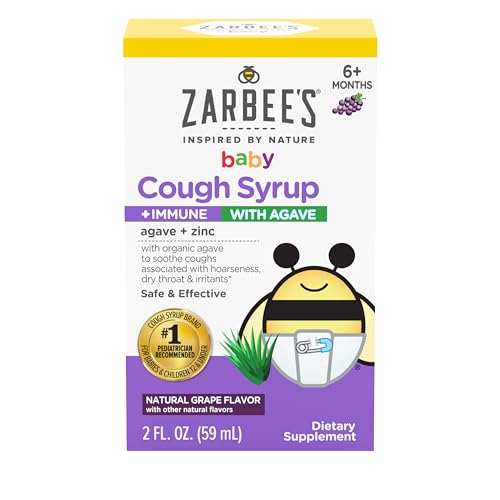
Zarbee's Baby Cough Syrup + Immune with Agave & Zinc, 2 fl oz
by Zarbee's
The cheapest way into honey-free infant cough relief, and the only tier of product usable before a child's first birthday.
Pros
- Uses agave rather than honey, so it clears the 12-month infant botulism restriction and is usable from 6 months
- The least expensive cough syrup in this guide, which matters when a bottle may only be needed for a few days
- Zinc content adds an immune-support angle without introducing an active drug
- Small bottle size suits a single short illness rather than forcing a bulk purchase
Cons
- Daytime formula only; night-time coughing needs the two-bottle pack instead
- Two fluid ounces runs out quickly if a cough lingers beyond a few days
3. Delsym Children’s 12 Hour Cough Relief: Runner-Up
Delsym is the first genuinely pharmaceutical option in this guide, and the age rules matter. It is labeled for 4 and up with a reduced dose between 4 and 6, and I would not use it in that lower band without speaking to your pediatrician first. From 6 upward it is straightforwardly appropriate.
What it does well is duration. Dextromethorphan polistirex is bound to a resin that releases it over twelve hours, so a single evening dose covers a whole night. Every immediate-release syrup requires redosing every four hours, which in practice means either a broken night or a cough that returns at 3 a.m. For a dry cough that is costing the household sleep, that difference is the entire value.
It is a suppressant only, with no expectorant or decongestant, and that narrowness is a virtue rather than a gap. It also means it is the wrong choice for a wet, productive cough: that cough is clearing your child’s airway, and quieting it works against the thing it is doing. Match it to a dry, tickly, unproductive cough and it performs.

Delsym Children's 12 Hour Cough Relief Liquid, Grape, 5 fl oz
by Delsym
The long-acting option for a dry, sleep-wrecking cough, once a child is old enough for dextromethorphan.
Pros
- Genuine 12-hour extended-release coverage, so one evening dose lasts through the night without a 3 a.m. redose
- Suppressant only, with no decongestant or antihistamine, which keeps the ingredient list as narrow as a drug product gets here
- Alcohol-free formulation
- Consistently rated as effective and palatable by parents of school-age children
Cons
- Firmly off-limits below age 4, and between 4 and 6 it should only be used on a pediatrician's say-so
- Suppressing a productive cough is counterproductive, so this is the wrong choice for a wet, mucus-heavy cough
4. Frida Baby 3-in-1 Cool Mist Humidifier: Premium Pick
This is the most expensive item here and the only one that works at literally every age in this guide, including the first six months where no syrup is an option at all. Humidified air eases the airway irritation driving a dry cough and loosens the nasal drainage behind a wet one, and it does so without a dose, an age floor, or an interaction to worry about.
The practical case is the sixty-hour tank. Overnight humidifiers that need refilling every night get abandoned by the third night of an illness, whereas this one runs several nights unattended. Cool mist rather than warm also removes the scald risk that makes warm-mist units a poor idea in a child’s room, and the built-in nightlight means it stays useful once the cough resolves.
I want to be straightforward about why it rates lower than the syrups. Its reviews contain a persistent thread about mold developing in the water chamber, and a smaller one about leaking around the base. The mold complaints are largely a cleaning-frequency problem, and the manufacturer’s schedule is not optional with any ultrasonic humidifier. If you will not commit to that, buy something else.

Frida Baby 3-in-1 Cool Mist Humidifier for Large Rooms & Bedroom
by Frida Baby
The one intervention that works at literally any age, provided you commit to cleaning it on the manufacturer's schedule.
Pros
- Works at every age in this guide, including the newborn window where no syrup is an option
- Sixty-hour tank runs several nights between refills, which matters when the illness outlasts your patience
- Cool mist carries no scald risk, unlike warm-mist units in a child's room
- Doubles as a nightlight, so it earns its place in the room after the cough resolves
Cons
- Reviews contain a recurring thread about mold in the water chamber when cleaning is skipped, which is why it sits below the syrups on rating
- A minority of units are reported to leak around the base
5. Zarbee’s Baby Daytime & Nighttime Cough Syrup with Agave
This is the fuller version of the budget pick and the most complete option for the under-3 band. Same honey-free agave base, safe from 6 months, but with separate day and night bottles rather than daytime alone. Given that infant coughs are reliably worse lying down, the night formulation is the half most parents actually need.
The two-bottle format is the right structure for how these illnesses run. A cough that is manageable during the day becomes the reason nobody sleeps, and having a formulation intended for that window avoids the temptation to reach for something age-inappropriate at midnight. It contains no drugs, alcohol, or gluten, so it can sit alongside a separately dosed fever reducer with no stacking risk.
Parents describe the syrup as sticky, and some find it thin. Neither is a safety issue, but at 2 fluid ounces per bottle it does not last long if the illness drags.

Zarbee's Baby Daytime & Nighttime Cough Syrup with Agave, 2 x 2 fl oz
by Zarbee's
The most complete option for the under-3 age band, covering both day and night without honey.
Pros
- Honey-free agave base makes it safe from 6 months, well clear of the 12-month honey cutoff
- Separate day and night bottles cover the hours when an infant cough is worst
- No drugs, alcohol, or gluten, so it carries no interaction risk with a separate fever reducer
- Naturally flavored, which parents report makes dosing an unwilling infant less of a fight
Cons
- Still unusable in the first six months, the window where parents have the fewest options
- The syrup is noticeably sticky, and several reviewers find it thin
6. Hyland’s Kids Cold and Cough Day and Night Combo Pack
Hyland’s occupies the same 2-and-up drug-free slot as the Zarbee’s honey syrups and offers parents a second option, which matters when a child rejects one flavor outright. With more than eight thousand reviews it has the deepest track record of any drug-free syrup in this guide, the Zarbee’s bottles included, and the day and night pairing covers the full cycle.
The practical advantages are real: no known drug interactions, so it sits safely alongside a separate fever reducer, and a mild sweet taste young children generally accept without a fight. For the 2 to 5 band, which has no OTC drug options at all, having more than one palatable choice is genuinely useful.
I have to be plain about the evidence, though. This is a homeopathic preparation, which means it is not assessed for efficacy the way an FDA monograph drug is, and a meaningful minority of the reviews report no noticeable effect. That is the honest expectation to set. If you want the option with the strongest supporting evidence in this age band, the honey-based syrups have it.

Hyland's Kids Cold and Cough, Day and Night Combo Pack, 2 x 4 fl oz
by Hyland's
A widely used drug-free alternative for the 2 to 5 band, with realistic expectations about what a homeopathic syrup does.
Pros
- More than 8,000 reviews, the deepest track record of any drug-free syrup in this guide
- No known drug interactions, so it can sit alongside a separately dosed fever reducer
- Day and night pair covers the full 24 hours for the 2 to 5 band that has no drug options
- Mild, sweet taste that young children generally accept
Cons
- A meaningful minority of parents report no noticeable effect, which is the honest expectation to set for a homeopathic preparation
- Homeopathic products are not assessed for efficacy by the FDA the way an OTC monograph drug is
7. Mucinex Children’s Multi-Symptom Cold Medicine
Mucinex Children’s is the only product here that pairs a cough suppressant with a genuine expectorant, and for a chesty, productive cough in a school-age child that combination is the right match. Guaifenesin is the one expectorant with FDA monograph backing, so the mucus-thinning claim rests on evidence rather than marketing.
It is also the least expensive of the drug-containing syrups, and it is free of alcohol, sugar, and high-fructose corn syrup, which is a better formulation profile than the price suggests.
Two cautions carry real weight. First, it contains phenylephrine, an oral decongestant that an FDA advisory panel concluded in 2023 performs no better than placebo, so you are giving a child an ingredient with no demonstrated benefit alongside two that work. Second, three active ingredients means three opportunities to double-dose if you also reach for a combination fever medicine. The label technically permits use from 4, but between the decongestant and the stacking risk I would keep this one to 6 and above.
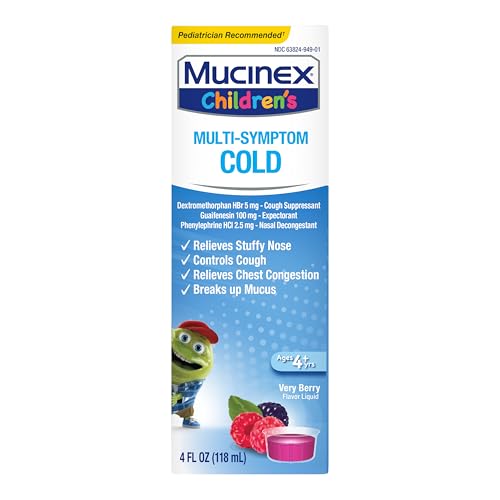
Mucinex Children's Multi-Symptom Cold Medicine, Very Berry, 4 fl oz
by Mucinex
The most complete multi-symptom formula here, best reserved for school-age children with a genuinely chesty cough.
Pros
- The only product here that pairs a suppressant with a genuine expectorant, which suits a chesty, productive cough
- Least expensive of the drug-containing syrups in this guide
- Free of alcohol, sugar, and high-fructose corn syrup
- Guaifenesin is the one expectorant with FDA monograph backing, so the mucus-thinning claim is not marketing
Cons
- Contains phenylephrine, an oral decongestant an FDA advisory panel concluded in 2023 is no better than placebo, so you are dosing a child with an ingredient carrying no proven benefit
- Three active ingredients means three chances to double-dose if you also give a combination fever medicine
8. Little Remedies Sterile Baby Saline Nasal Mist
If I could put only one product in front of a parent of a coughing infant, it would be this one. Most coughing in babies is driven by nasal drainage running backward into the throat, not by anything happening in the chest. Saline loosens that drainage, which treats the cause rather than muting the reflex, and it is safe from birth.
That newborn safety makes it one of only three things in this guide usable in the first six months, alongside the aspirator and the humidifier. It contains no preservatives, alcohol, or active drug, so there is no dosing ceiling and nothing to interact with. Nearly twelve thousand reviews at 4.8 stars is close to consensus.
The mist format is slightly harder to aim than drops in a squirming newborn, and a drops version is sold separately if you prefer it. It also does nothing for a chest-based cough, so it is the right first move rather than the whole answer.

Little Remedies Sterile Baby Saline Nasal Mist, 3 fl oz
by Little Remedies
The single most useful product in this guide, safe from birth and the correct first move for most infant coughs.
Pros
- Safe from birth, which makes it one of only three things in this guide usable in the first six months
- Nearly 12,000 reviews at 4.8 stars, the kind of consensus this category rarely produces
- Loosens the post-nasal drainage that causes most infant coughing, treating the cause rather than muting the reflex
- No preservatives, alcohol, or active drug, so it carries no dosing ceiling or interaction risk
Cons
- A mist is harder to aim precisely than drops in a squirming newborn; a drops version is sold separately
- Works on the nose, so it does nothing for a chest-based cough
9. Frida Baby NoseFrida SnotSucker Nasal Aspirator
The NoseFrida is the natural companion to saline and the best-reviewed product in this entire guide, with close to thirty-seven thousand verified reviews. Saline loosens the mucus; this removes it. Used together on a baby too young for any syrup, they are the most effective combination available.
It outperforms the bulb syringe most families are sent home from hospital with, and the design explains why: suction is parent-controlled rather than fixed, so you can be gentle or firm as needed, and nothing is inserted into the nasal passage. It also fully disassembles for cleaning, unlike a bulb whose interior you can neither see nor properly dry, which is not a small point for something used on a newborn.
The parent-powered design puts some people off. A hygiene filter sits between you and anything you are removing, so the objection is aesthetic rather than practical, and the review volume suggests most parents get past it quickly.

Frida Baby NoseFrida SnotSucker Nasal Aspirator with 4 Hygiene Filters
by Frida Baby
The best-reviewed product in this entire category and the right tool when a baby is too young for any syrup.
Pros
- Nearly 37,000 reviews, the largest verified pool of any product in this guide by a wide margin
- Parent-controlled suction consistently outperforms the bulb syringe most families are sent home from hospital with
- Nothing is inserted into the nasal passage, which avoids the irritation bulbs cause
- Fully disassembles for cleaning, unlike a bulb whose interior you cannot see or dry
Cons
- The parent-powered design puts some people off, though a hygiene filter means nothing actually reaches you
- Paired with saline it works far better than alone, so budget for both
10. Zarbee’s Baby Soothing Chest Rub with Eucalyptus and Lavender
Chest rubs occupy a specific place here, and the critical safety point is what this one leaves out. Adult vapor rubs contain menthol and camphor, both of which can cause respiratory distress in young children, and they should never be used on an infant. This formulation omits both, which is why it can carry a 2-month minimum age, the earliest of any topical product in this guide.
The base is beeswax and shea butter rather than petroleum, which is what parents of children with sensitive or eczema-prone skin tend to be looking for. And the massage is a real part of the effect: a settling bedtime ritual has value for a child who is uncomfortable and overtired, quite apart from what the eucalyptus is doing.
Anyone expecting the intensity of an adult rub will find it mild, which is deliberate and correct. It also needs rubbing in, which is harder on an already-sleeping child than a spray.

Zarbee's Baby Soothing Chest Rub with Eucalyptus & Lavender, 1.5 oz
by Zarbee's
The gentlest chest rub available, and the only one usable as early as 2 months.
Pros
- Usable from 2 months, the earliest minimum age of any topical product in this guide
- Contains no menthol or camphor, the two ingredients that make adult vapor rubs unsafe for infants
- Petroleum-free base, which parents of children with sensitive or eczema-prone skin specifically seek out
- The massage itself is a settling bedtime ritual, which is a real part of why these products help
Cons
- Deliberately mild, so anyone expecting the intensity of an adult vapor rub will find it underwhelming
- A balm needs rubbing in, which is harder on a sleeping child than a spray would be
11. Vicks BabyRub Chest Rub Ointment
Vicks BabyRub is worth understanding as a genuinely different product from adult VapoRub rather than a smaller jar of the same thing. The menthol and camphor are removed, leaving aloe, eucalyptus, lavender, and rosemary in a petrolatum base. That reformulation is what makes it safe for infants, and it is the reason substituting the adult product is dangerous rather than merely stronger.
For many parents the brand familiarity is the draw, and at 2 a.m. reaching for something you recognize has its own value. The jar is larger than the Zarbee’s alternative for a similar outlay, and the petrolatum base holds moisture on skin dried out by a week of illness.
Its minimum age is 3 months rather than 2, which rules it out for the very youngest infants where the Zarbee’s rub still works. The petrolatum base also feels heavier and greasier than a beeswax balm, which is a matter of preference rather than performance.

Vicks BabyRub Chest Rub Ointment with Aloe, Eucalyptus, Lavender and Rosemary, 1.76 oz
by Vicks
A capable brand-name chest rub, correctly stripped of the menthol and camphor that make the adult product unsafe here.
Pros
- A genuinely different formulation from adult VapoRub, with the menthol and camphor removed
- Larger jar than the Zarbee's alternative for a similar outlay
- Familiar brand, which matters to parents who want something they recognize at 2 a.m.
- Aloe and petrolatum base holds moisture on skin dried out by a week of illness
Cons
- Three-month minimum age, one month later than the Zarbee's rub, which rules it out for the youngest infants
- The petrolatum base feels heavier and greasier than a beeswax balm
12. Zarbee’s Kids Daytime Cough Syrup + Immune with Honey and Zinc
This is the same honey base as our top pick with elderberry, vitamin D, and zinc added, aimed at parents who want immune support alongside cough relief. The age floor of 2 years is identical, as is the drug-free status that makes it usable in the band where no OTC drug is appropriate.
This slot used to hold the day-and-night value pack of the same formula. Amazon delisted that pack in September 2026, so we moved to the daytime bottle, which is the same immune formula sold on its own. If you want the night version as well, Zarbee’s sells a Nighttime Cough + Immune bottle, with chamomile added, separately.
Where it earns its place is intent. If you are already giving elderberry or a zinc supplement during cold season, consolidating that into the cough syrup is a reasonable simplification rather than a duplication.
Two things keep it below its sibling. It has fewer than four hundred reviews against more than three thousand for the mucus formulation, which is a much thinner base to judge from. And the immune-support ingredients are a supplement claim, not a treatment claim: they should not be read as shortening the illness. Choose this over our top pick only if you specifically want that angle.
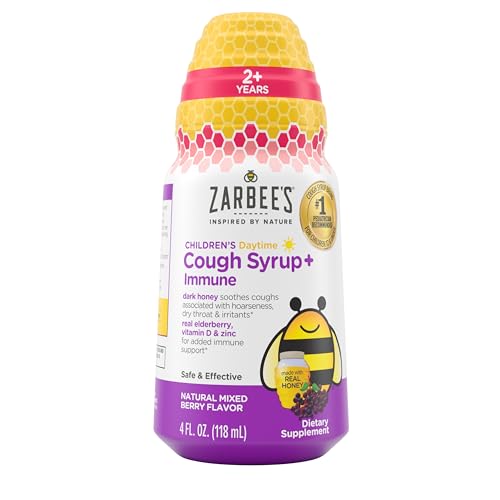
Zarbee's Kids Daytime Cough Syrup + Immune with Honey, Zinc, 4 fl oz
by Zarbee's
Worth choosing over our top pick only if you specifically want the elderberry and zinc angle, and can accept a thinner review history.
Pros
- Adds elderberry, vitamin D, and zinc to the same honey base used by our top pick
- Sold and shipped by Amazon as a single 4 fl oz bottle, a low-commitment way to try the immune formula
- Drug-free, and therefore usable in the 2 to 5 band that has no OTC drug options
- Same formulation family and manufacturer as our top pick
Cons
- Fewer than 400 reviews, a far thinner evidence base than its 3,000-review sibling
- Daytime formula only; the Nighttime Cough + Immune version is sold as a separate bottle
- The immune-support ingredients are a supplement claim, not a treatment claim, and should not be read as shortening an illness
Best Cough Relief for Infants Under 1
This is the age band with the fewest options and the most anxious parents, so I want to be exact. Nothing in the drug category is appropriate. Honey is unsafe below 12 months because of infant botulism risk. And there is no cough syrup of any kind on the US market labeled below 6 months, which means that for a newborn to 6-month-old, the effective interventions are entirely non-oral: saline to loosen nasal drainage, suction to remove it, humidified air, and fluids.
That is not a gap in this guide. It is the actual state of the category, and any page that hands you a syrup for a 3-month-old is telling you something the label does not support. From 6 months an agave-based syrup becomes an option, since agave carries none of the botulism concern that rules out honey. If your infant’s cough comes with fast or laboured breathing, chest retractions, a barking quality, or any fever in a baby under 3 months, that is a call to your pediatrician rather than a purchase.
| Product | Price | Buy |
|---|---|---|
| Little Remedies Sterile Baby Saline Nasal Mist, 3 fl ozBest from birth Safe from day one and the correct first move, since most infant coughing is driven by nasal drainage rather than the chest | $5.47 | View on Amazon |
| Frida Baby NoseFrida SnotSucker Nasal Aspirator with 4 Hygiene FiltersBest for a blocked nose Pairs with saline to actually remove what the saline has loosened, and outperforms the hospital bulb syringe | $13.62 | View on Amazon |
| Zarbee's Baby Daytime & Nighttime Cough Syrup with Agave, 2 x 2 fl ozBest syrup once baby is 6 months The earliest any cough syrup becomes appropriate, using agave so the honey botulism rule does not apply | $13.49 | View on Amazon |
Best Cough Medicine for 2 Year Olds
Two is the age at which this category finally opens up a little. Honey becomes safe at 12 months, and the honey-based syrups are labeled from 2, so a genuine cough syrup is available for the first time. What remains off-limits is everything pharmaceutical: no dextromethorphan, no guaifenesin, no decongestant, because the FDA’s under-4 advisory still applies with full force.
The practical approach at this age is a honey-based syrup during the day, a chest rub formulated without menthol at bedtime, and a humidifier running overnight. One warning worth repeating, because it is the most common serious mistake at this age: do not use an adult vapor rub. The menthol and camphor that make it feel effective on an adult can cause respiratory distress in a 2-year-old. Use a product formulated for children, or none.
| Product | Price | Buy |
|---|---|---|
| Zarbee's Kids Cough Syrup + Mucus Value Pack with Honey, 2 x 4 fl ozBest overall at age 2 Newly appropriate at this age and built on the ingredient with the best evidence behind it for pediatric cough | $14.82 | View on Amazon |
| Hyland's Kids Cold and Cough, Day and Night Combo Pack, 2 x 4 fl ozBest drug-free alternative A second palatable drug-free choice for the child who rejects the honey syrup outright | $12.97 | View on Amazon |
| Zarbee's Baby Soothing Chest Rub with Eucalyptus & Lavender, 1.5 ozBest for bedtime Menthol-free and camphor-free, which is what makes it safe here where an adult rub is not | $6.28 | View on Amazon |
Best Cough Medicine for 3 Year Olds
Three is still inside the under-4 restriction, so the product set is the same as at 2. What changes is the context. Three-year-olds are typically in preschool or daycare, which means back-to-back viral illnesses through the autumn and winter, and parents at this age are usually dealing with the fourth cough of the season rather than the first.
That shifts what is worth buying. It is worth keeping enough syrup in the cupboard to get through the season rather than buying a bottle per illness, and the case for a humidifier running through the whole season strengthens considerably. It is also the age where broken sleep becomes the dominant complaint, and the interventions that help there are environmental rather than oral: humidified air, elevating the head of the mattress slightly, and a settling bedtime routine. If you are tracking fevers across a run of illnesses, our guide to the best forehead thermometers covers the devices that make that less disruptive at night.
| Product | Price | Buy |
|---|---|---|
| Zarbee's Kids Daytime Cough Syrup + Immune with Honey, Zinc, 4 fl ozBest for repeat winter illnesses Adds elderberry, vitamin D, and zinc to the honey base, which suits a season of back-to-back preschool infections | $9.12 | View on Amazon |
| Frida Baby 3-in-1 Cool Mist Humidifier for Large Rooms & BedroomBest for overnight relief Runs several nights unattended and works at every age, making it the most reusable purchase in this guide | $43.49 | View on Amazon |
| Vicks BabyRub Chest Rub Ointment with Aloe, Eucalyptus, Lavender and Rosemary, 1.76 ozBest brand-name bedtime rub A familiar brand with the menthol and camphor correctly removed, safe from 3 months and up | $7.47 | View on Amazon |
Best Cough Medicine for 4 Year Olds
Four is the threshold the entire category is built around, and it is worth being precise about what it means. At 4, dextromethorphan products stop being contraindicated and start being conditional: the labeling permits a reduced dose between 4 and 6, and both the FDA and the manufacturers frame that band as requiring a pediatrician’s involvement. It is not a green light, it is a conversation.
My own view is that at 4 the burden of proof still sits with the drug. If a dry cough is genuinely preventing sleep across multiple nights, an extended-release suppressant discussed with your pediatrician is reasonable. If the cough is productive, or merely annoying rather than disruptive, the drug-free options remain the better choice, and they are the same ones that served at 2 and 3. I would specifically avoid multi-symptom combination products at this age: the decongestant component adds no proven benefit and the stacking risk with a separate fever reducer is real.
| Product | Price | Buy |
|---|---|---|
| Delsym Children's 12 Hour Cough Relief Liquid, Grape, 5 fl ozBest for a dry cough, with pediatrician guidance The first dextromethorphan option that becomes appropriate, at a reduced 4-to-6 dose and only after speaking to your pediatrician | $15.23 | View on Amazon |
| Hyland's Kids Cold and Cough, Day and Night Combo Pack, 2 x 4 fl ozBest drug-free alternative The sensible default if the cough is productive or not disrupting sleep, with no age conditions attached | $12.97 | View on Amazon |
| Zarbee's Kids Cough Syrup + Mucus Value Pack with Honey, 2 x 4 fl ozBest honey-based option Still fully appropriate at 4 and the better choice when the cough does not warrant a drug | $14.82 | View on Amazon |
Best Cough Medicine for Kids by Age and Situation
The remaining situations parents ask about most often, matched to the right pick from the lineup above:
| Product | Price | Buy |
|---|---|---|
| Mucinex Children's Multi-Symptom Cold Medicine, Very Berry, 4 fl ozBest for school-age kids 6 to 11 Fully appropriate at this age and the only option here pairing a suppressant with a real expectorant for a chesty cough | $9.07 | View on Amazon |
| Delsym Children's 12 Hour Cough Relief Liquid, Grape, 5 fl ozBest for night-time coughing Twelve-hour release covers a whole night on one evening dose, from age 4 with guidance and comfortably from 6 | $15.23 | View on Amazon |
| Zarbee's Kids Cough Syrup + Mucus Value Pack with Honey, 2 x 4 fl ozBest drug-free cough relief Honey has the strongest evidence of anything in this guide and needs no age exemption above 2 | $14.82 | View on Amazon |
| Frida Baby 3-in-1 Cool Mist Humidifier for Large Rooms & BedroomBest for dry indoor air Central heating dries airways and worsens a night cough; humidified air treats that directly at any age | $43.49 | View on Amazon |
| Frida Baby NoseFrida SnotSucker Nasal Aspirator with 4 Hygiene FiltersBest for chesty congestion in babies Suction removes what saline loosens, which is the only effective route in babies too young for syrup | $13.62 | View on Amazon |
| Zarbee's Baby Cough Syrup + Immune with Agave & Zinc, 2 fl ozBest for a short illness A small daytime bottle sized to one illness rather than a bulk pack that expires in the cupboard | $7.63 | View on Amazon |
Buyer's Guide
The decision tree for a child's cough is unusual in that the first question is not which product works best. It is how old your child is, because that single answer eliminates most of the shelf before efficacy enters the picture. Work through these factors in order.
Your child's age, before anything else
Age is a hard gate, not a preference. The FDA advises against OTC cough and cold medicines under 4, and manufacturers voluntarily print "do not use under 4" on dextromethorphan products. Between 4 and 6 these products should only be used on a pediatrician's advice. From 6 upward the labeled OTC options become appropriate at full dose. Below 4 the honest answer is that the effective interventions are drug-free: honey from age 1, saline and suction at any age, humidified air, and fluids. A product that is excellent for a 9-year-old is simply not an option for a 2-year-old, however good its reviews.
Drug-free versus an OTC drug
This follows directly from age and is the real dividing line in this category. Drug-free products carry no dosing ceiling, no interaction with a separately given fever reducer, and no age floor beyond the honey and botulism rule. They also do less. OTC drug products act on a defined mechanism but bring age restrictions and stacking risk. For most children searching triggers this page, under 6, the drug-free lane is the only one open, so choose the best product within it rather than treating it as a compromise.
Whether the cough is dry or productive
A dry, tickly, non-productive cough is a candidate for a suppressant such as dextromethorphan, which quiets the cough reflex. A wet, productive cough that is bringing up mucus is doing useful work, and suppressing it is counterproductive; an expectorant such as guaifenesin, which thins the mucus, is the better match. Buying a suppressant for a chesty cough is the most common reason parents conclude that cough medicine does not work.
Single-symptom versus multi-symptom formulas
Combination products treat cough, congestion, and fever in one dose, which is convenient and is also the single most common route to an accidental overdose in children. If you give a multi-symptom syrup containing acetaminophen and then give Children's Tylenol for the fever, you have double-dosed the same drug. Read both labels before dosing, and prefer a single-ingredient product plus a separate fever reducer when you can, because that combination is far harder to get wrong.
How you measure the dose
Pediatric dosing is by weight rather than age, and the labeled age bands are an approximation of that. Use the syringe or cup that came with the product; a kitchen teaspoon varies by two to three times across a typical drawer, which at these volumes is the difference between a therapeutic dose and a dangerous one. If you need to convert between units, our teaspoon to milliliter converter handles it. Write down the time of each dose during a night-time illness, because misremembering is how the four-hour interval quietly becomes two.
Dyes, sugar, and allergens
Liquid formulations vary widely in what is carried alongside the active ingredient. Artificial dyes, high-fructose corn syrup, and alcohol appear in some pediatric syrups and not others, and matter more than usual for children with sensitivities, eczema, or diabetes. Honey-based products are unsuitable below 12 months regardless of what else they contain, and any product containing an ingredient your child has previously reacted to should be avoided even where the reaction was mild.
How to Choose the Best Cough Medicine for Your Child
Answer three questions in order and the choice largely makes itself. How old is your child? Under 4 rules out every drug option and points you to honey above 12 months, saline and suction below it, and humidified air at any age. Is the cough dry or productive? A dry, tickly cough is what a suppressant is for; a productive one is clearing the airway and should not be suppressed. And is it actually disrupting sleep, or is it just wearing on everyone? That last question matters more than parents expect, because most viral coughs resolve on their own and the intervention that helps most is often environmental rather than pharmaceutical.
Whatever you choose, measure it with the syringe or cup that came in the box. Pediatric dosing is by weight, the age bands on the label are an approximation of that, and kitchen teaspoons vary by two to three times across a typical drawer. If you need to convert between units mid-illness, our teaspoon to milliliter converter does it without arithmetic at 3 a.m. Write down the time of every dose, because misremembering under fatigue is how a four-hour interval quietly becomes two.
Final Verdict
For most children whose parents come looking for this, Zarbee’s Kids Cough Syrup + Mucus with Honey is the right answer: drug-free, usable from 2, and built on the one ingredient in this category with genuinely strong clinical evidence behind it in children. For infants under 1, the answer is not a syrup at all but Little Remedies saline paired with the NoseFrida aspirator, which together address the nasal drainage actually causing most infant coughing. From 4 with pediatric guidance, and more comfortably from 6, Delsym’s twelve-hour formulation is the strongest option for a dry cough that is costing your household sleep. If cost is the constraint, the small agave bottle covers a short illness for a fraction of the outlay.
The larger point is one this category tends to obscure. For children under 4, the absence of a suitable cough medicine is not a problem to be solved with a cleverer purchase. It reflects a considered regulatory judgement that these drugs do not work well in young children and carry real risks when they are used off-label. Honey, saline, suction, humidified air, and fluids are not consolation prizes; for this age group they are the interventions with the best evidence behind them. Keep a well-stocked first aid kit and a reliable thermometer on hand, watch for the red flags described in the FAQs above, and call your pediatrician for any cough with laboured breathing, a barking quality, a whooping sound, or a duration beyond three weeks.
Frequently Asked Questions
Can I give my 1-year-old cough medicine?
What can I give a 2-year-old for a cough?
Does Zarbee's actually work, and do pediatricians recommend it?
Which is better for a child, Delsym, Mucinex, or Robitussin?
How long should a child's cough last before I call the doctor?
Related Articles
About the Reviewer

Dr. David Taylor, MD, PhD
Drexel University College of Medicine (MD), Indiana University School of Medicine (PhD)
Dr. David Taylor is a licensed physician and medical researcher who founded BestRatedDocs in 2016. With an MD from Drexel University and a PhD from Indiana University School of Medicine, he combines clinical expertise with a passion for health technology to provide evidence-based product recommendations. Dr. Taylor specializes in health informatics and regularly evaluates medical devices, diagnostic equipment, and therapeutic products to help healthcare professionals and patients make informed decisions.