Best Probiotics for Kids of 2026
Dr. David Taylor reviews the best probiotics for kids on Amazon. Compare pediatric strains, CFU counts, age ranges, and formats for constipation, diarrhea, and immune support.
Updated
Walk down the children’s supplement aisle and the probiotic shelf is the one making the boldest promises with the least specificity. Bottles advertise billions of colony-forming units in cheerful fonts, gummies promise immunity and gut health in the same breath, and almost none of them name the actual organism inside. That gap matters more in pediatrics than it does for adults, because the clinical evidence for probiotics in children is unusually good in a few narrow places and unusually thin everywhere else. A parent buying on CFU count alone is optimizing the one variable that matters least.
The honest starting point is that most healthy children do not need a daily probiotic at all. A varied diet with fiber and some fermented foods maintains a child’s microbiome without help, and no major pediatric body recommends routine supplementation for a well child. Where the research is genuinely strong is situational: preventing antibiotic-associated diarrhea, shortening acute infectious diarrhea, and easing infant colic. Those three indications carry randomized trial evidence that holds up. Chronic constipation, eczema, and general immune support sit further down the evidence ladder, with real but modest effects that marketing routinely oversells.
For this guide we evaluated eleven of the best-selling pediatric probiotics on Amazon across every format parents actually buy: flavorless powders, chewable tablets, gummies, and infant drops. Our assessment draws on Dr. David Taylor’s clinical experience, the published pediatric probiotic literature including the ESPGHAN working group recommendations, and analysis of more than 80,000 verified Amazon ratings. We weighted strain-level transparency above CFU marketing, age-appropriate formats above flavor claims, and honest limitations above brand storytelling. If your child’s issue is primarily regularity, our guides to fiber supplements and stool softeners cover the interventions with stronger evidence for that specific problem.
Here are the eleven pediatric probiotics that earned a place in this guide, at a glance.
| Product | Price | Buy |
|---|---|---|
| Culturelle Kids Daily Probiotic PacketsBest Overall | $32.99 | View on Amazon |
| Garden of Life Dr. Formulated Organic Kids+ ChewablesRunner-Up | $18.49 | View on Amazon |
| Florastor Kids Dual Action Probiotic PowderBudget Pick | $18.59 | View on Amazon |
| Llama Naturals Kids Probiotic with Prebiotic FiberPremium Pick | $29.99 | View on Amazon |
| Culturelle Kids Daily Chewable Probiotic, BerryRunner-Up | $20.48 | View on Amazon |
| Culturelle Kids Probiotic + Veggie Fiber GummiesRunner-Up | $18.12 | View on Amazon |
| SmartyPants Kids Probiotic and Prebiotic GummiesRunner-Up | $18.29 | View on Amazon |
| MaryRuth Organics Kids Probiotic GummiesRunner-Up | $26.95 | View on Amazon |
| LOVEBUG Kids Probiotic Powder with Prebiotic FiberRunner-Up | $23.95 | View on Amazon |
| BioGaia Baby Probiotic DropsRunner-Up | $17.58 | View on Amazon |
| Hyperbiotics Vital Nutrients Pro Kids Probiotic ENTRunner-Up | $33.99 | View on Amazon |
Find the Best Probiotic for Your Child
The right product depends almost entirely on your child’s age and the reason you are buying. Jump to your situation:
- Best probiotics for kids overall — all eleven picks reviewed
- Best probiotics for kids constipation
- Best probiotics for kids diarrhea and after antibiotics
- Best probiotics for kids immune system
- Best probiotics for toddlers and 1 to 2 year olds
- Best probiotic gummies for kids
- Best sugar free and organic probiotics for kids
- Best probiotics for teens
- More use cases
How We Selected These Probiotics for Kids
Every product here discloses its organisms at strain level or names a specific characterized blend, is labeled for a defined pediatric age range, and is currently available on Amazon with verified stock. We applied three filters. First, strain transparency: products advertising an undefined “proprietary probiotic blend” were excluded, because there is no way to check them against the literature. Second, age-appropriate formatting: a product had to state the ages it is intended for, and we assessed the format against what a child of that age can actually take safely. Third, review depth: every product except one carries more than 500 verified ratings, and most carry several thousand, which is enough signal to detect a formulation that families abandon.
We deliberately included formats that compete with each other rather than picking a single winner and padding the list. Flavorless powder, chewable tablet, gummy, and infant drops each solve a different compliance problem, and the best product for a resistant three-year-old is the wrong one for a nine-year-old who takes their own vitamins. We also included one oral-cavity probiotic that works in the throat rather than the gut, because recurring ear and throat infections are a common reason parents start looking in the first place.
Best Probiotics for Kids Overall
These are the eleven pediatric probiotics reviewed in full below. Culturelle Kids Daily Probiotic Packets is our best overall pick because it delivers the most-studied pediatric strain at the dose the trials used, in the format most likely to actually get swallowed. The use-case sections after the reviews then match each specific reason a parent goes looking — constipation, diarrhea, immune support, a toddler, a teen — to the product that fits it.
1. Culturelle Kids Daily Probiotic Packets — Best Overall
If you buy one pediatric probiotic without a specific clinical reason, this is the one. Culturelle Kids is built on Lactobacillus rhamnosus GG, which is not merely one option among many — it is the single most extensively studied probiotic organism in children, with more than a thousand published trials examining outcomes from acute gastroenteritis to antibiotic-associated diarrhea to respiratory infection frequency. When the ESPGHAN working group issued recommendations on probiotics for pediatric acute gastroenteritis, LGG was on the short list. That level of evidence is rare in the supplement aisle and it is the reason this product carries the pediatrician-recommended designation.
The dose is right, which sounds obvious but frequently is not. At 5 billion CFU, Culturelle Kids sits squarely inside the 1 to 10 billion range where most pediatric trial data was generated. Competitors advertising 15 or 20 billion CFU are not delivering three times the benefit; above the studied threshold the effect plateaus for most strains, and the extra number exists for the shelf rather than the child. Paying for CFU inflation is the most common way parents overspend in this category.
The format is what makes it work day to day. The powder is genuinely flavorless and dissolves into yogurt, applesauce, or cold milk without changing taste or texture, which matters enormously for the four-year-old who has decided that anything presented as medicine is suspect. The 50-packet box works out to a 50-day supply, so the sticker price, which is the highest here, translates into a per-day cost that undercuts most of the chewables. The one real constraint is heat: this cannot go into oatmeal, warm milk, or anything hot, because the temperature kills the organisms before they are swallowed.

Culturelle Kids Daily Probiotic Packets
by Culturelle
The pediatrician-recommended standard — LGG at the clinically studied 5 billion CFU dose in a flavorless powder that hides in any cold food.
Pros
- Built on Lactobacillus rhamnosus GG, the single most-studied probiotic strain in pediatrics with over 1,000 published trials behind it
- Completely flavorless powder mixes into yogurt, applesauce, or milk without a child noticing — the most reliable format for a resistant eater
- 50-packet box is a 50-day supply, roughly double what most pediatric probiotics provide per purchase
- Shelf-stable with no refrigeration required, so a missed trip back to the fridge does not silently kill the dose
Cons
- Highest sticker price in this guide, though the per-day cost is competitive because of the 50-day count
- Must not be added to hot food or drinks, which rules out mixing it into oatmeal or warm milk at breakfast
2. Garden of Life Dr. Formulated Organic Kids+ Chewables — Runner-Up
Where Culturelle bets everything on one exceptionally well-studied organism, Garden of Life takes the opposite approach: fourteen strains at 5 billion CFU total, spanning both major genera. Both strategies are defensible. Single-strain products let you match a specific organism to a specific indication with published evidence behind it. Multi-strain products cover more ground when the goal is general daily support and you do not have a particular problem to solve, which describes most families buying a kids’ probiotic.
The added vitamins are a meaningful practical advantage rather than a marketing flourish. Vitamin C and vitamin D in the same chewable means many families can drop a separate immune supplement, and vitamin D in particular is one of the few micronutrients where American children are commonly short. The certification stack is unusually complete: USDA Organic, non-GMO, and no added sugar in a berry-cherry chewable, which is a harder formulation problem than it sounds. Most no-added-sugar chewables taste like it.
The engineering detail worth knowing about is the desiccant-lined bottle. Probiotic viability degrades with heat and moisture, and a standard bottle opened daily in a humid kitchen loses potency faster than the label suggests. Garden of Life’s moisture-controlled packaging is a real answer to that problem rather than a claim. The limitation is age: this is a chewable tablet labeled for 4 and up, so it does not reach the toddler window at all, and thirty chewables means a monthly repurchase.

Garden of Life Dr. Formulated Organic Kids+ Chewables
by Garden of Life
Fourteen strains plus vitamins C and D in a no-added-sugar organic chewable — the most complete daily formula for school-age kids.
Pros
- Fourteen strains at 5 billion CFU deliver far broader coverage than the single-strain products in this category
- Adds vitamin C and vitamin D to the same chewable, replacing a separate immune supplement for many families
- USDA Organic and non-GMO with no added sugar, which is unusual for a berry-cherry chewable kids will actually eat
- Desiccant-lined bottle technology protects viability against heat and humidity in a way standard bottles do not
Cons
- Chewable tablet format is not appropriate for toddlers who cannot reliably chew and swallow a tablet
- Thirty chewables per bottle means monthly repurchase, unlike the longer-supply powders here
3. Florastor Kids Dual Action Probiotic Powder — Budget Pick
Florastor Kids is the odd one out here in the most useful possible way. Saccharomyces boulardii is a yeast, not a bacterium, and that single biological fact changes how you use it. Antibacterial antibiotics cannot kill a yeast. Every other probiotic in this guide has to be spaced at least two hours from an antibiotic dose, which in practice means a parent trying to remember a staggered schedule while managing a sick child. Florastor can be given at the same time as the antibiotic, and the manufacturer documents resistance to sixteen common oral antibiotics.
That matters because antibiotic-associated diarrhea is the single best-evidenced reason to give a child a probiotic. It affects a substantial minority of children on antibiotics, and the trials consistently show that starting the probiotic alongside the antibiotic works considerably better than starting once symptoms have already appeared. A box of Florastor sitting in the medicine cabinet, ready to open the day a prescription is filled, is genuinely useful in a way a daily maintenance supplement is not.
At the lowest price in this guide it is also the easiest to justify keeping on hand. The twenty-stick count reads as a short supply, but that is the correct design for a product used in two-week courses rather than year-round. The three-year shelf life without refrigeration supports exactly that usage pattern. Two cautions are worth stating plainly: S. boulardii should not be given to severely immunocompromised children or to a child with a central venous catheter without physician approval, because case reports of catheter-related fungemia exist.

Florastor Kids Dual Action Probiotic Powder
by Florastor
The only yeast-based option here — antibiotic-resistant by nature, so it works during a course rather than around it, at the lowest price in the guide.
Pros
- Saccharomyces boulardii is a yeast, not a bacterium, so antibiotics cannot kill it and it can be given at the same time as a course
- Lowest price in this guide by a wide margin, which matters for a product used in short courses rather than indefinitely
- Approved from 12 months of age and mixes into any cold food or drink, making it usable across the whole toddler-to-teen range
- Three-year shelf life with no refrigeration means a box can sit in the medicine cabinet until the next antibiotic prescription
Cons
- Twenty sticks is a short supply for daily use — this is designed around antibiotic courses, not year-round maintenance
- Not appropriate for severely immunocompromised children or those with a central venous catheter without physician approval
4. Llama Naturals Kids Probiotic with Prebiotic Fiber — Upgrade Pick
Llama Naturals is the product for the parent who reads the supplement facts panel before the front of the box. The gummy is made from real organic fruit with no added cane sugar, no syrups, no synthetic sweeteners, and no synthetic vitamins. That is an unusual combination in a category where “no artificial colors” is often the extent of the clean-label claim, and it comes with an allergen profile that excludes all nine major allergens plus corn, which makes it workable for children that most other kids’ gummies rule out.
The formulation logic is sound beyond the label. It pairs 2 billion CFU with 1,000 mg of organic XOS prebiotic, which is a real prebiotic dose rather than a token inclusion. Probiotics and prebiotics work together: the bacteria you swallow need a fermentable substrate to establish themselves, and most kids’ probiotics ship the organisms without the food. A product delivering both is doing something the majority of this category does not.
There is also a dental angle worth taking seriously, because daily gummies are a daily sugar-and-acid exposure. Llama Naturals is formulated to be less sticky and without the tooth-harming acids common in gummy vitamins. The tradeoffs are real: this is the most expensive option per day, the 2 billion CFU count is the lowest here, and with only 515 verified ratings the track record is far thinner than the established brands. You are paying a premium for ingredient quality rather than potency, which is a legitimate choice but should be a deliberate one.

Llama Naturals Kids Probiotic with Prebiotic Fiber
by Llama Naturals
A whole-fruit gummy with a real prebiotic dose and no added sugar — the pick for parents who read labels before they read CFU counts.
Pros
- Made from real organic fruit with no added cane sugar, syrups, or synthetic sweeteners — the cleanest label of any gummy here
- Pairs 2 billion CFU with 1,000 mg of organic XOS prebiotic, so the bacteria arrive with the fiber substrate they feed on
- Free of the nine major allergens plus corn, which makes it viable for children other kids' gummies rule out
- Less sticky than conventional gummies and formulated without tooth-harming acids, a genuine consideration for daily dosing
Cons
- Most expensive per day in this guide, and the 2 billion CFU count is the lowest here
- Only 515 verified ratings, a much thinner track record than the established brands on this list
5. Culturelle Kids Daily Chewable Probiotic, Berry
This is the same LGG strain at the same 5 billion CFU dose as our top pick, in a berry chewable tablet. For a child old enough to take their own supplement, the chewable frequently wins on compliance grounds alone. There is no mixing, no bowl, no parent standing over a yogurt cup, and a seven-year-old can handle the whole routine unsupervised. The 4.8-star average across more than nine thousand ratings is among the highest satisfaction scores in the entire pediatric supplement category, which tells you children genuinely accept the flavor rather than tolerating it.
One underappreciated detail is the oral care claim, which is more substantive than it sounds. LGG transits the mouth before it reaches the gut and colonizes there transiently, and there is research on lactobacilli and dental caries risk in children. Culturelle lists oral care alongside digestive and immune support on this product specifically because the chewable format holds the organisms in the mouth longer than a swallowed powder does.
The allergen profile is clean: no gluten, dairy, yeast, milk, soy, or preservatives, covering the sensitivities that most commonly disqualify a pediatric supplement. The constraint is the age floor. This is labeled for 3 and up, and a chewable tablet is not appropriate below that, so families with a toddler need one of the powders instead. Thirty chewables is a one-month supply, which puts the per-day cost above the 50-packet powder box despite the lower sticker price.

Culturelle Kids Daily Chewable Probiotic, Berry
by Culturelle
The LGG evidence base in a berry chewable — the same strain and dose as our top pick, in the format an independent school-age child prefers.
Pros
- Same clinically studied LGG strain and 5 billion CFU dose as the powder, in a format a child can take independently
- Berry flavor with a 4.8-star average across more than 9,000 ratings — one of the highest satisfaction scores in the category
- Free of gluten, dairy, yeast, milk, soy, and preservatives, covering the most common pediatric sensitivities
- Labeled for oral care alongside digestive and immune support, since LGG colonizes the mouth on the way down
Cons
- Ages 3 and up only, so it does not cover the toddler window the powder formats do
- Thirty chewables is a one-month supply at a higher per-day cost than the 50-packet powder box
6. Culturelle Kids Probiotic + Veggie Fiber Gummies
This is the product to reach for when regularity is the actual reason you are shopping. It pairs probiotics with prebiotic veggie fiber in one gummy, and that pairing is the specific combination the pediatric constipation literature supports. Probiotics alone have a modest effect on stool frequency and consistency in children. Probiotics with a fermentable fiber substrate have a better rationale, because the fiber does mechanical work in the colon while feeding the organisms you just introduced.
The formulation is cleaner than the gummy format usually allows: sugar-free, dye-free, vegan, and gluten-free, with vitamin C added for immune support. Getting a berry gummy that children request while keeping added sugar out of it is a genuine formulation achievement, and it removes the dental objection that applies to most daily gummy vitamins. The 60-count bottle supports either one or two gummies per day, so you can adjust the dose without buying a different product.
The honest limitations are twofold. Culturelle is less forthcoming about the CFU count on this gummy than on the powder and chewable, which is a transparency step backward from the rest of its line. And gummies for a three-year-old, the bottom of the labeled age range, warrant supervision. If your child’s constipation is persistent, involves withholding, or comes with soiling, this is a pediatrician conversation rather than a supplement decision, and our stool softener guide covers the interventions with stronger evidence for an episode already underway.

Culturelle Kids Probiotic + Veggie Fiber Gummies
by Culturelle
Probiotic plus prebiotic veggie fiber in a sugar-free gummy — the combination that matters most when regularity is the goal.
Pros
- Combines probiotics with prebiotic veggie fiber, which is the pairing the pediatric constipation research actually supports
- Sugar-free, dye-free, vegan, and gluten-free despite being a berry gummy children ask for
- Adds vitamin C for immune support without requiring a second daily supplement
- Sixty-count bottle gives flexible one-or-two-per-day dosing across a full month
Cons
- Ages 3 and up, and gummies carry a choking consideration for the youngest end of that range
- Culturelle does not publish a CFU count as prominently for the gummy as it does for the powder and chewable
7. SmartyPants Kids Probiotic and Prebiotic Gummies
SmartyPants solves the delivery problem differently from everyone else here, and the approach is scientifically interesting. Rather than protecting fragile organisms with coatings or delayed-release engineering, it uses spore-forming bacteria: Bacillus coagulans and Bacillus subtilis. Spore formers exist in a dormant, physically armored state that survives stomach acid natively, then germinate in the intestine. The manufacturer reports a 95 percent survivability rate, and unlike conventional strains they hold viability at room temperature without any refrigeration or moisture engineering.
The prebiotic here is also more specific than most. M-Gard is a beta-glucan from a proprietary baker’s yeast strain with its own published research on immune support, which is a step up from products that list “chicory root fiber” and leave it there. Pairing a clinically studied prebiotic with acid-resistant organisms is a coherent formulation strategy rather than a list of trendy ingredients.
The purity credentials are legitimate: a Clean Label Project Purity Award, with third-party testing for more than 200 contaminants and chemicals. For a supplement given to a child every day, independent contaminant testing is worth more than most of the claims on the front of the bottle. Two limitations: the serving is two gummies, so the 60-count bottle lasts only a month, and spore formers have a thinner pediatric evidence base than LGG or S. boulardii, where the trial literature is deep and specifically in children.

SmartyPants Kids Probiotic and Prebiotic Gummies
by SmartyPants
Spore-forming strains that reliably survive the stomach, paired with a clinically studied immune prebiotic and third-party purity testing.
Pros
- Uses spore-forming Bacillus coagulans and Bacillus subtilis, which survive stomach acid far better than conventional strains
- Manufacturer reports a 95 percent survivability rate, and spore formers need no refrigeration to hold that viability
- Includes M-Gard beta-glucan, a clinically studied prebiotic for immune support rather than a generic fiber
- Clean Label Project Purity Award winner, third-party tested for more than 200 contaminants
Cons
- Two gummies per serving means the 60-count bottle is only a 30-day supply
- Spore-forming strains have a thinner pediatric evidence base than LGG or S. boulardii
8. MaryRuth Organics Kids Probiotic Gummies
MaryRuth’s carries the certification pair that matters most to parents shopping on ingredient quality: USDA Organic and Non-GMO Project Verified together, which relatively few gummies in this category hold simultaneously. The gummy is pectin-based rather than gelatin-based, making it genuinely vegetarian and vegan rather than merely meat-free by omission, and the brand adds a Clean Label Project Purity Award on top.
The economics are the quiet advantage. At one gummy per day, the 60-count bottle is a full two-month supply, which is the longest of any gummy in this guide and roughly double the SmartyPants or Llama Naturals equivalent. For a product intended for continuous daily use, that halves the repurchase frequency and materially changes the per-day cost, even though the sticker price looks similar to the competition.
The strain is named and characterized: Bacillus subtilis DE111, a spore former with published human data behind it rather than an undisclosed blend. That transparency is exactly what this category usually lacks. The two honest caveats are that it is made with organic cane sugar, so it is not a sugar-free option like the Culturelle or Llama Naturals gummies, and that 2.5 billion CFU sits toward the lower end of the pediatric dosing range. Organic cane sugar is still sugar as far as your child’s teeth are concerned.

MaryRuth Organics Kids Probiotic Gummies
by MaryRuth Organics
A USDA Organic, pectin-based gummy with a named spore-forming strain and a full two-month supply per bottle.
Pros
- USDA Organic and Non-GMO Project Verified, a certification pair few gummies in this category carry together
- Pectin-based rather than gelatin-based, so it works for vegetarian and vegan households
- Sixty-count bottle at one gummy per day is a genuine two-month supply, the longest of any gummy here
- Bacillus subtilis DE111 is a spore former with published human data, not an undisclosed proprietary blend
Cons
- Made with organic cane sugar, so it is not a sugar-free option like the Culturelle or Llama Naturals gummies
- 2.5 billion CFU is toward the lower end of the pediatric dosing range
9. LOVEBUG Kids Probiotic Powder with Prebiotic Fiber
LOVEBUG fills a gap that most of this category ignores entirely. It is purpose-formulated for 12 months to 4 years, which is precisely the window where chewables and gummies are unsafe and infant drops have aged out. Parents of a two-year-old routinely find themselves choosing between a product labeled for newborns and one labeled for 4 and up, and neither is correct. This is built for the middle.
The potency is the highest here by a considerable margin: 15 billion CFU across 8 strains including LGG, with prebiotic fiber included. That figure needs the same caveat as always, since more CFU does not scale linearly into more benefit, but a genuinely multi-strain toddler formula with a named flagship organism and a prebiotic is a substantive product rather than a repackaged adult formula with a cartoon on the label. The USDA Organic certification and the absence of artificial colors, flavors, and preservatives back that up.
Practically, the unflavored instant-dissolve powder is what makes it viable for the target age. Toddlers are the most suspicious eaters in the household, and a powder that vanishes into milk, a smoothie, or yogurt without altering taste or texture defeats the detection problem that sinks flavored products. The clear limitations are that it ages out at 4, so a family with an older sibling needs a second product, and that thirty single-serve packets at this price lands among the higher per-day costs in this guide.

LOVEBUG Kids Probiotic Powder with Prebiotic Fiber
by LOVEBUG
The highest-potency toddler formula here — 15 billion CFU across 8 strains with prebiotic fiber, in an unflavored powder built for ages 1 to 4.
Pros
- Purpose-formulated for 12 months to 4 years, the age window most kids' probiotics skip entirely
- Fifteen billion CFU across 8 strains including LGG is the highest potency in this guide
- Unflavored powder dissolves instantly into any drink or food, so a fussy toddler will not detect it
- USDA Organic with prebiotic fiber included, targeting normal bowel movements rather than general wellness claims
Cons
- Ages out at 4, so a family with older children needs a second product alongside it
- Thirty single-serve packets at this price is one of the higher per-day costs here
10. BioGaia Baby Probiotic Drops
BioGaia is the only product in this guide that reaches below 12 months, and it earns that position on the strongest condition-specific evidence base here. Lacticaseibacillus reuteri DSM 17938 is the most studied probiotic organism in the world for infant colic, with multiple randomized controlled trials and meta-analyses examining crying time in breastfed infants. The same strain appears in the Canadian Digestive Health Foundation’s guidance as the one organism with any recommendation for constipation in children, which is a narrow but real distinction.
The dosing looks strange next to everything else on this page and should not alarm you. At 100 million CFU it is orders of magnitude below the billions advertised elsewhere, because that is the dose the trials used. This is the clearest illustration in the whole category of why CFU count is a poor proxy for quality: the most rigorously validated pediatric probiotic here has the smallest number on the label, and adding zeros to it would not improve the outcome.
The drops format removes every compliance obstacle for the under-2 group, with no chewing, no mixing, and no tablet to swallow. Five drops go directly into the mouth or onto a spoon, and the formula is free of dairy, soy, gluten, sugar, and artificial colors for breast-fed, bottle-fed, and mixed-fed babies alike. Two practical notes: the 5 mL bottle is about a 50-day supply and needs to be used within a few weeks of opening, and the oil suspension separates, so it must be shaken before every dose or the dose is not what you think it is.

BioGaia Baby Probiotic Drops
by BioGaia
The most researched colic strain in the world, in drops safe from day one — the only option here that covers the under-1 age group.
Pros
- Lacticaseibacillus reuteri DSM 17938 is the most studied probiotic for infant colic anywhere in the world
- Safe from the first day of life, covering an age range no other product in this guide reaches
- Liquid drops require no chewing, mixing, or swallowing a tablet, which removes every compliance obstacle for the under-2 group
- Free of dairy, soy, gluten, sugar, and artificial colors, appropriate for breast-fed, bottle-fed, and mixed-fed babies
Cons
- Five milliliters is only about a 50-day supply at five drops per day, and the bottle must be used within a few weeks of opening
- Oil suspension separates and needs shaking before each dose, an easy step to forget
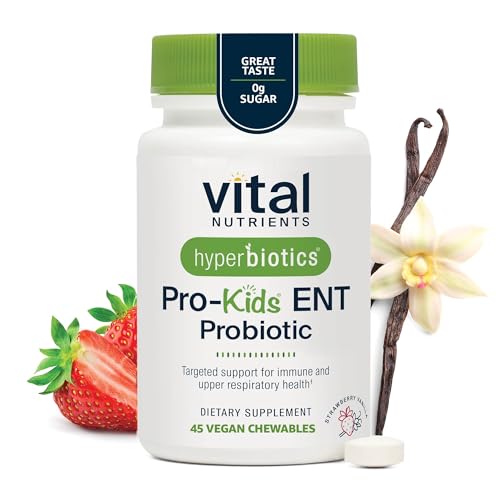
11. Hyperbiotics Vital Nutrients Pro Kids Probiotic ENT
This one is doing something categorically different from every other product here, and it is worth understanding before you buy it or skip it. Rather than targeting the intestine, it uses BLIS strains of Streptococcus salivarius — K12 and M18 — which colonize the mouth and throat. The premise is that the oral cavity is the entry point for the pathogens behind recurring ear, nose, and throat infections, and that establishing beneficial organisms there competes with them at the door rather than downstream.
The supporting research is specific rather than generic. Published work on the BLIS strains reported a substantial reduction in recurring seasonal ear, nose, and throat infections in children, and S. salivarius M18 produces an enzyme that helps break down dental biofilm, which is why the product carries an oral-health claim alongside the immune one. For the family whose child cycles through repeated ear infections and antibiotic courses each winter, this addresses that pattern directly in a way a gut-focused probiotic does not.
Set expectations correctly and the tradeoffs are clear. This is the most expensive product in the guide and carries the lowest star rating at 4.5, and its digestive benefit is genuinely secondary — a child whose main problem is constipation or diarrhea is better served by almost anything else on this page. It is sugar-free, free of all nine major allergens, and a simple one-tablet-per-day regimen for ages 2 and up. Buy it for the ear, nose, and throat pattern specifically, or do not buy it.
Hyperbiotics Vital Nutrients Pro Kids Probiotic ENT
by Hyperbiotics
The only oral-cavity probiotic here — BLIS S. salivarius strains that target recurring ear, nose, and throat infections rather than the gut.
Pros
- BLIS strains of Streptococcus salivarius colonize the mouth and throat rather than only the intestine, which is a genuinely different mechanism
- Published research on the BLIS strains reported a substantial reduction in recurring seasonal ear, nose, and throat infections
- S. salivarius M18 helps break down dental biofilm, so it supports oral health alongside immune function
- Sugar-free and free of all nine major allergens, with a simple one-tablet-per-day regimen
Cons
- Most expensive product in this guide and the lowest star rating at 4.5
- Digestive benefit is secondary here — a child whose main issue is constipation or diarrhea is better served elsewhere
Best Probiotics for Kids Constipation
Constipation is the single most common reason parents start looking at probiotics, and it deserves the most honest framing on this page. The evidence is modest. Meta-analyses in children show a small increase in weekly bowel movements and somewhat improved stool consistency, which is a real effect and not a large one. A probiotic belongs alongside fiber, fluids, physical activity, and an unhurried toilet routine, not instead of them, and any product marketed as a constipation cure for children is ahead of the data.
Two things guide the choice. Look for Bifidobacterium representation and a prebiotic fiber in the same product, because the fiber does independent mechanical work while feeding the organisms. And give it four weeks before judging, since the microbiome does not shift in days. The one strain with any specific pediatric mention for constipation is L. reuteri DSM 17938. If your child is withholding stool, soiling, or in pain, that is a pediatrician visit rather than a supplement decision, and our fiber supplement guide covers the pairing that actually moves the needle.
| Product | Price | Buy |
|---|---|---|
| Culturelle Kids Probiotic + Veggie Fiber GummiesBest for kids constipation Probiotic plus prebiotic veggie fiber in one sugar-free gummy, which is the combination the constipation research supports | $18.12 | View on Amazon |
| LOVEBUG Kids Probiotic Powder with Prebiotic FiberBest for toddler constipation Eight strains with prebiotic fiber formulated for ages 1 to 4, targeting normal bowel movements specifically | $23.95 | View on Amazon |
| BioGaia Baby Probiotic DropsBest strain-specific option L. reuteri DSM 17938 is the one strain named in pediatric guidance for childhood constipation | $17.58 | View on Amazon |
Best Probiotics for Kids Diarrhea and After Antibiotics
This is where pediatric probiotic evidence is strongest, and where a supplement genuinely earns its place. Two organisms carry that evidence. Saccharomyces boulardii is a yeast, so antibacterial antibiotics cannot kill it, which means it can be given at the same time as an antibiotic dose rather than staggered two hours away. Lactobacillus rhamnosus GG has the largest trial base for acute infectious diarrhea and shortens the episode by roughly a day.
Timing is the part most parents get wrong. For antibiotic-associated diarrhea, the probiotic works preventively, so starting it on day one alongside the antibiotic is substantially more effective than starting after loose stools appear. Continue for one to two weeks after the course finishes. During an acute episode, rehydration matters more than any supplement, and bloody stools, a high fever, signs of dehydration, or diarrhea persisting beyond a few days need medical attention rather than a probiotic.
| Product | Price | Buy |
|---|---|---|
| Florastor Kids Dual Action Probiotic PowderBest during an antibiotic course A yeast rather than a bacterium, so it survives antibiotics and can be given at the same time as each dose | $18.59 | View on Amazon |
| Culturelle Kids Daily Probiotic PacketsBest for acute diarrhea LGG has the largest trial base for shortening acute infectious diarrhea, by roughly a day | $32.99 | View on Amazon |
| Culturelle Kids Daily Chewable Probiotic, BerryBest for kids 3+ taking their own dose The same LGG strain and dose in a chewable an older child can take without supervision | $20.48 | View on Amazon |
Best Probiotics for Kids Immune System
Immune support is the most-advertised and least-substantiated claim in this category, so it is worth separating what the research shows from what the packaging implies. There is reasonable evidence that certain probiotic strains modestly reduce the frequency and duration of upper respiratory infections in children, particularly in daycare and school settings where exposure is constant. What there is not is evidence that a probiotic prevents illness in a meaningful, noticeable way. Expect somewhat fewer sick days over a season, not a child who stops catching colds.
The mechanism is worth knowing because it changes what to buy. Roughly seventy percent of immune tissue sits in the gut, which is why gut-focused probiotics have any respiratory effect at all. But for a child whose specific pattern is recurring ear, nose, and throat infections, an oral-cavity probiotic that colonizes the throat works on a different and more direct pathway. Adding vitamin D matters too, since deficiency is common in children and it has an independent role in immune function.
| Product | Price | Buy |
|---|---|---|
| Garden of Life Dr. Formulated Organic Kids+ ChewablesBest for daily immune support Fourteen strains plus vitamins C and D in one chewable, covering the gut and the micronutrient side together | $18.49 | View on Amazon |
| Hyperbiotics Vital Nutrients Pro Kids Probiotic ENTBest for recurring ear and throat infections BLIS S. salivarius strains colonize the mouth and throat, addressing the ENT pattern directly rather than downstream | $33.99 | View on Amazon |
| SmartyPants Kids Probiotic and Prebiotic GummiesBest prebiotic-backed immune formula M-Gard beta-glucan is a clinically studied immune prebiotic rather than a generic fiber filler | $18.29 | View on Amazon |
Best Probiotics for Toddlers and 1 to 2 Year Olds
The toddler window is the hardest to shop for and the most commonly mishandled. Chewables and gummies are generally labeled from ages 3 or 4 because a younger child cannot chew them reliably, and infant drops are formulated around colic in the first months rather than ongoing digestive support. That leaves parents of a one- or two-year-old choosing between two products that are both wrong for the age, which is how toddlers end up taking a quarter of an adult capsule on someone’s advice.
Powders solve this cleanly. A flavorless powder dissolves into milk, yogurt, or a smoothie and is undetectable to the most suspicious eater in the household, and the leading pediatric powders are labeled from 12 months. If your child is still under one, drops are the only appropriate format, and L. reuteri DSM 17938 is the organism with the evidence at that age. Match the format to what the child can safely take, because a superior formula that cannot be administered delivers nothing at all.
| Product | Price | Buy |
|---|---|---|
| LOVEBUG Kids Probiotic Powder with Prebiotic FiberBest for ages 1 to 4 Purpose-built for the 12-month to 4-year window most kids' probiotics skip, at the highest potency here | $23.95 | View on Amazon |
| Culturelle Kids Daily Probiotic PacketsBest flavorless daily powder Flavorless LGG powder from 12 months up that disappears into yogurt or cold milk without detection | $32.99 | View on Amazon |
| BioGaia Baby Probiotic DropsBest for under 12 months Drops safe from the first day of life, with the most studied colic strain in the world | $17.58 | View on Amazon |
Best Probiotic Gummies for Kids
Gummies win on the variable that decides whether a supplement works at all: whether the child takes it. A pharmacologically superior powder that becomes a nightly argument loses to a mediocre gummy that gets requested at breakfast, and compliance is not a soft consideration in pediatrics — it is the whole mechanism. For a picky eater or an older child who manages their own routine, the gummy is frequently the right call even against a better formula.
There are two real tradeoffs to weigh. Added sugar is the first, since gummies are the format most likely to carry it, and daily sticky sugar is a dental exposure your dentist will flag. Several gummies here are genuinely sugar-free, so this is avoidable rather than inherent. The second is age: gummies generally start at 3 or 4 and warrant supervision at the bottom of that range. Check the serving size too, because a two-gummy serving quietly halves the supply a bottle count implies.
| Product | Price | Buy |
|---|---|---|
| Culturelle Kids Probiotic + Veggie Fiber GummiesBest sugar-free gummy Sugar-free and dye-free with prebiotic veggie fiber and vitamin C, at one or two gummies per day | $18.12 | View on Amazon |
| MaryRuth Organics Kids Probiotic GummiesBest value gummy One gummy per day makes the 60-count bottle a genuine two-month supply, the longest here | $26.95 | View on Amazon |
| SmartyPants Kids Probiotic and Prebiotic GummiesBest acid-resistant gummy Spore-forming strains survive stomach acid natively, paired with a clinically studied immune prebiotic | $18.29 | View on Amazon |
Best Sugar Free and Organic Probiotics for Kids
Parents looking for a natural or organic kids’ probiotic are usually solving two problems at once: they want the ingredient list short and recognizable, and they want the daily sugar exposure near zero. Those goals do not automatically travel together. USDA Organic certification verifies ingredient sourcing but says nothing about sugar content, and plenty of certified-organic gummies are sweetened with organic cane sugar, which behaves exactly like sugar on a child’s teeth.
Read the supplement facts panel rather than the front of the box. The cleanest options here achieve sweetness from whole fruit or use no sweetener at all, and the flavorless powders sidestep the question entirely by having nothing to sweeten. It is also worth knowing that organic certification does not verify CFU viability, so a Clean Label Project or NSF mark tells you something different and arguably more useful for a living-organism product. The two certifications answer different questions and neither substitutes for the other.
| Product | Price | Buy |
|---|---|---|
| Llama Naturals Kids Probiotic with Prebiotic FiberBest clean-label gummy Real organic fruit with no added cane sugar, syrups, or synthetic vitamins, plus a full prebiotic dose | $29.99 | View on Amazon |
| Garden of Life Dr. Formulated Organic Kids+ ChewablesBest organic chewable USDA Organic and non-GMO with no added sugar, and vitamins C and D included in the same chewable | $18.49 | View on Amazon |
| Culturelle Kids Daily Probiotic PacketsBest no-sweetener option A flavorless powder has nothing to sweeten, which removes the sugar question from the decision entirely | $32.99 | View on Amazon |
Best Probiotics for Teens
Teenagers are the group most likely to be given an adult probiotic by default, and that is usually fine but not always optimal. By the mid-teens the gut microbiome has largely reached adult composition, so adult multi-strain formulas are physiologically appropriate. The practical questions become different ones: will they remember to take it, does it fit around a schedule of skipped breakfasts and late nights, and are they taking it for a reason that a probiotic actually addresses.
Two teen-specific situations are worth naming. Acne and skin concerns drive a lot of teenage supplement buying, and the gut-skin axis research is genuinely preliminary rather than actionable, so set expectations low. Repeated antibiotic courses for acne are common and are a legitimate reason to use S. boulardii alongside them. For everyday use, a chewable or gummy a teenager will actually take beats a capsule regimen they abandon in a week, and our adult probiotics guide covers the higher-CFU multi-strain options once they are ready for them.
| Product | Price | Buy |
|---|---|---|
| Garden of Life Dr. Formulated Organic Kids+ ChewablesBest daily option for teens Fourteen strains with vitamins C and D in a chewable that needs no water or routine to remember | $18.49 | View on Amazon |
| Hyperbiotics Vital Nutrients Pro Kids Probiotic ENTBest for teens with recurring throat issues Labeled for use as a teen probiotic, with BLIS strains that work in the mouth and throat | $33.99 | View on Amazon |
| Florastor Kids Dual Action Probiotic PowderBest during acne antibiotic courses A yeast that antibiotics cannot kill, which suits the long antibiotic courses common in acne treatment | $18.59 | View on Amazon |
Best Probiotics for Kids by Use Case
Beyond the situations above, a few narrower needs come up often enough to be worth matching to a specific product.
| Product | Price | Buy |
|---|---|---|
| Culturelle Kids Daily Chewable Probiotic, BerryBest for 3 year olds A berry chewable labeled from age 3, the first format most children can manage independently | $20.48 | View on Amazon |
| Garden of Life Dr. Formulated Organic Kids+ ChewablesBest for 4 year olds and school age Fourteen strains plus vitamins C and D, labeled from age 4 for the school-age routine | $18.49 | View on Amazon |
| Llama Naturals Kids Probiotic with Prebiotic FiberBest for picky eaters A whole-fruit gummy children ask for, with no added sugar and no synthetic vitamins | $29.99 | View on Amazon |
| LOVEBUG Kids Probiotic Powder with Prebiotic FiberBest probiotic powder for kids Unflavored instant-dissolve powder that disappears into any cold drink or food | $23.95 | View on Amazon |
| MaryRuth Organics Kids Probiotic GummiesBest prebiotic and probiotic combination One gummy a day pairing a named spore-forming strain with a two-month supply | $26.95 | View on Amazon |
| Hyperbiotics Vital Nutrients Pro Kids Probiotic ENTBest for kids ear nose and throat BLIS S. salivarius strains that colonize the throat rather than the intestine | $33.99 | View on Amazon |
| Florastor Kids Dual Action Probiotic PowderBest for travel and daycare bugs Shelf-stable for three years with no refrigeration, ready whenever a stomach bug or prescription arrives | $18.59 | View on Amazon |
How to Choose the Best Probiotic for Your Child
The buyer’s guide factors below cover the core criteria, but three practical points deserve emphasis because they are where parents most often go wrong.
The first is that CFU count is the weakest signal on the label, and the products in this guide demonstrate it directly. The most rigorously validated pediatric probiotic here, BioGaia’s L. reuteri drops, carries 100 million CFU — orders of magnitude below the billions advertised on gummy bottles — because that is the dose used in the colic trials. A number is only meaningful relative to what was studied for that organism, and above the studied threshold the effect plateaus. Buying on CFU is buying on the one variable manufacturers can inflate for free.
The second is that refrigeration is largely a solved problem, and a product requiring it is now a liability rather than a mark of freshness. Modern lyophilized and spore-forming formulations hold viability at room temperature, while a refrigerated product that sat in a warm delivery truck has lost potency you cannot see or measure. For anything ordered online, shelf-stable is the safer bet.
The third is that probiotics do not permanently colonize. Research consistently shows supplemented strains fade from the gut within a few weeks of stopping, which means the model is continuous use for an ongoing issue and a defined course for an acute one — not a bottle finished once and considered done. For a child on antibiotics, that means two to four weeks after the course ends. For chronic constipation, it means daily use for as long as the problem persists, reassessed with your pediatrician rather than continued indefinitely by habit.
Buyer's Guide
Choosing a probiotic for a child comes down to matching a named strain to a specific reason, in a format your child will actually take at an age-appropriate dose. Nearly every buying mistake in this category comes from ignoring one of those three.
Strain Specificity Over CFU Count
The strain matters more than any other variable, and in pediatrics the evidence concentrates on a short list. Lactobacillus rhamnosus GG has the largest trial base for acute infectious diarrhea and antibiotic-associated diarrhea. Saccharomyces boulardii CNCM I-745 has strong data for the same indications and, being a yeast, survives concurrent antibiotics. Lacticaseibacillus reuteri DSM 17938 is the most studied organism for infant colic and the only strain some pediatric bodies mention for childhood constipation. A label reading 'proprietary blend of Lactobacillus' without strain identifiers cannot be checked against any of that literature. Look for the letter-and-number suffix after the species name, and if it is absent, treat the product as unevaluable rather than as a reasonable default.
Age Range and Format
The dose that gets swallowed is the only dose that counts. Liquid drops are the only format appropriate under 12 months and are the standard for colic. Flavorless powders cover roughly 12 months onward and are the most reliable choice for a child who resists supplements, because they disappear into yogurt or applesauce without changing the taste. Chewable tablets and gummies generally start at ages 3 or 4, both because a younger child cannot chew them reliably and because of the choking consideration. A gummy that a 6-year-old asks for every morning outperforms a superior powder that becomes a daily argument, so weigh compliance heavily rather than treating it as a soft factor.
Pediatric CFU Dosing
Children do not need adult doses, and higher numbers are not automatically better. Most pediatric clinical trials used doses between 1 and 10 billion CFU, and the products with the strongest evidence in this guide sit squarely in that band at 5 billion. A 15 billion CFU toddler formula is not five times better than a 3 billion one, because the effect above the studied threshold plateaus for most strains. What does matter is whether the CFU count is guaranteed through the expiration date rather than at time of manufacture, since probiotic organisms die off during shelf life. A guarantee at manufacture tells you nothing about the count on the day your child takes it.
Sugar Content and Clean Label
Gummies are the format children prefer and the format most likely to carry added sugar, so this deserves a direct look at the supplement facts panel rather than the marketing on the front. Several products here are genuinely sugar-free, including the Culturelle gummies and the Llama Naturals whole-fruit gummy, while others use organic cane sugar. A gram or two per day is not a health crisis, but it accumulates alongside everything else a child eats, and sticky sugary gummies taken daily are a dental consideration your dentist will raise before your pediatrician does. Dye-free and allergen-free formulations also matter more in pediatrics than in adult supplements, since childhood food allergies are common and label reading is the only protection.
Third-Party Testing and Certification
The active ingredient in a probiotic is a living organism, which means the gap between what the label claims and what the bottle contains can be large and invisible. Independent verification from the Clean Label Project, NSF International, or USP confirms both purity and that the stated organisms are actually present at the stated counts. USDA Organic certification verifies ingredient sourcing but does not independently confirm CFU viability, so the two are not interchangeable. For products given to children daily, third-party testing for heavy metals and contaminants is not a premium feature, and several products in this guide carry that verification explicitly.
Matching the Strain to the Reason
Start from the problem, not the product. For a course of antibiotics, choose S. boulardii, which antibiotics cannot kill, or LGG taken two hours apart from each dose. For acute diarrhea, LGG has the largest evidence base. For colic in a baby under 12 months, L. reuteri DSM 17938 is the only well-supported answer. For constipation, look for Bifidobacterium representation paired with a prebiotic fiber, and set modest expectations. For recurring ear, nose, and throat infections, the BLIS Streptococcus salivarius strains work in the mouth and throat rather than the gut, which is a different mechanism entirely. For general daily support in a healthy child, a multi-strain formula with named organisms is a reasonable maintenance choice.
Final Verdict
For most families buying a pediatric probiotic without a specific clinical reason, Culturelle Kids Daily Probiotic Packets is our best overall pick. It delivers the most-studied pediatric strain at the dose the trials actually used, in a flavorless powder that works from 12 months through the school years and disappears into any cold food. The 50-packet count makes the highest sticker price in this guide into a competitive per-day cost.
For the antibiotic prescription that arrives twice a winter, Florastor Kids is the one to keep in the medicine cabinet. Being a yeast, it survives the antibiotic and can be given at the same time, which removes the staggered-schedule problem entirely, and it is the least expensive product here. For parents prioritizing ingredient quality over potency, Llama Naturals offers the cleanest label in the category with a real prebiotic dose, and for babies under one year BioGaia Baby Drops is the only appropriate choice on this page.
A closing note that matters more here than in most categories: the majority of healthy children do not need a daily probiotic, and the evidence is strongest for specific situations rather than routine supplementation. If your child has a chronic digestive condition, is immunocompromised, is receiving chemotherapy, or has a central venous catheter, probiotic selection is a clinical decision rather than a consumer one. Talk to your pediatrician before starting, and be skeptical of any product promising more than the research supports.
Frequently Asked Questions
Do kids need a daily probiotic?
Is it safe for kids to take probiotics daily?
What age can a child start taking probiotics?
How long does it take for probiotics to work in kids?
Can a probiotic replace MiraLAX for a constipated child?
Related Articles
About the Reviewer

Dr. David Taylor, MD, PhD
Drexel University College of Medicine (MD), Indiana University School of Medicine (PhD)
Dr. David Taylor is a licensed physician and medical researcher who founded BestRatedDocs in 2016. With an MD from Drexel University and a PhD from Indiana University School of Medicine, he combines clinical expertise with a passion for health technology to provide evidence-based product recommendations. Dr. Taylor specializes in health informatics and regularly evaluates medical devices, diagnostic equipment, and therapeutic products to help healthcare professionals and patients make informed decisions.