Best Vaginal Probiotics of 2026
Dr. David Taylor, MD, reviews the best vaginal probiotics of 2026. Compare 14 picks by strain designation, CFU, format and honest evidence.
Updated

The vaginal probiotic shelf is one of the few places in the supplement aisle where the marketing has run further ahead of the evidence than usual. Bottles promise pH balance, odor control and yeast balance, and almost none of them will tell you which organism is inside. After two decades of having this conversation in clinic, usually with a woman on her third course of metronidazole in a year, I can tell you the question that separates these products is not how many billion CFU appear on the front label. It is whether the strain inside carries a designation you can look up. The best vaginal probiotics of 2026 are the handful that do.
Start with what the guidelines actually say, because no other page in this category will tell you. The 2021 CDC STI Treatment Guidelines address these products directly and state that “no studies support these products as an adjunctive or replacement therapy for women with BV.” That is an insufficient-evidence position rather than a finding of harm, and it belongs alongside a more permissive one: the 2023 DGGG, OEGGG and SGGG guidelines from Germany, Austria and Switzerland treat Lactobacillus supplementation as a reasonable option for recurrence prophylaxis after a course of antibiotics. Both documents are current. In July 2025 the Harvard T.H. Chan School of Public Health published a skeptical piece arguing that probiotics for vaginal health may not deliver what buyers expect. That argument deserves engaging with rather than ignoring, and you will find it woven through the reviews below.
There is real evidence in this niche, and all of it is strain-specific. The strongest randomised trial available is LACTIN-V (Cohen CR et al., New England Journal of Medicine 2020;382:1906-1915), which gave women a Lactobacillus crispatus CTV-05 vaginal applicator after a metronidazole course and reported bacterial vaginosis recurrence at 12 weeks of roughly 30 percent against 45 percent on placebo. The oral pairing of L. rhamnosus GR-1 with RC-14 traces back to Reid G et al., FEMS Immunology and Medical Microbiology 2003;35(2):131-4, and carries a nomenclature wrinkle nobody flags on the shelf: RC-14 was originally published as L. fermentum and is now marketed as L. reuteri. The newest entry is L. rhamnosus TOM 22.8 (Udjianto U et al., 2025, PMC12059960), dosed at ten billion CFU daily for ten days. None of that evidence transfers to a bottle labeled “proprietary blend.”
We reviewed 14 products for this guide, each verified live and in stock on the day of writing. What follows is a full review of every one, then seven sections matching a specific situation to the right products on this page. Choosing the best probiotic for vaginal health comes down to three things in this order: whether the strains are designated rather than hidden behind a proprietary blend, whether the dose is matched to those strains, and whether the format puts the organisms where you need them. Every women’s vaginal probiotic below is judged on that basis rather than on its front label. If what you want is a general daily formula rather than a vaginal-specific one, our probiotics for women guide covers that ground, and our general probiotics roundup covers it without the women’s-health framing at all.
Find the Right Vaginal Probiotic for Your Situation
Different situations point to genuinely different products here. Jump to the one that matches yours:
- Best vaginal probiotics overall, all 14 picks reviewed in full
- Best vaginal probiotic suppositories
- Best probiotics for BV
- Best vaginal probiotic gummies
- Best probiotic for vaginal odor
- Best probiotics for yeast infections
- Best probiotics for UTI prevention
- Best probiotics for pH balance
- More use cases
How We Chose These Vaginal Probiotics
Every product here was verified live, in stock and correctly identified on Amazon before it earned a place, and each price, rating and review count was read from the listing rather than carried across from an older draft. Beyond availability we applied a floor of 200 verified ratings. That is far below the 5,000-rating floor we hold to on our general probiotic guides, and the reason is structural: this category is much smaller, a vaginal-specific formula with a designated strain rarely accumulates the review volume a general gut probiotic does, and keeping the higher floor would have left this page filled with drugstore blends and nothing checkable on it.
Three picks sit below that general floor, and they should be named rather than allowed to pass quietly. Vitanica carries 227 verified ratings, the LCR86 crispatus tablet 232, and Life-Space 418. All three earned inclusion on the same ground: each names its organisms specifically enough to be searched in the literature, which several products with fifty times their review volume do not. Where a thin review base is the trade you are making, it appears in that product’s cons rather than being smoothed over.
Beyond the floor we applied four filters. Label transparency came first, with a product naming a designated strain scored above one hiding a roster inside a trademarked blend, and any undisclosed CFU count stated in the review rather than skipped past. Second, delivery format, so that this page covers oral capsules, tablets, gummies and vaginal suppositories rather than pretending one route suits everyone. Third, honest tolerance data, which meant reading the critical reviews as carefully as the positive ones, since local irritation is the single most common reason a suppository gets abandoned. Fourth, we required that add-ins such as cranberry, D-mannose or hyaluronic acid be defensible on their own merits rather than decorative.
Three products that rank well for these searches were deliberately excluded, and the reason is worth knowing before you shop. Each was a homeopathic applicator sold with “BV treatment” or “bacterial vaginosis relief” in the title. None contained a live probiotic culture. A title making a disease-treatment claim on a product regulated as a dietary supplement is the clearest warning sign in this category that you are being sold something other than what you searched for. When you see that phrasing, keep scrolling.
Best Vaginal Probiotics Overall
These are the 14 products that made the guide, reviewed in the order we would recommend considering them. Jarrow Fem-Dophilus is our best overall pick because it is built on the single best-documented strain pair available without a prescription and does not dress that up with anything else. The seven situation-specific sections that follow the reviews then match particular problems, from recurrent bacterial vaginosis to odor to urinary tract prevention, to particular bottles on this page.
1. Jarrow Fem-Dophilus Probiotics: Best Overall
Jarrow’s formula is the least cluttered thing on this page and that is exactly why it wins. There is no cranberry, no prebiotic, no vitamin C, no proprietary blend name with a trademark on it. There are two organisms, Lactobacillus rhamnosus GR-1 and Lactobacillus reuteri RC-14, both carrying alpha-numeric designations, which means you can take those codes to PubMed and read what has actually been studied. That pairing traces to the work of Gregor Reid and colleagues from 2003 onwards, and it remains the most-cited oral combination in vaginal and urinary flora research. One nomenclature detail is worth carrying with you: RC-14 was originally published as Lactobacillus fermentum and was later reclassified, so you will see it sold under both species names. It is the same organism.
The one billion CFU count will look thin against competitors advertising fifty times more, and I would encourage you to ignore that instinct. Dosing in this literature is matched to the strain and to the route rather than escalated for the label. The trials behind GR-1 and RC-14 used doses in this general range, and the vaginal applicator in the LACTIN-V trial delivered roughly two billion CFU per application, which tells you how far the marketing convergence on ten billion has drifted from the research. A documented organism at a studied dose is a more defensible purchase than an anonymous blend at any count.
The honest limitations are two. The review base of 3,560 verified ratings is respectable but a fraction of what the drugstore brands carry, so the tolerance picture is less thoroughly characterised. And because there is nothing here but the culture, this does nothing for urinary tract support, so if that is your real concern you want a product further down this page with cranberry or D-mannose in it. Take one capsule with a meal and water, and give it eight weeks before forming a view.

Jarrow Fem-Dophilus Probiotics, 60 Capsules
by Jarrow Formulas
The only pick on this page built entirely around the GR-1 and RC-14 pair, which is the closest thing this category has to a documented strain combination.
Pros
- Carries L. rhamnosus GR-1 and L. reuteri RC-14, the designated strain pair with the longest published record in vaginal and urinary flora research
- Shelf-stable, so there is no cold chain to break in shipping or in a warm cupboard
- Free of the common food allergens, and taken as one capsule with a meal and water
- The manufacturing process is built to protect the culture from stomach acid rather than overdosing to compensate for die-off
Cons
- 1 billion CFU is the lowest labeled count of any oral capsule in this guide, which reads badly next to competitors even though the published work on this pair used comparable doses
- No cranberry, prebiotic or other add-in, so it does nothing for urinary tract support beyond the strains themselves
2. vH essentials Probiotics for Women with Prebiotics and Cranberry: Budget Pick
vH essentials carries the lowest sticker price on this page and one of the largest review bases in the entire category, at more than 43,000 verified ratings. Those two facts together are the whole argument for it. For someone who wants to run a two or three month trial without a meaningful outlay, or who has never taken a vaginal probiotic and does not want to commit to a premium bottle to find out whether it does anything, this is the sensible starting point.
What you get for that price is a capsule paired with an FOS prebiotic, cranberry powder and vitamin C, which is a more complete formulation than several products costing three times as much. Reviewers describe it as easy to swallow with almost no smell, and the review summary reports benefit across both digestive and vaginal comfort. What you do not get is any way of checking it. The listing names no strain and states no CFU count, which means everything above is a description of a formula rather than a claim you can verify, and it is why this sits second rather than first despite the price.
One honest correction to the obvious assumption. Lowest sticker price is not the same as cheapest to use. Because this is a thirty-day supply, the LCR86 crispatus tablet further down this page costs a fraction per day of what the gummies do, which makes it the least expensive product here by a wide margin over any month you actually count. vH essentials is the cheapest bottle. It is not the cheapest habit. Nausea also appears repeatedly in critical reviews, so take it with food rather than on an empty stomach.

vH essentials Probiotics for Women with Prebiotics and Cranberry, 60 Ct
by vH essentials
The lowest sticker price in the category attached to the largest review base of any budget option, held back by a listing that discloses neither strain nor CFU count.
Pros
- Lowest sticker price on this page, attached to a review base of more than 43,000 verified ratings
- Pairs the culture with an FOS prebiotic, cranberry powder and vitamin C rather than selling the bacteria alone
- Reviewers consistently describe the capsules as easy to swallow with almost no smell
- The review summary reports benefit for both digestive and vaginal comfort across a mature pool of buyers
Cons
- Neither the strains nor the CFU count appears on the listing, so there is nothing here to check against published research
- Nausea comes up repeatedly in critical reviews
- Opinions on taste are divided
3. Life-Space Vaginal Probiotic Women’s Microflora pH Balance: Upgrade Pick
Life-Space assembles the widest set of designated vaginal strains available in a single oral capsule. GR-1 and RC-14 are both here, which puts it level with our best overall pick on that front, and it adds Lactobacillus crispatus LBV88 plus three further organisms across a six-strain roster. Crispatus is the species most consistently associated with a stable, acidic vaginal community in the microbiome literature, and it is the genus and species used in LACTIN-V, so having a designated crispatus strain alongside the GR-1 and RC-14 pair is the most complete configuration on this page.
The potency claim is also the most carefully worded here, and that matters more than the number. Life-Space states 6.3 billion CFU as a minimum guaranteed through expiration rather than at time of manufacture. Almost nothing else in this category makes that distinction, and it is the distinction that counts, because probiotic organisms die steadily through months of warehousing, shipping and cupboard storage. A count measured on packing day describes a bottle you never saw. The culture is freeze-dried and shelf-stable, and the listing cites both FDA-registered and Australian TGA-registered manufacturing.
The trade is visibility. At 418 verified ratings this has the smallest oral-capsule review base in the guide, which means less evidence about batch-to-batch consistency and a thinner picture of how well it is tolerated across a large population. It is also the most expensive bottle on this page, although across a 60-day supply the daily cost is unremarkable. Buy this one if recurrent bacterial vaginosis after antibiotic treatment is the problem you are actually trying to solve and you want the fullest designated-strain roster available by mouth.

Life-Space Vaginal Probiotic Women's Microflora pH Balance
by Life-Space
The most complete designated-strain roster available in an oral capsule, with a potency guarantee that runs to expiration rather than to packing day.
Pros
- Six strains including GR-1, RC-14 and L. crispatus LBV88, the widest set of designated vaginal strains on this page
- 6.3 billion CFU stated as a minimum guaranteed through expiration rather than at time of manufacture
- Freeze-dried and shelf-stable, with the listing citing FDA-registered and Australian TGA-registered manufacturing
- A 60-day supply per bottle, which reviewers repeatedly describe as worth the outlay
Cons
- 418 verified ratings is the smallest oral-capsule review base in this guide, so the tolerance picture is thinner than the drugstore brands
- Sits at the top of this guide's price range
4. RepHresh Pro-B Vaginal Probiotic Supplement: Runner-Up
RepHresh Pro-B has been on pharmacy shelves longer than most of this category has existed, and it shows in the review pool: nearly 24,000 verified ratings, which makes its tolerance profile one of the best characterised here. It is also sold and shipped by Amazon directly rather than through a third-party storefront, which quietly removes a category of risk that affects most of the products on this page, where listing variants and pack sizes shift under the same ASIN.
The formulation is straightforward. Five billion CFU in one capsule a day, no prebiotic, no cranberry, nothing else in the bottle. Reviewers describe it as working quickly and repeatedly mention reduced odor. I want to be careful with the stronger claims that appear in its reviews, some of which describe stopped recurrences of yeast infections and bacterial vaginosis. Those are buyers describing their own experience, not findings, and this product is not approved to treat or prevent either condition. Read them as the reason the brand has stayed on the shelf for two decades, not as evidence.
The deduction is the same one that applies across most of this category. The listing describes its organisms as clinically tested Lactobacillus strains but names not one of them, so there is no designation to check and no trial to read. That is why this is a runner-up rather than a top pick despite the review depth. Nausea appears often enough in critical reviews to plan around, and a recurring complaint holds that the price is high for how little the label discloses. Both of those are fair.

RepHresh Pro-B Vaginal Probiotic Supplement
by RepHresh
The drugstore default with a real CFU disclosure and a deep review pool, undercut by a label that names no strain you can look up.
Pros
- 5 billion CFU in a single daily capsule from one of the longest-established brands in the feminine care aisle
- Sold and shipped by Amazon directly, which removes the third-party seller variability affecting most of this category
- Reviewers describe it as working quickly and note its odor-reducing properties
- Nearly 24,000 verified ratings, one of the deepest review pools among vaginal-specific formulas
Cons
- The listing calls its strains clinically tested but names none of them, so nothing here can be matched to a published trial
- Nausea appears often enough in critical reviews to plan around
- A recurring complaint that the price is high for what the label actually discloses
5. AZO Complete Feminine Balance Daily Vaginal Probiotics: Best-Known Drugstore Brand
AZO is the name most women reach for first, because it has been in the feminine health aisle of every American pharmacy for years, and the review pool of more than 17,000 verified ratings reflects that familiarity. The routine could not be simpler: one sugar-free capsule daily, and the listing states it is safe during pregnancy, which is a question I am asked about this category constantly. Confirm that with your own obstetric provider before starting anything in pregnancy, but it is one of the few products here that addresses the point at all.
AZO markets this on its Intelliflora blend, and the branded name is where the trail ends. The individual strains are not named and the CFU count is not disclosed anywhere on the listing, which means there is no way to compare its potency against anything else on this page and no organism to search. The manufacturer also promotes a claim about how quickly the product works. That is AZO’s claim rather than ours, and I would not build a purchase decision on it, because a proprietary blend with no published designation cannot be traced to the study a claim like that would need.
What AZO genuinely offers is adherence. Reviewers describe it as extremely easy to swallow and easy to keep in a daily routine, and a probiotic taken every day for three months beats a better-documented one abandoned in a drawer after two weeks. The counterweights are real: stomach pain appears in a meaningful share of critical reviews, and opinions on value split sharply. Buy this one if brand familiarity and a frictionless routine are what will actually keep you consistent.
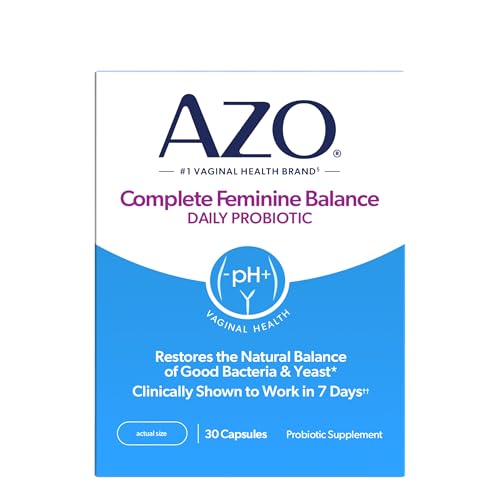
AZO Complete Feminine Balance Daily Vaginal Probiotics
by AZO
The most recognisable name on the shelf and the easiest routine to keep, sold with neither a strain list nor a CFU count.
Pros
- The most widely recognised feminine-health brand in this set, with more than 17,000 verified ratings
- One capsule daily, sugar free, and described on the listing as safe during pregnancy
- Reviewers describe it as very easy to swallow and simple to keep in a daily routine
- The review summary reports help maintaining pH balance across a large pool of buyers
Cons
- The Intelliflora blend is proprietary, and neither the individual strains nor the CFU count appears on the listing
- Stomach pain shows up in a meaningful share of critical reviews
- Opinions on value are sharply divided
6. URO Vaginal Probiotics for Odor, Flora & pH Balance: Most-Reviewed Odor Formula
URO has assembled one of the largest review bases on this page, more than 37,000 verified ratings, in a fraction of the time AZO or RepHresh took. The product itself is a reasonable piece of formulation: five billion CFU across two capsules daily, paired with an XOS prebiotic so the culture arrives with a substrate to feed on. Xylooligosaccharides are a well-characterised prebiotic fiber, and pairing one with a live culture makes this a genuine synbiotic rather than a probiotic with a marketing word attached.
Reviewers are unusually consistent on the practical points. The capsules are odorless, easy to swallow and leave no aftertaste, which sounds trivial until you have abandoned a supplement because of how it smelled when you opened the bottle. The listing states third-party testing and the brand backs the product with a 30-day money-back guarantee, which is a meaningful gesture in a category where the honest advice is to give any product eight weeks.
The same limitation applies here as almost everywhere else. The V-Positiv blend does not name its strains, so the five billion CFU is a real number attached to organisms you cannot identify. There is also a specific safety signal worth naming rather than burying: severe abdominal pain appears in a subset of critical reviews, more prominently than the general first-week adjustment discomfort common across this category. Start with a single capsule rather than the full two-capsule serving, take it with food, and stop if abdominal pain is significant rather than mild.

URO Vaginal Probiotics for Odor, Flora & pH Balance
by URO (O Positiv)
A heavily reviewed daily capsule with a real CFU figure and a prebiotic, from a brand that will not say which organisms it is counting.
Pros
- 5 billion CFU paired with an XOS prebiotic, so the culture arrives with a substrate to feed on
- More than 37,000 verified ratings, one of the largest review bases on this page
- Reviewers describe the capsules as odorless, easy to swallow and free of aftertaste
- Third-party tested per the listing, and backed by a 30-day money-back guarantee
Cons
- The V-Positiv blend does not name its strains, so the 5 billion CFU cannot be attributed to any documented organism
- Severe abdominal pain appears in a subset of critical reviews
- Among the more expensive daily capsules in this guide
7. Physician’s CHOICE Probiotics for Women: Best General Women’s Formula
This product needs a piece of framing before anything else, because it is the most-reviewed thing on this page by a wide margin and it is not a vaginal probiotic. It is a general women’s gut, urinary and feminine health formula that surfaces in vaginal searches because of how it is titled. It is also our best overall pick on the separate probiotics for women guide, where it competes against general formulas and wins comfortably. Here it is in a different race.
On its own terms it is the strongest formulation on the page. Fifty billion CFU across six strains is the highest labeled count here, and the add-in stack of organic prebiotics, Pro-Cran cranberry extract and D-mannose is the most complete, targeting the urinary tract rather than the vagina specifically. The listing states third-party testing for purity and potency, it is one capsule a day, and the review pool of more than 56,000 verified ratings means its tolerance profile is better characterised than anything else in this guide.
The reasons it is not the vaginal pick are two. First, its six strains are not individually named, so all fifty billion of those CFU belong to organisms you cannot trace to any published work, and in a category where the entire quality signal is strain designation that is a heavy deduction. Second, read the reviews and the sentiment is overwhelmingly about digestion and bloating rather than vaginal outcomes, which is what you would expect from a formula built for the gut. Buy it if you want one capsule covering gut, urinary and general feminine health. Buy something further up this page if the vaginal community is the actual target.

Physician's CHOICE Probiotics for Women, 50 Billion CFU
by Physician's CHOICE
The largest review pool and the highest CFU count in this guide, from a general women's formula that surfaces in vaginal searches without being built for them.
Pros
- 50 billion CFU across six strains, the highest labeled count on this page
- Adds organic prebiotics, Pro-Cran cranberry extract and D-mannose, the two ingredients most associated with urinary tract support
- The largest review pool of any product researched for this guide, at more than 56,000 verified ratings
- Third-party tested for purity and potency per the listing, in a once-daily capsule
Cons
- Formulated as a general women's gut and urinary product rather than a vaginal-specific one, and its review sentiment reflects that
- The six strains are not individually named, so the 50 billion CFU cannot be traced to any published organism
- Stomach discomfort during the first week is a recurring report
8. Vitanica V-Probiotics: Best Crispatus-Led Suppository
Vitanica leads its five-species blend with Lactobacillus crispatus, and given that crispatus dominance is the microbiological state most associated with a stable vaginal environment, leading with it is the right formulation instinct. L. gasseri, L. jensenii, L. reuteri and L. rhamnosus fill out the roster, which reads like a reasonable reconstruction of a healthy vaginal community rather than a list assembled for the label. It is formulated by Dr. Tori Hudson, a naturopathic physician who has specialised in women’s health for decades, and made in a GMP-certified facility per the listing.
The disclosure that matters most here is the CFU count. Vitanica states two billion CFU per suppository, and it is the only suppository in this guide that discloses a dose at all. That number is also right in line with the roughly two billion CFU per applicator used in LACTIN-V, which is the closest any product on this page comes to matching the dosing of the strongest trial in the field. The clean label is genuine too: no parabens, fragrances, preservatives or artificial colors, which matters more for something used intravaginally than for a capsule you swallow.
Two honest deductions. The species are named without alpha-numeric strain codes, so while you know you are getting crispatus, you cannot know which crispatus, and strains within that species behave differently. And several customers report irritation, which is the most common failure mode for this whole format and appears in the reviews of all three suppositories here. At 227 verified ratings the base is thin for a product used internally. If itching or burning develops, stop and see your clinician rather than continuing through it.

Vitanica V-Probiotics, Blend with L. Crispatus, 30 Vaginal Suppositories
by Vitanica
The only suppository here that discloses its CFU count, built around L. crispatus, though its species are named without the codes that would make them checkable.
Pros
- Names L. crispatus first among five Lactobacillus species, the organism most associated with a stable vaginal community
- Discloses 2 billion CFU per suppository, which is rare in this format
- Formulated by a women's health specialist, Dr. Tori Hudson, and made in a GMP-certified facility per the listing
- Clean label with no parabens, fragrances, preservatives or artificial colors
Cons
- The species are named but carry no alpha-numeric strain codes, so none can be matched to a specific trial
- Several customers report irritation
- 227 verified ratings is a thin base for a product used internally
9. Biom Vaginal Probiotic Suppository: Best Strain Disclosure in Suppository Form
Biom does the thing that almost nothing else in the suppository format does: it names its strains with designations. Lactobacillus crispatus Bi16 and Lactobacillus gasseri Bi19 are specific codes attached to specific organisms, alongside L. acidophilus and L. coagulans, and the formula is covered by two cited US patents. For a reader who has followed the argument of this page, that this is the most checkable suppository here should carry weight.
The supporting ingredients are also the most thoughtful in the format. Prebiotics give the culture a substrate, lactic acid addresses vaginal pH directly rather than waiting for the bacteria to produce it, and hyaluronic acid is a humectant that helps with the dryness and discomfort that often accompany the symptoms bringing someone to this category. The review summary reports it balancing pH and reducing odor, and some reviewers describe fast relief from itching. Biom’s own listing goes further than that, promising rapid relief from redness, itching and burning. That is the manufacturer’s language, not ours, and this product is not approved to treat any of those symptoms.
The gap in an otherwise strong package is the CFU count, which is not disclosed. Naming your strains and then declining to say how many of them are in each suppository is a strange combination, and it means the designations cannot be matched to a dose. Reviewer feedback on comfort is genuinely mixed, with some reporting more irritation rather than less, and opinions on ease of insertion divide. At 15 suppositories per box this is the most expensive suppository here per application.

Biom Vaginal Probiotic Suppository (15 count)
by Biom
The most specific strain disclosure in the suppository format, paired with lactic acid and hyaluronic acid, but with no CFU count to attach to those names.
Pros
- Names L. crispatus Bi16 and L. gasseri Bi19, the most specific strain disclosure of any suppository on this page
- Combines the culture with prebiotics, lactic acid and hyaluronic acid rather than bacteria alone
- The review summary reports it balances pH and reduces odor, with some reviewers noting fast relief from itching
- Free of parabens, titanium dioxide and triclosan, with the formula covered by two cited US patents
Cons
- The CFU count is not disclosed, so the named strains cannot be attached to a dose
- Feedback on comfort is mixed, with some reviewers reporting more irritation rather than less
- Opinions on ease of insertion are divided
10. VagiBiom Lactobacillus Suppository: Most Accessible Suppository
VagiBiom is the least expensive way into the suppository format, which makes it the default entry point for anyone who wants to try a suppository without committing to a premium box. It is free of preservatives and fragrances, and reviewers repeatedly note moisturizing properties that help with sensitive skin, which is a real advantage in a format where irritation is the main reason people stop.
Some reviewers report a noticeable difference after the first application. I would read that carefully rather than dismissively. A suppository placed intravaginally produces immediate physical effects, lubrication, a pH change from the excipients, that have nothing to do with bacterial colonisation, and colonisation is a process measured in weeks rather than hours. Whatever is happening in the first day is not the probiotic doing what a probiotic does. The brand’s own marketing also uses odor treatment language and makes a comparative claim against tea tree suppositories. Both are VagiBiom’s claims rather than assessments of ours, and neither is something this product is approved to make.
The disclosure here is the weakest on the page: no strains named, no CFU count stated, so a Lactobacillus suppository is genuinely all you know you are buying. Experiences with side effects are mixed and some reviewers report developing yeast infections afterwards, which is worth taking seriously in a format placed internally. Pack size also varies by listing variant, so check the count on the exact option you select rather than assuming.
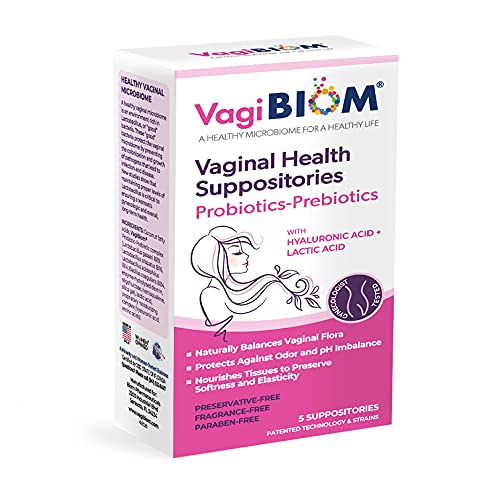
VagiBiom Lactobacillus Suppository
by VagiBiom
The least expensive way into the suppository format, sold with no strain list and no CFU figure at all.
Pros
- The least expensive suppository on this page
- Free of preservatives and fragrances, with reviewers noting moisturizing properties on sensitive skin
- Some reviewers report a noticeable difference after the first dose
- 881 verified ratings, a larger base than either of the other suppositories in this guide
Cons
- Neither the strains nor the CFU count is disclosed on the listing
- Experiences with side effects are mixed, with some reviewers reporting yeast infections afterwards
- Pack size varies by listing variant, so check the count before ordering
11. Lemme Purr Vaginal Probiotic Gummies: Best Gummy
Lemme Purr is the product that made vaginal probiotic gummies a category, and its review pool of more than 6,000 verified ratings is the largest in the format by a distance. The pineapple flavor is genuinely good, which is not a trivial point: adherence is the entire mechanism by which any of this works, and a gummy someone looks forward to gets taken for three months while a capsule that smells odd gets abandoned in three weeks. Many reviewers also describe it as gentle on the stomach, which is a meaningful contrast against several of the capsules here.
On disclosure it does better than most gummies. The strain is identified as SNZ-1969, a proprietary designation, which at least gives you something specific rather than a generic Lactobacillus blend. Vitamin C is included alongside real pineapple, and the listing states cGMP-certified manufacturing. What is missing is the CFU count, which appears nowhere, so the named strain cannot be attached to a dose, and dose is half of what makes a strain designation useful.
The running cost is where the reviews split hardest, with buyers dividing between those who consider it worth it and those who describe it as expensive candy. At two gummies a day for a thirty-day bottle, this is one of the most expensive daily routines on this page, several times the per-day cost of the crispatus tablet further down. Stomach pain appears in critical reviews and opinions on the aroma divide. Buy this if a gummy is the only format you will genuinely keep taking, and understand that you are paying for palatability rather than for potency you can verify.
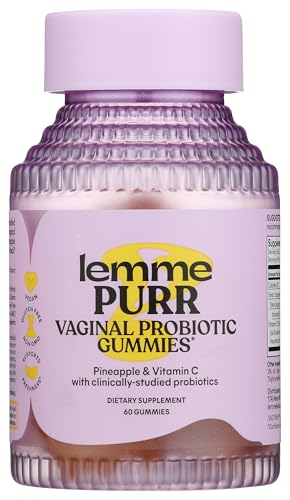
Lemme Purr Vaginal Probiotic Gummies for Women, 30-Day Supply
by Lemme
The gummy people actually finish, with a named strain and the largest review pool in the format, sold without a CFU count and at a running cost that divides its reviewers.
Pros
- The largest gummy review pool in this category at more than 6,000 verified ratings
- Names a proprietary designated strain, SNZ-1969, which is more than most gummies disclose
- Adds vitamin C and real pineapple, and reviewers consistently praise the taste
- Described as gentle on the stomach by many reviewers, and made in a cGMP-certified facility per the listing
Cons
- No CFU count on the listing, so the named strain cannot be attached to a dose
- Opinions on value divide sharply, with 'expensive candy' a recurring phrase in critical reviews
- Stomach pain and divided opinions on the aroma both appear in critical reviews
12. Hello Lovely! Probiotics for Women Gummies with Cranberry: Best Cranberry Gummy
Hello Lovely gets the biology of a gummy right in a way most of this format does not. The named organism is Bacillus coagulans, a spore-forming bacterium that encases itself in a protective structure tolerating heat, moisture and stomach acid. That is the only reason a live culture can survive a warm, moist, sugar-containing gummy at all, and it is why virtually every credible probiotic gummy uses a Bacillus species rather than the Lactobacillus organisms that dominate the capsules. Three billion CFU per serving is a real dose for the format.
The cranberry is the other reason to consider it. Cranberry proanthocyanidins are associated with urinary tract support rather than with vaginal flora, and for a reader whose actual pattern is recurrent urinary symptoms alongside vaginal discomfort, having that in a gummy she will take daily is a practical combination. Reviewers praise the chewy texture and taste and report no off-putting smell, and the listing states cGMP formulation with third-party testing.
The honest problem is the listing itself. The title claims six premium strains but only Bacillus coagulans is named in the bullet copy, so five of the six cannot be checked in any way, and the copy overall is keyword-stuffed to the point that verifying what is in the bottle takes more effort than it should. Reviewers also report the gummies sticking to teeth. One further point that applies to every gummy: none of them is Lactobacillus-based, so if what you want is a vaginal Lactobacillus, no gummy on this page delivers one.

Probiotics for Women Gummies with Cranberry (Hello Lovely!)
by Hello Lovely!
A cranberry gummy built on a spore-forming organism that suits the format, let down by a listing that claims six strains and names one.
Pros
- 3 billion CFU of Bacillus coagulans per serving, a spore-forming organism that genuinely survives a gummy matrix
- Cranberry-infused, which is the add-in most associated with urinary tract support
- Reviewers praise the chewy texture and taste, with no off-putting smell or flavor
- Formulated under cGMP guidelines and third-party tested per the listing
Cons
- The title claims six premium strains but only Bacillus coagulans is named in the bullets, so the rest cannot be checked
- Reviewers report the gummies stick to teeth
- Listing copy is keyword-stuffed, which makes verifying what is in the bottle harder than it should be
13. Lactobacillus Crispatus Probiotic, Strain LCR86: Best Single-Strain Crispatus Option
This is the most interesting product on the page and the one I would have expected not to exist. It is a single strain, Lactobacillus crispatus LCR86, with a designation, disclosed at three billion CFU, in a small tablet, at 240 tablets for a four-month supply. Crispatus is the species at the centre of the vaginal microbiome literature and the species used in LACTIN-V, and having access to a designated crispatus strain on its own, rather than buried inside a five-species blend, is genuinely useful for anyone building a considered regimen.
The economics are the other half of the story. Because it is a four-month supply rather than a thirty-day one, this runs at a small fraction of the gummies’ daily cost, a spread that nobody in this category surfaces because everybody compares bottle prices. Over the eight to twelve weeks it takes to know whether a vaginal probiotic is doing anything, that difference is the difference between finishing the trial and abandoning it. Reviewers describe the tablets as small and easy to swallow, and the listing states GMP-certified manufacturing.
The caution is proportionate. At 232 verified ratings the base is thin and the brand has no long track record here, so batch consistency is less established than with the drugstore names. Being single-strain is also a genuine narrowing: crispatus is the right species to bet on but a blend covers more ground if you do not know what your community is missing. If you want the crispatus rationale with more support around it, Vitanica and Biom deliver it in suppository form and Life-Space in an oral capsule with GR-1 and RC-14 alongside.
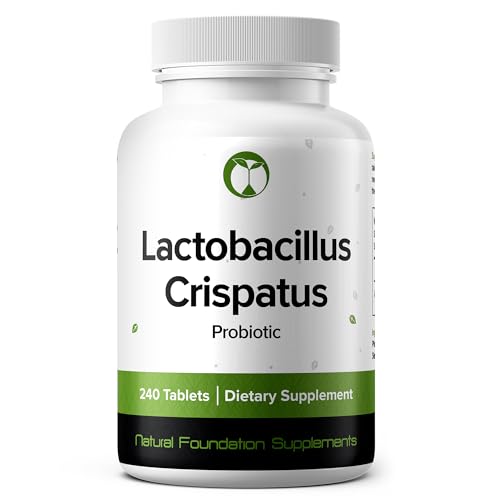
Lactobacillus Crispatus Probiotic, Strain LCR86, 240 Tablets
by Natural Foundation
By far the cheapest product here to actually run, and the only clean way to take a designated L. crispatus strain on its own.
Pros
- The only single-strain L. crispatus product in this guide, carrying the designated strain LCR86
- 240 tablets at a four-month supply, by far the lowest cost per day on this page
- Small tablets that reviewers describe as easy to swallow
- 3 billion CFU disclosed, made in a GMP-certified facility per the listing
Cons
- 232 verified ratings is a thin base, and the brand has no long track record in this category
- Single-strain formula, so it covers a narrower spectrum than the blends here
14. biophix D-Mannose Capsules with Cranberry & Probiotics: Best for Urinary Tract Support
biophix belongs on this page for a specific reader: the woman whose vaginal and urinary symptoms travel together, which is an extremely common pattern and one the rest of this category handles poorly. It pairs 1,000 mg of D-mannose and cranberry extract with a ten billion CFU probiotic blend, and that CFU figure is the point. A great many D-mannose products add a token million CFU so they can print the word probiotic on the label. Ten billion is a real dose, which makes this a urinary formula that genuinely supports flora rather than a urinary formula pretending to.
D-mannose is a simple sugar that is thought to work mechanically rather than antimicrobially, binding the fimbriae that certain E. coli use to adhere to the bladder wall so the organism is carried out in urine instead of attaching. That mechanism is prevention, not treatment, and the distinction matters. Some reviewers describe strong results for urinary problems. Those are their experiences, and nothing here is approved to treat or prevent a urinary tract infection. An active infection with burning, urgency, fever or flank pain needs a clinician and, usually, an antibiotic.
The deduction is familiar by now: the probiotic strains are not disclosed, so ten billion CFU of unidentified organisms is what you are buying on that side of the formula. At 616 verified ratings the base is modest against the vaginal-specific leaders here, and opinions on swallowability and taste are mixed. But 120 capsules is a long run between repurchases and reviewers consistently describe it as gentle on the stomach, which is not always the case at this dose.

biophix D-Mannose Capsules with Cranberry & Probiotics
by biophix
The only pick here pairing a real 10 billion CFU dose with D-mannose and cranberry, which makes it a urinary tract formula that supports flora rather than the reverse.
Pros
- 10 billion CFU alongside 1,000 mg of D-mannose and cranberry extract, a real probiotic dose rather than a token one
- 120 capsules per bottle, which is a long run between repurchases
- Reviewers describe it as gentle on the stomach and worth the price
- Manufactured under GMP standards and third-party tested per the listing
Cons
- The probiotic strains are not disclosed, so the 10 billion CFU cannot be attributed to any named organism
- Opinions on swallowability and taste are mixed
- 616 verified ratings is modest against the vaginal-specific leaders in this guide
Best Vaginal Probiotic Suppositories
A suppository skips the entire question that hangs over every oral capsule in this category, which is whether a swallowed organism survives stomach acid, transits the gut, and reaches the vagina by ascending migration from the perineum. Placing Lactobacillus where you want it is why the LACTIN-V trial used a vaginal applicator rather than a pill. The trade-offs are consistent across all three products below: they are dosed two or three times a week for maintenance rather than daily, they cost more per application, and local irritation is the most common reason people abandon them. Read the strain disclosure and the CFU column carefully here, because the format’s premium price is only justified if you know what is being placed.
| Product | Price | Buy |
|---|---|---|
| Vitanica V-Probiotics, Blend with L. Crispatus, 30 Vaginal SuppositoriesBest crispatus-led suppository The only suppository here disclosing a dose, at 2 billion CFU per unit, which matches the applicator dose used in LACTIN-V | $24.95 | View on Amazon |
| Biom Vaginal Probiotic Suppository (15 count)Best strain disclosure Names L. crispatus Bi16 and L. gasseri Bi19 with lactic acid and hyaluronic acid alongside, though it states no CFU count | $36.95 | View on Amazon |
| VagiBiom Lactobacillus SuppositoryMost accessible entry point The least expensive box of the three, with no strains and no CFU count disclosed at all | $16.98 | View on Amazon |
Best Probiotics for BV (Bacterial Vaginosis)
Be clear-eyed about what the guidelines say before buying anything for bacterial vaginosis. The 2021 CDC STI Treatment Guidelines state that no studies support these products as an adjunctive or replacement therapy for women with BV. The 2023 German, Austrian and Swiss guidelines are more permissive, treating Lactobacillus supplementation as reasonable for recurrence prophylaxis after antibiotics. The best trial in the field, LACTIN-V, tested a crispatus suppository after metronidazole and found recurrence at 12 weeks of roughly 30 percent against 45 percent on placebo. Every product below carries designated strains you can check, which is the minimum standard worth applying when the evidence base is this thin. None of them replaces treatment for an active infection.
| Product | Price | Buy |
|---|---|---|
| Jarrow Fem-Dophilus Probiotics, 60 CapsulesBest documented strain pair GR-1 and RC-14 with nothing else in the capsule, the most-cited oral pairing in this literature | $35.94 | View on Amazon |
| Life-Space Vaginal Probiotic Women's Microflora pH BalanceBest for recurrence after antibiotics Adds L. crispatus LBV88 to GR-1 and RC-14, with potency guaranteed through expiration rather than at manufacture | $43.99 | View on Amazon |
| RepHresh Pro-B Vaginal Probiotic SupplementDeepest review pool Nearly 24,000 verified ratings and a stated 5 billion CFU, though it names none of its strains | $23.99 | View on Amazon |
Best Vaginal Probiotic Gummies
One thing to understand before buying a gummy: neither of the products below is Lactobacillus-based in the way the capsules are. A gummy is a warm, moist, sugar-containing matrix that kills most probiotic organisms, which is why credible gummies use spore-forming Bacillus species or proprietary strains selected for stability. That is a real formulation constraint, not a shortcut. The argument for a gummy is adherence and nothing else, and it is a good argument: a product taken daily for three months does more than a better-documented capsule abandoned after two weeks. Look at what is actually disclosed, because both of these bottles claim more on the front than they itemise on the back.
| Product | Price | Buy |
|---|---|---|
| Lemme Purr Vaginal Probiotic Gummies for Women, 30-Day SupplyBest-reviewed vaginal probiotic gummy Names a proprietary strain, SNZ-1969, with the largest gummy review pool in the category, but discloses no CFU count | $29.97 | View on Amazon |
| Probiotics for Women Gummies with Cranberry (Hello Lovely!)Best gummy with cranberry 3 billion CFU of spore-forming Bacillus coagulans with cranberry, though five of its six claimed strains are never named | $14.82 | View on Amazon |
Best Probiotic for Vaginal Odor
Odor is the symptom that brings most women to this category, and it is also the symptom most likely to indicate something that needs a diagnosis rather than a supplement. A fishy odor, particularly one that intensifies after sex, is the classic presentation of bacterial vaginosis and warrants a clinician’s assessment, not a bottle. Where a probiotic has a defensible role is maintenance, supporting a Lactobacillus-dominant community and the lactic acid production that keeps vaginal pH low, after a diagnosis has been made and treated. Both products below are chosen for the depth of their real-world reporting on this point rather than for strain evidence, because neither names its organisms.
| Product | Price | Buy |
|---|---|---|
| URO Vaginal Probiotics for Odor, Flora & pH BalanceMost-reviewed odor and flora formula 5 billion CFU with an XOS prebiotic and more than 37,000 verified ratings, with odor and flora as its explicit framing | $28.97 | View on Amazon |
| AZO Complete Feminine Balance Daily Vaginal ProbioticsMost familiar drugstore option One capsule daily from the best-known feminine health brand, though it discloses neither strains nor CFU count | $27.00 | View on Amazon |
Best Probiotics for Yeast Infections
Yeast infections are fungal, caused most often by Candida albicans, which makes them a different problem from bacterial vaginosis in every respect that matters. A probiotic does not kill Candida. The plausible role is indirect: supporting a Lactobacillus-dominant, acidic environment less hospitable to fungal overgrowth, particularly during and after the antibiotic courses that so often precede a yeast infection. An active infection needs an antifungal, whether that is fluconazole by prescription or an over-the-counter option from our antifungal cream guide. Take a probiotic alongside that treatment, not instead of it, and continue it for two to four weeks after the course finishes.
| Product | Price | Buy |
|---|---|---|
| RepHresh Pro-B Vaginal Probiotic SupplementBest daily capsule for yeast balance Framed around yeast and bacteria balance with a 5 billion CFU dose and a long review track record | $23.99 | View on Amazon |
| Vitanica V-Probiotics, Blend with L. Crispatus, 30 Vaginal SuppositoriesBest suppository option Five Lactobacillus species led by crispatus at a disclosed 2 billion CFU per suppository, placed where the imbalance is | $24.95 | View on Amazon |
| Physician's CHOICE Probiotics for Women, 50 Billion CFUBest if gut and vaginal balance travel together 50 billion CFU with prebiotics and cranberry, useful when antibiotic courses have disrupted gut and vaginal flora together | $19.99 | View on Amazon |
Best Probiotics for UTI Prevention
Urinary tract prevention is a different mechanism from vaginal flora support, and the ingredient doing most of the work is usually not the probiotic. D-mannose is a simple sugar thought to bind the adhesive fimbriae certain E. coli use to attach to the bladder wall, so the organism is flushed out rather than establishing. Cranberry proanthocyanidins are proposed to work similarly. Both are prevention rather than treatment, and neither belongs anywhere near an active infection with fever or flank pain, which needs a clinician and usually an antibiotic. The vaginal probiotic angle is real but indirect: the vaginal reservoir is where uropathogens often stage from, so supporting Lactobacillus dominance is plausibly part of prevention.
| Product | Price | Buy |
|---|---|---|
| biophix D-Mannose Capsules with Cranberry & ProbioticsBest D-mannose and probiotic combination 1,000 mg of D-mannose and cranberry with a genuine 10 billion CFU dose rather than the token amount most D-mannose products add | $27.99 | View on Amazon |
| Probiotics for Women Gummies with Cranberry (Hello Lovely!)Best gummy for urinary support Cranberry-infused with 3 billion CFU of spore-forming Bacillus coagulans, the easiest of the two to keep taking daily | $14.82 | View on Amazon |
Best Probiotics for pH Balance
Vaginal pH sits between roughly 3.8 and 4.5 in a healthy premenopausal woman, and it is held there by Lactobacillus species producing lactic acid. When that community thins, whether after antibiotics, during menopause as oestrogen falls, or after douching, pH rises and the environment becomes more hospitable to the organisms associated with bacterial vaginosis. That is the whole mechanistic argument for this category, and it is a sound one. What it does not establish is that any particular bottle restores that state, which is exactly the gap the CDC points at. The three below are the products marketed most directly at pH, and all three are worth judging on their disclosure rather than their front label.
| Product | Price | Buy |
|---|---|---|
| AZO Complete Feminine Balance Daily Vaginal ProbioticsBest-known pH balance capsule One capsule daily from the most familiar brand in the aisle, marketed on pH and yeast balance but disclosing neither strains nor CFU | $27.00 | View on Amazon |
| URO Vaginal Probiotics for Odor, Flora & pH BalanceBest pH formula with a prebiotic 5 billion CFU with an XOS prebiotic so the culture arrives with a substrate, backed by the second-largest review base here | $28.97 | View on Amazon |
| RepHresh Pro-B Vaginal Probiotic SupplementBest pH option sold by Amazon directly A stated 5 billion CFU in a single daily capsule, shipped by Amazon rather than a third-party storefront | $23.99 | View on Amazon |
Best Vaginal Probiotics by Use Case
A few situations do not need a full section but do point at a specific bottle. Here are four of them, each matched to a product reviewed above.
| Product | Price | Buy |
|---|---|---|
| vH essentials Probiotics for Women with Prebiotics and Cranberry, 60 CtBest vaginal probiotic capsules on a budget The lowest sticker price here with more than 43,000 verified ratings, plus prebiotic, cranberry and vitamin C | $9.47 | View on Amazon |
| Lactobacillus Crispatus Probiotic, Strain LCR86, 240 TabletsBest Lactobacillus crispatus supplement A designated crispatus strain, LCR86, on its own at 3 billion CFU, and by far the lowest cost per day on this page | $14.99 | View on Amazon |
| Life-Space Vaginal Probiotic Women's Microflora pH BalanceBest for recurrent BV Six strains including GR-1, RC-14 and crispatus LBV88, with potency guaranteed through expiration | $43.99 | View on Amazon |
| Physician's CHOICE Probiotics for Women, 50 Billion CFUBest women's probiotic with vaginal support 50 billion CFU with cranberry and D-mannose, a general women's formula that covers gut and urinary health alongside | $19.99 | View on Amazon |
How to Choose a Vaginal Probiotic
The six factors below cover the core decision. Three further points come up often enough in clinic that they belong on the page rather than in a guide box.
The strain evidence split, stated plainly. Of the 14 products here, five carry strain designations you can search: Jarrow with GR-1 and RC-14, Life-Space with GR-1, RC-14 and LBV88, the LCR86 crispatus tablet, Biom with Bi16 and Bi19, and Lemme Purr with SNZ-1969. Everything else names a genus, a species, or a trademarked blend. AZO’s Intelliflora, URO’s V-Positiv, RepHresh’s clinically tested Lactobacillus, vH essentials, Physician’s CHOICE and Hello Lovely’s six premium strains all sit in that second group. This is not an accusation of dishonesty. Proprietary blends are ordinary commercial practice and several of those products have very satisfied buyers. It is a statement about what you can and cannot verify. If a product will not name its organism, no published research supports that specific bottle, whatever the research says about the species on the front.
Timing around metronidazole and fluconazole, which nobody spells out. Antibiotics do not distinguish between the organisms causing your infection and the ones you swallowed twenty minutes ago. If you are taking metronidazole for bacterial vaginosis, separate the probiotic from the antibiotic dose by about two hours in either direction, and keep taking the probiotic for two to four weeks after the course ends, because the weeks after treatment are when the vaginal community either re-establishes or does not. For fluconazole and a yeast infection the reasoning differs slightly: fluconazole is an antifungal and will not kill a bacterial probiotic, so the interval matters less, but the post-course window matters just as much and the two to four week continuation still applies. If you are using boric acid, keep it away from a probiotic suppository, because boric acid at those concentrations kills Lactobacillus as readily as anything else. Boric acid first, probiotic afterwards.
What the regulation actually permits, and what it does not. These are dietary supplements under DSHEA, regulated as foods. The FDA does not approve them, does not verify the CFU count, and does not evaluate the claims on the box, which is what that small asterisked disclaimer means. No product on this page is approved to treat, prevent or cure bacterial vaginosis, a yeast infection or a urinary tract infection, and where a manufacturer’s own listing edges toward that language, as several here do, you are reading marketing rather than a regulatory finding. Use these as an adjunct to medical care. Fever, pelvic or abdominal pain, symptoms during pregnancy, symptoms in anyone significantly immunocompromised, or a pattern of three or more episodes in a year all need a clinician rather than another bottle. If it is the difference between the bacteria and the fiber that is confusing you, our probiotics versus prebiotics explainer covers which one your symptoms point at.
Buyer's Guide
Vaginal probiotics are sold on two numbers, CFU count and strain count, and neither one decides whether the bottle in your hand has any research behind it. These six factors are what separate a product you can check against the literature from one you can only take on faith.
Strain Designations, Not Species Names
A probiotic's evidence attaches to a strain, not to a genus or a species. Lactobacillus crispatus is a species containing many strains that behave differently in the vaginal environment, which is why the research names them precisely: GR-1, RC-14, CTV-05, LBV88, LCR86, Bi16, Bi19, TOM 22.8. When a label says only Lactobacillus crispatus, or hides its roster inside a proprietary blend with a trademark attached, there is nothing to look up. Five of the fourteen products in this guide carry designated strains you can search in the literature. The rest name a genus, a species, or a brand name for a blend. That is the largest quality divide in this category, and almost nobody selling these products draws attention to it.
CFU Count Is Strain-Matched, Not a Ranking
The marketing convergence on ten billion CFU has no basis in the vaginal probiotic trials. Doses in the actual studies are matched to the strain and to the route of delivery. The 2025 work on Lactobacillus rhamnosus TOM 22.8 used ten billion CFU daily for ten days by mouth. LACTIN-V, the strongest randomised trial in this niche, delivered roughly two billion CFU per vaginal applicator, which is not comparable to an oral dose at all because it bypasses the gut entirely. A one billion CFU capsule of a documented strain is a better-evidenced purchase than a fifty billion CFU capsule of an unnamed blend. Read the count as a formulation detail, not as a score.
Oral Capsule Versus Vaginal Suppository
The two formats solve the problem differently. An oral capsule relies on organisms surviving stomach acid, transiting the gut, and reaching the vagina by ascending migration from the perineum, which is a documented route but an indirect one. A suppository places the organisms where you want them and skips the journey, which is why the LACTIN-V trial used one. Suppositories are usually dosed two or three times a week for maintenance rather than daily, they cost more per application, and they carry a higher rate of local irritation reports. Capsules are easier to keep taking across the months this actually requires. Neither format is universally better, and the choice usually comes down to what you will sustain.
Shelf Stability and What Reaches Your Cupboard
Every product in this guide is sold as shelf-stable, and that claim is worth reading carefully rather than accepting. Lactobacillus crispatus is a more fastidious organism than L. rhamnosus or L. acidophilus, and holding it viable at room temperature through months of warehousing, a hot delivery truck and a bathroom cabinet is a genuine formulation challenge. A count guaranteed at time of manufacture tells you about a bottle you never saw. Life-Space is the only product here stating a minimum guaranteed through expiration. Where a listing says nothing on the point, assume the number describes packing day and discount it accordingly.
Cost Per Day, Not Cost Per Bottle
Bottle prices in this category sit close together and running costs do not. A four-month supply of tablets and a thirty-day supply of gummies can carry similar shelf prices while differing several-fold in what a day of use costs. Divide the price by the days of supply before deciding anything. Two cautions apply. First, that arithmetic does not carry across formats, because suppositories are typically used two or three times a week for maintenance rather than daily, so a per-application figure is the fairer comparison there. Second, several listings do not state a days supply at all, and a bottle count is not the same thing when the serving is two units.
What DSHEA Regulation Actually Means Here
Probiotics are regulated as foods under the Dietary Supplement Health and Education Act, not as drugs. The FDA does not review them for safety or effectiveness before sale, does not verify the CFU count on the label, and does not evaluate the claims printed on the box. Nothing in this guide is FDA-approved to treat, prevent or cure anything, including bacterial vaginosis, yeast infections or urinary tract infections, and any listing implying otherwise is ahead of both its evidence and the regulation. Independent verification is the only real check, so third-party testing, GMP certification and a manufacturer willing to name its organisms all carry weight. Treat every product here as an adjunct to medical care. Fever, pelvic pain, symptoms during pregnancy, or symptoms that keep coming back need a clinician, not a supplement.
Final Verdict
For most women looking for a daily vaginal probiotic, Jarrow Fem-Dophilus is our best overall pick. It carries the GR-1 and RC-14 pair with nothing else in the capsule, which means the two organisms you are buying are the two with the longest published record in this field and you can read that record yourself. Its one billion CFU count will look small next to the competition, and it should not put you off: dose in this literature is matched to the strain, not escalated for the label, and the applicator dose in the best trial available was roughly two billion. If recurrent bacterial vaginosis after antibiotic treatment is your specific problem, Life-Space adds L. crispatus LBV88 to that same pair and guarantees its count through expiration, which makes it the upgrade worth paying for.
On cost, the honest ranking has two answers. vH essentials carries the lowest sticker price on this page and pairs it with more than 43,000 verified ratings, which makes it the sensible first bottle. But the LCR86 crispatus tablet is a four-month supply and runs at a small fraction of the gummies’ daily cost, so if you intend to stay on something for the eight to twelve weeks this actually takes, it is the least expensive habit here by a wide margin and the only clean way to take a designated crispatus strain on its own. If a general daily formula is closer to what you need, our probiotics for women guide covers that category properly, and our general probiotics roundup covers it without the women’s-health framing.
A last word from the clinic. Probiotics are a low-risk adjunct and they are not a treatment. The 2021 CDC guidance is unambiguous that the studies supporting them for bacterial vaginosis do not yet exist, the German, Austrian and Swiss guidance is more open to them after antibiotics, and reasonable clinicians read that gap differently. What nobody should do is treat a supplement as a substitute for a diagnosis. Fishy odor, unusual discharge, itching, burning or pelvic pain all need someone to examine you and test rather than a bottle chosen from a list. Take these alongside proper care, give any of them eight weeks, and raise recurrent symptoms with your gynecologist rather than solving them at the checkout.
Frequently Asked Questions
Should I take probiotics after antibiotics for BV?
Can you use boric acid and probiotics together for BV?
How long does it take for probiotics to work for BV?
Do probiotic suppositories work better than oral capsules?
Why do I keep getting BV even though I take probiotics?
Related Articles
About the Reviewer

Dr. David Taylor, MD, PhD
Drexel University College of Medicine (MD), Indiana University School of Medicine (PhD)
Dr. David Taylor is a licensed physician and medical researcher who founded BestRatedDocs in 2016. With an MD from Drexel University and a PhD from Indiana University School of Medicine, he combines clinical expertise with a passion for health technology to provide evidence-based product recommendations. Dr. Taylor specializes in health informatics and regularly evaluates medical devices, diagnostic equipment, and therapeutic products to help healthcare professionals and patients make informed decisions.