7 Best Plantar Fasciitis Insoles of 2026
Dr. David Taylor MD reviews the best plantar fasciitis insoles on Amazon. Compare arch support, heel cup depth, and rigidity across 7 podiatrist-recommended picks.
Updated
Plantar fasciitis is the most common cause of heel pain in adults, affecting an estimated 2 million Americans annually and accounting for approximately 1 million outpatient physician visits per year according to the American Academy of Orthopaedic Surgeons. If you have ever taken your first steps in the morning and felt a sharp, stabbing pain in the bottom of your heel — pain that gradually improves after a few minutes of walking but returns after sitting for extended periods — you are familiar with the defining clinical presentation of plantar fasciitis. As a physician who regularly evaluates patients with musculoskeletal foot complaints, I can tell you that the right insole is often the most effective non-prescription intervention available, and the difference between the right and wrong product is significant.
The plantar fascia is a thick band of connective tissue that runs along the bottom of the foot from the calcaneus (heel bone) to the bases of the toes, forming the structural foundation of the longitudinal arch. Plantar fasciitis occurs when repetitive tensile loading causes microtears and degenerative changes at the fascial insertion on the calcaneus — the pathological process is more accurately described as fasciosis (degenerative) than fasciitis (inflammatory), though the inflammatory label persists clinically. Risk factors include pes planus (flat feet), pes cavus (high arches), tight calf muscles and Achilles tendon, prolonged standing on hard surfaces, and sudden increases in physical activity. If you have not yet been evaluated for ankle and arch alignment, consider reviewing our ankle brace guide alongside this article — ankle instability and PF frequently co-occur in the same biomechanical failure pattern.
At BestRatedDocs.com, I reviewed seven plantar fasciitis insoles in 2026 against a structured set of clinical criteria: arch support mechanism, heel cup geometry, material rigidity, verified user review aggregates across tens of thousands of purchases, and endorsement by podiatric and orthopedic professional organizations. This is the only physician-authored plantar fasciitis insole roundup published on the open internet — a meaningful distinction in a category where most buying guides are written by general content writers without clinical training. Here is what I found.
After evaluating the evidence across all seven products, the comparison table below shows all picks side-by-side.
| Product | Price | Buy |
|---|---|---|
| PowerStep Pinnacle InsolesBest Overall | $39.88 | View on Amazon |
| WalkHero Arch Support Insoles for Plantar FasciitisBudget Pick | $19.99 | View on Amazon |
| PowerStep Pinnacle Maxx Orthotic InsolesPremium Pick | $54.95 | View on Amazon |
| Superfeet GREEN All-Purpose Support High Arch InsolesRunner-Up | $43.88 | View on Amazon |
| VALSOLE Heavy Duty Support Pain Relief OrthoticsRunner-Up | $22.17 | View on Amazon |
| Dr. Scholl's Plantar Fasciitis Pain Relief Orthotic InsolesRunner-Up | $9.97 | View on Amazon |
| Superfeet Run Pain Relief InsolesRunner-Up | $51.96 | View on Amazon |
How We Selected These Plantar Fasciitis Insoles
Selection criteria for this review prioritized four dimensions: clinical mechanism of action (does the insole actually address the biomechanical root cause of plantar fasciitis), verified user outcomes at scale (thousands of Amazon reviews filtered for PF-specific feedback), brand clinical credibility (APMA acceptance, podiatrist endorsement data, professional clinical adoption), and breadth of coverage across the key population segments — budget buyers, heavy-duty users, runners, high-arch patients, and those needing maximum stability for overpronation. Insoles were excluded if their arch support mechanism was inadequate to the condition (soft gel insoles), if sizing or quality control issues were persistently reported across review cohorts, or if the product could not be verified as a current live Amazon listing.
PowerStep Pinnacle Insoles

PowerStep Pinnacle Insoles
by PowerStep
The gold standard in PF insoles — podiatrist-endorsed, APMA-accepted, Made in USA, backed by 30,000 verified reviews.
Pros
- Number one podiatrist-recommended insole brand in the US, accepted by the American Podiatric Medical Association — the only insole in this review with APMA acceptance
- Moderate arch support with a deep angled heel cup addresses the two primary biomechanical drivers of plantar fasciitis simultaneously
- Versatile across sneakers, dress shoes, and work boots without requiring any shoe modification or trimming
- Firm EVA base plate with semi-rigid arch support provides structure without the stiffness that causes initial discomfort in fully rigid orthotics
Cons
- Mid-range price may deter first-time buyers who want to trial a cheaper option before investing
- Can feel slightly thick in narrow dress shoes or low-volume running shoes without a removable factory insole
The PowerStep Pinnacle is my Best Overall recommendation, and the reasoning starts with the clinical credentials rather than the consumer review count. PowerStep holds the APMA Seal of Acceptance — a formal evaluation process conducted by the American Podiatric Medical Association confirming the product’s safety and efficacy for foot health. This is not a marketing label; it represents an independent professional assessment by foot specialists, and it is the only insole in this review with that designation. The fact that it is also the number one podiatrist-recommended insole brand in the US, Made in USA, and backed by 30,000 verified Amazon reviews is a convergence of clinical and consumer validation that no other insole in this category achieves.
The biomechanical design targets the two primary drivers of plantar fasciitis simultaneously. The moderate arch support profile distributes load across the longitudinal arch, reducing the tensile strain at the plantar fascia insertion on the calcaneus. The deep angled heel cup contains the heel fat pad and corrects the medial heel strike pattern that underlies most cases of PF. The semi-rigid EVA base plate is firm enough to resist compression under body weight — ensuring the support geometry is maintained throughout the gait cycle — while avoiding the stiffness of fully rigid orthotics that require prolonged adaptation. For patients who have tried soft gel insoles without relief, the Pinnacle’s semi-rigid construction typically produces noticeable improvement within the first week.
The practical advantage over custom orthotics, which a podiatrist might prescribe at several hundred to over a thousand dollars per pair, is substantial. The Pinnacle provides the same core biomechanical intervention — arch support and heel containment — at a fraction of the cost. For the majority of plantar fasciitis cases, custom orthotics do not produce meaningfully better outcomes than well-designed over-the-counter insoles, a finding supported by multiple randomized controlled trials comparing the two approaches. The Pinnacle is the over-the-counter standard that makes custom orthotics difficult to justify as a first-line intervention.
WalkHero Arch Support Insoles for Plantar Fasciitis
WalkHero Arch Support Insoles for Plantar Fasciitis
by WalkHero
The most reviewed PF insole on Amazon at under $20 — exceptional value for moderate plantar fasciitis.
Pros
- Most-reviewed plantar fasciitis insole on all of Amazon with over 73,000 ratings — an unprecedented volume of real-world feedback across diverse foot types and use cases
- Half the price of the PowerStep Pinnacle while delivering comparable arch height and heel cup depth for the majority of moderate PF cases
- No break-in period reported by the majority of reviewers — usable in most shoes from day one without gradual adaptation
- Performs well for high-activity use cases including pickleball, walking, and prolonged standing in retail or healthcare environments
Cons
- Arch profile can feel aggressive initially for users transitioning from flat insoles — a 30-minute first-day wear schedule helps with adaptation
- Not engineered for users over 220 lbs; arch support may compress and lose function faster under heavy sustained load
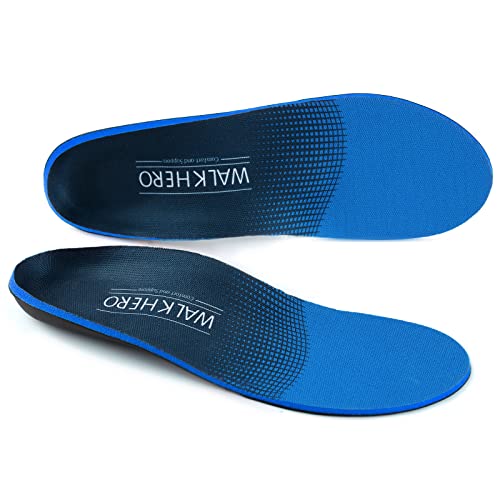
The WalkHero insole occupies a remarkable position in the market: it is the most-reviewed plantar fasciitis insole on all of Amazon with over 73,000 verified ratings, meaning its aggregate feedback represents a larger real-world clinical sample than most published orthotic trials. At less than half the price of premium alternatives, it is priced for the budget-conscious buyer who is not yet certain whether insoles will help their PF — and at that price point and review volume, it is the lowest-risk entry point into structured arch support available.
The arch profile is moderate with a flat-foot focus, making it particularly appropriate for patients with pes planus-associated PF — the foot type most commonly presenting with PF in clinical settings. The deep heel cup geometry mirrors the therapeutic design of the PowerStep Pinnacle, and the majority of reviewers report immediate or near-immediate pain reduction with no break-in period. For patients standing in retail, healthcare, or manufacturing environments for 8-12 hour shifts, the WalkHero’s durability across prolonged static standing use is a particularly validated characteristic in the review corpus.
The limitation to be aware of is weight capacity. The WalkHero is engineered for standard-weight users and has not been validated for sustained heavy use above approximately 220 lbs. For heavier users, arch support compression over time reduces the insole to a flat foam pad — the VALSOLE heavy-duty insole reviewed later is the appropriate choice for that population. For the large majority of PF patients in the standard weight range, the WalkHero is a clinically sound choice that the 73,000-review track record validates comprehensively.
PowerStep Pinnacle Maxx Orthotic Insoles

PowerStep Pinnacle Maxx Orthotic Insoles
by PowerStep
Clinical-grade step-up from the standard Pinnacle for overpronators and post-surgical recovery patients needing maximum stability.
Pros
- Angled heel post corrects lateral heel strike mechanics — the specific biomechanical intervention cited by orthopedic physicians for overpronation-driven plantar fasciitis
- Pedorthist and orthopedic doctor-recommended for post-surgical recovery, severe overpronation, and patients who did not respond to standard arch support
- Maximum stability rating provides measurably more motion control than the standard Pinnacle — appropriate when moderate support is insufficient
- Maintains the same Made in USA manufacturing and APMA-acceptance lineage as the standard Pinnacle
Cons
- Firmest feel in this review — a 2-to-4 day break-in schedule starting at 1-2 hours per day is recommended before all-day wear
- Higher price is only clinically justified for diagnosed overpronation or cases where moderate support has already proven insufficient
The PowerStep Pinnacle Maxx is the clinical step-up from the standard Pinnacle for a specific patient population: those with confirmed overpronation, lateral heel strike mechanics, or plantar fasciitis that has not responded adequately to moderate arch support. The distinguishing feature is the angled heel post — a structural component that introduces a lateral tilt correction at the calcaneus, directly addressing the pronation-driven medial loading pattern that underlies a significant subset of PF cases. This is the intervention mechanism that orthopedic physicians reference when they recommend motion-control footwear or custom orthotics for overpronation.
The maximum stability rating means this insole is the firmest in the PowerStep lineup and requires a more deliberate break-in approach. I recommend starting at 1-2 hours of wear on the first day and increasing by 30-60 minutes per day over the first week. This is standard guidance for any maximum-stability orthotic and reflects the adaptation time required for the intrinsic foot muscles and Achilles tendon-calf complex to adjust to the corrected biomechanical position. Users who bypass break-in commonly report arch soreness in the first few days, which resolves with gradual adaptation.
Pedorthists — the clinical specialists who customize and fit orthopedic footwear — cite the Pinnacle Maxx as a preferred over-the-counter option for post-surgical foot recovery and for patients transitioning from custom orthotics to a lower-cost maintenance solution. For compression socks users managing lower extremity circulation alongside PF, see our compression socks guide for pairing recommendations that address both plantar pain and venous return simultaneously.
Superfeet GREEN All-Purpose Support High Arch Insoles

Superfeet GREEN All-Purpose Support High Arch Insoles
by Superfeet
Heritage insole brand trusted by runners, hikers, and doctors for 50 years — best structural choice for high-arch PF.
Pros
- Biomechanical stabilizer shell with a deep sculpted heel cup provides structural support that has been doctor-recommended for PF recovery for over 50 years
- High-density foam layer with moisture-wicking top cover maintains hygiene and odor control through extended athletic use
- Exceptional long-term durability — the rigid stabilizer cap holds its shape over years of use, unlike foam-only insoles that compress and flatten
- Preferred by hikers, military personnel, and workers in boots where the trim-to-fit design accommodates non-standard footwear volumes
Cons
- Trim-to-fit design requires careful cutting with scissors — mis-trimmed insoles cannot be reversed and may waste the purchase
- No cushioning layer beneath the stabilizer cap — pure structural support without impact absorption makes this less comfortable for hard surface impact activities
Superfeet GREEN has been a clinical standard for over 50 years and represents the structural approach to plantar fasciitis support: a rigid biomechanical stabilizer cap that delivers pure arch and heel control without the cushioning layer that softer insoles prioritize. For high-arch patients — those with pes cavus — the GREEN’s deep stabilizer profile provides the specific support geometry that shallow insoles cannot reach. The trim-to-fit design, while requiring a careful sizing step, enables the GREEN to fit inside hiking boots, work boots, and non-standard footwear volumes where pre-sized insoles may not accommodate the shape.
The durability of the Superfeet GREEN is a genuine clinical advantage. The rigid stabilizer cap does not compress or deform over time the way foam-based insoles do, meaning the therapeutic geometry is maintained over 2-3 years of use rather than degrading within 3-6 months. For patients who have experienced the frustrating cycle of purchasing foam insoles, experiencing initial relief, and then watching the benefit gradually disappear as the insole compresses, the GREEN’s long-term structural stability is a meaningful upgrade. The 33,000-review cohort confirms this durability claim across diverse real-world use cases.
The caveat is the absence of cushioning below the stabilizer cap. For patients whose primary complaint is impact-related heel pain on hard surfaces — concrete floors, tile, pavement — the GREEN’s pure structural design may be less comfortable than the padded construction of the PowerStep Pinnacle. The GREEN is the better choice when structural biomechanical correction is the priority; the Pinnacle is the better choice when a combination of structure and cushioning comfort is needed. For runners considering the GREEN for trail use, the Superfeet Run reviewed later provides a lighter carbon-fiber alternative.
VALSOLE Heavy Duty Support Pain Relief Orthotics
VALSOLE Heavy Duty Support Pain Relief Orthotics
by VALSOLE
The only top-selling insole purpose-built for heavier users — essential for anyone over 220 lbs dealing with plantar fasciitis.
Pros
- Engineered for users over 220 lbs — the only top-selling insole in this review with an explicit heavy-duty weight rating, filling a critical gap in the standard market
- Amazon Best Seller rank top 3 in shoe insoles with 27,000 verified reviews confirms real-world adoption by physically active heavier users
- Designed for work boot compatibility — fits the wider, higher-volume footwear used in construction, warehousing, and field work where PF is occupationally prevalent
- Immediate heel and arch pain relief reported by users standing 12-hour shifts, with ratings holding above 4.3 stars even under heavy-use conditions
Cons
- Rigid arch profile requires gradual break-in — start with 2-3 hours per day and increase over the first week to avoid arch soreness
- Less versatile for slim dress shoes or low-profile athletic footwear where the higher insole volume creates a tight fit
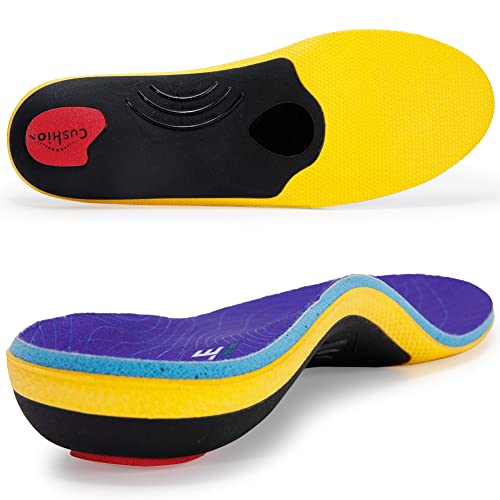
The VALSOLE occupies a gap in the plantar fasciitis insole market that most buyers never consider until they are already in it: heavy-duty load capacity. Standard insoles are designed and tested for users in the roughly 130-200 lb range. For users over 220 lbs — a large segment of the American adult population, and a population with disproportionately high rates of plantar fasciitis due to the elevated mechanical loading on the plantar fascia — standard insoles compress rapidly under sustained load, and the therapeutic arch support disappears within weeks.
The VALSOLE’s high-arch rigid construction with heavy-duty materials provides the structural integrity to maintain its support geometry under loads that would flatten a standard foam insole. The work boot compatibility is another critical design specification for this user population, which skews toward physically demanding occupations — construction, manufacturing, agriculture, law enforcement — where hard-surface standing in boots for extended shifts is the norm. The insole’s Amazon Best Seller ranking in the top 3 for shoe insoles, with 27,000 verified reviews, confirms that this is not a niche product but a mainstream solution for an underserved need.
Break-in is required and should be taken seriously. The rigid arch of the VALSOLE is firmer than any other insole in this review, and transitioning abruptly from flat insoles to full-day wear in the first session commonly produces arch soreness. Starting at 2-3 hours per day for the first week before progressing to all-day wear is the appropriate approach. For users managing both PF and broader musculoskeletal lower back strain from heavy physical work, reviewing our lumbar support pillow guide alongside this article may provide complementary relief options.
Dr. Scholl’s Plantar Fasciitis Pain Relief Orthotic Insoles

Dr. Scholl's Plantar Fasciitis Pain Relief Orthotic Insoles
by Dr. Scholl's
Most recognized PF brand at the lowest price — the ideal first step before committing to premium orthotics.
Pros
- Most affordable name-brand plantar fasciitis insole available — a full 75% less than premium alternatives for users who want brand recognition at entry-level pricing
- Proprietary Shock Guard technology cushions heel impact, directly targeting the microtrauma mechanism that perpetuates plantar fasciitis inflammation
- 90-day money-back guarantee reduces purchase risk for first-time insole buyers uncertain whether insoles will help their specific presentation
- Built-in odor control layer — a meaningful practical feature for users wearing the same insoles in multiple shoes throughout the day
Cons
- Low arch height is insufficient for users with high arches or significant overpronation — appropriate for mild PF and normal or low-arch feet only
- Less durable than premium alternatives — foam compresses noticeably within 2-3 months of daily use under moderate physical activity loads
Dr. Scholl’s has been the most recognized brand in foot care for over a century, and the Plantar Fasciitis Pain Relief insole is their specific response to the most common heel pain complaint in their category. It is priced as an entry point — the product a first-time insole buyer purchases before deciding whether to invest in the PowerStep or Superfeet tier — and the 90-day money-back guarantee acknowledges that reality explicitly. If it works for your PF presentation, you have resolved your foot pain at minimal cost. If it does not, the guarantee limits the financial risk of the trial.
The Shock Guard technology in the heel pad directly targets the microtrauma mechanism of plantar fasciitis: repetitive impact loading at the calcaneus creates microdamage at the fascial insertion, and reducing that impact force — which the Shock Guard does via energy absorption — reduces the perpetuation of the inflammatory-degenerative cycle. This is clinically sound as far as it goes, but it addresses only the cushioning component of the insole equation. The arch support in the Dr. Scholl’s PF insole is low-to-moderate and appropriate for mild PF cases with normal or low arches; it is not the right choice for high-arch patients or those with significant overpronation.
The durability limitation is the most important practical consideration. Foam-based insoles compress under daily use, and the Dr. Scholl’s PF insole should be expected to provide meaningful arch support for roughly 2-3 months before replacement is warranted. For patients who respond well to this insole, budgeting for quarterly replacement is more cost-effective than upgrading to a premium insole for those who use insoles primarily for comfort rather than as a therapeutic intervention.
Superfeet Run Pain Relief Insoles

Superfeet Run Pain Relief Insoles
by Superfeet
Carbon-fiber-reinforced insole purpose-built for runners with plantar fasciitis — premium performance at a premium price.
Pros
- EVOLyte carbon fiber stabilizer shell delivers rigid structural support at a fraction of the weight of traditional plastic shells — purpose-built for runners where gram-level weight matters
- Universal arch height design accommodates a wider range of foot types than the fixed-height GREEN insole, making it accessible to runners who found the GREEN too high
- Designed specifically for the repetitive heel-strike loading pattern of running — the use case most commonly responsible for acute plantar fasciitis flares
- Premium carbon fiber construction represents the highest-performance material in mainstream consumer insoles — appropriate for serious runners logging 30+ miles per week
Cons
- Only 1,005 verified reviews — the most limited social proof of any product in this review, which is a meaningful limitation when selecting a medical-adjacent product
- Trim-to-fit sizing requires care; the carbon fiber shell is harder to cut than foam and may require heavier scissors or a utility knife for clean trimming
The Superfeet Run addresses a specific clinical situation: the runner with plantar fasciitis who requires both structural arch support and the lightest possible insole to avoid disrupting running biomechanics. The EVOLyte carbon fiber stabilizer shell is the most technically sophisticated material in this review — carbon fiber provides rigidity-to-weight ratios far superior to plastic or EVA, which is why it is used in elite athletic applications from carbon-plated running shoes to orthopedic prosthetics. For a runner logging significant weekly mileage, the weight savings of the carbon shell over a plastic stabilizer is a legitimate performance consideration, not simply a marketing claim.
The universal arch height design is a deliberate departure from Superfeet’s traditional fixed-height approach in the GREEN. Many runners found the GREEN’s high arch profile too aggressive for the dynamic loading of running gait, and the universal height in the Run insole offers a more accessible entry point while maintaining the structural benefits of the stabilizer cap. The trim-to-fit sizing requires careful cutting — the carbon fiber shell is stiffer than foam and may require a utility knife for clean trimming rather than standard household scissors. Trim conservatively from the toe end, checking fit in your running shoe before cutting further.
The limited review count (just over 1,000) is the honest limitation to acknowledge. This is a newer product relative to the GREEN and has not yet accumulated the social proof volume that the other insoles in this review offer. For a medical-adjacent product, the limited feedback corpus is a genuine consideration. Runners who want maximum social proof should default to the Superfeet GREEN or PowerStep Pinnacle with the understanding that those products have not been specifically optimized for running gait mechanics.
How to Choose the Best Plantar Fasciitis Insole
The single most consequential buying decision is matching the arch support level to your actual foot type. A mismatched arch height — too high for a flat foot, too low for a high arch — will not produce the biomechanical offloading that makes insoles therapeutically effective for plantar fasciitis. If you are uncertain of your arch type, the wet footprint test provides a reasonable approximation: a normal arch leaves a footprint with a visible narrow band connecting the heel and forefoot; a flat arch leaves a nearly full footprint; a high arch leaves almost no connection between heel and forefoot. Your foot type should be the primary filter before considering price, brand, or any secondary feature.
After arch type, heel cup depth is the second factor to optimize. The deep angled heel cups in the PowerStep Pinnacle and Pinnacle Maxx are the current clinical standard for this feature, and they are the reason those products appear at the top of podiatrist recommendation surveys. Shoe compatibility is the practical filter that determines whether you will actually wear the insole you choose — an insole that does not fit in your daily footwear provides zero therapeutic benefit regardless of its design quality. Remove your factory insole and test fit before committing to a full-length purchase if you have non-standard footwear. Consult your podiatrist or orthopedic physician if your PF has not responded to 8 weeks of consistent insole use — a non-responsive presentation warrants further clinical evaluation to rule out differential diagnoses including calcaneal stress fracture, tarsal tunnel syndrome, and the L5-S1 nerve root compression discussed earlier in this article.
Final Verdict
The PowerStep Pinnacle (B000KPOMZY) is our Best Overall recommendation for plantar fasciitis insoles in 2026 — APMA-accepted, podiatrist-endorsed, Made in USA, and validated across 30,000 verified reviews. The combination of moderate arch support and a deep angled heel cup addresses the biomechanical root cause of PF at a price point that is accessible without being the cheapest option on the shelf. For the majority of plantar fasciitis presentations, this is the insole to start with.
For buyers who want to trial arch support at the lowest possible cost before investing in a premium product, the WalkHero Arch Support Insoles (B075YFD7GV) represent extraordinary value — more reviews than any other PF insole on Amazon, clinical-grade arch height and heel cup geometry, and pricing that makes risk-free trialing practical. For overpronators and patients with severe PF who need maximum stability with a heel post correction, step up to the PowerStep Pinnacle Maxx. As always, if you have been managing heel pain for more than 2-3 months without meaningful improvement, seek an evaluation from a podiatrist or orthopedic physician — not all heel pain is plantar fasciitis, and the right diagnosis is essential to the right treatment.
Sources:
Frequently Asked Questions
What insoles do podiatrists recommend for plantar fasciitis?
Should plantar fasciitis insoles be firm or soft?
Can an L5-S1 disc problem cause heel pain that mimics plantar fasciitis?
Is there a vitamin deficiency associated with plantar fasciitis?
Are plantar fasciitis insoles covered by HSA or FSA?
Related Articles
About the Reviewer

Dr. David Taylor, MD, PhD
Drexel University College of Medicine (MD), Indiana University School of Medicine (PhD)
Dr. David Taylor is a licensed physician and medical researcher who founded BestRatedDocs in 2016. With an MD from Drexel University and a PhD from Indiana University School of Medicine, he combines clinical expertise with a passion for health technology to provide evidence-based product recommendations. Dr. Taylor specializes in health informatics and regularly evaluates medical devices, diagnostic equipment, and therapeutic products to help healthcare professionals and patients make informed decisions.