7 Best Diabetic Socks of 2026
Dr. David Taylor reviews the best diabetic socks on Amazon. Compare seamless toe, non-binding, moisture-wicking options that protect neuropathic and at-risk diabetic feet.
Updated
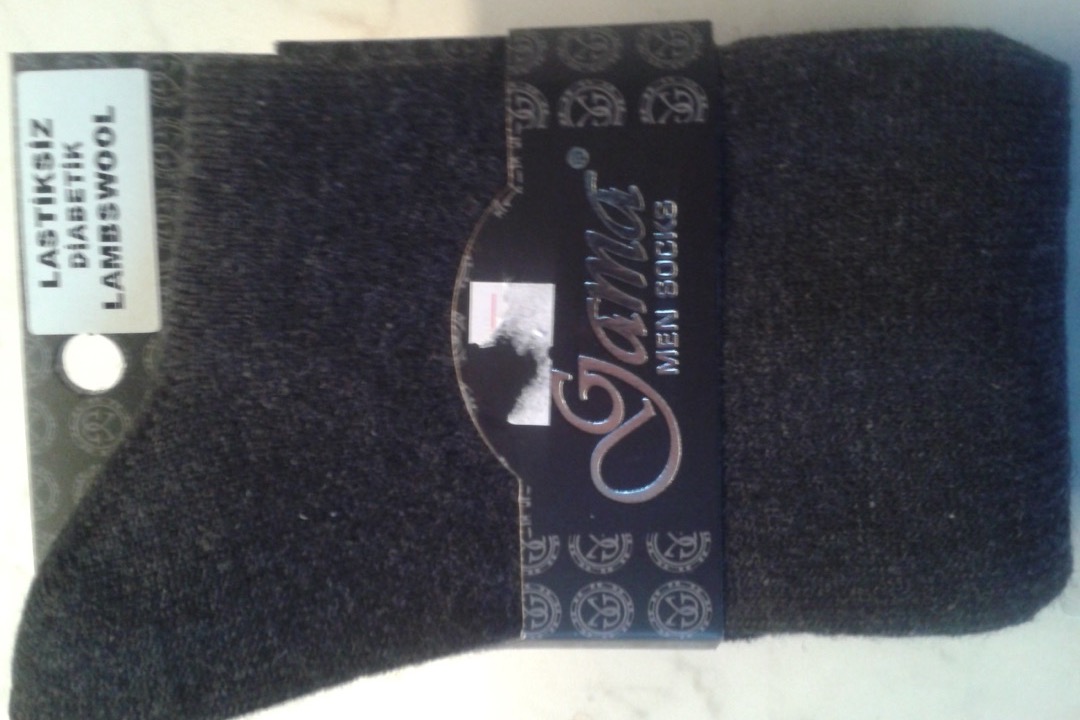
The American Diabetes Association estimates that approximately 160,000 diabetes-related lower-extremity amputations are performed each year in the United States — the end stage of a clinical pathway that almost always begins with a foot ulcer that becomes infected, fails to heal in compromised diabetic skin, and progresses from cellulitis to osteomyelitis to surgical removal. The single most important intervention in breaking that pathway is preventing the ulcer in the first place, and the single most preventable cause of diabetic foot ulceration is friction and pressure from inappropriate socks worn for 10 to 14 hours per day by patients whose neuropathy prevents them from feeling the damage as it occurs. Diabetic socks exist to address that mechanism directly.
At BestRatedDocs.com, we approach diabetic foot care the same way Dr. David Taylor approaches any condition where patient compliance with daily preventive measures determines long-term outcome — by identifying products that combine genuine clinical engineering with the practical features that make daily wear sustainable. In 2026, we reviewed the top-selling diabetic socks across Amazon’s category, evaluating each against the three core diabetic sock requirements (seamless toe, non-binding top, moisture management) and the secondary considerations that determine fit for specific diabetes complications. The result is this guide: seven products spanning every budget tier and clinical application from low-risk Type 2 diabetes to advanced peripheral neuropathy and chronic edema. For patients also managing diabetes-related blood pressure complications, our guide to the best blood pressure monitors covers home monitoring options that pair naturally with diabetic foot care.
| Product | Price | Buy |
|---|---|---|
| Doctor's Choice Diabetic Socks for Men, Crew (4 Pairs)Best Overall | $21.99 | View on Amazon |
| Dr. Scholl's Men's Diabetes & Circulator Crew Socks (6 Pairs)Budget Pick | $12.98 | View on Amazon |
| Dr. Scholl's Women's Diabetes & Circulatory Low Cut Socks (4 Pairs)Runner-Up | $10.99 | View on Amazon |
| Falari Physicians Approved Diabetic Crew Socks (12 Pairs)Budget Pick | $19.99 | View on Amazon |
| Special Essentials Neuropathy Diabetic Crew Socks (12 Pairs)Runner-Up | $24.99 | View on Amazon |
| Facool Merino Wool Diabetic Crew Socks (3 Pairs)Premium Pick | $17.99 | View on Amazon |
| Pembrook Ankle Diabetic Socks for Women (6 Pairs)Runner-Up | $19.95 | View on Amazon |
Find the Right Diabetic Sock for Your Situation
Jump straight to the pick that matches your feet and your footwear:
- Best diabetic socks overall — our seven picks reviewed
- Best diabetic socks for men
- Best diabetic socks for women
- Best diabetic socks for neuropathy and swelling
- Best diabetic ankle and low-cut socks
- More: warmth and bulk value
The Clinical Pathway Diabetic Socks Are Designed to Interrupt
The diabetic foot ulcer is the index event in the cascade that ends in amputation. The pathway is well documented in podiatric and endocrinology literature: peripheral neuropathy reduces or eliminates protective sensation in the foot, meaning the patient cannot feel friction, pressure, or minor injury as it occurs. A small abrasion from a poorly constructed sock seam — invisible to the patient because of the sensory loss — develops into a superficial ulcer over hours of continued wear. The ulcer becomes contaminated with skin flora, and in a diabetic patient with impaired wound healing from microvascular disease and immune dysfunction, the local infection progresses faster and clears slower than in non-diabetic skin. From cellulitis the infection can extend to deep soft tissue and ultimately to bone (osteomyelitis), at which point surgical debridement or amputation may be the only effective treatment.
The peer-reviewed evidence on diabetic sock effectiveness is more nuanced than marketing claims suggest. Otter and colleagues published a systematic review in the Journal of Foot and Ankle Research in 2015 examining the available trials of diabetic-specific hosiery and concluded that while definitive effectiveness data is limited, the design features themselves — seamless construction, non-binding tops, moisture management — directly target known precursors to ulceration and are reasonable components of a multi-component prevention strategy. Other interventions, such as the copper-fiber socks that have been heavily marketed, have not held up to scrutiny: the Guzman Arocho 2013 PLoS One trial found copper-impregnated socks performed equivalently to placebo socks for diabetic ulcer healing, suggesting the antimicrobial copper claim is not clinically meaningful. The features that work are mechanical and material — seamless toes prevent friction; non-binding tops preserve circulation; moisture-wicking fibers suppress the warm, wet environment that favors infection.
Sizing matters as much as the engineering — run your shoe size through our free compression sock size chart before ordering. It cross-references eight popular brands and flags wide-calf or extra-wide options when your measurements need them, and the use-case dropdown specifically calls out which compression levels are diabetic-safe (mild 8–15 mmHg or non-graduated) versus which require ruling out peripheral arterial disease first.
How We Selected These Diabetic Socks
Our selection process prioritized products with substantial verified Amazon review pools — most carry several thousand ratings, and the one exception is included on its APMA credential rather than review volume — true diabetic-specific engineering rather than generic athletic socks marketed with diabetic terminology, and meaningful differentiation across the category in terms of length, material composition, pack size, and clinical use case. We specifically required either true seamless toe construction or, at minimum, a smooth toe seam rather than conventional flat-knit toes. Products without explicit non-binding top engineering were excluded. We sought to cover the full spectrum of diabetic patient needs — from low-risk Type 2 patients who need basic protection through patients with peripheral neuropathy and chronic edema who require maximum-feature clinical socks. Products with American Podiatric Medical Association acceptance were noted, but APMA acceptance was not a requirement, as several uncertified brands offer engineering equivalent to or better than the certified options.
Best Diabetic Socks Overall
These are the seven diabetic socks that earned a place in this guide, each reviewed in full below. The Doctor’s Choice crew is my best overall pick for the broadest range of diabetic patients; the use-case sections after the reviews then match specific needs — men, women, neuropathy and swelling, ankle silhouette, and warmth — to the right pick from this same lineup.
1. Doctor’s Choice Diabetic Socks for Men, Crew — Best Overall
The Doctor’s Choice diabetic sock has earned its place at the top of this guide through the rare combination that defines a genuinely best-in-class diabetic product: every one of the three core diabetic sock requirements is engineered to clinical standard, the per-pair cost in the 4-pack puts daily rotation within reach of typical Medicare diabetic patients, and the 15,000+ verified review pool provides a depth of real-world performance data that smaller-volume products cannot match. For the broadest segment of diabetic patients — those without specialized requirements for ankle silhouette, natural fibers, or neuropathy-specific extra-wide engineering — this is the sock to buy first.
The seamless toe construction is the genuine clinical version, not a smooth-seam compromise. The toe is closed using a linking process rather than a sewn seam, which means there is no raised ridge, no thread bundle, and no friction point at the most ulcer-prone location on the diabetic foot. The non-binding top maintains its position throughout a 12-hour wear cycle without leaving the visible indentation pattern that signals circulatory compromise — and importantly, it stays in place without requiring the elastic tension that creates that compromise. The full-cushion plantar surface is the third leg of the engineering, providing meaningful shock absorption for the heel and forefoot zones where pressure-related ulceration most commonly develops in diabetic patients who stand or walk on hard surfaces.
The honest limitation is the 4-pair pack size. For a sock designed to be worn daily and washed daily, weekly rotation requires a minimum of seven pairs, which means most users will need to order at least two packs to build a sustainable wardrobe. That is a feature of the product strategy, not a flaw in the sock itself, but it deserves explicit mention because many first-time buyers misjudge the quantity they need.
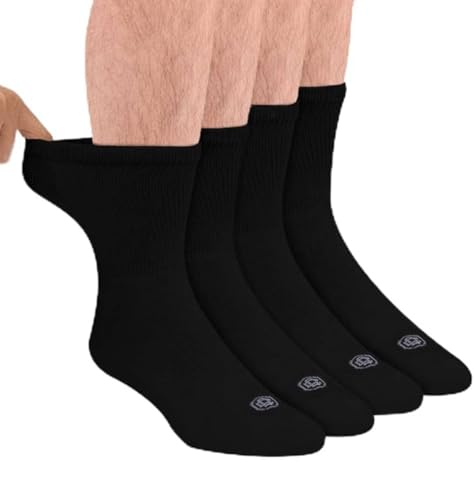
Doctor's Choice Diabetic Socks for Men, Crew (4 Pairs)
by Doctor's Choice
A true-seamless crew sock that combines genuine non-binding construction with full plantar cushioning, at a per-pair cost that supports daily medical-grade rotation.
Pros
- True seamless toe construction eliminates the single most common pressure point that triggers diabetic foot ulcers in neuropathic patients
- Non-binding top stays in place for 12+ hours without leaving the circulation indentation that constricts already-compromised venous return
- Full cushion sole provides meaningful shock absorption for the high-pressure plantar zones where diabetic ulcers most often develop
- Polyester-rubber-spandex blend wicks moisture aggressively, keeping the diabetic foot environment dry enough to suppress fungal and bacterial colonization
Cons
- Crew length only — patients needing ankle or over-the-calf coverage for edema management should look elsewhere
- 4-pair pack means weekly rotation requires a second order — daily-wear users typically need 7 pairs minimum
2. Dr. Scholl’s Men’s Diabetes & Circulator Crew Socks — Budget Pick
Dr. Scholl’s holds the unique position in diabetic hosiery of being one of only a handful of brands whose diabetic socks carry the American Podiatric Medical Association Seal of Acceptance — a third-party clinical credential that most direct-to-consumer brands either cannot obtain or do not pursue. For diabetic patients buying their first medical-grade socks, the APMA acceptance provides a meaningful trust signal that the product has been evaluated by podiatrists rather than simply being marketed as diabetic. The 6-pack at this price point makes the per-pair cost the lowest of any APMA-accepted diabetic sock on Amazon.
The TempRite non-binding top is a substantive engineering feature rather than marketing language. The yarn is engineered to relax slightly as it warms — meaning that as the patient’s lower leg warms through the day and distal edema typically increases, the sock cuff loosens incrementally rather than tightening against the swelling. This addresses a real clinical complaint diabetic patients commonly report with conventional diabetic socks: morning fit is comfortable, but by afternoon the cuff has become constrictive as the leg has swelled. The Made-in-USA construction provides supply chain transparency that matters for patients with skin sensitivity who need consistent fiber composition between batches.
The honest limitation is the toe construction: smooth toe seam rather than fully seamless. For the majority of diabetic patients without severe neuropathy or active ulcer history, the smooth toe is adequate and the price differential against fully seamless options is meaningful. For patients with documented loss of protective sensation, prior toe ulceration, or active wound history, the upgrade to a fully seamless option like the Doctor’s Choice crew is worth the additional per-pair cost.

Dr. Scholl's Men's Diabetes & Circulator Crew Socks (6 Pairs)
by Dr. Scholl's
The lowest per-pair cost on a podiatrist-vetted diabetic sock — APMA-accepted, US-manufactured, and built specifically for low-risk diabetic patients who need clinical-grade construction at value pricing.
Pros
- APMA Seal of Acceptance — one of the few diabetic socks formally vetted by the American Podiatric Medical Association for diabetic foot care
- TempRite non-binding top uses temperature-responsive yarn that loosens in warm conditions when distal swelling is most likely
- Smooth toe seam construction is a substantive upgrade over the cheap flat-knit toes found in dollar-store diabetic socks at similar price points
- Made in USA — supply chain transparency that matters for patients who require consistent fiber composition for skin sensitivity
Cons
- Smooth toe seam is not fully seamless — patients with severe peripheral neuropathy or active ulcer history should choose a fully seamless option
- 98% polyester / 1% spandex blend is less soft than cotton or merino alternatives during the break-in period
3. Dr. Scholl’s Women’s Diabetes & Circulatory Low Cut Socks — Runner-Up
The women’s low-cut version of the Dr. Scholl’s diabetic sock is the only APMA-accepted ankle-style sock in this guide, and the only pick here that pairs podiatric vetting with a fully seamless toe. Its review pool is the smallest in this guide, so weigh the APMA credential and the construction rather than the volume of feedback. For diabetic women whose footwear preferences run toward fashion sneakers, casual flats, and other shoes where a crew-length sock would be visible above the shoe collar, this product solves the compliance problem that affects many female diabetic patients — namely, that they will not wear a clinical-looking crew sock with their everyday footwear, and therefore do not wear diabetic socks at all.
The clinical engineering is a step up from the men’s crew version in one important respect: the toe is fully seamless rather than smooth-seamed. This is the construction that matters most for patients with neuropathy, and it makes the women’s low-cut a more clinically appropriate product for high-risk patients than its men’s crew counterpart, despite the lower price. The 97% polyester construction wicks moisture aggressively, which is particularly important in low-cut socks where the limited material area must work harder to keep the foot environment dry. The non-binding cuff sits below the gastrocnemius bulk where calf edema accumulates first, which is the appropriate position for a sock not intended to manage edema directly.
The clinical limitation of the low-cut format is that it provides no protection against shoe-collar friction at the ankle. For diabetic women with healthy ankle skin and intact sensation, this is not a problem. For patients with current or prior wounds at the ankle, malleolus, or heel, a crew-length sock is medically necessary — the low-cut should not be used.

Dr. Scholl's Women's Diabetes & Circulatory Low Cut Socks (4 Pairs)
by Dr. Scholl's
The only APMA-accepted low-cut option in this guide, and the one that upgrades to a genuinely seamless toe over the men's crew — the right choice for diabetic women who need clinical construction in a no-show silhouette.
Pros
- APMA Seal of Acceptance for diabetic foot care — the same podiatric vetting as the crew version, in a low-cut format for warmer climates
- Truly seamless toe (not just smooth) — the upgrade over the men's crew version that matters most for neuropathic patients
- Light-to-moderate cushion is appropriate for diabetic women who do not stand on hard surfaces all day and need a slimmer fit inside fashion footwear
- Non-binding top sits below the gastrocnemius bulk where calf edema accumulates first, avoiding the upper-calf indentation pattern
Cons
- Low-cut design provides no protection against shoe-collar friction at the ankle — not suitable for patients with active heel or malleolar wounds
- Light cushion is insufficient for patients with diabetic neuropathy who need maximum plantar protection
4. Falari Physicians Approved Diabetic Crew Socks — Bulk Value Leader
The Falari 12-pack solves a specific economic problem in diabetic foot care: the cost of building and maintaining a daily-rotation diabetic sock wardrobe out of single-pair or 3-pair packs is prohibitive for many patients on fixed incomes managing chronic diabetes. By delivering 12 pairs in a single order at a per-pair cost that approaches commodity sock pricing, Falari makes true daily rotation — with each pair washed after a single wear and given multiple days to fully dry and recover its shape — practical for the patient population most affected by diabetes prevalence and least able to absorb premium-pricing per-pair costs.
The 90% cotton construction is a deliberate trade-off that benefits some patients and disadvantages others. Cotton is softer than polyester blends and better tolerated by patients with sensitive skin, dermatitis history, or contact reactions to synthetic fibers. The trade-off is moisture management: cotton retains more moisture than polyester, creating an environment more favorable to fungal and bacterial growth. For diabetic patients without active fungal infection, hyperhidrosis, or wound history, the cotton blend is acceptable — even preferable for skin comfort. For patients with any of those conditions, the moisture retention is clinically problematic and a polyester-blend sock should be selected instead.
The seamless construction is described as smooth toe rather than true seamless, placing it at the same construction tier as the Dr. Scholl’s men’s crew. The loose non-binding top is genuinely loose — appropriate for patients with moderate distal edema but potentially too loose for patients seeking a snug fit. Pair the Falari with daily glucose monitoring to complete a basic diabetic self-care kit; our guide to the best glucose monitors covers the home meters and continuous monitoring systems that pair with this kind of foundational diabetic foot care.

Falari Physicians Approved Diabetic Crew Socks (12 Pairs)
by Falari
The category bulk-value leader — a 12-pack of cotton-blend diabetic crew socks that brings true daily-rotation pricing within reach for patients managing diabetes on a fixed budget.
Pros
- 12 pairs in a single order — the only product in this guide that supports a full two-week rotation cycle out of the box, which matters for patients who must wash diabetic socks daily
- 90% cotton blend is the softest material in the value tier, important for patients with skin breakdown history who cannot tolerate synthetic fibers
- Loose non-binding top accommodates moderate distal edema without compounding venous stasis at the upper calf
- Per-pair cost is a fraction of single-pair clinical brands, making compliance practical for patients on fixed incomes managing chronic diabetes
Cons
- High cotton content retains more moisture than polyester blends — not the right choice for patients with active fungal infections or hyperhidrosis
- Loose-knit construction means cushion compresses faster than denser premium socks, reducing plantar protection over time
5. Special Essentials Neuropathy Diabetic Crew Socks — Best for Neuropathy and Edema
Special Essentials has built a 12-pack diabetic sock specifically engineered for the patient population with the highest clinical risk: those with established peripheral neuropathy, chronic distal edema, or both. The defining engineering feature is the extra-wide non-binding top — a cuff opening substantially wider than competing products, designed to accommodate the patient whose lower leg circumference at the cuff position varies significantly between morning baseline and end-of-day swelling. For these patients, conventional diabetic socks become constrictive by mid-afternoon, which defeats the purpose of the non-binding design.
The combination of true seamless toe, extra-wide non-binding cuff, and cotton blend construction in a 12-pair pack at this price point is a meaningful value proposition for the high-risk diabetic patient. The clinical engineering matches what neuropathic and edematous patients need; the pack size enables daily rotation without stretching the household budget; and the cotton blend provides skin comfort that polyester alternatives cannot match for sensitivity-prone patients. The moderate cushion runs slightly thicker than competing 12-pack options, providing real plantar protection for patients standing on hard surfaces.
The engineering choices that make this product right for neuropathic and edematous patients make it less ideal for diabetics without those complications. The extra-wide cuff feels slouchy on patients with normal calf circumference, which can lead to bunching inside footwear — itself a friction risk for diabetic feet. Patients without distal edema or neuropathy are better served by a sock with a more standard non-binding cuff. For patients addressing diabetic foot care alongside circulatory complications, our best foot massagers guide covers home circulation devices used as adjuncts to medical care.

Special Essentials Neuropathy Diabetic Crew Socks (12 Pairs)
by Special Essentials
The neuropathy and edema specialist — a 12-pack engineered around the widest non-binding top in the category for diabetic patients whose feet swell throughout the day.
Pros
- Extra-wide non-binding top is engineered specifically for diabetic patients with chronic edema or neuropathy-related distal swelling — the widest opening in this guide
- 12-pair pack at a per-pair cost only slightly above the Falari, but with neuropathy-specific design upgrades that justify the premium
- Cotton blend with seamless toe addresses the two most common diabetic foot complaints in a single product — pressure points and synthetic skin irritation
- Moderate cushion runs slightly thicker than competing 12-packs, providing real protection for patients standing on hard floors during long medical or work shifts
Cons
- Extra-wide top can feel slouchy on patients without distal swelling — not the right choice for diabetics with normal calf circumference seeking a snug fit
- Sizing runs slightly large; patients on the smaller end of their range should size down for proper toe-box fit
6. Facool Merino Wool Diabetic Crew Socks — Upgrade Pick
The Facool merino wool diabetic sock is the only natural-fiber clinical-engineering option in this guide, and it occupies a category of its own. Merino wool provides three properties that synthetic diabetic socks cannot replicate: temperature regulation that keeps feet warm in cold environments without inducing the sweat that polyester traps in summer; natural antimicrobial activity that suppresses the bacterial and fungal colonization diabetic feet are at elevated risk for; and a soft hand-feel that improves daily wear compliance for patients who find synthetic compression-style materials clinically uncomfortable.
For the cold-climate diabetic patient, the temperature regulation is genuinely meaningful. Diabetic peripheral neuropathy frequently includes loss of cold sensation as well as protective sensation, meaning patients cannot feel when their feet are dangerously cold — a setup for frostbite or non-freezing cold injury that can complicate already-fragile diabetic skin. Merino wool’s insulating properties help maintain foot temperature in conditions where synthetic socks would leave the foot exposed to thermal stress. For patients with recurrent interdigital fungal infection, the natural antimicrobial properties of wool fiber provide a real reduction in colonization between washes — not a marketing claim, but a property of the wool fiber itself.
The trade-offs are real. The 3-pair pack at the upgrade price tier means the per-pair cost is meaningfully higher than synthetic alternatives, and patients needing daily rotation will need to budget accordingly. Wool also requires gentler laundry care — cool water, gentle cycle, air drying flat — to maintain its compression properties and avoid the felting that destroys wool socks washed in hot water. For patients willing to accept the cost and care requirements, the Facool delivers diabetic-specific engineering in a material category that no mass-market brand offers.
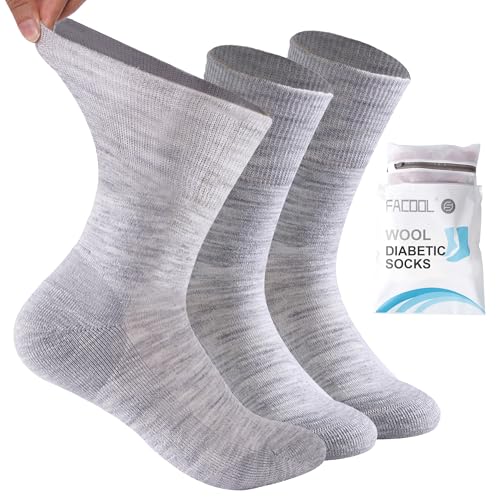
Facool Merino Wool Diabetic Crew Socks (3 Pairs)
by Facool
The premium natural-fiber upgrade for diabetics who refuse to compromise on warmth, odor resistance, or skin comfort — particularly suited to cold-climate patients and those with chronic interdigital fungal issues.
Pros
- Merino wool blend provides natural temperature regulation — keeps diabetic feet warm in cold weather without inducing the sweat that polyester traps in summer
- Naturally antimicrobial wool fibers suppress bacterial and fungal colonization between washes, a meaningful advantage for diabetics prone to interdigital infections
- Soft padded sole adds shock absorption without the bulk of full-cushion synthetics — the right balance for diabetics who need protection inside dress or athletic shoes
- Seamless toe and rubber-grip non-binding top combine the two most important diabetic sock features in a natural-fiber construction unavailable in mass-market brands
Cons
- 3-pair pack at this price means the per-pair cost is roughly triple the budget options — a real consideration for patients needing daily rotation
- Wool requires gentle wash cycle and air drying to maintain shape and compression — synthetic socks tolerate harsher laundry conditions
7. Pembrook Ankle Diabetic Socks for Women
The Pembrook ankle diabetic sock fills the gap between the clinically focused Dr. Scholl’s women’s low-cut and the broader market of fashion-oriented women’s ankle socks that lack diabetic engineering. The 6-pair pack at this price point delivers true seamless toe construction and a wide non-binding ankle band — both genuine diabetic-specific features — in an ankle silhouette designed for everyday lifestyle wear inside flats, sneakers, and other casual women’s footwear where a crew-length sock would be inappropriate.
The wide non-binding ankle band is the engineering differentiator against typical women’s ankle socks, which use elastic tension at the ankle to stay in place. The Pembrook cuff stays in place through fit rather than constriction, which is the same principle applied to crew-length non-binding tops — appropriate for diabetic patients with prominent malleoli, ankle edema, or any circulatory compromise at the distal lower leg. The cotton-poly blend balances the breathability women want in fashion footwear with enough synthetic content to wick moisture effectively, an important consideration in low-cut socks where the limited fabric area must work harder to maintain a dry foot environment.
The clinical limitations are inherent to the ankle silhouette: no protection against shoe-collar friction above the malleolus, and lighter cushion than crew alternatives. For diabetic women whose lifestyle requires ankle-style socks and whose feet are otherwise healthy, the Pembrook is the most clinically appropriate choice in this format. For patients with neuropathy, ulcer history, or wounds at the ankle or shin, a crew-length sock is medically necessary regardless of footwear preference.

Pembrook Ankle Diabetic Socks for Women (6 Pairs)
by Pembrook
The best-in-class women's ankle diabetic sock — pairs seamless toe construction and a wide non-binding band with enough pattern variety and value pricing for everyday lifestyle wear.
Pros
- True seamless toe construction at a 6-pair price point that beats most ankle-style competitors — the rare combination of clinical features and value in a women's silhouette
- Wide non-binding ankle band stays in place without rolling, even for patients with prominent malleoli or ankle edema
- Cotton-poly blend balances the breathability diabetic women need in fashion footwear with enough synthetic content to wick moisture effectively
- Light cushion is properly calibrated for ankle-style wear inside flats, sneakers, and lifestyle shoes where bulky cushioning would not fit
Cons
- Ankle length offers no friction protection above the malleolus — patients with active wounds at the ankle or shin should choose crew length
- Lighter cushion than crew alternatives — not appropriate for diabetics with significant peripheral neuropathy who need maximum plantar protection
Best Diabetic Socks for Men
Men’s diabetic feet tend to be larger, more prone to standing-related plantar pressure, and more likely to need sizing that runs to size 13-15 — which is where a men’s-cut crew sock with genuine full cushion earns its place. For most men, the Doctor’s Choice crew is the pick: true seamless toe, a non-binding top that holds for a 12-hour day without an indentation, and full plantar cushioning for the heel and forefoot. If you want a third-party clinical credential without paying up for it, the Dr. Scholl’s men’s crew carries the APMA Seal of Acceptance; for men with neuropathy or afternoon swelling, the Special Essentials extra-wide top gives the room a standard cuff doesn’t.
| Product | Price | Buy |
|---|---|---|
| Doctor's Choice Diabetic Socks for Men, Crew (4 Pairs)Best for men overall True seamless toe + full cushion, sized for larger feet and long days on hard floors | $21.99 | View on Amazon |
| Dr. Scholl's Men's Diabetes & Circulator Crew Socks (6 Pairs)Best value for men The only APMA-accepted men's crew here, and the cheapest way into one — TempRite cuff loosens as the leg warms | $12.98 | View on Amazon |
| Special Essentials Neuropathy Diabetic Crew Socks (12 Pairs)Best for men with swelling Extra-wide non-binding top for men whose feet swell through the afternoon | $24.99 | View on Amazon |
Best Diabetic Socks for Women
Women more often need a diabetic sock that disappears inside flats and fashion sneakers, which is exactly where a clinically-engineered low-cut or ankle sock matters — a crew sock they won’t wear protects nothing. The Dr. Scholl’s women’s low-cut is the only APMA-accepted no-show option here and, notably, upgrades to a fully seamless toe over the men’s smooth-seam version. For an ankle silhouette with a wider, roll-free band, the Pembrook pairs a true seamless toe with a non-binding ankle cuff at a strong 6-pair value.
| Product | Price | Buy |
|---|---|---|
| Dr. Scholl's Women's Diabetes & Circulatory Low Cut Socks (4 Pairs)Best for women overall APMA-accepted low-cut with a fully seamless toe for fashion footwear | $10.99 | View on Amazon |
| Pembrook Ankle Diabetic Socks for Women (6 Pairs)Best women's ankle value Seamless toe + wide non-binding ankle band in a 6-pair everyday pack | $19.95 | View on Amazon |
Best Diabetic Socks for Neuropathy and Swelling
Peripheral neuropathy and chronic distal edema are the two complications that most change which sock is safe: the foot can’t feel a seam it’s rubbing against, and a leg that swells through the day needs a cuff that gets looser, not tighter. The Special Essentials 12-pack is built for exactly this — the widest non-binding top in the guide, a true seamless toe, and a slightly thicker cushion — at a bulk price that makes daily rotation realistic for a high-risk patient. The Doctor’s Choice crew is the seamless-toe, full-cushion backup for neuropathic feet without significant swelling.
| Product | Price | Buy |
|---|---|---|
| Special Essentials Neuropathy Diabetic Crew Socks (12 Pairs)Best for neuropathy & edema Widest extra-wide non-binding top + seamless toe in a 12-pair value pack | $24.99 | View on Amazon |
| Doctor's Choice Diabetic Socks for Men, Crew (4 Pairs)Best for neuropathy (no swelling) True seamless toe and full cushion for high-pressure plantar protection | $21.99 | View on Amazon |
Best Diabetic Ankle and Low-Cut Socks
Ankle and low-cut diabetic socks suit patients with healthy ankle skin who wear casual or athletic footwear in warm weather — but only if the ankle band is non-binding, because a tight low-cut cuff sits right over the spot where diabetic swelling shows first. Both picks here solve that with a wide, roll-free band and a seamless toe. Note the tradeoff of the silhouette: neither protects against shoe-collar friction, so anyone with a current or prior wound at the ankle or heel should stay in a crew length.
| Product | Price | Buy |
|---|---|---|
| Pembrook Ankle Diabetic Socks for Women (6 Pairs)Best ankle diabetic sock Wide non-binding ankle band that won't roll, with a true seamless toe (6 pairs) | $19.95 | View on Amazon |
| Dr. Scholl's Women's Diabetes & Circulatory Low Cut Socks (4 Pairs)Best low-cut diabetic sock APMA-accepted no-show low-cut with a fully seamless toe for fashion shoes | $10.99 | View on Amazon |
More Diabetic Sock Use Cases
Two narrower needs, matched to the right pick from the lineup above:
| Product | Price | Buy |
|---|---|---|
| Facool Merino Wool Diabetic Crew Socks (3 Pairs)Best for warmth / cold climates Merino wool regulates temperature and resists odor — for cold weather and cold-sensitive neuropathic feet | $17.99 | View on Amazon |
| Falari Physicians Approved Diabetic Crew Socks (12 Pairs)Best bulk value A 12-pair cotton-blend pack that brings true daily rotation within a fixed budget | $19.99 | View on Amazon |
Diabetic Socks vs. Compression Socks — The Clinical Distinction
Patients frequently ask whether they can use compression socks instead of diabetic socks, or whether they need both. The clinical answer depends on the specific diabetes complications present. Diabetic socks and compression socks address different problems through different mechanisms, and substituting one for the other can cause harm in the wrong patient.
Diabetic socks are designed to prevent skin breakdown through three mechanical features: seamless toe construction (eliminates friction at the most ulcer-prone location), non-binding top (preserves venous return without constriction), and moisture management (suppresses the warm, wet environment that promotes infection). They apply minimal pressure to the leg. The clinical indication is any diabetic patient at risk for foot ulceration — which includes essentially all patients with diabetes for more than five years, all patients with established peripheral neuropathy, and all patients with prior foot wound history.
Compression socks apply graduated external pressure (typically 15-20, 18-25, 20-30, or 30-40 mmHg) to enhance venous return through the calf muscle pump. The clinical indication is venous insufficiency, edema, varicose veins, DVT prevention, or post-surgical recovery — vascular conditions that may or may not coexist with diabetes. For diabetic patients without peripheral arterial disease, mild compression in the 18-25 mmHg range can be safely used under physician guidance to manage venous problems; this is the safe overlap zone where patients use diabetic-appropriate compression socks. For diabetic patients with PAD — common in long-standing diabetes — compression socks are contraindicated because they further restrict already-impaired arterial flow. For diabetic patients with severe peripheral neuropathy, even mild compression should be used with caution because the patient cannot feel whether the compression is causing damage.
The practical guidance: most diabetic patients should wear diabetic socks for daily foot protection. A subset with documented venous insufficiency, edema, or DVT risk — and without PAD or severe neuropathy — may also benefit from mild graduated compression under physician guidance. Never self-prescribe compression above 20 mmHg with diabetes. Our best compression socks guide covers the full mmHg range for non-diabetic and physician-directed use.
When Diabetic Socks Aren’t Enough
Diabetic socks are one component of a comprehensive diabetic foot care program. They reduce the risk of friction and pressure-related ulcer initiation, but they do not eliminate it, and they do not address the broader spectrum of diabetic foot risk. Patients relying on diabetic socks alone — without daily foot inspection, regular podiatric care, glycemic management, and appropriate footwear — are not adequately protected against the ulcer-amputation pathway. Keeping average glucose down is what lowers neuropathy risk in the first place; our free A1C conversion calculator translates an A1C result into the average blood-sugar number it represents, which makes the target concrete.
Daily foot inspection is the single most important diabetic foot care activity, and it should be performed every evening before bed. The patient (or a household member if the patient cannot reach or see their feet) should examine the entire plantar surface, the dorsum, between the toes, around the heel, and at the malleoli for any redness, blistering, abrasion, callus formation, or discoloration. A simple practical technique that many podiatrists recommend: choose diabetic socks with a white sole. Any new red, brown, or yellow stain on the white sole at the end of the day signals bleeding, drainage, or wound formation that the neuropathic patient could not feel — and should trigger immediate inspection and physician contact.
Indications to see a podiatrist immediately, not at the next routine appointment: any new wound regardless of size; any change in foot shape (Charcot foot can develop within days and is a surgical emergency); any redness, warmth, or swelling that suggests infection; any black or dusky discoloration of any part of the foot; any persistent pain in a previously asymptomatic foot. Patients with established peripheral neuropathy should establish ongoing care with a podiatrist regardless of symptoms, with routine visits at intervals their podiatrist recommends — typically every three to six months. Patients managing diabetes alongside cardiovascular risk should also consider home monitoring tools beyond foot care; our guide to the best electrolyte powders covers hydration management options relevant to diabetic patients.
How to Choose the Best Diabetic Socks
The buyer’s guide factors below cover the technical decision criteria, but a simpler framework helps for most patients. First, assess your specific diabetic complications: do you have established peripheral neuropathy, peripheral arterial disease, distal edema, or prior wound history? Patients with any of these need maximum-feature diabetic socks — true seamless toe, extra-wide non-binding top, full cushion, polyester or merino wool material. Patients without these complications can use intermediate-feature socks at lower per-pair cost. Second, calculate your weekly rotation need: minimum seven pairs for daily wear with daily washing, ideally 10-12 pairs to allow each pair multiple drying days between wears. Choose pack sizes that build to your rotation target without forcing repeat orders. Third, consider HSA/FSA eligibility: most diabetic socks qualify, and reimbursement effectively reduces the per-pair cost by your marginal tax rate.
A second consideration the diabetic sock market largely ignores is the integration with footwear. A diabetic sock that fits perfectly inside a too-tight shoe creates pressure that the sock itself cannot prevent. Patients with neuropathy should have their footwear professionally fitted at least once, with attention to toe-box width, instep height, and overall volume. Diabetic socks should be worn during the fitting so that the sock-shoe combination is what the foot actually experiences in daily wear. For patients with significant foot deformity, prescription diabetic shoes are covered by Medicare Part B once per year — coordinate with your podiatrist to access this benefit.
Buyer's Guide
The right diabetic sock is determined by your specific diabetes complications — peripheral neuropathy, peripheral arterial disease, distal edema, ulcer history, and ambient temperature exposure all change which features matter most. The six factors below cover the decision framework most diabetic patients should walk through before purchasing.
Seamless Toe Construction
The toe seam is the single most important feature in any diabetic sock and the one most often compromised in cheaper alternatives. In patients with peripheral neuropathy, the inability to feel pressure means a raised toe seam can create unnoticed friction for 8 to 14 hours per day, leading to skin breakdown that progresses to ulceration without warning. True seamless construction — where the toe is closed using a linking process rather than a sewn seam — eliminates this risk entirely. Some products advertise a smooth toe seam, which is an improvement over conventional flat-knit toes but is not equivalent to true seamless construction. For patients with active ulcer history, severe neuropathy, or any prior toe-area skin breakdown, true seamless toe is non-negotiable.
Non-Binding Top Band
The upper cuff of a conventional sock uses elastic tension to stay in place — visible as an indentation around the calf at the end of the day. In a diabetic patient, this constriction restricts venous return in legs whose circulation is already compromised by the microvascular and macrovascular effects of long-term hyperglycemia. A non-binding top uses a different engineering approach: a wider band, a temperature-responsive yarn that loosens with heat, or a softer rib construction that stays in place through fit rather than constriction. For patients with chronic distal edema or PAD, look specifically for extra-wide non-binding designs that provide additional accommodation. The cuff should never leave a visible indentation when removed.
Moisture-Wicking Material
Diabetic feet are at elevated risk for fungal infection (tinea pedis, onychomycosis) and bacterial colonization (cellulitis, ulcer infection) — and the warm, moist environment created by sweat-trapping cotton socks accelerates both. Polyester blends move moisture away from the skin most aggressively and are the standard for diabetic athletic and clinical socks. Merino wool blends provide moisture management with naturally antimicrobial properties — the premium choice for diabetics with recurrent fungal issues or those in cold climates. High-cotton blends are softer but trap moisture; they are appropriate only for patients without infection history and with low ambient activity levels. For patients with hyperhidrosis or active fungal infection, polyester or merino is essential — cotton is contraindicated.
Padding and Cushion Level
Plantar cushioning in diabetic socks serves two purposes: shock absorption for the high-pressure zones (heel and forefoot) where ulcers most commonly develop, and friction reduction between the foot and shoe. Full cushion is appropriate for patients with peripheral neuropathy, those who stand on hard surfaces for long periods, and those with prior ulceration in plantar zones. Moderate cushion suits most diabetic patients in the general population. Light cushion is appropriate only for diabetics with normal sensation, healthy feet, and primarily seated or low-impact lifestyles. Heavily cushioned socks add thickness, which can compromise fit inside dress shoes — verify that the sock-shoe combination does not create a tight fit that itself becomes a pressure source.
Fit, Width, and Sizing Options
A diabetic sock that does not fit properly defeats its protective purpose. A sock that is too small constricts the toes and creates the pressure points it was designed to prevent; a sock that is too large bunches inside the shoe and creates friction folds that can initiate skin breakdown. Use the manufacturer's specific size chart against your shoe size, not generic S/M/L labels — sizing varies substantially between brands. Patients with significant distal edema should purchase sizes accommodating the swollen state, not the morning baseline. Wide-foot or extra-wide options are available in several brands and should be used by patients with bunions, hammer toes, or Charcot foot deformity. The toe box should allow full toe spread without compression.
Sock Length (Ankle vs Crew vs Over-the-Calf)
Crew length is the default for most diabetic patients — it provides protection against shoe-collar friction at the ankle, accommodates the most common cuff position for non-binding tops, and works inside the widest range of footwear. Ankle or low-cut length is appropriate for diabetics with healthy ankle skin who wear casual or athletic footwear in warm climates; it provides no protection against shoe-collar friction and is inappropriate for patients with current or prior wounds at the ankle or shin. Over-the-calf length is the right choice for patients with distal edema requiring full lower-leg coverage, those who wear compression hosiery overnight under physician guidance, or those whose work environment exposes the lower leg to abrasion. Patients with PAD generally do better in shorter socks that do not approach the knee, where additional constriction risk increases.
Final Verdict
For most diabetic patients — whether managing recently diagnosed Type 2 diabetes or long-standing Type 1 with established complications — Doctor’s Choice Diabetic Socks for Men, Crew is our best overall pick. The combination of true seamless toe construction, genuine non-binding top engineering, full plantar cushion, and a five-figure verified-review pool at a per-pair cost that supports daily rotation makes it the safest and most practically useful recommendation across the broadest segment of the diabetic population.
For patients who need maximum value to support a full daily-rotation wardrobe, the Falari 12-pack delivers diabetic-specific engineering at a per-pair cost that brings true compliance within reach of patients on fixed incomes — the right choice for low-risk diabetics without active fungal or wound history. For patients with established peripheral neuropathy or chronic distal edema, the Special Essentials Neuropathy 12-pack delivers extra-wide non-binding engineering that addresses the specific clinical needs of higher-risk patients without sacrificing the bulk-pack economics. For patients in cold climates or those who refuse to compromise on natural fibers, the Facool merino wool upgrade is a category of its own.
As with all diabetic foot care decisions, we recommend consulting your podiatrist or primary care physician before making material changes to your daily footwear or hosiery — particularly if you have established peripheral neuropathy, prior ulcer history, or peripheral arterial disease. Diabetic socks are an effective component of a comprehensive diabetic foot care program; they are not a replacement for daily foot inspection, regular podiatric care, or appropriate professional footwear. For patients building a complete diabetic self-care toolkit, our guide to the best glucose monitors covers the home monitoring devices that pair naturally with diabetic foot protection.
Frequently Asked Questions
Do diabetic socks really help prevent foot complications?
What's the difference between diabetic socks and regular socks?
Can I wear compression socks if I have diabetes?
Are diabetic socks HSA or FSA eligible?
How often should I replace my diabetic socks?
Related Articles
About the Reviewer

Dr. David Taylor, MD, PhD
Drexel University College of Medicine (MD), Indiana University School of Medicine (PhD)
Dr. David Taylor is a licensed physician and medical researcher who founded BestRatedDocs in 2016. With an MD from Drexel University and a PhD from Indiana University School of Medicine, he combines clinical expertise with a passion for health technology to provide evidence-based product recommendations. Dr. Taylor specializes in health informatics and regularly evaluates medical devices, diagnostic equipment, and therapeutic products to help healthcare professionals and patients make informed decisions.