8 Best Blood Pressure Monitors of 2026
Dr. David Taylor reviews the best blood pressure monitors on Amazon. Compare top-rated upper arm cuffs by accuracy, Bluetooth, cuff size, and clinical validation.
Updated
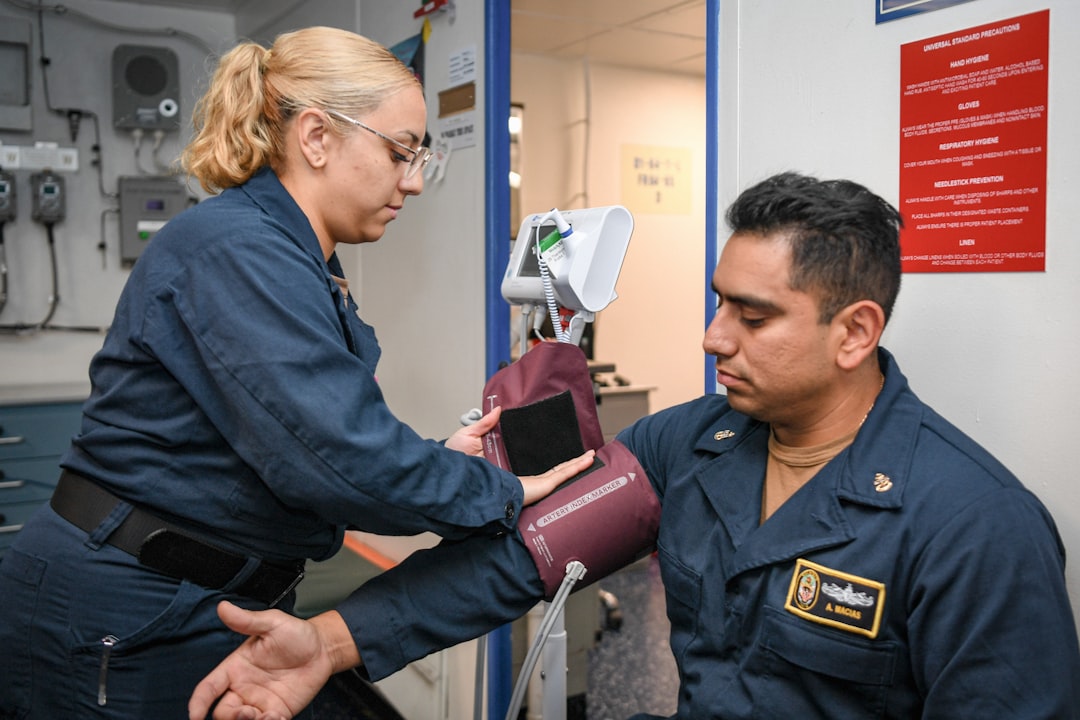
Hypertension affects approximately 122 million American adults — nearly half the US adult population — yet studies consistently show that fewer than one in four people with high blood pressure have it adequately controlled. Home blood pressure monitoring closes this gap. The American Heart Association and the American College of Cardiology both endorse regular home monitoring as a complement to clinical care, particularly for patients with white-coat hypertension, masked hypertension, and those adjusting medications. In 2026, the blood pressure monitor category on Amazon includes dozens of upper arm and wrist devices across a wide price range, with varying levels of clinical validation and connectivity. We reviewed eight of the best-selling, most-validated upper arm monitors — including a dedicated extra-large-cuff option for larger arms — to help you identify the right device for your needs.
Our evaluations are informed by the clinical expertise of Dr. David Taylor, who has advised patients on home monitoring protocols throughout his career. We prioritized clinical validation above all other criteria — a blood pressure monitor that produces inaccurate readings is worse than no monitor at all, as it can mask uncontrolled hypertension or trigger unnecessary medication adjustments. We also assessed connectivity, cuff sizing, memory depth, and real-world usability based on Amazon review analysis across tens of thousands of verified user experiences.
After reviewing all eight models, our top picks are summarized in the comparison table above. For most users managing hypertension or monitoring cardiovascular health at home, the refreshed Omron Silver represents the best combination of clinical validation, usability, and value. Read on for detailed analysis of each device.
| Product | Price | Buy |
|---|---|---|
| Omron Silver Blood Pressure Monitor Upper ArmBest Overall | $67.56 | View on Amazon |
| Omron Iron Blood Pressure Monitor Upper ArmBudget Pick | $37.67 | View on Amazon |
| Omron Gold Blood Pressure Monitor Upper ArmPremium Pick | $77.61 | View on Amazon |
| Withings BPM Connect Wi-Fi Smart Blood Pressure MonitorRunner-Up | $98.99 | View on Amazon |
| Greater Goods Upper Arm Blood Pressure Monitor | $35.99 | View on Amazon |
| iHealth Track Smart Upper Arm Blood Pressure Monitor | $27.98 | View on Amazon |
| Wellue BP2A Smart Blood Pressure Monitor with One-Piece DesignRunner-Up | $79.99 | View on Amazon |
| A&D Medical UA-789AC Blood Pressure Monitor — Extra Large Cuff | $123.99 | View on Amazon |
Find the Best Blood Pressure Monitor for Your Situation
Jump straight to the pick that matches how you’ll use it:
- Overall best blood pressure monitors — our top picks reviewed
- Most accurate blood pressure monitor
- Best portable and travel blood pressure monitor
- Best blood pressure monitor for two users and couples
- Best blood pressure monitor for seniors
- Best blood pressure monitor for large arms
- More: smaller arms and most-reviewed
Prefer a wrist cuff for travel or a stiff shoulder? See our separate guide to the best wrist blood pressure monitors.
How We Chose These Blood Pressure Monitors
We limited our selection to clinically validated upper arm monitors available on Amazon with substantial verified ratings, or devices from brands with independent clinical validation data published in peer-reviewed literature. We excluded wrist monitors from this review due to their well-documented positioning sensitivity and lower accuracy in home settings. For each device, we analyzed the validation protocol cited by the manufacturer, cross-referenced user feedback for recurring accuracy concerns, evaluated the cuff range against standard adult arm size distributions, and assessed whether connectivity features added genuine utility or complexity.
Hypertension and dyslipidemia travel together — most adults tracking BP at home should also be tracking lipids. Run your latest lab values through our free cholesterol ratio calculator to see your TC/HDL, LDL/HDL, non-HDL, and AIP all in one place against AHA-cited targets, and pair the resulting log with your at-home BP readings before your next clinician visit.
There is a cheaper measurement worth taking alongside the cuff, and it needs nothing but a tape. High blood pressure is one of three conditions that current NICE guidance ties directly to fat carried around the middle, and a waist-to-height ratio over 0.5 is the signal that prompts checking the other two. Our free waist to height ratio calculator gives you the ratio, the band it falls in, and the specific waist measurement to stay under at your height — a number you can verify each year without a device.
Whichever monitor you pick, accuracy depends on tracking the readings consistently — the AHA recommends two readings, one minute apart, twice a day for at least 3 days before each appointment. Type yours into our free blood pressure log and each row auto-color-codes against current AHA categories (Normal / Elevated / Stage 1 / Stage 2 / Severe), with running averages and a clinician-ready PDF you can bring to your visit.
Best Blood Pressure Monitors Overall
These are the eight monitors that earned a place in this guide, each reviewed in full below. The Omron Silver is our best overall pick for the widest range of home users; the use-case sections after the reviews then match specific situations — accuracy, travel, couples, seniors, and large arms — to the right pick from this same lineup.
1. Omron Silver Blood Pressure Monitor Upper Arm — Best Overall
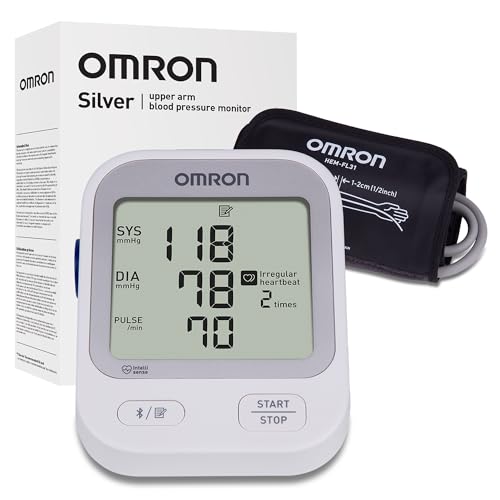
The Omron Silver is the most widely recommended home blood pressure monitor across clinical and editorial sources. This 2024-refresh SKU carries forward the same IntelliSense inflation engine and clinical validation profile that made the previous Silver generation the category benchmark — the cuff automatically determines the correct inflation level for each user’s arm, which eliminates the manual pressure setting errors that affect older-generation monitors and reduces cuff discomfort from over-inflation. Review volume on the refreshed model is still building, but the underlying device is the same proven platform.
What positions the Omron Silver as the best overall is its balance of features versus simplicity. Bluetooth connectivity to the free Omron Connect app is included, providing trend charts and historical logging without a subscription. The irregular heartbeat detection flag runs passively during every reading — a meaningful passive screen for a population already managing cardiovascular risk factors. The 30-reading on-device memory with date and time stamps covers a typical two-week tracking window, and the Omron Connect app holds unlimited history beyond that for a physician review. For the vast majority of adults using a blood pressure monitor for the first time or upgrading from a basic device, the Omron Silver is the right answer.
The single-user memory is the most notable limitation. Couples or households where more than one person uses the monitor will either need two devices or should step up to the dual-user Omron Gold. The standard cuff covers arm circumferences up to 17 inches — users with larger arms should confirm their measurement before purchasing.
Omron Silver Blood Pressure Monitor Upper Arm
by Omron
The most trusted upper arm monitor on Amazon — clinically validated, Bluetooth-enabled, and the refreshed 2024+ Silver model with the same IntelliSense engine.
Pros
- Clinically validated to AHA standards with IntelliSense technology that auto-adjusts inflation for consistent cuff pressure
- Stores 30 readings with time and date stamps, with unlimited history in the Omron Connect app
- Bluetooth connectivity syncs to the Omron Connect app for iOS and Android without a subscription fee
- Irregular heartbeat detection flags potential arrhythmias during routine readings as a passive safety screen
Cons
- Single-user storage limits usefulness for couples or multi-person households sharing the device
- The included cuff fits arms 9 to 17 inches — users outside this range need to purchase separately
- Bluetooth sync can occasionally require a manual reconnection after phone OS updates
2. Omron Iron Blood Pressure Monitor Upper Arm — Budget Pick
The Omron Iron is the refreshed entry-level model that replaces Omron’s older Bronze line — and it is the right choice when the primary need is a clinically validated upper arm reading at the lowest possible price from a trusted brand. It delivers the same core IntelliSense inflation technology and irregular heartbeat detection as the more expensive Omron models, without the Bluetooth, deeper memory, or multi-user profiles that justify the higher price points.
The 14-reading memory is deliberately shallow, designed for users who take a reading, note it down, and move on — not for users trying to build a longitudinal database. For patients managing a stable blood pressure with a well-established treatment regimen who simply need a reliable device for spot checks or occasional monitoring, this limitation is irrelevant. For patients newly diagnosed with hypertension who are titrating medications and need trend data, the 14-reading limit is a practical constraint worth acknowledging — and a reason to consider the Silver or Gold instead.
The Iron is also an excellent choice as a dedicated travel monitor, a backup device, or a device for an elderly parent who finds technology interfaces confusing. The single-button operation reduces every session to press and wait — there is nothing to configure, pair, or update.

Omron Iron Blood Pressure Monitor Upper Arm
by Omron
Omron's new entry-level upper arm monitor — the refreshed replacement for the Bronze line at the same accessible price point.
Pros
- Most affordable clinically validated upper arm monitor from a physician-trusted brand
- IntelliSense inflation technology ensures consistent cuff pressure without manual pumping
- 14-reading memory with average function displays a rolling mean — useful for white-coat hypertension context
- Simple one-button operation reduces barriers for older adults or technology-averse users
Cons
- 14-reading memory is shallow — readings roll over quickly if not transferred to a log
- No Bluetooth or app connectivity; data must be manually recorded or photographed
- Single-user only with no option to add a second user profile
3. Omron Gold Blood Pressure Monitor Upper Arm — Upgrade Pick
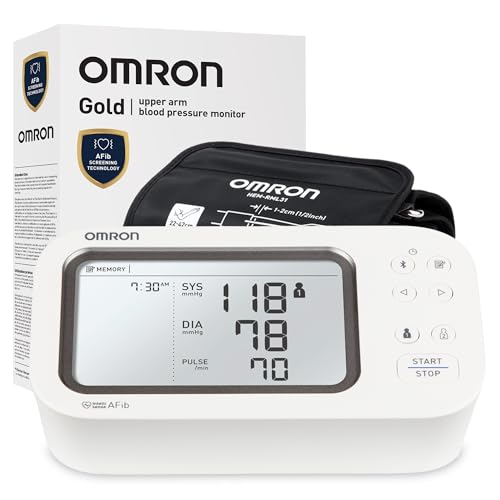
The Omron Gold is the upgrade pick for users who need more than the Silver offers — specifically, couples tracking together and anyone who wants atrial fibrillation screening built into a routine reading. Two-user mode stores 80 readings per user, 160 in total, so two people can share one device without one person’s history overwriting the other’s. That is more than double the Silver’s 30-reading single-user memory, and it is the single clearest reason to step up.
AFib detection is the Gold’s most clinically relevant differentiator. Standard irregular-heartbeat flags, which nearly every monitor here includes, tell you only that the rhythm varied during the reading. The Gold specifically screens for atrial fibrillation, the arrhythmia most strongly associated with stroke risk, and it is the rhythm most likely to be silent in a patient who feels entirely well. A home device cannot diagnose AFib, and a flag is not a diagnosis. What it does is give you something concrete to bring to your physician, which is exactly the role a home monitor should play.
The Gold also carries a High Morning Average Indicator, which surfaces elevated morning readings — the window when blood pressure surges carry the highest cardiovascular risk. Note that this is a morning-specific indicator, not a full morning-and-evening averaging protocol; evening readings are stored, but the device does not average them separately.
One honest caveat for readers who arrived here looking for TruRead, Omron’s triple-reading averaging feature. TruRead belonged to the Platinum, and the Platinum has been discontinued and delisted from Amazon. No current Omron model in this lineup carries TruRead. If a three-reading average is what your physician has asked for, take three readings a minute apart and average them yourself — the arithmetic is the same, it is only the automation that is gone.
Omron Gold Blood Pressure Monitor Upper Arm
by Omron
Best for couples and AFib screening — two-user memory at 80 readings each, plus Omron's AFib detection.
Pros
- Two-user mode stores 80 readings per user (160 total) — the right configuration for couples monitoring together
- AFib detection flags the irregular rhythm most associated with stroke risk, a step beyond basic irregular-heartbeat alerts
- High Morning Average Indicator surfaces morning blood pressure spikes, which carry elevated cardiovascular risk
- Bluetooth syncs to Omron Connect app with unlimited cloud history and shareable reports for physician visits
Cons
- No TruRead triple-reading averaging — that feature belonged to the discontinued Platinum and no current Omron model carries it
- Averaging indicator covers mornings only; evening readings are stored but not separately averaged on the device
- App requires account creation, which may deter privacy-conscious users
4. Withings BPM Connect Wi-Fi Smart Blood Pressure Monitor — Runner-Up
The Withings BPM Connect stands out from every other device on this list with its dual Wi-Fi and Bluetooth connectivity. Most Bluetooth-only monitors require you to actively open the app and initiate a sync after each measurement. The BPM Connect uploads automatically via Wi-Fi in the background — you take your reading, put the device down, and the data is already in your Health Mate dashboard by the time you pick up your phone. For users who find active syncing a friction point that reduces compliance, this passive upload behavior is a genuine quality-of-life improvement. With more than 16,000 verified reviews, it is the most user-validated Wi-Fi monitor in this roundup — the Bluetooth-only iHealth Track carries a larger review base still.
User ratings have softened slightly with the refreshed model — the average sits at 4.1 stars rather than the 4.3+ that earlier production runs achieved — and most of the recent negative reviews cite Wi-Fi setup friction rather than measurement accuracy. The underlying clinical validation is unchanged, and Withings remains one of the few consumer brands with published AFib detection capability built into the BP measurement cycle rather than requiring a separate device.
The integrated all-in-one design — cuff, pump, and digital display in a single cylindrical unit — is compact and travel-friendly in a way that traditional two-piece upper arm monitors are not. The USB-C rechargeable battery eliminates AA battery expense. The Health Mate app supports integration with Apple Health and Google Fit, making it a natural choice for users already within a connected health ecosystem tracking steps, sleep, and weight alongside blood pressure. The tradeoff is price — the BPM Connect costs significantly more than the Omron Silver without adding diagnostic capability beyond AFib screening.

Withings BPM Connect Wi-Fi Smart Blood Pressure Monitor
by Withings
The best smart home monitor for connected health ecosystems — Wi-Fi auto-sync and AFib detection in one unit, with 15,000+ user reviews behind it.
Pros
- Wi-Fi and Bluetooth dual connectivity syncs readings automatically without opening an app — data uploads in background
- Companion Health Mate app provides long-term trend charts and heart health insights beyond raw readings
- Compact all-in-one design integrates cuff, pump, and display in a single unit with no separate monitor base
- FSA and HSA eligible for purchase, reducing out-of-pocket cost for eligible buyers
Cons
- Requires Wi-Fi network setup during onboarding — less straightforward than standalone button-press monitors
- Battery life is shorter than traditional AA-battery devices due to wireless radio activity
- At over $100, the price premium over the Omron Silver is hard to justify for users who only need basic readings
5. Greater Goods Upper Arm Blood Pressure Monitor
Greater Goods isn’t a name physicians reach for the way they reach for Omron, but it has earned something arguably more telling for a value pick: it has been a recommended monitor in Wirecutter’s testing five separate times, and it carries more than 28,000 verified Amazon reviews at a 4.4-star average. That combination of independent expert validation and broad user feedback is the strongest credibility profile of any no-Bluetooth monitor in this price tier. For the buyer who wants a well-vetted, FDA-cleared upper arm monitor without paying for connectivity, this is the cleanest non-Omron option I’d point patients toward.
The 120-reading dual-user memory (60 per user) stores roughly a month of daily readings for two people on a single device, and irregular heartbeat detection is included on every reading. What sets the kit apart at this price is completeness — it ships with AAA batteries, a wall adapter, and a travel case, so there is nothing extra to buy before your first reading. The large backlit display with a color-coded range indicator reads clearly in any lighting, which matters for older users or anyone checking readings early in the morning or at night. The standard cuff fits 8.75 to 16.5 inches, covering most adult arms.
The main tradeoffs are connectivity and a small learning curve. There is no Bluetooth or app, so sharing data with a physician means logging readings manually — though for users who simply want reliable spot-check readings rather than a synced longitudinal record, that simplicity is a feature, not a bug. Cuff alignment takes a few practice readings to position correctly, and battery life is shorter under daily use; the included wall adapter is the practical workaround for households that measure every day. The brand carries less weight if your cardiologist has expressed a preference for Omron-validated data, but the FDA clearance means the underlying device is held to the same accuracy standard as any Class II BP monitor.

Greater Goods Upper Arm Blood Pressure Monitor
by Greater Goods
A five-time Wirecutter pick with 28,000+ ratings and a complete out-of-the-box kit — the most credibly validated no-Bluetooth upper arm monitor under $40.
Pros
- A five-time Wirecutter recommended pick — the strongest third-party validation of any no-Bluetooth monitor in the sub-$40 tier
- Dual-user 120-reading memory (60 per user) stores about a month of daily readings for two people on one device
- Complete kit includes AAA batteries, a wall adapter, and a travel case — nothing extra to buy
- Large backlit display with a color-coded range indicator reads clearly in any lighting
Cons
- No Bluetooth or app connectivity — readings must be logged manually to share with a physician
- Cuff alignment takes a few practice readings to position correctly
- Battery life is shorter under daily use — the included wall adapter is the practical workaround
6. iHealth Track Smart Upper Arm Blood Pressure Monitor
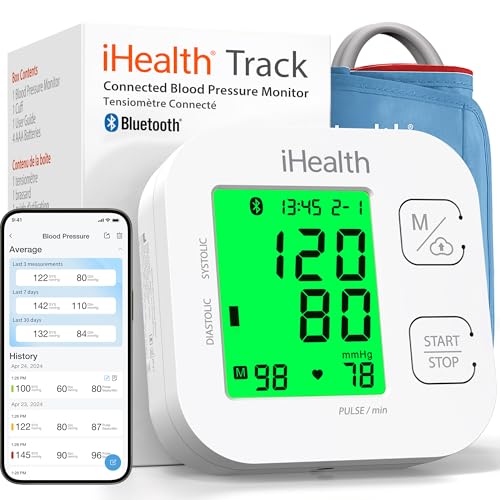
The iHealth Track has the largest user-validated review dataset of any device in this entire review — more than 63,000 verified Amazon ratings at a 4.5-star average. For a Class II medical device, that level of real-world social proof is exceptional and worth weighing seriously regardless of physician brand familiarity. When tens of thousands of consumers report consistent accuracy and reliability against a 4.5-star ceiling, the data should carry weight in a purchasing decision.
The Track’s most distinctive feature is its color-coded classification display. After each reading, the monitor categorizes the result using the AHA five-tier classification (normal, elevated, Stage 1 hypertension, Stage 2 hypertension, hypertensive crisis) and illuminates the corresponding color band on the device screen. For users who are uncertain how to interpret raw systolic and diastolic numbers, this visual guidance reduces the cognitive load of self-monitoring and supports appropriate clinical triage — prompting a call to a physician when readings fall in the Stage 2 or crisis range.
Bluetooth connectivity syncs to the iHealth MyVitals app with free unlimited cloud storage, making this the best value among connected monitors. The app provides trend graphs and supports multiple users, though device-level memory is limited to 99 readings. For tech-comfortable adults who are new to blood pressure monitoring and want intuitive feedback without investing in an Omron premium tier, the iHealth Track is a legitimate alternative. The caveat worth noting is that iHealth carries less physician recognition than Omron, which can matter when sharing data with a cardiologist who may be more familiar with Omron’s clinical validation dossier.
iHealth Track Smart Upper Arm Blood Pressure Monitor
by iHealth
The most-reviewed Bluetooth monitor on Amazon — 67,000+ ratings make this the strongest social-proof pick in the connected-monitor category.
Pros
- Largest user-validated dataset in this review — 63,000+ verified Amazon reviews at 4.5 stars is the strongest social proof in the category
- Bluetooth sync to the iHealth MyVitals app stores unlimited history and overlays readings on a timeline graph
- Color-coded display classifies each reading against AHA hypertension stages without requiring number interpretation
- FSA and HSA eligible with FDA clearance
Cons
- iHealth brand carries less physician recognition than Omron, which may matter when sharing data with a cardiologist
- App has received mixed reviews for reliability on certain Android versions — check compatibility before purchasing
- 99-reading local memory requires consistent app pairing to avoid losing data between sync sessions
7. Wellue BP2A Smart Blood Pressure Monitor — Runner-Up
The Wellue BP2A solves a problem that conventional upper arm monitors do not: it eliminates the external tube and the separate display base entirely. The cuff, pump, and OLED readout are integrated into a single unit that wraps directly around your arm and packs flat. For frequent travelers, renters in studio apartments, and anyone who finds the standard cuff-tube-base configuration awkward to store, the one-piece form factor is a meaningful quality-of-life upgrade in a category that rarely innovates on hardware design.
Operation is deliberately minimal. One button starts the measurement, and systolic, diastolic, and pulse appear in about thirty seconds on a display bright enough to read in a dim hotel room. The device is FDA cleared, and every reading syncs over Bluetooth into the Wellue Health app, where separate household profiles keep one person’s history from overwriting another’s — a genuine advantage over the single-user memory that most compact monitors ship with. The wide-range cuff covers arms from 22 to 42 centimetres, which spans most adults comfortably.
The feature that matters most on the road is the battery. This is a rechargeable device that runs for months on a single charge, so there are no AA or AAA cells to pack, hunt for, or replace mid-trip. The tradeoffs are honest ones: reading history lives in the app rather than in a large on-device memory bank, so the monitor is less useful if you never pair a phone, and Wellue does not carry the brand recognition of Omron or Withings despite a strong rating across well over a thousand reviews. For a traveller or a small-space household that wants one clean device and no accessories, it is the most practical monitor here.
Note on this update: the Omron Evolv previously held this position. Its Amazon listing has been delisted and now returns a 404, which is why it has been replaced rather than simply re-priced.

Wellue BP2A Smart Blood Pressure Monitor with One-Piece Design
by Wellue
The tubeless travel-ready pick — a one-piece rechargeable monitor that packs flat in a carry-on and syncs every reading to the app.
Pros
- Tubeless one-piece design integrates cuff, pump, and OLED display into a single unit — no external tubing or separate base to position
- FDA-cleared oscillometric measurement of systolic, diastolic, and pulse, with a full reading completed in about 30 seconds from one button press
- Rechargeable battery runs for months on a single charge, so there are no disposable cells to carry or replace on a trip
- Wide-range cuff fits 22 to 42 cm arms and Bluetooth sync stores history in the app for multiple household members to review and share
Cons
- App-based history rather than a large on-device memory bank, so readings live on the phone rather than in the monitor
- Brand recognition is lower than Omron or Withings, and the review base is smaller despite a strong average rating
8. A&D Medical UA-789AC Blood Pressure Monitor — Best for Large Arms
Every other monitor in this guide tops out around a 17-inch arm — the Omron cuffs stop at 17 inches and even the wide Withings cuff stops at 18.5 inches. For the millions of adults whose upper-arm circumference is larger than that, a standard cuff does not just fit poorly; it produces falsely high readings that can trigger unnecessary worry or medication changes. The A&D Medical UA-789AC exists specifically for that buyer. Its tapered extra-large cuff fits arms from 16.5 to 23.6 inches — into the bariatric range — and A&D Medical is one of the few nearly-50-year clinical brands whose devices carry validated accuracy and appear on physician and pharmacist recommendation lists.
The tradeoff for that specialized fit is a simpler feature set. There is no Bluetooth on this model — you read the numbers off the oversized LCD and either rely on the 60-reading on-device memory or log them by hand in the free A&D Heart Track app. The unit averages your last three readings and flags irregular heartbeats, and the included AC adapter means it can live plugged in at a bedside table without battery worries. If your arm measures under about 16 inches, this is the wrong monitor — the tapered XL cuff will not fit snugly and one of the standard-cuff picks above will read more accurately. But for large and bariatric arms, this is the clinically credible answer, and the reason it earns a place alongside the seven mainstream picks.

A&D Medical UA-789AC Blood Pressure Monitor — Extra Large Cuff
by A&D Medical
The clinical-brand answer for arms above 17 inches — A&D Medical's extra-large tapered cuff reaches 23.6 inches with clinically validated accuracy and an included AC adapter.
Pros
- Extra-large tapered cuff fits arms from 16.5 to 23.6 inches — purpose-built for large and bariatric arms where standard 17-inch cuffs stop
- A&D Medical is a nearly 50-year clinical brand recommended by physicians and pharmacists, with clinically validated measurement accuracy
- AC adapter included plus simple one-button operation — no battery anxiety and nothing to configure for a fixed home setup
- Averages the last three readings and flags irregular heartbeat, matching the multi-reading protocol clinicians recommend
Cons
- No Bluetooth — readings are stored on-device (60) or logged manually in the A&D Heart Track app, not synced automatically
- Single-user memory only, so couples sharing the device lose separate histories
- The XL cuff is tapered for very large arms — users with average-size arms should choose a standard-cuff monitor for the best fit
Most Accurate Blood Pressure Monitor
Accuracy on a home monitor comes down to two things: a device validated against a recognized protocol, and a cuff that inflates correctly for your arm every time. Both picks below are clinically validated Omron units running the same IntelliSense inflation engine — the Silver is the most widely recommended validated monitor for everyday use, while the Gold adds atrial fibrillation screening on top of the standard irregular-heartbeat flag, so an abnormal rhythm gets named rather than just noted. Worth knowing: no current Omron model automates three-reading averaging. That was TruRead, and it retired with the discontinued Platinum. Taking three readings a minute apart and averaging them by hand gives you the same number.
| Product | Price | Buy |
|---|---|---|
| Omron Silver Blood Pressure Monitor Upper ArmMost accurate for everyday use Clinically validated IntelliSense inflation — the category's most-recommended accurate monitor | $67.56 | View on Amazon |
| Omron Gold Blood Pressure Monitor Upper ArmBest rhythm screening Adds AFib-specific detection, the arrhythmia most linked to stroke risk, to the same validated platform | $77.61 | View on Amazon |
Best Portable and Travel Blood Pressure Monitor
A travel monitor needs to survive a carry-on and set up without a tangle of tubing. Both picks here integrate the cuff, pump, and display into a single unit — no separate base to pack, and both recharge rather than eating disposable batteries on the road. The Wellue BP2A is the tubeless, drawer-sized pick that reads in about thirty seconds from one button; the Withings is the pick if you also want automatic Wi-Fi syncing so readings land in your phone before you leave the hotel room.
| Product | Price | Buy |
|---|---|---|
| Wellue BP2A Smart Blood Pressure Monitor with One-Piece DesignBest tubeless travel monitor One-piece tubeless body packs flat in a carry-on and recharges instead of using disposable cells | $79.99 | View on Amazon |
| Withings BPM Connect Wi-Fi Smart Blood Pressure MonitorBest connected travel monitor Compact all-in-one that auto-syncs over Wi-Fi and recharges by USB-C | $98.99 | View on Amazon |
Best Blood Pressure Monitor for Two Users and Couples
When two people share one monitor, single-user memory is a problem — one person’s readings overwrite the other’s history. Both picks below store separate profiles. The Omron Gold keeps 80 readings each for two users and flags morning highs; the Greater Goods monitor is the no-Bluetooth value option, storing 60 readings each for two people in a complete out-of-the-box kit.
| Product | Price | Buy |
|---|---|---|
| Omron Gold Blood Pressure Monitor Upper ArmBest dual-user overall 160 readings across two profiles, plus a High Morning Average Indicator and AFib detection | $77.61 | View on Amazon |
| Greater Goods Upper Arm Blood Pressure MonitorBest value for two users Dual-user 120-reading memory in a five-time Wirecutter pick — no app needed | $35.99 | View on Amazon |
Best Blood Pressure Monitor for Seniors
For an older adult, the priorities shift to simplicity and readability: one button, a clear display, and nothing to pair or configure. The Omron Iron reduces every session to a single press and inflate, with no app or menus in the way. The Greater Goods monitor pairs an equally simple workflow with a large backlit, color-coded display that is easy to read in low light — and it ships with a wall adapter so there is no battery fuss.
| Product | Price | Buy |
|---|---|---|
| Omron Iron Blood Pressure Monitor Upper ArmSimplest one-button operation One-button press-and-wait with no app or pairing — the easiest to operate | $37.67 | View on Amazon |
| Greater Goods Upper Arm Blood Pressure MonitorBest large, easy-to-read display Large backlit color-coded display with an included wall adapter for daily use | $35.99 | View on Amazon |
Best Blood Pressure Monitor for Large Arms
An arm circumference above 17 inches is where most home monitors fail — a standard cuff that is too small reads falsely high, a clinically significant error. The fix is a genuine extra-large cuff, not a standard cuff stretched to its limit. The A&D Medical UA-789AC is purpose-built for this, with a tapered XL cuff reaching 23.6 inches from a validated clinical brand. For moderately large arms up to 18.5 inches that also want automatic syncing, the Withings is the widest-cuff connected option.
| Product | Price | Buy |
|---|---|---|
| A&D Medical UA-789AC Blood Pressure Monitor — Extra Large CuffBest for extra-large & bariatric arms Tapered XL cuff fits 16.5-23.6 inches — clinical-brand accuracy for large arms | $123.99 | View on Amazon |
| Withings BPM Connect Wi-Fi Smart Blood Pressure MonitorWidest connected cuff Fits up to 18.5 inches with automatic Wi-Fi syncing and AFib screening | $98.99 | View on Amazon |
Blood Pressure Monitors by Use Case
A couple more situations come up often. Here is the quick-decision pick for each — both drawn from the monitors reviewed above, with a live Amazon link so you can check the current price.
| Product | Price | Buy |
|---|---|---|
| Greater Goods Upper Arm Blood Pressure MonitorBest for smaller arms Cuff fits from 8.75 inches — a snug, accurate fit on slimmer arms | $35.99 | View on Amazon |
| iHealth Track Smart Upper Arm Blood Pressure MonitorMost-reviewed value pick 67,000+ verified reviews with color-coded readings and free app syncing | $27.98 | View on Amazon |
How to Choose the Best Blood Pressure Monitor
The buyer’s guide above covers the six most important variables. One additional consideration is how you plan to use the data. A monitor used for occasional peace-of-mind checks has different requirements than one used to document 7-day averages for a physician-supervised medication titration. If your cardiologist has given you a specific monitoring protocol — such as twice-daily readings for two weeks before a follow-up appointment — choose a monitor with enough memory to hold that whole window without overwriting it (Omron Gold or Withings BPM Connect).
For patients with chronic kidney disease, diabetes, or atrial fibrillation alongside hypertension, a monitor with irregular heartbeat detection (all devices reviewed here) and ideally AFib screening (Withings BPM Connect) is worth prioritizing. Wrist monitors are not reviewed here but deserve mention: while convenient, they require strict arm positioning at heart level and are more sensitive to small postural errors than upper arm models. For diagnostic purposes, upper arm monitors are the clinical standard.
Buyer's Guide
Choosing the right blood pressure monitor means matching the device's cuff size, memory capacity, and connectivity to your specific monitoring needs and how you plan to share data with your care team.
Clinical Validation
Not all blood pressure monitors sold on Amazon meet the accuracy standards required for clinical use. Look for devices validated to AAMI/ANSI SP10, the ESH International Protocol, or cleared by the FDA under 510(k). Omron is the brand most consistently cited in clinical literature for consumer-grade accuracy. Withings and iHealth also carry FDA clearance. Avoid monitors without any stated validation standard, regardless of star ratings — consumer reviews cannot substitute for protocol-based accuracy testing.
Cuff Size
This is the most critical variable in blood pressure measurement accuracy. Measure your upper arm circumference (midpoint between shoulder and elbow) and verify your measurement falls within the included cuff's range before purchasing. Most standard cuffs cover 9 to 17 inches. If your arm circumference is above 17 inches, purchase a monitor that includes a large or extra-large cuff, or buy a compatible extension cuff separately. An incorrectly sized cuff can skew readings by 10 to 15 mmHg — a clinically significant margin.
Memory and Multi-User Support
Single-person households managing a chronic condition need enough stored readings to track trends meaningfully between physician appointments, and most on-device memories are shallower than buyers expect. Couples sharing a monitor need a device with two user profiles — otherwise one person's readings overwrite the other's history. The Omron Gold stores 160 readings across two users, 80 each. Bear in mind that ACC/AHA guidelines establish a hypertension diagnosis from a 7-day average of twice-daily readings, so what matters is having enough memory to cover that window without overwriting it — a bar every dual-user pick here clears.
Bluetooth and App Connectivity
Bluetooth-enabled monitors sync readings to smartphone apps that graph trends over time, flag anomalies, and generate PDF reports for physician visits. If you have multiple conditions being managed across several providers, connected monitoring provides a shareable audit trail that manual logs cannot. For older adults who prefer simplicity, or users who only need occasional spot checks, a non-connected monitor is perfectly adequate. The key question is whether your physician reviews your home data — if so, connectivity pays dividends.
Irregular Heartbeat Detection
Most monitors reviewed here include an irregular heartbeat detection flag that triggers when the device detects an atrial rhythm inconsistency during measurement. This feature does not diagnose arrhythmia — a single flag should not cause alarm — but a pattern of repeated flags during routine monitoring is a legitimate reason to discuss further evaluation with your physician. If AFib detection is a primary concern, the Withings BPM Connect includes dedicated AFib screening capability beyond the basic IHB flags present on other monitors.
Power Source
Battery-powered monitors using 4 AA batteries are the most common configuration and reliable in settings without accessible outlets. AC adapter compatibility — available on select Omron models — eliminates battery replacement entirely for bedside units. The Withings BPM Connect uses a rechargeable battery via USB-C, which reduces recurring battery costs but requires periodic charging. If the monitor will be used at a fixed bedside location, AC power or USB-C recharging is more convenient; for travel or shared household use, replaceable AA or AAA batteries offer the most flexibility.
Final Verdict
For most people seeking a home blood pressure monitor, the Omron Silver is the best overall choice. It combines the clinical validation that physicians trust, the IntelliSense technology that ensures consistent cuff inflation, Bluetooth connectivity to the free Omron Connect app, and 30-reading on-device memory backed by unlimited app history — all at a price that does not require a significant budget commitment. The 2024 refresh preserves the same proven hardware platform that earned the Silver line its category-leading reputation.
For buyers seeking the lowest possible price from a validated brand, the Omron Iron delivers the core accuracy of the Omron platform with the simplest possible interface. Couples managing hypertension together should step up to the Omron Gold for dual-user memory and AFib detection. Buyers willing to step outside the Omron lineup will find the Greater Goods monitor a deeply validated value pick — a five-time Wirecutter recommendation backed by 28,000-plus user reviews — and the iHealth Track offers the deepest user-validation dataset in the connected-monitor category. As always, consult your physician before beginning a home monitoring program to discuss appropriate target ranges, monitoring frequency, and how to share your data effectively at your next appointment.
Frequently Asked Questions
What is the most accurate type of blood pressure monitor for home use?
How do I know if a blood pressure monitor is clinically validated?
What is considered normal blood pressure?
How should I take my blood pressure at home for the most accurate results?
Can blood pressure monitors be inaccurate? What causes errors?
Related Articles
About the Reviewer

Dr. David Taylor, MD, PhD
Drexel University College of Medicine (MD), Indiana University School of Medicine (PhD)
Dr. David Taylor is a licensed physician and medical researcher who founded BestRatedDocs in 2016. With an MD from Drexel University and a PhD from Indiana University School of Medicine, he combines clinical expertise with a passion for health technology to provide evidence-based product recommendations. Dr. Taylor specializes in health informatics and regularly evaluates medical devices, diagnostic equipment, and therapeutic products to help healthcare professionals and patients make informed decisions.