10 Best Airplane Ear Plugs of 2026
Dr. David Taylor compares the 10 best airplane ear plugs of 2026 for pressure and noise, plus how to clear your ears on descent and when not to fly at all.
Updated
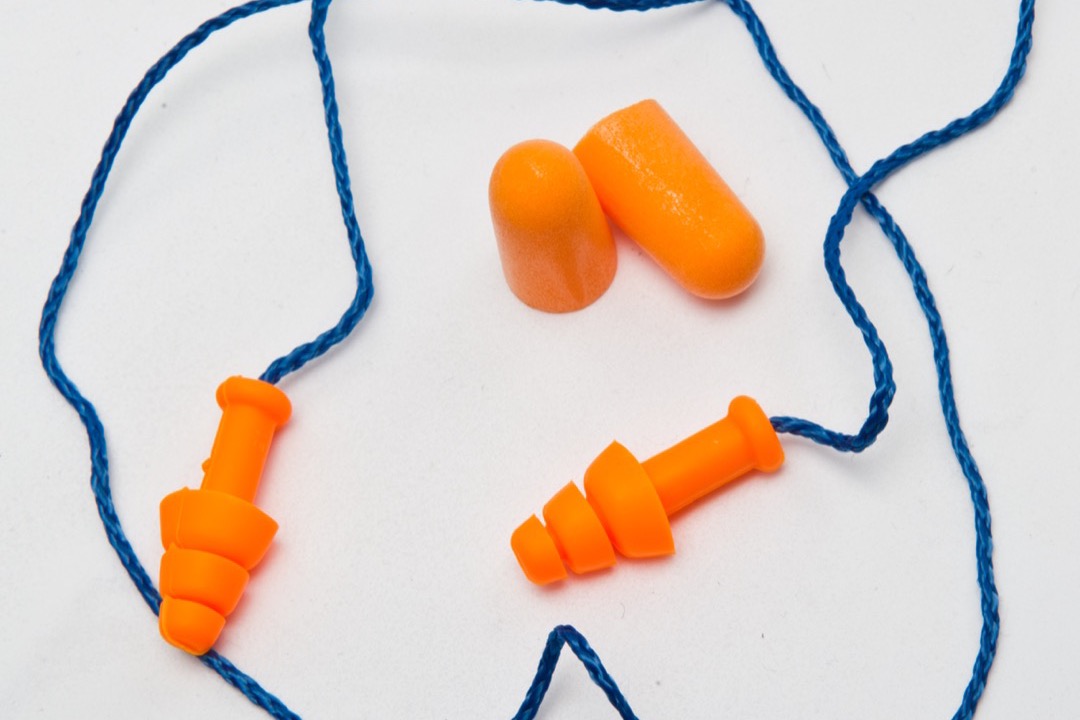
Ear pain on a plane almost always arrives in the last half hour of the flight. The seatbelt sign comes on, the cabin starts to repressurise for landing, and one or both ears fill with a pressure that swallowing will not shift. For most people it clears within minutes of landing. For people with a cold, allergies, or ears that block easily, it can be sharp enough to ruin the end of a trip and linger for days. Airplane ear plugs with a pressure filter are the simplest tool I know for taking the edge off it, and a good pair of ear plugs for flying also makes the engine drone far easier to sleep through.
I am Dr. David Taylor, and flight-related ear pain is a question I get from patients before almost every holiday season. The honest answer is that no plug can force a blocked Eustachian tube open. What a filtered plug can do is slow the pressure change reaching your eardrum so the tube has more time to catch up. That is useful, but it works best alongside the techniques and precautions I cover further down, including when a decongestant makes sense and when you should not fly at all until a doctor has looked in your ears.
For 2026 I compared ten products that are in stock and sold new on Amazon US: eight filtered airplane ear plugs for adults and children, one noise plug for the cruise portion of a flight, and one set of ear muffs for babies who are too young for any plug. If you are shopping for sleep at home rather than travel, my guide to the best ear plugs for sleeping is the better fit. For long flights, compression socks for travel are the other item I would pack.
| Product | Price | Buy |
|---|---|---|
| Original Adult EarPlanesBest Overall | $8.49 | View on Amazon |
| Mack's Flightguard Airplane Pressure Relief EarplugsBudget Pick | $7.73 | View on Amazon |
| Alpine FlyFitRunner-Up | $16.95 | View on Amazon |
| New Super Soft Adult EarPlanes (5 Pairs)Premium Pick | $27.95 | View on Amazon |
| SANOHRA Fly Ear Plugs for Flying, Adults | $14.00 | View on Amazon |
| Eargasm Aviation Earplugs | $37.95 | View on Amazon |
| SANOHRA Fly Ear Plugs for Flying, Kids | $14.00 | View on Amazon |
| Original Children's EarPlanes | $19.85 | View on Amazon |
| Alpine Muffy Baby Ear Muffs | $29.99 | View on Amazon |
| Loop Quiet 2 | $24.95 | View on Amazon |
Find the Best Airplane Ear Plugs for Your Need
Jump straight to the section that matches your trip, your ears, or the person you are buying for.
- Best airplane ear plugs overall
- Best ear plugs for airplane pressure
- Best filtered earplugs for flying
- Best airplane ear plugs for kids and infants
- Best earplugs for airplane noise
- More use cases
How I Chose These Airplane Ear Plugs
Every product here was confirmed in stock, sold new, and showing a working Add to Cart button on Amazon US before publication. The first rule was simple: only plugs with an actual pressure-regulating filter could compete for a pressure role. Plenty of listings call a plain foam or silicone plug an “airplane ear plug” because it blocks engine noise. That is a real benefit, but it is a different job, so the two noise-only products on this page are labelled as noise-only in every table.
After that I weighed the type of filter, the fit range, how many flights a pair is rated for, and the depth of the review record. I recorded which scale each noise figure uses, since only one listing here publishes a US Noise Reduction Rating and the rest use European SNR figures or unlabelled numbers. Where two listings share one review pool, as the SANOHRA adult and kids plugs do, I say so rather than counting the reviews twice. For children, I followed each maker’s stated age guidance and added my own clinical line: no plug in the ear of a baby under one.
Best Airplane Ear Plugs Overall
All ten picks are reviewed individually below, starting with the four headline choices and then the specialists for congestion, premium reusables, children, babies, and cruise noise.
Original Adult EarPlanes: Best Overall
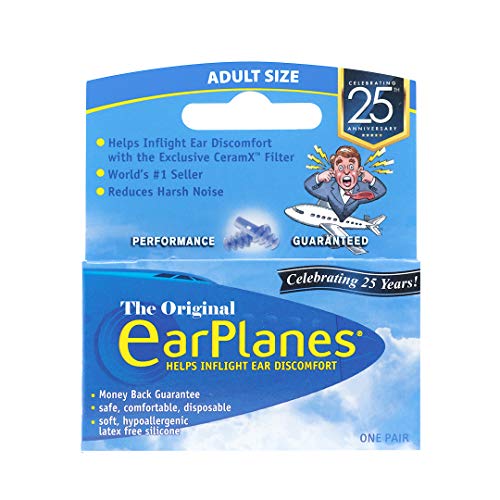
EarPlanes are the plug most people picture when they think of flight ear plugs, and after comparing the field they remain the one I would hand to most adults first. The design places a small CeramX ceramic filter inside soft, hypoallergenic silicone flanges. The filter lets air through, but slowly, so the change in cabin pressure reaches the eardrum at a gentler rate. Cirrus Healthcare, the maker, cites testing with US Navy pilots, and the listing carries 6,615 reviews with a 4.5 star rating.
In practice the benefit shows up on descent. People who normally feel a building, painful fullness as the plane comes down tend to report a slower, more manageable sensation, which gives swallowing and yawning time to work. The flanges are soft enough for most adults to wear through a whole flight, and the maker’s figure of roughly 20 dB of noise reduction takes the edge off the engine without making it hard to hear a crew announcement.
The trade-off is lifespan. EarPlanes are meant for a few flights per pair, not dozens, so a frequent flyer will go through them. There is also only one adult size, and no US NRR is published. If the flanges feel too firm or will not seal, the Super Soft version and the Children’s EarPlanes further down cover softer and smaller fits.
Original Adult EarPlanes
by Cirrus Healthcare
The flight plug I would hand to most adults first: a proven ceramic pressure filter in soft silicone, with a deep review record behind it.
Pros
- A CeramX ceramic filter slows the rate of pressure change reaching the eardrum, which is the specific job a flight plug exists to do
- Soft hypoallergenic silicone flanges that most adults can wear from boarding to landing
- Takes the edge off engine and cabin noise too, at roughly 20 dB by the maker's figure
- 6,615 reviews on this listing, with the design long associated with flight use and the maker citing testing with US Navy pilots
Cons
- Reusable for only a few flights before the filter should be replaced
- No US NRR is published, so the noise figure cannot be compared directly with a foam plug's label
- One adult size, which will not seal every canal
Mack’s Flightguard: Best Budget
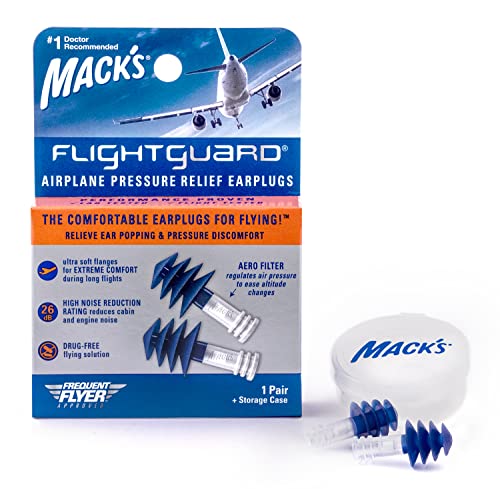
Mack’s has made earplugs for a long time, and Flightguard is its filtered flight plug. It uses what Mack’s calls an aero filter to moderate pressure change during climb and descent, in a reusable body you can keep for several trips. It is rated 4.5 stars across 4,440 reviews, level with the Original EarPlanes.
What sets it apart on this page is documentation. Flightguard is the only listing here that publishes a US Noise Reduction Rating, 26 dB NRR, alongside a 33 dB SNR. That makes it the strongest published noise figure of the ten, and it is the plug I would pick for someone who wants meaningful quiet at cruise and pressure help on descent without carrying two pairs.
Two cautions. The Amazon buy box on this listing is held by a third-party seller rather than Mack’s directly, so check the seller name before you order. And a plug that seals this firmly can feel more intrusive than the softer EarPlanes flanges, especially for people who dislike anything deep in the ear canal.
Mack's Flightguard Airplane Pressure Relief Earplugs
by Mack's
Genuine filtered flight protection from a long-standing earplug maker, with the strongest published noise rating on the page.
Pros
- The only listing on this page that publishes a US Noise Reduction Rating, 26 dB NRR (33 dB SNR)
- An aero filter moderates pressure change on climb and descent
- Reusable, so one pair can cover several trips
- Rated 4.5 stars across 4,440 reviews
Cons
- The buy box is held by a third-party seller rather than Mack's itself
- A strong seal can feel more intrusive than the softer EarPlanes flanges
- One universal adult size
Alpine FlyFit: Runner-Up
FlyFit is the plug I suggest to people who fly every month. Alpine, a Dutch hearing-protection company, builds it from ThermoShape material that softens with body heat and moulds to the canal, with a pressure-regulating filter in the centre. It is silicone-free and hypoallergenic, which matters for the minority of people who react to silicone plugs, and Alpine rates it for up to about 100 uses. A carry case comes in the box.
Its 10,597 reviews are the deepest record of any filtered flight plug on this page, and the reusability is the main reason it earns its spot. A frequent flyer replacing short-life plugs every few trips usually spends more over a year than on one pair of FlyFit, and a plug that lives in your carry-on case is a plug you actually have with you.
The compromises are noise and patience. At 17 dB SNR it cuts less noise than the Mack’s or SANOHRA plugs, and the material needs a minute in the ear to warm and soften before it seals properly. People who push it in and expect an instant fit sometimes conclude it is too loose.

Alpine FlyFit
by Alpine
The reusable filtered plug for people who fly often, made in the Netherlands and built to last far longer than disposable-style flight plugs.
Pros
- A pressure-regulating filter set in ThermoShape material that softens with body heat and moulds to the canal
- Silicone-free and hypoallergenic, useful for people who react to silicone plugs
- Alpine rates it reusable for up to about 100 uses, and it comes with a carry case
- 10,597 reviews, the deepest record of any filtered flight plug on this page
Cons
- 17 dB SNR is lighter noise reduction than the Mack's or SANOHRA plugs
- The material takes a minute to warm and soften before it seals well
- Rated 4.3 stars, a little below the EarPlanes picks
New Super Soft Adult EarPlanes: Upgrade Pick
This is the same CeramX filter as the Original EarPlanes in a noticeably softer silicone, sold as a five-pair box. At 4.6 stars across 4,878 reviews it carries the highest rating on this page, and the recurring theme in those reviews is comfort on long-haul flights, where the firmer original can start to ache after several hours.
The five-pair box is the other reason it is my upgrade pick. EarPlanes are designed for a few flights per pair, so a round trip with connections, or a couple travelling together, uses them up quickly. Having spare pairs also solves the most common failure of any flight plug, which is dropping one on the floor of a dark cabin just before descent.
The larger up-front purchase is the obvious drawback, and each pair still has a limited life. There is no published NRR for noise. For people who found the Original EarPlanes uncomfortable, though, this is the first thing I would try.

New Super Soft Adult EarPlanes (5 Pairs)
by Cirrus Healthcare
The EarPlanes filter in a softer body and a five-pair box, the better buy for long flights and regular travel.
Pros
- The same CeramX ceramic pressure filter as the Original EarPlanes in a softer silicone
- Reviewers repeatedly single out comfort on long-haul flights
- Five pairs in the box, enough for a round trip with connections or for a travelling family of adults
- Rated 4.6 stars, the highest rating on this page
Cons
- No US NRR is published for noise reduction
- A bigger up-front purchase than a single pair
- Each pair still lasts only a few flights
SANOHRA Fly Adults: Best for Congestion-Prone Ears
SANOHRA Fly is made in Germany around a patented pressure filter designed to let the ear equalise gradually. That gradual approach is why I point people with ears that block easily toward it. If your Eustachian tubes are slow to open, a smoother pressure curve gives them the best chance to keep up. The maker rates it at 24 dB of noise reduction and for up to six flights per pair, sized for regular and medium adult canals.
SANOHRA is unusually specific about timing: insert the plugs about 45 minutes before landing. That is sensible advice, because descent is when the ear does its hardest work, but it means setting a reminder on a long flight rather than relying on the seatbelt sign. The 4.4 star rating comes from a review pool of 4,591 that is shared with the kids version, so I treat that number as a record for the SANOHRA filter design rather than for this listing alone.
One point I make to every patient who asks: a filtered plug helps a congested ear, but it cannot open a tube that swelling has shut. If you are flying with a heavy cold or a sinus infection, read the sections below on decongestants and on when not to fly.

SANOHRA Fly Ear Plugs for Flying, Adults
by SANOHRA
A German-made filtered plug built around gradual equalisation, well suited to flyers whose ears block easily.
Pros
- A patented pressure filter designed to let the ear equalise gradually, the approach I prefer for congestion-prone ears
- 24 dB of noise reduction by the maker's figure
- Rated for up to six flights per pair
- Made in Germany, sized for regular and medium adult canals
Cons
- The 4,591-review total is shared with the kids version, not this listing alone
- The maker's timing is specific: insert about 45 minutes before landing, which takes some planning
- Not intended for small adult canals
Eargasm Aviation Earplugs: Best Premium Reusable
Eargasm is better known for concert plugs, and the Aviation version brings the same build quality to flying. It uses a membrane filter aimed at both pressure and noise, with the maker claiming about 20 dB of reduction, and it ships with an aluminum keychain case that holds up far better in a carry-on than a plastic box.
It is the most expensive plug on this page, and its 499 reviews are the thinnest record here, so I rank it as a premium choice for people who value a durable reusable kit rather than as a default recommendation. The reviews that exist are generally positive about comfort and noise on longer flights.
Fit is the thing to check. Feedback is mixed from people with small ear canals, some of whom find the body too large to seal. If you have worn standard-size silicone plugs comfortably before, it is a reasonable buy. If you usually need small sizes, look at Children’s EarPlanes instead.

Eargasm Aviation Earplugs
by Eargasm
A premium reusable flight plug with a durable metal case, best for adults with average or larger canals.
Pros
- A membrane filter aimed at both cabin pressure and noise
- About 20 dB of noise reduction by the maker's claim
- Aluminum keychain case that survives being thrown in a carry-on
- Reusable build meant for repeated trips
Cons
- The most expensive plug on this page
- 499 reviews, the thinnest record here
- Fit feedback is mixed for people with small ear canals
SANOHRA Fly Kids: Best for Toddlers
Children feel flight pressure more sharply than adults, largely because their Eustachian tubes are shorter, narrower, and more horizontal, so they drain and ventilate less efficiently. SANOHRA Fly Kids scales the same patented filter as the adult plug down for small canals, and the maker states a minimum age of one. That clear label is why I prefer it for toddlers: parents are not left guessing whether a plug was designed for a child this young.
The filter, noise figure of 24 dB, and six-flight rating match the adult version, and so does the review pool of 4,591, which is shared between the two listings. The 4.4 star rating should be read with that in mind.
The practical problem with toddlers is keeping plugs in. Most will pull at anything new in their ears, so put them in when the child is calm, give them something to drink or eat during descent, and keep an eye on the plugs the whole time. A plug that ends up in a small child’s mouth is a choking hazard.

SANOHRA Fly Ear Plugs for Flying, Kids
by SANOHRA
The filtered plug I would reach for with a toddler over one year old, because the maker sizes and labels it for that age.
Pros
- The same patented pressure filter as the adult SANOHRA, scaled for small ear canals
- The maker states a minimum age of 1, which gives parents a clear line to work from
- 24 dB of noise reduction by the maker's figure
- Rated for up to six flights per pair
Cons
- The 4,591-review total is shared with the adult version
- Toddlers often pull plugs out, so it needs supervision for the whole descent
Original Children’s EarPlanes: Best for School-Age Kids
Children’s EarPlanes use the same CeramX ceramic filter as the adult range in a smaller silicone body. They fit school-age children well, and they are also my standing suggestion for adults with narrow ear canals who cannot get a seal from standard flight plugs. The box holds three pairs, and the listing carries 2,713 reviews with a 4.4 star rating.
Older children usually tolerate them better than toddlers do, because they can understand why the plug is there and tell you if it hurts. The soft flanges help. Show your child how to swallow or yawn on descent while wearing them, since the plug and the swallowing work together.
The listing states no minimum age, so the decision falls to parents. For a child under one I would not use any plug. For a young toddler I would choose SANOHRA Fly Kids, which is explicitly labelled from age one. For a child who can reliably leave a plug alone for an hour, Children’s EarPlanes are a good fit.

Original Children's EarPlanes
by Cirrus Healthcare
EarPlanes' filter in a smaller body, for school-age children and adults whose canals are too narrow for standard plugs.
Pros
- CeramX ceramic pressure filter, the same system as the adult EarPlanes
- Sized for children and also fits adults with small ear canals
- Three pairs in the box, so a lost plug mid-trip is not the end of the plan
- Soft silicone flanges that school-age children tend to tolerate
Cons
- The listing states no minimum age, so parents have to judge readiness themselves
- No US NRR is published
- Each pair lasts a limited number of flights, as with the adult EarPlanes
Alpine Muffy Baby: Best for Babies (Noise Only)
This is not an ear plug, and it does nothing for cabin pressure. I include it because parents of babies search for airplane ear plugs, and the right answer for a baby is not a plug at all. The Muffy Baby is an over-ear muff with an adjustable band, made for babies and toddlers up to about 48 months, and it reduces engine and cabin noise without putting anything inside the ear canal. With 35,558 reviews, it has the largest review base on this page.
For the pressure itself, infants have a better tool than any device: sucking and swallowing. Offer a breast or bottle, or a pacifier, as the plane begins to descend, and again during takeoff if your baby is awake. Each swallow helps open the Eustachian tube. Crying also helps, though it is harder on the rest of the row.
The limitation is simply that some babies will not keep anything on their head. Try the muffs at home for a few short sessions before the trip so they are familiar by the time you board.

Alpine Muffy Baby Ear Muffs
by Alpine
Noise protection for babies who are too young for any plug, paired with feeding or a pacifier on descent for the pressure.
Pros
- Over-ear design puts nothing inside a baby's ear canal
- Made for babies and toddlers up to about 48 months
- An adjustable band that holds on a small head during a nap
- 35,558 reviews, the largest review base on this page
Cons
- No pressure function at all: it reduces engine noise only
- Some babies will not tolerate anything on their head
- Bulkier to pack than a pair of plugs
Loop Quiet 2: Best for Cruise Noise
Loop Quiet 2 is a noise plug, not a pressure plug, and I have labelled it that way throughout. It is soft silicone with a 24 dB SNR rating, four tip sizes, and a washable, reusable build. For sleeping through the long middle stretch of a flight, when the cabin is at a steady pressure and the only problem is engine drone and conversation, reviewers often describe it as comfortable enough to sleep in, and its 33,195 reviews are the second largest review base on this page.
The way I recommend using it is as half of a two-plug system. Wear the Loop Quiet 2 at cruise for sleep, then switch to a filtered plug such as EarPlanes before the descent begins. Wearing a sealed noise plug through descent gives you no pressure regulation and can make the moment of equalisation feel sharper.
At 4.1 stars it has the lowest rating on this page, with the complaints mostly about fit and plugs working loose during sleep. The four tip sizes solve that for most people once they find the right one.

Loop Quiet 2
by Loop
A comfortable noise plug for sleeping through the cruise, to be swapped for a filtered plug before descent.
Pros
- 24 dB SNR of noise reduction in soft silicone that is comfortable for sleeping at cruise
- Four tip sizes, so more people get a proper seal
- Washable and reusable
- 33,195 reviews, the second largest review base on this page
Cons
- No pressure filter, so it does nothing for ear pain on climb or descent
- Rated 4.1 stars, the lowest rating on this page
- Needs to be swapped for a filtered plug before the descent begins
Best Ear Plugs for Airplane Pressure
If pressure pain is the reason you are shopping, choose a plug by its filter first and everything else second. The EarPlanes ceramic filter is the most proven design here and the one I recommend to most adults. SANOHRA’s gradual filter is the better choice when your ears block easily, as long as you follow its timing of about 45 minutes before landing. Mack’s Flightguard gives you a filtered plug plus the strongest published noise rating on the page. None of the three can clear a tube that congestion has closed, so pair them with swallowing and, where appropriate, a decongestant.
| Product | Price | Buy |
|---|---|---|
| Original Adult EarPlanesBest ear plugs for airplane pressure CeramX ceramic filter in soft silicone, the default I recommend to most adults | $8.49 | View on Amazon |
| SANOHRA Fly Ear Plugs for Flying, AdultsBest for ears that block easily A gradual-equalisation filter, inserted about 45 minutes before landing | $14.00 | View on Amazon |
| Mack's Flightguard Airplane Pressure Relief EarplugsBest budget pressure plug Aero filter with a published 26 dB NRR for cabin noise as well | $7.73 | View on Amazon |
Best Filtered Earplugs for Flying
Every filtered flight plug does the same basic job, slowing the pressure change that reaches the eardrum, but the filters differ. EarPlanes use a small porous ceramic element that meters air through. Alpine FlyFit sets a pressure-regulating filter in a thermoplastic body that softens with body heat, so the seal improves as it warms. Mack’s Flightguard uses an aero filter in a firmer reusable body. Eargasm Aviation, reviewed above, uses a membrane. There is no published head-to-head evidence that one filter design is clearly better, so I choose between them on fit, lifespan, and comfort.
| Product | Price | Buy |
|---|---|---|
| Original Adult EarPlanesBest filtered earplugs for flying Ceramic filter, soft flanges, designed for a few flights per pair | $8.49 | View on Amazon |
| Alpine FlyFitBest reusable filtered earplugs Filter in heat-softening ThermoShape material, rated for up to about 100 uses | $16.95 | View on Amazon |
| Mack's Flightguard Airplane Pressure Relief EarplugsBest budget filtered earplugs Aero filter in a reusable body with the page's only published US NRR | $7.73 | View on Amazon |
Best Airplane Ear Plugs for Kids and Infants
Age decides this, not preference. Babies under one should not wear any ear plug: their canals are too small and a plug is a choking hazard. For infants, feed or offer a pacifier during descent to keep them swallowing, and use over-ear muffs such as the Alpine Muffy Baby for noise only. From age one, SANOHRA Fly Kids is labelled for that age and uses a filter scaled for small canals, but it needs an adult watching. School-age children usually do well with Children’s EarPlanes. A child with an ear infection or a heavy cold should see their doctor before the flight.
| Product | Price | Buy |
|---|---|---|
| SANOHRA Fly Ear Plugs for Flying, KidsBest airplane ear plugs for toddlers (1+) Maker-stated minimum age of one, filter scaled for small canals; supervise throughout | $14.00 | View on Amazon |
| Original Children's EarPlanesBest airplane ear plugs for school-age kids CeramX filter in a smaller body, three pairs in the box | $19.85 | View on Amazon |
| Alpine Muffy Baby Ear MuffsBest for infants (noise only, no plug) Over-ear muffs up to about 48 months; use feeding or a pacifier for pressure | $29.99 | View on Amazon |
Best Earplugs for Airplane Noise
Cabin noise at cruise is loud enough to make sleep hard for many people, and noise is a separate problem from pressure. For the most noise reduction with a filter still in place, Mack’s Flightguard publishes a 26 dB NRR. For comfort while sleeping through a long cruise, Loop Quiet 2 is softer and comes in four tip sizes, but it has no pressure filter, so swap it for a filtered plug before descent. SANOHRA Fly gives 24 dB by the maker’s figure alongside its gradual filter, which suits people who want one plug from cruise through landing.
| Product | Price | Buy |
|---|---|---|
| Mack's Flightguard Airplane Pressure Relief EarplugsBest earplugs for airplane noise 26 dB NRR, the only published US NRR on this page, plus an aero filter | $7.73 | View on Amazon |
| Loop Quiet 2Best for sleeping at cruise (no filter) 24 dB SNR soft silicone with four tip sizes; switch to a filtered plug before descent | $24.95 | View on Amazon |
| SANOHRA Fly Ear Plugs for Flying, AdultsBest noise and pressure in one plug 24 dB by the maker's figure with a gradual pressure filter for landing | $14.00 | View on Amazon |
Best Ear Plugs for Flying by Use Case
A few more searches that come up often, matched to the picks reviewed above.
| Product | Price | Buy |
|---|---|---|
| Loop Quiet 2Loop earplugs for flying Loop Quiet 2 for noise at cruise; it has no pressure filter, so change plugs before descent | $24.95 | View on Amazon |
| New Super Soft Adult EarPlanes (5 Pairs)Best earplugs for flying with tinnitus A soft filtered plug that avoids a full, hard seal; if tinnitus changes after flying, see an audiologist | $27.95 | View on Amazon |
| Mack's Flightguard Airplane Pressure Relief EarplugsNoise cancelling earplugs for flying Passive noise reduction with no electronics, and the page's only published US NRR at 26 dB | $7.73 | View on Amazon |
| Alpine FlyFitFoam earplugs for flying alternative A reusable filtered alternative to foam that also regulates pressure on descent | $16.95 | View on Amazon |
Why Descent Hurts More Than Ascent
The middle ear is an air-filled space behind the eardrum, connected to the back of the nose by the Eustachian tube. The tube is normally closed and opens briefly when you swallow or yawn. On the way up, cabin pressure falls, and the air in the middle ear expands. Expanding air pushes the tube open passively, so the ear vents on its own and most people notice little more than a pop.
On the way down, cabin pressure rises and the air in the middle ear contracts, pulling the eardrum inward. A closed tube does not open passively under that kind of pull. It has to be opened actively, by the muscles that act when you swallow, yawn, or chew. If swelling from a cold or allergies narrows the tube, or if you are asleep and not swallowing, the pressure difference builds. That is the pain, fullness, and muffled hearing of airplane ear, and in more severe cases it can bruise the eardrum or cause fluid behind it. This is why every piece of timing advice on this page centres on the descent.
How to Clear Your Ears on a Plane
Start with the gentle methods and keep them going through the whole descent rather than waiting for pain. Stay awake for landing if you can, since you swallow far less while sleeping.
- Swallow and yawn often. Sip water, suck a sweet, or chew gum. Each swallow briefly opens the tube.
- Try the Toynbee maneuver. Pinch your nostrils closed and swallow. This is gentle and useful when simple swallowing is not enough.
- Use a gentle Valsalva maneuver. Take a breath, close your mouth, pinch your nostrils, and blow very softly as if blowing up a balloon, until you feel your ears pop. Stop at the first pop.
- Repeat little and often. Several gentle attempts as the plane descends work better than one hard attempt after the pain has built.
The warning I give with the Valsalva maneuver is about force. Blowing hard against a pinched nose can injure the inner ear or the eardrum. If gentle attempts do not work, stop and keep swallowing rather than pushing harder, and if your ear stays blocked or painful after landing, see a doctor.
Should You Take a Decongestant Before Flying?
For adults with a cold or allergy congestion, a decongestant can make descent easier by reducing swelling around the opening of the Eustachian tube. Two common options are an oral pseudoephedrine tablet, typically taken about 30 to 60 minutes before descent, and an oxymetazoline nasal spray, typically used about 30 minutes before descent. On a long flight, time the dose to the landing, not the takeoff. My guide to the best nasal sprays compares the spray options, and if seasonal allergies are the underlying cause, the best allergy medicine guide covers daily control that starts working before you travel.
Decongestants are not right for everyone. Check with your doctor or pharmacist first if you have high blood pressure that is not well controlled, a heart rhythm problem, glaucoma, an enlarged prostate, or thyroid disease, if you take an MAOI antidepressant, or if you are pregnant. Oxymetazoline sprays should not be used for more than three days in a row, because longer use can cause rebound congestion that is worse than the original problem. Do not give decongestants to young children unless their doctor has advised it.
When Not to Fly Without Seeing a Doctor First
Ear plugs and swallowing techniques help healthy ears cope with pressure. They are not a substitute for an examination when something is already wrong. See a doctor before you fly if you have:
- An active middle ear infection, or ear pain with a fever
- A known or suspected perforated eardrum
- Recent ear surgery, or sinus surgery
- A severe sinus infection or heavy congestion that has not improved
- Discharge from the ear, new hearing loss, or vertigo
Flying with an active infection or a blocked tube can cause severe pain and barotrauma, and occasionally a perforated eardrum. Your doctor may advise treatment first or suggest postponing the trip. After a flight, ear pain or blocked hearing that lasts more than a few days also needs to be checked, as does any hearing loss, discharge, or dizziness.
How to Use Airplane Ear Plugs
The details differ by brand, so follow the instructions in the box. The general pattern looks like this:
- Insert at the right time. EarPlanes and Alpine FlyFit go in before takeoff, and in any case before the descent begins. SANOHRA asks for insertion about 45 minutes before landing.
- Get a proper seal. Reach over your head with the opposite hand, pull the top of your ear gently up and back to straighten the canal, and insert the plug with a slight twist until it feels snug. Do not force it deeper.
- Keep swallowing. The plug slows the pressure change. Swallowing and yawning still do the equalising.
- Leave them in until the door opens. The cabin pressure keeps adjusting during taxiing, so keep the plugs in until the aircraft door opens.
- Remove them slowly. Twist gently as you draw each plug out rather than pulling it straight out, which avoids a sudden pressure change against the eardrum.
Foam Ear Plugs vs Filtered Ear Plugs for Flying
Foam plugs are excellent at blocking noise, and many people fly with them. What they do not do is regulate the rate of pressure change, because there is no filter, only a seal. A very tight seal can even make the moment the ear equalises feel sharper. That is the reason I steer people with flight ear pain toward a filtered plug and keep foam for noise.
Keep the bigger picture in mind, though. The main factor in airplane ear is how well your Eustachian tube opens. A filtered plug gives it more time, but a person with healthy, open tubes may be comfortable with foam or with nothing at all, and a person with a heavy cold may still hurt through the best filtered plug on this page. For noise at cruise, foam or a soft silicone plug such as the Loop Quiet 2 is fine. For descent, use a filter.
Buyer's Guide
Choosing airplane ear plugs comes down to whether the plug actually regulates pressure, whether it fits the ears it is going into, and who is wearing it. These are the six factors that decide it.
Filter type
A flight plug is only a pressure plug if it has a filter. EarPlanes use a CeramX ceramic filter, Mack's Flightguard an aero filter, Alpine FlyFit a pressure-regulating filter in a heat-softening body, SANOHRA a patented pressure filter, and Eargasm Aviation a membrane. They differ in design but share the goal of slowing pressure change at the eardrum. A plug without a filter, including foam and the Loop Quiet 2, is a noise plug, however it is marketed.
Noise versus pressure (NRR and SNR)
Pressure relief and noise reduction are separate jobs. Mack's Flightguard is the only listing here that publishes a US Noise Reduction Rating, 26 dB. Others give a European SNR or an unlabelled dB figure, and the two scales are not interchangeable. If sleep at cruise matters most, weight the noise figure. If ear pain on descent is the problem, the filter matters far more than the number.
Fit and canal size
A filtered plug only works if it seals, because air that leaks around the edge bypasses the filter completely. Most flight plugs come in one adult size. Adults with narrow canals often do better in Children's EarPlanes, and SANOHRA's adult plug is sized for regular and medium canals. If a plug hurts or will not stay seated after a few minutes, try a smaller size rather than pushing it deeper.
Reusability and cost per flight
EarPlanes are designed for a few flights per pair, and SANOHRA rates its plugs for up to six. Alpine claims up to about 100 uses for FlyFit, which suits frequent flyers, and Eargasm Aviation is also built for repeat use. If you fly once a year, a single pair of a short-life plug is sensible. If you fly monthly, a longer-life reusable plug or a multi-pair box usually works out better.
Kids and age limits
No plug belongs in a baby under one: canals are too small and plugs are a choking risk. For infants, use feeding or a pacifier on descent and over-ear muffs for noise. From age one, choose a plug the maker labels for that age, such as SANOHRA Fly Kids, and supervise it. School-age children usually manage Children's EarPlanes well.
When to see a doctor before flying
Ear plugs cannot make up for an ear that cannot equalise. See a doctor before flying if you have an active ear infection, a perforated eardrum, recent ear or sinus surgery, a severe sinus infection, or current ear pain, discharge, hearing loss or vertigo. After a flight, ear pain or blocked hearing that lasts more than a few days also needs an examination.
How to Choose the Best Airplane Ear Plugs
Decide first what problem you are solving. If it is pain on descent, only a filtered plug is relevant, and among those I would start with the Original EarPlanes, move to SANOHRA Fly if your ears block easily, and choose Alpine FlyFit if you fly often enough that reusability matters. If it is noise and sleep, the published noise figure matters more, and a noise plug for cruise plus a filtered plug for landing is a sensible combination.
Then match the fit to the wearer. Adults with narrow canals often do better in children’s sizes. For children, go by age: over-ear muffs and feeding for babies, a plug labelled from age one for toddlers, and Children’s EarPlanes for school-age kids. Finally, look at your own health before the trip. A cold, a sinus flare, or recent ear trouble changes the plan more than any plug choice does.
Final Verdict
The Original Adult EarPlanes are my overall pick for 2026. Their ceramic filter is the most proven pressure design here, the silicone is comfortable for most adults, and the review record is deep. If you want to spend less, Mack’s Flightguard gives you a genuine filter plus the only published US NRR on this page. For long-haul comfort and spare pairs, the New Super Soft Adult EarPlanes are worth the step up, and Alpine FlyFit is the plug to buy once if you fly every month.
For children, match the product to the age: Alpine Muffy Baby and a bottle or pacifier for infants, SANOHRA Fly Kids from age one, and Children’s EarPlanes for school-age kids. If you also wear plugs at shows, my guide to the best concert ear plugs covers filtered plugs built for music. And if your ear is painful, discharging, or not hearing normally before a flight, see your doctor before you board. That appointment will do more for your ear than any plug.
Frequently Asked Questions
Do airplane ear plugs work?
Do earplugs help with airplane pressure?
How do you use airplane ear plugs?
Can you wear earplugs for flying with an ear infection?
Are airplane ear plugs safe for babies and kids?
Related Articles
About the Reviewer

Dr. David Taylor, MD, PhD
Drexel University College of Medicine (MD), Indiana University School of Medicine (PhD)
Dr. David Taylor is a licensed physician and medical researcher who founded BestRatedDocs in 2016. With an MD from Drexel University and a PhD from Indiana University School of Medicine, he combines clinical expertise with a passion for health technology to provide evidence-based product recommendations. Dr. Taylor specializes in health informatics and regularly evaluates medical devices, diagnostic equipment, and therapeutic products to help healthcare professionals and patients make informed decisions.