7 Best Lightweight Wheelchairs of 2026
Dr. David Taylor reviews the best lightweight wheelchairs under 30 lbs. Compare ultralight transport and manual chairs for travel, daily use, and home care.
Updated
Approximately 2.7 million Americans use manual wheelchairs as their primary means of mobility, and a growing segment — active older adults, post-surgical patients, and frequent travelers — have made chair weight a primary purchasing criterion. The reason is straightforward: for every caregiver who loads a wheelchair into a car trunk ten times per week, the difference between a 15 lb and a 30 lb chair is not abstract. It is shoulder health, lower back strain, and the physical sustainability of caregiving over months and years. In 2026, we reviewed seven of the best lightweight wheelchairs available on Amazon, focusing specifically on chairs under 30 lbs — covering ultralight transport chairs, lightweight self-propelled options, and folding travel designs built for portability.
Our evaluation draws on verified Amazon review analysis, published manufacturer specifications, and the clinical perspective of Dr. David Taylor, who has evaluated durable medical equipment across a range of patient diagnoses and functional levels. We prioritized real-world usability: how the chair performs when loaded from a car trunk, navigated through a narrow home hallway, or gate-checked at an airport — not just how it reads on a specification sheet. If you also need a power mobility option, see our best electric wheelchairs guide, and for a broader comparison of manual wheelchairs across all weight classes, see our best wheelchairs review.
How We Selected These Lightweight Wheelchairs
We began with the top-selling wheelchairs on Amazon in the lightweight and ultra-lightweight categories, filtered to those weighing 30 lbs or less. For each product we analyzed verified Amazon review patterns to identify recurring issues — assembly problems, durability failures, sizing inconsistencies, and caregiver handling reports. We compared manufacturer-stated specifications against user-reported real-world measurements, with particular attention to chair weight (frequently understated when footrests are excluded), seat width (often narrower in practice than labeled due to armrest padding), and weight capacity (especially important on ultralight frames where limits run lower than standard).
Products were selected to cover the full range of lightweight wheelchair use cases: the absolute lightest transport chairs for maximum caregiver convenience, transport chairs with larger wheels for outdoor use, the best self-propelled ultralight for frequent travelers, a magnesium-framed alternative for users who self-propel, and petite-fit options for adults and adolescents who fall outside the standard 18- to 19-inch seat width range.
1. Medline Ultra Lightweight Transport Wheelchair — Best Overall
At 15 lbs complete, the Medline Ultra Lightweight Transport Wheelchair is the lightest full-featured transport chair in this review — and likely the lightest chair in its class on Amazon. The aircraft-grade aluminum frame achieves this weight without the capacity trade-off that plagues many ultralight designs: the 300 lb weight capacity matches what you would expect from a heavier 25 lb chair. For caregivers who have been managing a 30 lb steel transport chair for months, switching to this model is a felt difference on the very first lift.
The practical implication of a 15 lb chair extends beyond comfort. Caregivers with rotator cuff limitations, arthritis, or back injuries — conditions that are common in the age group most likely to be providing care for an elderly parent or spouse — can manage this chair comfortably where a heavier chair would become a burden. The desk-length padded armrests facilitate lateral transfers, and the swing-away footrests remove cleanly for parallel approaches at cars, beds, and toilets. The main functional limitation is the absence of hand brakes: on any sloped surface, the caregiver relies on technique and body weight to control descent rather than a mechanical braking system. On flat environments — which describe most hospital corridors, shopping centers, and newer home construction — this is not a meaningful constraint.
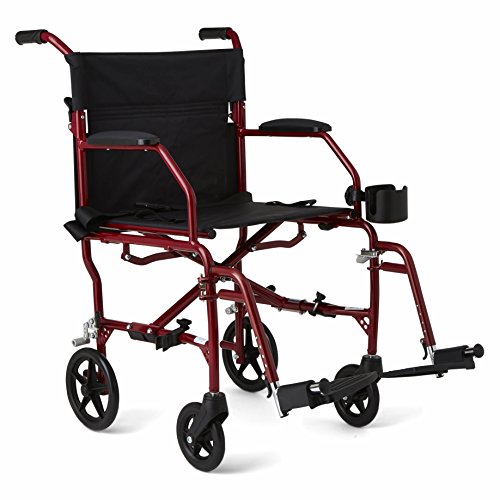
Medline Ultra Lightweight Transport Wheelchair, 19-Inch Seat, Red Frame
by Medline
The lightest transport chair in this review at 15 lbs — 300 lb capacity with no weight-class trade-off.
Pros
- 15 lbs complete makes it the lightest full-feature transport chair in this review — a caregiver with shoulder limitations can lift it with one arm
- 19-inch padded seat with swing-away legrests and desk-length arms accommodates most adults for extended outings
- 300 lb weight capacity matches the standard despite the ultralight aluminum frame — no capacity trade-off
- Cross-brace fold compacts to roughly 10 inches wide, fitting comfortably in most sedan trunks and airplane overhead bins
Cons
- No caregiver hand brakes — slope control requires caregiver to grip the push handles and lean back to slow descent
- 8-inch rear casters limit outdoor terrain use; best suited to smooth floors, paved surfaces, and hospital corridors
- Minimal seat cushioning becomes noticeable for users seated more than 90 minutes without an aftermarket pad
2. Drive Medical Lightweight Expedition Transport Wheelchair — Budget Pick
The Drive Medical Expedition is the most-reviewed transport wheelchair on Amazon, and its combination of 19 lbs, hand brakes, and 12-inch wheels explains why. At a price that undercuts the Medline Best Overall by a meaningful margin, it adds two features the Medline lacks: caregiver hand brakes and larger 12-inch rear wheels. Those two additions expand what environments the chair can safely navigate. The 12-inch wheels clear standard curb cuts and handle the crowned surfaces common in parking lots and shopping center entrances; the hand brakes give the caregiver active control over descent speed on ramps, sloped driveways, and parking lot grades.
For the majority of caregivers — those managing regular medical appointments, family outings, and home-to-vehicle transitions — the Expedition covers every scenario at a price that makes it the budget recommendation not because it cuts corners, but because it delivers genuine value. The review base of over 6,300 verified users provides a statistical confidence level that no competing transport chair in this weight class can match. The trade-off relative to the Medline is 4 additional pounds; if the caregiver has no physical limitations that make those 4 lbs consequential, the Expedition’s brakes and larger wheels are worth the difference.

Drive Medical Lightweight Expedition Folding Transport Wheelchair
by Drive Medical
Amazon's top-rated transport chair — 19 lbs with hand brakes and curb-capable 12-inch wheels.
Pros
- Amazon's #1 bestselling transport chair with over 6,300 reviews — the most validated lightweight option available
- Hand brakes on the caregiver push handles provide slope control and secure chair locking during patient transfers
- 12-inch flat-free rear wheels navigate curb cuts and threshold transitions better than 7- or 8-inch alternatives
- Only 19 lbs with footrests attached — significantly lighter than any steel-framed competitor at this price
Cons
- Transport-only design means the user cannot self-propel — a caregiver must be present at all times
- Stated 19-inch seat width measures slightly narrower in practice once armrest padding is accounted for
- Basic nylon upholstery shows wear after 18 to 24 months of daily use in some verified reviews
3. Medline Lightweight Transport Wheelchair with Handbrakes and 12-Inch Wheels — Runner-Up
The Medline with 12-inch wheels and hand brakes occupies a specific position in this category: it matches the functional specifications of the Drive Medical Expedition (hand brakes plus 12-inch wheels) while offering a non-standard red frame color that many home users find less institutionally clinical. The included seat belt is a genuine differentiator — several competing chairs at this price range omit it, leaving the caregiver to source a compatible aftermarket belt separately.
At 26 lbs, this is the heaviest chair in our transport chair group. The weight premium over the Expedition (7 lbs) is worth understanding: the Medline uses a slightly different frame construction that some reviewers find more rigid on uneven outdoor surfaces, while the Expedition’s 12-inch flat-free tires are marginally lighter. For caregivers who prioritize the seat belt inclusion and the aesthetic departure from clinical-looking equipment — common for users who use a transport chair regularly in social settings — the Medline runner-up is a legitimate choice. For caregivers focused primarily on minimizing chair weight, the Drive Medical Expedition is the better pick at nearly 7 lbs lighter.

Medline Lightweight Foldable Transport Wheelchair with Handbrakes and 12-Inch Wheels
by Medline
Runner-up transport chair with 12-inch wheels, hand brakes, and seat belt as standard — in a non-institutional red frame.
Pros
- 12-inch rear wheels combined with hand brakes deliver the best outdoor transport combination in this review outside of the Drive Medical Expedition
- Red frame provides a less clinical appearance that many home users prefer over standard black or silver finishes
- Seat belt included as standard safety equipment — a feature conspicuously absent on several competing chairs at this price
- Swing-away footrests detach fully for parallel transfers at low clearance surfaces
Cons
- 26 lbs is heavier than the lightest transport chairs in this category, though still lighter than any steel alternative
- Some verified reviewers report that the folding latch mechanism loosens after 6 to 12 months of daily use
- Narrower Amazon review base than the Drive Medical Expedition reduces statistical confidence in long-term durability
4. Karman LT-980 Ultra Lightweight Wheelchair — Upgrade Pick
The Karman LT-980 is built for a specific user profile: someone who travels frequently, self-propels independently, and is willing to pay a significant premium for a frame weight that changes how they interact with their chair daily. The 13 lb frame — 24 lbs complete with wheels — is less than a third the weight of a standard steel self-propelled wheelchair. For a user who lives in a building without an elevator, commutes via public transit, or flies regularly for work or family, this weight difference is not a preference — it is the difference between managing daily life independently and needing assistance for every trip.
The 22-inch pneumatic tires are the second defining feature. Solid hard tires on most lightweight chairs transmit every sidewalk crack, expansion joint, and curb chip directly through the frame and into the user’s spine. Pneumatic tires absorb these micro-impacts, producing a noticeably smoother ride for users with back pain, pressure sensitivity, or spinal injuries. The folding backrest — uncommon at any price point — allows the chair to pack to a smaller height for airline overhead bins and compact vehicle trunks. The buyer must verify two specifications before purchasing: the 250 lb weight capacity (lower than the 300 lb standard) and their comfort with maintaining tire pressure. If both boxes are checked, the LT-980 is the benchmark for lightweight self-propelled travel chairs. For users who need a lighter caregiver-pushed option for everyday outings, our best crutches guide may also be relevant for mobility support during short-term recovery.

Karman LT-980 Ultra Lightweight Wheelchair
by Karman Healthcare
The premier ultralight for frequent travelers — a 13 lb frame with pneumatic tires and a folding backrest.
Pros
- 13 lb frame is the lightest self-propelled wheelchair in this review — less than a third the weight of a standard steel self-propelled chair
- Aircraft-grade aluminum frame construction resists corrosion and metal fatigue over years of daily travel use
- 22-inch pneumatic rear tires absorb vibration from sidewalk cracks, expansion joints, and outdoor terrain transitions
- Folding backrest reduces packed height for airline cabin storage and compact vehicle trunks — uncommon at any price point
Cons
- 250 lb weight capacity is below the 300 lb standard — users must confirm they fall within this limit before purchasing
- Pneumatic tires require periodic inflation monitoring and are puncture-susceptible compared to flat-free solid alternatives
- Premium price reflects specialized engineering that most home-only users do not need
5. Hi-Fortune Magnesium Wheelchair 21lbs — Best Lightweight Self-Propelled for Petite Users
The Hi-Fortune stands apart from every other product in this review through its frame material: magnesium alloy, not aluminum. Magnesium is approximately 35% lighter than aluminum by volume while offering comparable structural strength, and it has superior vibration damping characteristics — the frame absorbs more road energy before transmitting it to the seated user. The practical result is a complete self-propelled chair at 21 lbs, 3 lbs lighter than the Karman LT-980 complete, with the added benefit of a cushion and travel bag included in the purchase price.
The trade-offs are significant and must be stated clearly. The 220 lb weight capacity is the lowest in this review — with a 15% safety buffer applied, only users under approximately 190 lbs should consider it. The 17.5-inch seat width is designed for petite adults; average-framed users will find it noticeably narrow. Roughly a quarter of verified reviewers report quality control variability across units — loose spokes, paint blemishes, and inconsistent hardware torque. For the right user — petite, independently mobile, under the weight limit, and budget-conscious relative to the Karman LT-980 — the Hi-Fortune is a compelling option. For users who do not fit these specifications, one of the other chairs in this review is a safer choice.

Hi-Fortune Magnesium Wheelchair 21lbs Lightweight Self-Propelled Chair
by Hi-Fortune
The lightest self-propelled option for petite users — magnesium alloy frame at 21 lbs with travel bag and cushion included.
Pros
- Magnesium alloy frame delivers 21 lbs for a complete self-propelled chair — an uncommon material that offers better vibration damping than aluminum at comparable weight
- Travel bag and seat cushion included as standard, reducing the immediate out-of-pocket cost of accessories
- Anti-tipper bar included and pre-installed for passive fall prevention on inclines and ramps
- Swing-away footrests allow close parallel transfers at bedside and vehicle seat without removing the chair
Cons
- 220 lb weight capacity is the lowest of any product in this review — not suitable for users above 190 lbs when the 15% safety margin is applied
- 17.5-inch seat width is narrower than most competitors — best suited to petite adults rather than average or larger body types
- Approximately 25% of verified reviewers report quality control variability across units, including paint finish and spoke tension
6. Drive Medical Deluxe Lightweight Aluminum Transport Wheelchair, 17-Inch
The Drive Medical Deluxe serves a specific clinical gap: petite adults and adolescents who need a transport chair but find the standard 18- to 19-inch seat width uncomfortable or functionally unsafe. A seat that is too wide creates lateral instability, making it difficult for the user to brace their arms and upper body during transport. The 17-inch seat on the Deluxe is correctly sized for users in the 120 to 150 lb range whose hip width falls below the average adult measurement.
At 19 lbs in aluminum construction, the Deluxe achieves the same weight as the Drive Medical Expedition while costing less — the trade-off being the absence of hand brakes and the smaller 8-inch wheels that limit outdoor terrain capability. For a user whose environment is primarily smooth indoor surfaces and for whom the correct seat width is the primary sizing concern, this chair delivers excellent value from an established DME brand with a reliable parts supply chain. The 300 lb weight capacity is consistent with the full-size transport chairs in this category, which is a better spec than several competing petite-seat options.

Drive Medical Deluxe Lightweight Aluminum Transport Wheelchair, 17-Inch
by Drive Medical
Best lightweight transport chair for petite users — 17-inch seat at 19 lbs, from the market-leading DME brand.
Pros
- 17-inch seat width makes this the best-fitting transport chair for petite adults and adolescents who find standard 18-19 inch seats too wide
- 19 lbs in aluminum construction at one of the lowest price points for this weight class
- 8-inch composite wheels with tight turning radius navigate narrow hallways and doorways more easily than larger-wheeled alternatives
- Backed by Drive Medical's DME manufacturer warranty and established replacement parts supply chain
Cons
- No hand brakes on the push handles — slope control requires physical technique rather than mechanical assistance
- 17-inch seat is specifically sized for smaller users; average and larger adults will find it uncomfortably narrow
- Basic construction with limited padding appropriate for outings but not prolonged daily seated use
7. Karman K-LT-2017 Ultra Lightweight Transport Wheelchair, 17-Inch Seat
The Karman K-LT-2017 offers an alternative to the Drive Medical Deluxe in the petite transport chair segment, with a different armrest configuration and Karman’s engineering reputation. Where the Drive Medical Deluxe uses desk-length armrests that allow closer table access, the K-LT-2017 uses full-length armrests that provide more continuous lateral support along the user’s entire arm — a meaningful functional difference for users with limited core stability or upper limb weakness who rely on the armrests for postural bracing during transport.
The pull-to-lock handle brakes are a partial mitigation for the absence of full hand brakes: they allow the caregiver to park the chair securely on any surface, which is useful during transfers, but they do not provide the active descent-speed control of a true hand-brake lever system. For caregivers whose environments are flat or only gently graded, this is adequate. The 250 lb weight capacity is the one specification that requires verification against the user’s weight — the full-length armrest design otherwise makes this a well-rounded option for the petite transport chair use case.

Karman K-LT-2017 Ultra Lightweight Transport Wheelchair, 17-Inch Seat
by Karman Healthcare
Karman's 19 lb transport chair for smaller users — full-length arms and pull-to-lock parking brakes.
Pros
- 19 lbs at a 17-inch seat width delivers maximum portability for smaller adults in a Karman Healthcare-engineered frame
- Full-length armrests provide better lateral trunk support than desk-length alternatives — beneficial for users with limited core stability
- Pull-to-lock handle brakes allow secure parking on any surface without a full hand-brake mechanism
- Swing-away footrests detach fully for close floor-level transfers at home beds and car seats
Cons
- 250 lb weight capacity requires verification — users approaching this limit need to step up to a higher-capacity model
- Fixed full-length armrests prevent the chair from sliding under most tables or desks without repositioning
- Relatively modest review count means fewer data points on long-term durability compared to Drive Medical alternatives
How to Choose the Best Lightweight Wheelchair
The six factors above cover the critical variables. Two additional considerations are worth expanding on before purchasing.
Match the chair to the caregiving environment, not just the user. A 15 lb transport chair that never leaves a flat, air-conditioned hospital corridor is an excellent choice. The same chair used daily to navigate a sloped suburban driveway, gravel paths, and occasional outdoor events is a poor match — the 12-inch wheeled Drive Medical Expedition serves that environment better despite weighing 4 more pounds. Before prioritizing maximum lightness, walk through every environment the chair will be used in and identify the terrain challenges.
For progressive diagnoses, plan ahead. Users managing multiple sclerosis, Parkinson’s disease, post-stroke hemiparesis, or ALS benefit from wheelchair evaluations conducted by a physical or occupational therapist who can assess current function and project likely progression. A lightweight manual chair may be appropriate today but inadequate within 12 to 24 months as strength or coordination changes. A certified rehabilitation technology supplier (CRTS) can advise on whether a manual lightweight chair or a power wheelchair better serves the user’s long-term independence, and their documentation can support Medicare or insurance reimbursement claims.
Buyer's Guide
Lightweight wheelchairs represent a specific engineering trade-off — reduced frame weight in exchange for higher cost, sometimes lower capacity, and design choices that prioritize portability over durability at extreme loads. Understanding these trade-offs is essential for matching the right chair to the user's actual daily needs.
Chair Weight and Who Actually Benefits
Frame weight matters most to the person who lifts the chair, not just the person who sits in it. A caregiver making 10 trunk lifts per week notices the difference between a 15 lb and a 26 lb chair immediately. For users who travel frequently — medical appointments, airports, family outings — a sub-20 lb transport chair is worth the price premium. For users who stay in one accessible location and rarely travel, a heavier steel chair at a lower price is equally functional.
Transport Chair vs. Self-Propelled Lightweight
Transport chairs achieve their light weight through small 7- to 12-inch rear wheels the user cannot grip and push. Self-propelled lightweight chairs require 22- to 24-inch wheels with a gripping rim, which adds weight but restores user independence. The clinical question is simple: will the user ever be unsupervised for any period during the day? If yes, a transport chair creates a dangerous entrapment situation, and a self-propelled model is the only appropriate choice regardless of weight.
Weight Capacity and the 15% Safety Buffer
Never select a wheelchair rated at or below the user's body weight. The minimum threshold is body weight plus a 15% safety margin. Ultralight chairs frequently rate at 220 to 250 lbs rather than the standard 300 lbs found on heavier frames. This is an engineering reality of thinner-gauge aluminum construction. A user at 210 lbs needs a chair rated for at least 245 lbs — the 220 lb Hi-Fortune would be insufficient, but the 250 lb Karman LT-980 would be borderline.
Wheel Size and Terrain
Transport chair rear wheels range from 7 to 12 inches. The 12-inch wheels on the Drive Medical Expedition navigate curb cuts, threshold transitions, and outdoor terrain far better than 7- or 8-inch alternatives. For purely indoor use on smooth floors — hospitals, malls, flat home environments — 8-inch wheels are adequate and contribute to a tighter turning radius. For any regular outdoor use, 12-inch wheels are strongly preferred.
Seat Width and Clinical Fit
Seat width has more clinical consequence than most buyers anticipate. The 17-inch seats on the Drive Medical Deluxe and Karman K-LT-2017 are designed for petite users — average adults will find them uncomfortably narrow within an hour. The 19-inch seats on the Medline and Drive Medical Expedition accommodate most adults comfortably. Measure at the widest point of the hips while seated and add 2 inches before selecting. Do not estimate this measurement.
Folded Dimensions and Storage
All chairs in this review use a cross-brace fold. The most relevant measurement is folded width — typically 9 to 11 inches — which determines whether the chair fits in a sedan trunk alongside luggage or in a closet alongside other equipment. Models with folding backrests (such as the Karman LT-980) reduce the packed height further, enabling airline overhead bin storage. Measure your vehicle trunk and any storage spaces before committing to a specific model.
Final Verdict
For caregivers who need the lightest possible transport chair without sacrificing weight capacity, the Medline Ultra Lightweight Transport Wheelchair is our best overall pick. At 15 lbs with a 300 lb capacity, it is genuinely exceptional engineering — lighter than most competing chairs in its class while maintaining the standard capacity rating. Caregivers with physical limitations will notice the difference from the first lift.
For buyers who need hand brakes and larger wheels — and who will use the chair outdoors at least occasionally — the Drive Medical Expedition is the better choice despite weighing 4 lbs more. Its position as Amazon’s #1 bestselling transport chair is backed by over 6,300 verified reviews that consistently validate its performance across diverse real-world environments. For self-propelled users who travel frequently and fall under 250 lbs, the Karman LT-980 justifies its premium price through a 13 lb frame and pneumatic tires that genuinely change the travel experience. As always, consult your physician or physical therapist before making a final purchase decision — the right lightweight wheelchair is the one that matches your specific diagnosis, functional capacity, and daily environment.
Frequently Asked Questions
What is the weight threshold for a 'lightweight' wheelchair?
Do lightweight wheelchairs have lower weight capacities?
Can I take a lightweight folding wheelchair on an airplane?
What is the difference between a lightweight transport chair and a lightweight self-propelled wheelchair?
Does Medicare cover lightweight wheelchairs?
How do I measure for the correct seat width on a lightweight wheelchair?
Related Articles
About the Reviewer

Dr. David Taylor, MD, PhD
Drexel University College of Medicine (MD), Indiana University School of Medicine (PhD)
Dr. David Taylor is a licensed physician and medical researcher who founded BestRatedDocs in 2016. With an MD from Drexel University and a PhD from Indiana University School of Medicine, he combines clinical expertise with a passion for health technology to provide evidence-based product recommendations. Dr. Taylor specializes in health informatics and regularly evaluates medical devices, diagnostic equipment, and therapeutic products to help healthcare professionals and patients make informed decisions.