7 Best Smart Bathroom Scales of 2026
Dr. David Taylor reviews the best smart bathroom scales with BMI and body composition tracking. Compare top-rated Wi-Fi and Bluetooth scales by accuracy and features.
Updated

Body weight is among the most commonly tracked health metrics in the world, and in 2026 smart bathroom scales have transformed what a simple weigh-in can reveal. Beyond weight and BMI, today’s top-selling smart scales measure body fat percentage, muscle mass, visceral fat, bone density, and more — syncing that data automatically to Apple Health, Fitbit, and other platforms where it becomes a useful longitudinal health record. Whether you are managing a chronic condition, tracking athletic progress, or simply maintaining a healthy weight, the right smart scale gives you a richer picture of your body composition than any number on a standard scale could provide.
We reviewed seven of the best smart bathroom scales available on Amazon in 2026, evaluating them on measurement accuracy, connectivity reliability, app ecosystem, platform build quality, and value. Our analysis draws on thousands of verified Amazon reviews, published bioelectrical impedance research, and the clinical perspective of Dr. David Taylor, who reviews the role of at-home body composition monitoring in patient wellness management. As with all health monitoring tools, these scales are intended to support wellness tracking — not to replace clinical assessment by your physician.
| Product | Price | Buy |
|---|---|---|
| Withings Body+ Smart Wi-Fi Body Composition ScaleBest Overall | $99.95 | View on Amazon |
| RENPHO Smart Body Fat ScaleBudget Pick | $29.99 | View on Amazon |
| eufy Smart Scale C1Runner-Up | $35.99 | View on Amazon |
| Greater Goods Digital Body Weight Bathroom Scale | $24.99 | View on Amazon |
| Withings Body Cardio Smart ScalePremium Pick | $179.95 | View on Amazon |
| Etekcity Smart Fitness Scale | $39.99 | View on Amazon |
| INEVIFIT Smart Body Fat Scale | $49.99 | View on Amazon |
How We Chose These Smart Scales
We focused on scales with at least 5,000 verified Amazon ratings and documented app integrations with major health platforms. For each model we analyzed user review patterns to identify recurring accuracy complaints, sync failures, and app friction points. We also considered the clinical validity of the body composition metrics measured — distinguishing between core readings with an established evidence base (body fat percentage, muscle mass, visceral fat) and algorithmically derived estimates that add less independent value. Products were selected to cover the full range of budgets and use cases: a premium Wi-Fi scale for multi-user households, a budget entry point, a cardiovascular-focused upgrade, and a reliable weight-only option for users who don’t want app dependency.
1. Withings Body+ Smart Wi-Fi Body Composition Scale — Best Overall
The Withings Body+ is the benchmark against which every other smart scale in this category is measured — and for good reason. Its automatic Wi-Fi sync is the feature that separates it from the field of Bluetooth-only competitors. Rather than requiring you to open an app and stand nearby, the Body+ uploads your complete body composition reading directly to the Withings Health Mate cloud the moment you step off. In a two-person or family household where the scale is used daily by multiple people at different times, this distinction determines whether everyone’s data actually gets logged or whether the “smart” scale becomes a dumb one that nobody remembers to sync.
The body composition measurement system — covering body fat percentage, body water, muscle mass, and bone mass — uses four bioimpedance sensors in a validated configuration. The platform recognizes up to 8 users automatically based on weight, switching profiles without any manual input. The Health Mate app’s longitudinal charting is among the most polished in the category, and the native integrations with Apple Health, Google Fit, Fitbit, and MyFitnessPal mean your weight data flows into whatever platform anchors your broader health tracking. At a premium price, the Body+ is the correct choice for users who will actually use it every day — the friction-free Wi-Fi sync is the single biggest predictor of long-term adherence.
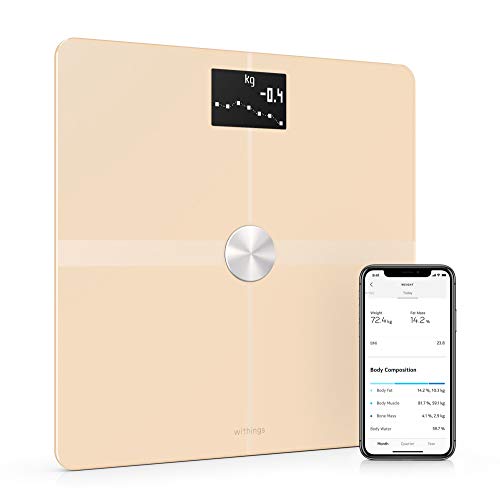
Withings Body+ Smart Wi-Fi Body Composition Scale
by Withings
Best-in-class Wi-Fi scale for multi-user households needing full body composition — syncs automatically without app interaction.
Pros
- Full body composition breakdown: weight, body fat %, water %, muscle mass, and bone mass in one reading
- Automatic Wi-Fi sync to the Health Mate app — no manual Bluetooth pairing needed for daily use
- Recognizes up to 8 user profiles automatically, making it the best multi-user household scale reviewed
- Syncs natively with Apple Health, Google Fit, Fitbit, and MyFitnessPal without third-party workarounds
Cons
- Full body composition readings require standing in bare feet — shoes or thick socks cause inaccurate readings
- Premium price is higher than most Bluetooth-only competitors in this round-up
2. RENPHO Smart Body Fat Scale — Budget Pick
No smart scale review is complete without the RENPHO. With over 212,000 Amazon ratings, it holds a position unique in the consumer health device category: more independently verified reviews than virtually any other medical or wellness product on the platform. That breadth of real-world feedback, spanning years of daily use across hundreds of thousands of households, gives a level of confidence in its core functionality that no laboratory test alone could provide.
The RENPHO’s 13 metrics cover every body composition data point a general wellness user needs, and at its price point, the cost-to-feature ratio is unmatched. The app is functional, the Bluetooth pairing process is straightforward, and the Apple Health and Fitbit integrations work reliably. Its limitation is also a function of its price: Bluetooth-only connectivity requires your phone present at every weigh-in. For users who are disciplined about having their phone in hand each morning, this is a non-issue. For users who prefer a more passive tracking experience, the Withings Body+ is worth the price difference. For the vast majority of people simply looking for a reliable, affordable scale that does what it advertises — the RENPHO is the obvious starting point.
RENPHO Smart Body Fat Scale
by RENPHO
The most-reviewed body composition scale on Amazon — 13 metrics at an entry-level price.
Pros
- Over 212,000 Amazon ratings make it the most validated body composition scale ever reviewed on this site
- Tracks 13 body composition metrics including body fat %, BMI, visceral fat, bone mass, and metabolic age
- RENPHO app syncs directly to Apple Health, Fitbit, and Samsung Health at no extra cost
- Slim 0.8-inch platform fits under most bathroom furniture for easy storage
Cons
- Bluetooth-only — requires your phone to be present and app open during each weigh-in
- Step-on ITO sensor technology is less accurate than the wet-electrode systems on premium models
- Syncs only one weight entry at a time — cannot upload retroactively if you weigh in without your phone
3. eufy Smart Scale C1 — Runner-Up
The eufy C1 earns its runner-up position on the strength of its app experience. Among the sub-$50 Bluetooth scales reviewed, the EufyLife app has the most intuitive onboarding process and the cleanest data visualization. New users — particularly older adults adopting smart scale tracking for the first time — consistently cite the app’s clarity as a differentiator in Amazon reviews. The 16-user profile support is also meaningfully above the 8-profile ceiling common on many competitors, making the C1 a practical choice for larger households unwilling to spend Withings prices.
The ITO-coated sensor produces consistent readings across different foot positions on the platform, reducing the measurement variance that can erode confidence in at-home body composition data. At its price point, the eufy C1 is the stronger alternative to the RENPHO for users who prioritize app usability over maximum metric count.
eufy Smart Scale C1
by eufy (Anker)
Best app experience among budget Bluetooth scales — clean UI, 16 profiles, and reliable sensor consistency.
Pros
- 12 body composition measurements including body fat %, muscle mass, bone density, and visceral fat
- ITO sensor coating produces consistent readings across different standing positions on the platform
- EufyLife app has a clean, intuitive interface that new users find significantly easier than competitors
- Supports 16 user profiles — more than most competing Bluetooth scales in the sub-$50 range
Cons
- Bluetooth-only connectivity requires phone proximity for every weigh-in
- No native integration with MyFitnessPal — requires Apple Health or Google Fit as an intermediary
4. Greater Goods Digital Body Weight Bathroom Scale
Not every user needs body composition data, app connectivity, or cloud sync. For users who want a single accurate weight reading with no app dependency, no Bluetooth pairing, and no subscription upsell, the Greater Goods scale delivers clinical-grade accuracy in a no-frills package. The Step-On Technology produces a stable reading within 2 seconds without the tap-to-wake delay common on budget digital scales, and the large backlit display reads clearly from standing height — a feature genuinely appreciated by older adults who find themselves bending to read competitors’ displays.
The 400 lb maximum capacity and 0.2 lb resolution make this scale clinically appropriate across a wide range of users. The tempered glass platform’s verified drop resistance is unusual at this price point and reflects Greater Goods’ quality commitment. For users managing a health condition where weight trend is the primary metric tracked — heart failure, lymphedema, post-surgical recovery — a simple, accurate scale they will actually step on every morning is more valuable than a feature-rich smart scale they abandon because the app is frustrating. This is that scale.
Greater Goods Digital Body Weight Bathroom Scale
by Greater Goods
Best non-smart option — clinician-grade accuracy, fast Step-On reading, and a 400 lb capacity at minimal cost.
Pros
- Clinician-grade Step-On Technology delivers a reading within 2 seconds — no tapping to wake needed
- Large 3.5-inch backlit display is readable without bending or squinting, useful for older adults
- Tempered glass platform has passed 2,000 lb drop testing — among the most durable platforms reviewed
- Measurement precision to 0.2 lbs gives more granular feedback than many Bluetooth scales at higher prices
Cons
- Weight-only scale — no body composition metrics, BMI calculation, or app connectivity
- No memory function for multiple users; each reading must be recorded manually or via separate app
5. Withings Body Cardio Smart Scale — Upgrade Pick
The Withings Body Cardio occupies a unique position in the consumer health device market: it is the only widely available smart scale that measures Pulse Wave Velocity (PWV), a validated marker of arterial stiffness associated with cardiovascular disease risk. PWV is measured clinically using specialized equipment; having a proxy measurement available daily from a bathroom scale represents a genuinely novel capability for at-home cardiovascular monitoring. The scale also records standing heart rate at each weigh-in, adding a passive data point for resting heart rate trends over time.
It is important to understand what PWV from a consumer scale does and does not provide. The measurement is an estimate, not a clinical diagnostic reading, and any values that appear concerning warrant discussion with your physician rather than self-interpretation. For users with established cardiovascular risk factors — hypertension, elevated cholesterol, family history of heart disease — who are already engaged in regular wellness monitoring, the Body Cardio’s additional data layer has genuine value. For general wellness users without specific cardiovascular concerns, the standard Withings Body+ provides comparable body composition accuracy at a significantly lower price point. The upgrade premium here buys cardiovascular data, not meaningfully better body composition measurement.
Withings Body Cardio Smart Scale
by Withings
The only consumer scale with Pulse Wave Velocity cardiovascular measurement — for data-driven health monitoring beyond standard body composition.
Pros
- Pulse Wave Velocity (PWV) measurement provides a validated cardiovascular health indicator beyond standard body composition
- Standing heart rate measurement adds a passive cardio data point during every weigh-in
- Wi-Fi sync uploads readings automatically without requiring phone proximity, ideal for high-compliance tracking
- Medical-grade weight accuracy to 0.1 lbs — the highest precision in this review
Cons
- Pulse Wave Velocity feature is clinically interesting but not validated for diagnostic use — requires physician interpretation
- Premium price positions this above the clinical utility threshold for most general wellness users
- Body composition accuracy is comparable to the Withings Body+ despite the significant price premium
6. Etekcity Smart Fitness Scale
The Etekcity scale addresses one of the common accuracy criticisms of budget BIA scales: two-electrode measurement configurations, which only analyze one half of the body and extrapolate the rest. The Etekcity’s four-electrode layout sends the impedance current through both the lower and upper body, producing a more complete and repeatable full-body reading. The auto-calibration feature, which adjusts the baseline reading for uneven bathroom floor surfaces, further reduces a common source of day-to-day variance that affects readings on older tile floors.
The VeSync app’s trend graphing and custom date-range analysis are more powerful than those on RENPHO and eufy at comparable price points, making the Etekcity particularly well-suited to users who want to analyze their data beyond the daily reading. The mandatory account registration before first use is a genuine friction point worth acknowledging for privacy-conscious buyers.
Etekcity Smart Fitness Scale
by Etekcity
Solid four-electrode Bluetooth scale with trend graphing and auto-calibration for uneven floors.
Pros
- Measures 13 body composition metrics with a four-electrode sensor layout that improves accuracy over two-electrode alternatives
- VeSync app allows graphing weight trends and body composition changes over custom date ranges
- Works with Apple Health and Google Fit without requiring the VeSync app as an intermediary
- Auto-calibration feature adjusts for uneven bathroom floors, reducing reading variance
Cons
- VeSync app requires account creation and email verification before the scale functions — frustrating for privacy-minded users
- Athlete mode readings for users with very high muscle mass are less reliable than standard mode results
7. INEVIFIT Smart Body Fat Scale
The INEVIFIT’s ten-sensor configuration is the highest sensor density in this review, and the resulting measurement repeatability — getting the same number twice in a row when stepping off and back on — is noticeably more consistent than four-sensor alternatives. For users who have been frustrated by seemingly random day-to-day fluctuations on other scales, this consistency is the scale’s strongest argument.
The FITINDEX app’s percentile benchmarking — showing where your body fat percentage or muscle mass sits relative to other users of the same age and sex — is a feature absent from most competitors and provides useful context for interpreting raw numbers. The 330 lb maximum capacity is the primary limitation to verify before purchasing; users above 280 to 290 lbs should consider a scale with a higher ceiling.
INEVIFIT Smart Body Fat Scale
by INEVIFIT
Ten-sensor precision scale with percentile benchmarking — strong mid-range option for consistent tracking.
Pros
- Ten high-precision sensors provide a more stable and repeatable reading than four-sensor competitors
- Measures 10 body composition metrics with a 330 lb capacity and precision to 0.1 lbs
- FITINDEX app integration provides body composition trend charts with percentile benchmarking
- Tempered glass platform with anti-slip rubber feet performs reliably on tile and hardwood floors
Cons
- 330 lb maximum capacity is lower than the 396-400 lb ceiling on most competing models
- FITINDEX app requires account registration and pushes upsell notifications for premium subscription features
How to Choose the Best Smart Bathroom Scale
The buyer’s guide factors above cover the six most important variables. One consideration worth emphasizing separately is long-term tracking discipline. The best smart scale is the one you step on consistently — not the one with the most features. Every additional step in the sync process (opening an app, waiting for Bluetooth, remembering your phone) is a friction point that causes people to miss readings over weeks and months. If you have historically been inconsistent about daily tracking, a Wi-Fi scale like the Withings Body+ that syncs passively is worth the premium. If you are reliably disciplined, a Bluetooth scale saves money without meaningfully impacting your data quality.
For users managing chronic conditions where weight is a clinically monitored metric — heart failure, kidney disease, post-bariatric surgery — discuss your at-home monitoring protocol with your healthcare provider before choosing a scale. They may have specific recommendations about measurement frequency, time of day, and which metrics to prioritize for your condition. At-home body composition data is a wellness tool that complements clinical care — it does not replace it.
Buyer's Guide
Choosing a smart bathroom scale means matching the connectivity, measurement depth, and app ecosystem to how you actually intend to use the data every day.
Wi-Fi vs. Bluetooth Connectivity
Bluetooth scales require your phone nearby and the app active during each weigh-in. Wi-Fi scales sync automatically to the cloud the moment you step off, regardless of where your phone is. For consistent daily tracking — especially in multi-user households — Wi-Fi connectivity removes the friction that causes people to skip readings and lose longitudinal data.
Body Composition Metrics
Entry-level scales measure weight only. Mid-range Bluetooth scales typically measure 10 to 13 metrics using bioelectrical impedance. The four metrics with the strongest evidence base for wellness tracking are weight, body fat percentage, muscle mass, and visceral fat. Additional derived metrics like metabolic age and protein ratio are calculated from these core readings and add limited independent value. Prioritize accuracy on the four core metrics over the total count of measurements advertised.
Maximum Weight Capacity
Standard smart scales accommodate 396 to 400 lbs. If your weight is above 300 lbs, verify the maximum capacity before purchasing — some scales, including the INEVIFIT reviewed here, have a lower 330 lb ceiling. Always choose a scale with at least 20 to 30 lbs of headroom above your current weight to ensure accurate readings at the edges of the measurement range.
App Ecosystem and Integrations
The scale app is where you will spend most of your time reviewing data. Evaluate whether the app integrates with Apple Health, Google Fit, or Fitbit — whichever platform anchors your existing health data. Withings Health Mate and the RENPHO app offer broad integrations, while some proprietary apps like VeSync require mandatory account creation and offer fewer native connections. If you use MyFitnessPal for calorie tracking, verify the integration exists before committing to a platform.
Platform Size and Build Quality
Larger platforms — 12 inches square or wider — are more comfortable for larger users and reduce the risk of measurement error caused by off-center standing. Tempered glass platforms are standard and durable; verify the glass thickness (5 to 6 mm is typical). Anti-slip rubber feet or pads are important for safe use on wet bathroom tile. Avoid scales where the display requires bending significantly — a high-contrast backlit display visible from standing height is a meaningful usability feature.
Pregnancy and Athlete Modes
Bioelectrical impedance is not recommended during pregnancy — the electrical current, though small, has not been validated as safe for fetal exposure. If any household member is pregnant, the scale should be used for weight-only tracking, and body composition features disabled. Athlete mode, available on several reviewed models, recalibrates body fat estimates for individuals with unusually high muscle mass — important for strength athletes who would otherwise receive inflated fat percentage readings from standard algorithms.
Final Verdict
The Withings Body+ is our best overall smart bathroom scale for 2026. Its automatic Wi-Fi sync, 8-user auto-recognition, and comprehensive body composition measurement combine with the best app ecosystem in the category to deliver a daily tracking experience that competitors with Bluetooth-only connectivity simply cannot match. For households with multiple users or anyone who wants truly passive, friction-free data logging, it is the right choice.
For buyers on a tight budget, the RENPHO Smart Body Fat Scale is the clear recommendation. More than 212,000 real-world users cannot all be wrong — it tracks 13 body composition metrics reliably, syncs to Apple Health and Fitbit, and costs a fraction of the premium alternatives. For most people beginning a health tracking regimen, the RENPHO is everything they need. For users with cardiovascular risk factors interested in arterial stiffness monitoring, the Withings Body Cardio’s Pulse Wave Velocity feature represents a meaningful clinical upgrade worth the investment. As always, consult your physician before using any at-home monitoring data to inform health decisions.
Frequently Asked Questions
Are smart bathroom scales accurate for body fat percentage?
What is the difference between Wi-Fi and Bluetooth bathroom scales?
How many body composition metrics do I actually need?
Can multiple family members use the same smart scale?
Does BMI from a bathroom scale replace a clinical assessment?
Related Articles
About the Reviewer

Dr. David Taylor, MD, PhD
Drexel University College of Medicine (MD), Indiana University School of Medicine (PhD)
Dr. David Taylor is a licensed physician and medical researcher who founded BestRatedDocs in 2016. With an MD from Drexel University and a PhD from Indiana University School of Medicine, he combines clinical expertise with a passion for health technology to provide evidence-based product recommendations. Dr. Taylor specializes in health informatics and regularly evaluates medical devices, diagnostic equipment, and therapeutic products to help healthcare professionals and patients make informed decisions.