7 Best Wart Removers of 2026
A physician's guide to the best OTC wart removers — salicylic acid pads, gels, sticks, and cryotherapy kits reviewed for efficacy, safety, and value.
Updated
Warts are among the most common dermatological conditions encountered in primary care, affecting an estimated 7-10% of the general population at any given time. Caused by the human papillomavirus (HPV) — with over 100 identified strains, of which HPV types 1, 2, 4, 27, and 57 are responsible for the vast majority of cutaneous warts — these benign epithelial proliferations appear most frequently on the hands, fingers, and soles of the feet. While warts are medically harmless in immunocompetent individuals and many resolve spontaneously within 1-3 years as the immune system mounts a response, the reality is that most patients want them gone well before the immune system gets around to clearing the infection. The cosmetic impact, social stigma, and physical discomfort of plantar warts all drive strong demand for effective OTC treatment.
The OTC wart remover market offers two fundamentally different therapeutic approaches: salicylic acid (SA) keratolytic therapy and dimethyl ether/propane cryotherapy. Understanding how each works — and which wart types respond best to each — is essential for choosing the right product and setting realistic expectations. At BestRatedDocs.com, our reviews are informed by Dr. David Taylor’s clinical experience evaluating dermatological treatments and patient outcomes. We reviewed the best OTC wart removers available on Amazon in 2026, covering salicylic acid products across multiple delivery formats (pads, gels, sticks, strips, and hydrogel bandages) and cryotherapy kits from the two leading brands. If you are also managing foot discomfort related to plantar warts, our best orthotic insoles guide and best plantar fasciitis insoles guide cover supportive products that can reduce pressure on affected areas during treatment.
After evaluating seven products across both treatment categories and analyzing the clinical evidence behind each approach, here are our top wart remover picks for 2026. The summary table below highlights the key differentiators at a glance.
How We Selected These Wart Removers
Our selection criteria prioritized clinical efficacy data, verified review volume, and practical usability. We required a minimum of 8,000 verified Amazon reviews to ensure a robust real-world performance signal, evaluated the active ingredient concentration and delivery mechanism for each product, and assessed the application method for ease of use across different patient populations including children. We included both salicylic acid and cryotherapy products because the clinical evidence supports both approaches and individual response varies — some warts that resist weeks of SA treatment resolve with a single freeze cycle, and vice versa. We deliberately excluded duct tape, banana peel, and other home remedies with anecdotal but no rigorous clinical support.
How OTC Wart Removers Work: Salicylic Acid vs. Cryotherapy
Before reviewing individual products, understanding the two therapeutic mechanisms helps contextualize the differences in treatment duration, discomfort, and efficacy.
Salicylic acid is a keratolytic agent that works by dissolving the keratin protein that makes up both the wart tissue and the thick dead skin layer (stratum corneum) that protects it. When applied at concentrations of 17-40%, SA softens and breaks down the wart layer by layer over days to weeks. The process also creates a mild inflammatory response that recruits immune cells to the treatment site, which may contribute to HPV clearance beyond the direct tissue destruction. The 2012 Cochrane review of wart treatments found SA to be significantly more effective than placebo, with cure rates of approximately 50-70% for common warts after 6-12 weeks of consistent use.
Cryotherapy products use compressed dimethyl ether and propane (DMEP) to rapidly cool a foam or metal applicator to approximately -57 degrees Celsius. When pressed against the wart for 20-40 seconds, this temperature is sufficient to freeze the intracellular water in the epidermal cells, causing cellular destruction and blister formation. The blister separates the wart tissue from the underlying dermis, and the localized tissue damage also triggers an immune response that may help clear the HPV infection. OTC cryotherapy does not reach the -196 degrees Celsius temperature of liquid nitrogen used in dermatology offices, which is why professional cryotherapy is more aggressive and often more effective for recalcitrant warts.
1. Compound W One Step Pads — Best Overall
The Compound W One Step Pad is the most straightforward and well-validated wart treatment on Amazon, and its position as our best overall pick reflects the convergence of simplicity, efficacy, and an unmatched review volume that provides the strongest real-world data signal in the category. With over 44,000 verified ratings, this product has more consumer validation than any other wart remover — and the sustained 4.3-star average across that volume indicates consistent performance rather than polarized love-or-hate responses.
The mechanism is elegant in its simplicity: each waterproof pad contains 40% salicylic acid embedded in the adhesive, providing continuous keratolytic contact with the wart tissue for as long as the pad remains in place. This continuous-contact approach eliminates the compliance challenge inherent in liquid and gel formulations, which require daily reapplication and can be messy or time-consuming. Apply the pad, leave it on for 48 hours, remove it, soak the area in warm water, file away the dead white tissue with an emery board, and apply a fresh pad. This soak-file-reapply cycle, repeated consistently, is the evidence-based protocol that maximizes SA treatment efficacy.
The practical limitations are real but manageable. Adhesion can fail in high-moisture environments — between the toes, on actively sweating plantar surfaces during exercise, or in humid climates. The one-size pad format means some trimming may be necessary for small finger warts or large plantar warts. And the timeline is weeks, not days — expect 2-4 weeks for common warts and potentially 6-8 weeks for deep plantar warts. For patients who want faster results and tolerate discomfort well, the cryotherapy options below may be more appropriate. For everyone else — particularly families with children, patients on a budget, and anyone who values simplicity — the Compound W One Step Pad is the product to start with.
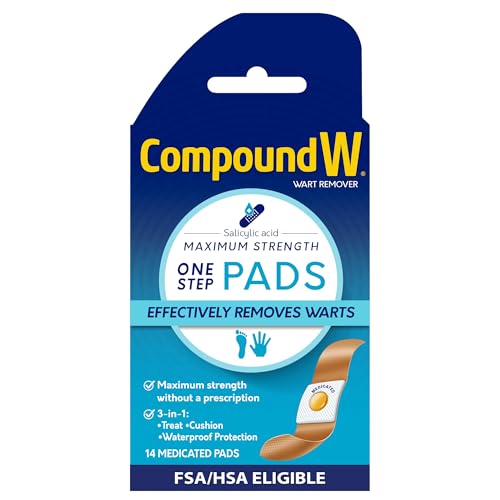
Compound W One Step Pads, Maximum Strength Salicylic Acid Wart Remover, 14 Medicated Pads
by Compound W
The most trusted wart remover on Amazon — maximum strength salicylic acid in a waterproof pad format with over 44,000 verified reviews confirming consistent results.
Pros
- The most-reviewed wart remover on Amazon with over 44,000 verified ratings — the strongest real-world efficacy signal in the category
- Waterproof self-adhesive design delivers continuous salicylic acid contact without reapplication, maximizing keratolytic penetration into the wart tissue
- Set-and-forget treatment requires minimal daily effort — apply the pad and leave it in place, eliminating the mess of liquid or gel formulations
- Maximum strength 40% salicylic acid concentration built directly into each pad, with extra cushioning that reduces pressure discomfort on plantar warts
Cons
- Pads may not adhere well in high-moisture areas like between toes or on the soles of feet during heavy physical activity
- One-size pad format may not fit all wart sizes — large plantar warts or very small finger warts both present coverage challenges
- Slower onset than cryotherapy methods — expect 2-4 weeks of consistent daily use before the wart fully resolves
2. Dr. Scholl’s Freeze Away — Runner-Up
For patients who prefer a more aggressive treatment approach or who have not responded to salicylic acid after several weeks, cryotherapy offers a fundamentally different mechanism of action. Dr. Scholl’s Freeze Away uses dimethyl ether/propane to cool a foam applicator to approximately -57 degrees Celsius, which is then pressed against the wart for 20-40 seconds depending on wart size. The freeze event destroys the wart cells directly and, critically, creates a subepidermal blister that physically separates the wart tissue from the underlying dermis — a process analogous to what happens when a dermatologist uses liquid nitrogen in the office, though at a less extreme temperature.
The ThermoColor temperature indicator is a genuine safety and efficacy feature, not a marketing gimmick. It confirms that the applicator has reached the therapeutic freeze temperature before you apply it to your skin, which matters because an insufficiently cold application will cause discomfort without reaching the cellular destruction threshold needed for efficacy. The indicator turns a specific color when the foam tip has absorbed enough DMEP to deliver a therapeutic freeze — apply before this color change and you waste an application.
The honest reality of OTC cryotherapy is that it rarely works in a single treatment for anything other than the smallest, most superficial warts. The marketing language of “as few as 1 treatment” is technically accurate but statistically uncommon. Most common warts require 2-3 treatments spaced 10-14 days apart, and plantar warts may require 3-4 treatments. The 12-application format provides enough for treating 4-6 warts through a full treatment course, or 1-2 stubborn warts through multiple cycles. The sting during application is unavoidable — it is a direct consequence of tissue freezing — but it is brief and tolerable for most adults. For young children, the pain management products we review separately may help with pre-treatment anxiety, though most pediatric dermatologists recommend SA products rather than cryotherapy for children under 8.

Dr. Scholl's Freeze Away Wart Remover, Cryotherapy Kit, 12 Applications
by Dr. Scholl's
The best cryotherapy option for users who want fast results — doctor-comparable freeze technology with a temperature indicator for safer home use.
Pros
- Fast results with as few as one treatment — cryotherapy initiates a blister-mediated immune response that can resolve warts within 10-14 days
- ThermoColor temperature indicator confirms the applicator has reached the therapeutic freeze temperature before skin contact, reducing user error
- Doctor-comparable dimethyl ether cryotherapy mechanism — the same freeze-based approach used in dermatology offices adapted for home use
- Trusted Dr. Scholl's brand with over 13,000 verified reviews and consistent efficacy ratings across multiple wart types
Cons
- Application produces a noticeable sting during the 20-40 second freeze cycle — some users, particularly children, find this uncomfortable
- May require 2-3 treatments spaced 10-14 days apart for stubborn or deep-rooted warts, despite single-treatment marketing claims
- Foam applicator tips can be imprecise for very small warts, risking freeze damage to surrounding healthy skin
3. Compound W Maximum Strength Fast-Acting Gel
The gel formulation fills an important niche that pads and strips cannot: precise coverage of irregularly shaped warts and warts in anatomically difficult locations where flat adhesive products do not conform well. The brush-on applicator allows the user to paint a thin layer of 17% salicylic acid gel directly onto the wart surface, including into crevices and fissures in roughened wart tissue that a flat pad would bridge over without making full contact.
The 17% SA concentration is lower than the 40% found in pads and strips, but this is not necessarily a disadvantage. The gel vehicle delivers SA in a form that penetrates rapidly into the wart tissue rather than relying on sustained surface contact, and the lower concentration reduces the risk of irritation to surrounding healthy skin — a real concern when treating warts on the thin skin of the fingers, wrists, or backs of hands. The manufacturer’s claim of results in as few as 9 days for common warts is supported by a subset of reviews, though 2-3 weeks is a more typical timeline for most users.
The 0.25 oz tube is objectively small, and patients treating multiple warts simultaneously will go through it quickly. For a single common wart, the tube is more than adequate for a complete treatment course. For plantar warts or multiple warts, consider pairing the gel with one of the pad-based products — use the gel for initial penetration into the wart tissue, then cover with a 40% SA pad for sustained overnight contact. This layered approach is used by some dermatologists and may accelerate resolution compared to either product alone.

Compound W Maximum Strength Fast-Acting Gel, Salicylic Acid Wart Remover, 0.25 oz
by Compound W
A fast-acting gel formula for targeted wart treatment — the brush-on applicator delivers precision coverage for common and stubborn warts.
Pros
- Reported to work in as few as 9 days for common warts — one of the fastest-acting salicylic acid formulations available OTC
- Effective on deep and stubborn warts that pad-based treatments struggle to penetrate, thanks to the gel's ability to conform to irregular wart surfaces
- No-drip gel formula stays precisely where applied without running onto surrounding healthy tissue
- Brush-on applicator allows targeted coverage of individual warts with minimal waste and maximum precision
Cons
- Small 0.25 oz tube provides limited volume — heavy users treating multiple warts simultaneously may exhaust the supply quickly
- Can irritate surrounding healthy skin if gel is applied beyond the wart margin — petroleum jelly barrier recommended for sensitive skin
- May require 4-6 weeks of consistent daily application for plantar warts, which are deeper-seated than common warts
4. WartStick Maximum Strength Solid-Stick — Upgrade Pick
The WartStick represents a genuinely differentiated approach in the SA wart remover category: maximum 40% concentration in a solid twist-up stick format that eliminates the mess, imprecision, and waste associated with liquid and gel alternatives. The solid vehicle melts slightly on contact with warm skin, depositing a concentrated layer of SA directly onto the wart surface without the dripping, spreading, or brush cleanup that characterize liquid and gel formulations.
The 40% SA concentration matches the maximum strength found in pad-based products, but the stick format offers superior precision for treating individual warts of any size — you can apply exactly the amount needed for a 2mm finger wart or a 10mm plantar wart without trimming pads or wasting adhesive strips. The painless, odorless application is a meaningful advantage for pediatric patients and adults who find the mild stinging of liquid SA formulations unpleasant. WartStick is approved for children as young as 2 years — the lowest age threshold of any product in this review.
The upgrade designation reflects the combination of maximum strength concentration with the most user-friendly delivery mechanism in the SA category. The approximately 35 applications per stick provide enough product for a complete treatment course for 2-3 warts, making the per-treatment value competitive with pad-based alternatives despite the higher per-unit price. The waxy residue after application is the primary usability complaint in reviews — applying a thin, even layer and allowing it to dry before covering with a bandage minimizes this issue.

WartStick Maximum Strength Salicylic Acid Solid-Stick Wart Remover, 40%
by WartStick
The highest-strength OTC wart remover — 40% salicylic acid in a mess-free solid stick that is painless, odorless, and suitable for the whole family.
Pros
- Highest salicylic acid concentration available OTC at 40% in a unique solid-stick delivery system — more potent than standard gels and liquids
- Solid stick format eliminates the mess associated with liquid and gel wart removers — no dripping, no spilling, no brush cleanup
- Painless and odorless application makes it well-suited for children and adults with sensitivity to the stinging associated with liquid SA formulations
- Each stick provides approximately 35 or more applications, delivering strong per-treatment value relative to single-use pad alternatives
Cons
- Requires patience — several weeks of consistent daily application are typically needed for complete wart resolution
- Waxy residue from the solid stick can be difficult to remove from skin and clothing if over-applied
- Relatively small product size for the price point compared to bulk pad or gel options
5. Compound W Freeze Off Advanced
The Freeze Off Advanced differentiates itself from the Dr. Scholl’s Freeze Away primarily through its Accu-Freeze precision tip and higher application count. The precision tip is designed to focus the freeze zone more tightly on the wart itself while minimizing contact with surrounding healthy skin — an important consideration because collateral freeze damage to healthy tissue causes unnecessary pain and can leave temporary hypopigmentation marks that take weeks to resolve.
With 15 applications per package versus 12 for the Dr. Scholl’s product, the Freeze Off Advanced provides 25% more treatments at a modestly higher price point, making it the better per-treatment value for users who need multiple treatment sessions or who are treating more than one wart. The cryotherapy mechanism is identical between the two products — both use DMEP at similar temperatures — so the therapeutic efficacy difference comes down primarily to the precision of application and the number of available treatments.
The blistering that follows cryotherapy is expected and is, in fact, the therapeutic mechanism. First-time users should understand that a blood blister or clear fluid blister forming 24-48 hours after treatment is a sign that the freeze reached the correct depth, not a sign of injury. Do not puncture the blister — allow it to resorb naturally over 7-10 days, then assess whether the wart has cleared or requires a repeat treatment. For users managing foot discomfort during the blistering phase, our best first aid kits guide includes options with blister bandages and wound care supplies.

Compound W Freeze Off Advanced Wart Remover, Cryotherapy Kit, 15 Applications
by Compound W
The most precise cryotherapy kit available — Accu-Freeze targeting with 15 treatments makes it the best value for users treating multiple warts.
Pros
- Accu-Freeze precision tip targets warts accurately while minimizing contact with surrounding healthy skin — the most precise applicator in the freeze category
- 15 treatments included — the most applications per package of any OTC cryotherapy kit, providing better per-treatment value
- Doctor-comparable freeze method initiates a blister-mediated immune response that can clear warts from the root
- Begins destroying wart tissue from the first application, with visible results often appearing within 10-14 days
Cons
- Most expensive non-nitrous freeze option on the market — the precision tip premium adds cost versus standard applicators
- Can cause blistering and temporary discoloration at the treatment site — a normal part of the cryotherapy mechanism but alarming to first-time users
- Deep plantar warts may require the full 3-4 treatment cycles spaced over 6-8 weeks for complete resolution
6. Dr. Scholl’s Clear Away Hydrogel Bandages
Warts on the fingers and toes present a unique treatment challenge that this product was specifically engineered to address. Standard flat pads and strips are designed for relatively flat skin surfaces — the back of the hand, the sole of the foot — and consistently fail to maintain adhesion around the curved, flexing anatomy of the digits. The hydrogel bandage format wraps around fingers and toes, conforming to the curved surface and maintaining SA contact through the flexion and extension movements of daily hand and foot use.
The 40% SA concentration is identical to the Compound W One Step Pads and Invisible Strips, so the therapeutic mechanism and expected timeline are equivalent. The differentiator is purely anatomical — if your wart is on a finger, toe, or the web space between digits, this product will deliver the medication more effectively and stay in place longer than any flat pad alternative. The built-in cushioning also protects the treatment site from the friction and pressure that aggravate digit warts during typing, gripping, and walking.
The trade-off is cost per unit and versatility. At a similar price to the Compound W pads but in a format optimized exclusively for digits, the Clear Away bandages are not the right choice for plantar warts, hand-back warts, or warts on flat skin surfaces. They are a purpose-built solution for a specific problem — and for that specific problem, they are the best product available.

Dr. Scholl's Clear Away Hydrogel Wart Remover for Fingers and Toes, 14 Bandages
by Dr. Scholl's
The best wart remover for fingers and toes — hydrogel bandages designed to conform to digit anatomy where standard pads fail.
Pros
- Specifically designed for fingers and toes — the most difficult-to-treat anatomical locations where standard flat pads consistently fail to adhere
- Hydrogel bandage stays in place for multiple days of continuous salicylic acid delivery, reducing the need for daily reapplication
- Maximum strength 40% salicylic acid concentration with built-in cushioning that protects the wart site from pressure and friction
- Flexible bandage format conforms to the curved surfaces of digits better than rigid pad or strip alternatives
Cons
- Not ideal for plantar warts on the sole of the foot — the bandage format is optimized for digit anatomy, not weight-bearing surfaces
- Higher per-bandage cost than Compound W pad alternatives despite similar active ingredient concentration
- Adhesive can loosen with extended water exposure — frequent handwashing or swimming may require more frequent bandage changes
7. Compound W Invisible Strips — Budget Pick
The Invisible Strips address the most common cosmetic complaint about wart treatment: visibility. Standard medicated pads are opaque, thick, and immediately noticeable on the hands — which is precisely where most common warts appear and where social visibility is highest. The clear, thin strip design is genuinely difficult to see once applied, making it the best option for patients who need to treat hand warts while continuing to work, attend school, or socialize without advertising their treatment.
The 40% SA concentration and peel-and-stick application method are identical to the standard Compound W pads, so therapeutic efficacy should be equivalent. The waterproof adhesive maintains contact through normal handwashing and showering, though prolonged submersion (swimming, dishwashing) may loosen the strips. The SA is concentrated in the center of the strip rather than distributed across the entire adhesive surface — a design choice that focuses the active ingredient on the wart while minimizing exposure to the surrounding healthy skin margin.
At the lowest price point in the pad and strip category, the Invisible Strips deliver maximum strength SA treatment with the best combination of discretion and value. The reduced cushioning compared to the standard pads makes them less ideal for plantar warts where pressure relief matters, but for common warts on the hands and fingers — which represent the majority of OTC wart treatment scenarios — they are the smartest budget choice. If you are also building a home health toolkit for treating minor injuries and skin conditions, our best muscle rubs guide and first aid kits review round out the essential OTC medicine cabinet.

Compound W One Step Invisible Strips, Maximum Strength Wart Remover, 14 Strips
by Compound W
The most discreet wart remover available — invisible waterproof strips with maximum strength salicylic acid at the best price in the category.
Pros
- Truly invisible on skin — clear strip design allows discreet treatment of warts on visible areas like hands and fingers without drawing attention
- Waterproof adhesive maintains contact through handwashing, showering, and light physical activity
- Salicylic acid concentrated in the center of the strip for targeted delivery directly to the wart tissue while minimizing exposure to surrounding skin
- Effective on both common and plantar warts with consistent 4.3-star ratings across more than 10,000 verified reviews
Cons
- Less cushioning than the standard Compound W One Step Pads — not ideal for plantar warts where pressure relief is a priority
- Adhesive can irritate sensitive skin with prolonged continuous use — rotating application sites between strip changes may help
Matching Wart Removers to Wart Types
Choosing the right product depends heavily on the type and location of the wart being treated. Here is a practical matching guide based on wart classification:
Common warts (verruca vulgaris) — the raised, rough-surfaced warts that appear most frequently on the fingers and backs of the hands — respond well to virtually every product in this review. For simplicity and value, start with Compound W One Step Pads or Invisible Strips. If you prefer a faster-acting approach, either cryotherapy kit is appropriate.
Plantar warts (verruca plantaris) — found on the soles of the feet, often with black pinpoint dots (thrombosed capillaries) visible on the surface — require more aggressive and sustained treatment because the wart is embedded in thick, weight-bearing skin. The 40% SA products (pads, WartStick, or strips) with diligent daily soak-and-file debridement are the first-line OTC approach. Cryotherapy alone is often insufficient for plantar warts because the freeze depth does not penetrate the full thickness of plantar skin.
Flat warts (verruca plana) — small, slightly raised, smooth-surfaced warts that often appear in clusters on the face, arms, or legs — are best treated with the Compound W gel at 17% SA concentration. The lower concentration reduces the risk of visible scarring on cosmetically sensitive areas, and the brush-on applicator allows precise treatment of individual small lesions within a cluster.
Periungual and subungual warts — warts around or under the fingernails and toenails — are among the most difficult to treat with OTC products and frequently require professional intervention. The Dr. Scholl’s Clear Away hydrogel bandages can provide some benefit for periungual warts, but subungual warts (under the nail plate) are not accessible to topical treatment and should be referred to a dermatologist.
How to Use Wart Removers Effectively
Regardless of which product you choose, following a consistent treatment protocol dramatically improves outcomes. For salicylic acid products, the evidence-based approach is a daily soak-file-apply cycle:
- Soak the wart in warm water for 5 minutes to hydrate the keratinized tissue and improve SA penetration
- File the white, dead tissue with a disposable emery board or pumice stone — this debridement step removes the layer of destroyed tissue and exposes fresh wart tissue to the next SA application
- Apply the SA product (pad, gel, stick, or strip) to the debrided wart surface
- Cover gel and stick applications with a bandage to maintain contact; pads and strips are self-adhesive
- Repeat daily without interruption until the wart is completely gone, plus an additional 1-2 weeks to address subclinical infected tissue
For cryotherapy products, follow the manufacturer’s instructions for freeze duration based on wart size, allow the blister to form and resolve naturally over 10-14 days, then assess the treatment site. If wart tissue remains, repeat the freeze. Do not attempt to freeze a wart while a blister from the previous treatment is still present.
One critical hygiene note: HPV is contagious through direct contact and through fomites (shared surfaces). Do not share emery boards, pumice stones, towels, or nail clippers with others during treatment. Use a dedicated emery board for wart debridement and dispose of it after the wart resolves. Wash hands thoroughly after touching the wart or handling treatment products.
When to See a Dermatologist
OTC wart removers are appropriate first-line treatment for common and plantar warts in immunocompetent adults and children. However, professional evaluation is warranted when OTC treatment has failed after 12 weeks of consistent application, when warts are spreading rapidly despite treatment, when the growth is on the face or genitals, when the lesion is bleeding or changing in appearance (to rule out non-wart diagnoses such as squamous cell carcinoma or amelanotic melanoma), or when the patient has a compromised immune system. Dermatologists have access to liquid nitrogen cryotherapy at -196 degrees Celsius (far colder than OTC products), prescription compounded SA preparations at concentrations up to 70%, immunotherapy agents such as candida antigen injections, and procedural options including electrodesiccation and pulsed dye laser treatment.
Buyer's Guide
Selecting the right wart remover requires matching the treatment method to your wart type, anatomical location, pain tolerance, and willingness to commit to a multi-week treatment regimen — the wrong product for your situation wastes both time and money.
Active Ingredient & Concentration
OTC wart removers use two fundamentally different mechanisms. Salicylic acid (SA) is a keratolytic agent that dissolves the protein structure of wart tissue layer by layer through repeated daily application. It is available in concentrations from 17% (gels and liquids) to 40% (pads, strips, and sticks). Higher concentration does not always mean faster results — the delivery method and contact duration matter equally. Cryotherapy products use dimethyl ether/propane to freeze wart tissue to approximately -57 degrees Celsius, creating a blister that separates the wart from underlying skin and triggers a localized immune response against the HPV-infected cells. SA is generally more effective for plantar warts; cryotherapy may resolve common warts faster but with more discomfort.
Wart Type Compatibility
Common warts (verruca vulgaris) on the hands and fingers respond well to both SA and cryotherapy. Plantar warts on the soles of the feet are embedded in thicker keratinized skin and generally respond better to sustained SA treatment at 40% concentration with daily debridement. Flat warts (verruca plana) are typically small and numerous — SA gel at 17% is preferred because it allows precise application to multiple small lesions without the tissue damage risk of cryotherapy on thin facial or forearm skin. No OTC wart remover is approved for genital warts, periungual warts (around the nail bed), or filiform warts on the face — these require professional treatment.
Application Method
Peel-and-stick products (pads, strips, hydrogel bandages) provide the simplest application with the least room for user error — peel, apply, and leave in place for 24-48 hours. Gel and liquid formulations require more precise application technique but offer better coverage of irregular wart surfaces. Solid sticks provide a no-mess middle ground. Cryotherapy requires the most technique — correct freeze duration, firm contact pressure, and proper positioning relative to the wart margin all affect treatment efficacy. Users who are uncomfortable with the precision required for cryotherapy or who are treating children should generally start with a peel-and-stick SA product.
Treatment Duration
Set realistic expectations based on the method. SA products require 2-6 weeks of daily application for common warts and 4-12 weeks for plantar warts. The daily ritual involves soaking, filing dead tissue, and reapplying — consistency is the decisive factor. Cryotherapy products can show visible results in 10-14 days but may require 2-3 treatments. Neither method produces overnight results despite marketing claims. If you need the wart gone for a specific event or deadline, start treatment at least 6 weeks in advance for SA products or 4 weeks for cryotherapy to allow for multiple treatment cycles.
Pain & Comfort Level
SA products are generally painless during application — mild tingling or itching may occur as the acid begins dissolving wart tissue, but significant pain is uncommon with proper application technique. Cryotherapy produces a noticeable sting during the 20-40 second freeze cycle, followed by throbbing that typically resolves within 1-2 hours. Blistering at the freeze site is normal and expected — it is the therapeutic mechanism, not a side effect. For children, pain-averse adults, or anyone treating warts in sensitive locations, SA products in pad or strip format are the more comfortable first-line approach.
Treatments Per Package
Value calculation requires comparing the number of complete treatment cycles per package, not just the unit count. SA pads and strips (14 per box) provide approximately 14 days of treatment — sufficient for one wart through most of the treatment cycle but potentially requiring a second box for stubborn warts. Cryotherapy kits provide 12-15 applications, with each wart requiring 1-3 applications spaced 10-14 days apart. For users treating multiple warts simultaneously, SA products generally provide better per-wart value because each pad treats one wart per day, while cryotherapy applications are consumed more rapidly when treating multiple sites in a single session.
Final Verdict
For most patients seeking an effective, affordable, and low-effort wart remover, Compound W One Step Pads are our best overall pick — the 40% SA concentration, waterproof pad format, and unmatched 44,000-review validation make it the safest starting point in the category. The set-and-forget application eliminates the compliance barrier that undermines more technique-dependent treatments.
For users who want maximum potency with the cleanest application experience, the WartStick 40% SA Solid-Stick is our upgrade pick — same maximum strength concentration in a precision stick format that works on any wart size and is approved for children as young as 2 years.
For budget-conscious buyers who also need discretion, the Compound W Invisible Strips deliver identical 40% SA treatment in a nearly invisible format at the lowest price in the category — the clear choice for hand warts that need to be treated without being seen.
For patients who prefer cryotherapy or who have not responded to SA treatment, the Dr. Scholl’s Freeze Away provides doctor-comparable freeze technology with a safety-confirming temperature indicator. And for the anatomically challenging finger and toe warts that flat pads cannot treat effectively, the Dr. Scholl’s Clear Away Hydrogel Bandages are purpose-built to solve that specific problem.
As with all dermatological conditions, individual response varies, and patients who do not achieve clearance after 12 weeks of consistent OTC treatment should consult a dermatologist for evaluation and consideration of prescription-strength or procedural alternatives. The products reviewed here represent the best OTC options available, but a clinical assessment can identify wart subtypes, immunological factors, or alternative diagnoses that no OTC guide can substitute for.
Frequently Asked Questions
How long does it take for a wart remover to work?
Is freezing or salicylic acid better for warts?
Do warts come back after removal?
Can children use OTC wart removers?
When should you see a doctor instead of using OTC wart remover?
Related Articles
About the Reviewer

Dr. David Taylor, MD, PhD
Drexel University College of Medicine (MD), Indiana University School of Medicine (PhD)
Dr. David Taylor is a licensed physician and medical researcher who founded BestRatedDocs in 2016. With an MD from Drexel University and a PhD from Indiana University School of Medicine, he combines clinical expertise with a passion for health technology to provide evidence-based product recommendations. Dr. Taylor specializes in health informatics and regularly evaluates medical devices, diagnostic equipment, and therapeutic products to help healthcare professionals and patients make informed decisions.