7 Best Shoulder Braces of 2026
Physician-reviewed: the 7 best shoulder braces for rotator cuff tears, AC joint injuries, post-surgical recovery, and chronic shoulder pain. Compare by type, fit, and condition.
Updated
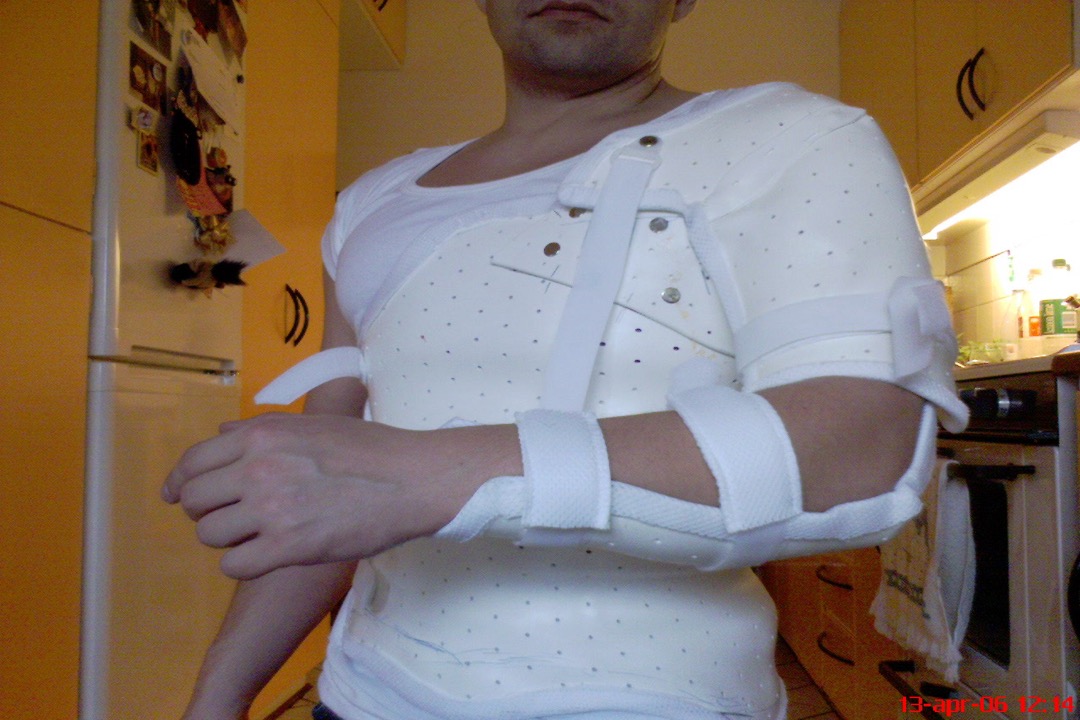
The shoulder is the most mobile joint in the human body — and that mobility comes at a price. Rotator cuff tears affect approximately 30% of adults over 60 and 65% of adults over 70, making shoulder pathology one of the most prevalent musculoskeletal conditions in the United States. The glenohumeral joint achieves its extraordinary range of motion through a complex interplay of static stabilizers (the glenoid labrum, joint capsule, and ligaments) and dynamic stabilizers (the four rotator cuff muscles: supraspinatus, infraspinatus, teres minor, and subscapularis). This anatomical complexity also makes the shoulder the most commonly dislocated major joint in the body — accounting for roughly 45% of all joint dislocations seen in emergency departments. For the millions of Americans managing rotator cuff tears, AC joint sprains, post-surgical recovery, frozen shoulder, or chronic bursitis, a well-chosen shoulder brace can provide meaningful pain relief and structural support during the healing process.
The challenge is that “shoulder brace” is not a single product category — it is four functionally distinct product types serving four different clinical mechanisms. In 2026, we reviewed seven of the best-selling shoulder braces on Amazon, spanning compression sleeves, abduction slings, sports-medicine athletic stabilizers, and clinical arm slings. Our goal is to match you to the brace that addresses your specific injury, not the one with the most reviews or the lowest price. If you are also managing related upper extremity pain, our review of the best elbow braces applies the same condition-matched evaluation framework.
| Product | Price | Buy |
|---|---|---|
| FIGHTECH Shoulder Brace for Torn Rotator CuffBest Overall | $31.99 | View on Amazon |
| Sparthos Shoulder BraceBudget Pick | $19.97 | View on Amazon |
| KMEIVOL Komoko Shoulder BraceRunner-Up | $19.99 | View on Amazon |
| Shock Doctor 842 Shoulder Support BraceRunner-Up | $45.99 | View on Amazon |
| Vive Shoulder Abduction SlingPremium Pick | $59.98 | View on Amazon |
| Velpeau Arm Sling Shoulder ImmobilizerRunner-Up | $26.99 | View on Amazon |
| Suptrust Shoulder BraceRunner-Up | $23.99 | View on Amazon |
Understanding the Four Types of Shoulder Braces
Before comparing individual products, establishing what each brace type does — and does not — accomplish is essential. This single decision narrows the field from seven products to two or three that are clinically relevant for your situation.
Compression sleeves with arm slings are the most common type sold online. They wrap around the shoulder and upper arm to provide compression, warmth, and mild mechanical support, while an attached sling or strap reduces the gravitational load on the joint. These are appropriate for rotator cuff strains, bursitis, AC joint pain, and general shoulder instability during daily activity and exercise. They are not designed for post-surgical immobilization or acute dislocations requiring structural containment.
Abduction slings with wedge pillows immobilize the arm at a specific abducted angle — typically 15 to 30 degrees away from the body. This angle is prescribed after rotator cuff repair, shoulder reconstruction, or labrum surgery because it reduces tension on the repaired tissue during healing. A standard arm sling held at the body’s side creates tension on a freshly repaired rotator cuff; the abduction wedge eliminates this tension. Using a standard sling instead of an abduction sling after rotator cuff repair is a clinical error that can compromise healing.
Athletic stabilizers use structured chest-wrap straps and directional supports to protect the AC (acromioclavicular) joint and glenohumeral joint alignment during athletic activity. They are designed for return-to-sport scenarios following AC joint sprains, shoulder subluxations, or mild instability — not for acute post-injury management or post-surgical recovery.
Medical arm slings provide neutral-position immobilization at the elbow flexed to 90 degrees with the arm held against the body. They are the standard ER discharge device for clavicle fractures, humeral fractures, shoulder dislocations (once reduced), and post-procedure immobilization that does not require abduction. They are simple, effective for their intended purpose, and completely inappropriate as a substitute for abduction slings after rotator cuff surgery.
How We Selected These Shoulder Braces
Our selection methodology prioritized products with meaningful review volume (at least 1,900 verified Amazon ratings), meaningful design differentiation across the four brace categories, and clinical relevance to the most common shoulder conditions seen in orthopedic, sports medicine, and primary care settings. We assessed compression sleeves by ice/heat therapy integration, sizing range, and material breathability for extended wear. Abduction slings were evaluated by wedge angle, waist strap security, and clinical setting use. Athletic stabilizers were assessed by strap engineering and return-to-sport applicability. Medical slings were evaluated by sizing range, material comfort for extended wear, and ease of application without assistance.
1. FIGHTECH Shoulder Brace for Torn Rotator Cuff — Best Overall
The FIGHTECH earns best overall with a straightforward argument: more than 16,000 verified Amazon reviews representing one of the largest real-world clinical feedback pools in the category, consistent physical therapist endorsement, and a built-in ice/heat pack pocket that delivers a clinically meaningful combined therapy capability no competing compression sleeve at this price tier provides. The thermal pocket allows users to apply cold therapy immediately after activity to reduce post-exertion inflammation while maintaining compression — a combination that approximates the RICE (Rest, Ice, Compression, Elevation) protocol in a wearable format.
The four-size range (XS through XL/XXL) is clinically important in a category where many competitors offer only “universal” sizing that poorly accommodates the natural variation in shoulder and torso dimensions across different body types and sexes. Physical therapists fitting patients with shoulder braces routinely encounter the challenge of finding options that work for both a lean 120-pound woman and a broad-shouldered 220-pound man; the FIGHTECH’s four-size structure provides a meaningful degree of anatomical accommodation that universal-size designs cannot. The sizing runs small — essentially every sizing reviewer corroborates this — so ordering one size up from your measured size is a firm recommendation before purchase.
The neoprene construction provides the therapeutic warmth appropriate for the chronic phase of rotator cuff management but becomes uncomfortable during extended summer wear or for users who run warm. For most users managing a rotator cuff strain, bursitis, or AC joint sprain and seeking a brace they can wear during daily activity and exercise, the FIGHTECH is the most clinically defensible starting point on Amazon.

FIGHTECH Shoulder Brace for Torn Rotator Cuff
by FIGHTECH
The most battle-tested shoulder brace on Amazon with 16,000+ reviews, a built-in ice/heat pocket, and consistent PT approval for rotator cuff and AC joint injuries.
Pros
- Ice/heat pack pocket enables simultaneous compression and cold therapy — the most clinically versatile design in the category
- Four distinct sizes with PT-approved fit for rotator cuff and AC joint injuries across a wide range of body types
- Maintains range of motion during upper-body exercise and rehabilitation without over-restricting movement
- Machine-washable durable neoprene construction survives the repeated washing required during active recovery
Cons
- Runs small — most reviewers recommend sizing up one full size before ordering
- Neoprene retains heat; uncomfortable in warm weather or for extended wear beyond 3–4 hours
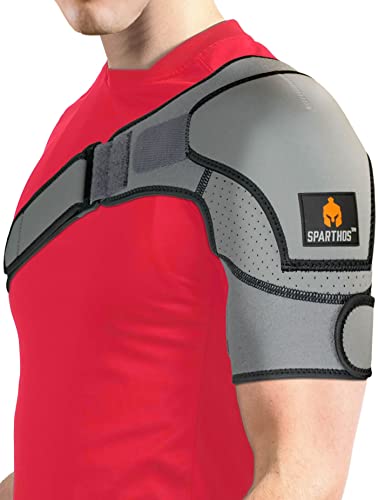
2. Sparthos Shoulder Brace — Budget Pick
The Sparthos holds the distinction of being the most-reviewed shoulder brace on Amazon — nearly 19,000 verified ratings across a diverse population of users provides a signal-to-noise ratio in the review aggregate that smaller review pools simply cannot replicate. When a product sustains a 4.0-star average across that volume, it indicates consistent baseline performance rather than a polarized response driven by a narrow user segment. For a buyer seeking the lowest possible entry point to shoulder bracing before committing to a more specialized or expensive option, the Sparthos delivers what the category promises.
The included hot/cold pack pocket is notable at this price tier — most competing designs at this price point provide compression only, without thermal therapy integration. The removable waist strap allows the brace to be customized for different torso lengths and shapes, which is a genuine functional differentiator from fixed-strap alternatives. The critical caveat — and it bears repeating — is sizing. The “universal” designation is misleading; the bicep opening runs small for many adult arm circumferences, and Sparthos sizing complaints are among the most consistent in the category. Measure your bicep circumference before ordering and compare it against the stated range of 10 to 14 inches. Users outside this range will not achieve proper compression regardless of waist strap adjustment.
The mild-to-moderate support level also sets a real clinical ceiling: the Sparthos is appropriate for managing mild to moderate shoulder discomfort during daily activity, but it does not provide the structural support required for moderate-to-severe AC joint instability, labrum pathology, or post-surgical immobilization.
Sparthos Shoulder Brace
by Sparthos
The Amazon category's most-reviewed shoulder brace at under $20 — an excellent entry point for mild shoulder pain, with the caveat that sizing requires careful measurement before purchase.
Pros
- Highest review count in the shoulder brace category at nearly 19,000 verified ratings — the broadest real-world validation available
- Most affordable top-5 Amazon bestseller option — the lowest barrier to entry for first-time brace users
- Hot/cold pack pocket for combined compression and thermal therapy at a price well below single-function alternatives
- Removable waist strap allows custom fit adjustment for different torso configurations
Cons
- Sizing is notoriously inconsistent — 'universal' runs very small on arm circumference; measure carefully before ordering
- Mild compression is not suitable for moderate-to-severe instability or post-surgical immobilization
3. KMEIVOL Komoko Shoulder Brace — Runner-Up
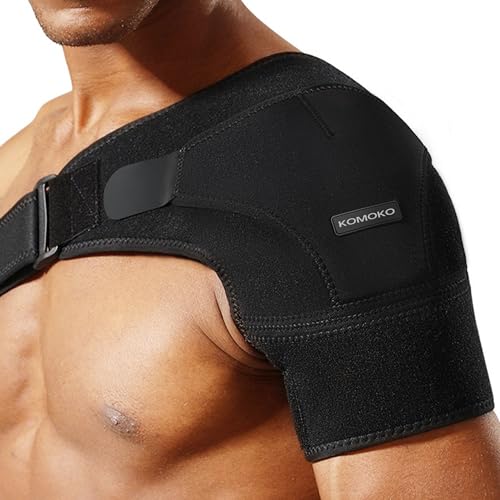
The KMEIVOL Komoko holds Amazon’s #1 Best Seller rank in shoulder braces by active monthly sales volume — a metric that reflects current buyer preference more accurately than cumulative review count. Its market position is built on a specific functional advantage that none of the other compression-style braces in this review fully match: the self-application design. Reviewers who have tried five or six shoulder brace designs and report the KMEIVOL as the only one they can consistently apply correctly without assistance represent a meaningful clinical population — patients in single-person households, individuals with injury to their dominant arm, and post-surgical patients who may not have a caregiver available for every brace application.
The fit profile also addresses a gap in the shoulder brace market. Most top-selling shoulder braces are engineered around a male upper body archetype — broader at the shoulder and larger at the bicep than the average female body. The KMEIVOL’s adjustable design fits smaller frames and women’s shoulder anatomy more effectively than competitors, and the bilateral design (fits either shoulder) means a single purchase covers either arm. The discreet profile wearable under clothing matters practically for the employed patient who must maintain professional appearance while managing a shoulder injury — a clinical reality for many working adults in an age where extended recovery timelines are common.
The primary limitation is the product’s relative youth in the market: with only 3,100+ reviews versus the FIGHTECH’s 16,000+, long-term durability data is limited. For buyers who prioritize ease of self-application and fit for smaller frames above all other criteria, the KMEIVOL is the current market leader by revealed buyer preference.
KMEIVOL Komoko Shoulder Brace
by KMEIVOL
Amazon's #1 Best Seller by monthly sales volume, praised above all others for one-handed self-application — the top pick for buyers managing brace application without assistance.
Pros
- Current Amazon #1 Best Seller with 10,000+ monthly purchases — market leader by active sales volume
- Best self-application design in category — praised by reviewers who tested 6+ competing braces for one-handed ease of use
- Fits women and smaller frames better than male-focused competitors — adjustable for either left or right shoulder
- Discreet low-profile wearable under clothing at work or school without visible bulk
Cons
- Newer product with only 3,100+ reviews vs. 16,000+ for established competitors — less long-term durability data
- FSA eligibility unconfirmed — listed in Industrial & Scientific, not Health & Household
4. Shock Doctor 842 Shoulder Support Brace — Runner-Up for Athletes
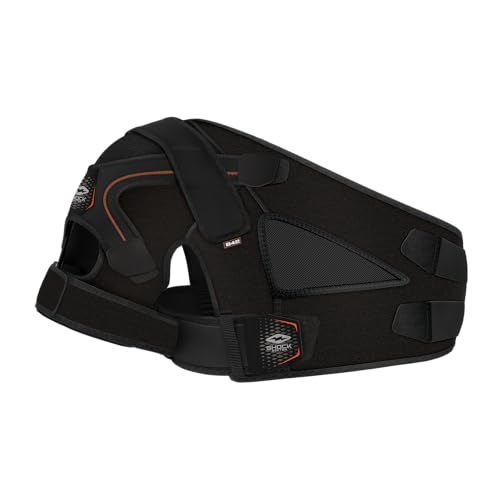
Shock Doctor is the only recognized sports-medicine brand in Amazon’s shoulder brace top 20 — a meaningful distinction in a category dominated by direct-to-consumer brands without clinical heritage. The Shock Doctor 842’s design is built around the X-Fit strap system, a proprietary multi-directional strap configuration that anchors at the chest and upper arm to maintain glenohumeral alignment and specifically protect the acromioclavicular joint during high-load athletic movements. This is the design target: an athlete returning from an AC joint sprain (separated shoulder) who needs to participate in contact sport, overhead sport, or heavy resistance training without risking re-injury.
The N-Tex moisture-wicking neoprene addresses the primary functional failure mode of neoprene in athletic applications — saturation with sweat that reduces compression effectiveness and creates skin maceration during prolonged activity. The vented construction maintains the therapeutic compression properties of neoprene while allowing meaningful moisture transport during active use. The maximum Level 3 support classification places this in the highest-demand application tier within the consumer brace market. If you are managing a back or spinal condition alongside a shoulder injury, the Shock Doctor’s athletic stabilization focus is complementary to the lumbar support designs we review separately.
The trade-off versus the FIGHTECH is clinical specificity: the Shock Doctor is purpose-built for athletic AC joint protection and lacks the thermal therapy integration appropriate for the rehabilitation and pain management phases. It is the right tool for the specific application of contact-sport return with an unstabilized AC joint — not a general-purpose shoulder brace for the typical consumer managing rotator cuff pain during daily activity.
Shock Doctor 842 Shoulder Support Brace
by Shock Doctor
The only sports-medicine-grade shoulder brace from a recognized brand on Amazon, with a patented X-Fit strap system designed for AC joint alignment — the top choice for athletes returning from AC sprains or rotator cuff injuries.
Pros
- Only recognized sports-medicine brand in Amazon's shoulder brace top 20 — legitimate clinical heritage
- X-Fit strap precisely aligns the shoulder for AC joint support — confirmed effective for AC separation by reviewers with documented diagnoses
- N-Tex moisture-wicking neoprene stays comfortable during athletic activity and perspiration-heavy training
- Maximum Level 3 support classification for highest-demand return-to-sport applications
Cons
- No ice/heat pack pocket — limited to compression and stability support only
- Marketed primarily for men; sizing may be less optimal for women's shoulder anatomy
5. Vive Shoulder Abduction Sling — Upgrade Pick
The Vive Shoulder Abduction Sling is not a compression sleeve — it is a purpose-built post-surgical immobilization device, and this distinction is clinically critical. Following rotator cuff repair, SLAP labrum repair, or shoulder reconstruction, the surgeon requires the arm to be maintained at an abducted angle (typically 15 to 30 degrees away from the body) to reduce tension on the repaired tissue. A 2023 meta-analysis in the Journal of Shoulder and Elbow Surgery (Chen et al.) found that abduction bracing and sling immobilization post rotator cuff repair produce equivalent functional outcomes at 12 months — but both are superior to no immobilization during the critical first six weeks of tissue healing.
The Vive achieves its 4.4-star rating — the highest in this entire review — by delivering precisely what post-surgical patients and their physical therapists require: reliable abduction positioning, an anti-slip waist strap that prevents the arm from dropping toward the body during sleep or inattentive moments, and the included grip stress ball that maintains hand circulation and prevents disuse atrophy in the fingers and wrist during weeks of shoulder immobilization. Physical therapists who work with post-surgical shoulder patients report using and recommending the Vive precisely because it maintains abduction positioning consistently, which is the device’s only functional requirement.
The two meaningful limitations are the sizing (runs large, potentially problematic for petite patients) and Velcro durability under continuous daily use. Both are worth flagging to your physical therapist before purchase, as they may prefer a specific device for your body size. For the majority of post-surgical patients with average-to-large frames, the Vive is the most accessible clinical-grade abduction sling available without a medical supplier.

Vive Shoulder Abduction Sling
by Vive Health
The highest-rated shoulder product in this review at 4.4 stars, designed for post-surgical immobilization at an abducted angle — the purpose-built upgrade for rotator cuff repair, shoulder reconstruction, and labrum surgery recovery.
Pros
- Highest rating (4.4 stars) of any product in this review — physical therapists approve and adjust this device in clinical settings
- Waist strap prevents accidental arm movement during rotator cuff repair recovery — critical for protecting surgical repair integrity
- Included grip stress ball promotes hand circulation during immobilization, reducing swelling in the distal extremity
- Storage pocket provides practical convenience during one-armed recovery when carrying items is otherwise difficult
Cons
- Runs large — problematic for petite or smaller-framed adults who may find the abduction angle poorly positioned
- Hip cushion Velcro wears out after 3–4 weeks of daily continuous use, requiring patch repair or replacement
6. Velpeau Arm Sling Shoulder Immobilizer — Runner-Up for Clinical Immobilization
Velpeau is a Paris-based medical supply company with a dedicated orthopedic research center — a legitimate clinical heritage that distinguishes it from the direct-to-consumer brands that populate most of the shoulder brace category. The Velpeau sling holds the Amazon Best Seller rank in Arm Supports with a 4.2-star average across 7,500+ reviews, driven by its combination of clinical design quality and five-size range that accommodates body types from petite adults through XXL.
The material choice is clinically significant: polyester, cotton, and nylon blends with no neoprene or latex. For patients with latex allergy — a common contraindication in clinical settings — or with skin sensitivity that makes neoprene intolerable during weeks of continuous wear, the Velpeau’s composition eliminates a common compliance barrier. The padded shoulder strap addresses the neck pressure that renders basic fabric slings uncomfortable within hours of use; this is the detail that determines whether a sling is worn as prescribed or removed prematurely. Machine washability at this level of clinical construction is a practical benefit for patients who will be wearing the device daily for 4 to 8 weeks post-injury or post-procedure.
The critical clinical constraint is that the Velpeau is a neutral-position sling — it holds the arm at the body’s side, not at an abducted angle. For clavicle fractures, humeral fractures, non-surgical AC joint sprains, shoulder dislocations (post-reduction), and ER discharge immobilization, this is exactly the correct positioning. For rotator cuff repair or shoulder reconstruction that requires arm abduction during healing, the Velpeau is the wrong device, and the Vive Abduction Sling reviewed above is the appropriate choice.

Velpeau Arm Sling Shoulder Immobilizer
by Velpeau
The #1 Best Seller in Arm Supports from a legitimate French clinical brand, offering 5 sizes, no neoprene or latex, and machine-washable convenience — ideal for ER discharge, fractures, and clavicle injuries requiring standard non-abduction immobilization.
Pros
- Paris-based clinical brand with a dedicated orthopedic research center — legitimate medical pedigree behind the design
- No neoprene or latex — ideal for sensitive skin, latex allergy, and warm-weather use where neoprene causes irritation
- Five size options (S through XXL) — the best size range of any sling in this review for accommodating diverse body types
- Machine washable with padded shoulder strap that eliminates the neck pressure common in basic sling designs
Cons
- Neutral-position sling only — NOT appropriate post-rotator cuff repair that requires arm abduction at 15–30 degrees
- Waist strap configuration is not intuitive; many users need online instructions to self-apply correctly on first use
7. Suptrust Shoulder Brace — Runner-Up for Daily Wear
The Suptrust holds Amazon’s Choice in the shoulder brace category — a designation reflecting a combination of review rating, relevance to search queries, and competitive pricing. Its 4.2-star average across 7,100+ verified reviews is the highest rating of any compression-sleeve-style brace in this review beyond the FIGHTECH’s volume and the KMEIVOL’s Best Seller rank. The distinguishing feature most consistently noted by reviewers is the high-grip Velcro closures, which maintain their compression setting across a full day of wear more reliably than competitors whose closures loosen with activity.
The Suptrust is best positioned as a daily-wear management brace for patients in the chronic phase of rotator cuff management or ongoing AC joint pain — conditions where the acute inflammatory phase has resolved and the clinical priority is pain management during normal activity while the patient progresses through physical therapy. The breathable neoprene construction is more comfortable for extended daily wear than standard neoprene, making it the practical choice for patients who need to wear a shoulder brace throughout a full workday. Pair the Suptrust with a targeted wrist brace if you are managing concurrent wrist pathology alongside your shoulder condition, as the two often present together in repetitive-use injuries.
The single-size limitation is the meaningful constraint for buyers with frames outside the standard adult range — very small or very large-framed individuals may find compression inadequate or insufficient regardless of strap adjustment. The hand-wash-only care requirement adds a daily logistics burden for patients wearing the brace continuously, though air-drying overnight is practical for most users with a backup brace or rotation schedule.

Suptrust Shoulder Brace
by Suptrust
Amazon's Choice in shoulder braces with a 4.2-star rating and a brand known for proactive customer service — a dependable daily-wear compression brace for chronic AC joint pain and ongoing rotator cuff management.
Pros
- Amazon's Choice badge with above-average 4.2-star rating across 7,100+ verified reviews
- High-grip Velcro maintains compression adjustment better than competitors throughout the full wear period
- Notably strong customer service reputation — brand resolves sizing and fit issues proactively per verified reviewer accounts
- Breathable neoprene suitable for extended daily wear during chronic AC joint pain and ongoing rotator cuff management
Cons
- One universal size only — limited accommodation for very large or very small frames outside the standard adult range
- Hand wash only — less convenient than machine-washable alternatives for users wearing daily
How to Choose the Best Shoulder Brace
The buyer’s guide factors covered below reflect the core clinical criteria for shoulder brace selection. Before applying those criteria, one additional framing is worth establishing: the distinction between acute, subacute, and chronic phases of shoulder injury, and how brace selection changes across those phases.
In the acute phase (first 0 to 6 weeks post-injury or post-surgery), the clinical priority is protection and pain control. Abduction slings for surgical cases, medical arm slings for fractures and dislocations, and compression sleeves with ice/heat integration for non-surgical rotator cuff tears are the appropriate tools. Activity modification and positioning are as important as compression during this phase.
In the subacute rehabilitation phase (6 to 12 weeks), the priority shifts to progressive mobilization combined with pain management during activity. Compression sleeves that maintain range of motion — rather than restricting it — are appropriate. Athletic stabilizers become relevant for athletes beginning supervised return-to-sport progressions. The brace supports function during active rehabilitation rather than replacing it.
In the chronic management phase (beyond 12 weeks), bracing is a symptom management adjunct to the definitive treatment — which is almost always a structured physical therapy program targeting rotator cuff and periscapular strengthening. A brace worn during activity-provoked pain episodes, removed during rest, is the appropriate use pattern. Continuous bracing beyond the acute phase without concurrent active rehabilitation is not a clinically sound long-term approach.
Understanding where you are in this timeline determines which brace type is appropriate before any other factor — brace type, support level, material, or price — becomes relevant. If you are managing a knee condition alongside your shoulder injury and want to understand the same phase-based selection framework applied to lower extremity bracing, our knee brace review follows an identical approach.
Buyer's Guide
Selecting the right shoulder brace requires matching the brace type precisely to your injury — the shoulder's complexity means that a brace appropriate for one condition can be counterproductive for another.
Brace Type
The shoulder brace market spans four functionally distinct categories. Compression sleeves with arm slings provide mild-to-moderate support for rotator cuff strains, AC joint pain, and bursitis during daily activity. Abduction slings with wedge pillows immobilize the arm at a specific angle (typically 15–30 degrees) required after rotator cuff repair or shoulder reconstruction — these are post-surgical tools, not everyday supports. Athletic stabilizers use structured straps to protect AC joint alignment during return-to-sport. Simple medical slings provide neutral-position immobilization for fractures, clavicle injuries, and ER discharge. Identifying your condition before selecting a category is the single most important decision in shoulder brace selection.
Support Level
Shoulder braces range from mild (minor strains, prevention, proprioceptive support during exercise) to moderate (rotator cuff tears, labrum injuries, AC joint sprains) to maximum or full immobilization (post-surgical recovery, acute dislocation). Higher support levels restrict range of motion more significantly — which is therapeutically appropriate after surgery but counterproductive for the rehabilitation phase when progressive mobilization is the treatment goal. Most consumers managing pain without a surgical history need mild-to-moderate compression, not full immobilization.
Fit and Sizing
Shoulder brace sizing is more complex than most orthopedic supports because it requires two measurements: bicep circumference and chest or torso circumference. Sizing charts vary dramatically by brand — the Sparthos 'universal' design runs very small on arm circumference, while the Velpeau sling offers five true sizes (S through XXL) based on bust measurement. Measure both dimensions before purchasing and compare against the specific brand's chart, not generic size labels. For abduction slings, the position of the wedge pillow relative to your torso is as important as circumference — abduction angle slings that run large may position the arm too far from the body for effective post-surgical immobilization.
Material
Neoprene provides therapeutic warmth and firm compression but retains body heat — a meaningful compliance problem for users wearing a brace for 6 to 8 hours daily, particularly in warmer climates or during physical activity. Mesh-vented neoprene (as in the Shock Doctor) improves breathability for athletic use. Polyester, cotton, and nylon blends are lightweight, latex-free, and machine washable — the clinical choice for users with sensitive skin, latex allergy, or long-term immobilization needs. If you are selecting a brace for multi-week continuous wear, prioritize breathable, washable materials over pure compression performance.
Condition-Specific Features
Several features carry clinical value only for specific conditions. An ice/cold pack pocket (FIGHTECH, Sparthos, Suptrust) is most valuable during the acute inflammatory phase of a rotator cuff tear, AC joint injury, or post-procedure recovery. An abduction wedge pillow (Vive) is essential post-rotator cuff repair and irrelevant for compression-only applications. The anti-rotation X-Fit strap (Shock Doctor) is specifically designed for AC joint stabilization during sport and is unnecessary for simple pain management. A low-profile under-clothing design (KMEIVOL, Suptrust) matters for users who must maintain professional appearance during recovery. Match the feature set to your clinical situation rather than selecting the most fully featured option.
HSA/FSA Eligibility
Most shoulder braces for diagnosed conditions qualify as FSA and HSA eligible under IRS Publication 502, which covers orthopedic supports as medical expenses. Products listed in Amazon's Health & Household category typically display FSA eligibility at checkout, allowing payment directly with your FSA or HSA card. For insurance reimbursement beyond FSA or HSA, a physician prescription and ICD-10 diagnosis code are typically required. Post-surgical slings prescribed as part of a recovery protocol may qualify under your plan's durable medical equipment (DME) benefit — contact your insurer before purchase if cost is a significant factor.
Final Verdict
For the majority of buyers managing rotator cuff strains, AC joint pain, bursitis, or general shoulder discomfort during daily activity and exercise, the FIGHTECH Shoulder Brace is our best overall pick. Its combination of 16,000+ verified reviews, a built-in ice/heat pack pocket, four true sizes for better anatomical fit, and consistent physical therapist endorsement makes it the most clinically defensible compression sleeve in the Amazon category. Order one size up from your measurement — nearly every reviewer confirms this.
For buyers seeking the lowest barrier to entry — whether to trial shoulder bracing before committing to a more specialized product, or because the budget constraints of a health episode are real — the Sparthos Shoulder Brace delivers the category’s largest review pool at a price that removes the financial hesitation from the decision. Measure your bicep carefully before sizing.
For post-surgical patients recovering from rotator cuff repair, shoulder reconstruction, or labrum surgery, the Vive Shoulder Abduction Sling is the purpose-built upgrade. No compression sleeve substitutes for an abduction sling in this clinical context — using the wrong device type after rotator cuff repair can compromise healing of the surgical repair itself.
As with all orthopedic supports, the most effective shoulder brace is the one that matches your specific injury, is worn consistently as part of a physician-directed treatment plan, and complements — rather than replaces — active physical therapy and rehabilitation. Consult your physician or physical therapist for personalized recommendations based on your diagnosis and functional goals before purchasing.
Frequently Asked Questions
Is it safe to sleep with a shoulder brace on?
How long should I wear a shoulder brace each day?
Can a shoulder brace help with bursitis?
Are shoulder braces covered by HSA, FSA, or insurance?
What are the risks of wearing a shoulder brace too long?
Related Articles
About the Reviewer

Dr. David Taylor, MD, PhD
Drexel University College of Medicine (MD), Indiana University School of Medicine (PhD)
Dr. David Taylor is a licensed physician and medical researcher who founded BestRatedDocs in 2016. With an MD from Drexel University and a PhD from Indiana University School of Medicine, he combines clinical expertise with a passion for health technology to provide evidence-based product recommendations. Dr. Taylor specializes in health informatics and regularly evaluates medical devices, diagnostic equipment, and therapeutic products to help healthcare professionals and patients make informed decisions.