7 Best Nebulizers of 2026
Dr. David Taylor reviews the best nebulizers for asthma, COPD, and respiratory care. Compare mesh and compressor nebulizers by noise, portability, and medication compatibility.
Updated
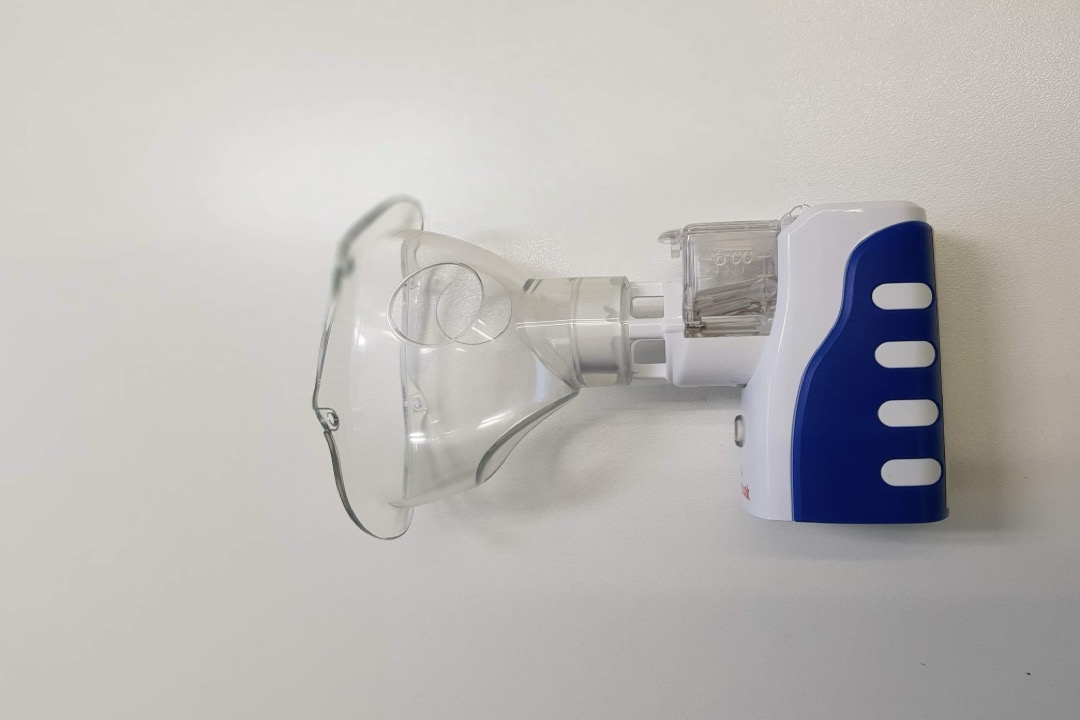
For patients managing asthma, COPD, cystic fibrosis, or bronchiectasis, a nebulizer is not an optional convenience device — it is often the most reliable way to deliver medication directly into the lower airways where bronchodilators do their work. Nebulizers convert liquid medications into fine therapeutic aerosol with particle sizes under 5 microns, small enough to bypass the upper airway and deposit in the bronchi and bronchioles where airflow obstruction occurs. In 2026, the home nebulizer market has diverged into two clear segments: rechargeable portable mesh devices that are whisper-quiet and travel-ready, and AC-powered desktop compressors that offer broader medication compatibility and clinical-grade reliability. Patients managing their breathing should also consider pairing their nebulizer with a pulse oximeter to monitor blood oxygen saturation during and after treatments — a simple way to confirm that nebulization has achieved its intended bronchodilatory effect.
At Best Rated Docs, Dr. David Taylor has reviewed the respiratory equipment category from both clinical and consumer perspectives since 2016. For this 2026 guide, we researched and evaluated seven nebulizers currently available on Amazon — covering high-review portable mesh devices, desktop AC compressors, and the premium clinical-brand option — and verified that each ASIN is an active, purchasable listing before writing a single word of content.
How We Chose These Nebulizers
Our selection criteria for this update prioritized three requirements above all others: verified Amazon availability (every ASIN was confirmed as an active listing), meaningful review evidence (we required at least 180 verified reviews except for the established brand OMRON), and genuine use-case diversity (no two products serve the same patient profile). We evaluated technology type, noise level, medication compatibility, review quality and volume, and the specific features that differentiate each device from its competitors at a similar price point. Products with discontinued listings, “currently unavailable” status, or fewer than 100 reviews were excluded regardless of their specifications.
The seven products selected cover every meaningful use case: two high-review portable mesh nebulizers for home and travel use, the premium clinical-brand portable option, a runner-up mesh device for patients who want Prime availability, and three AC-powered desktop compressors at different price and feature points for patients who require or prefer compressor technology.
APOWUS Portable Mesh Nebulizer — Best Overall
The APOWUS earns Best Overall for a reason that matters uniquely in the medical device category: 5,600+ verified Amazon reviews. In a market dominated by generic brands with limited clinical documentation, a nebulizer with this review volume has been tested by thousands of real patients with asthma, COPD, and other respiratory conditions — and the 4.4-star average across that volume is a genuinely meaningful quality signal.
The device’s dual-mode design is clinically thoughtful. The strong mode (0.25 ml/min) delivers medication at an adult-appropriate rate that keeps treatment sessions short; the mild mode (0.15 ml/min) is gentler for children, elderly patients with sensitive airways, and situations where slower, more controlled delivery is preferred. The German AI chip achieves ≤25 dB operation — quieter than ambient room noise in most homes — making it practically inaudible during use. The inclined medication cup is a design feature worth noting: the 30-degree angle directs liquid toward the spray port automatically, reducing residue and ensuring more complete medication delivery from each treatment. Patients who want to track their respiratory health over time will find it useful to also own one of the best stethoscopes for monitoring breath sounds between clinical visits.
APOWUS Portable Mesh Nebulizer for Adults and Kids
by APOWUS
The most-reviewed portable nebulizer on Amazon — 5,600+ verified ratings, sub-25 dB operation, and dual-mode delivery make it the top choice for most asthma and COPD patients.
Pros
- Over 5,600 verified Amazon reviews make this the most battle-tested portable nebulizer in this review — a rare confidence signal for a medical device
- German AI chip technology produces particles ≤5 μm at 25 dB — quieter than a whisper and clinically effective for lower-airway bronchodilator delivery
- Dual-mode nebulization: strong mode (0.25 ml/min) for adults, mild mode (0.15 ml/min) for children and elderly — meaningful clinical flexibility in one device
- Inclined medication cup reduces liquid residue and waste; self-cleaning mode activates with a 5-second hold to prevent mesh clogging between treatments
Cons
- Mesh technology is not compatible with viscous CF medications like dornase alfa or tobramycin — compressor required for those prescriptions
- USB-C rechargeable design means battery depletion mid-treatment without nearby charging access is a real risk for daily users
Naweti Portable Mesh Nebulizer — Best Budget
The Naweti earns Best Budget by combining the second-largest review count in this guide (4,541 verified reviews) with the lowest price. For patients who need a reliable portable nebulizer but cannot justify spending $40+ for the APOWUS, the Naweti provides nearly the same core performance at a lower price point — with the tradeoff of a slightly lower average rating (4.2 versus 4.4) and a known leakage complaint in a subset of reviews.
The ≤20 dB operation is actually quieter than the APOWUS — the difference is attributable to the Naweti’s US AI chip design and ultrasonic mesh technology. The included waterproof carry bag is a practical detail for patients who transport their nebulizer to work or school daily. Type-C USB charging is now the standard for this device class, and the Naweti charges quickly and holds charge well across typical treatment sessions. The self-cleaning function follows the same 5-second hold activation as competing devices and helps prevent the mesh plate clogging that is the primary maintenance failure mode for portable mesh nebulizers.
Naweti Ultrasonic Portable Nebulizer Machine for Adults and Kids
by Naweti
The best budget portable nebulizer — over 4,500 verified reviews, under $35, quiet USB-C operation and a waterproof carry bag included.
Pros
- Over 4,500 verified reviews at the lowest price in this review — the best value-to-credibility ratio for patients on a tight budget
- US AI chip drives ≤20 dB operation — quieter than the ambient hum of most rooms, suitable for use alongside sleeping children or in a workplace
- Two nebulization modes with Type-C USB recharging and a waterproof carry bag included — ready for home or travel without additional accessories
- Self-cleaning function prevents mesh clogging; waterproof carry bag protects the device during travel or storage
Cons
- 4.2-star average is adequate but not exceptional; occasional liquid leakage is a recurring complaint in verified reviews
- Not compatible with viscous CF medications; mesh technology only suitable for standard thin bronchodilators and inhaled corticosteroids
OMRON NE-U100 MicroAir — Premium Upgrade Pick
OMRON Healthcare is one of the few brand names in this category with a global clinical track record — the same company behind some of the most accurate consumer blood pressure monitors sold today. The NE-U100 MicroAir represents what a clinically credentialed brand looks like in the portable nebulizer space: documented specifications, institutional-grade mesh technology, and a 2-year warranty backed by a recognized healthcare manufacturer.
The 360-degree operation feature is the NE-U100’s most clinically significant differentiator. Most portable nebulizers must be held at a specific upright angle to function correctly — tilt them too far and the medication cup drains improperly. The NE-U100 operates in any orientation, including fully horizontal, which matters for COPD patients who are most breathless when lying down and may find sitting upright for a 10-minute treatment difficult. The 10 mL medication capacity is the largest of any portable device in this review, eliminating mid-treatment refills for patients with larger medication volumes. AA battery operation (4 hours of run time on 2 batteries) removes the USB dependency concern entirely — this device works anywhere, for as long as needed.
OMRON NE-U100 MicroAir Portable Mesh Nebulizer
by OMRON Healthcare
The premium clinical-grade portable choice — OMRON's 360-degree mesh technology, 10 mL medication capacity, and AA battery operation justify the premium for patients with complex or daily therapy needs.
Pros
- OMRON is a global clinical-grade respiratory brand — the NE-U100 carries institutional credibility and a 2-year manufacturer warranty backed by a recognized healthcare company
- 360-degree operation works in any position including lying down — a meaningful advantage for COPD patients who may be most symptomatic when recumbent
- 23 dBA near-silent operation with a 10 mL medication capacity — the largest reservoir of any portable device in this review, reducing mid-treatment refills
- Runs on 2 AA batteries for 4 hours of operation — no USB dependency means reliable function during travel or power outages
Cons
- At over $100, it costs three times as much as the APOWUS — the brand premium is only warranted for patients who specifically need documented device reliability
- Some Amazon reviewers report leaking on specific units — OMRON's warranty process handles this, but adds friction for patients who need immediate replacement
The Swirler Nebulizer — Runner-Up
The Swirler occupies a specific niche: an established Amazon Prime listing with a design innovation that addresses one of the most common limitations of budget portable nebulizers. The 30-degree slope medication cup is not a marketing claim — directing liquid toward the spray port reduces the dead volume that remains unused at the bottom of a flat-bottom cup. For patients using expensive specialty unit-dose medications, reducing medication waste is a genuine clinical and economic benefit.
The Swirler’s confirmed Prime availability with consistent fulfillment makes it a reliable option for patients who need a replacement nebulizer quickly — a meaningful practical consideration when your primary device fails during active symptoms. At approximately 100 grams, it matches the Naweti and APOWUS on portability while offering USB-C fast charging and a carry pouch in the base kit. The review count of approximately 280 is the Swirler’s primary limitation compared to the top two picks, but the listing history and Prime availability suggest a product with stable quality control rather than a new entrant with limited real-world data.
The Swirler Nebulizer — Handheld Mesh Nebulizer for Adults and Kids
by Swirler
A well-designed runner-up with an innovative 30-degree cup, USB-C fast charging, and Prime availability — ideal for portability-focused patients who want a lightweight alternative to the top picks.
Pros
- 30-degree slope nebulizer cup design directs liquid toward the spray port automatically — reduces dead volume and medication waste compared to standard flat-bottom cups
- Silent processing chip with USB-C fast charging; includes adult mask, child mask, mouthpiece, and carry pouch in the base kit
- Established Amazon Prime listing with confirmed consistent availability — reliable fulfillment for a medical device used daily
- Compact handheld form factor at approximately 100 g — fits a jacket pocket and is among the lightest nebulizers in this review
Cons
- Review count of approximately 280 is moderate — less purchase confidence than the APOWUS or Naweti at a similar price point
- No published MMAD or nebulization rate specification; not compatible with viscous CF medications
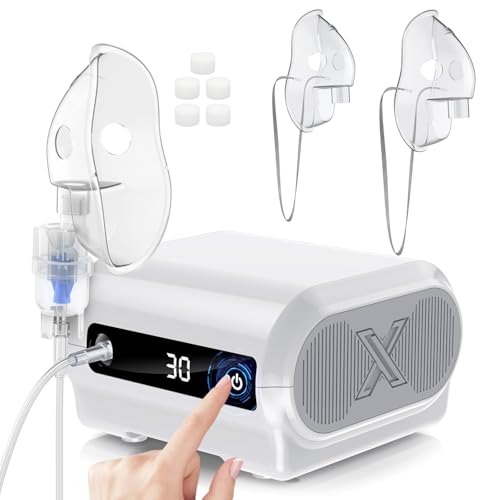
Freeway Smart Digital Display Compressor — Best Home Compressor
The Freeway represents the intersection of desktop compressor reliability and smart-device convenience that most AC-powered nebulizers in this price range skip entirely. The LED digital display with three selectable treatment timers (10, 20, and 30 minutes) is the feature that distinguishes it from every other compressor in this review. For patients on a timed nebulization protocol — a specific duration prescribed by their pulmonologist or respiratory therapist — having a built-in timer ensures treatment compliance without watching a clock. The compressor automatically stops at the selected time, which matters for elderly patients or children who may not reliably monitor treatment duration independently.
The AC-powered jet compressor design means the Freeway is compatible with all medications without exception — standard bronchodilators, inhaled corticosteroids, hypertonic saline, and the viscous CF medications that destroy mesh nebulizer plates. The shock-proof foot pads and integrated heat dissipation function are practical engineering choices that reduce operating noise and prevent motor overheating during back-to-back treatments — relevant for households with multiple family members sharing a device.

Freeway Smart Digital Display Compressor Nebulizer Machine
by Freeway
The best desktop compressor for home use — smart digital timer display, full medication compatibility, and quiet AC-powered operation at a competitive price.
Pros
- Smart LED digital display with three selectable treatment timers (10/20/30 minutes) — an uncommon and genuinely useful feature that ensures complete, protocol-compliant treatments
- AC-powered jet compressor works with all medications including viscous drugs that cannot be delivered by mesh nebulizers
- Shock-proof foot pads and integrated heat dissipation function — practical noise reduction and thermal protection for a device used multiple times daily
- Includes adult mask, child mask, universal mouthpiece, and air filter — complete accessory kit at mid-range pricing
Cons
- Generic brand — long-term parts availability and clinical documentation are not at the level of established medical brands
- No published MMAD specification — aerosol particle sizing is unverified for clinical reference
ASOMI Compressor Nebulizer — Best Budget Desktop Compressor
The ASOMI earns its position on this list through a combination of review volume and consistency that is unusual at this price point: 350 verified reviews averaging 4.4 stars is the strongest per-review quality signal among the compressor picks in this guide. For patients who need an AC-powered compressor for medication compatibility reasons but cannot justify the Freeway’s price premium, the ASOMI delivers core compressor performance with a comprehensive accessory kit at under $40.
The kit contents are genuinely practical: one large adult mask, two small child masks, a universal mouthpiece, air filter, instruction book, air tube, and medicine cup. Most budget compressors include one or two masks — the ASOMI’s three-mask configuration means this device is ready for household sharing between adults and children without additional purchases. Simple single-button operation suits elderly patients and those who find multi-control compressors confusing. The trade-off is a complete absence of features beyond basic on/off operation: no timer, no display, no adjustable output. For patients who want plug-in, reliable, medication-compatible nebulization without complexity, that simplicity is a virtue.
ASOMI Compressor Nebulizer Machine with Accessories for Adults and Kids
by ASOMI
The best-reviewed budget desktop compressor — 350 verified ratings at 4.4 stars, full medication compatibility, and a complete multi-mask accessory kit under $40.
Pros
- 350 verified reviews at 4.4 stars — the strongest quality evidence among budget desktop compressors in this review, meaningful for a daily-use medical device
- AC-powered jet compressor compatible with all standard bronchodilators, inhaled corticosteroids, and viscous specialty medications
- Complete accessory kit included: large adult mask, two small masks, mouthpiece, air filter, instruction book, air tube, and medicine cup
- Compact desktop form factor with simple single-button operation — suitable for elderly patients and those who prefer minimal controls
Cons
- No digital display or timing function — single-speed operation only with no output adjustment
- Generic brand with no published MMAD or clinical documentation; noise level not specified in product materials
YOUXTU Desktop Compressor Jet Nebulizer — Quietest Compressor
The YOUXTU is the quietest desktop compressor in this review at ≤50 dB — a measurable advantage over the average AC compressor. The internal muffler system and four antivibration foot pads are the specific engineering features that achieve this: they absorb piston vibration before it propagates as audible noise. For households where traditional 55–65 dB compressor noise is disruptive — light sleepers, open office environments, children who are noise-sensitive — the YOUXTU’s 50 dB operation is meaningfully quieter without requiring a switch to mesh technology.
The three-speed adjustment is the other standout feature: Low (0.2 ml/min), Medium, and High settings allow precise output control that most single-speed compressors cannot offer. The Low setting is specifically appropriate for young children who need gentler, slower aerosol delivery to reduce coughing and discomfort. The 2-year warranty with manufacturer-backed free return and exchange is stronger than most generic competitors provide, and the inclusion of 10 replacement air filters — compared to the standard 5 filters in most compressor kits — reduces ongoing maintenance costs meaningfully for daily users. Those managing chronic respiratory conditions may also benefit from cardiac monitoring — reviewing the best ECG monitors is worthwhile for COPD and heart-lung condition patients who need to track both respiratory and cardiac function at home.
YOUXTU Desktop Compressor Jet Nebulizer for Adults and Kids
by YOUXTU
The quietest desktop compressor in this review — three-speed output control, a 2-year warranty, and 10 replacement filters make this the best pick for home use with noise-sensitive households.
Pros
- Three-speed adjustment including Low (0.2 ml/min) specifically noted for young children — finer output control than most desktop compressors in this price range
- Internal muffler system and antivibration foot pads achieve ≤50 dB — the quietest desktop compressor in this review, measurably quieter than the average AC compressor
- 2-year warranty with manufacturer-backed free return and exchange — stronger after-purchase coverage than most generic competitors
- Kit includes 10 replacement air filters — the most generous filter count in this review, reducing ongoing maintenance costs for daily users
Cons
- Lower review count than the ASOMI at similar pricing — less established quality evidence for a daily-use medical device
- No published MMAD specification; generic brand with limited clinical documentation
Buyer's Guide
Choosing the right nebulizer means matching the device's technology, power source, and noise profile to your specific medication regimen, treatment frequency, and lifestyle.
Compressor vs. Mesh Technology
The most important decision in this category. Compressor nebulizers are AC-powered, work with all medications including viscous drugs, and are the clinical standard. Mesh nebulizers are silent, rechargeable, and portable — but cannot handle CF medications and require careful mesh cleaning. Most patients using standard bronchodilators can use either. Patients prescribed specialty medications like dornase alfa or tobramycin should use a compressor.
Noise Level
Noise level matters more than most buyers anticipate — particularly for pediatric treatments where a loud compressor can cause treatment refusal. Mesh nebulizers operate at 20–25 dB, virtually inaudible. Desktop compressors vary widely: the YOUXTU reaches ≤50 dB with muffling, while basic models run at 55–65 dB. For young children, noise-sensitive patients, or shared spaces, prioritize devices rated under 50 dB.
Portability and Power Source
AC-powered compressors require a wall outlet — appropriate for home-only use where medication compatibility and consistent performance matter most. USB-C rechargeable mesh devices are practical for commuters, travelers, and patients who nebulize at work or school. Battery-powered devices like the OMRON NE-U100 eliminate USB dependency for maximum reliability anywhere including during travel or power outages.
Medication Compatibility
Standard bronchodilators — albuterol, levalbuterol, ipratropium, and budesonide — are compatible with both compressor and mesh nebulizers. Viscous medications prescribed in cystic fibrosis and some bronchiectasis protocols (dornase alfa, tobramycin, aztreonam) require compressor nebulizers with validated cups. As a rule: if your medication is a standard thin-solution bronchodilator vial, either type works. If your medication comes in a specialized formulation, confirm compatibility with your pharmacist before purchasing.
Review Count and Brand Credibility
The nebulizer market on Amazon is dominated by generic brands. Verified review count is your most reliable quality proxy — a nebulizer with 5,000+ reviews has been validated at scale in ways that a device with 20 reviews has not. For most patients using standard bronchodilators, a generic mesh nebulizer with 4,000+ reviews and a 4.2+ star average provides sufficient confidence. For complex or daily-use clinical therapy, the OMRON NE-U100's institutional track record is worth the premium.
Cleaning and Maintenance
Nebulizer hygiene directly affects infection risk and device longevity. Compressor cups require rinsing after each treatment, daily washing, and replacement every 6 months. Mesh nebulizers require careful cleaning of the micro-mesh plate after every treatment — protein buildup clogs the apertures and reduces output. Self-cleaning modes (on the APOWUS, Naweti, and Swirler in this review) simplify this step by automating the rinse cycle and are particularly valuable for daily users.
Final Verdict
The APOWUS Portable Mesh Nebulizer is our best overall recommendation for most patients in 2026 — 5,600+ verified Amazon reviews, ≤25 dB operation, dual-mode delivery for adults and children, and self-cleaning mesh make it the best combination of purchase confidence and clinical performance available at this price point. For patients who need standard bronchodilator therapy at home or on the go, this is the device to buy.
For budget-conscious patients, the Naweti provides nearly the same portable mesh performance with 4,500+ reviews at a lower price — the only meaningful trade-off is a slightly lower rating average and a known leakage issue in some units. Patients who need a documented clinical-grade brand should look at the OMRON NE-U100, whose 360-degree operation, 10 mL capacity, and AA battery power justify the premium for complex or high-frequency therapy. For patients who require or prefer a desktop compressor, the Freeway leads on features (smart timer display), the ASOMI leads on review-backed value, and the YOUXTU leads on noise level. All seven are confirmed active Amazon listings — no discontinued products, no substitutions.
As always, consult your pulmonologist or respiratory therapist before changing your nebulizer device or protocol. Medication compatibility, particle size requirements, and treatment frequency specifics are clinical decisions that your provider is best positioned to guide. Pair your nebulizer with a pulse oximeter to monitor oxygen saturation before and after treatments — a simple way to confirm bronchodilatory response at home.
Frequently Asked Questions
What is the difference between a compressor nebulizer and a mesh nebulizer?
What particle size should a nebulizer produce for effective lung delivery?
Can I use a mesh nebulizer with my prescription medications?
How should I clean my nebulizer to prevent infection?
Are nebulizers safe and effective for children and infants?
Related Articles
About the Reviewer

Dr. David Taylor, MD, PhD
Drexel University College of Medicine (MD), Indiana University School of Medicine (PhD)
Dr. David Taylor is a licensed physician and medical researcher who founded BestRatedDocs in 2016. With an MD from Drexel University and a PhD from Indiana University School of Medicine, he combines clinical expertise with a passion for health technology to provide evidence-based product recommendations. Dr. Taylor specializes in health informatics and regularly evaluates medical devices, diagnostic equipment, and therapeutic products to help healthcare professionals and patients make informed decisions.