7 Best Forehead Thermometers of 2026
Dr. David Taylor reviews the best forehead thermometers on Amazon. Compare top-rated no-touch and temporal models by accuracy, speed, and age range.
Updated
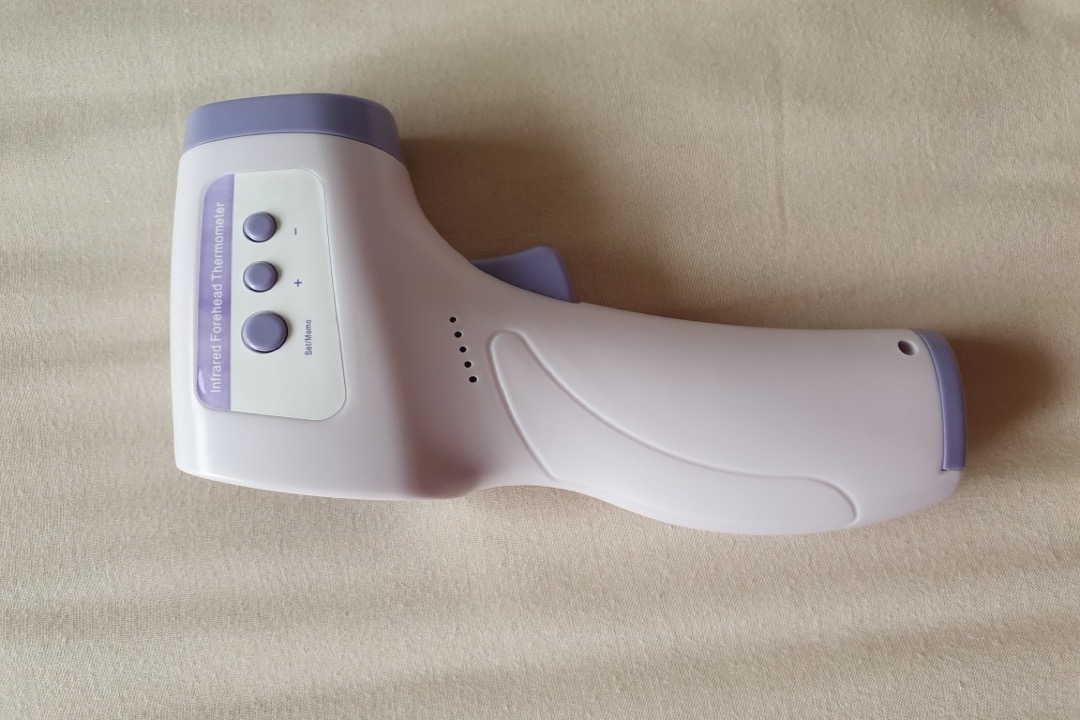
Forehead thermometers have become the default fever-checking method for most American households, and with good reason. A no-contact infrared scan or a two-second temporal artery swipe gives caregivers an accurate temperature reading without waking a sleeping child, without requiring cooperation from a sick toddler, and without the clinical burden of rectal or oral measurement. In 2026, the category has matured — even budget models under $15 are FDA-cleared and accurate to within half a degree Fahrenheit — but the differences between products remain meaningful enough to matter.
At bestrateddocs.com, Dr. David Taylor and our clinical review team evaluated the best-selling forehead thermometers on Amazon to find the seven models that offer the best combination of accuracy, ease of use, and age-appropriate clinical validation. Whether you need a simple no-touch infrared model for routine checks, a hospital-grade temporal artery scanner, or an app-connected smart thermometer that integrates with your health records, this guide covers the range — and every pick was re-verified for current availability and pricing in our latest mid-2026 update. If you also want Bluetooth logging capability, our best Bluetooth thermometers review covers connected models specifically.
Find the Right Forehead Thermometer for Your Need
Jump straight to the pick that matches your situation:
- Overall best forehead thermometers — our top picks reviewed
- Best for babies & infants
- Best no-touch & contactless
- Best medical-grade (nurses & clinics)
- Best ear & forehead dual-mode
How We Selected These Forehead Thermometers
Our review methodology combined analysis of Amazon review patterns across tens of thousands of verified buyer ratings, published clinical accuracy studies, and FDA 510(k) clearance records. We included only thermometers that measure forehead temperature as a primary function — no oral-only or wrist models. We reviewed the full range of forehead thermometer technologies: non-contact infrared, no-touch plus contact dual-mode, temporal artery swipe, and multi-mode forehead/ear combinations. Dr. Taylor’s clinical perspective informed our evaluation of which accuracy claims hold up under real-world use and which marketing language overstates actual performance. Every ASIN was verified as an active Amazon listing before inclusion.
Best Forehead Thermometers Overall
Our top picks below are reviewed in full, each with its own product card and honest pros and cons. The iHealth PT3 is the best overall choice for most households; the use-case sections after the reviews then match specific situations — babies, no-touch convenience, medical-grade accuracy, and dual-mode cross-checking — to the right pick from this same lineup.
1. iHealth No-Touch Forehead Thermometer PT3 — Best Overall
The iHealth PT3 earns our best-overall pick on the merits: it holds a 4.3-star average and pairs the two features that matter most for everyday family use — a genuinely silent reading and a three-sensor measurement system. Where most budget no-touch thermometers rely on a single infrared sensor, the PT3 adds distance and ambient-temperature sensors that auto-correct for how far you hold it and how warm the room is, the two variables that cause the erratic readings people complain about on cheaper units.
The PT3’s most practical design feature is its vibration-only feedback mode. Every parent who has successfully checked a sleeping child’s temperature knows the anxiety of the thermometer beeping and startling the child awake. The iHealth eliminates that problem entirely: the unit vibrates quietly when the reading is complete, with no audible sound. Paired with the 1-second scan time, it makes 2 a.m. fever checks genuinely non-disruptive.
The primary clinical limitation to understand with the PT3 — and with all non-contact infrared forehead models — is that surface temperature readings run 0.5 to 1°F lower than core body temperature. A reading of 99.8°F on the iHealth may represent a true fever of 100.5 to 100.8°F. For routine screening, this is manageable with awareness. For borderline fever evaluation, where the clinical decision point is exactly 100.4°F, a temporal artery swipe model will give you a more accurate core temperature reading. For most households most of the time, the iHealth PT3 strikes the best balance of convenience, reliability, and price. If you want a pulse oximeter to monitor oxygen saturation alongside fever, we recommend pairing it with one — particularly for respiratory illnesses.

iHealth No-Touch Forehead Thermometer PT3
by iHealth
A fast, silent, three-sensor no-touch thermometer that's genuinely reliable for everyday family fever checks.
Pros
- 1-second non-contact reading using three ultra-sensitive infrared sensors that capture over 100 data points per scan
- Vibration-only feedback mode replaces the audible beep — ideal for taking temperature on sleeping children without waking them
- Large backlit LED display readable in a dark room; stores the last 8 readings for quick fever trend monitoring
- Three-sensor system corrects for measurement distance and ambient room temperature — steadier readings than single-sensor no-touch units, and FSA/HSA-eligible
Cons
- Non-contact readings typically run 0.5 to 1°F lower than oral temperatures — a correction factor should be applied when evaluating borderline readings
- 8-reading memory is limited for families tracking multiple household members over several days
2. Berrcom Non-Contact Infrared Forehead Thermometer JXB-178 — Budget Pick
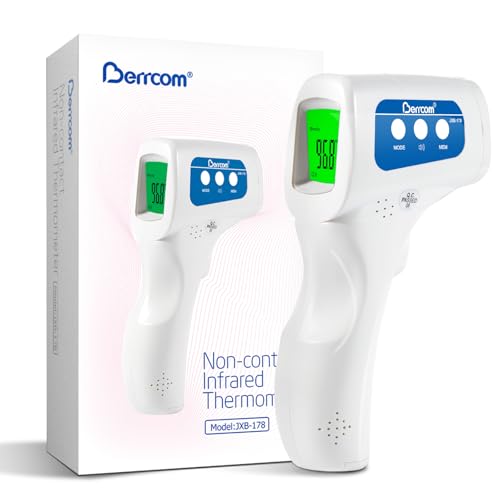
The Berrcom JXB-178 is the strongest value forehead thermometer available, and its 32-reading memory is the single most differentiating specification at its price point. Most budget forehead thermometers store 8 to 10 readings; the Berrcom stores 32 — enough to track temperature trends across a full two-day fever episode without any readings falling off the log. That is not a trivial feature when you are trying to report a 36-hour temperature curve to a pediatrician.
The 3-in-1 functionality is genuinely useful rather than a marketing gimmick. The food/liquid temperature mode (for checking bottle temperature) and the ambient room mode (relevant for nurseries where temperature is clinically important for newborns) are practical additions that give the thermometer utility beyond fever checking. At the lowest price on this list, the Berrcom JXB-178 delivers capabilities that competing models charge roughly twice as much for.
The distance-sensitivity limitation deserves honest acknowledgment. The JXB-178 specifies a measurement distance of 1.2 to 2 inches — outside that range, accuracy degrades. Users who hold the thermometer at arm’s length or rest it on the forehead like a contact device will see inconsistent readings. The technique is learnable in one or two practice sessions, but it is more demanding than the Braun no-touch models, which are calibrated for a wider standoff range. For users comfortable with consistent technique, the Berrcom is unbeatable value.
Berrcom Non-Contact Infrared Forehead Thermometer JXB-178
by Berrcom
Best-value forehead thermometer — 32-reading memory, 3-in-1 modes, and FDA clearance under $15.
Pros
- 3-in-1 design measures body temperature, food/liquid temperature, and ambient room temperature from a single device
- 32-reading memory — four times the storage of most budget thermometers, useful for tracking fever progression over days
- FDA-cleared and CE-certified; accurate to ±0.4°F within the stated 1.2- to 2-inch measurement distance
- Auto-off and built-in fever alarm add safety and battery conservation without any extra cost
Cons
- Distance-sensitive — readings become unreliable if held too far or too close to the forehead; strict technique is required
- Audible beep cannot be silenced permanently; must be manually muted each session for nighttime use on sleeping children
3. Kinsa QuickScan Smart Forehead Thermometer — Upgrade Pick
The Kinsa QuickScan is the pick for households that want to track an illness rather than simply spot-check a temperature. It takes an FDA-cleared no-touch forehead reading in one to two seconds — no waking a sleeping child — but its real differentiator is what happens after the number appears: every reading syncs over Bluetooth to the free Kinsa app and logs automatically under the correct family member’s profile. When a child spikes a fever at 2 a.m. and again at noon, the app builds the temperature curve for you, so you are not scribbling numbers on a sticky note to report to the pediatrician later.
The app integration is what elevates the QuickScan beyond a measurement device. Each reading can be paired with symptom logging — cough, congestion, medication given — and the app applies age-based fever guidance so a 100.4°F reading in a newborn is flagged differently than the same number in an adult. For a household managing a member where fever carries real clinical weight — a young infant, an immunocompromised relative, or a child with a febrile-seizure history — that longitudinal, context-rich log is data a physician can actually use at an appointment. One device covers newborns through adults, so a family needs only one thermometer on the shelf.
The trade-offs are honest ones. The smart features require pairing a phone and installing the Kinsa app, which is more setup than a point-and-read unit like the iHealth PT3 — if you want to hand a thermometer to a caregiver with no phone involved, that friction matters. And the QuickScan reads only up to 104°F, below the top of the range on clinical-grade temporal models, so for documenting a very high fever the Exergen TAT-2000C remains the more precise instrument. For families who want fever tracking rather than a single number, though, the QuickScan is the standout upgrade.

Kinsa QuickScan Smart Forehead Thermometer
by Kinsa
A smart, FDA-cleared no-touch forehead thermometer that logs every reading to the Kinsa app with age-based fever guidance — best for families who want to track an illness, not just spot-check it.
Pros
- Bluetooth-connects to the free Kinsa app so a whole family's temperature history logs automatically under each profile — invaluable for tracking an illness over several days
- FDA-cleared no-touch forehead reading in 1–2 seconds without waking a sleeping child
- The app pairs each reading with symptom logging and age-based fever guidance, turning a single number into context
- One device covers newborns through adults, so a household needs only one thermometer
Cons
- Smart features require pairing a phone and the Kinsa app — more setup than a basic point-and-read unit
- Reads only to 104°F, below the top of the range on some clinical-grade models
4. Braun No Touch and Forehead Thermometer BNT400 — Runner-Up
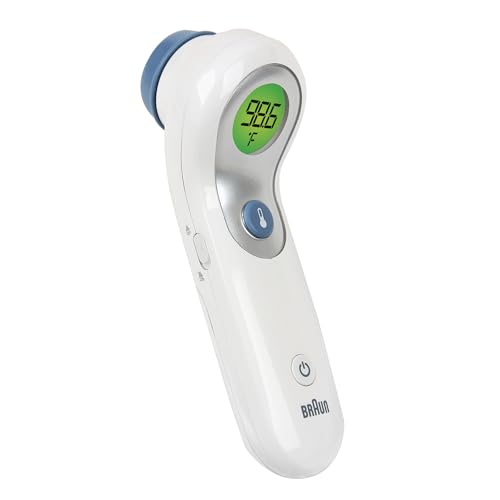
Braun is the number one thermometer brand recommended by pediatricians, and the BNT400 is the product that established that reputation in the consumer no-touch category. Its core capability — a clinically validated forehead reading from up to 2 inches away without any skin contact — is something that sounds incremental until the first time you check a sleeping child’s temperature at midnight and they stay asleep. That scenario converts every parent who experiences it.
The Age Precision feature is Braun’s most clinically meaningful design contribution. The thermometer applies distinct fever threshold calculations for newborns, infants, and adults, because those thresholds are genuinely different from a medical standpoint. A reading of 100.4°F in a 10-day-old infant requires a call to the pediatrician or emergency evaluation; the same reading in a 35-year-old warrants rest and hydration. The BNT400’s color-coded LED alert (green/yellow/red) adjusts based on the selected age profile, giving the caregiver an immediate, age-calibrated visual signal.
The contact mode — engaging the thermometer directly to the forehead — provides a secondary measurement option when a precise reading is needed for clinical documentation or when borderline readings require confirmation. This dual-mode capability gives the BNT400 more versatility than a pure no-touch model, at a price point that reflects its clinical validation investment. For households seeking a no-touch forehead thermometer from a brand with deep pediatric credibility, the BNT400 is the strongest choice.
Braun No Touch and Forehead Thermometer BNT400
by Braun
Best no-touch forehead thermometer with age-specific fever thresholds — reads sleeping children from 2 inches away.
Pros
- No-touch mode reads from up to 2 inches away — clinically valuable for sleeping children and infection-control environments
- Age Precision technology applies separate fever thresholds for newborns, infants, and adults with color-coded LED feedback
- Contact forehead mode increases precision for borderline readings when exact accuracy is more important than distance
- Silent mode available for nighttime checks without the audible beep disturbing a sleeping child
Cons
- No-touch mode carries a slightly wider margin of error (approximately ±0.5°F) than contact temporal models at the same price point
- No on-device memory beyond the current reading — previous measurements are not stored without an optional app
5. Braun Sensian 7 Forehead 3-in-1 Non-Contact Thermometer
The Braun Sensian 7 is the most feature-complete thermometer in this review, combining no-touch forehead infrared, tympanic ear measurement, and ambient room temperature sensing in a single device — with seven distinct age-calibrated fever profiles covering premature infants through adults. For households with a wide age spread (a premature infant, a toddler, school-age children, and parents), no other single device provides the breadth of validated measurement modes the Sensian 7 does.
The ear mode is worth particular attention. For cooperative children and adults, tympanic ear measurement is fast and highly accurate — some clinical studies place it closer to core temperature than forehead surface measurement. Braun’s pre-warmed ear probe tip addresses the most common source of tympanic error: the temperature differential between a cold probe and the warm ear canal, which causes the probe to artificially lower the first reading. The pre-warming reduces this artifact, improving first-measurement accuracy in cold-room environments.
The 7-age precision calibration — the most granular age-profile system of any thermometer reviewed — applies different alarm thresholds for premature infants (whose thermoregulation is less mature), neonates, infants, toddlers, children, adults, and elder adults. For families managing a medically complex child or an elderly household member on immunosuppressive medications, where the clinical significance of a 100°F reading differs meaningfully by age and health status, this precision matters. The best blood pressure monitors we review pair well with the Sensian 7 for families managing multiple vital sign parameters.

Braun Sensian 7 Forehead 3-in-1 Non-Contact Thermometer
by Braun
Most versatile forehead thermometer — 7-age precision modes, forehead no-touch, ear, and room temperature in one device.
Pros
- 3-in-1 design measures forehead (no-touch), ear (tympanic), and ambient room temperature — the most versatile single-device option reviewed
- Age Precision mode with seven distinct fever thresholds from premature infants through adults, the most granular age calibration in the category
- Pre-warmed ear probe tip reduces measurement error caused by the probe cooling effect common in cold environments
- Color-coded temperature guidance with instant green/yellow/red LED display for immediate fever interpretation
Cons
- Premium price among non-Bluetooth forehead thermometers — users who need only forehead measurement can save significantly with simpler models
- Ear mode adds complexity; proper canal positioning technique is required to avoid tympanic measurement errors
6. Exergen Temporal Artery Thermometer TAT-2000C
The Exergen TAT-2000C is the thermometer used in hospitals — specifically, in neonatal intensive care units, pediatric wards, and adult medical floors where clinical accuracy is non-negotiable. The technology underlying the TAT-2000C, arterial heat balance measurement, was developed by Dr. Francesco Pompei of Exergen Corporation and has been validated in more peer-reviewed clinical studies than any other non-invasive thermometry method. When physicians and nurses need a forehead temperature reading they can trust for clinical decision-making, this is the instrument they reach for.
The consumer TAT-2000C uses the same core technology as the professional TAT-5000 used in hospitals, in a form factor designed for home use. The measurement technique is simple: press the button, draw the sensor from the center of the forehead to the hairline above the ear at a steady pace, and release. The device captures the peak temperature reading during the swipe. The technique is more involved than pressing a button at a distance, but it is learnable in one or two practice sessions, and the accuracy payoff is substantial.
For users who have been burned by inconsistent non-contact infrared readings — particularly for borderline fever evaluations where the exact temperature matters — the Exergen TAT-2000C provides a meaningful accuracy upgrade at a reasonable price. It is the strongest choice for households with chronically ill family members, immunocompromised patients, or anyone who needs to report reliable temperature data to a physician on a regular basis. The display’s limited backlighting is a genuine ergonomic limitation in dark rooms, but it is a minor trade-off against the clinical confidence the device provides.

Exergen Temporal Artery Thermometer TAT-2000C
by Exergen
Hospital-grade temporal artery accuracy in a consumer device — the trusted clinical standard for forehead scanning.
Pros
- Patented arterial heat balance technology measures temporal artery temperature with clinical accuracy equivalent to rectal measurement in published peer-reviewed studies
- Simple swipe-and-scan technique — press the button, draw across the forehead, release — requires no distance calibration or standoff compliance
- Widely used in hospitals and clinical settings; the same technology used in neonatal ICUs and pediatric wards
- Gentle contact design is appropriate for all ages including premature infants, without the discomfort of tympanic or rectal measurement
Cons
- Contact forehead swipe technique requires slow, deliberate motion across the brow — users who swipe too quickly may get lower readings
- Display is smaller and less backlit than modern LCD competitors, making readings harder to view in low-light environments
7. Frida Baby 3-in-1 Infrared Thermometer for Ear, Forehead and Touchless
Frida Baby has built its brand on the insight that pediatric health products designed specifically for children — rather than scaled-down adult products — perform better in the hands of tired parents. The Frida Baby thermometer applies that philosophy to temperature measurement: a compact grip sized for one-hand use, quiet operation that minimizes infant distress, and three measurement modes accessible without reading a manual.
The touchless forehead mode, contact forehead mode, and tympanic ear mode give parents options for every scenario. A sleeping newborn warrants the touchless mode from a comfortable distance. A cooperative toddler gets the contact mode for maximum accuracy. An older child or adult who prefers ear measurement gets the tympanic option. The 1-second reading time in all three modes is among the fastest in the category, and the automatic fever alarm at 100.4°F removes the need to remember the clinical threshold — the thermometer knows.
The memory limitation (one reading stored per mode) is the honest constraint of the Frida Baby’s design priorities. The device is optimized for in-the-moment measurement rather than trend tracking — it tells you the current temperature quickly and accurately but does not build a historical log. For families who want to track fever trends across a multi-day illness, either logging readings manually or pairing the Frida Baby with a model that has longer memory is advisable. For the acute single-reading use case that constitutes most pediatric temperature checks, the Frida Baby is the most parent-friendly design in this review.

Frida Baby 3-in-1 Infrared Thermometer for Ear, Forehead and Touchless
by Frida Baby
Best pediatric-focused forehead thermometer — three modes, infant-optimized design, and instant 1-second readings.
Pros
- Three measurement modes in one device: touchless forehead infrared, contact forehead, and tympanic ear — covering every age and situation
- 1-second reading time in all modes; fever alarm activates automatically when temperature exceeds 100.4°F
- Designed specifically with pediatric use in mind — compact grip and quiet operation reduce infant distress during measurement
- Backlit screen with color-coded fever indication works well during nighttime checks without requiring room lights
Cons
- Ear mode calibration is optimized for infants and small children; adult ear canal anatomy can introduce slight measurement variability
- Memory stores only the most recent reading per mode — not suitable for households tracking multi-day fever trends without manual logging
Best Forehead Thermometers for Babies & Infants
For a sleeping newborn, a true no-touch read that never disturbs the child matters more than any other feature.
| Product | Price | Buy |
|---|---|---|
| Frida Baby 3-in-1 Infrared Thermometer for Ear, Forehead and TouchlessBest multi-mode for babies Ear, forehead, and touchless modes adapt as the baby grows from newborn to toddler | $26.99 | View on Amazon |
| Braun No Touch and Forehead Thermometer BNT400Best trusted-brand no-touch No-touch forehead reads from a pediatrician-familiar brand parents already trust | $50.99 | View on Amazon |
| Berrcom Non-Contact Infrared Forehead Thermometer JXB-178Best budget for newborns The lowest-cost non-contact option for a nursery without sacrificing a fast read | $13.98 | View on Amazon |
Best No-Touch & Contactless Forehead Thermometers
Non-contact reads avoid cross-infection between family members and never need probe covers.
| Product | Price | Buy |
|---|---|---|
| iHealth No-Touch Forehead Thermometer PT3Best no-touch overall One-second infrared reads with a large backlit display for the whole family | $22.98 | View on Amazon |
| Berrcom Non-Contact Infrared Forehead Thermometer JXB-178Best budget no-touch Reliable contactless reading at the lowest price in this lineup | $13.98 | View on Amazon |
| Braun Sensian 7 Forehead 3-in-1 Non-Contact ThermometerBest no-touch with modes Adds selectable modes on top of a fast contactless forehead read | $9.99 | View on Amazon |
Best Medical-Grade Forehead Thermometers (Nurses & Clinics)
Clinicians prize repeatability — a device that returns the same reading twice on the same forehead.
| Product | Price | Buy |
|---|---|---|
| Exergen Temporal Artery Thermometer TAT-2000CBest clinical temporal Temporal-artery scanning is the method used in hospitals for its proven repeatability | $29.98 | View on Amazon |
| iHealth No-Touch Forehead Thermometer PT3Best professional no-touch A fast, consistent no-touch option for busy clinical and school-nurse settings | $22.98 | View on Amazon |
Best Ear & Forehead (Dual-Mode) Thermometers
A dual-mode unit lets you cross-check a borderline forehead reading against an ear reading for confidence.
| Product | Price | Buy |
|---|---|---|
| Frida Baby 3-in-1 Infrared Thermometer for Ear, Forehead and TouchlessBest 3-in-1 for families Ear, forehead, and touchless in one device for cross-checking a fever | $26.99 | View on Amazon |
| Braun Sensian 7 Forehead 3-in-1 Non-Contact ThermometerBest forehead-plus modes Combines a primary forehead read with additional selectable modes | $9.99 | View on Amazon |
How to Choose the Best Forehead Thermometer
The buyer’s guide below outlines the six factors most important to match your purchase to your household’s needs. Beyond those factors, one consideration worth adding here is the relationship between thermometer type and your specific clinical context.
If you have a newborn under 3 months, confirm your preferred measurement method with your pediatrician before relying on any forehead model for fever determination. The clinical guidance from the American Academy of Pediatrics remains that rectal measurement is the gold standard for infants in this age group for whom fever determination carries the highest clinical stakes — a temperature above 100.4°F in a newborn is a medical emergency, not a monitor-at-home situation.
For households managing older children and adults, the primary decision is convenience versus accuracy. The iHealth PT3 offers the best combination of both for most families. For users who need data they can confidently share with a physician, the Exergen TAT-2000C’s temporal artery technology provides a level of clinical backing that no non-contact infrared model can match. For users who want the most complete connected fever record, the Kinsa QuickScan logs every reading to its companion app with symptom notes and age-based guidance, turning a single number into a trackable illness history.
Whatever model you choose, a forehead thermometer is a screening tool — not a diagnostic device. Fever is a symptom, and a reading above 103°F in any adult, above 102°F in a child with behavioral changes, or above 100.4°F in an infant under 3 months warrants contact with your physician rather than home management alone. Consult your healthcare provider for personalized guidance on fever thresholds and response protocols for your family’s specific health circumstances.
Buyer's Guide
Forehead thermometers range from under-$15 non-contact infrared models to clinical-grade temporal artery scanners used in hospitals. Choosing the right one means matching the technology to your household's specific age range, accuracy needs, and usage habits.
Measurement Technology
Forehead thermometers use two distinct sensing methods. Non-contact infrared models measure heat radiating from the skin surface at a distance, offering touchless convenience but with greater sensitivity to ambient temperature and technique variation. Temporal artery scanners make gentle contact with the forehead and read arterial blood heat directly, achieving clinical accuracy comparable to rectal measurement in published studies. For households with infants or immunocompromised members where accurate fever detection is critical, a temporal artery model like the Exergen TAT-2000C is the stronger clinical choice.
No-Touch vs. Contact Forehead Measurement
No-touch capability is the most requested feature for parents of young children — it allows temperature checks on sleeping children without any physical disturbance. Models like the Braun BNT400 read accurately from up to 2 inches away. The trade-off is a slightly wider margin of error compared to contact measurement at the same price. If your primary use case is fever screening during sleep, no-touch is worth prioritizing. If you need borderline-reading accuracy for clinical follow-up, a contact temporal swipe model will serve you better.
Age Range and Pediatric Validation
Not all forehead thermometers are validated for every age group. Check that the model you choose is FDA-cleared and clinically tested for the youngest person in your household. The Braun Sensian 7 offers seven distinct age-calibrated fever thresholds — the most granular pediatric calibration reviewed. The Exergen TAT-2000C is used in neonatal ICUs. The American Academy of Pediatrics recommends rectal temperature as the gold standard for infants under 3 months; confirm your preferred method with your pediatrician before relying on any forehead model for very young infants.
Response Time and Ease of Use
Most infrared forehead thermometers read in 1 second; temporal artery models complete a swipe scan in 2 seconds. Either is fast enough for uncooperative children, but technique matters significantly for the temporal swipe models — the swipe must be slow and deliberate. No-touch models are more forgiving of operator variation. For households where multiple caregivers take temperatures, the simplicity of a no-touch model reduces technique-dependent error across less experienced users.
Memory and Fever Trend Tracking
During an active fever illness, tracking temperature trends over 12 to 24 hours provides more clinical information than any single reading. On-device memory ranges from 1 reading (Frida Baby, per mode) to 32 readings (Berrcom JXB-178). If you manage a household with young children who get fevers regularly, a thermometer with at least 8 to 10 stored readings makes it easier to report temperature patterns to your pediatrician without manual logging. The Kinsa QuickScan logs every reading to its companion app for the most complete trend data.
Display Clarity and Low-Light Usability
Most fever checks happen at night. A backlit display that shows the reading clearly without requiring a full room light is a meaningful practical feature. Color-coded fever indication — green for normal, yellow for low fever, red for high fever — allows instant interpretation without reading a number at 3 a.m. The Braun models and Frida Baby use LED color systems. The Exergen TAT-2000C has a simpler display without backlighting, which is the one ergonomic concession in an otherwise clinically superior device.
Final Verdict
For most households, the iHealth No-Touch PT3 is our Best Overall forehead thermometer. Its combination of a 1-second no-contact scan, silent vibration feedback, a three-sensor accuracy system, and FSA/HSA eligibility makes it the most practically useful forehead thermometer in the category. At a mid-range price with a strong 4.4-star record, it delivers outstanding value for routine family fever monitoring.
For budget-conscious buyers, the Berrcom JXB-178 is the clear pick — FDA-cleared, multi-mode capable, and equipped with 32-reading memory that outpaces thermometers costing twice as much. For households that need clinical-grade temporal artery accuracy, the Exergen TAT-2000C is the hospital-proven choice that eliminates the surface-temperature correction factor required with all infrared models. And for families who want to track an illness rather than spot-check it, the Kinsa QuickScan is the premium upgrade that logs every no-touch reading to its app with age-based fever guidance.
Whichever model fits your needs, prioritize a thermometer with FDA clearance and an established review base — and consult your pediatrician or physician about the right measurement method for the most vulnerable members of your household.
Forehead readings often come back in whichever scale the device defaults to. Our free Celsius to Fahrenheit converter switches a reading between °C and °F as you type and shows whether it crosses the 100.4°F (38.0°C) fever line.
Frequently Asked Questions
How accurate are forehead thermometers compared to oral or rectal thermometers?
What is the difference between a no-touch forehead thermometer and a temporal artery thermometer?
What is a normal forehead temperature reading, and when should I be concerned?
Are forehead thermometers accurate for newborns and infants?
How do I get an accurate reading from a forehead thermometer?
Can a forehead thermometer be used to check food or bath water temperature?
Related Articles
About the Reviewer

Dr. David Taylor, MD, PhD
Drexel University College of Medicine (MD), Indiana University School of Medicine (PhD)
Dr. David Taylor is a licensed physician and medical researcher who founded BestRatedDocs in 2016. With an MD from Drexel University and a PhD from Indiana University School of Medicine, he combines clinical expertise with a passion for health technology to provide evidence-based product recommendations. Dr. Taylor specializes in health informatics and regularly evaluates medical devices, diagnostic equipment, and therapeutic products to help healthcare professionals and patients make informed decisions.