7 Best Bluetooth Thermometers of 2026
Dr. David Taylor reviews the best Bluetooth thermometers with app connectivity. Compare smart thermometers for fever tracking, baby monitoring, and continuous logging.
Updated
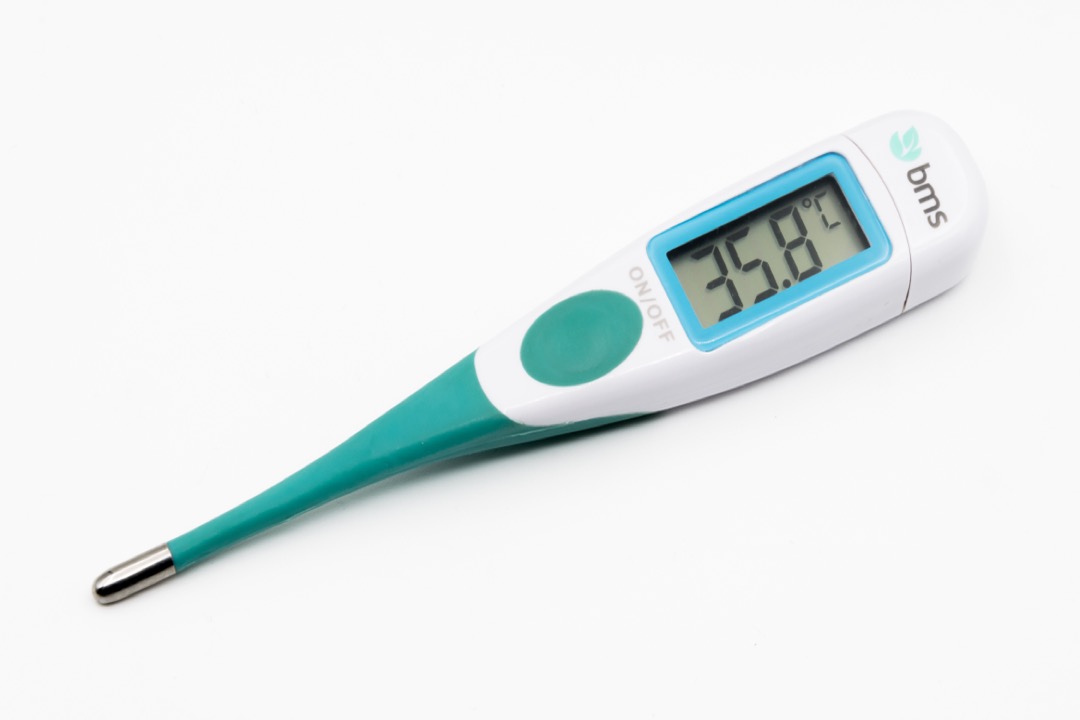
Smart thermometers with Bluetooth connectivity represent one of the most practical advances in home health monitoring of the past decade. Rather than jotting fever readings on a notepad or relying on memory when speaking with a physician, smart thermometers log every reading automatically — with timestamps, trend lines, and multi-family-member profiles — all accessible from a smartphone app. For our 2026 refresh, we re-verified Amazon stock and reviewed seven of the best-selling smart and connected thermometers on the platform, covering oral, rectal, underarm, no-touch forehead, tympanic ear, basal body, and continuous-monitoring wearable designs to help you find the right model for your household.
A note on this year’s lineup: the smart-thermometer category churned significantly between our last update and this one. TempTraq (the wearable continuous-monitoring patch that previously led that use case) has exited Amazon entirely as of 2025, and Vicks discontinued its SmartTemp Bluetooth line. The current best-in-class for continuous monitoring is now the Momcozy wearable, which we recommend with the explicit caveat that its review base is still small. We’ve also included one non-Bluetooth product — the iProven DMT-489 — because its 17,469 ratings are by far the deepest review record on this page, and iProven currently has no app-connected model in its lineup. We flag this transparently in that product’s section so buyers prioritizing app connectivity can route to a Kinsa pick instead. In September we also replaced our fertility pick after it went out of stock on Amazon; the Tempdrop overnight sensor now fills that slot. For broader context on home fever measurement options, see our companion guides to the best digital thermometers and the best infrared thermometers.
Our evaluations draw on analysis of tens of thousands of verified Amazon reviews, published product specifications, FDA clearance records, and the clinical perspective of Dr. David Taylor, MD. We paid particular attention to how each thermometer performs during the most stressful use case: a sick child at 2 a.m., a parent operating on minimal sleep, in low light, with a child who will not hold still. Real-world usability under those conditions is the true test of whether a smart thermometer earns a place in your medicine cabinet.
| Product | Price | Buy |
|---|---|---|
| Kinsa QuickCare Smart Digital ThermometerBest Overall | $29.50 | View on Amazon |
| Vive Precision Smart Oral Thermometer BT-SBudget Pick | $4.99 | View on Amazon |
| Braun ThermoScan 7+ Connect Digital Ear ThermometerPremium Pick | $59.49 | View on Amazon |
| iProven DMT-489 Ear and Forehead ThermometerRunner-Up | $27.99 | View on Amazon |
| Kinsa QuickScan Smart Forehead Thermometer | $38.99 | View on Amazon |
| Tempdrop Wearable Fertility Monitor (Ovulation Tracker BBT) | $189.00 | View on Amazon |
| Momcozy Wearable Baby Thermometer | $42.74 | View on Amazon |
Find the Right Smart Thermometer for Your Situation
App-connected thermometers split by what you are actually tracking — a child’s fever over a few days, a baby’s temperature continuously overnight, or your basal body temperature for fertility. Jump to the section that matches your goal:
- Best smart thermometers overall — our seven picks reviewed in full
- Best smart thermometer for babies and kids
- Best smart basal thermometer for fertility tracking
How We Selected These Smart Thermometers
We reviewed the top-selling smart and Bluetooth-enabled thermometers on Amazon, supplemented by one continuous-monitoring wearable that fills a clinically distinct use case after the previous category leader (TempTraq) exited the platform. For each model, we re-verified live Amazon availability via Playwright navigation to the product detail page and analyzed Amazon review patterns for recurring accuracy complaints, app reliability issues, and disconnection problems. We compared stated specifications against user-reported real-world performance, and we verified FDA 510(k) clearance status for clinical use claims. Products were selected to represent the full range of smart thermometer types: flexible-tip multi-site, no-touch forehead infrared, tympanic ear, overnight wearable basal, and wearable continuous-monitoring designs.
Best Smart Thermometers Overall
These are the seven app-connected thermometers that earned a place in this guide, each reviewed in full below. The Kinsa QuickCare is my best overall pick for everyday household fever tracking, but the use-case sections that follow the reviews match more specific goals — continuous baby monitoring and fertility charting — to the right device from this same lineup.
1. Kinsa QuickCare Smart Digital Thermometer — Best Overall
The Kinsa QuickCare Smart Digital Thermometer is our top overall pick because it is the only smart thermometer in this lineup with full clinical flexibility: a flexible-tip probe rated for oral, rectal, and underarm measurement, all FDA-cleared and all paired with what is by a comfortable margin the most complete companion app in the category. For pediatric households especially, this matters: the American Academy of Pediatrics recommends rectal measurement as the clinical gold standard for infants under 3 months, and the QuickCare is one of the few smart thermometers that can serve that use case rather than punting parents to a separate rectal probe.
The Kinsa app is what makes this the clear best overall rather than just a solid spec sheet. Unlimited family profiles, symptom tracking, medication reminders, and Apple Health sync are all standard and all free. Readings sync automatically when the phone is within Bluetooth range, building a longitudinal record that is genuinely useful to share with a pediatrician at the next appointment. The 8-second reading speed is not the fastest in the category — Braun’s tympanic and iProven’s dual-mode infrared models read in 1 second — but axillary measurement is the most universally accessible across ages and cooperation levels, and 8 seconds is fast enough to stay ahead of a wriggling toddler.
The one practical limitation is the lack of on-device memory. Every reading requires an active Bluetooth connection to log. For households where the thermometer is used in close proximity to a smartphone — which is most modern households — this is a minor inconvenience. If you anticipate using the thermometer in places where the phone may not be nearby, the iProven DMT-489 below carries 20 readings on-device.

Kinsa QuickCare Smart Digital Thermometer
by Kinsa
FDA-cleared flexible-tip smart thermometer with full three-site capability and the most complete companion app in the category.
Pros
- Flexible-tip design supports oral, rectal, and underarm measurement in a single device — the only FDA-cleared smart thermometer in this lineup with full three-site clinical flexibility
- Reads in under 8 seconds across all measurement sites, fast enough to capture a reading on an uncooperative child
- Kinsa app (iOS and Android) tracks unlimited family profiles, logs symptoms, sets medication reminders, and syncs to Apple Health
- FDA-cleared with reliable Bluetooth pairing and a free app — no subscription, no in-app upsells for core fever tracking
Cons
- Requires the smartphone nearby during measurement to sync — no on-device memory means readings taken without the app are not logged
- Rectal use (the clinical gold standard for infants under 3 months) requires careful probe-tip cleaning between sites; consider dedicating one probe-cover or single-use sheaths
2. Vive Precision Smart Oral Thermometer BT-S — Budget Pick
This slot used to hold a second Kinsa QuickCare listing. We removed it in August 2026 for two reasons: Amazon stopped showing a featured offer on it, so there was no working buy button on the page, and the remaining seller price had drifted above our best overall pick, which makes it a strange thing to call a budget option. Rather than leave a broken link in place, we went looking for the cheapest thermometer that still does the one thing this list is about, which is sending a reading to your phone.
The Vive Precision BT-S is what we found, and it is worth being straight about what you are getting. It costs about a third of what the Kinsa QuickCare costs. It has the same flexible soft tip and the same oral, rectal, and underarm coverage. It pairs over Bluetooth to the Vive Now app, where readings are logged and can be sent to a clinician. It is waterproof, ships with probe covers and a case, is FSA/HSA eligible, and carries Vive’s 60-day guarantee.
Now the caveats, and they matter on a device like this. The listing makes no FDA-clearance claim, which every Kinsa and Braun unit on this page does. It averages 3.5 stars across 69 ratings, easily the thinnest and weakest feedback here, and pairing problems come up more than once in the negative reviews. It signals a finished reading with a run of beeps rather than a stated time, so it is slower than the sub-8-second Kinsa units in practice.
My advice: if you are measuring a newborn’s temperature to decide whether to call a paediatrician tonight, spend more on the FDA-cleared Kinsa QuickCare. Buy the Vive when you want a cheap second thermometer for a bag or a spare bathroom, or when the app log is the point and the readings are for an adult who can also tell you how they feel.

Vive Precision Smart Oral Thermometer BT-S
by Vive Precision
The only genuinely app-connected body thermometer we found well under our top pick's price — real savings, at a real cost in review depth and with no FDA-clearance claim.
Pros
- Roughly a third the price of our best overall pick — the only genuinely app-connected body thermometer we could find well below it
- Flexible soft tip covers oral, rectal, and underarm readings, the same three-site flexibility as the Kinsa units
- Pairs to the Vive Now app so readings are logged on your phone and can be shared directly with a clinician
- Waterproof body with probe covers and a hard case included, FSA/HSA eligible, and backed by Vive's 60-day guarantee
Cons
- Carries no FDA-clearance claim on its listing, unlike every Kinsa and Braun device in this review — a real gap on a thermometer you may use to decide whether an infant needs to be seen
- A 3.5-star average across only 69 ratings is by far the thinnest and weakest feedback on this page; pairing complaints recur in the negative reviews
- Signals completion with a series of beeps rather than a stated read time, so it is slower in practice than the sub-8-second Kinsa units
3. Braun ThermoScan 7+ Connect Digital Ear Thermometer — Upgrade Pick
The Braun ThermoScan 7+ Connect is our upgrade pick for buyers who want clinical-grade tympanic measurement with smartphone integration. Braun’s tympanic ear thermometer line is the most-recommended thermometer brand among pediatricians in published industry surveys, and the ThermoScan 7+ adds two features that materially improve on the standard tympanic experience: ExacTemp positioning confirmation and Age Precision interpretation.
ExacTemp addresses the single biggest weakness of tympanic thermometers: technique sensitivity. A tympanic reading aimed at the ear canal wall rather than the eardrum can read 1°F or more cooler than the true core temperature, and this is the source of most negative Amazon reviews of ear thermometers across all brands. The ThermoScan 7+ uses an indicator that confirms correct probe alignment before the reading captures, which makes it forgiving for parents taking a quick check on a moving child. Age Precision applies different fever-threshold calculations for 0–3 months, 3–36 months, and 36 months+ — a small but clinically meaningful detail, since 100.4°F is an emergency in a neonate and watchful-waiting in a healthy adult.
The Bluetooth connection to the Braun Family Care app syncs an unlimited cloud history with family profiles and color-coded fever alerts. The 1-second reading speed is the fastest in this lineup, which matters more than spec sheets suggest at 2 a.m. Two practical caveats: Amazon stock on this model has been intermittent in past checks, and disposable lens filters are a recurring consumable that should be replaced between users to prevent cross-contamination.

Braun ThermoScan 7+ Connect Digital Ear Thermometer
by Braun
Only clinical-grade Bluetooth tympanic thermometer with Age Precision and ExacTemp positioning — the upgrade pick when accuracy matters most.
Pros
- 1-second tympanic reading is the fastest in this lineup — practical advantage with squirming children at 3 a.m.
- Age Precision feature applies distinct fever thresholds for 0–3 months, 3–36 months, and 36 months+, calibrated to clinical pediatric guidance
- ExacTemp positioning indicator confirms proper ear-canal alignment before reading, addressing the technique sensitivity that undermines most tympanic thermometers
- Braun Family Care app (iOS and Android) syncs unlimited readings; physically the #1 brand recommended by pediatricians in survey-based claims
Cons
- Amazon stock has been intermittent in past checks, so expect occasional backorders
- Disposable lens filters are recurring consumables; each tympanic reading should use a clean filter to prevent cross-contamination between users
4. iProven DMT-489 Ear and Forehead Thermometer — Runner-Up
A transparent disclosure up front: the iProven DMT-489 is the one non-Bluetooth product in this lineup. iProven’s current product line has no app-connected smart thermometer, and we include the DMT-489 here because its 17,469 Amazon ratings are by far the deepest review record on this page. For buyers whose primary value driver is review depth and proven reliability — and who do not need or want smartphone app integration — this is the runner-up worth considering. Buyers who specifically want Bluetooth connectivity and a companion app should route to one of the Kinsa picks instead.
The dual-mode operation is the practical strength. The no-touch forehead swipe and the tympanic ear reading both complete in 1 second, faster than the Kinsa QuickCare and matching the Braun ThermoScan 7+ Connect. The 20-reading on-device recall is useful for households where someone manually logs readings into a notebook or spreadsheet rather than relying on an app sync. FSA/HSA eligibility and standard 2 AAA battery operation keep total cost of ownership low.
The same technique caveat applies to the ear mode as to all tympanic thermometers: proper canal alignment matters. The DMT-489 does not have a positioning-confirmation feature equivalent to Braun’s ExacTemp, so the user is responsible for correct probe placement on every reading. For parents who have used tympanic thermometers before and have the technique down, this is not an issue; for first-time tympanic users, the Braun is more forgiving.
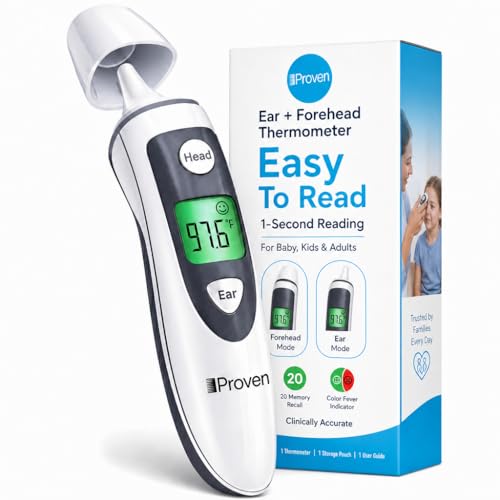
iProven DMT-489 Ear and Forehead Thermometer
by iProven
Most-reviewed dual forehead/ear thermometer on Amazon — included as the no-app runner-up for buyers who don't want smartphone dependency.
Pros
- 17,469 Amazon ratings, by far the deepest review record on this page and a long track record for a dual forehead/ear thermometer
- Dual-mode operation: no-touch forehead swipe and tympanic ear measurement in a single device
- 1-second reading speed at both measurement sites; 20-reading recall on-device for households without the phone always at hand
- FSA/HSA eligible; runs on standard 2 AAA batteries with no proprietary cells or app subscription required
Cons
- This is the one non-Bluetooth product in this roundup — iProven's current lineup has no app-connected model, so readings are not auto-logged to a smartphone
- Ear mode is technique-sensitive like all tympanic thermometers; proper canal alignment matters more than the price suggests
5. Kinsa QuickScan Smart Forehead Thermometer
The Kinsa QuickScan fills the no-touch forehead use case within the Kinsa ecosystem. This is the thermometer to choose when the primary use case is checking the temperature of a sleeping infant or young child without contact — and without waking them. The infrared sensor reads from a short distance away in essentially zero time, and the same Kinsa app that powers the QuickCare logs each reading with symptom data, medication reminders, family profiles, and Apple Health sync.
The clinical limitation of no-touch forehead measurement is well documented: ambient skin temperature, sweat, and forehead positioning can introduce a wider margin of error than contact oral or rectal measurement. We recommend treating no-touch forehead readings as a screening tool — a useful first-look number that flags whether a contact follow-up reading is warranted. For sleeping-child checks and routine spot-screens during the day, that screening role is exactly what most parents need.
Its 900 ratings are fewer than the contact QuickCare’s, but the 4.4-star rating across that base suggests the device performs as advertised. If your household already uses the Kinsa app for other family members, adding the QuickScan to the same app eliminates the friction of managing readings across two different ecosystems.

Kinsa QuickScan Smart Forehead Thermometer
by Kinsa
No-touch infrared smart thermometer for nighttime spot-checks and sleeping-infant scans — same Kinsa ecosystem, no contact required.
Pros
- No-touch infrared forehead measurement — read a sleeping infant's temperature without contact and without waking them
- Instant reading time with no contact required, ideal for nighttime spot-checks and infection-control situations
- Same Kinsa app integration as the QuickCare: symptom logging, family profiles, medication reminders, Apple Health sync
- FDA-cleared and supports unlimited in-app memory across multiple family members
Cons
- No-touch forehead readings carry a slightly wider margin of error than contact oral or rectal measurement — best treated as a screening tool
- Smaller review base (900) than the contact QuickCare; still 4.4 stars but less data depth to validate long-term reliability
6. Tempdrop Wearable Fertility Monitor
This slot held the Easy@Home EBT-300 oral basal thermometer until September 2026, when it went out of stock on Amazon with no buy button for more than two weeks. We looked first at Easy@Home’s replacement Bluetooth model, but it opened with a weak rating on only a few dozen reviews, and the other app-connected oral basal thermometers we found had similarly thin records. The Tempdrop is the fertility device with a real review history behind it, and it works differently enough that you should understand the trade before you buy.
The most important point first: the Tempdrop is not a thermometer you put in your mouth. It is a small sensor worn on the upper arm while you sleep. Conventional basal body temperature charting asks you to take an oral reading at the same time every morning, before you sit up, talk, or drink anything, and a late or interrupted morning spoils that day’s data point. The Tempdrop removes the alarm. It records temperature through the night and learns your own nightly pattern, which the brand says makes it better suited to irregular cycles. It stores up to 60 hours of data on the device, so a missed sync does not lose a night, and it sends readings over Bluetooth to the Tempdrop app, which charts the curve, shows the fertile window, and confirms when ovulation has happened.
A little physiology sets the right expectations. After ovulation, progesterone raises resting body temperature by a few tenths of a degree, and that rise holds until the next period. A BBT chart therefore confirms ovulation after it has occurred; on its own it does not predict ovulation days in advance, which is why many of my patients pair temperature charting with ovulation test strips. BBT tracking of any kind is also not contraception, and I would not rely on it to avoid pregnancy.
Now the caveats. The Tempdrop costs far more than anything else on this page, several times the price of a conventional basal thermometer. Its 4.1-star average across 756 ratings is a much deeper record than any app-connected oral basal thermometer we could find, but it is a lower average than every fever thermometer here except the Vive. The listing makes no FDA-clearance claim, and it cannot take a fever reading, so it does not replace any of the thermometers above. If a nightly armband and the higher price are acceptable to you, it is the easiest way I know of to keep a consistent basal chart. If they are not, a conventional basal thermometer used at the same time each morning still does the job.

Tempdrop Wearable Fertility Monitor (Ovulation Tracker BBT)
by Tempdrop
An overnight upper-arm basal sensor that removes the morning thermometer routine from fertility charting, at by far the highest price on this page.
Pros
- Worn on the upper arm overnight, so there is no early alarm and no oral reading to take before you get out of bed
- Learns your own nightly temperature pattern, which the brand says makes it better suited to irregular cycles than a single morning reading
- Stores up to 60 hours of data on the device, so a missed sync does not cost you a night's reading
- Syncs to the Tempdrop app over Bluetooth to chart basal temperature, show the fertile window, and confirm ovulation
Cons
- Costs far more than any other product on this page, and several times the price of a conventional basal thermometer
- A wearable sensor, not a thermometer: it cannot take a fever reading, and the listing makes no FDA-clearance claim
- BBT charting confirms ovulation after it happens; it is a conception aid, not a method of contraception
7. Momcozy Wearable Baby Thermometer
The Momcozy wearable patch is included as the continuous-monitoring pick — a clinically distinct use case that no spot-reading thermometer can address. Important context for readers: the previous category leader, TempTraq (manufactured by ROLI Health), has exited Amazon entirely as of 2025. Momcozy is the best currently available continuous-monitoring substitute for that use case, and we recommend it on that basis, while being transparent that the review base is still small (296 reviews) and the long-term reliability picture is still emerging.
The product premise is sound. A soft underarm patch with a reusable sensor monitors temperature continuously and transmits the data to the Momcozy app for real-time trend visualization. The sealed battery lasts 180 hours per charge, eliminating the per-episode disposable cost that made TempTraq a recurring consumable. Only the 3M ISO 10993 hypoallergenic adhesive stickers (replaced every 8 hours) are consumables, and they are designed specifically for infant skin contact. Clinically, this is the use case where continuous monitoring earns its keep: a high fever in a young child can climb rapidly during sleep, and an alarm system that wakes the parent only when a threshold is crossed is objectively safer and less exhausting than manual hourly spot-checks.
Two practical limitations to flag. First, the small review base means we have less data on long-term reliability than we’d like — we will revisit this product in future updates as the review pool grows. Second, the continuous data stream requires the Momcozy app to remain in the foreground; backgrounding the app or locking the phone can interrupt readings. Plan to dedicate a phone or tablet to the monitoring session rather than expecting it to run alongside normal phone use. For parents managing infrequent significant fever episodes, this is a useful tool to keep on hand; for routine fever checks, one of the spot-reading models above will be more practical.

Momcozy Wearable Baby Thermometer
by Momcozy
Continuous-monitoring wearable that replaces the discontinued TempTraq — strong premise, smaller review base; flagged as emerging.
Pros
- Wearable underarm patch enables continuous temperature monitoring — replaces the discontinued TempTraq for this clinically distinct use case
- Reusable sensor with 180-hour sealed battery (no per-episode disposable cost; only the 3M hypoallergenic adhesive stickers are consumables)
- Momcozy app displays real-time trend charts so parents can monitor fever trajectory from another room without disturbing a sleeping child
- ISO 10993 hypoallergenic adhesive stickers (replace every 8 hours) are safer for infant skin than typical medical tape
Cons
- Thin review base (296 reviews) — Momcozy is the best available continuous-monitoring substitute since TempTraq exited Amazon, but the long-term reliability picture is still emerging
- Continuous monitoring requires the Momcozy app to remain in the foreground; backgrounding the app or locking the phone can interrupt the data stream
Best Smart Thermometer for Babies and Kids
For infants and young children, the value of an app-connected thermometer is less about a single reading and more about tracking a fever’s trend over hours — and doing it without waking a sleeping child. The Momcozy Wearable is the standout for this: a soft underarm patch that stays on during sleep and streams temperature to the app with threshold alerts, so a parent watching a feverish baby overnight gets warned of a spike without disturbing the child. For a fast, on-demand pediatric reading, the Braun ThermoScan 7+ Connect is the tympanic (ear) standard, with an Age Precision feature that interprets whether a reading is a fever for the child’s age. And for older children who can hold still, the Kinsa QuickCare logs each reading against a symptom timeline the whole family shares.
| Product | Price | Buy |
|---|---|---|
| Momcozy Wearable Baby ThermometerBest for continuous baby monitoring Soft underarm patch streams temperature overnight with app spike alerts — no waking the baby | $42.74 | View on Amazon |
| Braun ThermoScan 7+ Connect Digital Ear ThermometerBest for fast pediatric ear readings Tympanic reading in seconds with Age Precision fever interpretation for the child's age | $59.49 | View on Amazon |
| Kinsa QuickCare Smart Digital ThermometerBest for tracking a child's fever Logs every reading against a shared family symptom timeline | $29.50 | View on Amazon |
Best Smart Basal Thermometer for Fertility Tracking
Basal body temperature (BBT) tracking is a different job from fever measurement. It depends on catching the small, sustained rise in resting temperature that follows ovulation, and that only works when every reading is taken under the same conditions. The usual method is an oral basal thermometer at the same time each morning before rising, and the most common reason a chart fails is that the routine slips. The Tempdrop is our pick because it takes the routine out of your hands: you wear it on the upper arm overnight, it learns your own sleeping temperature pattern, and it syncs to the Tempdrop app to show the fertile window and confirm ovulation. Be clear about what it is. It is a wearable sensor rather than a morning thermometer, it costs far more than any other product on this page, and like all BBT tracking it is a conception aid, not contraception.
| Product | Price | Buy |
|---|---|---|
| Tempdrop Wearable Fertility Monitor (Ovulation Tracker BBT)Best wearable basal tracker for fertility Worn on the upper arm overnight: no morning alarm, and the Tempdrop app charts the fertile window and confirms ovulation | $189.00 | View on Amazon |
How to Choose the Best Smart Thermometer
The buyer’s guide section above identifies the six most important factors in selecting a smart thermometer. Beyond those variables, one additional consideration is worth highlighting: the primary physician relationship. Smart thermometers — particularly those in the Kinsa and Braun ecosystems — can export reading logs in formats useful to share with a pediatrician or primary care physician. If you manage a family member with a condition where fever is a clinically significant event (immunosuppression, post-chemotherapy, febrile seizure history, or cardiac conditions), choosing a thermometer whose app can export a timestamped temperature log to share at appointments is worth prioritizing. Our companion guide to the best thermometers for adults covers spot-reading device options for adult-focused households where smart-app features are less of a priority.
For most households, the Kinsa QuickCare delivers the best combination of ease of use, app quality, and clinical flexibility, and at its current price it is also the one I would hand to a first-time buyer. For families with very young infants and the resources to invest in a dedicated tympanic device, the Braun ThermoScan 7+ Connect’s combination of 1-second readings, ExacTemp positioning, and Age Precision interpretation adds meaningful clinical safety margin.
Whatever thermometer you choose, the device is a screening tool — not a diagnostic one. A reading above 103°F in any adult or above 100.4°F in an infant under 3 months warrants a call to your physician rather than app analysis alone.
Buyer's Guide
Bluetooth thermometers span a wide range of measurement sites, app ecosystems, and use cases. Matching the right model to your household needs means thinking beyond the spec sheet.
Measurement Site
Different measurement sites suit different users and ages. Rectal is the clinical gold standard for infants under 3 months, supported by the flexible-tip Kinsa QuickCare and Vive BT-S. Forehead (no-touch infrared) is fast and contact-light for sleeping children. Oral is most accurate for cooperative adults. Ear (tympanic) is fast but technique-sensitive — the Braun ThermoScan 7+ Connect's ExacTemp indicator helps. Axillary is gentlest for continuous monitoring (the Momcozy patch) but reads 0.5 to 1°F below core temperature. The Tempdrop is worn on the upper arm overnight and is built for basal fertility charting, not fever checks. Choose the site appropriate for the primary user's age and cooperation level.
Reading Speed
Spot readings range from 1 second (Braun tympanic, iProven dual-mode) to several seconds for the flexible-tip oral models, while the Momcozy patch and the Tempdrop read continuously rather than on demand. For febrile children who won't hold still, a 1- to 8-second reading is far more practical. For fertility tracking, speed matters less than consistency: a basal reading only means something when it is taken under the same conditions every day, which is the problem the overnight Tempdrop is built to solve. Match the reading method to the patience and cooperation of the primary user.
On-Device Memory
Some Bluetooth thermometers require an active smartphone connection to log readings. If the phone is not nearby, the reading is not saved, and the Kinsa QuickCare falls in this category. Others store readings on-device and sync later: the iProven DMT-489 holds 20 readings, the Tempdrop stores up to 60 hours of overnight data, and the Braun ThermoScan 7+ retains one reading on the display plus unlimited in the cloud. For households where the phone may not always be at arm's reach, on-device memory is a meaningful convenience feature.
App Ecosystem and Integration
The quality of the companion app varies significantly between brands. The Kinsa app includes symptom logging, medication reminders, family profiles, and Apple Health sync. The Braun Family Care app applies Age Precision interpretation to readings. The Tempdrop app is purpose-built for fertility tracking: it charts overnight basal temperature, shows the fertile window, and confirms ovulation. The Momcozy app provides real-time trend visualization for continuous monitoring. Evaluate whether the app's features match your reason for buying. A basic logging app may be sufficient for general fever monitoring, while fertility tracking demands purpose-built charting.
Continuous vs. Spot Monitoring
Standard thermometers provide a single point-in-time reading. Continuous monitoring thermometers — the Momcozy wearable patch in this lineup — re-read continuously over hours, sending alerts when fever thresholds are crossed. Continuous monitoring is clinically valuable during high fever episodes in young children, where rapid temperature changes can occur during sleep when parents cannot monitor manually. Note that TempTraq, which previously led this category, has exited Amazon entirely; Momcozy is the best currently available substitute, though its review base is still small.
Age Range and Clinical Validation
Check that the thermometer you select is clinically validated and FDA-cleared for the age group you intend to use it with. The Braun ThermoScan 7+ Connect specifies Age Precision modes with distinct fever thresholds for newborns, infants, and adults — a medically important distinction, since a 100.4°F reading in a 2-week-old warrants emergency evaluation but may be watchful-waiting in a healthy adult. Always confirm age-appropriate usage with your pediatrician.
Final Verdict
For most households, the Kinsa QuickCare Smart Digital Thermometer is our top overall pick. Its combination of FDA-cleared flexible-tip oral/rectal/underarm measurement, best-in-class Kinsa app integration with symptom tracking and Apple Health sync, and reliable Bluetooth pairing make it the most comprehensively capable smart thermometer in the category. The free app with no subscription requirement keeps the total cost of ownership low.
For buyers who mainly want the lowest price on something that still syncs to a phone, the Vive Precision BT-S is the cheapest genuinely connected option we could verify, provided you have read the caveats above about its thin review record and the absence of an FDA-clearance claim. For the most clinically advanced upgrade — particularly for parents who want fast tympanic readings with age-calibrated fever-threshold interpretation — the Braun ThermoScan 7+ Connect justifies its premium price within the right use case. For continuous fever monitoring, the Momcozy wearable is the best currently available substitute since TempTraq exited Amazon, with the caveat that the review base is still small. For fertility charting, the Tempdrop swaps the morning oral reading for an overnight arm sensor, at a much higher price than anything else here. For our broader take on companion home-monitoring devices, see our best pulse oximeters roundup. As always, consult your physician or pediatrician for personalized guidance on fever management and which measurement method is appropriate for your family’s specific clinical needs.
Frequently Asked Questions
What is a Bluetooth thermometer and how does it work?
Are Bluetooth thermometers as accurate as regular thermometers?
Which Bluetooth thermometer is best for babies and newborns?
Do Bluetooth thermometers require a subscription?
How do I compare Bluetooth thermometer accuracy to a mercury or digital baseline thermometer?
Related Articles
About the Reviewer

Dr. David Taylor, MD, PhD
Drexel University College of Medicine (MD), Indiana University School of Medicine (PhD)
Dr. David Taylor is a licensed physician and medical researcher who founded BestRatedDocs in 2016. With an MD from Drexel University and a PhD from Indiana University School of Medicine, he combines clinical expertise with a passion for health technology to provide evidence-based product recommendations. Dr. Taylor specializes in health informatics and regularly evaluates medical devices, diagnostic equipment, and therapeutic products to help healthcare professionals and patients make informed decisions.