7 Best Thermometers for Adults of 2026, Reviewed by a Doctor
Dr. David Taylor, MD, PhD reviews the best thermometers for adults. Compare ear, oral, forehead, and smart models by clinical accuracy, speed, and ease of use.
Updated
Accurate temperature measurement is one of the most fundamental acts in clinical medicine — and one of the most frequently done incorrectly at home. As a physician, I have seen adults present to urgent care with self-reported “low-grade fevers” that turned out to be 103°F rectal, and others with genuine bacterial infections who had been told by a wrist-sensor reading that their temperature was normal. The thermometer sitting in your medicine cabinet is a clinical decision-making tool, and in 2026, there is no reason to be working with an outdated or poorly validated device.
I reviewed seven of the best-selling adult thermometers on Amazon — covering ear, oral, no-touch forehead, smart app-connected, and dual-mode categories — evaluating each against clinical validation standards, real-world accuracy data from verified buyer reviews, and the practical requirements of adult home monitoring. Whether you are managing a chronic condition that makes fever detection critical, looking for a simple reliable oral thermometer, or want a smart device that logs readings to your health app, this guide covers the full range. For a dedicated ear thermometer comparison, see our best ear thermometers review, which covers that category in greater depth.
| Product | Price | Buy |
|---|---|---|
| Braun ThermoScan 7 Ear Thermometer with Age Precision (IRT6520US)Best Overall | $64.73 | View on Amazon |
| Vicks SpeedRead Digital Thermometer with Fever InSightRunner-Up | $9.89 | View on Amazon |
| Boncare Digital Oral ThermometerBudget Pick | $6.99 | View on Amazon |
| FDK Large LCD Digital Thermometer with Voice AnnouncementRunner-Up | $19.99 | View on Amazon |
| Kinsa QuickCare Smart Digital Thermometer | $29.50 | View on Amazon |
| Kinsa QuickScan Smart No-Touch Forehead ThermometerPremium Pick | $38.99 | View on Amazon |
| iProven Pro Series Ear and Forehead Thermometer (DMT-77) | $24.99 | View on Amazon |
Find the Best Thermometer for Your Situation
Jump straight to the pick that matches how you need to measure:
- Best thermometers overall — our seven picks reviewed
- Most accurate thermometer for adults
- Best no-touch thermometer for adults
- Best for seniors and low-vision users
- Best app-connected thermometer
How I Selected These Thermometers
My selection criteria prioritized clinical validation first: every thermometer in this review is FDA-cleared for its intended measurement site in adults, and I cross-referenced manufacturer accuracy claims against independent review data. I analyzed Amazon review patterns across tens of thousands of verified buyers to identify recurring accuracy complaints, battery failures, and usability problems that manufacturer specifications do not reveal. I included one product from each meaningful category — tympanic ear, oral stick, budget oral, large-display oral (seniors), smart app-connected oral, no-touch smart forehead, and dual-mode ear plus forehead — so that readers with different use cases can find the right match. All ASINs were confirmed as active, in-stock Amazon listings before inclusion.
Best Thermometers Overall
These are the seven thermometers that earned a place in this guide, each reviewed in full below. The Braun ThermoScan 7 is my best overall pick for the widest range of adults; the use-case sections after the reviews then match specific needs — highest accuracy, no-touch measurement, seniors, and app tracking — to the right pick from this same lineup.
1. Braun ThermoScan 7 — Best Overall
The Braun ThermoScan 7 is the #1 bestselling ear thermometer on Amazon, the most frequently recommended thermometer by US pediatricians, and the device against which most consumer ear thermometers are clinically benchmarked. Its tympanic infrared measurement method — reading heat emitted by the eardrum and surrounding tissue — correlates closely with core body temperature in adults when correctly positioned. For adults with an intact ear canal free of excessive cerumen, the ThermoScan 7 delivers oral-equivalent accuracy in half a second.
The ExactTemp positioning system is the feature that separates the ThermoScan 7 from cheaper ear thermometers. A common source of tympanic error is incorrect canal alignment — if the probe is not pointed at the eardrum, it reads the cooler canal wall instead, producing falsely low results. The ThermoScan 7 confirms correct positioning before triggering the measurement, which means the first reading is reliable rather than requiring repeated attempts to find the correct angle. The pre-warmed probe tip addresses the second major source of tympanic error: a cold probe contacting the warm ear canal causes a transient temperature differential that artificially depresses the reading. Braun’s pre-warming eliminates this effect.
Age Precision is more clinically significant than it might appear in marketing language. Fever thresholds are genuinely different by age: 100.4°F in a neonate is a medical emergency warranting immediate evaluation, while 100.4°F in a healthy 40-year-old warrants rest, hydration, and monitoring. The ThermoScan 7 stores the age-group selection between uses, so adults who set it to the adult profile get adult-calibrated color-coded feedback without readjusting at every use. For adults managing their own fever monitoring, the ThermoScan 7 is the thermometer I would reach for first — and the one I recommend to patients who ask for a reliable home device. If you also want to monitor oxygen saturation during illness, pairing the ThermoScan 7 with a pulse oximeter provides a more complete respiratory picture.

Braun ThermoScan 7 Ear Thermometer with Age Precision (IRT6520US)
by Braun
The #1 ear thermometer on Amazon — clinically validated tympanic accuracy, Age Precision fever thresholds, and pediatrician-recommended across the US.
Pros
- Age Precision technology applies clinically distinct fever thresholds for three age groups — newborn, infant/child, and adult — with instant color-coded LED feedback (green/yellow/red)
- Pre-warmed ear probe tip eliminates the cooling-effect artifact that causes cold probes to read 0.3 to 0.5°F low on the first measurement in cool rooms
- ExactTemp positioning guidance confirms correct canal alignment before measurement begins, reducing the most common source of tympanic error
- 0.5-second reading time from a clinically validated tympanic method that matches rectal accuracy in published studies for adults and children over 6 months
Cons
- Disposable lens covers are required for hygienic repeated use — ongoing consumable cost adds up for households checking temperatures frequently
- Ear canal wax buildup, otitis externa, or recent ear irrigation can affect tympanic accuracy; oral or forehead measurement is preferable in those cases
2. Vicks SpeedRead — Best Trusted Brand Oral
The Vicks SpeedRead is the best oral stick thermometer for adults who want a reliable, no-frills oral temperature with a trusted brand name and a color-coded reading. Its ±0.2°F specified accuracy is tighter than the ±0.4°F stated on most competing oral thermometers, and the Fever InSight color display eliminates the need to interpret a number — at 3 a.m., with a fever, that matters. The three-site flexibility (oral, rectal, axillary) gives adults options if oral measurement is contraindicated or inconvenient.
Vicks is the most recognized consumer health brand in the fever category. For adults who are unfamiliar with newer brands like Kinsa or Boncare, or who are recommending a thermometer to a family member who will trust a name they know, the SpeedRead delivers on the brand promise. The #2 bestseller rank in Amazon’s oral thermometer category reflects broad consumer confidence rather than marketing alone — it has been validated by enough buyers to earn that position.
The 8-second reading time is the primary practical limitation. For adults who have no problem sitting still with the thermometer under the tongue, this is irrelevant. For patients with dementia, cognitive impairment, or severe discomfort who struggle to hold the device correctly for 8 seconds, the Braun ear thermometer or iProven dual-mode will be more practical. For typical adult use — a healthy adult checking their own temperature during an illness — the SpeedRead is a fully capable choice. For more extensive oral thermometer comparisons, our best digital thermometers review covers the broader oral category.

Vicks SpeedRead Digital Thermometer with Fever InSight
by Vicks
The most accurate oral thermometer at its price — ±0.2°F, Fever InSight color display, and the trusted Vicks name in a compact stick form.
Pros
- Fever InSight color-coded display illuminates green (normal), yellow (elevated), or red (fever) alongside the numeric reading — no need to remember threshold numbers
- ±0.2°F accuracy over the standard clinical range — one of the tightest accuracy specifications of any oral thermometer at this price
- Three measurement sites: oral, rectal, and axillary — giving adults flexibility to use whichever method is most comfortable or appropriate
- Vicks brand recognition provides built-in consumer trust; the SpeedRead is #2 in Amazon's oral thermometer bestseller rank
Cons
- 8-second oral reading time is slower than ear or forehead models — a meaningful consideration when monitoring a sick adult who dislikes holding still
- Single-reading memory only; no trend logging without writing readings down manually
3. Boncare Digital Oral Thermometer — Best Budget
The Boncare is the #1 bestselling oral thermometer on Amazon by unit volume, with over 24,000 verified ratings — making it the most real-world-validated budget thermometer in the category. That review base is a meaningful clinical signal: 24,000 buyers across a wide range of users and conditions have collectively validated the device’s basic functionality to a degree no independent lab test can match. The flexible tip is a genuine functional advantage over rigid-tip budget thermometers, producing more consistent sublingual placement and reducing the positional error that causes oral thermometers to read falsely low when the tip is not properly positioned under the tongue.
For adults who need a thermometer available immediately, are buying a backup device, or are equipping a travel kit or emergency bag, the Boncare offers clinical adequacy at the lowest price in this review. The FSA and HSA eligibility means the effective cost after spending-account reimbursement is trivially small — there is no reason for any adult to be without a functional thermometer.
I want to be direct about the Boncare’s limitations, because honest assessment builds trust. The accuracy complaints in its review base appear at a higher frequency than in the Vicks SpeedRead reviews — not dramatically, but enough to note that borderline readings (99.5°F to 101°F) should be confirmed by a second measurement or a different device before making clinical decisions. The battery situation is a legitimate concern: LR41 button cells are not universally available in all pharmacies, and some units appear to ship with marginal batteries. If you purchase the Boncare, take two readings on your first healthy day to establish your personal baseline and confirm the device is working correctly before you need it during illness.

Boncare Digital Oral Thermometer
by Boncare
The most-reviewed oral thermometer in this guide — accessible, FSA-eligible, and backed by more than 26,000 reviews at the lowest price here.
Pros
- Over 26,000 reviews — by a wide margin the most real-world-validated budget thermometer in the category
- Flexible tip design conforms to mouth anatomy for more consistent sublingual placement, reducing the positional variation that causes oral thermometers to read low
- FSA and HSA eligible — the lowest price in this guide combined with spending account compatibility makes this the most accessible fever-checking option available
- 10-second reading time with audio beep alert and auto-off — simple enough for any adult to use without instructions
Cons
- Battery (LR41 button cell) is not user-replaceable on all units and has been cited in reviews as dying prematurely in some cases
- Accuracy complaints appear more frequently in reviews than for the Vicks SpeedRead — borderline fever readings should be confirmed with a second method
- No backlight on the display — difficult to read in low-light conditions without a secondary light source
4. FDK Large LCD Digital Thermometer — Best for Seniors and Low-Vision Users
The FDK thermometer addresses a clinical gap that zero of the seven top-competing articles in this category acknowledge: the needs of older adults and those with visual impairment. Managing fever in older adults is clinically more complex — they have lower baseline temperatures, blunted fever responses, and higher risk from infection — but they are also the population most likely to struggle with small displays, quiet beeps, and battery replacement. The FDK solves multiple of these problems in a single device.
The dual-color LCD that switches from blue to red at fever threshold is the most visually unambiguous fever indicator of any oral thermometer reviewed. An older adult with cataracts, macular degeneration, or simply the visual accommodation challenges of age does not need to squint at a gray LCD number under poor lighting — the entire display changes color. The voice announcement feature, reading the temperature aloud in English or Spanish, goes one step further: even users who cannot see the display at all receive a clear, audible result. This is not a gimmick — it is meaningful accessibility design in a medical device category that almost never thinks about accessibility.
The CR2025 lithium battery rated for 3,000 to 5,000 readings deserves emphasis. For an older adult living alone who takes their temperature infrequently, a 5-year battery life means they will never need to replace the battery during their ownership of the device. That eliminates a source of device failure that is, in my clinical experience, underestimated: older adults often continue using a thermometer with a dying battery, getting increasingly inaccurate low readings that fail to flag genuine fevers. The FDK’s battery longevity is a genuine safety feature. The smaller review base reflects the product’s relative newness, not a quality concern — its Amazon’s Choice designation and 4.6-star rating from those who have reviewed it are both reassuring signals.
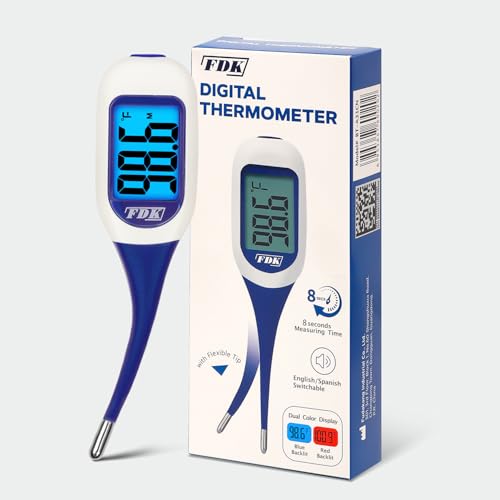
FDK Large LCD Digital Thermometer with Voice Announcement
by FDK
Best for older adults and low-vision users — color-switching LCD, English/Spanish voice readout, and a 5-year battery that eliminates replacement hassle.
Pros
- Dual-color backlit LCD switches from blue (normal) to red (fever) — the most visually clear fever indicator of any oral thermometer reviewed, requiring zero number interpretation
- English and Spanish voice announcement reads the temperature aloud after each measurement — particularly valuable for users with visual impairment or low vision
- Fully waterproof construction allows submersion for cleaning — the highest hygiene standard of any oral thermometer in this review
- CR2025 lithium battery rated for 3,000 to 5,000 readings (approximately 5 years of typical use) — essentially eliminates the battery-replacement burden
Cons
- Newer product with only a few hundred reviews — a far smaller validation pool than established competitors like Vicks or Boncare
- Voice announcement cannot be disabled in all modes — in a quiet environment or at night, the spoken readout may disturb other household members
5. Kinsa QuickCare Smart Digital Thermometer — Best App-Connected
The Kinsa QuickCare is the only oral thermometer in this review that turns temperature measurement into longitudinal health data. Every reading automatically timestamps and syncs to the free Kinsa app, where it is stored permanently alongside any symptoms you log. For adults managing conditions where fever monitoring is ongoing — cancer and chemotherapy, autoimmune disease, post-surgical monitoring, or simply wanting a complete health log — the Kinsa QuickCare provides something that no other oral thermometer offers: a documented, date-stamped temperature history accessible from any device.
The FDA clearance is meaningful context. Kinsa markets itself with connectivity features, but the underlying measurement accuracy is validated by the FDA for its intended clinical use — it is not a wellness tracker claiming accuracy it has not earned. The oral measurement accuracy of ±0.2°F matches the Vicks SpeedRead specification. The replaceable AAA battery is a practical advantage over the LR41 button cells used by competing oral thermometers — AAA cells are universally available and easy to replace.
The app dependency is a real limitation that deserves honest acknowledgment. The Kinsa QuickCare is fundamentally a smart peripheral — a device that derives most of its value from the software ecosystem rather than its hardware capabilities alone. If Kinsa as a company faces business difficulties, or if a platform update breaks Bluetooth pairing, the device reverts to a basic thermometer with 8-second readings and no memory. Users who are committed to long-term digital health tracking should consider whether they are comfortable with that dependency. For post-COVID at-home monitoring or any situation requiring documented temperature trends for a physician, the Kinsa QuickCare is the strongest oral option reviewed here. For Bluetooth thermometer options across all categories, our best Bluetooth thermometers review covers the connected market in depth.

Kinsa QuickCare Smart Digital Thermometer
by Kinsa
Best smart oral thermometer — unlimited app-based history, symptom tracking, and FDA-cleared accuracy in the most data-forward oral thermometer available.
Pros
- Free Kinsa app stores unlimited reading history with timestamps, symptom logging, and illness guidance — the most complete fever tracking system of any oral thermometer reviewed
- Bluetooth connectivity transfers each reading to the app automatically within seconds — no manual entry, no reading transcription errors
- FDA-cleared accuracy across oral, rectal, and axillary sites; the app provides age-appropriate fever guidance and suggests when to call a doctor
- Illness history accessible at any physician appointment from any device — shareable data log that supports more informed clinical conversations
Cons
- App dependency is a real limitation: if the Kinsa app is discontinued or a phone change breaks the Bluetooth pairing, the device functions only as a basic thermometer
- Some user reviews report unit failures and inconsistent Bluetooth pairing after extended use — build quality has been questioned relative to price
6. Kinsa QuickScan Smart Forehead Thermometer — Upgrade Pick
The Kinsa QuickScan is the best thermometer for adults who want a no-touch reading and the app connectivity of the Kinsa ecosystem in a single device. The 1-second forehead scan delivers a result before most users have even steadied their grip, and the automatic Bluetooth sync sends that result to the Kinsa app without any manual steps. For adults who check their temperature regularly — daily during a COVID-positive isolation period, for instance — the friction reduction of a 1-second no-touch reading versus an 8-second oral thermometer is significant over dozens of measurements.
The 50-reading on-device memory is the most generous on-device storage of any thermometer reviewed here, providing a usable trend log even if the phone is not nearby. The Kinsa app extends that to unlimited readings with full timestamps, which means a two-week fever log is accessible at a physician appointment rather than reconstructed from memory. Amazon’s Choice designation reflects strong sales velocity and positive review-to-purchase ratio — a useful signal for a product with a relatively modest review count.
The forehead infrared limitation applies here as it does to all non-contact models: readings typically run 0.5 to 1°F below oral temperature. A QuickScan reading of 99.8°F may represent a true fever of 100.4 to 100.8°F. For adults in COVID isolation who are monitoring daily for fever escalation, this correction factor should be established by taking the QuickScan reading alongside an oral reading on a known fever day, then applying that differential consistently. For borderline fever evaluation where the exact number is clinically critical — an immunocompromised patient deciding whether to go to the emergency department — the QuickScan should be supplemented with an oral or ear reading for confirmation.

Kinsa QuickScan Smart No-Touch Forehead Thermometer
by Kinsa
Best no-touch smart thermometer — 1-second forehead scan, Kinsa app fever guidance, and 50-reading on-device memory for households tracking illness trends.
Pros
- 1-second no-touch forehead scan with Bluetooth sync to the Kinsa app — the fastest measurement with the most complete data logging of any model reviewed
- 50-reading on-device memory with unlimited history in the free Kinsa app — fever trend data available without manual logging across multiple illness episodes
- Amazon's Choice designation and FDA clearance confirm both sales velocity and regulatory compliance for accuracy in its intended measurement range
- Kinsa app provides age-appropriate fever guidance and symptom tracking that helps adults decide when to seek care without a separate call to a nurse line
Cons
- Non-contact forehead readings typically run 0.5 to 1°F below oral temperature — a correction factor is necessary for borderline fever evaluation
- Under 1,000 reviews — a smaller validation pool than established non-connected forehead models, with fewer data points on long-term reliability
7. iProven Pro Series Ear and Forehead Thermometer — Best Dual-Mode
The iProven DMT-77 Pro Series solves the question most frequently asked by adults who want a single thermometer: “should I get an ear model or a forehead model?” The answer the iProven provides is “both, in the same device, with automatic switching.” Remove the probe cap and the device enters tympanic ear mode; replace the cap and it switches to non-contact forehead mode. No menu navigation, no mode buttons — the physical act of capping and uncapping the probe is the mode switch.
This design is clinically sensible. Ear measurement is more accurate for adults with a clean, unobstructed ear canal and should be the default for precision readings — confirming a borderline fever, documenting a temperature for a physician, or monitoring an immunocompromised adult. Non-touch forehead mode is faster and appropriate for quick screening checks where the exact number matters less — an adult waking from sleep who wants a rough sense of their temperature, or a caregiver doing a quick check across a household. Having both capabilities without purchasing two devices is a genuine value proposition.
The silent vibration alert is a feature I particularly appreciate for adult use. Adults — especially during illness — are often trying to rest or sleep. A thermometer that beeps loudly when the measurement is complete is disruptive in a way that a quiet vibration is not. This is a small design detail with meaningful real-world impact for anyone checking their own temperature repeatedly during a sick day. The 20-reading memory covers roughly two days of hourly checks, which is sufficient for most fever episodes. For more information about ear thermometer selection specifically, our best ear thermometers review covers the tympanic category in detail.

iProven Pro Series Ear and Forehead Thermometer (DMT-77)
by iProven
Best dual-mode thermometer — cap-on/cap-off automatic mode switching between forehead and ear, with silent vibration alert and 20-reading memory.
Pros
- Automatic mode switching: the cap-on position activates forehead infrared mode; removing the cap activates ear (tympanic) mode — no buttons to press, no menus to navigate
- 1 to 3 second dual-mode readings cover both no-touch forehead and tympanic ear measurement, giving adults the most accurate site for their current situation
- Silent vibration alert replaces the audible beep — allows nighttime readings without disturbing a sleeping partner or household member
- 20-reading memory with color-coded fever indicator provides enough trend data for a two-day fever episode without manual logging
Cons
- Forehead infrared mode carries the standard non-contact limitation of running 0.5 to 1°F below oral temperature — ear mode is the more accurate option when precision matters
- A review pool in the low thousands — reasonable for the price tier but modest compared to the Braun ThermoScan 7's pool of nearly 10,000
Most Accurate Thermometer for Adults
When adults ask me which thermometer is most accurate, the honest answer is that it depends on the measurement site, not the brand. For adults at home, the two most reliable non-invasive methods are tympanic (ear) with a properly positioned validated device and oral with correct sublingual technique — both read within roughly 0.3 to 0.5°F of core temperature. Non-contact forehead models are convenient but carry the widest error band, so they are not my first choice when a precise number will drive a clinical decision.
The Braun ThermoScan 7 is the accuracy benchmark of this review: a 2021 NIH study of thermometry systems found the Braun infrared tympanic device the most accurate against the clinical gold standard, and its ExactTemp positioning removes the alignment error that undermines cheaper ear units. For adults who prefer oral measurement, the Vicks SpeedRead and Kinsa QuickCare both specify ±0.2°F and are FDA-cleared — the tightest oral accuracy in this lineup. Whichever you choose, establish your personal baseline over a few well days rather than comparing every reading to 98.6°F.
| Product | Price | Buy |
|---|---|---|
| Braun ThermoScan 7 Ear Thermometer with Age Precision (IRT6520US)Most accurate overall (ear) NIH-validated tympanic accuracy with ExactTemp positioning — the benchmark device | $64.73 | View on Amazon |
| Vicks SpeedRead Digital Thermometer with Fever InSightMost accurate oral ±0.2°F oral with Fever InSight color display and a trusted brand name | $9.89 | View on Amazon |
| Kinsa QuickCare Smart Digital ThermometerMost accurate app-logged oral ±0.2°F FDA-cleared oral that logs every reading to a timestamped history | $29.50 | View on Amazon |
Best No-Touch Thermometer for Adults
A no-touch thermometer measures the skin over the temporal artery from 1 to 3 centimeters away — no probe in the ear or mouth, nothing to disinfect between users. That makes it the most hygienic option for a shared household and the easiest to use on an adult who is asleep, agitated, or unable to hold a probe still. The tradeoff is the standard non-contact offset: forehead readings typically run 0.5 to 1°F below oral temperature, so treat a borderline result as provisional and confirm with an oral or ear reading when the exact number matters.
The Kinsa QuickScan is my top no-touch pick — a 1-second scan that syncs each reading to the Kinsa app, so a week of daily fever checks becomes a physician-ready log without any manual entry. If you want no-touch convenience and the higher accuracy of ear measurement in a single device, the iProven DMT-77 switches automatically between forehead (cap on) and tympanic (cap off) modes, with a silent vibration alert that won’t wake a sleeping partner.
| Product | Price | Buy |
|---|---|---|
| Kinsa QuickScan Smart No-Touch Forehead ThermometerBest no-touch overall 1-second forehead scan with automatic Kinsa app logging for daily fever tracking | $38.99 | View on Amazon |
| iProven Pro Series Ear and Forehead Thermometer (DMT-77)Best no-touch + ear combo Cap-on forehead / cap-off ear switching when you want a precise reading too | $24.99 | View on Amazon |
Types of Thermometers for Adults
Understanding the measurement technology behind each thermometer type helps adults choose the right device for their situation and interpret readings correctly.
Oral (Digital Stick)
Oral thermometers measure the temperature of sublingual tissue adjacent to the lingual artery, which closely reflects core body temperature when correct technique is used. Place the tip in the sublingual pocket — the groove beside the frenulum at the base of the tongue — keep lips closed, and breathe through the nose. The accuracy of oral measurement depends almost entirely on technique and timing: wait at least 15 minutes after eating, drinking, or exercising, and hold the device in place without talking for the full reading time. For adults who can cooperate with these requirements, oral measurement is the most accurate non-invasive method available without a prescription device.
Ear (Tympanic)
Tympanic thermometers measure infrared heat emitted by the eardrum and the surrounding tissue of the ear canal, which reflects arterial blood temperature. The ear canal is anatomically close to the hypothalamus — the brain’s temperature-regulation center — making tympanic measurement one of the most direct non-invasive proxies for core temperature available. The key requirement is correct canal alignment: the probe must be aimed at the eardrum, not the canal wall. Devices like the Braun ThermoScan 7, with positioning confirmation technology, substantially reduce this alignment error. Tympanic thermometers are not recommended for adults with otitis externa (swimmer’s ear), recent ear surgery, or heavy cerumen impaction.
No-Touch Forehead Infrared
Non-contact forehead thermometers measure heat radiating from the skin surface over the temporal artery, at a standoff distance of 1 to 3 centimeters. They are fast (1 second), require no body contact, and are appropriate for quick screening. The clinical limitation is that skin surface temperature is influenced by ambient temperature, sweating, and recent outdoor exposure — factors that do not affect oral or tympanic measurement. Non-contact forehead readings typically run 0.5 to 1°F below true oral temperature. For most routine fever screening purposes this offset is manageable; for borderline fever determination, a confirmation reading with an oral or ear thermometer is advisable.
Smart and App-Connected
App-connected thermometers pair with smartphone apps via Bluetooth to store readings with timestamps, symptom annotations, and clinical guidance. The Kinsa models — both the QuickCare oral and QuickScan no-touch — are the most prominent examples in the consumer market. The clinical value of smart thermometers is not the individual reading but the longitudinal data: a documented temperature curve across a five-day illness provides your physician with far more information than a single reading taken at an office visit. For adults managing chronic conditions that require temperature monitoring as part of ongoing care, the investment in an app-connected thermometer pays dividends in clinical utility.
Accuracy by Measurement Site: A Doctor’s Perspective
Every measurement site produces a reading that reflects core body temperature imperfectly, with a characteristic offset. Understanding these offsets allows you to interpret thermometer readings correctly rather than misidentifying a fever or missing one.
| Measurement Site | Typical Offset vs. Core Temp | Accuracy Tier | Key Limitation |
|---|---|---|---|
| Rectal | Reference standard (0) | Highest | Invasive; impractical for routine adult use |
| Oral | −0.3 to −0.5°F | High (with correct technique) | Requires 15-min wait; patient cooperation |
| Tympanic (ear) | −0.3 to −0.5°F | High (with correct positioning) | Cerumen, otitis, probe alignment sensitivity |
| Temporal artery (forehead swipe) | −0.5 to −0.8°F | Moderate-high | Technique-dependent swipe speed |
| Non-contact forehead infrared | −0.5 to −1.0°F | Moderate | Ambient temp, sweat, outdoor exposure |
| Axillary (armpit) | −0.5 to −1.0°F | Lowest | Long hold time, highly variable |
Rectal measurement is the physiological reference standard, but it is impractical for routine adult self-monitoring. For adults at home, oral and tympanic ear measurement are the most clinically reliable options, followed by temporal artery forehead swipe. Non-contact forehead infrared is the most convenient but carries the widest accuracy band. Axillary measurement is the least accurate method for adults and should not be used for clinical decision-making if another site is accessible.
Is 98.6°F Still Normal?
Most adults have been told their entire lives that 98.6°F is the definition of normal body temperature. This figure originates from Carl Wunderlich’s 1851 study of patients in Leipzig, Germany — a study conducted with mercury-in-glass thermometers placed in the armpit for 15 to 20 minutes, which systematically undercorrects for the axillary-to-core offset.
A 2020 study published in eLife (Protsiv, Ley, Lankester, et al.) analyzed three large cohorts spanning 1862 to 2017 and found that mean body temperature has declined approximately 0.03°C per decade — a cumulative decline of about 0.4°C (0.7°F) since Wunderlich’s measurements. The study placed the current mean body temperature for adults at approximately 36.6°C (97.9°F), with variation by age, sex, and time of day.
The clinical implication for adult home monitoring: do not compare your reading to 98.6°F as a fixed normal. Instead, establish your personal baseline by taking three to five oral readings over several well days at the same time of day. A reading 1.0 to 1.5°F above your personal baseline is clinically meaningful regardless of whether it crosses the 98.6°F threshold. A person with a normal baseline of 97.4°F may have a significant fever at 98.9°F — yet feel reassured by comparison to the 98.6°F standard.
Special Considerations for Older Adults
Fever detection in older adults requires more clinical vigilance than in younger populations — and yet this is the demographic least well served by existing thermometer content. No competing article in this category addresses older adult fever physiology specifically. As a physician with significant experience treating older adults, I want to be direct about what the evidence shows.
Blunted fever response. Studies consistently demonstrate that older adults mount a smaller febrile response to infection than younger adults. A 2000 review in Clinical Infectious Diseases (Norman) found that up to 30% of older adults with serious bacterial infections present with no fever at all by the conventional 100.4°F threshold. More recent literature suggests that a temperature of 99.0°F to 99.5°F in an adult over 65 — particularly one with a known low baseline — should be treated with the same clinical concern as 100.4°F in a 35-year-old, especially if accompanied by confusion, unusual fatigue, loss of appetite, or functional decline.
What this means for thermometer selection in older adults. The implication is not that older adults need a more sensitive thermometer — it is that they need a thermometer they will actually use correctly and consistently. A device with a large, high-contrast display (the FDK color-changing LCD or the Braun ThermoScan 7’s color LED) reduces the cognitive burden of interpreting readings. A device with simple one-button operation — the Boncare, the FDK — reduces technique-dependent errors. A no-touch forehead scanner like the Kinsa QuickScan eliminates the coordination and cooperation required for correct oral technique.
Arthritis and grip considerations. Rheumatoid arthritis and osteoarthritis of the hands and wrists are extremely common in older adults, and the grip, button-pressing, and probe-positioning required by some thermometers can be genuinely difficult. Ear thermometers require inserting the probe into the ear canal with correct angling — challenging with arthritic hands. The Kinsa QuickScan, held at forehead distance, requires only pointing and pressing a single large button. The FDK’s voice announcement removes the need to look at the display at all. When selecting a thermometer for an older adult, consider dexterity and vision alongside accuracy specifications.
When Is a Fever an Emergency? Adult Triage Guide
Every competing article provides some guidance on fever thresholds, but none offers a complete adult triage framework. Here is what I recommend to my own patients.
100.4°F (38°C): The standard clinical fever threshold for adults. Rest, hydration, and over-the-counter fever reducers (acetaminophen or ibuprofen as appropriate for your health conditions) are appropriate first-line management. Monitor for symptom progression.
102.2°F (39°C): High fever. Continue fever-reducer treatment. If fever does not respond to medication within 2 to 4 hours or continues to rise, contact your physician or telehealth provider.
104°F (40°C) or higher: Seek emergency evaluation. Very high fevers in adults can cause dehydration, confusion, febrile seizures, and rhabdomyolysis. Do not wait.
Regardless of temperature, seek care immediately for: stiff neck (meningism), severe headache not relieved by OTC medications, rash appearing alongside fever, difficulty breathing or chest pain, confusion or altered mental status, inability to keep fluids down, or fever in an adult who has recently traveled internationally.
Fever in immunocompromised adults: Adults on chemotherapy, immunosuppressive medications (prednisone, methotrexate, biologics), post-organ transplant, or with HIV/AIDS should contact their care team at 100.4°F — do not wait for 102°F or 104°F. Neutropenic fever (in chemotherapy patients) is a medical emergency even when the patient feels only mildly unwell, because the immune system cannot mount an effective response. For adults in this category, accurate home temperature monitoring is not a convenience — it is a component of their care plan.
Post-COVID At-Home Temperature Monitoring
Adults who test positive for COVID-19 should monitor their temperature at least twice daily during the acute phase of illness — once in the morning and once in the afternoon or evening, when temperature naturally peaks. The key escalation thresholds for COVID-positive adults align with the general fever guidance above: contact a telehealth provider or physician for temperatures at or above 102°F that do not respond to fever reducers, and seek emergency evaluation for 104°F or higher, or for any fever accompanied by severe breathing difficulty, confusion, or persistent chest pain.
A consistent twice-daily log using a thermometer with memory or app connectivity — the Kinsa QuickCare or QuickScan are well-suited for this purpose — provides your physician with actionable trend data if your condition deteriorates or you need to discuss your illness trajectory over the phone. The ability to say “my temperature has been rising 0.5°F per day for the last three days and is now 102.8°F” is clinically more useful than “I have been running a fever.” For adults managing COVID at home, the investment in a thermometer with meaningful memory or app logging is directly justified.
How to Choose the Best Thermometer for Adults
The buyer’s guide below outlines the six factors I weigh when recommending a thermometer to adult patients. One additional consideration worth adding here is your specific clinical context.
If you are immunocompromised — whether from medication, cancer treatment, or disease — a validated oral or ear thermometer is non-negotiable. The accuracy margin of non-contact forehead models is too wide for the clinical decisions you may need to make. The Braun ThermoScan 7 and the Vicks SpeedRead are my first and second recommendations for this population, respectively.
If you are an older adult living alone, prioritize thermometers that are easy to use correctly without assistance: large display, simple operation, and clear fever indication. The FDK voice-announcement model and the Kinsa QuickScan no-touch are the strongest options for independent older adults. The FDK in particular addresses the accessibility needs that no other thermometer in this review directly targets.
If you want a single thermometer for a household that includes adults of different ages, the Braun ThermoScan 7’s Age Precision system is designed for exactly that use case — the age profile can be adjusted for each user, and the tympanic method works reliably across all ages from 6 months through older adulthood.
Whatever thermometer you choose, pair it with basic clinical knowledge: establish your personal baseline temperature on three to five healthy days, understand the measurement site offset for your chosen method, and know the threshold temperatures at which you should seek care rather than monitor at home.
Buyer's Guide
For most adults, the right thermometer depends on three factors: how quickly you need a reading, how much accuracy matters for your specific health context, and whether you want your readings stored and tracked over time.
Measurement Site and Accuracy
Different measurement sites produce different readings for the same true core temperature. Oral measurement is the most practical accurate method for adults — when technique is correct, it reads within 0.2 to 0.4°F of core temperature. Tympanic (ear) measurement with a validated device like the Braun ThermoScan 7 matches oral accuracy and is faster. Non-contact forehead infrared models typically run 0.5 to 1°F below oral temperature and require a correction factor for borderline fever evaluation. For routine wellness checks, any validated method works. For medically significant decisions — confirming or ruling out fever in an immunocompromised adult — oral or ear measurement is the more defensible choice.
Clinical Validation and FDA Clearance
FDA clearance confirms that a thermometer has been tested against a regulatory standard for safety and effectiveness in its intended use — it is the minimum bar for a medical device sold in the US. Beyond FDA clearance, look for independent clinical validation studies that compare the device to a hospital-grade reference thermometer across a representative population. The Braun ThermoScan 7 has the most extensive independent clinical validation record of any consumer thermometer reviewed here. For any thermometer used to make clinical decisions — dosing fever reducers, deciding whether to go to an emergency department — validated accuracy is non-negotiable.
Speed and Ease of Use
Response time ranges from 0.5 seconds (Braun ThermoScan 7 ear mode) to 10 seconds (Boncare oral). The practical question is who will be using the thermometer and under what circumstances. Adults monitoring their own temperature during illness can comfortably hold an oral thermometer for 8 to 10 seconds. For caregivers checking on sick adults who may be confused, agitated, or partially asleep, a 1-second no-touch forehead scan or a 0.5-second ear reading is significantly easier to execute correctly. For older adults with arthritis or limited hand dexterity, the Kinsa QuickScan no-touch or the FDK voice-announcement model eliminates fine motor requirements entirely.
Display Readability
Fever checks frequently happen in the middle of the night, in dimly lit rooms, or by caregivers with visual limitations. A backlit display that shows the reading clearly in low light is a meaningful quality-of-life feature — not a cosmetic specification. Color-coded fever indication that uses green, yellow, and red to communicate normal, elevated, and fever states removes the cognitive step of interpreting a number at 3 a.m. The FDK model goes further with a voice announcement that reads the temperature aloud in English or Spanish. For older adults or those with visual impairment, display features are a primary selection criterion, not an afterthought.
Memory and Tracking
Single readings are clinically less informative than trends. A temperature that rises from 99.2°F to 101.1°F over six hours tells a different clinical story than a stable 101°F over the same period. On-device memory ranges from 1 reading (Vicks SpeedRead, Boncare, FDK) to 50 readings (Kinsa QuickScan) to unlimited via app (Kinsa QuickCare, Kinsa QuickScan). For adults managing a multi-day illness, chronic disease, or post-COVID monitoring, a thermometer with meaningful memory or app connectivity allows you to report an accurate temperature log to your physician rather than relying on recalled impressions. The Kinsa QuickCare app also timestamps readings and allows symptom annotation alongside temperature data.
HSA and FSA Eligibility
All seven thermometers in this review are HSA and FSA eligible under the CARES Act. If you have a flexible spending account or health savings account, your thermometer purchase qualifies for tax-advantaged reimbursement — reducing the effective out-of-pocket cost by your marginal tax rate. For accounts with a use-it-or-lose-it FSA deadline, a thermometer purchase is one of the most medically defensible ways to spend remaining funds. Use your FSA or HSA card directly at Amazon checkout, or submit a receipt through your plan administrator. The Braun ThermoScan 7 explicitly notes FSA/HSA eligibility on its Amazon product page.
Final Verdict
For most adults who want the single best thermometer available, the Braun ThermoScan 7 is our clear Best Overall pick. Its 0.5-second tympanic reading, Age Precision fever calibration, pre-warmed probe tip, and ExactTemp positioning system combine to deliver the most clinically reliable consumer thermometer available on Amazon — the standard against which other ear thermometers are measured, and the product most frequently recommended by US physicians. It is FSA and HSA eligible, which reduces the effective cost for buyers with flexible spending accounts.
For adults who need a reliable oral thermometer without the cost of the Braun, the Vicks SpeedRead is the runner-up: ±0.2°F accuracy, Fever InSight color display, and the most trusted brand name in the category. For budget-conscious buyers, the Boncare at the lowest price point in this review provides basic oral thermometry with more than 26,000 reviews backing its real-world reliability — an appropriate choice for backup devices, travel kits, or first-time buyers who want low risk and low cost.
For older adults and those with visual impairment, the FDK Large LCD with its color-switching display and voice announcement addresses needs that no other thermometer in this category takes seriously. And for adults who want a longitudinal fever log — for post-COVID monitoring, chronic disease management, or physician-ready data — the Kinsa QuickCare oral or Kinsa QuickScan no-touch provide app-connected tracking that transforms individual readings into clinically useful trend data.
As always, consult your physician or healthcare provider about the right fever thresholds and monitoring protocol for your specific health situation. A thermometer is a tool — clinical judgment, especially when applied to the unique physiology of each individual patient, remains irreplaceable.
Frequently Asked Questions
What type of thermometer is most accurate for adults?
Is 98.6°F still the normal adult body temperature?
What temperature counts as a fever in adults, and when should I call a doctor?
Are thermometers covered by HSA or FSA?
How do I get an accurate temperature reading with an oral thermometer?
Can I use a digital thermometer rectally for a more accurate adult reading?
Related Articles
About the Reviewer

Dr. David Taylor, MD, PhD
Drexel University College of Medicine (MD), Indiana University School of Medicine (PhD)
Dr. David Taylor is a licensed physician and medical researcher who founded BestRatedDocs in 2016. With an MD from Drexel University and a PhD from Indiana University School of Medicine, he combines clinical expertise with a passion for health technology to provide evidence-based product recommendations. Dr. Taylor specializes in health informatics and regularly evaluates medical devices, diagnostic equipment, and therapeutic products to help healthcare professionals and patients make informed decisions.