7 Best Ear Endoscope Cameras of 2026
Dr. David Taylor reviews the best ear endoscope cameras for home use. Compare top WiFi ear cameras by image quality, probe flexibility, app compatibility, and value.
Updated
Every year, millions of Americans make unnecessary urgent care visits for earwax buildup that a quick visual inspection might have clarified days earlier. Consumer ear endoscope cameras — also called ear cameras, visual ear cleaners, or otoscope cameras — have brought a live, high-definition view of the ear canal to the smartphone screen, making it straightforward for anyone to see what is happening in their ears, document it, and share it with a healthcare provider before or instead of a clinic visit. In 2026 — with every pick’s pricing and in-stock availability re-verified in June — we reviewed seven of the best ear endoscope cameras available on Amazon to identify the options that deliver genuine diagnostic and cleaning value across a range of budgets, connection preferences, and household use cases.
Our assessment draws on Amazon review analysis spanning thousands of verified user experiences, published product specifications, Dr. David Taylor’s clinical perspective on home diagnostic tools, and hands-on analysis of how each model’s hardware and app perform in real-world conditions. If you are managing routine earwax buildup, monitoring ear health between physician visits, or looking for a practical tool for family ear care, this guide will help you identify the right ear camera for your situation. For related home diagnostic tools, our best otoscopes guide covers clinical-grade digital otoscopes, and our best diagnostic sets guide reviews multi-tool home health kits.
| Product | Price | Buy |
|---|---|---|
| Bebird Earsight Plus D39R Ear Wax Removal Tool CameraBest Overall | $46.99 | View on Amazon |
| Bebird Earsight Ultra Ear Wax Removal Tool CameraPremium Pick | $69.99 | View on Amazon |
| BEBIRD R1 Wax Removal Tool for EarBudget Pick | $23.39 | View on Amazon |
| DEETOK Ear Wax Removal Tool CameraRunner-Up | $12.99 | View on Amazon |
| Jegoat Ear Wax Removal Tool Camera | $16.99 | View on Amazon |
| Yorsfun Ear Wax Removal 3 in 1 Earwax Removal Kit | $21.99 | View on Amazon |
| Anykit Digital Otoscope with Gyroscope, 4.5 Inches Screen | $92.99 | View on Amazon |
Bebird Earsight Plus D39R — Best Overall
The consumer ear endoscope category has matured significantly in recent years, but most models still rely on a rigid probe that the user inserts straight into the ear canal at a fixed angle. The Bebird Earsight Plus D39R takes a different approach with its 270-degree flexible silicone tube lens — the probe tip bends to follow the natural curve of the ear canal, reducing the awkward repositioning that rigid cameras require. For self-inspection particularly, this flexibility means the probe tip reaches angles of the canal wall that a straight rigid probe simply cannot access without significant head tilting.
The D39R ships as a genuinely comprehensive kit: four tip types covering scoop, tweezers, dropper, and pick functions let a single device handle wet earwax, dry earwax, and precise debris removal without purchasing additional accessories. The built-in safety stopper with a calibrated depth scale is the standout safety feature — it physically prevents over-insertion, which is the most common misuse risk with home ear cameras, especially in households with children. FSA/HSA eligibility makes the price more accessible for plan holders, and Bebird’s 24-month warranty is the most generous in this review. The one trade-off is the AA battery requirement rather than a built-in USB-C rechargeable cell — a minor but genuine inconvenience.

Bebird Earsight Plus D39R Ear Wax Removal Tool Camera
by Bebird
Best overall ear endoscope — flexible 270° lens, four cleaning modes, FSA eligible, and a safety stopper for safe family use.
Pros
- 270-degree flexible silicone tube lens navigates the natural curve of the ear canal without painful repositioning
- FSA/HSA eligible, making it accessible as a pre-tax health expense for qualifying plan holders
- Four interchangeable tip types — scoop, tweezers, dropper, pick — handle both wet and dry earwax in one kit
- Built-in safety stopper with a calibrated depth scale prevents over-insertion for adults and children alike
Cons
- Requires AA batteries rather than USB-C charging — an inconvenience compared to most competing models
- Flexible neck adds slightly more setup complexity than rigid-probe cameras for first-time users
How We Selected These Ear Cameras
We focused exclusively on consumer ear endoscope cameras with documented availability on Amazon and sufficient review volume to assess real-world consistency. Our selection criteria prioritized meaningful differentiation — each model in this review offers something the others do not, whether it is a flexible probe, standalone screen, the largest tip bundle, the highest resolution, multi-cavity versatility, or the lowest price. We excluded products with generic brand provenance and models where the review pools showed significant quality control inconsistency. Seven models were selected to span the full category: flexible probe, 2K HD premium, budget wireless, high-volume-tip household pick, above-1080P mid-range value, multi-purpose 3-in-1, and a standalone screen option for phone-free use.
Bebird Earsight Ultra — Upgrade Pick
For users who want the sharpest possible image quality and the most stable wireless connection, the Bebird Earsight Ultra is the clear upgrade pick. Its 2K HD camera paired with a 5G Wi-Fi chip delivers real-time video at a resolution meaningfully above the standard 1080P models in this review — fine canal wall texture, earwax color variation, and subtle changes in the eardrum appearance are all rendered with greater fidelity. The 5G connection also addresses the occasional lag and dropout issues that affect 2.4GHz Wi-Fi models on congested home networks.
The 90-minute battery is a practical advantage in larger households where multiple family members need ear inspection in a single session. The five tip variants — more options than most competitors — cover the full range of earwax consistency types. For users who photograph or video-record canal views to share with a physician via telemedicine, the 2K resolution makes a tangible difference in image quality at the receiving end. The 5G requirement is the primary compatibility caveat: users with older routers that broadcast only on 2.4GHz should confirm their network supports 5GHz before purchasing.

Bebird Earsight Ultra Ear Wax Removal Tool Camera
by Bebird
Premium upgrade pick — 2K HD resolution with 5G Wi-Fi for near-zero-lag streaming and a 90-minute battery for whole-family sessions.
Pros
- 2K HD camera with 5G Wi-Fi chip delivers near-zero-lag real-time video — significantly sharper than standard 1080P models
- 90-minute battery life covers multiple family members in a single session without recharging
- Premium 4P endoscope lens produces accurate color reproduction for identifying earwax versus canal wall tissue
- Includes five scoop tip variants for wet earwax, dry earwax, gripping, scraping, and precise picking
Cons
- Among the priciest options in this review — a meaningful investment for occasional household use
- 5G Wi-Fi connection requires a compatible 5GHz network band; older routers broadcasting only 2.4GHz may cause pairing issues
BEBIRD R1 Wax Removal Tool — Budget Pick
The Bebird R1 is the most-reviewed ear camera in this guide, with over 11,000 ratings on Amazon providing a large pool of real-world performance data that smaller-volume products cannot match. This extensive review base is itself meaningful evidence of consistent build quality — products with significant defect rates do not accumulate thousands of positive ratings over time. The 1080P HD sensor with a 6-LED cold-light ring delivers clear, adequately illuminated views of the ear canal at a price that sits well below mid-range alternatives.
The R1 connects via Wi-Fi to both iOS and Android through the Bebird app, which has earned consistently strong marks across platforms. Multiple tip variants handle both wet and dry earwax. The trade-offs relative to more expensive Bebird models are real: no gyroscope means self-inspection without a helper is more mentally demanding, and the battery runtime of approximately 30–40 minutes is the shortest in this review. For budget-conscious buyers who want a reliable, brand-backed wireless ear camera for occasional personal or family use, the R1’s price-to-performance ratio is difficult to beat. It is the right starting point for anyone entering this product category for the first time.

BEBIRD R1 Wax Removal Tool for Ear
by Bebird
Best budget ear camera — over 11,000 reviews back the Bebird R1's 1080P wireless performance at the category's lowest brand-name price.
Pros
- One of the most-reviewed ear cameras on Amazon with over 11,000 ratings — extensive real-world validation
- 1080P HD sensor with 6 LED cold-light ring provides clear illumination at an entry-level price
- Wi-Fi connection supports both iOS and Android without adapters or cables
- Multiple replacement tip variants accommodate both oily and dry earwax cleaning styles
Cons
- No gyroscope — self-inspection without a helper requires mentally interpreting a rotating image
- Battery capacity is smaller than mid-range models, with approximately 30–40 minutes of continuous runtime
DEETOK Ear Wax Removal Tool Camera — Runner-Up
The Deetok ear camera earns its runner-up position primarily on the strength of its accessory bundle. Fifty silicone ear tips is the most generous inclusion in this review by a substantial margin — a family of four sharing the device can rotate through dedicated sets of tips per person and still have replacements for months. This hygiene-forward approach makes the Deetok particularly well-suited to households where the ear camera will be a communal tool rather than a personal device.
Beyond the tip bundle, the 90-minute battery life is the equal of much more expensive models, and the FSA/HSA eligibility broadens its accessibility. The 1080P HD wireless connection to iOS and Android works without internet — the camera creates its own local Wi-Fi network — which means it functions in any location without a router dependency. The primary gaps relative to the Bebird D39R are the absence of a gyroscope and the less flexible probe design; for users who prioritize accessory quantity and battery runtime over probe flexibility, the Deetok delivers excellent value for the price. Pair it with a blood pressure monitor or other home health devices for a comprehensive household monitoring setup.

DEETOK Ear Wax Removal Tool Camera
by Deetok
Runner-up pick — 50-piece tip bundle and 90-minute battery make this the top choice for families needing high-volume hygienic use.
Pros
- Includes 50 replacement silicone ear tips — the largest accessory bundle in this review for hygienic multi-user households
- 90-minute continuous use battery with 30-day standby rivals much more expensive models
- 1080P HD wireless camera connects to iOS and Android via the companion app with no internet access required
- FSA/HSA eligible, broadening purchase accessibility for health account holders
Cons
- App interface has been noted by some reviewers as less polished than the Bebird app on older Android versions
- No gyroscope stabilization — image rotation must be compensated manually during self-inspection
Jegoat Ear Wax Removal Tool Camera
The Jegoat ear camera occupies an interesting position in the mid-range: a 1296P HD sensor at a price that competes directly with standard 1080P alternatives. That resolution step — from 1080P to 1296P — is modest but visible in side-by-side comparison, particularly when examining fine canal wall texture or attempting to document subtle color variations for a physician. The 70-minute battery is solid for the price tier, and the 10-silicone-tip plus 7-piece traditional ear care kit bundle covers the common cleaning scenarios without requiring immediate accessory repurchase.
The Jegoat’s primary limitation is brand maturity. Bebird and Deetok have years of Amazon review history and established customer support ecosystems. Jegoat, while consistent in its review pool, has a smaller sample and less documented long-term durability data. For buyers comfortable with a newer brand in exchange for above-average resolution at a mid-range price, the Jegoat is a sound choice. If brand support and warranty infrastructure matter more, spend slightly more for the Deetok or Bebird options.

Jegoat Ear Wax Removal Tool Camera
by Jegoat
Best value mid-range — 1296P resolution above 1080P peers, 70-minute battery, and solid accessory bundle at a competitive price.
Pros
- 1296P HD resolution — a step above standard 1080P for clearer canal wall detail at the same price tier
- Body-temperature-calibrated probe tip is designed to minimize discomfort sensation during insertion
- 70-minute battery covers most household inspection needs on a single charge
- 10 silicone ear tips plus a 7-piece traditional ear care kit provide solid accessory value
Cons
- Less established brand than Bebird or Deetok — a smaller review base means less long-term durability data
- App lacks some advanced features like LED brightness control and video diary found in the Bebird ecosystem
Yorsfun 3-in-1 Earwax Removal Kit
The Yorsfun is the most versatile tool in this review because its 1080P camera and tip system cover ear, nasal, and scalp inspection in a single device. For households where multiple body areas need periodic monitoring — adults managing chronic nasal congestion, parents inspecting a child’s throat, or individuals tracking scalp health — this 3-in-1 approach delivers meaningful value that single-purpose ear cameras cannot. The 6 LEDs and 1080P resolution are more than adequate for all three inspection contexts, and the 90-minute battery ensures the device can move through multiple use cases in a single session.
The 15 replacement silicone tips and 7-piece traditional ear care kit make the Yorsfun one of the more accessory-complete options in the mid-price tier, and FSA/HSA eligibility is a genuine bonus. The functional switching between the three modes — via tip swaps — requires a moment of setup that single-purpose cameras skip, which may feel slightly cumbersome for users who only ever plan to inspect ears. But for households that will genuinely use all three functions, the Yorsfun eliminates the cost and clutter of purchasing separate tools for each body area.

Yorsfun Ear Wax Removal 3 in 1 Earwax Removal Kit
by Yorsfun
Best multi-purpose pick — 3-in-1 ear, nose, and scalp camera with a 90-minute battery and FSA eligibility for household versatility.
Pros
- 3-in-1 design combines endoscope, ear pick, and nasal/scalp inspection capability in a single device
- 1080P HD camera with 6 LEDs covers ear, nose, and scalp inspection for multi-purpose household utility
- 90-minute continuous battery life with 30-day standby on a single charge
- FSA/HSA eligible with 15 replacement silicone tips for shared multi-user hygienic use
Cons
- Switching between the three function modes requires tip swaps that may feel fiddly for new users
- Smaller review base than established brands — fewer long-term ownership reports available
Anykit Digital Otoscope with 4.5-Inch Screen
The Anykit Digital Otoscope is categorically different from every other product in this review because it does not need a smartphone. The 4.5-inch built-in HD screen displays the live camera feed directly on the device — connect the probe, turn it on, and see your ear canal without downloading an app, pairing with Wi-Fi, or reaching for your phone. This self-contained design makes the Anykit the right choice for users who find smartphone app pairing unreliable, households where the ear camera will be used by elderly family members unfamiliar with app-based tools, or any situation where phone-free simplicity is the priority.
The built-in gyroscope automatically corrects image orientation as the probe rotates — a feature notably absent from most competitors at this price. The 32GB card records photos and video directly on-device without cloud storage or app export, and the 3-level adjustable LED brightness addresses the glare management gap that fixed-brightness cameras cannot resolve. The trade-off is physical size: the Anykit is larger and heavier than slim camera-only probes, and it requires a dedicated storage space rather than fitting in a pocket alongside a phone. For users for whom the standalone screen and gyroscope combination is the priority, those trade-offs are well worth it. For a comparison of how clinical-grade ear examination tools differ from consumer cameras, see our best otoscopes review.
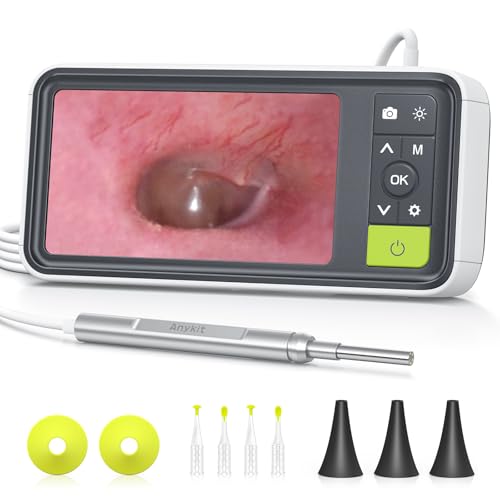
Anykit Digital Otoscope with Gyroscope, 4.5 Inches Screen
by Anykit
Best for no-phone use — 4.5-inch built-in screen with gyroscope and 32GB recording, no smartphone or app required.
Pros
- Built-in 4.5-inch HD screen eliminates the need for a smartphone — works completely standalone for users without compatible phones
- Built-in gyroscope delivers automatic image stabilization for correctly oriented real-time viewing regardless of probe rotation
- 32GB card included for on-device photo and video recording without cloud dependency
- 3-level adjustable LED brightness prevents glare on reflective earwax surfaces — a feature most competitors lack
Cons
- Larger and heavier than smartphone-dependent ear cameras — less compact for storage or travel
- Bulkier device footprint requires dedicated storage space, unlike slim camera-only probes
How to Choose the Best Ear Endoscope Camera
The buyer’s guide above covers the five core variables that drive meaningful differences between ear cameras. A few additional considerations are worth highlighting for specific use cases.
For telemedicine and physician sharing: The ability to export video and photos from the companion app directly to a messaging platform is the single most useful clinical communication feature in this category. If documenting and sharing ear canal findings with a healthcare provider is part of your goal, prioritize models with robust app video export — the Bebird ecosystem (D39R, Earsight Ultra, R1) all handle this well. The Anykit’s on-device 32GB recording also supports this use case without a phone.
For pediatric use: Children’s ear canals are narrower and more sensitive than adults’. A safety stopper — present on the Bebird Earsight Plus D39R — is the most important safety feature for households with young children. Second priority is probe diameter: narrower probes are more comfortable for young ears. All Wi-Fi models in this review connect to a parent’s phone, making the inspection visible to the parent while a second adult holds the child still.
For seniors and less tech-comfortable users: The Anykit Digital Otoscope is the clear choice. Its built-in screen removes the app pairing step entirely. For Wi-Fi models, the Bebird app consistently earns high marks for simplicity — connect, open the app, and the live view appears.
Finally, remember that ear cameras are observation and light cleaning tools, not diagnostic devices. They can show you what is present in your ear canal, but accurately interpreting what you see — distinguishing earwax from infection discharge, identifying a perforated eardrum, recognizing otitis externa — requires clinical training. Use your ear camera to document, monitor changes over time, and support informed conversations with your physician. If you observe ear pain, sudden hearing loss, visible discharge, or a perforated-looking eardrum, seek professional evaluation promptly regardless of what the camera image appears to show.
Buyer's Guide
Choosing the right ear endoscope camera depends on five key variables: image quality, probe design, connection method, gyroscope stabilization, and the accessory bundle. Here are the factors that matter most.
Camera Resolution and LED Lighting
Resolution determines how clearly you can distinguish the ear canal wall, earwax texture, and eardrum surface. Models in this review range from 1080P to 2K HD. More important than raw resolution is the quality of the LED ring — uneven or dim LEDs create shadows and hot spots that obscure detail even on high-resolution sensors. Look for 6 or more LEDs with even circumferential illumination, and prefer models offering adjustable brightness to manage glare on reflective earwax surfaces.
Probe Flexibility and Diameter
Rigid probes are simpler and lower cost, but they navigate the natural curve of the ear canal with more discomfort and less visual coverage. Flexible probes — such as the 270-degree bendable silicone tube on the Bebird Earsight Plus D39R — can follow the canal's anatomy without the user having to reposition their head repeatedly. For households with children or users with sensitive ears, a narrower probe and built-in safety stopper are the highest-priority safety features.
Connectivity — Wi-Fi vs. Standalone Screen
Wi-Fi ear cameras connect to a smartphone app, putting the live view on a familiar large screen with photo and video sharing built in. They require a 2.4GHz or 5GHz network and a compatible phone. Standalone screen models like the Anykit Digital Otoscope eliminate phone dependency entirely — the display is built in — which is valuable for users without compatible smartphones or who prefer a dedicated device. For iPhone users, any Wi-Fi model in this review will work seamlessly with the iOS app.
Gyroscope Stabilization
A built-in gyroscope automatically corrects image rotation as the probe rotates in the ear canal, keeping the video feed correctly oriented on screen regardless of the angle. Without a gyroscope, self-inspection is disorienting — the image rotates with the probe, requiring continuous mental remapping. If you plan to inspect your own ears without a helper, prioritize a model with gyroscope correction. The Anykit Digital Otoscope is the gyroscope-equipped standout at this price tier.
Accessory Bundle and Tip Variety
The ear spoon and tip kit determines how versatile the device is for different earwax types and family members. Wet earwax and dry earwax require different tool geometries — scoop tips for dry, softer options for wet. Multi-purpose models include tweezers, dropper tips, and scrapers. For hygienic multi-user households, the number of included silicone replacement tips matters: the Deetok includes 50 tips, which is the most generous in this review. Always check whether replacement tip packs are available and reasonably priced before committing to a brand.
FSA/HSA Eligibility and Warranty
Several models here are FSA/HSA eligible, meaning the purchase qualifies as a pre-tax medical expense under most flexible spending and health savings account plans — the Bebird Earsight Plus D39R, Bebird Earsight Ultra, Deetok, and Yorsfun all carry this designation. Beyond eligibility, look for a warranty of at least one year and accessible customer support. Ear cameras are used near a sensitive body part, and quality assurance matters. Bebird offers a 24-month warranty on most models, which is the strongest coverage in this category.
Final Verdict
For most households, the Bebird Earsight Plus D39R is the best overall choice in 2026. Its 270-degree flexible probe, four-function tip kit, built-in safety stopper, and FSA/HSA eligibility represent the most complete package for family ear care, and Bebird’s 24-month warranty provides meaningful assurance for a tool used near a sensitive body part. If budget is the primary constraint, the Bebird R1 delivers solid 1080P wireless performance backed by over 11,000 Amazon ratings at the category’s most accessible price.
Users who prioritize maximum image sharpness and lag-free streaming should consider the Bebird Earsight Ultra — its 2K HD sensor and 5G Wi-Fi chip make it the highest-performance wireless ear camera available at a premium that reflects the hardware investment. And for anyone who wants to skip smartphone pairing entirely, the Anykit Digital Otoscope with its built-in 4.5-inch screen and gyroscope stabilization is the clear choice. As always, consult your physician if you observe anything unusual during a home ear inspection, and seek professional care for ear pain, discharge, sudden hearing changes, or any symptom that persists beyond a few days. Our best hearing aids guide covers options for users managing diagnosed hearing conditions.
Frequently Asked Questions
Are ear endoscope cameras safe for home use?
What is the difference between an ear endoscope camera and a traditional otoscope?
What probe flexibility and diameter should I look for?
Do ear camera apps work on both iPhone and Android?
Can an ear endoscope camera detect ear infections?
How do I clean and maintain an ear endoscope camera?
Related Articles
About the Reviewer

Dr. David Taylor, MD, PhD
Drexel University College of Medicine (MD), Indiana University School of Medicine (PhD)
Dr. David Taylor is a licensed physician and medical researcher who founded BestRatedDocs in 2016. With an MD from Drexel University and a PhD from Indiana University School of Medicine, he combines clinical expertise with a passion for health technology to provide evidence-based product recommendations. Dr. Taylor specializes in health informatics and regularly evaluates medical devices, diagnostic equipment, and therapeutic products to help healthcare professionals and patients make informed decisions.