7 Best Elbow Braces of 2026
Physician-reviewed: the 7 best elbow braces for tennis elbow, golfer's elbow, cubital tunnel syndrome, and ligament instability. Compare by type, fit, and condition.
Updated
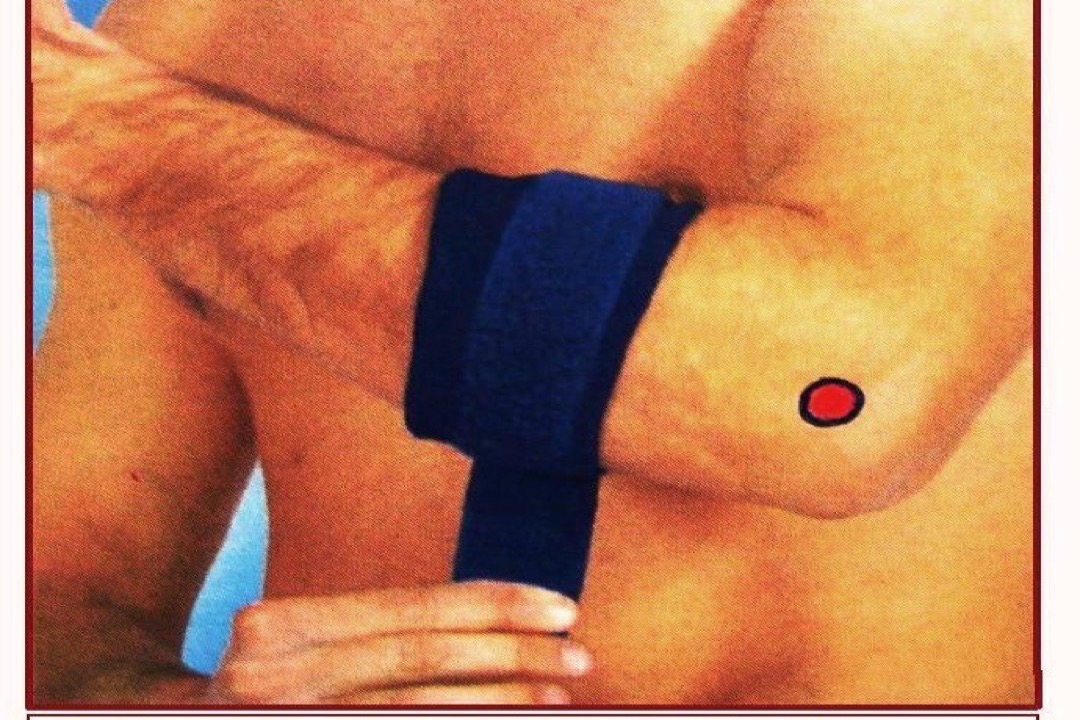
Lateral epicondylitis — commonly known as tennis elbow — affects an estimated 1 to 3 percent of the adult population in the United States, translating to roughly 200,000 new cases diagnosed each year. Despite its name, fewer than 5 percent of cases occur in tennis players; the condition predominantly strikes adults aged 35 to 50 who perform repetitive forearm extension movements in occupational settings — painters, plumbers, carpenters, and office workers with poor ergonomics. The pathology originates at the extensor carpi radialis brevis (ECRB) tendon, where chronic tensile overload causes micro-tears at the lateral epicondyle attachment. A well-chosen elbow brace can meaningfully reduce pain and restore function during the healing process — but only if the brace type matches the underlying condition.
The elbow is also the site of three other distinct clinical syndromes that require different types of bracing: medial epicondylitis (golfer’s elbow), cubital tunnel syndrome (ulnar nerve compression at the elbow’s medial groove), and ulnar collateral ligament (UCL) instability from throwing sports or overextension injuries. Each condition has a mechanically different treatment target, which is why the elbow brace market includes four functionally distinct product categories — and why selecting the wrong one provides no benefit. In 2026, we reviewed seven of the best-selling elbow braces on Amazon, spanning all four categories, to give you a clear path from diagnosis to the right brace.
Understanding the Four Types of Elbow Braces
Before comparing products, it is worth establishing what each brace category does and does not accomplish — because this single decision narrows the field from seven products to two or three relevant options for most buyers.
Counterforce straps are narrow bands worn approximately 1 to 2 inches below the elbow joint. They work by compressing the bulk of the extensor (or flexor, for golfer’s elbow) muscle, partially redistributing tensile force away from the inflamed tendon attachment at the epicondyle. This is the standard brace treatment for both tennis elbow and golfer’s elbow, and it has the strongest clinical evidence base of the four categories.
Compression sleeves cover the full elbow joint and provide broad joint support, warmth, and proprioceptive feedback. They are appropriate for arthritis, bursitis, general tendonitis affecting the whole elbow region, and for gym users who want joint protection during heavy compound lifting.
Cubital tunnel splints are positional immobilizers designed primarily for nighttime use. Cubital tunnel syndrome — compression of the ulnar nerve at the elbow — worsens with sustained elbow flexion during sleep. The splint holds the elbow in slight extension, relieving pressure on the nerve. No counterforce strap or compression sleeve addresses this mechanism.
Hinged elbow braces provide medial and lateral ligament support with polycentric hinges that control range of motion. They are the clinical tool for UCL injuries, post-surgical rehabilitation, and hyperextension protection in throwing sports — a fundamentally different application from epicondylitis management.
How We Selected These Elbow Braces
Our selection methodology prioritized products with meaningful review volume (at least 1,000 verified Amazon ratings), design differentiation across the four brace categories, and clinical relevance to the most common elbow conditions seen in orthopedic and primary care settings. We evaluated counterforce straps by pad design and adjustability, sleeves by material breathability and sizing accuracy, the cubital tunnel splint by immobilization mechanism and overnight wearability, and the hinged brace by hinge quality and rehabilitation applicability. We did not include products that make unsupported clinical claims or that appear to be rebranded generics without distinguishing engineering characteristics. If you are managing a knee condition alongside your elbow injury, our knee brace review applies the same evaluation framework.
1. Sleeve Stars Tennis Elbow Brace with Compression Pad — Best Overall
The Sleeve Stars counterforce strap earns the best overall designation by solving the two most common complaints about elbow braces at this price tier: fixed compression that cannot be adjusted, and a pad that only works for lateral epicondylitis. By including three interchangeable straps with different tension profiles and a repositionable gel pad, Sleeve Stars gives the user the ability to dial in both the compression level and the anatomical pad position across multiple wears — an approach that mirrors how a physical therapist would approach brace fitting.
The pad repositionability is clinically significant. Tennis elbow pain originates at the lateral epicondyle on the outside of the elbow; golfer’s elbow pain originates at the medial epicondyle on the inside. A single fixed-position pad can only target one side. The Sleeve Stars pad slides and anchors on either side of the forearm, meaning a single brace covers both presentations without requiring the user to purchase two different products. For users whose elbow pain has been inconsistently localized — or whose dominant arm injury has shifted — this adaptability is worth more than the modest price premium over single-pad designs.
The latex-free breathable fabric is a practical inclusion. Latex sensitivities are common enough in the clinical population that it is worth noting, and the non-neoprene construction means extended daytime wear is comfortable without the heat retention that reduces compliance in neoprene alternatives. The positioning learning curve noted in the cons is real but temporary — the included instructions are detailed enough that most users report confident placement by the second or third wear.

Sleeve Stars Tennis Elbow Brace with Compression Pad
by Sleeve Stars
The most versatile counterforce strap on Amazon — three swappable straps and a repositionable pad cover both lateral and medial epicondylitis.
Pros
- 3 interchangeable compression straps allow precise tension adjustment — no single fixed compression level across all users
- Repositionable gel pad accommodates both lateral epicondylitis (tennis elbow) and medial epicondylitis (golfer's elbow) without buying two braces
- Hook-and-loop closure stays anchored during racket sports, weightlifting, and tool use without mid-activity slipping
- FSA and HSA eligible — out-of-pocket cost is recoverable through pre-tax health accounts
Cons
- Sold as a single unit; buyers who want one for each arm pay twice
- Correct pad positioning takes a few wears to master — first-time users sometimes place it too high or too low
2. CAMBIVO 2 Pack Tennis Elbow Brace with Compression Pad — Budget Pick
The CAMBIVO 2-pack is the clearest value argument in the elbow brace category. For under $10, the buyer receives two braces — one for each arm, or a backup when the primary brace is being hand-washed. At under $5 per unit, the CAMBIVO removes any financial barrier to trialing bracing as a first-line treatment before committing to more expensive physical therapy accessories or injection therapy.
The neoprene SBR pad construction is firmer than fabric gel alternatives, which some users prefer for the sense of definite compression. The neoprene material in this context is targeted to the compression pad only, not the full band, which limits the heat retention issue to the pad area rather than the entire circumference of the forearm. For buyers who have already confirmed they respond to counterforce bracing and simply need a reliable, affordable replacement or backup, the CAMBIVO 2-pack is the rational economic choice.
The tradeoff versus the Sleeve Stars is adjustability. The CAMBIVO uses a single fixed-position neoprene pad with standard hook-and-loop closure — effective for straightforward lateral epicondylitis where pain is centered directly over the epicondyle, but less adaptable if pain is slightly off-center or alternates between medial and lateral presentations. As a first brace for a user who has just been diagnosed and is testing whether bracing helps their symptoms, the CAMBIVO 2-pack is a low-cost starting point with enough clinical validity to be useful.

CAMBIVO 2 Pack Tennis Elbow Brace with Compression Pad
by CAMBIVO
Under $10 for two braces — the CAMBIVO 2-pack is the clearest budget entry point for first-time elbow brace users.
Pros
- Two-pack brings the per-brace cost under $5 — the most affordable verified elbow brace option on Amazon
- Neoprene compression pad delivers firm, focused pressure on the extensor muscle origin without complex fitting
- Universal fit works on either arm and accommodates most adult forearm circumferences without separate sizing
- FSA and HSA eligible at under $10 for both braces combined
Cons
- Single fixed pad is less adjustable than multi-strap designs for users whose pain sits off-center on the epicondyle
- Neoprene retains heat during prolonged use — can feel uncomfortably warm in summer or during intense exercise
3. DonJoy Performance Bionic Elbow Brace II — Upgrade Pick
DonJoy (a brand of DJO Global, now Enovis) has a 40-year history designing orthopedic braces for professional athletes and post-surgical rehabilitation programs. The Bionic Elbow Brace II is not a treatment for tennis elbow — it is a structural ligament support device for UCL injuries, medial and lateral collateral ligament instability, and elbow hyperextension. These are the conditions that end pitching careers, sideline offensive linemen, and require “Tommy John” surgical reconstruction when left unmanaged.
The bilateral polycentric hinges are the defining feature. Unlike single-axis hinges that only limit one plane of motion, polycentric hinges follow the elbow’s natural anatomical rotation arc, providing controlled motion that supports both the medial collateral ligament (MCL) on the inside and the lateral collateral ligament (LCL) on the outside simultaneously. The adjustable hyperextension stops allow a physician or athletic trainer to set hard limits on extension range during rehabilitation, preventing re-injury during the progressive return to activity. This is the same design principle used in clinical post-surgical elbow braces costing several hundred dollars — the Bionic II brings it into a consumer price tier while maintaining DonJoy’s engineering standards.
If you are managing anything from the counterforce strap category — epicondylitis, general tendonitis, overuse pain — the DonJoy is not the right choice, and its bulk and price are unwarranted. If you have experienced a UCL sprain, posterior elbow instability, or a hyperextension injury, and your physician has recommended elbow bracing during recovery, the Bionic II is the appropriate consumer-available option. Pair it with a TENS unit for pain management during the rehabilitation period.

DonJoy Performance Bionic Elbow Brace II
by DonJoy Performance
Clinical-grade hinged elbow brace from the brand worn by professional athletes — the right tool for UCL injuries, hyperextension, and post-surgical recovery.
Pros
- Bilateral polycentric hinges protect both the medial collateral and lateral collateral ligaments simultaneously — essential for UCL injuries
- Adjustable hyperextension stops allow the physician or athletic trainer to set a safe range of motion during rehabilitation
- Removable hinges simplify cleaning and allow the shell to be worn as a compression sleeve during recovery progression
- DonJoy is the trusted brand of professional sports medicine programs — worn in the MLB, NBA, and NFL by injured athletes
Cons
- Premium price reflects clinical-grade construction; not warranted for standard tennis elbow or mild tendonitis
- Bulkier profile than counterforce straps or sleeves — noticeably visible under clothing and slightly restrictive for fine motor tasks
4. Bodyprox Elbow Brace 2 Pack for Tennis and Golfer’s Elbow — Runner-Up
The Bodyprox is the most-reviewed elbow brace on Amazon — 33,000 verified ratings provide a statistical confidence in real-world performance that smaller review pools simply cannot replicate. When a product accumulates that volume of feedback across diverse users (different ages, activity levels, arm sizes, and pain presentations), the aggregate signal becomes meaningful clinical validation in its own right. The Bodyprox has maintained a 4.4-star average across that volume, which indicates consistent performance rather than a polarized response.
The EVA foam pad is a materials upgrade over standard flat neoprene. EVA (ethylene-vinyl acetate) foam has a higher conformability — it deforms slightly under pressure to match the contour of the individual’s forearm, producing more even compression across the pad surface than a rigid neoprene disc. For users with forearms that are not perfectly cylindrical (which describes most people), this conformability reduces pressure points and distributes compression more evenly over the extensor muscle origin.
The two-pack configuration at under $12 puts the Bodyprox in competition with the CAMBIVO on price-per-unit while offering a slightly higher rating and the EVA pad advantage. The distinction between the Bodyprox and the Sleeve Stars as best overall comes down to adjustability: the Bodyprox single strap covers straightforward lateral epicondylitis effectively, while the Sleeve Stars three-strap and repositionable pad system handles more complex or shifting presentations. For the majority of buyers with a standard tennis elbow diagnosis, the Bodyprox is an excellent choice at an excellent price. Just as with wrist braces, the right counterforce strap is the one that fits your specific anatomy and activity pattern.
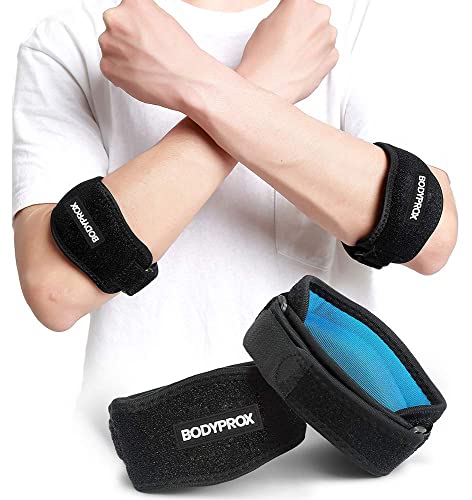
Bodyprox Elbow Brace 2 Pack for Tennis and Golfer's Elbow
by Bodyprox
The most-reviewed elbow brace on Amazon — 33,000+ ratings back up its reputation as a reliable, affordable two-pack counterforce strap.
Pros
- Most-reviewed elbow brace on Amazon with 33,000+ verified ratings — confidence in real-world performance across a massive user base
- Two-pack under $12 provides the value of the budget category with a slightly higher average rating
- EVA foam pad conforms to the soft tissue contour of the forearm better than flat neoprene designs
- Lightweight design causes no noticeable interference with typing, driving, or grip-heavy tasks
Cons
- Single adjustable strap provides less precision tension control than multi-strap designs
- Users with very slender forearms (under 9 inches circumference) may find the fit loose at the lower end
5. APOYO Elbow Brace Compression Sleeve with Adjustable Strap
The APOYO sleeve addresses a different patient population than the counterforce straps above. Users managing elbow arthritis, olecranon bursitis, diffuse tendonitis affecting the whole joint, or seeking joint compression during heavy gym training need circumferential compression around the entire elbow — not focused pad pressure on a single epicondyle. The APOYO’s full-sleeve design provides this broad support while its adjustable top strap allows compression to be increased during lifting sets and reduced during rest periods.
The knit fabric construction is the key differentiator from neoprene-based competitors. Neoprene sleeves work well in short-duration applications but become a compliance problem for users who wear their brace for four, six, or eight hours daily — the heat and moisture retention causes skin irritation and the urge to remove the brace, which defeats its purpose. The APOYO’s moisture-wicking knit fabric breathes throughout the wear period, making it the practical choice for all-day users. The sizing runs small, and the manufacturer’s measurement guidance (5 inches above the elbow) is specific for a reason — follow it before selecting a size, and err toward the larger option if you are between measurements.

APOYO Elbow Brace Compression Sleeve with Adjustable Strap
by APOYO
Knit compression sleeve that solves the neoprene heat and itch problem — the preferred sleeve format for gym users and all-day wearers.
Pros
- Moisture-wicking knit fabric eliminates the neoprene itch common in competing sleeves — critical for users wearing braces for multiple hours daily
- Full-coverage compression sleeve distributes pressure evenly across the entire elbow joint, not just the epicondyle — appropriate for tendonitis and arthritis
- Adjustable top strap allows users to dial up compression during high-demand activities and reduce it for recovery periods
- Available in S/M/L/XL with forearm measurement guidance, reducing the sizing guesswork common in one-size compression sleeves
Cons
- Sizing runs slightly small — measuring carefully and sizing up is advised for borderline measurements
- Sold as a single sleeve; not available as a pre-packaged pair
6. Hurmoya Elbow Brace for Cubital Tunnel Syndrome
Cubital tunnel syndrome is underrepresented in elbow brace roundups — most reviews focus exclusively on tennis elbow products and leave ulnar nerve entrapment patients without guidance. The Hurmoya fills this gap as the only cubital tunnel-specific brace in this review, and it is purpose-built for nighttime immobilization rather than daytime activity use.
The ulnar nerve passes through the cubital tunnel on the medial side of the elbow. When the elbow is flexed beyond approximately 90 degrees — the position most people naturally adopt during sleep — the nerve is stretched and compressed against the bony groove, producing the tingling and numbness in the ring and small fingers characteristic of cubital tunnel syndrome. The Hurmoya’s two removable metal stays lock the elbow in slight extension during sleep, eliminating the sustained flexion that drives the nerve compression cycle. The inner neoprene sleeve prevents the stays from creating direct skin pressure points during the 6–8 hours of overnight use.
Clinical management of cubital tunnel syndrome typically follows a ladder: nighttime splinting is the first-line conservative treatment before proceeding to activity modification, corticosteroid injection, or surgical decompression. The Hurmoya’s price point makes it an appropriate starting point for patients whose physician has recommended positional splinting, and its FSA/HSA eligibility means the out-of-pocket cost is genuinely modest when paid through a pre-tax health account. If you are experiencing daytime tingling in your ring and small fingers after prolonged elbow bending — desk work, driving, using a phone — discuss cubital tunnel evaluation with your physician before purchasing any brace.
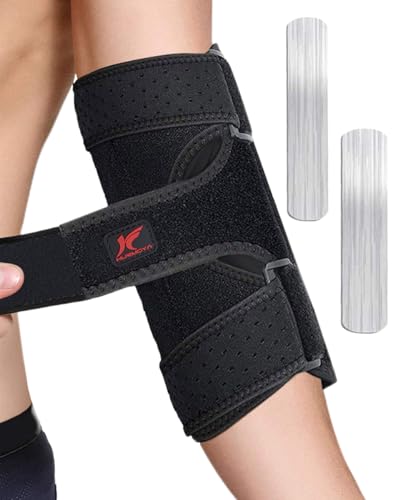
Hurmoya Elbow Brace for Cubital Tunnel Syndrome
by Hurmoya
Purpose-built cubital tunnel splint with removable metal stays — fills a gap in the market no counterforce strap or compression sleeve addresses.
Pros
- Two removable metal stays allow the brace to function as a firm positional splint at night, limiting elbow flexion that compresses the ulnar nerve
- Inner neoprene sleeve acts as a skin buffer, preventing the metal stays from creating pressure points during overnight use
- Three adjustable Velcro straps hold the brace securely through sleep movement without requiring morning re-tightening
- FSA and HSA eligible — cubital tunnel syndrome treatment costs are recoverable through pre-tax health accounts
Cons
- Neoprene inner sleeve retains body heat — may be uncomfortable for warm sleepers during summer months
- Bulky profile makes it impractical for daytime desk work or any activity requiring full arm movement
7. Comforband Adjustable Elbow Brace and Compression Sleeve
The Comforband’s primary differentiator is its ISO 13485 certification — a Quality Management System standard that governs the design, manufacturing, and quality assurance processes for medical device companies. Most consumer elbow braces are manufactured to general textile or consumer goods standards; ISO 13485 imposes a more rigorous documentation and quality control framework that is required for medical devices sold in regulated markets. This certification does not guarantee superior clinical outcomes, but it does indicate a manufacturing commitment beyond what most competitors in this price range demonstrate.
The one-size adjustable wrap design addresses a genuine market gap. Sizing uncertainty is one of the most common reasons for elbow brace returns — users who order the wrong size face the hassle of exchange, while users who are between sizes are forced to guess which direction to err. The Comforband’s adjustable Velcro wrap eliminates this problem entirely, making it a practical choice for buyers who are uncertain about sizing, purchasing as a gift, or who want a single brace that can be shared between household members with different forearm sizes. The dual-function design — providing both localized compression over the epicondyle and circumferential joint stabilization — reflects the orthopedic professional input acknowledged in the product’s development.
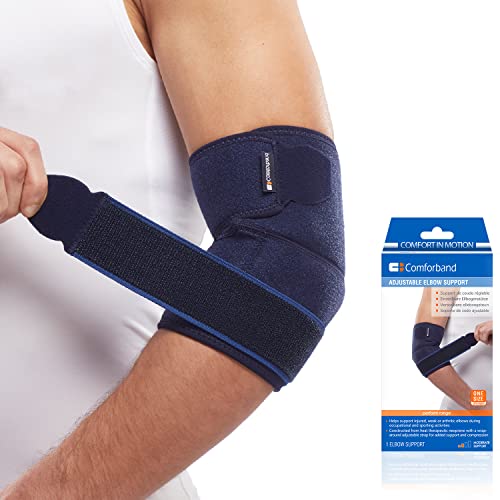
Comforband Adjustable Elbow Brace and Compression Sleeve
by Comforband
ISO 13485-certified elbow brace at a consumer price — orthopedic-professional input and medical-grade manufacturing standards without a prescription price tag.
Pros
- ISO 13485 Quality Management System certification — a manufacturing standard typically reserved for medical device companies, rare at this consumer price point
- One-size adjustable wrap eliminates the sizing chart ambiguity that leads to returns in sleeve and strap categories
- Designed with input from orthopedic professionals, reflected in the dual-function construction that provides both localized compression and joint stabilization
- FSA and HSA eligible, with a sub-$20 price that makes the certification-to-cost ratio exceptional
Cons
- One-size design may not achieve optimal compression fit at the extreme ends of forearm circumference
- Fewer reviews than established competitors limits long-term durability data from real-world users
How to Choose the Best Elbow Brace
The buyer’s guide factors covered below reflect the core clinical criteria for elbow brace selection. One additional clinical framing is worth establishing before reviewing those factors: the distinction between acute and chronic presentations, and where bracing fits within the full treatment hierarchy.
For acute epicondylitis — pain that started within the last six weeks following a specific activity change or overuse event — a counterforce strap combined with relative rest and ice is appropriate first-line management while the acute inflammatory response resolves. In this phase, the brace is a temporary support tool and should be expected to become unnecessary as tissue healing progresses over 6 to 12 weeks.
For chronic epicondylitis that has persisted for more than three months, bracing alone is unlikely to produce resolution. The current clinical evidence points to eccentric strengthening of the wrist extensors as the most effective long-term intervention for lateral epicondylitis — the Tyler Twist exercise protocol, using a rubber bar like a Thera-Band FlexBar, has demonstrated significant pain reduction in randomized controlled trials. A counterforce brace during this rehabilitation phase manages pain during activity while the eccentric loading program addresses the underlying tendon pathology. If conservative management with bracing and eccentric exercise fails after 6 to 12 months, corticosteroid injection and platelet-rich plasma (PRP) injection are the next clinical steps before considering surgical debridement.
For buyers who want to track whether bracing is actually improving their symptoms, a simple pain diary — rating pain before and after activities with and without the brace — provides useful data to share with your physician. Effective bracing should produce measurable pain reduction within 1 to 2 weeks of consistent use.
Buyer's Guide
Selecting the right elbow brace requires matching the brace type to your specific diagnosis — the four main brace categories address four fundamentally different mechanical problems.
Brace Type Matches Your Diagnosis
The four elbow brace types serve different clinical purposes. Counterforce straps are designed specifically for epicondylitis (tennis elbow or golfer's elbow) by offloading the tendon attachment at the epicondyle. Compression sleeves provide broad joint support for arthritis, bursitis, and general overuse. Cubital tunnel splints immobilize the elbow at night to protect the ulnar nerve from compression during sleep. Hinged braces provide ligament support and motion control after UCL injuries, hyperextension, or surgery. Using the wrong type — a counterforce strap for cubital tunnel syndrome, for example — provides no benefit. Identify your condition before selecting a brace category.
Compression Level and Pad Design
Not all counterforce straps apply compression the same way. Single fixed-pad designs provide one compression level at one anatomical location. Multi-strap designs with interchangeable pads allow the user to adjust tension and reposition the pad for lateral (tennis elbow) versus medial (golfer's elbow) placement — a meaningful functional difference. For compression sleeves, gradient compression that is firmer at the joint and lighter at the edges is preferable to uniform compression throughout. Excessive compression — tight enough to cause hand tingling or discoloration — indicates a fitting problem, not better support.
Fit and Sizing Accuracy
Elbow brace fit is measured at forearm circumference, not by general body size. A medium shirt does not predict a medium elbow brace. Before purchasing, measure your forearm at the point specified in the manufacturer's sizing guide (typically 3–5 inches below the elbow joint) and compare against the actual range in the size chart. One-size designs eliminate sizing complexity but may not achieve optimal compression at the extremes of the adult forearm range. If you are between sizes in a sleeve, size up — a slightly looser sleeve is more comfortable and can be tightened with the adjustment strap, while a too-small sleeve causes vascular compression.
Material and Breathability
Elbow braces are worn during physical activity, work, and sometimes overnight — conditions where heat and moisture accumulation create compliance problems. Neoprene provides therapeutic warmth and firm compression but retains heat and can cause skin irritation during extended wear. Knit and mesh fabric alternatives are breathable and comfortable for multi-hour daily use, though they provide less warmth. For users in physically active or outdoor settings, prioritize breathable materials. For users with arthritis who benefit from therapeutic warmth during sedentary activities, neoprene compression is appropriate.
Condition-Specific Features
Several product features carry clinical value only for specific conditions. Removable metal stays matter for cubital tunnel syndrome but are irrelevant for tennis elbow. Polycentric hinges with hyperextension stops are essential for post-UCL-surgery rehabilitation but add unnecessary bulk for a gym user managing tendonitis. Repositionable pads matter for users whose condition shifts between lateral and medial presentations. Matching features to condition prevents paying for engineering that does not apply to your situation — and avoids choosing a simpler brace that lacks a feature critical to your specific diagnosis.
FSA/HSA Eligibility and Reimbursement
All seven braces reviewed here are FSA and HSA eligible, but this is worth verifying on any brace before purchase. FSA and HSA accounts cover orthopedic supports under IRS Publication 502 as medical expenses for the treatment of a specific condition. Paying with a pre-tax FSA or HSA card effectively reduces the cost by your marginal tax rate — a $20 brace costs approximately $14–16 in real dollars for someone in the 20–28% bracket. For higher-priced options like the DonJoy hinged brace, this tax benefit is particularly meaningful. If your plan requires documentation, the Amazon order receipt with the product's medical purpose description is typically sufficient.
Final Verdict
For the majority of buyers managing tennis elbow, golfer’s elbow, or general elbow tendonitis, the Sleeve Stars Tennis Elbow Brace is our best overall pick. Its three interchangeable compression straps and repositionable gel pad provide genuine adjustability that fixed-pad alternatives cannot match, and its latex-free breathable construction makes it comfortable for extended daily wear. With over 13,000 verified reviews backing its effectiveness, it is the brace we would recommend to a patient asking for a counterforce strap that can grow with their rehabilitation.
For buyers seeking the most value per dollar — particularly those who want to trial counterforce bracing before committing to more involved treatment — the CAMBIVO 2-Pack delivers two functional braces for less than the cost of a single competing strap. The DonJoy Performance Bionic Elbow Brace II is the right choice for a fundamentally different situation: UCL instability, post-surgical rehabilitation, or hyperextension protection, where clinical-grade hinged support is the appropriate tool and counterforce straps are simply the wrong product category.
As with all orthopedic supports, the right brace is the one that matches your specific diagnosis and is worn as part of a treatment plan that addresses the underlying cause of your pain. Consult your physician or physical therapist for personalized recommendations — particularly if your symptoms include hand or finger numbness, significant grip weakness, or pain that has not responded to conservative care within six to eight weeks.
Frequently Asked Questions
Do elbow braces actually work for tennis elbow?
What is the difference between a counterforce strap and a compression sleeve for elbow pain?
Where exactly should I position my elbow brace?
Are elbow braces HSA and FSA eligible?
Can I sleep in an elbow brace?
Related Articles
About the Reviewer

Dr. David Taylor, MD, PhD
Drexel University College of Medicine (MD), Indiana University School of Medicine (PhD)
Dr. David Taylor is a licensed physician and medical researcher who founded BestRatedDocs in 2016. With an MD from Drexel University and a PhD from Indiana University School of Medicine, he combines clinical expertise with a passion for health technology to provide evidence-based product recommendations. Dr. Taylor specializes in health informatics and regularly evaluates medical devices, diagnostic equipment, and therapeutic products to help healthcare professionals and patients make informed decisions.