7 Best Collagen Supplements of 2026
Dr. David Taylor reviews the best collagen supplements of 2026. Compare top-rated powders, capsules, and gummies by collagen type, source, dose, and third-party testing.
Updated
Collagen is the most abundant protein in the human body — accounting for approximately 30% of total protein mass and comprising the structural backbone of skin, bone, cartilage, tendons, ligaments, and the intestinal wall. Collagen synthesis begins declining measurably around age 25, with skin collagen density decreasing at roughly 1% per year after that. By age 60, most adults have lost approximately 35% of their peak skin collagen content. This age-related decline drives an enormous consumer market: collagen supplements have become one of the fastest-growing categories in the $50 billion global supplement industry, with a particularly concentrated consumer base among adults over 40 managing skin aging, joint discomfort, and bone density concerns.
As a physician, I review collagen supplements with the same skepticism I bring to any supplement category — which means looking at the peer-reviewed clinical evidence rather than marketing language, understanding the biochemistry of why some products are better positioned to work than others, and flagging the clinical concerns that most review sites never mention. Two important facts tend to get lost in commercial collagen content: first, collagen is not a complete protein and cannot substitute for adequate dietary protein intake; second, the dose and collagen type matter enormously, and gummies with 80 mg of collagen per serving are unlikely to produce the same outcomes as the 10-gram daily doses used in published skin elasticity trials. Understanding these distinctions is what this review is built around.
The seven collagen supplements reviewed here represent the best options across powders, capsules, gummies, and tablets — spanning price points, collagen types, animal sources, and use cases. We analyzed formulas against the clinical literature, evaluated third-party testing credentials, and assessed real-world user feedback across hundreds of thousands of verified Amazon reviews. If you are also monitoring your overall wellness metrics while supplementing, pairing collagen with appropriate health monitoring can provide useful context — our guides to blood pressure monitors and glucose monitors cover devices worth knowing about.
How We Chose These Collagen Supplements
Our selection process started with three non-negotiable criteria: verified Amazon ASINs with meaningful review volume (at minimum 10,000 reviews), transparent labeling of collagen type and animal source, and at least one quality credential — whether third-party certification, GMP manufacturing, or institutional recognition. From a longer candidate list, we selected seven products representing distinct form factors, price points, and collagen type profiles. We evaluated each formula against the relevant clinical literature, paying particular attention to the dose per serving relative to the amounts studied in randomized controlled trials. We also deliberately excluded several popular products that lack transparent manufacturing credentials — a category where marketing claims routinely outrun the underlying quality controls.
1. Sports Research Collagen Peptides — Best Overall
Sports Research Collagen Peptides earns the Best Overall designation primarily because of one attribute that most collagen powders lack: Informed Sport certification. Informed Sport is an independent third-party testing program that screens every production batch for over 200 substances on the World Anti-Doping Agency banned list, as well as common label accuracy issues including heavy metal contamination. In a supplement category where fish and bovine-derived products have consistently failed independent testing for cadmium and lead, batch-level third-party verification is not a trivial credential — it is meaningful quality assurance that most competitors do not provide.
The formula itself is straightforward: hydrolyzed bovine collagen peptides from grass-fed, pasture-raised cattle providing Type I and Type III collagen. Hydrolysis — the enzymatic process that breaks collagen’s long triple-helix structure into shorter di- and tri-peptides — is critical to bioavailability. Intact collagen protein is too large to absorb meaningfully through the intestinal wall; hydrolyzed peptides, particularly the bioactive sequences Pro-Hyp and Hyp-Gly, have demonstrated absorption into circulation in multiple clinical studies and have shown uptake into skin tissue in skin-focused trials. The 11-gram serving size falls at the lower end of the research-backed range (5–15 grams), but remains within the window where clinical benefits have been documented.
For users who want the cleanest, best-verified collagen powder at a reasonable price point, Sports Research is the clear answer. It dissolves completely in cold or hot liquids, has no detectable flavor or odor, and carries dietary certifications that make it compatible with Keto, Paleo, and Non-GMO protocols. If you are also managing joint health alongside skin goals, consider our review of electrolyte powders — proper hydration is a meaningful supporting factor for connective tissue maintenance.

Sports Research Collagen Peptides Powder (41 Servings)
by Sports Research
The best-verified collagen powder on the market — third-party tested, fully unflavored, and compatible with nearly every dietary protocol.
Pros
- Third-party tested by Informed Sport — one of the only collagen powders with independent contamination verification
- Hydrolyzed Type I & III bovine collagen peptides provide the most bioavailable form for skin, hair, nail, and bone support
- Keto-certified, Paleo-friendly, and Non-GMO verified — compatible with the most common elimination diets
- Dissolves completely in hot or cold liquids with no clumping or aftertaste — genuinely unflavored
Cons
- Only 11 g collagen per serving — lower than some competitors offering 15-20 g per scoop
- Bovine-only source — not suitable for pescatarians who prefer marine collagen
2. Youtheory Advanced Collagen 6,000mg — Budget Pick
Youtheory Advanced Collagen represents the most cost-effective way to establish a daily collagen habit for users who prefer a tablet format. The value proposition here is straightforward: GMP-certified manufacturing at a per-serving cost that puts sustained daily supplementation within reach for most budgets. The 160-tablet bottle provides 48 days of supplementation at the recommended 6-tablet dose — and GMP certification means the collagen dose and label accuracy have been verified through standardized manufacturing controls.
The inclusion of Vitamin C is clinically significant in a way that gets underappreciated in budget supplement reviews. Vitamin C is not optional for collagen synthesis — it is the required cofactor for prolyl hydroxylase and lysyl hydroxylase, the enzymes responsible for hydroxylating proline and lysine residues in collagen precursor molecules. Without sufficient hydroxylation, the collagen triple helix cannot form properly. This is the biochemical mechanism behind scurvy, where connective tissue fails due to Vitamin C deficiency preventing proper collagen assembly. Many standalone collagen powders omit Vitamin C entirely, treating it as an unnecessary addition — Youtheory’s inclusion of it in a budget formula is a genuine formulation advantage.
The limitations are honest and important: six tablets per serving is a higher pill burden than most people prefer, and the collagen dose per serving is lower than what most positive clinical trials used. This is an appropriate starting point for users building a supplement habit or supplementing at a maintenance dose, but it should not be the primary strategy for someone with significant joint disease or age-related connective tissue concerns who needs the higher doses studied in clinical trials.

Youtheory Advanced Collagen 6,000mg (290 Tablets)
by Youtheory
The best budget collagen option for daily maintenance — affordable, GMP-certified tablets that include the critical Vitamin C cofactor most cheap alternatives skip.
Pros
- One of the lowest per-serving costs in the collagen category — excellent value for daily use
- GMP-certified manufacturing facility ensures consistent quality and label accuracy
- Includes Vitamin C, which is required for endogenous collagen synthesis — a cofactor many competing products omit
- Convenient tablet format requires no mixing — ideal for people who dislike powders
Cons
- 6 tablets per serving is a high pill burden — may be difficult for people with swallowing difficulties
- Type I & III only — does not provide Type II collagen for joint cartilage support
- Lower collagen dose than top-tier powders; clinical effects may take longer to appear
3. Vital Proteins Collagen Peptides Advanced — Upgrade Pick
Vital Proteins occupies a unique position in the collagen market: it is, by review volume, the most validated collagen product in the consumer space, with over 212,000 Amazon reviews for its Advanced formulation. At that scale of user feedback, the signal-to-noise ratio is genuinely informative — and the consistent themes across those reviews are favorable: users report improved nail strength, reduced joint discomfort, and skin quality improvements at the 8-to-12-week mark at rates that exceed typical placebo-effect timelines.
The Advanced formulation adds two cofactors that the standard Vital Proteins powder does not include: hyaluronic acid and Vitamin C. Hyaluronic acid is a glycosaminoglycan that plays a central role in skin hydration by retaining water in the extracellular matrix — up to 1,000 times its own weight in water. Clinical trials on oral hyaluronic acid supplementation have shown improvements in skin moisture and wrinkle depth at doses of 80–200 mg per day, and the Vital Proteins Advanced formula provides 80 mg per serving. Combined with the Vitamin C cofactor support for endogenous collagen synthesis, this creates a more complete skin support stack than any single-ingredient collagen powder achieves. The tradeoff is cost efficiency: the container provides only 27 servings, which means the per-day cost is meaningfully higher than the standard formulation or the Sports Research pick. For buyers whose primary goal is skin aging management and who value the most well-reviewed product in the category, this is the appropriate choice.

Vital Proteins Collagen Peptides Advanced with Hyaluronic Acid & Vitamin C
by Vital Proteins
The premium upgrade for skin-focused buyers — the most-reviewed collagen powder on Amazon, enhanced with hyaluronic acid and Vitamin C for a complete skin support stack.
Pros
- Most-reviewed collagen product on Amazon with 212,000+ verified reviews — unmatched consumer social proof
- Hyaluronic acid added at a clinically relevant dose to complement collagen's skin hydration effects
- Vitamin C included to support endogenous collagen synthesis alongside exogenous peptide delivery
- Whole30 Approved and Paleo-certified — grass-fed and pasture-raised bovine sourcing
Cons
- Only 27 servings per container — significantly fewer than competitors at a higher price point
- Type I & III only — does not provide Type II collagen for cartilage or joint-specific support
4. Ancient Nutrition Multi Collagen Protein with Probiotics — Runner-Up
Ancient Nutrition’s Multi Collagen Protein takes the multi-source approach further than any other product in this review. Rather than providing two or three collagen types, this formula delivers 10 types sourced from four animal proteins: grass-fed beef (Types I and III), chicken broth and chicken sternum (Types II, IX, X, XI), wild-caught fish (Types I and V), and eggshell membrane (Types I, V, X, XII, XIV, XVI). The clinical rationale for multi-collagen formulas rests on the fact that different collagen types play different structural roles in the body, and a deficiency in any single type may drive different symptom presentations.
The addition of probiotics distinguishes this formula further. The gut connection to collagen is not simply a marketing angle — the intestinal lining relies heavily on Type IV collagen and tight junction proteins, and probiotic support for the gut microbiome has documented downstream effects on systemic inflammation that can affect connective tissue metabolism. The co-formulation of probiotics with collagen peptides is logistically convenient and the CFU counts, while modest by standalone probiotic standards, are relevant for general gut maintenance. One important caveat: the multi-source complexity of this formula makes it difficult to isolate which component is producing any given benefit, and the collagen dose per type is lower than it would be in a single-type-focused product. For buyers who want comprehensive coverage of the collagen spectrum in a single daily product, this is the strongest option available.

Ancient Nutrition Multi Collagen Protein with Probiotics
by Ancient Nutrition
The broadest-spectrum collagen formula on this list — 10 types from 4 animal sources, plus probiotics and whole-food Vitamin C, for buyers who want comprehensive coverage.
Pros
- Broadest collagen type profile available — 10 collagen types sourced from beef, chicken, fish, and eggshell membrane
- Includes probiotics (CFU-verified) for gut health alongside collagen delivery — a unique combination
- Vitamin C included to support collagen synthesis; real whole-food vitamin C from organic acerola cherry
- Covers Type II (cartilage) collagen alongside Types I, III, V, and X — relevant for joint support goals
Cons
- Multi-source formula makes it difficult to identify which source contributes to which benefit
- Probiotic strains and CFU counts are modest compared to standalone probiotic supplements
5. Vital Vitamins Multi Collagen Complex Capsules
For users who want multi-collagen type coverage without committing to a powder, Vital Vitamins Multi Collagen Capsules are the strongest capsule option currently available. The formula covers all five major collagen types (I, II, III, V, and X) from four animal sources — grass-fed bovine, cage-free chicken, wild-caught fish, and eggshell membrane — in a three-capsule daily dose. The 50-serving container size provides a practical two-month supply and compares favorably in per-serving cost to comparable multi-collagen powders.
The capsule format solves a genuine practical problem for many supplement users: not everyone wants to add powder to their morning beverage, particularly at an office desk or during travel. The capsule form also eliminates the texture concerns some users report with collagen powders in cold liquids, where incomplete dissolution can produce a slightly gelatinous mouthfeel. The limitation is intrinsic to the form factor: three capsules can only deliver a modest total collagen dose compared to a tablespoon of powder, and users with joint disease or aggressive skin aging goals may find the dose insufficient based on the clinical research benchmarks. This is an excellent choice for users at the maintenance or preventive end of the spectrum rather than those seeking therapeutic-level intervention.
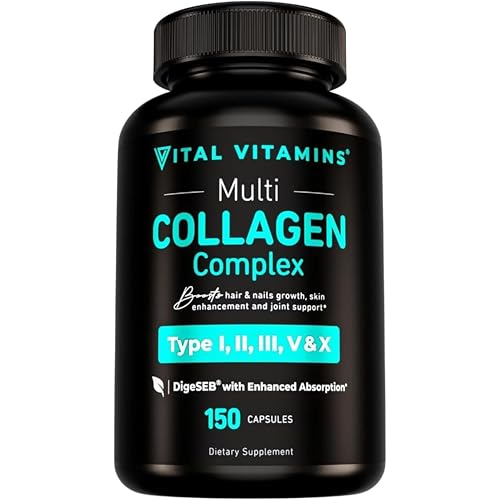
Vital Vitamins Multi Collagen Complex Capsules (150 Capsules)
by Vital Vitamins
The best capsule option for multi-collagen coverage — five types from four animal sources in a convenient daily capsule format with 50 servings per bottle.
Pros
- Capsule format provides precise, portable dosing without mixing — ideal for travel and office routines
- Multi-source formula covers Types I, II, III, V, and X — one of the most complete capsule options available
- Grass-fed, cage-free, and wild-caught sourcing across all protein sources
- 50 servings per container provides strong per-dose value for a multi-collagen capsule product
Cons
- 3 capsules per serving — still a meaningful pill burden for some users
- Lower collagen dose per serving than powder alternatives at comparable cost
6. Nature Made Collagen Gummies with Vitamin C, Zinc & Biotin
Nature Made’s Collagen Gummies occupy a specific and legitimate role in the collagen supplement ecosystem: they are the most credentialed entry in the gummy format category, backed by USP Verification — an independent quality testing program that confirms label accuracy and manufacturing standards. In a supplement category crowded with unverified gummy products making loosely supported claims, Nature Made’s USP designation is a meaningful differentiator that provides genuine consumer protection.
The formula is designed around skin and hair health, combining collagen with Vitamin C (which supports collagen synthesis), Zinc (which plays a role in protein metabolism and skin barrier function), and Biotin (which supports keratin production for hair and nail strength). This creates a multi-nutrient approach to skin and hair wellness in a convenient daily gummy. The honest clinical limitation, which we note directly, is dose. Each serving provides 80 mg of collagen — more than 100 times less than the 10-gram doses used in the clinical trials that established collagen supplementation as evidence-based. The gummies will support the cofactor needs (Vitamin C, Zinc, Biotin) with meaningful doses of those nutrients, but the collagen dose itself is unlikely to replicate the outcomes from higher-dose powder studies. For users who simply cannot or will not take powders, capsules, or tablets, Nature Made gummies are the best option available — with clear eyes about what that dose level can and cannot accomplish.

Nature Made Collagen Gummies with Vitamin C, Zinc & Biotin
by Nature Made
The most accessible entry point for collagen supplementation — USP-verified gummies with added Vitamin C, Zinc, and Biotin for users who prioritize ease of adherence over maximum dosing.
Pros
- USP Verified — Nature Made is one of the only mainstream gummy supplement brands with independent third-party verification
- Includes Vitamin C, Zinc, and Biotin alongside collagen — addressing multiple micronutrients relevant to skin and hair health
- Gummy format maximizes adherence for users who struggle with capsules, tablets, or powders
- 60 servings per container at a price point that makes daily supplementation genuinely accessible
Cons
- Contains added sugar — each gummy serving adds caloric load, which matters for some dietary goals
- Lower collagen dose than powders — the 80 mg collagen per serving is well below therapeutic doses studied in clinical trials
7. Vital Proteins Collagen Peptides Powder (Unflavored)
The standard Vital Proteins Collagen Peptides Powder is the single best option for culinary integration of collagen supplementation. At 20 grams per serving — the highest collagen dose in this review — it provides a dose at the upper end of what clinical trials have studied for skin and joint outcomes. The powder is genuinely unflavored and odorless, dissolves without trace in coffee, tea, smoothies, soups, oatmeal, and baked goods, and carries Whole30 and Paleo certifications for users following those dietary frameworks.
The limitation that warrants direct attention is the container size: approximately 9 servings per container, which makes this one of the smallest supply counts in the category at a price point that is not the lowest. For daily supplementation, users will need to reorder frequently, and the cost-per-day is higher than it appears at first glance. This formulation is best positioned as a trial product — or as a higher-dose option for users who want the maximal collagen dose in a single serving and do not need cofactors like Vitamin C or hyaluronic acid built in. For comprehensive health tracking while supplementing, our review of bathroom scales covers body composition monitoring tools that can complement a long-term collagen and nutrition protocol.
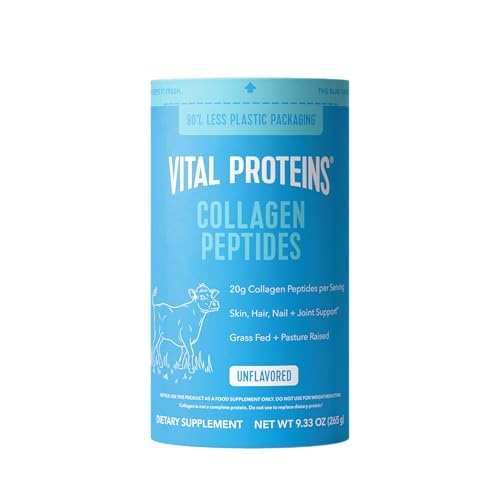
Vital Proteins Collagen Peptides Powder (Unflavored)
by Vital Proteins
The best pure-form collagen powder for culinary integration — a well-reviewed, high-dose unflavored option that disappears into any food or beverage without trace.
Pros
- Unflavored and odorless — dissolves invisibly into coffee, smoothies, soups, and baked goods without altering taste
- Grass-fed and pasture-raised bovine sourcing with Whole30 and Paleo certification
- 65,000+ Amazon reviews provide extensive real-world feedback across diverse use cases
- Low-barrier entry point for the Vital Proteins brand — same core formula as premium version at a lower price
Cons
- Only approximately 9 servings per container — the smallest serving count on this list
- No added Vitamin C, hyaluronic acid, or other cofactors — pure collagen only
How to Choose the Best Collagen Supplement
Buyer's Guide
Collagen supplements vary significantly in type, source, form factor, and dose — choosing the right product requires matching these variables to your specific health goal rather than simply buying the best-reviewed option.
Collagen Type
Not all collagen types serve the same function in the body. Type I and III are the primary structural collagens in skin, hair, nails, tendons, ligaments, and bone — making them the most relevant for skin elasticity and anti-aging goals. Type II is the dominant collagen in articular cartilage and is most studied for joint pain and osteoarthritis. Type V supports cellular membranes and hair follicle structure, while Type X plays a role in cartilage and bone matrix formation. Most bovine collagen powders provide Types I and III only; if joint cartilage support is your primary goal, look for products that include Type II from chicken or eggshell sources.
Animal Source
Bovine collagen (from cattle hides and connective tissue) is the most widely studied, typically the most affordable, and provides Types I and III peptides. Marine collagen from fish skin and scales also provides Types I and III, with a slightly smaller peptide size that some researchers associate with marginally better absorption. Chicken-derived collagen from sternum cartilage provides Type II — the most relevant type for joint health. Eggshell membrane collagen provides Types I, III, V, and X with additional glycosaminoglycans. Multi-collagen products blend several sources to cover all five major types. Dietary restrictions — particularly vegetarianism, pescatarian diets, or beef allergies — should guide source selection.
Form Factor
Hydrolyzed collagen powders offer the highest doses per serving (10–20 g) and dissolve into liquids and food, making them the most practical for achieving therapeutic doses. Capsules and tablets provide accurate, portable doses but typically cap out at 2–6 grams per serving, which may be below the dose ranges used in clinical trials. Gummies are the most adherence-friendly format but generally contain the lowest collagen doses (80–300 mg) and added sugars — useful for habit formation but unlikely to produce the outcomes seen in higher-dose research. Match your format to your lifestyle, but verify the dose per serving against the research before expecting clinical-grade results.
Dose Per Serving
Dose matters significantly in collagen research. Randomized controlled trials showing skin elasticity improvements typically use 5 to 10 grams of hydrolyzed collagen daily. Joint pain reduction studies often use 10 to 15 grams. Undenatured Type II collagen (UC-II) is an exception — it works through a different immune tolerance mechanism and shows benefit at just 40 mg per day. Gummies typically provide 80–300 mg per serving, which is insufficient to replicate powder trial results. If you are choosing between two otherwise comparable products, select the one providing a dose within the range studied in peer-reviewed trials for your specific goal.
Third-Party Testing
The supplement industry in the United States operates under minimal FDA oversight — manufacturers are not required to prove safety or efficacy before selling. Third-party certifications including NSF Certified for Sport, Informed Sport, USP Verified, and Informed Choice provide independent verification that what is on the label matches what is in the product, and that the product is free from banned substances and common contaminants. This is particularly important for marine-sourced collagen products, where independent testing has identified elevated heavy metals including cadmium, lead, and arsenic in some brands. At minimum, look for GMP-certified manufacturing; ideally, choose products with Informed Sport or USP Verified designations.
Cofactors for Collagen Synthesis
The body's ability to synthesize new collagen depends on several cofactors — most critically Vitamin C (ascorbic acid), which is required for the hydroxylation of proline and lysine in collagen molecule formation. Without adequate Vitamin C, collagen fibrils cannot form properly — a mechanism that explains the clinical presentation of scurvy. Some collagen products include Vitamin C, hyaluronic acid, biotin, and zinc to support the broader pathway. If your base diet is rich in Vitamin C from whole foods, standalone collagen peptides are appropriate. If your diet is low in produce, choosing a formula with added Vitamin C provides meaningful insurance against a cofactor bottleneck that would limit the benefit of the collagen itself.
The most important question before purchasing any collagen supplement is: what is your specific goal, and does the product’s collagen type and dose match the evidence for that goal?
For skin health and anti-aging: Choose a product providing Types I and III collagen at 5–10 grams per serving. The Vital Proteins Advanced formulation adds hyaluronic acid and Vitamin C for a more complete skin stack. Expect meaningful results at 8–12 weeks of consistent daily use.
For joint and cartilage support: Prioritize Type II collagen from chicken or eggshell sources. The Ancient Nutrition Multi Collagen formula provides Type II alongside other types. For concentrated Type II support, look for products containing UC-II (undenatured Type II collagen), which works through a different mechanism at doses as low as 40 mg.
For bone and tendon health: Types I and III from bovine sources are most relevant, with adequate Vitamin C intake to support hydroxylation. Sports Research and the standard Vital Proteins powder are both appropriate.
For maximum dietary compatibility: Sports Research is the only Informed Sport-certified option in this lineup — the best choice for anyone concerned about heavy metals, competitive athletes subject to drug testing, or buyers who simply want third-party batch verification.
A final note on what collagen supplements cannot do: they are not complete proteins, and they cannot replace adequate dietary protein intake. The essential amino acid tryptophan is absent from collagen, and collagen’s overall essential amino acid profile is poor compared to whey, casein, egg, or plant-based complete proteins. Use collagen as a targeted intervention for connective tissue support — not as a primary protein source. Consult your physician before beginning supplementation if you have chronic kidney disease, a history of kidney stones, or known allergies to animal proteins.
Final Verdict
Our top recommendation for most buyers is the Sports Research Collagen Peptides Powder — third-party Informed Sport certified, fully unflavored, compatible with every major dietary protocol, and appropriately dosed within the clinical research window. It is the only product in this review with batch-level independent contamination verification, which matters meaningfully in a supplement category where heavy metal issues have been documented by independent labs.
For buyers who want the most comprehensive collagen type coverage without a powder, the Vital Vitamins Multi Collagen Capsules offer five types from four sources in a convenient three-capsule daily format. For users committed to the tablet format on a budget, Youtheory Advanced Collagen includes the critical Vitamin C cofactor at an accessible price point with GMP manufacturing credentials.
Whatever product you choose, consistency matters more than brand selection at the margin: collagen supplementation benefits are dose-dependent and time-dependent, with most clinical evidence pointing to 8–12 weeks of daily use before significant measurable changes occur. Choose a format you will actually maintain daily, at a price point that supports long-term adherence, and verify that the dose per serving aligns with the evidence for your specific goal.
Frequently Asked Questions
What type of collagen supplement should I take for joint pain?
Is collagen a complete protein? Can it replace protein supplements?
How long does it take for collagen supplements to show results?
Does it matter whether collagen is marine-sourced or bovine-sourced?
Are there any safety concerns with collagen supplements?
Related Articles
About the Reviewer

Dr. David Taylor, MD, PhD
Drexel University College of Medicine (MD), Indiana University School of Medicine (PhD)
Dr. David Taylor is a licensed physician and medical researcher who founded BestRatedDocs in 2016. With an MD from Drexel University and a PhD from Indiana University School of Medicine, he combines clinical expertise with a passion for health technology to provide evidence-based product recommendations. Dr. Taylor specializes in health informatics and regularly evaluates medical devices, diagnostic equipment, and therapeutic products to help healthcare professionals and patients make informed decisions.