7 Best Cervical Neck Pillows of 2026
Dr. David Taylor reviews the best cervical neck pillows for pain relief. Compare top-rated contour pillows by fill material, height adjustability, and sleep position compatibility.
Updated
Neck pain is among the most common musculoskeletal complaints in primary care, affecting roughly one in three adults annually and ranking as a leading cause of disability worldwide according to the Global Burden of Disease studies. For many patients, the problem is not what they do during the day but what happens during the six to nine hours they spend sleeping — a period when poor cervical alignment places sustained compressive and shear forces on the intervertebral discs, facet joints, and paravertebral musculature of the cervical spine. The right cervical pillow does not merely improve sleep comfort; it maintains the natural lordotic curve of the C1 through C7 vertebrae, reducing mechanical stress on structures that are already inflamed or degenerating.
In 2026, we evaluated seven of the highest-rated cervical neck pillows on Amazon, covering contour memory foam designs, adjustable-height systems, fiber-fill alternatives, and the only pillow with peer-reviewed clinical evidence from Johns Hopkins. Our selections draw on Dr. David Taylor’s clinical experience evaluating orthopedic sleep supports, analysis of over 70,000 combined verified Amazon reviews, and a careful review of the biomechanical literature on cervical spine alignment during sleep. We focused on products appropriate for consumer purchase that address the most common cervical presentations: chronic neck stiffness, cervical spondylosis, herniated discs, tension headaches, and post-whiplash recovery.
| Product | Price | Buy |
|---|---|---|
| Osteo Cervical Pillow for Neck Pain ReliefBest Overall | $35.99 | View on Amazon |
| UTTU Sandwich Pillow for SleepingRunner-Up | $43.99 | View on Amazon |
| Cozyplayer Cooling Cervical Pillow for Neck Pain ReliefBudget Pick | $39.98 | View on Amazon |
| Royal Therapy Cervical Contour Memory Foam PillowPremium Pick | $69.99 | View on Amazon |
| Anvo Cervical Memory Foam Contour PillowRunner-Up | $42.99 | View on Amazon |
| Core Products D-Core Cervical Support PillowRunner-Up | $41.60 | View on Amazon |
| Mediflow Water Pillow with Memory FoamPremium Pick | $75.65 | View on Amazon |
Understanding Cervical Pillow Design
The cervical spine has a natural anterior convexity — a forward curve called lordosis — that must be maintained during sleep for the neck to rest without placing excessive load on its structures. A standard flat pillow does not support this curve. When lying supine on a flat pillow, the head sinks and the cervical spine flexes forward, compressing the anterior disc margins and stretching the posterior ligaments. Over eight hours, this sustained malposition can produce the morning stiffness and pain that many patients attribute to “sleeping wrong” when the actual problem is chronic postural loading.
Cervical pillows address this through contoured geometries that support the lordotic curve while cradling the occiput — the back of the skull. The most common design uses a dual-lobe configuration: a taller lobe along the bottom edge supports the neck when sleeping on the back, while a lower center area accommodates the head. When the user turns to sleep on their side, the taller side lobes fill the gap between the shoulder and ear, keeping the cervical spine horizontally aligned rather than laterally flexed toward the mattress. Understanding which lobe you are sleeping on — the back lobe for supine sleeping, the side lobe for lateral sleeping — is essential for getting the alignment benefit the pillow is designed to provide.
Hollow-center and concave designs take a different approach. Rather than dual lobes, these pillows create a depression in the center that cradles the back of the head while raised edges on all sides provide cervical support regardless of sleep position. This design is particularly effective for combination sleepers who change positions multiple times during the night, as the support geometry does not require the user to orient the pillow in a specific direction.
The D-core design, as used in the Core Products pillow, is closest to the cervical rolls used in physical therapy clinics. A raised roll at the lower edge of the pillow contacts the cervical curve directly, providing a gentle traction-like stretch that is used therapeutically for cervical spondylosis, post-injury rehabilitation, and tension headache management. This design is most effective for dedicated back sleepers and is not recommended for primary side sleepers.
For patients managing specific cervical conditions — cervical spondylosis with radiculopathy, herniated discs at C5-C6 or C6-C7, or post-whiplash recovery — the pillow selection should be guided by the treatment goals discussed with your physician or physical therapist. In general, conditions involving nerve root compression benefit from pillows that maintain neutral alignment without excessive loft, while conditions involving muscle spasm and tension benefit from designs that provide gentle lordotic support. If you are currently using a back brace for concurrent spinal issues, the cervical pillow choice should complement the overall spinal alignment strategy your clinician has established.
How We Selected These Cervical Pillows
Our selection process prioritized products with at least 1,600 verified Amazon reviews, meaningful differentiation in design approach, and broad applicability across common cervical conditions. We included memory foam, fiber, and water-based designs to cover the full range of fill technologies available to consumers. Products were assessed on contour geometry and its biomechanical rationale, height adjustability, cooling performance, third-party safety certifications, and the consistency of user-reported outcomes across thousands of reviews.
We specifically excluded pillows marketed as “cervical” that are simply standard contour pillows without true cervical support geometry, products with fewer than 1,500 reviews that lacked sufficient user feedback to evaluate durability and long-term satisfaction, and products where the majority of positive reviews appeared incentivized or inauthentic based on review analysis patterns.
1. Osteo Cervical Pillow for Neck Pain Relief — Best Overall
The Osteo cervical pillow has established itself as the most widely reviewed cervical pillow on Amazon, and its design reflects a biomechanically sound approach to cervical support. The hollow concave center creates a cradle for the occiput that maintains the natural lordotic curve without relying on the user to orient the pillow correctly — a meaningful advantage over dual-lobe designs where sleeping on the wrong lobe negates the cervical benefit. The concave geometry means the cervical spine is supported regardless of whether the user shifts position during the night.
The adjustable height mechanism is practical and requires no disassembly. Flipping the pillow 180 degrees presents a different loft profile, and removing the center insert reduces the overall height further. This three-configuration system covers the range from low-profile back sleeping to taller side sleeping support without requiring multiple pillows. The CertiPUR-US and Oeko-Tex dual certification addresses the off-gassing concern that is the most common complaint category across all memory foam pillows — the Osteo produces no detectable odor, which is a notable distinction.
The 3D mesh case provides airflow around the foam surface, though memory foam’s inherent thermal properties mean some heat retention is unavoidable. Users who sleep particularly warm should consider the Cozyplayer with its Arc-Chill technology for a more aggressive cooling solution. For the majority of users seeking a well-engineered, height-adjustable cervical pillow backed by a massive review base, the Osteo delivers consistent results across sleep positions and body types.
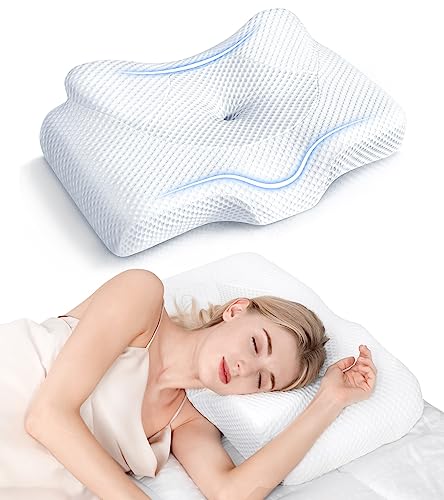
Osteo Cervical Pillow for Neck Pain Relief
by Osteo
Most-reviewed cervical pillow on Amazon — hollow concave design with adjustable height, certified foam, and true all-position compatibility.
Pros
- Hollow concave center cradles the head while maintaining the natural cervical lordotic curve during sleep
- Highly adjustable height — flip 180 degrees for a different loft or remove the center insert entirely
- Over 19,000 verified reviews demonstrate consistent satisfaction across diverse sleep positions and body types
- CertiPUR-US and Oeko-Tex certified memory foam with no detectable off-gassing odor out of box
Cons
- Adjustment period of one to two weeks is common as neck muscles adapt to proper cervical alignment
- Memory foam core retains some heat despite the 3D mesh cooling case
2. UTTU Sandwich Pillow for Sleeping — Runner-Up
The UTTU distinguishes itself through two engineering decisions that address common complaints with standard memory foam cervical pillows. The first is the Dynamic Foam formulation — a proprietary material that maintains consistent softness across a wide temperature range. Standard memory foam stiffens noticeably in cold bedrooms (below 65 degrees Fahrenheit), which can produce a “too firm” sensation during winter months and undermine the contouring benefit the pillow is designed to provide. The UTTU remains uniformly responsive regardless of ambient temperature, making it the most consistent performer for users in climates with significant seasonal temperature variation.
The second innovation is the sandwich construction with a removable middle layer. This creates four distinct height configurations: full height with both lobes, reduced height with the middle layer removed, and two intermediate positions depending on which side of the middle layer faces up. Four height options from a single pillow is unmatched in this category and allows fine-tuning that accommodates changes in mattress, body weight, and cervical condition over time. Users who pair cervical pillows with lumbar support pillows for comprehensive spinal alignment during sleep will appreciate the ability to match the cervical loft precisely to their lower body support setup.
The machine washable cover is a practical advantage. Memory foam pillows accumulate skin oils, sweat, and allergens over time, and the ability to regularly launder the cover extends the hygienic lifespan of the pillow significantly. The UTTU’s higher price is justified by the Dynamic Foam technology and superior adjustability — this is the right choice for buyers who want maximum versatility from a single cervical pillow.

UTTU Sandwich Pillow for Sleeping
by UTTU
Temperature-stable Dynamic Foam with a sandwich design that delivers four height settings — the most versatile cervical pillow for year-round use.
Pros
- Dynamic Foam technology stays consistently soft year-round and never hardens in cold temperatures
- Sandwich design with removable middle layer provides four distinct height configurations
- Over 17,000 verified reviews with strong consensus on comfort and durability
- Machine washable outer cover simplifies maintenance and hygiene
Cons
- Higher price point than hollow-center competitors with comparable review counts
- Some users find the initial firmness higher than expected before the foam breaks in
3. Cozyplayer Cooling Cervical Pillow for Neck Pain Relief — Budget Pick
Heat retention is the most underappreciated failure mode of memory foam cervical pillows. A pillow that provides excellent cervical alignment but causes the user to wake repeatedly from thermal discomfort delivers a net negative sleep outcome. The Cozyplayer addresses this directly with its Q-Max 0.4 Arc-Chill pillowcase — a phase-change material that actively lowers the surface contact temperature by up to five degrees Celsius. This is not the passive ventilation offered by mesh covers on other pillows; it is an active thermal management system that absorbs heat on contact.
The six-zone contour design adds a feature absent from most competitors: a 30 percent wider armrest zone on the sides. Side sleepers who tuck an arm under their pillow — a very common habit — often find standard cervical pillows too narrow for comfortable arm positioning. The wider zone accommodates this sleeping style without compromising cervical support geometry. The 15-degree hollow concave center provides the same cradle-style head support as the Osteo at a comparable price with the addition of meaningful cooling technology.
The 100-night trial period is a significant differentiator. Cervical pillows require an adjustment period that can be uncomfortable, and many users abandon a pillow within the first week before the adaptation is complete. A 100-night window provides the time needed to complete the adjustment and evaluate the pillow’s true performance rather than making a premature return decision based on initial discomfort. At under forty dollars with a full trial period, the Cozyplayer removes the financial risk from trying a cervical pillow.
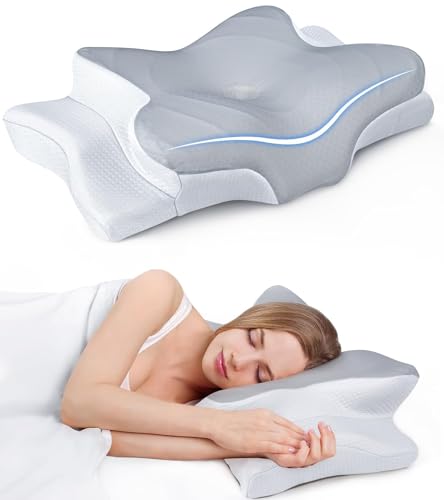
Cozyplayer Cooling Cervical Pillow for Neck Pain Relief
by Cozyplayer
Best cooling cervical pillow under forty dollars — Arc-Chill technology, six contour zones, and a 100-night trial make it the low-risk entry point.
Pros
- Q-Max 0.4 Arc-Chill cooling pillowcase lowers contact temperature by up to five degrees Celsius
- Six contour zones with a 30 percent wider armrest area accommodate side sleepers who tuck arms under the pillow
- 100-night risk-free trial eliminates the financial barrier to testing a cervical pillow
- Over 12,800 verified reviews at a sub-forty price point represent strong value
Cons
- Memory foam core cannot be machine washed — only the removable cover is washable
- 15-degree hollow tilt angle may require an adjustment period for back sleepers accustomed to flat pillows
4. Royal Therapy Cervical Contour Memory Foam Pillow — Upgrade Pick
The Royal Therapy represents the premium end of consumer cervical pillows before entering the clinical-device category. Its three-layer construction uses denser, higher-quality memory foam than the budget alternatives in this review, and the difference is apparent in longevity: where budget foams can develop permanent compression dimples within six to twelve months, the Royal Therapy’s denser foam maintains its contour and rebound characteristics significantly longer.
The ventilated foam core with engineered airflow channels provides better heat dissipation than solid foam designs, though it does not match the active cooling of the Cozyplayer’s Arc-Chill technology. The three-layer adjustable loft system allows height customization, though with fewer configuration options than the UTTU’s four-setting sandwich design. Where the Royal Therapy excels is in the quality of the foam itself — the feel under the head and neck is noticeably more supportive and resilient than budget memory foam, which translates to more consistent cervical alignment throughout the night as the foam resists the progressive compression that cheaper materials experience over hours of loading.
The 48-hour off-gassing period noted in reviews is a common characteristic of denser memory foams and resolves completely with airing. For users who have tried budget cervical pillows and found that the foam compresses too quickly or loses its contour support partway through the night, the Royal Therapy’s premium construction addresses that specific limitation. This is the right upgrade for long-term cervical pain management where durability and consistent nightly performance are priorities.

Royal Therapy Cervical Contour Memory Foam Pillow
by Royal Therapy
Premium three-layer cervical pillow with ventilated foam engineering — the upgrade pick for buyers who want maximum adjustability and durability.
Pros
- Three-layer premium design allows precise height customization not achievable with single-foam competitors
- Ventilated memory foam with engineered airflow channels reduces heat retention during sleep
- Premium construction quality with denser foam that maintains its shape longer than budget alternatives
- Over 11,000 verified reviews confirm durability and long-term satisfaction
Cons
- Higher price point at nearly double the cost of the best overall pick
- Some mild off-gassing reported during the first 48 hours after unboxing
5. Anvo Cervical Memory Foam Contour Pillow — Runner-Up
The Anvo occupies a specific clinical niche: it is the firmest cervical pillow in this review and is designed for users who need substantial support rather than plush contouring. The high-density memory foam with a three-to-five-second slow rebound provides a distinctly different feel from the softer foams in the Osteo and Cozyplayer — the head sinks in slowly and is held in position with minimal further compression. For patients with cervical spondylosis, moderate disc degeneration, or chronic facet joint irritation, this firm support prevents the progressive sinking that softer pillows allow during the night, maintaining cervical alignment more consistently for heavier heads and necks.
The dual-height design is straightforward: one side presents a 3.5-inch lobe and the other a 4.7-inch lobe, and the user simply flips the pillow to select the appropriate height. This is less flexible than the three- and four-setting systems on other pillows but is also simpler — there are no inserts to remove or layers to rearrange. The breathable inner cover between the foam and the outer pillowcase is a thoughtful detail that protects the foam from the moisture and oil penetration that degrades memory foam over time.
The published CertiPUR-US lab report ID is unusual and worth noting. While many pillows carry the CertiPUR-US certification logo, the Anvo provides the specific lab report identifier, allowing users to verify the certification independently. For users with chemical sensitivities or respiratory conditions, this transparency is a meaningful trust signal. If you also use posture correctors during the day to address cervical and thoracic alignment, the Anvo’s firm nighttime support provides a consistent alignment approach across waking and sleeping hours.
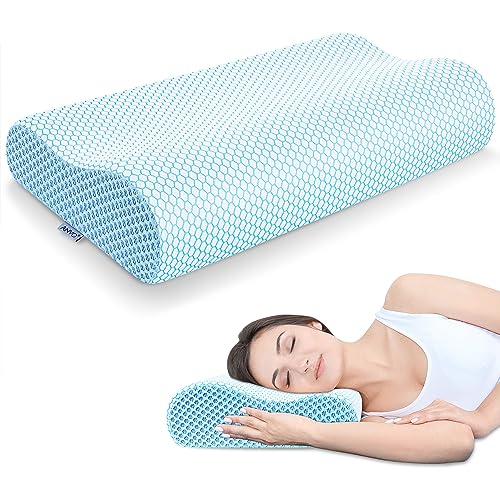
Anvo Cervical Memory Foam Contour Pillow
by Anvo
Firm, dual-height cervical pillow with documented CertiPUR-US lab certification — the clinical choice for chronic neck pain and cervical spondylosis.
Pros
- Two distinct neck support heights (3.5 inches and 4.7 inches) available by simply flipping the pillow
- CertiPUR-US certification with published lab report ID (E392-2021-00556001) provides verifiable safety documentation
- Breathable inner cover extends foam lifespan by protecting against moisture and skin oils
- Firm support profile specifically designed for chronic neck pain and cervical spondylosis management
Cons
- Firm only — not suitable for users who prefer medium or soft pillow feel
- Slightly smaller dimensions than standard queen-size competitors
6. Core Products D-Core Cervical Support Pillow — Runner-Up
The Core Products D-Core is the most clinically oriented pillow in this review and the closest consumer product to the cervical rolls used in physical therapy. The D-shaped center depression accommodates the occiput while the raised cervical roll at the lower edge contacts the posterior cervical spine directly, providing a gentle lordotic stretch similar to what a therapist might achieve with a rolled towel placed behind the neck. This design has been used in rehabilitation settings for cervical spondylosis, post-whiplash recovery, tension headache management, and cervical arthritis for decades.
The 100 percent virgin polyester fiber fill is a deliberate departure from the memory foam used by every other pillow in this review. Polyester fiber produces zero off-gassing, accommodates users with chemical sensitivities or latex allergies, and provides a more traditional pillow feel. The tradeoff is that fiber does not contour to head and neck shape the way memory foam does — the support is more generalized. For users who have tried memory foam cervical pillows and found the sinking, heat-retaining feel uncomfortable, the D-Core provides cervical alignment through its external geometry rather than material contouring.
The limitation is clear: this pillow is designed for back sleeping. The D-core geometry does not translate to effective side sleeping support, and dedicated side sleepers should select one of the adjustable-height memory foam options instead. For back sleepers managing cervical conditions — particularly those who have been prescribed cervical rolls or have a physical therapist who recommends lordotic support during sleep — the D-Core is the most therapeutically appropriate consumer option available. Patients recovering from whiplash or cervical strain may also benefit from pairing this pillow with heating pads applied to the upper trapezius and posterior cervical muscles before sleep to reduce spasm and improve the tissue’s response to the pillow’s lordotic support.

Core Products D-Core Cervical Support Pillow
by Core Products
Physical-therapy-style cervical pillow with D-shaped center and neck roll — the polyester fiber alternative for users who cannot tolerate memory foam.
Pros
- D-shaped center depression with integrated cervical neck roll restores natural lordotic curvature — closest design to physical therapy recommendations
- 100 percent virgin polyester fiber fill eliminates memory foam off-gassing entirely
- Assembled in the USA with nonallergenic materials suitable for sensitive users
- Specifically targets tension headaches, neck injury recovery, and cervical arthritis
Cons
- Optimized for back sleeping — not recommended for dedicated side sleepers
- Fewer reviews (2,149) compared to memory foam competitors limits long-term durability data
7. Mediflow Water Pillow with Memory Foam — Upgrade Pick
The Mediflow is unique in this review — and in the broader cervical pillow market — for one reason: it is the only pillow backed by a peer-reviewed clinical study conducted at Johns Hopkins University School of Medicine. The study, published in the Journal of Pain Research, demonstrated that the Mediflow water pillow significantly reduced neck pain intensity and improved overall sleep quality compared to standard pillows and cervical roll pillows in a controlled trial. This is a higher level of evidence than any other consumer cervical pillow can claim.
The mechanism is the adjustable water base. A sealed polyethylene water pouch sits beneath a layer of micro-perforated European memory foam. The user fills the water base to their desired level — more water for higher loft and firmer support, less water for lower loft and softer feel. Because the water automatically levels with head position changes during the night, the pillow provides continuous adaptive support as the user shifts between back, side, and transitional positions. This is fundamentally different from fixed-contour foam designs, which provide optimal support in one position and suboptimal support in others.
The water’s thermal mass also provides a passive cooling effect that exceeds most foam-based cooling technologies. Water absorbs and slowly dissipates body heat rather than reflecting it back, resulting in a pillow surface that feels consistently cooler throughout the night. The tradeoffs are price and setup complexity: the Mediflow is the most expensive pillow in this review, requires filling the water base during initial setup, and needs occasional refilling to maintain the desired loft. For users who value evidence-based products and want the most adaptive cervical support system available, the Mediflow’s clinical pedigree and self-leveling mechanism justify the investment. Combining cervical support during sleep with targeted massage therapy during the day creates a comprehensive approach to cervical muscle tension and pain management.

Mediflow Water Pillow with Memory Foam
by Mediflow
The only cervical pillow with peer-reviewed clinical evidence — water base technology auto-adjusts to every sleeping position for truly personalized support.
Pros
- Only cervical pillow backed by a peer-reviewed Johns Hopkins clinical study demonstrating reduced neck pain and improved sleep quality
- Water base automatically adjusts and levels with head position changes throughout the night
- Micro-perforated memory foam layer combined with water base provides cooler sleep than solid foam designs
- Truly personalized firmness and loft achieved by adjusting water fill level to individual preference
Cons
- Highest price in this review at over seventy-five dollars
- Requires initial setup to fill the water base and periodic refilling every few months
How to Choose the Best Cervical Pillow
The buyer’s guide factors above cover the core decision criteria. Several additional clinical considerations are worth addressing for readers managing specific cervical conditions.
Cervical spondylosis and degenerative disc disease benefit from pillows that maintain neutral alignment with moderate firmness. A pillow that is too soft allows progressive sinking throughout the night, which can increase compressive loading on already degenerated disc spaces. The Anvo and Osteo are appropriate choices for this population.
Herniated discs with radiculopathy — disc herniations that produce arm pain, numbness, or tingling — require careful pillow selection in consultation with your treating physician. The goal is to avoid positions that narrow the neural foramen where the affected nerve root exits the spine. For most cervical herniations, a moderate-height pillow that keeps the cervical spine neutral without lateral flexion or excessive rotation is appropriate. Adjustable-height designs allow the user to find the specific loft that minimizes symptoms.
Post-whiplash recovery involves both structural healing and muscle spasm management. The cervical roll design of the D-Core can provide gentle lordotic traction that may help restore the normal cervical curve that whiplash injuries commonly flatten. Patients in the acute phase (first two to four weeks) should use whatever pillow position minimizes symptoms and transition to a therapeutic cervical pillow as the acute inflammation resolves.
Tension headaches of cervical origin — headaches that originate from muscle tension and joint dysfunction in the upper cervical spine — often improve with cervical pillows that reduce the sustained posterior muscle contraction caused by poor sleeping posture. The C1-C2 junction and suboccipital muscles are particularly sensitive to pillow height; a pillow that is even moderately too high can perpetuate the muscle tension that triggers cervicogenic headaches.
Regardless of the specific condition, the transition period matters. Start with the lowest comfortable height setting and increase gradually over one to two weeks. Sleep on the pillow for the full night from the first use rather than alternating between the cervical pillow and your old pillow — mixed usage prevents the muscular adaptation that makes cervical pillows effective.
Buyer's Guide
Choosing a cervical pillow requires matching the contour design, loft, and firmness to your sleeping position, body dimensions, and specific cervical condition — the wrong pillow can worsen neck pain rather than relieve it.
Fill Material and Firmness
Memory foam is the most common fill in cervical pillows and provides slow-rebound contouring that adapts to head and neck shape under body heat. Standard memory foam softens in warm conditions and stiffens in cold — temperature-stable formulations like UTTU Dynamic Foam address this limitation. Firmness is a clinical consideration: firm pillows maintain cervical alignment under heavier heads but can cause pressure discomfort on the ear and temporal region during side sleeping. Medium-firm is appropriate for most users. Polyester fiber fills, as in the Core Products D-Core, offer a non-foam alternative for users sensitive to off-gassing or who prefer a traditional pillow feel.
Loft and Height Adjustability
Loft — the height of the pillow under load — is the single most important fit parameter for a cervical pillow. A pillow that is too high forces the cervical spine into lateral flexion during side sleeping and hyperextension during back sleeping. A pillow that is too low fails to fill the gap between the shoulder and ear for side sleepers and allows cervical flexion for back sleepers. Adjustable-height designs — whether through removable inserts, sandwich layers, or water-fill systems — allow users to dial in the correct loft for their body dimensions and mattress firmness. Fixed-height pillows require careful size selection based on shoulder width and sleeping position.
Contour Shape and Design
Cervical pillows use several distinct contour geometries. The most common is the dual-lobe design with a taller side lobe for side sleeping and a lower back lobe for supine sleeping — users rotate the pillow or sleep on different sides depending on position. Hollow-center or concave designs cradle the back of the head in a depression while the surrounding edges support the cervical curve. D-core designs feature a raised cervical roll at the lower edge with a recessed center for the occiput. Each geometry targets cervical alignment differently; the best choice depends on your primary sleeping position and whether you change positions during the night.
Sleeping Position Compatibility
Back sleepers need a lower center loft that supports the cervical lordosis without pushing the head forward into flexion. Side sleepers need a taller lobe that fills the shoulder-to-ear gap and keeps the spine horizontally aligned. Stomach sleepers — a position discouraged by most cervical spine specialists because it forces sustained rotation — need the thinnest possible profile. Combination sleepers who change positions during the night benefit most from adjustable-height pillows or designs with both high and low lobe options. If you are recovering from a specific cervical condition, your physician or physical therapist can advise on which sleeping position to prioritize.
Cooling and Breathability
Memory foam inherently retains more body heat than fiber, down, or latex fills. For users who sleep warm or live in warmer climates, heat buildup can disrupt sleep quality and offset the cervical alignment benefit of the pillow. Cooling technologies address this through several mechanisms: gel-infused foam absorbs and dissipates heat, ventilated foam cores with airflow channels allow passive convection, and phase-change fabric covers such as Arc-Chill technology actively lower the surface contact temperature. Water-based pillows offer the best passive cooling due to the thermal mass of water. If you consistently wake with a warm or sweaty neck, prioritize a pillow with active cooling features rather than relying on a mesh cover alone.
Certifications and Safety Standards
CertiPUR-US certification indicates that the memory foam has been tested for harmful chemicals including formaldehyde, heavy metals, and phthalates, and meets emission standards for volatile organic compounds. Oeko-Tex Standard 100 is a broader textile safety certification that covers the entire pillow including cover fabrics. These certifications matter particularly for users with chemical sensitivities or respiratory conditions such as asthma. Foam pillows without third-party certification may produce noticeable off-gassing odor — while generally not harmful, this can take several days to dissipate and is a common cause of early returns. Clinical study backing, as with the Mediflow water pillow's Johns Hopkins research, provides a higher level of evidence than certification alone.
Final Verdict
For most buyers seeking relief from neck pain, morning stiffness, or cervical alignment issues during sleep, the Osteo Cervical Pillow is our best overall pick. Its hollow concave design provides effective cervical support across all sleeping positions without requiring the user to orient the pillow correctly, the adjustable height covers most body types, and over 19,000 verified reviews provide strong confidence in its performance. The dual CertiPUR-US and Oeko-Tex certification addresses the off-gassing concern that plagues many memory foam competitors.
For budget-conscious buyers, the Cozyplayer delivers genuine cooling technology and a 100-night trial at a price under forty dollars — the lowest-risk entry point into cervical pillow use. For buyers who want premium construction and the longest-lasting foam, the Royal Therapy three-layer design justifies its higher price with denser foam that maintains its contour and support characteristics over years of nightly use. And for evidence-minded buyers who want the only cervical pillow with peer-reviewed clinical research behind it, the Mediflow Water Pillow remains in a category of its own.
A cervical pillow is one component of a comprehensive approach to neck health that should include proper daytime ergonomics, targeted strengthening exercises, and professional guidance for diagnosed conditions. Consult your physician or physical therapist if your neck pain is accompanied by arm symptoms, weakness, or changes in coordination — these presentations may require imaging and clinical evaluation beyond what a pillow change can address.
Frequently Asked Questions
What is a cervical pillow and how does it differ from a regular pillow?
Are cervical pillows recommended by doctors for neck pain?
How long does it take to adjust to a cervical pillow?
Can side sleepers use a cervical pillow?
How do I clean a memory foam cervical pillow?
Related Articles
About the Reviewer

Dr. David Taylor, MD, PhD
Drexel University College of Medicine (MD), Indiana University School of Medicine (PhD)
Dr. David Taylor is a licensed physician and medical researcher who founded BestRatedDocs in 2016. With an MD from Drexel University and a PhD from Indiana University School of Medicine, he combines clinical expertise with a passion for health technology to provide evidence-based product recommendations. Dr. Taylor specializes in health informatics and regularly evaluates medical devices, diagnostic equipment, and therapeutic products to help healthcare professionals and patients make informed decisions.