8 Best Nasal Sprays of 2026
A physician's guide to the best OTC nasal sprays — corticosteroids, decongestants, saline, and natural options reviewed for efficacy, safety, and value.
Updated
Approximately 50 million Americans suffer from allergic rhinitis, and nasal congestion ranks among the most frequent complaints in primary care and urgent care settings — yet the majority of patients select their nasal spray based on shelf placement or advertising rather than pharmacological fit. The OTC nasal spray market contains four fundamentally different drug classes — corticosteroids, decongestants, saline solutions, and natural alternatives — each working through a distinct mechanism with different onset times, durations, safety profiles, and appropriate use cases. Choosing the wrong class does not just underperform; in the case of decongestant sprays used beyond their 3-day limit, it can create rebound congestion worse than the original symptoms.
At BestRatedDocs.com, our reviews are informed by Dr. David Taylor’s clinical experience evaluating pharmacology and patient outcomes. In 2026, we reviewed the best OTC nasal sprays available on Amazon across all four major categories: intranasal corticosteroids for allergy management, oxymetazoline decongestants for acute congestion, saline sprays for daily nasal care, and xylitol-based natural alternatives. Our goal is to help you identify the right spray type for your specific situation — whether you are managing seasonal allergies, fighting a cold, maintaining nasal moisture in dry environments, or seeking a drug-free preventive option. For a broader view of allergy treatment including oral antihistamines and eye drops, see our best allergy medicines guide.
After evaluating eight products across four drug classes and analyzing the clinical evidence behind each active ingredient, here are our top nasal spray picks for 2026. The summary table below highlights the key differentiators at a glance.
How We Selected These Nasal Sprays
Our selection criteria prioritized pharmacological diversity and clinical relevance. We included products from all four major OTC nasal spray classes — corticosteroids, decongestants, saline, and natural alternatives — because each serves a distinct clinical purpose and the best spray for one patient may be entirely wrong for another. Within the corticosteroid category, we selected products representing all three available active ingredients (fluticasone propionate, fluticasone furoate, triamcinolone acetonide, and mometasone furoate) to cover the full range of tolerability and age-appropriateness profiles. We required a minimum of 1,000 verified Amazon reviews for medicated products and weighted our analysis toward sprays with 10,000+ reviews where possible. Every ASIN was verified as a live, in-stock Amazon listing at the time of publication.
1. Flonase Allergy Relief Nasal Spray — Best Overall
Fluticasone propionate is the most extensively studied intranasal corticosteroid in clinical medicine, and Flonase is the product that brought it from prescription-only to OTC status in 2014. The ACAAI and AAAAI jointly recommend intranasal corticosteroids as first-line pharmacotherapy for moderate-to-severe allergic rhinitis — not as a supplement to oral antihistamines, but as a superior alternative. A 2017 Cochrane meta-analysis of 19 randomized controlled trials confirmed that intranasal corticosteroids provide significantly greater improvement in total nasal symptom scores compared to oral antihistamines alone, and the combination of both classes outperforms either used independently.
What distinguishes fluticasone propionate from competing corticosteroid sprays — triamcinolone (Nasacort) and mometasone (Nasonex) — is its effect on ocular allergy symptoms. Fluticasone is the only OTC intranasal corticosteroid with clinical evidence demonstrating improvement in itchy and watery eyes in addition to nasal symptoms. The mechanism is not fully elucidated but is thought to involve reduction of inflammatory mediators that drain from the nasal cavity through the nasolacrimal duct into the eye. For the substantial proportion of allergy sufferers whose symptoms include both nasal congestion and ocular itching, this makes fluticasone the most comprehensive single-spray option.
The 144-spray bottle provides approximately 72 days of once-daily use — enough to cover most of a single allergy season without reordering. The honest caveat is that fluticasone is not a fast-acting medication. Patients expecting Afrin-like instant relief will be disappointed. The drug works by reducing eosinophil infiltration in the nasal mucosa through a genomic anti-inflammatory mechanism that takes 2-3 days to produce meaningful symptom reduction and 1-2 weeks to reach full therapeutic effect. Starting fluticasone 1-2 weeks before your typical allergy season onset produces the best clinical outcomes — a point that packaging rarely emphasizes but that physicians consistently recommend.

Flonase Allergy Relief Nasal Spray, 24 Hour Non Drowsy, 144 Sprays
by Flonase
The gold-standard nasal spray for allergic rhinitis — fluticasone propionate treats all six allergy symptoms and is the #1 allergist-recommended OTC option.
Pros
- The #1 allergist-recommended OTC nasal spray — fluticasone propionate treats all 6 allergy symptoms including itchy and watery eyes, which competing steroid sprays do not address
- Once-daily dosing delivers full 24-hour symptom control, eliminating the need for multiple applications throughout the day
- 144-spray bottle provides approximately 2.5 months of daily use per bottle, making it one of the longest-lasting single-bottle options in the category
- Non-drowsy formulation with no systemic sedation — fluticasone acts locally on nasal mucosa with minimal systemic absorption at recommended doses
Cons
- Requires 2-3 days of consistent daily use before reaching full anti-inflammatory effect — not suitable for immediate same-day relief
- Some users report nosebleeds with extended use, particularly in low-humidity environments or when spray technique directs the mist at the nasal septum
- Mild aftertaste or scent that some users find unpleasant during the first few days of use
2. Flonase Sensimist Allergy Relief — Upgrade Pick
The most common reason patients abandon intranasal corticosteroid therapy is not lack of efficacy — it is discomfort with the spray itself. Standard nasal spray formulations produce a mist that many users can feel entering the nasal cavity, accompanied by a taste or scent as the medication drips down the posterior pharynx. For patients who are averse to this sensation, Sensimist represents a genuine engineering advancement. Its MistPro Technology delivers fluticasone furoate in an ultra-fine mist that deposits almost entirely on the nasal mucosa with minimal posterior drip, virtually no fragrance, and a spray force users describe as barely perceptible.
Sensimist uses fluticasone furoate rather than the fluticasone propionate in standard Flonase — a closely related but distinct molecule with higher receptor binding affinity at a lower microgram dose (27.5mcg versus 50mcg). The clinical efficacy is comparable, and the side effect profile is similar. The meaningful practical difference is the delivery system: Sensimist’s mechanism produces a narrower, more controlled spray cone that stays within the nasal cavity rather than dispersing broadly, reducing the sensation of spray hitting the back of the throat.
The other significant advantage is age approval. Sensimist is approved for children as young as 2 years — the youngest age cutoff among all OTC corticosteroid nasal sprays, tied with Nasacort. For families with young children who need allergy management, the combination of gentle delivery and early age approval makes Sensimist the first choice. The trade-off is cost: the 2-pack of 60-spray bottles is more expensive per spray than standard Flonase or especially the Kirkland generic, and the smaller bottles require more frequent replacement. For adults without spray sensitivity, the standard Flonase formulation delivers equivalent clinical results at a lower per-dose cost. If you also manage respiratory symptoms beyond nasal congestion, our best nebulizers guide covers devices for more complex airway conditions.

Flonase Sensimist Allergy Relief Nasal Spray, 120 Sprays (2-Pack)
by Flonase
The premium upgrade for patients who dislike the feel of traditional nasal sprays — Sensimist's ultra-fine mist and scent-free formula make daily compliance effortless.
Pros
- MistPro Technology delivers an ultra-fine, scent-free mist that users barely feel entering the nasal passage — eliminates the drip-down-throat sensation that causes many patients to abandon nasal spray therapy
- Approved for children as young as 2 years old — the youngest age cutoff among all OTC corticosteroid nasal sprays, making it the best option for pediatric allergy patients
- Virtually no taste or fragrance, addressing the most common complaint users report with standard fluticasone formulations
- Same 24-hour multi-symptom allergy relief as regular Flonase with a significantly more comfortable delivery experience
Cons
- Higher per-spray cost than standard Flonase — the premium delivery technology comes at a measurable price increase
- Smaller individual bottles (60 sprays each) require more frequent replacement than the 144-spray standard Flonase format
- Priming mechanism can be finicky — some users report difficulty getting the first few sprays to dispense consistently
3. Kirkland Signature Aller-Flo — Budget Pick
The pharmacological reality of generic nasal sprays is identical to generic oral medications: the FDA requires all OTC generics to demonstrate bioequivalence to their reference brand, meaning the same active ingredient at the same dose is delivered at the same rate and to the same extent. Kirkland Aller-Flo contains fluticasone propionate 50mcg per spray — the exact same drug, dose, and regulatory standard as Flonase — at approximately one-third the per-spray cost. The 4.8-star average across more than 11,500 verified reviews confirms what the pharmacology predicts: users consistently report that it works identically to Flonase.
The 5-bottle pack delivers 600 total sprays, which translates to roughly 10 months of once-daily dosing for a single user. For a household where two members use fluticasone daily through allergy season, the pack lasts approximately 5 months — still exceptional value compared to buying Flonase bottles individually. The bulk format also makes this the most practical option for year-round allergy sufferers with perennial rhinitis from dust mites, pet dander, or mold who need continuous daily therapy rather than seasonal courses.
The genuine limitation of the 5-pack format is that it is a poor choice for first-time fluticasone users. If you have never used an intranasal corticosteroid before, you do not yet know whether fluticasone will adequately control your symptoms, whether you will tolerate the spray, or whether a different active ingredient (triamcinolone or mometasone) might be a better fit. Start with a single bottle of Flonase (our Best Overall pick) or Nasacort (our Runner-Up) to confirm the medication works for you, then switch to the Kirkland 5-pack for ongoing refills. This avoids committing to a 10-month supply of a medication you might not continue using.

Kirkland Signature Aller-Flo Fluticasone Propionate, 5-Pack (600 Sprays)
by Kirkland Signature
The unambiguous value leader — identical fluticasone to Flonase at roughly one-third the per-spray cost in a 10-month household supply.
Pros
- Identical active ingredient to Flonase — fluticasone propionate 50mcg per spray — at approximately one-third the per-spray cost, making it the best value in the corticosteroid nasal spray category
- 5-bottle pack provides roughly 10 months of once-daily dosing for a single user, eliminating mid-season reorders and pharmacy runs
- 4.8 stars across more than 11,500 verified reviews — the highest-rated fluticasone product on Amazon by combined review volume and rating
- FSA/HSA eligible under the CARES Act, providing an additional 20-40% effective discount depending on your tax bracket
Cons
- Bulk 5-pack format is impractical for first-time fluticasone users who have not yet confirmed the medication works for their symptom profile
- Individual bottles are slightly smaller (120 sprays) than the standard Flonase 144-spray bottle
- Availability can be inconsistent — stock levels fluctuate and Prime delivery is not always guaranteed
4. Nasacort 24HR Allergy Nasal Spray — Runner-Up
Triamcinolone acetonide occupies a specific and valuable niche in the corticosteroid nasal spray category: it is the gentlest formulation for patients with sensitive nasal passages. Nasacort’s alcohol-free, scent-free formula produces noticeably less stinging on application than fluticasone-based products, and users who experience persistent irritation or nosebleeds with Flonase frequently find Nasacort tolerable for long-term daily use. This is not a minor distinction — nasal spray compliance is the primary determinant of therapeutic success, and a product that patients actually use every day outperforms a theoretically superior product they abandon after a week.
With more than 16,600 verified Amazon reviews, Nasacort has one of the deepest real-world performance datasets in the nasal spray category. The 150-spray pack includes a 120-spray main bottle plus a 30-spray bonus travel bottle — a thoughtfully designed format for allergy sufferers who need medication access away from home. The travel bottle fits easily in a pocket, purse, or toiletry bag, which is a genuine convenience advantage over competing products that sell only full-size bottles.
The clinical trade-off compared to fluticasone is twofold. First, triamcinolone has a slower onset — initial relief may take up to 12 hours versus 2-4 hours for fluticasone, though both require 2-3 days for meaningful anti-inflammatory effect. Second, triamcinolone does not have the same evidence base for ocular symptom relief that fluticasone propionate demonstrates. For patients whose allergies include significant eye symptoms (itching, tearing, redness), fluticasone remains the better single-spray choice. For patients whose primary complaints are nasal congestion, sneezing, and runny nose without prominent eye involvement, Nasacort’s superior tolerability profile makes it an excellent first choice. If you’re also looking for eye symptom relief, our best eye drops for dry eyes guide covers options that complement nasal spray therapy.

Nasacort 24HR Allergy Nasal Spray, 150 Spray Pack
by Nasacort
The best corticosteroid spray for sensitive noses — Nasacort's alcohol-free, scent-free formula is the gentlest option with a massive review base confirming long-term reliability.
Pros
- Alcohol-free and scent-free formula is significantly gentler on sensitive nasal passages — the most well-tolerated corticosteroid spray for users who experience stinging or irritation with fluticasone
- Approved for children as young as 2 years, matching Sensimist as the youngest-approved corticosteroid spray on the market
- Includes a bonus 30-spray travel bottle in addition to the 120-spray main bottle — genuinely useful for allergy sufferers who need relief away from home
- More than 16,600 verified Amazon reviews with consistent 4.7-star performance across multiple years of OTC availability
Cons
- Slower onset than fluticasone — initial relief may take up to 12 hours versus 2-4 hours for Flonase, with full effect still requiring 2-3 days
- Does not address itchy or watery eyes — triamcinolone's mechanism targets nasal symptoms only, unlike fluticasone which provides some ocular relief
- Some users report the spray nozzle can clog after extended use, requiring more frequent priming
5. Nasonex 24HR Allergy Nasal Spray
Mometasone furoate’s transition from prescription-only to OTC status is relatively recent, and Nasonex represents the newest entrant in the OTC corticosteroid nasal spray category. For patients and physicians who have been using prescription Nasonex for years, the OTC formulation is identical — same active ingredient, same concentration, same delivery device. The brand’s prescription heritage gives it a clinical data depth that newer products lack: mometasone has been studied in dozens of randomized controlled trials over more than two decades, with a well-characterized safety profile for long-term daily use.
Mometasone’s pharmacological profile sits between fluticasone and triamcinolone in terms of receptor binding characteristics. It demonstrates high topical potency with low systemic bioavailability — less than 0.1% of the administered dose reaches the systemic circulation, among the lowest of any intranasal corticosteroid. This makes it a reasonable choice for patients or parents concerned about the systemic effects of long-term corticosteroid use, though all three OTC corticosteroid sprays have minimal systemic absorption at recommended doses.
The primary limitation is age approval: Nasonex is approved for ages 12 and older in its OTC formulation, which is more restrictive than Flonase (4+), Nasacort (2+), and Sensimist (2+). For families with children under 12 who need allergy management, this rules out Nasonex as an option. The relatively small Amazon review count (1,259) reflects its recent OTC launch rather than any quality concern — the prescription version has been used by millions of patients with consistent results. As the OTC review base grows, we expect Nasonex to establish the same reputation it held in the prescription market.
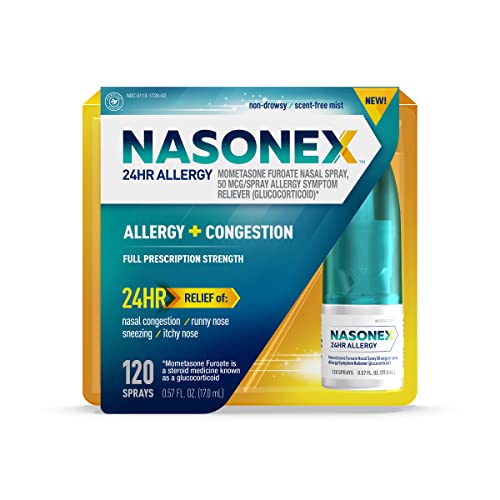
Nasonex 24HR Allergy Nasal Spray, Full Prescription Strength, 120 Sprays
by Nasonex
Full prescription-strength mometasone now available OTC — the former Rx-only Nasonex formula for patients who prefer a proven pharmaceutical pedigree.
Pros
- Former prescription-only mometasone furoate formula — transitioned to OTC status at the same full-strength clinical-grade concentration physicians previously prescribed
- Scent-free mist delivery is well-tolerated even by users who found other corticosteroid sprays unpleasant or nauseating
- Effective for both allergy symptoms and nasal congestion from non-allergic causes — a broader indication profile than some competing sprays
- Trusted pharmaceutical brand with decades of prescription heritage and clinical trial data supporting long-term safety
Cons
- Approved for ages 12 and older only — more restricted than Flonase (4+) or Nasacort (2+), limiting its usefulness for families with younger children
- Newer to OTC status with fewer Amazon reviews (1,259) than established competitors, though clinical data is extensive from its prescription era
- Higher price per spray than generic fluticasone options for a comparable clinical effect
6. Afrin No Drip Severe Congestion Nasal Mist
Oxymetazoline is pharmacologically unique among nasal sprays — it is a direct-acting alpha-adrenergic agonist that constricts dilated nasal blood vessels within seconds of application, producing faster and more dramatic congestion relief than any other OTC nasal medication. For patients with severe nasal obstruction from a cold, sinus infection, or acute sinusitis who cannot breathe through their nose, Afrin provides immediate functional relief that no corticosteroid or saline spray can match in terms of speed. The No Drip formula adds a viscosity-increasing agent that keeps the medication on the nasal mucosa rather than running down the posterior pharynx, improving both comfort and drug delivery.
The 3-day usage limit is not a suggestion — it is a clinical imperative backed by well-documented pharmacology. Oxymetazoline causes rebound congestion (rhinitis medicamentosa) when used beyond 3 consecutive days because the nasal vasculature develops tachyphylaxis to the vasoconstrictive effect while simultaneously developing a compensatory vasodilation response. When the drug wears off, blood vessels dilate more aggressively than before treatment, creating congestion that feels worse than the original symptoms and drives users to reach for the bottle again. This dependency cycle is physiologically real and can persist for weeks after discontinuation, often requiring a course of oral corticosteroids or intranasal steroids to manage the withdrawal congestion.
The clinically optimal approach is to use Afrin as a bridge medication during the first 2-3 days of severe congestion while simultaneously starting a corticosteroid spray like Flonase or Nasacort, which requires several days to reach therapeutic effect. Once the corticosteroid takes effect, discontinue Afrin completely. This protocol provides immediate relief during the critical first few days while establishing the anti-inflammatory therapy that will manage symptoms long-term. Our best cough medicine guide covers additional options for managing upper respiratory symptoms that often accompany nasal congestion.

Afrin No Drip Severe Congestion Nasal Mist, Twin Pack
by Afrin
The fastest relief in the category — Afrin clears severe congestion in seconds, but the strict 3-day usage limit makes it a short-term rescue tool, not a daily treatment.
Pros
- The fastest-acting nasal spray available — oxymetazoline delivers virtually instant congestion relief within seconds of application, faster than any other OTC nasal spray class
- No-drip formula stays on the nasal mucosa where it is applied rather than running down the throat, improving both comfort and drug delivery to target tissue
- 12-hour duration per dose means only two applications per day are needed for round-the-clock congestion relief during acute illness
- Twin pack format provides good value and ensures a backup bottle is available when you need it most — during a cold or sinus infection
Cons
- MUST NOT be used for more than 3 consecutive days — oxymetazoline causes rebound congestion (rhinitis medicamentosa) with prolonged use, creating a dependency cycle that is difficult to break
- Not an allergy treatment — oxymetazoline is a pure vasoconstrictor that shrinks swollen blood vessels but does not address the underlying inflammatory or histamine-mediated mechanisms driving allergic rhinitis
- Can cause transient stinging or burning sensation on application, particularly on irritated or inflamed nasal tissue
7. ARM & HAMMER Simply Saline Daily Mist
Saline nasal spray occupies a unique position in the category — it is the only type with zero pharmacological risk, zero drug interactions, and zero usage limitations, making it universally safe for infants, pregnant women, elderly patients on complex medication regimens, and everyone in between. ARM & HAMMER Simply Saline has earned the #1 doctor and pharmacist recommendation in the saline category by keeping its formulation radically simple: purified water, sodium chloride, and sodium bicarbonate. No preservatives, no medications, no fragrances — three ingredients that clean, moisturize, and buffer nasal pH without introducing any foreign compounds.
The clinical utility of saline extends beyond simple moisturizing. Used as a pre-treatment 5-10 minutes before a corticosteroid spray, saline rinses away mucus and dried secretions that would otherwise prevent the medicated spray from contacting the nasal mucosa directly. This pre-treatment protocol measurably improves the delivery efficiency of corticosteroid sprays — a simple intervention that physicians recommend routinely but that most patients never adopt. Saline also helps maintain the mucociliary clearance mechanism that serves as the nose’s natural defense against allergens, pollutants, and pathogens.
The 4.5-ounce aerosol format is simultaneously Simply Saline’s strength and its limitation. The continuous-mist delivery covers nasal passages more completely than pump-spray bottles, and the large volume means a single can lasts for weeks of daily use. However, the can is not portable — it is too large for a pocket or small bag, making it a home-only product. For portable saline, a pump-spray bottle like NeilMed NasaMist or the Xlear xylitol spray (reviewed below) is more practical. For home use as a daily maintenance spray and pre-treatment before medicated sprays, Simply Saline is the value leader in the saline category.

ARM & HAMMER Simply Saline Nasal Care Daily Mist, 4.5 oz
by Arm & Hammer
The safest daily nasal spray for everyone — drug-free saline that moisturizes, flushes irritants, and primes nasal passages for medicated sprays without any risk of side effects.
Pros
- The #1 doctor- and pharmacist-recommended saline nasal spray — drug-free, preservative-free, and safe for unlimited daily use with zero risk of rebound congestion or dependency
- Only three ingredients — purified water, sodium chloride, and sodium bicarbonate — making it the simplest and cleanest formulation in the entire nasal spray category
- Excellent as a pre-treatment before corticosteroid sprays — clearing mucus and moisturizing nasal passages improves the delivery and absorption of medicated sprays applied afterward
- Safe for all ages including infants, pregnant women, and elderly patients on multiple medications — no drug interactions, no contraindications, no side effects
Cons
- Does not treat underlying allergies, inflammation, or infection — saline only moisturizes and mechanically flushes nasal passages
- 4.5-ounce aerosol can is not pocket- or purse-portable, limiting its convenience for on-the-go use
- Some users find the aerosol stream pressure too forceful for comfort, particularly for children or patients with inflamed nasal tissue
8. Xlear Natural Nasal Spray with Xylitol
Xlear represents the most scientifically credible entry in the natural nasal spray space. Its key differentiator is xylitol — a sugar alcohol that has been extensively studied for its anti-adhesion properties in the upper respiratory tract. Bacteria rely on adhesion to mucosal surfaces as the first step in colonization, and xylitol interferes with this process by altering the osmotic environment and physically disrupting the adhesion mechanism. The evidence is strongest for xylitol’s effect on Streptococcus pneumoniae and Haemophilus influenzae — two of the most common pathogens involved in sinusitis and upper respiratory infections.
The practical implication is that Xlear offers a benefit that goes beyond what standard saline provides. While both saline and xylitol sprays moisturize and flush nasal passages, the xylitol component adds an active anti-microbial dimension that plain saline does not deliver. For patients who experience recurrent sinus infections or who want to reduce their microbial nasal burden during cold and flu season, Xlear provides a drug-free preventive approach that has biological plausibility and a growing body of supporting evidence. The 35,000+ Amazon reviews — the highest count of any product in this guide — suggest that a substantial user base has found ongoing value in the product over multiple repurchase cycles.
The trade-off is cost per ounce. At its current pricing for a 1.5-ounce bottle, Xlear is substantially more expensive than ARM & HAMMER Simply Saline on a volume basis. The small bottle format also runs out quickly at the recommended 2-4 daily applications. For patients who prioritize maximum value and whose nasal care needs are limited to moisturizing and allergen clearance, standard saline is the more economical choice. For patients who are willing to pay a premium for the anti-adhesion benefit — particularly those prone to sinus infections or looking for a drug-free approach to nasal health maintenance — Xlear offers a genuine differentiated benefit that justifies the higher cost. For monitoring respiratory health alongside nasal care, our best pulse oximeters guide covers devices that track blood oxygen levels at home.
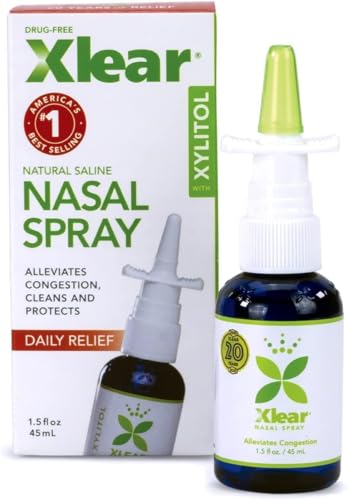
Xlear Natural Nasal Spray with Xylitol, 1.5 fl oz
by Xlear
The best natural nasal spray — Xlear's patented xylitol formula goes beyond simple saline by actively disrupting bacterial adhesion in the nasal passages.
Pros
- Xylitol creates a hostile environment for bacteria by disrupting their ability to adhere to nasal mucosa — a unique anti-adhesion mechanism not found in standard saline sprays
- All-natural ingredient profile (xylitol, saline, grapefruit seed extract) appeals to patients seeking drug-free, preservative-free nasal care with a biological activity advantage over plain saline
- More than 35,000 verified Amazon reviews — the highest review count of any nasal spray in this guide — indicating exceptional long-term customer loyalty and repurchase rates
- Compact 1.5-ounce bottle is pocket- and purse-portable, making it the most convenient format for daily carry and travel use
Cons
- Significantly more expensive per ounce than standard saline sprays — the xylitol premium adds meaningful cost for daily users
- Not as effective as medicated sprays for acute severe congestion or active allergy symptoms — the anti-adhesion mechanism is preventive rather than immediately therapeutic
- Small bottle volume (1.5 fl oz) runs out quickly at the recommended 2-4 times daily usage frequency
How to Use a Nasal Spray Correctly
Incorrect spray technique is the most common — and most preventable — cause of treatment failure with corticosteroid nasal sprays. The critical technique points are frequently overlooked even by long-term users.
Step 1: Clear your nasal passages. Blow your nose gently or use a saline spray to remove mucus before applying medication. Dried secretions on the nasal mucosa prevent the medicated spray from reaching its target tissue.
Step 2: Aim laterally, not upward. This is the most commonly violated instruction. Point the spray tip toward the outer corner of the eye on the same side — left nostril, aim toward left ear. Do NOT aim straight up toward the top of your skull. Aiming upward directs the spray at the nasal septum, which is not the target tissue and is the primary cause of spray-related nosebleeds. The turbinates on the lateral wall of the nasal cavity are where the drug needs to deposit.
Step 3: Use the opposite hand. Spray the left nostril with your right hand and the right nostril with your left hand. This naturally angles the spray away from the septum toward the lateral wall.
Step 4: Do not sniff hard after spraying. A gentle breath in through the nose is sufficient. Forceful sniffing draws the medication past the nasal cavity and into the throat, reducing the dose that reaches the target tissue and causing the aftertaste many users find unpleasant.
Step 5: Be consistent. Corticosteroid sprays are not rescue medications — they work through cumulative anti-inflammatory effects that require daily use to maintain. Missing doses delays the onset of full therapeutic benefit and reduces symptom control.
When to See a Doctor
Most nasal congestion and allergy symptoms respond well to OTC nasal sprays, but certain situations warrant professional evaluation. Seek medical attention if your congestion persists beyond 10-14 days without improvement despite consistent corticosteroid spray use, if you develop thick green or yellow nasal discharge with facial pain or pressure suggesting bacterial sinusitis, if you experience recurrent nosebleeds that do not respond to technique correction, if you have become dependent on decongestant sprays and cannot stop without severe rebound congestion, or if you notice unilateral (one-sided) nasal obstruction that does not respond to any treatment — which may indicate a structural issue such as a deviated septum or nasal polyp requiring surgical evaluation.
Frequently Asked Questions
What is the number one doctor-recommended nasal spray?
Can you use Flonase and Afrin together?
How long does it take for a nasal spray to start working?
What happens if you use Afrin for more than 3 days?
Are nasal sprays safe to use during pregnancy?
Related Articles
About the Reviewer

Dr. David Taylor, MD, PhD
Drexel University College of Medicine (MD), Indiana University School of Medicine (PhD)
Dr. David Taylor is a licensed physician and medical researcher who founded BestRatedDocs in 2016. With an MD from Drexel University and a PhD from Indiana University School of Medicine, he combines clinical expertise with a passion for health technology to provide evidence-based product recommendations. Dr. Taylor specializes in health informatics and regularly evaluates medical devices, diagnostic equipment, and therapeutic products to help healthcare professionals and patients make informed decisions.