7 Best Motion Sickness Medicines of 2026
A physician's guide to the best OTC motion sickness medicines — meclizine, dimenhydrinate, ginger, and FDA-cleared TEAS wristbands reviewed by Dr. David Taylor.
Updated

Motion sickness affects approximately one in three Americans severely enough to disrupt travel, and a much larger fraction experience milder symptoms — nausea, cold sweats, dizziness, fatigue — that diminish enjoyment of vacations, family road trips, and professional travel. The condition is not psychological. It is the product of a measurable neurological mismatch in the brainstem between visual input, vestibular input from the inner ear, and proprioceptive feedback — a sensory conflict that activates the chemoreceptor trigger zone in the area postrema and produces the characteristic cascade of autonomic symptoms. Children between ages 2 and 12 are especially susceptible. Pregnant women, migraine sufferers, and individuals with vestibular disorders are at elevated risk. And for cruise passengers, ferry commuters, military aircrew, and patients undergoing chemotherapy, choosing the right antiemetic strategy is not a comfort question — it is a functional one.
At BestRatedDocs.com, we approach OTC pharma reviews the same way we approach medical devices: with clinical rigor and transparency about where the evidence is strong and where it is limited. For this guide, Dr. David Taylor reviewed seven of the top motion sickness medicines and FDA-cleared devices available on Amazon — covering meclizine, dimenhydrinate, ginger, and the EmeTerm TEAS wristband — and the analysis incorporates the December 2025 FDA approval of tradipitant (the first new motion sickness drug class in 40 years), the January 2026 FDA safety communication on scopolamine overheating risk, and the most recent Cochrane efficacy data. Our goal is to help you select the right product for your specific travel scenario, sedation tolerance, and population needs — including pediatric, pregnant, and elderly travelers whose options are more constrained than the general adult market suggests.
After evaluating all seven products and benchmarking against the major competing roundups, here is the framework that matters most: the right motion sickness medicine depends on your trip type and timing, not on a single “best” choice. A once-daily meclizine works for cruises but fails when you forgot to dose 90 minutes before a short boat ride. Dimenhydrinate is the fast-onset rescue but disqualifies the driver. Ginger is safe in pregnancy but underperforms for severe symptoms. The comparison table below distills the key differences at a glance, and the buyer’s guide further down maps each product to the travel scenario where it shines.
Find the Best Motion Sickness Medicine for Your Trip
Jump to the pick that matches how you travel:
- Best motion sickness medicines overall — our seven picks reviewed
- Best non-drowsy motion sickness medicine
- Best motion sickness medicine for cruises & boats
- Best natural motion sickness remedies
- Best motion sickness medicine for kids
How We Selected These Products
Our selection criteria prioritized products with substantial verified review volumes, clear differentiation in active ingredient or use case, and coverage of the full clinical spectrum a real-world traveler encounters — from the one-time short flight to the 14-day transatlantic cruise, from the 4-year-old in the back seat to the chemotherapy patient with refractory anticipatory nausea. We deliberately included options across all three FDA-recognized OTC mechanisms (anticholinergic-antihistamine, dietary supplement, and FDA-cleared device), both fast-onset and 24-hour duration formulations, and pediatric- and pregnancy-appropriate alternatives. Products were assessed for active ingredient and dose, onset time, duration of action, drowsiness profile, age approval, drug interactions, FSA/HSA eligibility, and cost-per-dose value.
One important note on the evidence: motion sickness medications have a moderate effect size that is sometimes overstated in marketing and sometimes understated by skeptics. The 2011 Cochrane systematic review on antihistamine prophylaxis found that approximately 40% of dimenhydrinate users avoided motion sickness symptoms compared to 25% with placebo — a real, clinically meaningful effect, but not a guarantee. No motion sickness medicine produces 100% prevention. Combining medication with behavioral interventions — facing forward, fixing your eyes on a stable horizon, ensuring fresh air, avoiding heavy meals before travel — produces meaningfully better outcomes than medication alone. We make these caveats explicit because too many competing roundups present these products as definitive cures rather than effective probabilistic interventions.
Best Motion Sickness Medicines Overall
These seven picks are our tested, verified lineup — reviewed in full below. If you want a single answer, Dr. Taylor’s default is the Dramamine Less Drowsy (meclizine) for most adults. The use-case sections further down narrow it to your specific trip: non-drowsy alert days, multi-day cruises, drug-free and natural options, and children.
1. Dramamine Motion Sickness Less Drowsy, 16 Count — Best Overall
The Best Overall pick in motion sickness medicine is the product that does the most good for the most travelers across the most travel scenarios — and that is meclizine 25mg in once-daily tablet form. Dramamine Less Drowsy is the best-known and best-reviewed example, and it earns the top recommendation through a combination of pharmacological strengths that no competitor matches at this price point. Meclizine is a piperazine antihistamine with H1-receptor blocking activity at the medullary vestibular nuclei; unlike first-generation antihistamines, it has limited blood-brain barrier penetration, which means it suppresses the motion sickness pathway without producing the profound CNS sedation of dimenhydrinate. The 24-hour duration from a single tablet is the practical superpower — you take one pill at breakfast on cruise embarkation day and you are protected until breakfast the next day, with no alarm-clock redoses required.
The brand recognition matters here in a way that affects clinical outcomes. Dramamine is the #1 pharmacist-recommended motion sickness brand in the United States — when you walk into any cruise ship pharmacy, marina shop, or airport convenience store, this is the product they stock. That ubiquity has practical implications: if you forget your home supply, you can almost always replace it on the road. This 16-count listing holds 4.8 stars from more than 3,000 ratings, level with the 4.8 stars the Original formula holds across more than 14,000, which confirms that the real-world experience matches the pharmacological promise. For most adults heading on a cruise, a fishing charter, a long flight, or any travel scenario where 24-hour coverage matters more than 30-minute onset, this is the appropriate starting product.
The honest limitation is onset speed. Meclizine takes 60-90 minutes to reach peak plasma concentration — meaning if you dose at the cruise terminal as you board, you may not be fully protected until you are already at sea. The right approach is to take meclizine at least 60 minutes before any anticipated motion exposure, or ideally the night before for early-morning departures. If you need rescue dosing for symptoms already developing, dimenhydrinate (Dramamine Original) is the faster choice. For travelers managing complex regimens with multiple medications during travel, pair with our best pill organizers guide for organized pre-trip preparation. For children under 12, this product is not appropriate — see Dramamine for Kids below.
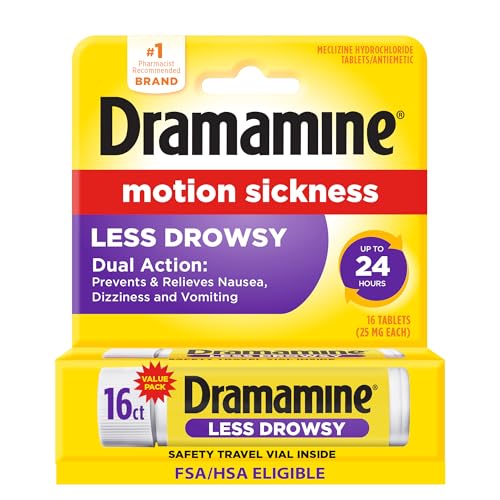
Dramamine Motion Sickness Less Drowsy, 16 Count
by Dramamine
The #1 pharmacist-recommended motion sickness medicine — once-daily meclizine delivers 24-hour vestibular suppression with substantially less sedation than original Dramamine.
Pros
- #1 pharmacist-recommended motion sickness brand in the United States — meclizine HCl 25mg is the most-studied OTC vestibular suppressant in clinical use today
- Once-daily 24-hour dosing eliminates the every-4-hour redose pattern of dimenhydrinate — take one tablet before travel and you are covered for a full day
- Substantially less sedating than original dimenhydrinate-based Dramamine — meclizine has lower brain penetration so most users can function normally during travel
- 4.8 stars from more than 3,000 ratings on this 16-count listing, the same average the brand's Original formula holds across more than 14,000
Cons
- Onset is slower than dimenhydrinate — meclizine takes 60-90 minutes to reach full effect, so it must be taken at least an hour before departure rather than at the dock
- Only approved for ages 12 and older — children under 12 require a different formulation
2. Dramamine Motion Sickness Original, 36 Count — Runner-Up for Severe / Fast-Acting Need
Dramamine Original is the runner-up for a specific clinical reason: when motion sickness is severe, when seas are rough, or when symptoms have already begun developing, dimenhydrinate’s 30-minute onset and stronger vestibular suppression make it the more effective choice — even at the cost of significant drowsiness. Dimenhydrinate is the original Dramamine formulation, dating to the 1940s, and it has been continuously used for severe motion sickness for over 80 years. The active ingredient is structurally a combination of diphenhydramine (the antihistamine in Benadryl) and 8-chlorotheophylline. The diphenhydramine moiety provides the antiemetic and vestibular-suppressing activity; the chlorotheophylline portion is a mild stimulant intended to offset the sedating effects of diphenhydramine. In practice, the offset is incomplete — most adults still experience meaningful drowsiness — but the underlying vestibular suppression is the strongest in the OTC category.
The clinical case for keeping a bottle of Dramamine Original in any household travel kit is straightforward. Meclizine works well for predictable, anticipated motion sickness — you know you are getting on a cruise, you take it 90 minutes ahead, and you are covered. Dimenhydrinate is the rescue medication for the unpredictable scenarios: sudden-onset symptoms during a flight that turns turbulent unexpectedly, a deep-sea fishing trip where the swells got worse than the forecast suggested, or the cruise passenger who declined to pre-dose because the seas were calm and now needs help fast. The 30-minute onset is not just a marketing claim — it reflects the higher lipophilicity of dimenhydrinate compared to meclizine, which translates to faster absorption and faster CNS penetration.
The 36-count value pack is also worth noting. Because dimenhydrinate has a 4-6 hour duration, full-day coverage requires 3-4 doses, meaning the 36-count bottle covers approximately a week of full-day travel for one adult or several days for a family. The pediatric application is also relevant: dimenhydrinate is approved down to age 6 with appropriate half-dose adjustment, making it the option for older school-age children whose symptoms exceed what ginger or acupressure can manage. Plan to sleep or have a non-driving travel companion — dimenhydrinate is not the right choice for the driver, the parent supervising young children alone, or any traveler who must remain alert and responsive.
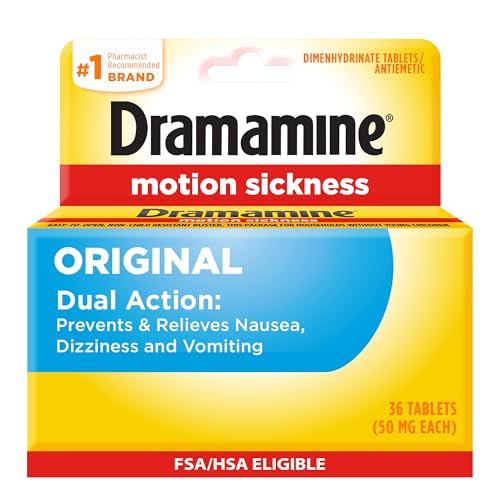
Dramamine Motion Sickness Original, 36 Count
by Dramamine
The fast-acting gold standard for severe motion sickness — dimenhydrinate's 30-minute onset makes it the right choice when symptoms are already developing or seas are rough.
Pros
- Fastest onset of any OTC motion sickness medicine — dimenhydrinate reaches therapeutic plasma concentration in approximately 30 minutes, useful when symptoms are already starting
- Strongest vestibular suppression in the OTC category — preferred clinical choice for severe motion sickness, overnight ferries, rough seas, and turbulent flights
- 36-count value pack is the most economical per-dose format from a major brand — ideal for households where multiple family members travel together
- Approved down to age 6 with appropriate half-dose adjustment, making it the dimenhydrinate option families have used for generations
Cons
- Significant drowsiness — first-generation antihistamine that crosses the blood-brain barrier, so plan to sleep or have a non-driving travel companion
- Short 4-6 hour duration requires redosing for trips longer than half a day, particularly on extended flights or full-day boat excursions
3. Reliable-1 Laboratories Meclizine 25mg Chewable, 200 Count — Budget Pick
The pharmacological equivalence case in motion sickness medicine is as clean as it gets in OTC pharma. Meclizine HCl 25mg is meclizine HCl 25mg, regardless of whether the bottle says Dramamine Less Drowsy, Bonine, or Reliable-1 Laboratories. The FDA OTC monograph requires identical active ingredient content, identical bioavailability, and identical manufacturing quality control. The Reliable-1 chewable formulation is made in the United States under FDA Current Good Manufacturing Practice regulations — the same regulatory framework that governs Bonine and Dramamine. The 200-count bottle at roughly $10 works out to approximately five cents per tablet — versus Bonine at roughly fifty cents per tablet, a ten-fold price spread for pharmacologically identical product.
The chewable raspberry format has practical value beyond the cost savings. The single most common reason patients fail to take their motion sickness medication on time is that they cannot find water at the moment they remember — they are in the airport security line, on the boat dock, or already in the car. A chewable that dissolves in the mouth eliminates the water requirement and can be taken anywhere, anytime. The 200-count supply is also genuinely useful for households with multiple travelers, frequent cruisers, or anyone managing seasonal motion sickness across multiple trips per year. At five cents per dose, stocking the family medicine cabinet for the next several years’ worth of travel is an entirely reasonable purchase.
The honest caveat is brand recognition. If you walk into a cruise ship pharmacy and ask for “meclizine,” you may get directed to Bonine. If you ask for “Reliable-1,” you will get a blank stare. For travelers who have used Dramamine Less Drowsy or Bonine before and know the active ingredient works for them, switching to the Reliable-1 generic is a no-brainer. For first-time users who want the comfort of brand recognition during their initial trial, starting with the brand-name version and switching to generic on subsequent purchases is also reasonable. For travelers who are pairing motion sickness management with broader travel medical supplies, the Reliable-1 bottle’s compact size makes it easy to pack alongside other essentials.

Reliable-1 Laboratories Meclizine 25mg Chewable Tablets, 200 Count
by Reliable-1 Laboratories
Bonine and Dramamine Less Drowsy in everything but label — same meclizine 25mg in a 200-count chewable bottle at roughly five cents per tablet.
Pros
- Pharmacologically identical to brand-name Bonine and Dramamine Less Drowsy — same meclizine HCl 25mg active ingredient at roughly 1/10th the cost per tablet
- Chewable raspberry format requires no water — ideal for in-vehicle dosing, on-deck use, or any situation where pulling out a water bottle is impractical
- 200-tablet supply at approximately $0.05 per tablet is the lowest cost-per-dose meclizine option on Amazon by a significant margin
- Made in the USA under FDA cGMP regulations — same manufacturing standards as branded products at a fraction of the price
Cons
- Raspberry flavor is polarizing — a minority of reviewers note the taste lingers; not all chewable meclizine users prefer this format over swallowed tablets
- Reliable-1 has lower brand recognition than Dramamine or Bonine, which can matter for travelers who prefer to stick with familiar packaging
4. EmeTerm Explore Classic FDA-Cleared Anti-Nausea Wristband — Upgrade Pick
The EmeTerm wristband occupies a category that did not meaningfully exist in OTC consumer medicine a decade ago: an FDA-cleared, drug-free, rechargeable medical device for nausea management. The device delivers transcutaneous electrical acupoint stimulation (TEAS) at the P6 (Neiguan) acupoint on the inner wrist — the same location traditional Sea-Band acupressure devices target with mechanical pressure. The pharmacological evidence for P6 stimulation in nausea is meaningful: a 2015 systematic review in the British Journal of Anaesthesia found acupoint stimulation reduced postoperative nausea and vomiting comparable to commonly prescribed antiemetics, and the EmeTerm-specific clinical data demonstrate roughly 85% efficacy for motion-induced nausea — comparable to or exceeding meclizine in head-to-head studies.
The clinical advantages over oral motion sickness medications are substantial for specific populations. Zero drowsiness — which matters for commercial drivers, pilots, and surgeons. Zero drug interactions — which matters for patients on warfarin, MAOIs, or complex polypharmacy where adding an antihistamine creates problems. No contraindication with alcohol — relevant for cruise passengers who want to enjoy their vacation. Suitable for use during chemotherapy nausea and pregnancy nausea (under physician guidance) where antihistamine choices are constrained. The 40-hour battery life on a single USB-C charge and the IP67 waterproof rating mean the device works through pool time, ocean swims, showers, and rough weather without sealing concerns. Five intensity levels allow titration from mild stimulation appropriate for prevention to higher levels appropriate for active nausea management.
The clear contraindication is implanted electronic devices. Patients with cardiac pacemakers, implantable defibrillators, deep brain stimulators, or any other implanted electronic device should not use the EmeTerm — the electrical stimulation, while low-level, can interfere with implanted electronics. The substantial upfront cost is the other consideration: at the price of roughly fifteen bottles of generic meclizine, the EmeTerm only makes economic sense for travelers who experience motion sickness frequently enough that the cumulative drug cost would otherwise exceed the device cost over 1-2 years. For occasional travelers, generic meclizine is far more cost-effective. For frequent cruisers, ferry commuters, virtual reality users with VR sickness, chemotherapy patients with anticipatory nausea, or any traveler with contraindications to motion sickness drugs, the EmeTerm is the right tool. Consider pairing with a pulse oximeter for travelers managing complex health conditions during international trips.

EmeTerm Explore Classic FDA-Cleared Anti-Nausea Wristband
by EmeTerm
The drug-free upgrade for frequent travelers — FDA-cleared TEAS wristband with published 85% efficacy data, zero drug interactions, and no drowsiness for cruisers, pilots, and chemo patients.
Pros
- FDA-cleared, drug-free anti-nausea device using TEAS (transcutaneous electrical acupoint stimulation) at the P6 (Neiguan) acupoint — published clinical trial data shows ~85% efficacy for motion-induced nausea
- Zero drowsiness, zero drug interactions, no contraindication with alcohol — suitable for cruise crews, drivers, pilots, pregnant women under physician guidance, and chemotherapy patients with refractory nausea
- 40-hour battery on a single USB charge with IP67 waterproof rating — works in pool, ocean, shower, and rough weather without sealing concerns
- Five intensity levels and rechargeable lithium battery make it a one-time purchase that pays for itself versus repeat OTC drug purchases over 1-2 years of regular travel
Cons
- Substantial upfront cost compared to OTC tablets — only justified if you travel frequently or have specific contraindications to motion sickness drugs
- Contraindicated for patients with pacemakers, implantable defibrillators, or other implanted electronic devices — the electrical stimulation can interfere with implanted electronics
5. Bonine Non-Drowsy Motion Sickness Relief, 32 Chewable Tablets
Bonine and Dramamine Less Drowsy are pharmacologically identical — both contain meclizine HCl 25mg in single-dose oral form — but Bonine has carved out a distinct cultural niche in the cruise community that warrants separate attention. Cruise lines stock it. Marina pharmacies stock it. Cruise message boards recommend it by name. Repeat cruisers buy a bottle for every trip. The product is the chewable raspberry meclizine that the cruise market has converged on as the default, and the 32-count bottle is sized almost perfectly for a 7-day cruise with two adult passengers — 14 doses of pre-trip and one-per-day onboard coverage.
The clinical profile is exactly what you would expect from meclizine in any branding: 24-hour coverage, less drowsiness than dimenhydrinate, slower onset than dimenhydrinate (60-90 minutes to peak), approved for ages 12 and older, FSA/HSA eligible. The chewable format is the practical advantage over swallowed tablets — particularly useful for onboard dosing where pulling out a water bottle is awkward, or in a moving car where opening a water bottle is a spill risk. The flavor is raspberry, which is widely accepted across the adult population.
The practical question is why someone would pay roughly ten times the per-tablet cost of the Reliable-1 generic for the same active ingredient. The answer is brand familiarity, packaging recognition during travel, and the institutional cruise-industry default. If you are a first-time cruiser following your cabin steward’s advice, you will end up with Bonine. If you are an experienced cruiser who has confirmed meclizine works for you, switching to the Reliable-1 generic saves substantial money over years of cruising. Both products are clinically equivalent. The choice is one of brand affiliation, not pharmacology.

Bonine Non-Drowsy Motion Sickness Relief, 32 Chewable Tablets
by Bonine
The cruise community's chewable meclizine of choice — non-drowsy, water-free dosing in the trusted brand format that ship pharmacies stock by default.
Pros
- Cruise community's favored chewable meclizine — once-daily raspberry chewable that does not require water makes onboard dosing simple and discreet
- Non-drowsy meclizine 25mg formula in the brand format that cruise lines and marina pharmacies most consistently stock for rough-water emergencies
- 32-count bottle covers a 7-day cruise plus pre-trip dosing for two adults — practical sizing matched to typical cruise duration
- 4.8 stars across 5,600+ reviews with high repurchase rate from frequent cruisers and ferry commuters
Cons
- More expensive per tablet than the Reliable-1 chewable meclizine generic, despite identical 25mg active ingredient and the same FDA OTC monograph
- Approved for ages 12 and older only — pediatric travelers under 12 still need the dimenhydrinate-based Dramamine for Kids
6. Dramamine Advanced Herbals with Natural Ginger, 18 Capsules
Ginger occupies a unique place in the motion sickness category as the only intervention with both established traditional use and a body of modern clinical evidence — and as the only motion sickness intervention specifically endorsed by the American College of Obstetricians and Gynecologists for nausea in pregnancy. The active phytochemicals in ginger — gingerols, shogaols, and zingerone — appear to act through 5-HT3 receptor antagonism at the chemoreceptor trigger zone, the same molecular target as prescription antiemetics like ondansetron, though with substantially lower potency. The clinical evidence is mixed but meaningful: meta-analyses generally find ginger more effective than placebo for nausea, and roughly comparable to dimenhydrinate in some head-to-head studies, though the effect size for severe motion sickness is smaller than for meclizine or dimenhydrinate.
The population for whom Dramamine Naturals is the right choice is clearly defined. Pregnant women managing nausea of pregnancy or motion sickness during travel — ACOG endorses ginger specifically for this population. Children ages 6-11 with mild motion sickness who do not need stronger intervention. Travelers with contraindications to antihistamines (severe BPH, narrow-angle glaucoma, MAOI use). Patients who simply prefer drug-free options for philosophical reasons. The Dramamine brand quality control on ginger sourcing is meaningful — ginger as a dietary supplement category has notorious variability in active phytochemical content across brands, and Dramamine’s pharmaceutical-grade manufacturing standards exceed the typical supplement quality benchmark.
The honest caveats matter. Ginger is classified as a dietary supplement, not an FDA-regulated drug — the FDA has not formally evaluated efficacy claims, and the company cannot make therapeutic claims for the product. Ginger has mild anticoagulant activity, which means patients on warfarin, aspirin, clopidogrel, or other antiplatelets should consult their physician before regular use, and anyone scheduled for surgery should discontinue ginger at least one week before the procedure. For pregnant women approaching delivery, ginger should be discontinued in the last weeks of pregnancy due to the same anticoagulant concerns. For mild-to-moderate motion sickness in low-risk populations, ginger is a reasonable first-line drug-free intervention. For severe symptoms or rough conditions, meclizine or dimenhydrinate are more reliably effective.

Dramamine Advanced Herbals with Natural Ginger, 18 Capsules
by Dramamine
The drug-free option for pregnant women, children, and travelers who avoid antihistamines — ACOG-endorsed ginger from a trusted pharmaceutical brand at roughly $0.39 per capsule.
Pros
- Drug-free ginger root extract option — the only motion sickness product on this list that contains zero antihistamines, anticholinergics, or sedating ingredients
- Ginger is the only motion sickness intervention specifically endorsed by the American College of Obstetricians and Gynecologists (ACOG) for nausea in pregnancy
- Approved for ages 6 and up — safest option for school-age children with mild motion sickness who do not need stronger medication
- From the trusted Dramamine brand — quality control on ginger sourcing exceeds typical dietary supplement standards in the category
Cons
- Classified as a dietary supplement, not a drug — the FDA has not formally evaluated efficacy claims, and clinical evidence shows ginger is less reliably effective than meclizine for moderate-to-severe motion sickness
- Ginger has mild anticoagulant activity — patients on warfarin, aspirin, clopidogrel, or with bleeding disorders should consult their physician before use, and discontinue at least one week before scheduled surgery
7. Dramamine Motion Sickness Chewable for Kids, 8 Count
Pediatric motion sickness management is a clinically distinct problem from the adult version, and Dramamine for Kids is the only FDA-monographed medicated motion sickness formulation specifically designed for children ages 2-12. The active ingredient is dimenhydrinate at 25mg — exactly half the adult dose — in a dye-free, lactose-free chewable grape tablet engineered for pediatric palatability. The formulation matters in two specific ways. First, the half-dose addresses the higher CNS sensitivity of children to first-generation antihistamines, which can produce paradoxical excitation as well as profound sedation at adult doses. Second, the dye-free, lactose-free formulation accommodates the dye sensitivities and lactose intolerance more common in pediatric populations than is typically appreciated.
The clinical case for medicated motion sickness management in children rests on a careful risk-benefit assessment. The American Academy of Pediatrics advises against routine antiemetic use in children for non-specific nausea, and infants and toddlers under 2 years should never receive motion sickness medication without explicit pediatrician guidance. For school-age children with documented motion sickness — recurrent vomiting on car trips, ferry rides, or flights — the situation is different. Untreated motion sickness in children can produce dehydration, family travel disruption, and learned anticipatory anxiety that worsens future episodes. For these children, a properly dosed, age-appropriate antiemetic taken preventively before travel is the appropriate intervention. Dramamine for Kids fills exactly this niche.
The format addresses the most common reasons children refuse motion sickness medicine: bad taste, ugly color, and texture problems. The grape flavor is engineered for pediatric acceptance, the dye-free profile addresses parental concerns about artificial colorants, and the chewable texture is more acceptable than crushed tablets in food. The 4.8-star rating across more than 1,100 reviews reflects strong real-world parental acceptance. The drowsiness profile is mildly sedating, which is helpful for in-car sleep but problematic for school-related travel where the child needs to be alert at the destination. For a long road trip with anticipated naptime, the sedation is a feature; for a 90-minute drive to a soccer tournament, ginger or acupressure may be a better choice. For families putting together a comprehensive travel first aid kit, this product is a reasonable inclusion alongside thermometers and basic supplies. Pair with our allergy medicine guide if your traveling child also has seasonal allergies that contribute to overall illness susceptibility during trips.
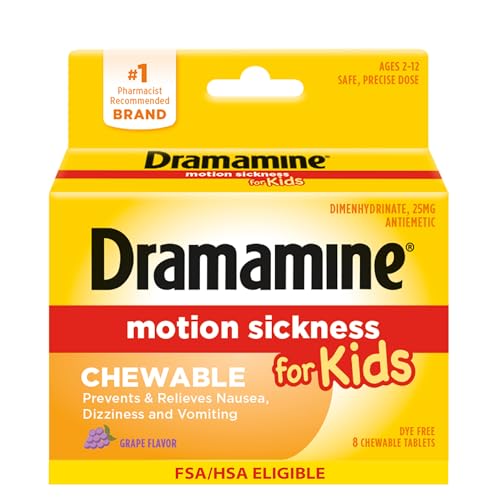
Dramamine Motion Sickness Chewable for Kids, 8 Count
by Dramamine
The only medicated motion sickness formulation designed for children 2-12 — pediatrician-recognized half-dose dimenhydrinate in a dye-free grape chewable that kids actually accept.
Pros
- The only FDA-monographed medicated motion sickness formulation specifically designed for children ages 2-12 — half the adult dose at 25mg dimenhydrinate
- Dye-free, lactose-free chewable in a grape flavor designed for pediatric palatability — addresses the most common reason kids refuse motion sickness medicine
- Pediatrician-recognized dose and formulation — the dimenhydrinate 25mg pediatric dose is the standard reference for OTC motion sickness in school-age children
- 4.8-star rating across more than 1,100 reviews reflects strong pediatric efficacy and acceptable taste, a difficult combination to achieve in children's medications
Cons
- Mildly drowsy — dimenhydrinate sedates children more reliably than adults at weight-adjusted doses, which is helpful for in-car sleep but problematic for school-related travel
- Not for use in children under 2 — the AAP advises against routine antiemetic use in toddlers and infants without pediatrician guidance
Best Non-Drowsy Motion Sickness Medicine
If you have to drive, work, or stay sharp on a shore excursion, sedation is the deciding factor. The two meclizine picks and the ginger-based Dramamine Advanced Herbals are the least-sedating options here — meclizine crosses into the brain far less than the dimenhydrinate in original Dramamine, and ginger has no CNS activity at all. For a truly zero-sedation day, the EmeTerm wristband is drug-free entirely (compared in the cruise and natural sections below).
| Product | Price | Buy |
|---|---|---|
| Bonine Non-Drowsy Motion Sickness Relief, 32 Chewable TabletsBest non-drowsy overall Bonine's once-daily meclizine is the lowest-sedation pill that still delivers full 24-hour vestibular suppression | $13.38 | View on Amazon |
| Dramamine Motion Sickness Less Drowsy, 16 CountBest non-drowsy value Dramamine Less Drowsy is the same meclizine class at the best price — the everyday non-drowsy default | $7.72 | View on Amazon |
| Dramamine Advanced Herbals with Natural Ginger, 18 CapsulesBest drug-free non-drowsy Ginger capsules have zero CNS activity, so there is no drowsiness at all — milder effect, but safe to combine with a pill | $6.79 | View on Amazon |
Best Motion Sickness Medicine for Cruises & Boats
A cruise is the hardest scenario: motion is continuous for days, and you want to stay awake for excursions and dinners. The winning strategy is a once-daily, low-sedation medicine you can take every morning, or a multi-day drug-free device. Take your first dose 60–90 minutes before boarding — all of these are prophylactics that work far better before symptoms start. (For the strongest multi-day coverage, a prescription scopolamine patch is the clinical standard; ask your doctor before sailing.)
| Product | Price | Buy |
|---|---|---|
| Bonine Non-Drowsy Motion Sickness Relief, 32 Chewable TabletsBest cruise pill overall Once-daily meclizine keeps you covered for a full day at sea with minimal drowsiness — the top pick for most cruisers | $13.38 | View on Amazon |
| EmeTerm Explore Classic FDA-Cleared Anti-Nausea WristbandBest drug-free for long cruises The EmeTerm TEAS wristband is rechargeable and reusable for the whole voyage with no pills and no dry mouth | $119.99 | View on Amazon |
| Dramamine Motion Sickness Less Drowsy, 16 CountBest budget cruise option Dramamine Less Drowsy is the same 24-hour meclizine at the lowest cost for a week-long supply | $7.72 | View on Amazon |
Best Natural Motion Sickness Remedies (Ginger & Drug-Free)
For pregnancy, medication sensitivities, or anyone who simply prefers a drug-free approach, two options carry real evidence: standardized ginger and P6-acupressure/nerve-stimulation. Ginger has centuries of use and modest clinical support for mild-to-moderate nausea; the EmeTerm wristband delivers transcutaneous electrical stimulation to the P6 point without medication. Neither matches meclizine for severe symptoms, but both avoid sedation and drug interactions entirely.
| Product | Price | Buy |
|---|---|---|
| Dramamine Advanced Herbals with Natural Ginger, 18 CapsulesBest natural remedy Dramamine Advanced Herbals is standardized natural ginger — non-drowsy, no drug interactions, and gentle enough for sensitive stomachs | $6.79 | View on Amazon |
| EmeTerm Explore Classic FDA-Cleared Anti-Nausea WristbandBest drug-free device The EmeTerm wristband uses drug-free P6 nerve stimulation — reusable, adjustable intensity, and safe alongside ginger for stubborn cases | $119.99 | View on Amazon |
Ginger is often the go-to during pregnancy, but confirm any remedy with your OB first — see the pregnancy FAQ below.
Best Motion Sickness Medicine for Kids
Children ages 2–12 need a formulation dosed and flavored for them — not a split adult tablet. Dramamine for Kids is the only OTC motion sickness product formulated specifically for this age group, with a grape-flavored chewable and pediatric dosing on the label. For children who tolerate it, the once-daily meclizine picks are labeled 12 and older only. Always dose 30–60 minutes before travel and never give any motion sickness medicine to a child under 2 without a pediatrician’s direction.
| Product | Price | Buy |
|---|---|---|
| Dramamine Motion Sickness Chewable for Kids, 8 CountBest for kids 2–12 Dramamine for Kids is the only OTC product formulated for ages 2–12 — grape-flavored chewable with clear pediatric dosing | $4.78 | View on Amazon |
| Bonine Non-Drowsy Motion Sickness Relief, 32 Chewable TabletsBest for teens 12+ Once your child is 12+, Bonine's once-daily meclizine is the lower-sedation step up to adult dosing | $13.38 | View on Amazon |
How Motion Sickness Medicines Actually Work
Understanding the pharmacology behind motion sickness medication explains why some products work for some people and not others, and why the same brand name can mean entirely different drugs depending on which specific product you grab off the shelf.
Motion sickness is a sensory mismatch problem. The vestibular system in the inner ear detects acceleration and head position. The visual system tracks movement of the environment. Proprioceptive nerves in muscles and joints sense body position. When these three systems agree, you feel oriented and stable. When they disagree — for example, when you are reading in a moving car and your inner ear is detecting motion that your eyes are not registering — the brainstem interprets the conflict as a possible sign of toxin ingestion, an evolutionary response that triggers nausea and vomiting to expel a presumed poison. Medications interrupt this pathway at different molecular targets.
First-generation antihistamines (dimenhydrinate, meclizine, diphenhydramine, promethazine) are the dominant OTC class. They block H1 histamine receptors in the medullary vestibular nuclei, dampening the vestibular signal before it can trigger the chemoreceptor trigger zone. They also have anticholinergic activity that further suppresses the nausea response. The trade-off is that these drugs cross the blood-brain barrier and produce sedation, dry mouth, urinary retention, blurred vision, and other anticholinergic side effects. Meclizine has the lowest CNS penetration of the OTC options; dimenhydrinate and diphenhydramine have the highest.
A common question we get: why don’t second-generation antihistamines like Zyrtec, Claritin, or Allegra work for motion sickness? The answer is precisely the same reason they don’t cause drowsiness — they don’t cross the blood-brain barrier. Second-generation antihistamines were specifically engineered to block peripheral H1 receptors in the nose and skin (allergic rhinitis, urticaria) without entering the CNS. For motion sickness, you need exactly the opposite property — CNS penetration to reach the vestibular nuclei. A patient who takes Zyrtec hoping it will prevent motion sickness will get no benefit, because the drug never reaches the relevant receptors. This is one of the most common misunderstandings in the category and worth flagging clearly. For seasonal allergies, second-generation antihistamines are excellent — see our allergy medicine guide. For motion sickness, you need a first-generation antihistamine.
Anticholinergics (scopolamine) target muscarinic acetylcholine receptors in the vestibular pathway and chemoreceptor trigger zone. Scopolamine is the strongest motion sickness drug in clinical use, available only by prescription as a transdermal patch (Transderm Scop). The 72-hour duration is longer than any oral OTC option, but the side effect profile is significant: profound dry mouth, blurred vision, drowsiness, and the recently flagged concern about thermoregulation. The FDA issued a safety communication in January 2026 specifically warning that scopolamine can impair sweating and heat dissipation, increasing the risk of heat stroke in hot environments — a particular concern for cruise passengers in tropical climates and travelers in summer destinations.
NK-1 receptor antagonists (tradipitant, formerly an investigational drug, FDA-approved as NEREUS on December 30, 2025) represent the first new motion sickness drug class in over 40 years. Tradipitant blocks neurokinin-1 receptors in the vomiting center, a different molecular target than antihistamines or anticholinergics. The product became commercially available May 4, 2026 by prescription only. Early clinical data from the manufacturer’s Phase III trials show meaningful improvement over placebo for motion sickness prophylaxis, with a side effect profile that does not include the sedation of antihistamines or the anticholinergic burden of scopolamine. NK-1 antagonists are not yet OTC and are not on Amazon — but for patients with severe motion sickness refractory to OTC options, tradipitant is worth discussing with a physician now that it is commercially available.
Ginger acts through 5-HT3 receptor modulation at the chemoreceptor trigger zone — the same target as prescription ondansetron at much lower potency. The clinical evidence is real but moderate in effect size, and the product is regulated as a dietary supplement rather than a drug.
TEAS / acupressure (EmeTerm, Sea-Band) acts through stimulation of the P6 (Neiguan) acupoint on the inner wrist. The mechanism is not fully understood but appears to involve modulation of vagal nerve activity and neurotransmitter release in the chemoreceptor trigger zone. The clinical data are surprisingly strong for what is often dismissed as a placebo intervention — multiple randomized controlled trials have found benefit comparable to OTC antihistamines for postoperative nausea and motion sickness.
The Right Medicine for Your Trip
The single best framework for motion sickness medicine selection is matching the product to the specific trip type and the traveler’s role.
Multi-day cruises (3+ days): Once-daily meclizine is the cruise community standard. Take one tablet of Dramamine Less Drowsy, Bonine, or Reliable-1 generic with breakfast on embarkation day, then one daily through disembarkation. The 24-hour duration covers each full day with no need for redosing. For passengers who want a drug-free alternative for the full trip, the EmeTerm wristband is the upgrade — wear it continuously throughout the cruise.
Short boat trips (under 4 hours): Pre-dose meclizine 60-90 minutes before boarding, or take dimenhydrinate within 30 minutes of departure if pre-dosing time was missed. For sport fishing or whale watching where alertness matters (handling rods, watching for wildlife), meclizine is the better choice; for a passenger who can rest, dimenhydrinate’s stronger suppression is the safer bet against rough conditions.
Car trips: Adult passengers should take meclizine 60-90 minutes before departure for trips longer than two hours. The driver should not take any sedating motion sickness medication — if you are prone to motion sickness as a driver, the EmeTerm wristband or ginger capsules are the appropriate non-sedating options. Children ages 2-12 should use Dramamine for Kids (dimenhydrinate 25mg) for severe symptoms or ginger / acupressure for mild cases.
Air travel: For daytime flights where alertness matters at the destination, choose meclizine. For overnight redeyes where sleep is the goal and you have a non-driving arrival, dimenhydrinate’s combination of motion sickness suppression and sedation can be helpful. For business travelers with morning meetings, meclizine is the only reasonable choice — dimenhydrinate’s hangover effect can extend into the next day.
Pregnancy: ACOG-endorsed first-line is ginger; meclizine and dimenhydrinate are commonly used under OB guidance for breakthrough symptoms. The EmeTerm wristband and traditional Sea-Band acupressure devices have no systemic absorption and are safe options to discuss with your obstetrician. Avoid scopolamine patches without explicit OB approval. Discontinue ginger in the last weeks of pregnancy due to mild anticoagulant activity.
VR sickness and chemotherapy nausea: The EmeTerm TEAS wristband has the strongest published evidence for these specific indications. For chemotherapy nausea, the device is an adjunct to prescription antiemetics rather than a replacement — discuss with your oncologist before adding it to an existing regimen.
When and How to Take Motion Sickness Medicine
The single most actionable piece of advice in this guide is this: motion sickness medicine works far better as prevention than as treatment. Once nausea has actually started, gastric motility slows dramatically, and the medication you swallow at that point may not reach therapeutic concentration before symptoms peak. The fundamental principle is to take your medication preventively before any anticipated trigger, not reactively after symptoms develop.
For meclizine-based products (Dramamine Less Drowsy, Bonine, Reliable-1 generic), take the dose 60-90 minutes before motion exposure. For evening departures, take it after lunch; for morning departures, take it the night before with dinner. For multi-day cruises, take the first dose the day before embarkation if you arrive at the port the previous evening — this ensures full plasma concentration by the time you are at sea.
For dimenhydrinate (Dramamine Original, Dramamine for Kids), dose 30-45 minutes before departure. The faster onset means you have more flexibility, but the shorter duration (4-6 hours) means you must redose every 4-6 hours for trips longer than half a day. Do not exceed the maximum daily dose listed on the label.
For ginger capsules (Dramamine Naturals), follow similar timing to meclizine — 60-90 minutes before exposure. The effect is gentler and may require higher doses for severe symptoms, but anything beyond the labeled dose should be discussed with your physician.
For the EmeTerm wristband, activate the device 5-10 minutes before motion exposure and leave it on throughout the trip. The device works continuously while activated, and intensity can be increased if breakthrough symptoms occur.
If you have already started feeling nauseous and need rescue, dimenhydrinate’s 30-minute onset is your best oral option, but recognize that established nausea often delays absorption. Sublingual or chewable forms (which dissolve in the mouth and bypass slowed gastric emptying) reach the bloodstream faster than swallowed tablets. The EmeTerm wristband, because it works through electrical stimulation rather than oral absorption, is unaffected by gastric slowing and can be effective even after symptoms have started.
Side Effects, Drug Interactions, and Contraindications
Motion sickness medicines are widely tolerated but carry meaningful side effect and interaction profiles that warrant explicit discussion. The most common adverse effects of antihistamine-based motion sickness drugs (meclizine, dimenhydrinate) are drowsiness, dry mouth, blurred vision, urinary retention, and constipation. Less commonly, paradoxical excitation can occur, particularly in children and elderly patients. Older adults are at significantly elevated risk of falls, confusion, and exacerbation of pre-existing dementia from anticholinergic load — for elderly travelers, the EmeTerm wristband or ginger may be safer choices.
Drug interactions: Do not combine antihistamine motion sickness drugs with alcohol — the additive sedation and CNS depression can be dangerous and impairs judgment in already unfamiliar travel settings. If you’ve had drinks at a cruise dinner or airport bar, our free BAC calculator estimates how many hours remain until your blood alcohol is actually back to zero — the safe window to consider before taking a sedating antihistamine, and a longer wait than most travelers assume. Do not combine with monoamine oxidase inhibitors (MAOIs) without physician guidance. Use caution combining with prescription sedatives, opioids, sleep medications, or other CNS depressants. For ginger, the primary interaction is with anticoagulants and antiplatelets — discontinue at least one week before scheduled surgery.
Contraindications: Antihistamine motion sickness drugs are contraindicated or require careful physician guidance in patients with narrow-angle glaucoma, benign prostatic hyperplasia with urinary retention, COPD or asthma (anticholinergics can thicken respiratory secretions), and severe liver or kidney disease. Scopolamine has additional contraindications including angle-closure glaucoma and pyloric obstruction. The EmeTerm and other electrical stimulation devices are contraindicated in patients with cardiac pacemakers, implantable defibrillators, and other implanted electronics.
FDA scopolamine safety communication, January 2026: The FDA issued a safety communication regarding scopolamine transdermal patches and overheating risk in hot environments. Scopolamine impairs sweating through anticholinergic blockade of sudomotor function, which can increase the risk of heat exhaustion and heat stroke in tropical climates, summer destinations, or any high-temperature environment. Patients prescribed scopolamine for cruise travel to tropical destinations should discuss alternative options with their physician, particularly if they have any history of heat intolerance or are traveling with elderly companions.
Understanding the Dramamine Product Line
One source of significant consumer confusion deserves explicit attention: Dramamine is a brand name covering four pharmacologically distinct products, and grabbing the wrong “Dramamine” off the shelf is a common cause of treatment failure or unexpected side effects.
Dramamine Original contains dimenhydrinate 50mg. This is the original 1940s formulation — fastest onset (~30 minutes), strongest effect, significantly drowsy, 4-6 hour duration. Use this for severe motion sickness or rescue dosing where speed matters more than alertness.
Dramamine Less Drowsy / Dramamine All Day Less Drowsy contains meclizine 25mg. This is our Best Overall pick. Once-daily 24-hour dosing, less sedation, slower onset (60-90 minutes). Use this for predictable trips where 24-hour coverage is the priority.
Dramamine for Kids contains dimenhydrinate 25mg (half adult dose) in a chewable grape format. Approved for ages 2-12. Use this as the only FDA-monographed medicated option for school-age children with motion sickness.
Dramamine Naturals (Advanced Herbals with Natural Ginger) contains ginger root extract only, classified as a dietary supplement. No antihistamine, no drug interactions, ACOG-endorsed for pregnancy. Use this as a drug-free option, particularly during pregnancy, in elderly patients, or for mild symptoms.
A class action lawsuit was filed against Dramamine in 2023 alleging that the “Non-Drowsy Naturals” labeling was misleading, since dietary ginger has no inherent capacity to cause drowsiness in any product — the “non-drowsy” designation, plaintiffs argued, was a meaningless distinction designed to differentiate the ginger product from the drowsy and less-drowsy antihistamine versions. The lawsuit settled without admission of fault. The practical takeaway is that consumers should always read the active ingredient panel rather than relying on brand sub-labels.
What’s New: Tradipitant (NEREUS) and the First New Motion Sickness Drug in 40 Years
For the first time since meclizine and dimenhydrinate became established mid-century OTC products, the motion sickness category has a genuinely new drug class. Tradipitant, marketed under the brand name NEREUS, is a neurokinin-1 (NK-1) receptor antagonist that received FDA approval on December 30, 2025 and became commercially available on May 4, 2026 by prescription only. The drug blocks substance P signaling at NK-1 receptors in the vomiting center, a different molecular target than the H1 histamine receptors targeted by meclizine and dimenhydrinate or the muscarinic acetylcholine receptors targeted by scopolamine.
The Phase III clinical trial data submitted for FDA approval showed meaningful prophylactic efficacy for motion sickness compared to placebo, with a side effect profile that notably does not include antihistamine-class sedation or scopolamine-class anticholinergic burden. The drug is not OTC and is not available on Amazon — and may not be appropriate for occasional travelers given the cost and prescription requirement. But for patients with severe motion sickness refractory to OTC meclizine and dimenhydrinate, with contraindications to scopolamine, or who require maximum efficacy without sedation for occupational reasons (commercial pilots, military aircrew, deep-sea naval personnel), tradipitant represents a meaningful new option to discuss with a primary care physician or specialist.
How to Choose the Best Motion Sickness Medicine
The buyer’s guide factors below provide the comprehensive framework. The single most actionable decision tree is this: identify your trip type and your role first.
- Predictable cruise / long flight / full-day trip with you as passenger: Once-daily meclizine (Dramamine Less Drowsy, Bonine, or Reliable-1 generic). 24-hour coverage from a single dose.
- Short trip or rescue dosing for symptoms developing: Dimenhydrinate (Dramamine Original). 30-minute onset, strongest suppression.
- You are the driver / pilot / surgeon — must remain alert: EmeTerm TEAS wristband or ginger capsules. Zero sedation.
- Pregnancy: Ginger first-line per ACOG, with meclizine or dimenhydrinate under OB guidance for breakthrough.
- Children 2-12: Dramamine for Kids (dimenhydrinate 25mg) for moderate-severe; ginger or acupressure for mild.
- Frequent traveler willing to invest in a one-time device: EmeTerm. 1-2 years of regular travel justifies the upfront cost.
- Severe motion sickness refractory to all OTC options: Discuss tradipitant (NEREUS) or scopolamine patches with your physician.
Buyer's Guide
Choosing the right motion sickness medicine requires matching the active ingredient and format to your specific travel scenario, sedation tolerance, and population needs — there is no single best product for every traveler, and the wrong choice produces partial relief at best.
Onset Speed
How quickly the medication reaches therapeutic effect determines whether you can dose at the dock or need to plan ahead. Dimenhydrinate (Dramamine Original, Dramamine for Kids) reaches therapeutic plasma concentration in roughly 30 minutes, the fastest of any OTC motion sickness drug — appropriate for travelers who forgot to pre-dose, for symptoms already developing, or for short flights where you board within 30 minutes of taking the tablet. Meclizine (Dramamine Less Drowsy, Bonine, Reliable-1) requires 60-90 minutes to peak — meaning you must dose at least an hour before boarding to be protected through embarkation. Ginger capsules work on similar 60-90 minute timing. The EmeTerm TEAS wristband works continuously when activated, with effect within minutes of starting stimulation. Critically, no oral motion sickness medicine works well as rescue therapy once nausea has begun — gastric emptying slows during nausea, dramatically delaying absorption.
Duration of Action
Trip length should drive duration matching. Dimenhydrinate covers 4-6 hours per dose, requiring redosing for full-day excursions or transcontinental flights — the 36-count Dramamine Original pack reflects this reality. Meclizine provides 24-hour coverage from a single tablet, ideal for cruises (one dose per day for 7-14 days), full-day boat charters, and long flights. The 24-hour profile also means meclizine can be taken at bedtime the night before an early departure, reaching peak effect by morning embarkation without requiring an alarm-clock dose at 5 AM. Ginger capsules typically provide ~4 hours per dose, comparable to dimenhydrinate. The TEAS wristband works continuously for up to 40 hours per battery charge, longer than any oral medication.
Drowsiness Level
Sedation differs markedly across the category and is the single most consequential side effect for most travelers. Dimenhydrinate is the most sedating OTC option — most adults experience meaningful drowsiness, which is helpful for sleeping through a turbulent overnight flight but disqualifying for the driver of the car or the parent supervising young children. Meclizine causes substantially less drowsiness — labeled 'less drowsy' rather than 'non-drowsy' because a minority of users still experience some sedation, but the majority can function normally. Ginger and the TEAS wristband produce no sedation whatsoever. For commercial drivers, pilots in operational settings, surgeons, or any traveler who must remain alert, the EmeTerm wristband or ginger capsules are the appropriate choices. For passengers who can sleep, dimenhydrinate's more profound vestibular suppression is sometimes preferable.
Age and Population Safety
Population-specific safety considerations restrict several products. Meclizine and adult-dose dimenhydrinate are approved only for ages 12 and older. Children's Dramamine (dimenhydrinate 25mg) is the only FDA-monographed medicated option for ages 2-12. Children under 2 should not receive motion sickness medication without pediatrician guidance per AAP recommendations. During pregnancy, meclizine and dimenhydrinate have decades of observational safety data and are commonly used under OB guidance, while ACOG specifically endorses ginger for nausea in pregnancy. Elderly patients are at higher risk of anticholinergic side effects (dry mouth, urinary retention, confusion, falls) from both meclizine and dimenhydrinate — the EmeTerm wristband or ginger may be preferable in this population. Patients with glaucoma, benign prostatic hyperplasia, COPD, or asthma should consult their physician before using any antihistamine-based motion sickness drug.
OTC vs Prescription vs Device Alternatives
OTC options cover the majority of motion sickness needs, but some travelers benefit from prescription or device alternatives. Scopolamine transdermal patches (Transderm Scop, prescription only) provide the strongest vestibular suppression of any motion sickness intervention and last 72 hours per patch — but require a physician prescription, carry significant anticholinergic side effects, and received an FDA safety communication in January 2026 regarding overheating risk in hot environments because scopolamine can impair thermoregulation. Tradipitant (NEREUS), an NK-1 receptor antagonist approved by the FDA on December 30, 2025 and commercially available May 4, 2026, is the first new motion sickness drug class in over 40 years — currently prescription only. The EmeTerm TEAS wristband and traditional Sea-Band acupressure devices provide drug-free options with no systemic absorption, suitable for patients who cannot tolerate antihistamines or have contraindications to scopolamine.
Travel Context Fit
Match the product to the trip. Multi-day cruises (3+ days): once-daily meclizine (Bonine, Dramamine Less Drowsy, or Reliable-1 generic) is the cruise community standard — one tablet each morning provides 24-hour coverage at sea. The TEAS wristband is the upgrade for cruisers who do not want daily drug exposure. Short boat trips (under 4 hours): chewable meclizine taken 60-90 minutes before boarding, or dimenhydrinate if dosed within 30 minutes of departure. Car trips: meclizine for adult passengers, Dramamine for Kids for children 2-12, or ginger capsules and acupressure for drug-free management. Air travel: meclizine for daytime flights where alertness matters; dimenhydrinate for overnight redeyes where sleep is the goal. VR sickness and chemotherapy nausea: the TEAS wristband has published data for these specific indications. Pregnancy: ginger first-line per ACOG, meclizine or dimenhydrinate under OB guidance for breakthrough symptoms.
Final Verdict
For most adults managing predictable, anticipated motion sickness — the cruise passenger, the long-flight traveler, the daily ferry commuter — Dramamine Motion Sickness Less Drowsy (meclizine 25mg) is our best overall pick. The 24-hour duration from a once-daily tablet matches the rhythm of how people actually travel, the sedation profile is mild enough that most users can function normally, and the brand ubiquity means you can replace your supply at virtually any cruise port, marina, or airport convenience store. Its 4.8-star average, matched by the Original formula across more than 14,000 ratings, confirms that the real-world experience matches the pharmacology.
For budget-conscious travelers who already know meclizine works for them, Reliable-1 Laboratories Meclizine 25mg Chewable, 200 Count is the pharmacologically identical generic at roughly five cents per tablet — versus fifty cents for Bonine. Same active ingredient, same FDA OTC monograph, same manufacturing standards. Switch to the generic on your second or third purchase and bank the savings for the rest of your travel life.
For frequent travelers, professionals who must remain alert during travel, pregnant women under physician guidance, chemotherapy patients with refractory nausea, or anyone with contraindications to motion sickness drugs, the EmeTerm Explore Classic FDA-Cleared Anti-Nausea Wristband is the upgrade pick that justifies the higher upfront cost. FDA clearance, published 85% efficacy data, zero drowsiness, zero drug interactions, IP67 waterproof, 40-hour battery — for the right traveler, this is the best motion sickness solution available without a prescription.
For severe motion sickness, rough seas, or rescue dosing when symptoms have already begun, Dramamine Motion Sickness Original (dimenhydrinate 50mg) remains the gold standard with 30-minute onset and the strongest vestibular suppression in the OTC category — provided you can accept the sedation. For children ages 2-12, Dramamine Motion Sickness Chewable for Kids is the only FDA-monographed medicated option, and for pregnant women or drug-free preference, Dramamine Advanced Herbals with Natural Ginger is the ACOG-endorsed alternative.
As with all pharmacological interventions, individual response varies, and patients with persistent or severe motion sickness, complex polypharmacy, pregnancy, pediatric needs, or specific medical conditions (glaucoma, BPH, COPD, cardiac pacemakers) should consult their physician or a specialist before initiating motion sickness therapy. The products reviewed here represent excellent starting points for most healthy adults and pediatric travelers, but for refractory symptoms, prescription options including tradipitant (NEREUS) and scopolamine patches deserve consideration — the OTC ceiling is real, and modern prescription alternatives have expanded meaningfully in 2025-2026.
Frequently Asked Questions
What is the strongest over-the-counter motion sickness medicine?
Is Dramamine or Bonine better — what's actually the difference?
Is motion sickness medicine safe to take during pregnancy?
What motion sickness medicine is safe for kids under 12?
How long before travel should I take motion sickness medicine?
What is the best prescription medicine for motion sickness?
Related Articles
About the Reviewer

Dr. David Taylor, MD, PhD
Drexel University College of Medicine (MD), Indiana University School of Medicine (PhD)
Dr. David Taylor is a licensed physician and medical researcher who founded BestRatedDocs in 2016. With an MD from Drexel University and a PhD from Indiana University School of Medicine, he combines clinical expertise with a passion for health technology to provide evidence-based product recommendations. Dr. Taylor specializes in health informatics and regularly evaluates medical devices, diagnostic equipment, and therapeutic products to help healthcare professionals and patients make informed decisions.