7 Best Ankle Braces of 2026
Dr. David Taylor reviews the best ankle braces on Amazon for sprains, sports, and daily support. Compare lace-up, stirrup, and sleeve styles by stability and fit.
Updated
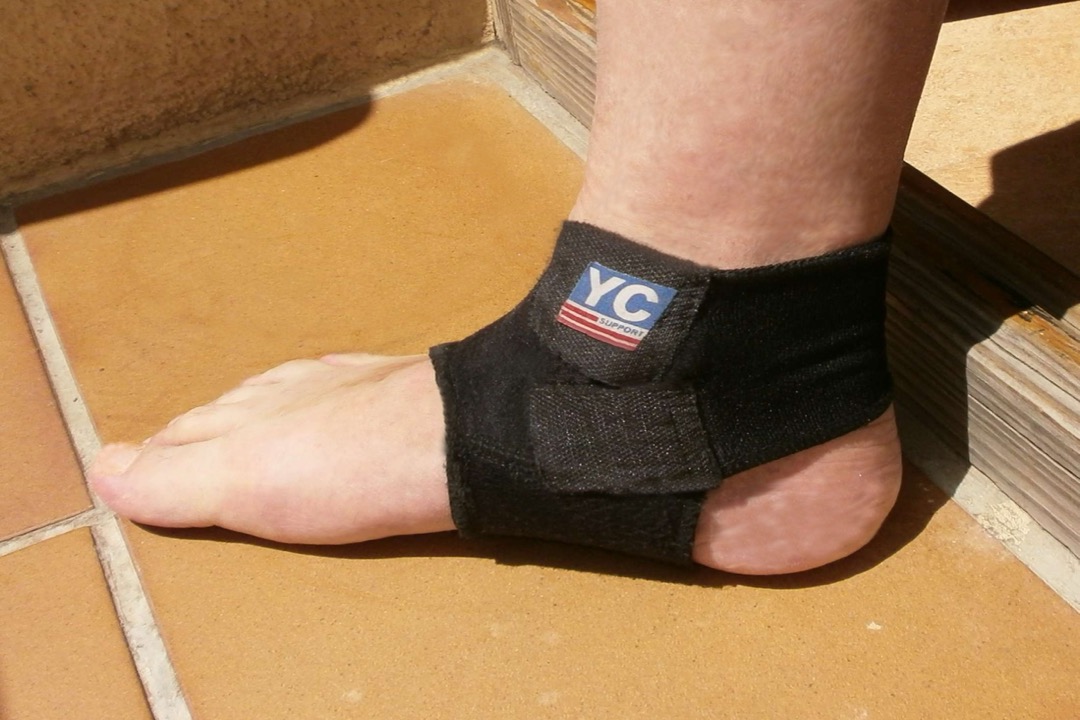
Ankle sprains are the most common musculoskeletal injury in the United States, affecting an estimated 25,000 people every day according to the American Academy of Orthopedic Surgeons. Whether you are a weekend basketball player recovering from your third inversion sprain, an active older adult managing chronic ankle instability, or an athlete returning to the court after a Grade II ligament injury, the right ankle brace can meaningfully reduce pain, limit re-injury risk, and compress recovery timelines. The wrong brace — or a brace sized or typed incorrectly for your condition — may provide false confidence without adequate mechanical support.
At BestRatedDocs.com, our team reviewed the ankle brace evidence base alongside thousands of verified Amazon customer reviews, athletic trainer consensus, and published rehabilitation guidelines to identify the seven best ankle braces available in 2026. We applied the same methodology we use across our knee brace and wrist brace reviews: real clinical context, honest trade-off analysis, and product recommendations organized around how you will actually use the brace, not simply by star rating or price.
Our selection spans every major brace category — compression sleeves for mild daily support, lace-up braces for sport sprain prevention, stirrup braces for acute rehabilitation, and maximum-support hinged braces for serious athletes with chronic instability. Every ASIN in this review was re-confirmed live on Amazon at our latest mid-2026 update. Here is what we found.
After evaluating over a dozen ankle brace models and analyzing thousands of verified user reviews, our top picks cover every support level and use case. The comparison table below shows all seven side-by-side.
Find the Best Ankle Brace for Your Situation
Jump straight to the pick that matches how you’ll actually use it:
- Best ankle braces overall — our seven top picks, reviewed
- For a sprained ankle — matched to sprain grade
- Lace-up ankle braces — the taping-style workhorses
- Ankle compression sleeves — low-profile daily wear
- For basketball — lateral cutting and jump-landing
- For volleyball — court sports and repeated blocking
- For peroneal tendonitis — lateral ankle pain
How We Selected These Ankle Braces
Our selection criteria prioritized four dimensions: clinical appropriateness (does the brace mechanism match the support claims), real-world wearability (does it fit in shoes, how long does application take, is it machine washable), verified user experience from Amazon review aggregates, and brand clinical credibility. We deliberately included braces from the category’s most trusted manufacturers — McDavid, Mueller, Aircast/DJO, Med Spec, and Zamst — alongside strong value options that represent the broader accessible market. Braces were excluded if their support mechanism was mismatched to their stated use case, if sizing was persistently inconsistent in user reports, or if construction quality reviews indicated rapid degradation.
Best Ankle Braces Overall
These are the seven braces we recommend, reviewed in full below. Each is the best answer for a particular support tier and use case — from an under-$20 compression sleeve for daily swelling to a maximum-support hinged brace built for high ankle sprains. If you already know your situation, use the use-case sections further down to jump to a focused two-or-three-product comparison.
McDavid Ankle Brace Ultralight
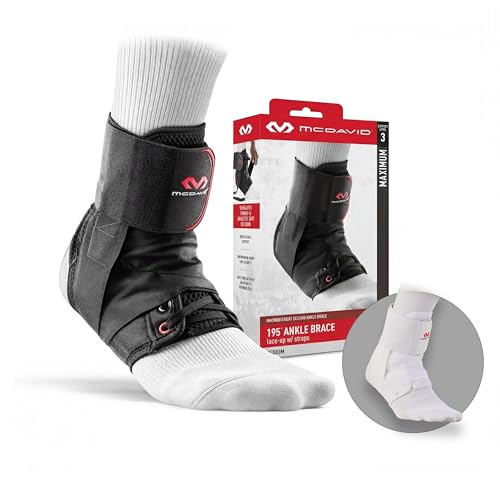
McDavid Ankle Brace Ultralight for Sprained Ankle, Figure 8 Ankle Braces, Lace up Ankle Brace
by McDavid
The closest thing to an athletic tape job in brace form — McDavid's Ultralight delivers reliable inversion control and fits inside any shoe.
Pros
- Figure-8 strap system mimics the mechanics of athletic taping — delivers firm inversion and eversion control without the bulk of a rigid brace
- Ultralight construction fits inside most standard athletic shoes without requiring users to size up in footwear
- Bilateral design works on either foot, so one brace covers both sides for athletes who rotate support
- Lace-up closure with elastic straps allows independent tension adjustment for the lower ankle and the malleolus region
Cons
- Lace-up application takes 2 to 3 minutes — athletes needing quick sideline application may prefer a slip-on style
- Polyester construction retains moisture during extended high-intensity activity; may require drying between double sessions
The McDavid Ultralight is our Best Overall pick because it solves the core challenge of ankle bracing: delivering genuine mechanical support in a profile thin enough to fit inside an athletic shoe. The figure-8 strap system wraps above the malleoli and locks the ankle in a mechanically neutral position during lateral cutting movements — the exact motion that produces the majority of inversion sprains in sport. Unlike rigid stirrup braces that add significant width, the Ultralight sits flat against the ankle and requires no shoe size adjustment for most users.
What distinguishes the Ultralight from cheaper lace-up alternatives is the combination of the lace closure — which allows fine tension adjustment across the entire ankle — and the elastic figure-8 straps, which maintain dynamic tension as the ankle flexes through full range of motion. Cheaper lace-up braces rely on laces alone; the strap mechanism here is what produces sport-taping-level lateral control. McDavid specifies this brace for Level 3 maximum protection, and the evidence base for lace-up braces in preventing recurrent ankle sprains is strong.
The bilateral design (one size serves both left and right ankles) is a practical advantage for athletic trainers managing team equipment budgets. The tradeoff is application time — athletes and patients who need to apply the brace quickly between periods or during a busy clinic day may prefer the Mueller AFT3’s 30-second slip-on mechanism. For most users, though, the 2-to-3-minute lacing investment is well worth the superior support delivered.
MUELLER Sports Medicine AFT3 Ankle Brace

MUELLER Sports Medicine AFT3 Ankle Brace
by Mueller Sports Medicine
Mueller's AFT3 is the best entry-level ankle brace for daily mild support — fast to apply, comfortable all day, and priced for the family medicine cabinet.
Pros
- Slip-on design with single figure-8 strap applies in under 30 seconds — ideal for patients who need quick daily application or have limited hand dexterity
- Neoprene-free construction is lighter and less warm than traditional bulky braces, making it practical for all-day wear
- One size fits most design eliminates sizing guesswork for casual users and caregivers purchasing for a family member
- Low profile sits comfortably inside standard shoes and work boots without requiring any footwear modification
Cons
- Single strap provides mild-to-moderate lateral support only — not appropriate for Grade II or Grade III sprains or post-surgical stabilization
- Compression is non-adjustable once sized; users with significant swelling may find the fit inconsistent as edema changes
The Mueller AFT3 earns its position as Best Budget by doing one thing exceptionally well: providing accessible daily mild support that is fast to apply, comfortable for all-day wear, and priced within reach of anyone. At a fraction of the cost of the Aircast or Zamst, the AFT3 addresses the large population of ankle brace users who need compression and mild stability — not rigid mechanical control — for conditions like mild chronic instability, early-stage arthritis, post-sprain daily wear after the acute phase, or simply long days on hard floors.
The slip-on design with a single adjustable figure-8 strap is the correct mechanism for this use case. Mueller’s one-size-fits-most approach works because this brace functions primarily through uniform compression rather than anatomical contouring — and for mild support, that is clinically sufficient. The neoprene-free construction keeps the ankle significantly cooler than older neoprene sleeve designs, which matters considerably for eight-plus-hour daily wear in warm environments.
The honest clinical limitation here is the support ceiling. The AFT3 is not appropriate for managing acute Grade II or Grade III sprains, for athletes returning to high-intensity cutting sports, or for post-surgical stabilization. For those needs, step up to the McDavid Ultralight or the Aircast Air-Stirrup. But for daily functional support and mild sprain management, the Mueller AFT3 delivers reliable performance at an accessible price point.
Aircast Air-Stirrup Universe Ankle Brace
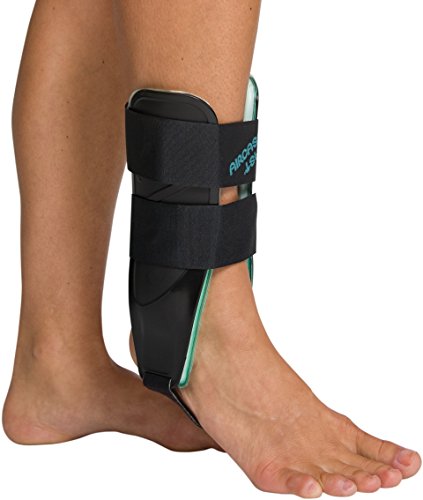
Aircast Air-Stirrup Universe Ankle Brace
by Aircast (DJO)
The Aircast Air-Stirrup Universe is the clinical gold standard for acute ankle sprain management — pneumatic compression with rigid stirrup protection in a universal fit.
Pros
- Duplex aircell system delivers graduated pneumatic compression that actively reduces post-sprain edema — a clinically validated mechanism used in hospital-based ankle management
- Universal left/right fit with a one-size shell makes this the preferred option for clinical settings and athletic training rooms stocking a single unit
- Semi-rigid stirrup shell limits inversion and eversion more definitively than any lace-up or sleeve in this review
- Proprietary SoftSport liner is removable and washable, maintaining hygiene during extended rehabilitation protocols
Cons
- Bulkier than lace-up styles — requires a wider toe box and typically a half-size larger shoe to accommodate the rigid shell
- Universal sizing means less precise anatomical contouring than the left/right-specific Air-Stirrup models
The Aircast Air-Stirrup is the brace most frequently recommended by emergency medicine physicians, orthopedic surgeons, and physical therapists for managing acute ankle sprains — and for good reason. The Duplex aircell technology delivers graduated pneumatic compression that mimics the hemodynamic effects of the R.I.C.E. protocol’s compression component, actively combating the edema that accumulates in the first 48 to 72 hours after a ligamentous injury. This is the only product in our review that addresses acute swelling mechanically rather than relying purely on structural support.
The semi-rigid stirrup shell limits inversion and eversion movement more definitively than any lace-up brace. While lace-up braces control lateral movement through strap tension, the Aircast’s rigid plastic shell physically blocks the ankle from reaching the angular extremes that damage ligament fibers. This matters most in the early post-injury phase when the ligamentous structures are still healing and vulnerable to re-stress.
The Universal version reviewed here (B00Y7WJQW0) fits either foot in a one-size design, making it practical for clinical settings and athletic training rooms. If you are purchasing for a specific individual and know the foot size, the left/right-specific Air-Stirrup models offer more precise anatomical fit. The primary trade-off versus lace-up options is bulk — the stirrup shell adds width that requires a wider or half-size-larger shoe. This is the expected cost of rigid mechanical protection, and for acute rehabilitation contexts, it is a trade-off worth making. Users managing ongoing instability alongside their recovery may also want to pair the Aircast with a TENS unit for adjunctive pain and inflammation management.
Med Spec ASO Ankle Stabilizer

Med Spec ASO Ankle Stabilizer, Lace Up Ankle Brace
by Med Spec
The Med Spec ASO is the athletic training room workhorse — durable canvas construction and clinical-grade strap mechanics make it a trusted sideline staple.
Pros
- Angled elastic stabilizing straps contour above the malleoli and replicate the figure-8 taping technique recommended by certified athletic trainers
- Durable canvas-like boot construction holds its shape through hundreds of applications without the laces losing tension or the strap anchors degrading
- Bilateral fit on either ankle with consistent performance across left and right — a practical advantage for teams and athletic training rooms
- Spacer mesh fabric on the tongue and Achilles tendon channel reduces pressure points during extended wear in cleated or rigid footwear
Cons
- Firmer canvas construction requires a brief break-in period compared to the softer nylon used in the McDavid Ultralight
- Lace-up application is slower than strap-only designs, which can be a limitation for sideline application under time pressure
The Med Spec ASO (Ankle Stabilizing Orthosis) is the standard-issue lace-up brace in athletic training rooms across American high schools, colleges, and professional sports organizations. If the McDavid Ultralight is the performance-focused option, the ASO is the institutional standard — built for durability through hundreds of applications, consistent bilateral fit, and the kind of mechanical reliability that athletic trainers depend on when they are applying braces to fifteen athletes before a game.
The distinguishing feature is the angled elastic stabilizing straps that contour specifically above the medial and lateral malleoli. This anatomical targeting more closely replicates the figure-8 taping technique used by certified athletic trainers than the flat figure-8 straps on most consumer lace-up braces. The canvas-like outer boot material is firmer than the polyester used in the McDavid Ultralight — which means a short break-in period, but also that the brace maintains its shape and structural integrity far longer under repeated use.
The ASO also comes in a wider size range than most competitors, including an XXL option that accommodates the broader ankle circumferences found in larger adult athletes. For athletes with persistent chronic instability who need a reliable workhorse brace they can trust season after season, the Med Spec ASO is a time-tested answer. At its current price point, it represents excellent long-term value for anyone who goes through more than two or three braces per year.
Zamst A2-DX Sports Ankle Brace

Zamst A2-DX Sports Ankle Brace with Protective Guards
by Zamst
The Zamst A2-DX is the performance athlete's choice for maximum ankle protection — NBA-endorsed, clinically designed for high ankle sprains and chronic instability.
Pros
- Dual X-strap stabilizers provide three-dimensional support — anterior, lateral, and medial — addressing the full mechanical challenge of high ankle sprains that simpler braces cannot reach
- Rigid side guards with protective shells physically block the extreme inversion and eversion range that produces Grade III ligament tears
- Worn by NBA-level athletes including Trae Young, providing high-performance credibility backed by professional sports use
- Breathable exterior shell reduces heat retention compared to enclosed rigid braces, allowing sustained wear in competitive athletic contexts
Cons
- Significantly bulkier than lace-up options — requires a wider shoe and is visibly larger under most athletic footwear
- Premium pricing places this above most consumer budgets; best justified for athletes with documented chronic instability or prior high ankle sprain
The Zamst A2-DX occupies a distinct tier above every other brace in this review: maximum-support, designed specifically for high ankle sprains and chronic instability severe enough that standard lace-up braces cannot adequately protect the joint. High ankle sprains — technically, injuries to the syndesmosis ligament connecting the tibia and fibula above the ankle mortise — are significantly harder to manage than lateral inversion sprains, heal more slowly, and require stabilization across a wider range of motion planes than most braces address.
The dual X-strap system is the A2-DX’s core innovation. Two crossing straps create anterior, lateral, and medial stabilization vectors simultaneously — addressing the complex three-dimensional instability of a high ankle sprain that single-plane lace-up or stirrup braces cannot adequately control. The rigid side guards then physically limit the extreme angular positions that would stress the healing syndesmosis ligament under athletic loading. This combination is why the A2-DX is found on the ankles of professional NBA players including Trae Young.
The clinical caveat is proportionate to the premium: the A2-DX is overkill for a mild lateral sprain, adds significant bulk to any shoe, and requires a brief learning curve on strap application to achieve correct positioning. For the athlete with a documented Grade III lateral sprain history, chronic laxity confirmed by stress imaging, or a prior high ankle sprain, however, the investment is clinically justified. This is not an everyday brace for casual users — it is specialized medical-grade protective equipment for specific high-risk scenarios.
Sleeve Stars Ankle Brace

Sleeve Stars Ankle Brace for Women & Men, Ankle Wrap for Sprain
by Sleeve Stars
Sleeve Stars' compression sleeve bridges the gap between passive compression and active stabilization — ideal for plantar fasciitis, mild swelling, and all-day discrete wear.
Pros
- Compression sleeve construction with an optional removable stabilizing strap adapts from mild all-day compression to targeted lateral support without switching products
- Low-profile knit design disappears inside socks and shoes — appropriate for professional or business dress where a visible brace would be unwelcome
- Graduated compression promotes venous return to reduce ankle swelling after long periods of standing, walking, or prolonged travel
- Ideal for plantar fasciitis management alongside ankle support, since the sleeve extends to the arch and provides mild plantar compression
Cons
- Compression-only base provides insufficient lateral stabilization for acute sprains or unstable ankles without the optional strap in place
- Knit construction stretches and loses compression tension after repeated washings; replacement is needed more frequently than rigid braces
The Sleeve Stars compression brace addresses a population underserved by most ankle brace reviews: people who need low-profile, all-day ankle support for plantar fasciitis, mild chronic swelling, prolonged standing occupations, or travel-related edema rather than acute sprain management. The compression sleeve construction with an optional removable strap is the right mechanism here — it is thin enough to disappear inside dress shoes, comfortable enough for twelve-hour wear, and machine washable for daily use.
The graduated compression design promotes venous return from the foot and lower ankle, directly addressing the circulatory component of ankle swelling that accumulates during prolonged sitting (air travel) or static standing (healthcare workers, retail associates, teachers). The arch extension of the sleeve provides mild plantar fascial support — a meaningful secondary benefit for the substantial overlap between ankle instability and plantar fasciitis populations.
The honest limitation is the support ceiling in lateral stabilization. Without the optional strap engaged, the Sleeve Stars provides compression only — adequate for managing swelling and mild discomfort, but not for controlling inversion instability during sport or lateral activity. With the strap engaged, it delivers moderate support appropriate for light activity and daily walking. For any use case involving athletics, court sports, or meaningful lateral loads, a lace-up brace or stirrup design is the appropriate choice.
Z Athletics Ankle Brace
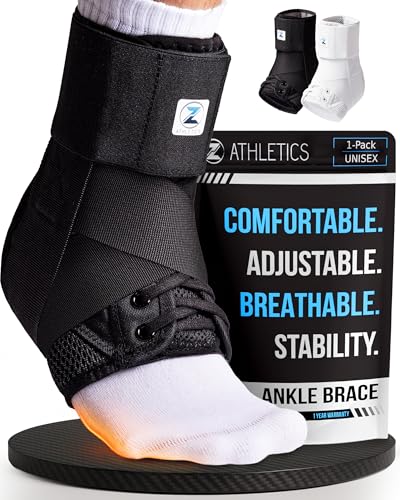
Z ATHLETICS Ankle Brace for Women & Men - Lace Up Adjustable Support with Side Stabilizers
by Z Athletics
Z Athletics delivers the structure of a stirrup brace in a lace-up form — plastic stabilizer stays and figure-8 straps make this a strong mid-range pick for court sports.
Pros
- Rigid side stabilizer panels add lateral stiffness to a lace-up design, offering a middle ground between soft lace-up braces and fully rigid stirrup styles
- Figure-8 elastic straps combined with stays deliver firm inversion control suitable for volleyball and basketball where lateral cutting is frequent
- Competitively priced against the McDavid Ultralight while adding plastic stabilizer stays for users who need additional structure
- Adjustable lace tension allows independent customization for the forefoot and ankle without removing the brace between adjustments
Cons
- Some users report the heel cup creates pressure points during prolonged wear; pairing with a thin heel pad can resolve this
- The added stabilizer bulk means this fits less easily inside lower-profile athletic shoes compared to the thinner McDavid Ultralight
The Z Athletics brace occupies an interesting middle position: it provides more structural support than a basic compression sleeve or thin lace-up brace through the addition of plastic stabilizer stays, while remaining thinner and more shoe-compatible than a rigid stirrup design. For athletes in court sports who want the lateral cutting stability of a stay-reinforced brace without the bulk of the Aircast or Zamst, this is a well-executed compromise.
The plastic stays on the medial and lateral sides add physical resistance to inversion and eversion that pure lace tension cannot replicate. Combined with the figure-8 elastic straps, the Z Athletics brace delivers mechanical support comparable to the Med Spec ASO at a lower price point — the trade-off being less durable construction over long-term repeated use. This makes it an appropriate choice for a single-season recovery or for budget-conscious athletes who need stay-reinforced support without the institutional-grade durability requirements of a high school or college athletic program.
User reports note that fit is generally accurate to sizing, though the heel cup can create pressure for users with a prominent heel pad or bony heel prominence — a thin gel heel pad resolves this in most cases. For volleyball, recreational basketball, and trail running where lateral ankle stability is a priority, the Z Athletics brace represents strong value in the moderate support tier.
Best Ankle Brace for a Sprained Ankle
The right brace for a sprain depends entirely on the grade. A Grade 1 sprain (mild ligament stretch) needs compression and light support to manage swelling. A Grade 2 sprain (partial tear) needs a lace-up brace that mechanically blocks the ankle from rolling. A Grade 3 sprain or an acutely swollen ankle needs a semi-rigid stirrup that limits inversion outright while pneumatic aircells drive down edema. Match the brace to your injury severity, and have a clinician confirm the grade before you return to weight-bearing activity.
| Product | Price | Buy |
|---|---|---|
| Sleeve Stars Ankle Brace for Women & Men, Ankle Wrap for SprainGrade 1 — mild Compression sleeve with an optional strap for mild sprains and lingering swelling | $18.95 | View on Amazon |
| McDavid Ankle Brace Ultralight for Sprained Ankle, Figure 8 Ankle Braces, Lace up Ankle BraceGrade 2 — moderate Figure-8 lace-up that locks out the inversion motion behind most Grade 2 sprains | $34.99 | View on Amazon |
| Aircast Air-Stirrup Universe Ankle BraceGrade 3 / acute Semi-rigid aircell stirrup — pneumatic compression for acute swelling and instability | $29.38 | View on Amazon |
Best Lace-Up Ankle Brace
Lace-up braces are the most popular category for good reason: they replicate an athletic tape job in a reusable, adjustable form, fit inside most shoes, and deliver moderate-to-firm support without the bulk of a rigid stirrup. The differences come down to durability and how much extra structure the straps and stays add. All three below use a figure-8 strap mechanism over a laced boot.
| Product | Price | Buy |
|---|---|---|
| McDavid Ankle Brace Ultralight for Sprained Ankle, Figure 8 Ankle Braces, Lace up Ankle BraceBest lace-up overall Ultralight laced boot with figure-8 straps — taping-level control that fits any shoe | $34.99 | View on Amazon |
| Med Spec ASO Ankle Stabilizer, Lace Up Ankle BraceMost durable Canvas ASO boot built for hundreds of applications; the athletic-training-room standard | $34.77 | View on Amazon |
| Z ATHLETICS Ankle Brace for Women & Men - Lace Up Adjustable Support with Side StabilizersBest value Adds plastic stabilizer stays to a lace-up at a lower price for extra lateral structure | $29.97 | View on Amazon |
Best Ankle Compression Sleeve
Compression sleeves trade rigid stabilization for all-day comfort. They slip on like a sock, disappear inside dress shoes, and use graduated compression to manage mild swelling, plantar fasciitis, and long days on your feet — the daily-wear end of the ankle-support spectrum. If you need to control an active sprain, step up to a lace-up; for swelling and mild support, a sleeve is the right tool.
| Product | Price | Buy |
|---|---|---|
| Sleeve Stars Ankle Brace for Women & Men, Ankle Wrap for SprainBest compression sleeve Knit sleeve with an optional strap and arch coverage — ideal for swelling and plantar fasciitis | $18.95 | View on Amazon |
| MUELLER Sports Medicine AFT3 Ankle BraceBest slip-on alternative Neoprene-free slip-on with a single figure-8 strap that applies in under 30 seconds | $20.69 | View on Amazon |
Best Ankle Brace for Basketball
Basketball produces ankle sprains through hard lateral cuts and awkward jump landings, and a prior sprain raises re-injury risk sharply. The braces court players and trainers reach for are the lace-up ASO and the semi-rigid Zamst A2-DX — the same models cited across basketball-specific roundups. Choose based on how much history of instability you’re protecting against, and whether the brace fits inside your basketball shoe.
| Product | Price | Buy |
|---|---|---|
| Med Spec ASO Ankle Stabilizer, Lace Up Ankle BraceBest for basketball The training-room ASO stabilizer — taping-level lateral control trusted by trainers | $34.77 | View on Amazon |
| Zamst A2-DX Sports Ankle Brace with Protective GuardsMaximum stability Rigid guard stabilizers worn by NBA guards; the pick for chronic instability | $80.00 | View on Amazon |
| McDavid Ankle Brace Ultralight for Sprained Ankle, Figure 8 Ankle Braces, Lace up Ankle BraceBest low-profile Slimmest option here — fits low-cut basketball shoes without sizing up | $34.99 | View on Amazon |
Best Ankle Brace for Volleyball
Volleyball loads the ankle on repeated blocking and hitting approaches, where players land on feet at the net. Court roundups favor structured lace-ups and rigid stabilizers that survive constant jumping. Our picks span the value-to-maximum range so you can match support to your sprain history and how often you’re at the net.
| Product | Price | Buy |
|---|---|---|
| Med Spec ASO Ankle Stabilizer, Lace Up Ankle BraceBest for volleyball Durable ASO stabilizer that holds up to a full season of jump-landing loads | $34.77 | View on Amazon |
| Z ATHLETICS Ankle Brace for Women & Men - Lace Up Adjustable Support with Side StabilizersBest value Stay-reinforced lace-up with figure-8 straps — court stability at a lower price | $29.97 | View on Amazon |
| Zamst A2-DX Sports Ankle Brace with Protective GuardsMaximum protection Rigid guards for players with a documented high ankle sprain or chronic laxity | $80.00 | View on Amazon |
Best Ankle Brace for Peroneal Tendonitis
Peroneal tendonitis is lateral (outer) ankle pain from overuse of the peroneal tendons, and the goal of a brace is to limit the rolling motion that aggravates them while controlling swelling. Clinicians point to lace-up braces, compression sleeves, and semi-rigid stirrups depending on pain level — flare-ups want firm lateral stability, while milder or recovering cases do better with adjustable compression. Pair any brace with rest and supportive footwear.
| Product | Price | Buy |
|---|---|---|
| Aircast Air-Stirrup Universe Ankle BraceBest for acute flare-ups Semi-rigid stirrup that blocks the lateral rolling motion which irritates the tendon | $29.38 | View on Amazon |
| Med Spec ASO Ankle Stabilizer, Lace Up Ankle BraceBest lace-up support Adjustable lace-up that limits inversion while you stay active during recovery | $34.77 | View on Amazon |
| Sleeve Stars Ankle Brace for Women & Men, Ankle Wrap for SprainBest for mild / recovery Light graduated compression for daily wear once the acute pain settles | $18.95 | View on Amazon |
How to Choose the Best Ankle Brace
Buyer's Guide
Choosing the right ankle brace depends on your injury history, activity level, and how much structural support versus wearing comfort you need. Here are the six factors that matter most.
Brace Type and Mechanism
Ankle braces fall into four functional categories: compression sleeves (mild support, maximum comfort), lace-up braces (moderate-to-firm support, flexible sizing), stirrup/semi-rigid braces (firm support with pneumatic or rigid shells), and hinged rigid braces (maximum support for severe instability). Matching the mechanism to your clinical need is the most important purchase decision. Wearing a compression sleeve for a Grade II sprain, or a rigid brace for mild daily swelling, is equally suboptimal in opposite directions.
Support Level and Sprain Grade
Ankle braces are typically rated mild, moderate, or maximum. Mild support is appropriate for compression, mild swelling management, and very mild instability during daily activity. Moderate support is the right tier for most sport-related Grade I and Grade II sprain prevention and recovery. Maximum support braces like the Zamst A2-DX are indicated for high ankle sprains, Grade III ligament injuries, and chronic ankle instability with documented laxity. Overprescribing support level can reduce proprioceptive feedback and weaken stabilizing musculature over time.
Fit, Sizing, and Bilateral Use
Most lace-up braces use shoe size or ankle circumference for sizing and are bilateral — a single brace works on either foot. Stirrup braces like the full Aircast line come in left/right-specific versions for more anatomical contouring, with a universal version available for clinical settings. Compression sleeves size by ankle circumference. Always measure before ordering — a brace that is too loose provides inadequate support, while one that is too tight can impair circulation or create pressure points around the malleolus.
Shoe Compatibility
A brace you cannot wear inside your shoes is a brace you will not use. Lace-up braces are generally the thinnest and most shoe-compatible. Semi-rigid stirrups add 6 to 10 mm of width and may require a wider or larger shoe. Rigid hinged braces with protective guards typically require a dedicated athletic shoe with significant internal volume. Before buying, consider whether you need the brace to fit inside work shoes, cleats, basketball shoes, or running shoes, and check manufacturer guidance for shoe clearance specifically.
Washability and Hygiene
Ankle braces worn during athletic activity accumulate sweat, bacteria, and odor rapidly. Machine-washable lace-up and compression braces are strongly preferred for athletes and active users. Stirrup braces with removable liners allow the liner to be washed separately while the rigid shell is wiped down. Rigid braces marked 'spot clean only' require more careful hygiene management. For clinical use or multi-user athletic training settings, washability is a non-negotiable specification.
Activity-Specific Design
Ankle braces designed for basketball and volleyball prioritize lateral cutting stability and court shoe compatibility. Braces designed for running prioritize low profile and reduced weight to avoid altering gait mechanics. Braces for daily wear and arthritis management prioritize all-day comfort and ease of application. Post-surgical and clinical rehabilitation braces prioritize controlled range-of-motion and pneumatic compression for edema management. Selecting a brace built for your actual activity produces better outcomes than choosing by price or brand name alone.
Selecting an ankle brace is a clinical decision more than a consumer one. The single most consequential choice is matching the brace type and support level to the actual injury or condition being managed. Using a compression sleeve for a Grade II ligament tear delays healing. Using a maximum-support rigid brace for mild daily swelling unnecessarily restricts movement, reduces proprioceptive feedback, and may weaken the stabilizing musculature over time. Get that first decision right, and the secondary considerations — shoe compatibility, washability, price — fall into place naturally.
For acute sprain management in the first four to six weeks post-injury, a semi-rigid stirrup brace like the Aircast Air-Stirrup is the evidence-based first choice. As the ligament heals and rehabilitation exercises progress, transitioning to a lace-up brace for return-to-sport activity is the standard protocol. For long-term sprain prevention in athletes with a prior sprain history, a lace-up brace with figure-8 straps is supported by systematic review evidence showing approximately 50% reduction in recurrent sprain incidence. For daily mild support outside of athletic contexts, a compression sleeve or mild strap brace is sufficient. Consult a physical therapist or orthopedic physician for guidance specific to your injury grade and rehabilitation stage.
Final Verdict
The McDavid Ankle Brace Ultralight (B000UVY90Q) is our Best Overall recommendation for the broadest range of users — athletes returning from Grade I or Grade II sprains, recreational players seeking prophylactic protection in basketball or volleyball, and anyone who needs reliable inversion control in a profile that fits inside standard athletic footwear. The figure-8 strap system delivers sport-taping-level mechanical support, the bilateral design adds practical flexibility, and McDavid’s decades of athletic trainer adoption provide real-world clinical validation.
For cost-conscious buyers who need mild daily support rather than sport-level stabilization, the Mueller AFT3 (B00VC7GJLE) is the strongest option in the budget tier — fast to apply, comfortable for all-day wear, and priced for the household medicine cabinet. For acute sprain rehabilitation where pneumatic compression and rigid stirrup protection are needed, the Aircast Air-Stirrup Universe remains the clinical gold standard endorsed by emergency medicine and orthopedic specialists. If you are managing ankle instability alongside broader lower extremity pain, explore our back brace guide for complementary orthopedic support options. As always, consult your healthcare provider before selecting a brace if you have an acute injury or have not been evaluated by a physician.
Sources:
Frequently Asked Questions
What is the best type of ankle brace for a sprained ankle?
Should an ankle brace be worn on the inside or outside of the sock?
Can I wear an ankle brace in shoes?
How long should I wear an ankle brace each day?
Do ankle braces prevent ankle sprains?
When should I see a doctor for an ankle injury instead of using a brace?
Related Articles
About the Reviewer

Dr. David Taylor, MD, PhD
Drexel University College of Medicine (MD), Indiana University School of Medicine (PhD)
Dr. David Taylor is a licensed physician and medical researcher who founded BestRatedDocs in 2016. With an MD from Drexel University and a PhD from Indiana University School of Medicine, he combines clinical expertise with a passion for health technology to provide evidence-based product recommendations. Dr. Taylor specializes in health informatics and regularly evaluates medical devices, diagnostic equipment, and therapeutic products to help healthcare professionals and patients make informed decisions.