8 Best Red Light Therapy Eye Masks of 2026
Dr. David Taylor reviews the best red light therapy eye masks on Amazon, with verified FDA records, wavelength data and honest safety guidance for the eyelid.
Updated
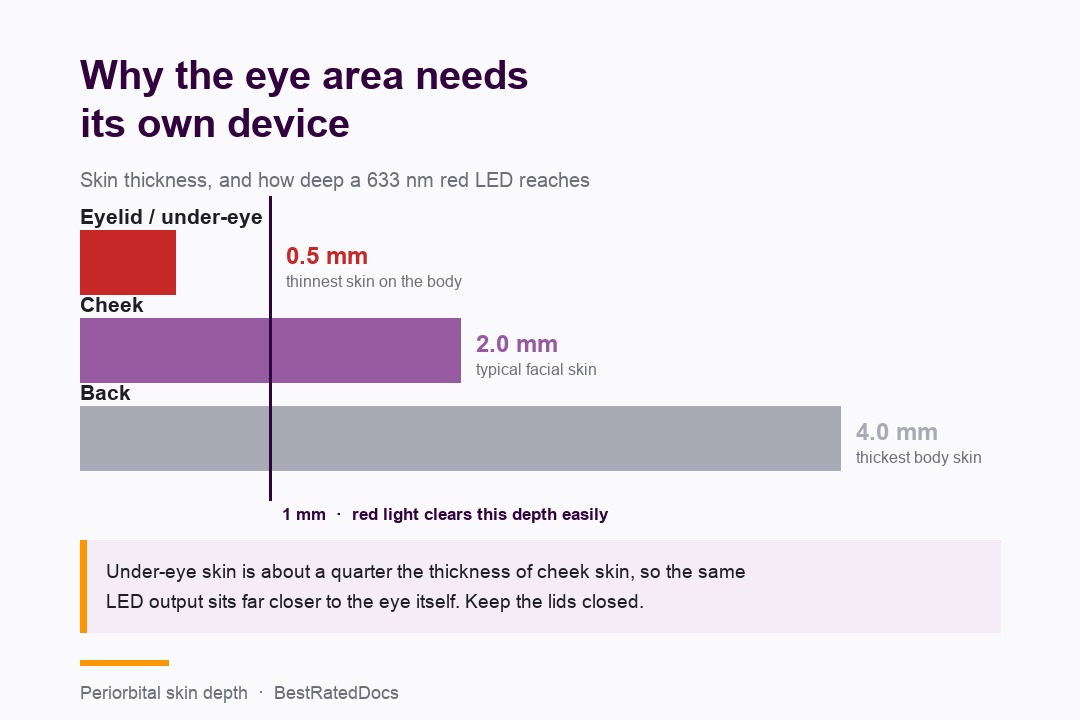
The skin at the eyelid is roughly half a millimetre thick. The skin over your cheek is about four times that. That single anatomical fact is why a red light therapy eye mask is a different device from the full-face masks I reviewed separately, and why the safety questions readers send me about this category deserve a real answer rather than a marketing one. Light that is unremarkable over a cheekbone sits much closer to the globe when it is directed at a lid, and the devices that handle that well are not always the expensive ones.
I went through this category the way I go through every medical device roundup on this site: verify that each listing is actually buyable, read the specification table rather than the marketing bullets, and then go to the source. In this case the source was FDA’s own device databases, and what came back reframed the whole page. A single device registration under product code OHS covers roughly a dozen separately branded eye masks spanning a tenfold price range, because one contract manufacturer is supplying many labels from the same chassis. I have named those brands below. If you take one thing from this guide, take that.
These eight devices are under-eye and periorbital units only. If you are looking for something that treats the whole face, that is a separate category with a separate set of trade-offs and I cover it in our guide to full-face red light therapy masks. And if what actually brought you here is gritty, burning, watery eyes rather than fine lines, skip to the section near the end on why an LED eye mask is not a dry eye mask, because those are two unrelated device classes that share a shape.
| Product | Price | Buy |
|---|---|---|
| Lumin Luminator LED Eye MaskBest Overall | $99.99 | View on Amazon |
| Epinuo Red Light Therapy for Eyes, 5 ModesBudget Pick | $19.99 | View on Amazon |
| iRestore Red Light Therapy for Eyes, 180 LEDsPremium Pick | $249.00 | View on Amazon |
| AMIRO Red Light Therapy for Eyes, 4 WavelengthsRunner-Up | $194.49 | View on Amazon |
| Solawave Red Light Eye Mask | $174.30 | View on Amazon |
| Dr. Dennis Gross DRx SpectraLite EyeCare Max Pro | $199.00 | View on Amazon |
| Viconor Red Light Therapy for Eyes | $56.99 | View on Amazon |
| Red Light Therapy for Eyes, FSA/HSA Eligible | $89.00 | View on Amazon |
Find the Best Red Light Therapy Eye Mask for Your Need
Jump straight to the situation that matches yours.
- Overall best red light therapy eye mask
- Best red light therapy eye mask for under-eye bags and puffiness
- Best red light therapy eye mask for wrinkles and crow’s feet
- Best red light therapy eye mask for dark circles
How We Chose These Eye Masks
Every device here was checked live on Amazon for a New-condition buy box, a working Add-to-Cart path and a US delivery locale, because a listing that looks healthy in a spreadsheet is frequently unbuyable in practice. I then read each listing’s own specification table against its marketing bullets, which is how I found a device whose title and bullets disagree about its own wavelength, and how the split between open-eye and enclosed designs became visible.
The part that took longest was the regulatory work, and it is the reason this page exists. I searched FDA’s device registration, 510(k) clearance and enforcement databases directly rather than repeating what listings claim. Three of the eight devices here make some form of FDA claim, and the three claims are not equivalent to each other. I have written out exactly what I found, including where I found nothing, because “the database returns no clearance under this brand name” is a genuinely useful thing for a buyer to know and nobody else in this category seems willing to say it.
I deliberately did not weight LED count heavily. Irradiance at the skin determines dose, almost nobody publishes it, and a dense array at low output can easily deliver less than a sparse array at high output. Where a listing’s own numbers and its marketing disagreed, I went with the numbers.
Best Red Light Therapy Eye Mask Overall
Eight devices, each reviewed once below, then sorted by situation further down the page.
Lumin Luminator LED Eye Mask — Best Overall
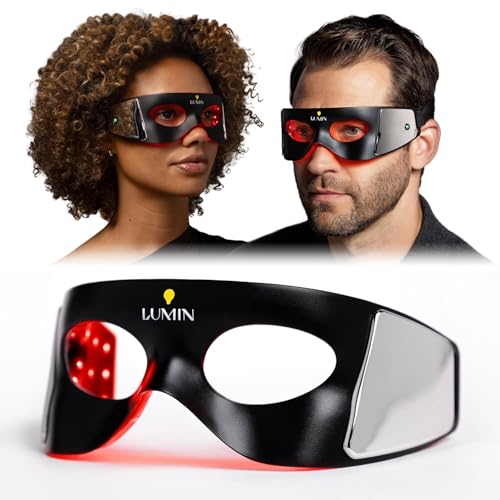
This is the device I would hand someone buying their first periorbital mask, and the reasoning has more to do with design and history than with spec-sheet superiority. The Luminator uses an open-eye layout: the emitters sit on the cheekbone and along the orbital rim rather than covering the socket, so the light is aimed at the skin you want treated and not down at a closed lid. For a reader who is nervous about putting LEDs near the eye, and a lot of you are, that architecture answers the question before it has to be asked.
It also carries the deepest owner history of anything on this page, which in a category this young is worth a great deal. Small review bases tell you whether a device arrived working. Only a deep one tells you whether it is still working a year later. The wavelength set is genuine rather than decorative, with 630 nm red and 850 nm infrared both confirmed alongside a deep red and an amber channel, so you get the superficial collagen effect and something that reaches further into tissue.
Now the honest part. Owner sentiment on the Luminator is split, and it is split on the two things that matter: whether the visible result is worth the outlay, and whether the result appears at all. That is not a defect in the product so much as an accurate reflection of what these devices do, which is subtle. The other gap is regulatory. Lumin appears in FDA’s device listing under product code OHS, which is a registration entry, not a clearance. It is a weaker signal than it looks, and I explain why further down.
Lumin Luminator LED Eye Mask
by Lumin
The only device in this category with enough owner history behind it to tell you what happens after the novelty wears off, and an open-eye design that sidesteps the main safety question.
Pros
- Holds the deepest review record of any eye mask on this page, which is the only way to learn how one of these devices behaves after a year rather than after a launch push
- Open-eye design rests the emitters on the cheekbone and orbital rim instead of sitting over the globe, so nothing is shining down at a closed lid
- Runs four bands including confirmed 630 nm red and 850 nm infrared, covering both the superficial collagen effect and deeper tissue
- Three-minute sessions with an auto shutoff, which is short enough that people actually repeat it several times a week
Cons
- Owner sentiment is genuinely split on whether the visible result justifies the outlay, and that split is wide enough to be worth reading before you buy
- The listing does not cite a 510(k) number, only an FDA device listing under product code OHS, which is a much weaker signal
- Three minutes per session means you are committing to frequency rather than to a single long treatment
Epinuo Red Light Therapy for Eyes, 5 Modes — Best Budget
This is the cheapest device on the page by a wide margin, and the reason it earns a place rather than a dismissal is that it did not cut the specification to get there. It runs a stated 630 nm red band with 850 nm infrared, both published in nanometres, which is the same evidence-backed pair the premium devices here run. Plenty of listings at several times this outlay describe themselves in colour names and never publish a figure at all.
Its session cycle is ten minutes with an auto shutoff, the longest standard cycle in this roundup. Whether that is an advantage depends entirely on you. Someone who will happily sit for one longer session will get on better with this than with a three-minute device they are supposed to use five times a week, and total weekly dose is what determines the result rather than any single sitting.
What you are giving up is certainty. The review base is very thin, the seller has no track record behind the listing, and there is no FDA claim of any kind. Sixty LEDs also means the array is sparser than the denser designs here, so coverage across the full orbital rim is less even. I would buy this one specifically to find out whether I would use a device like this at all before committing real money, which is a legitimate reason to buy something and an underrated one.
Epinuo Red Light Therapy for Eyes, 5 Modes
by Epinuo
The cheapest honest way to find out whether you will use one of these at all, and it delivers a real red plus infrared pair rather than a light-up novelty.
Pros
- The cheapest device on this page by a wide margin, and still pairs a genuine 630 nm red band with 850 nm infrared rather than substituting decorative colours
- Ten-minute sessions with an auto shutoff, the longest standard cycle here, which suits people who prefer one sitting to several
- USB powered, so it runs off a phone charger or a laptop with no proprietary dock
- Publishes both of its wavelengths in nanometres, which a surprising number of pricier listings in this category do not
Cons
- A very thin review base, so durability and output consistency are effectively unproven
- The seller has no track record behind this listing, and no FDA claim of any kind appears on it
- Sixty LEDs is a modest count, so coverage across the full orbital rim is less even than the denser designs here
iRestore Red Light Therapy for Eyes, 180 LEDs — Upgrade Pick
One hundred and eighty diodes is the densest array on this page by a considerable distance, and density is the one count that genuinely matters for a periorbital device. The area you are treating is small and awkwardly shaped, wrapping from the inner canthus around the orbital rim to the temple, and a sparse array leaves that curve unevenly lit. The iRestore covers it. It also runs the broadest wavelength spread here, from 590 nm amber through 633 nm red to both 830 and 850 nm in the infrared.
The most valuable thing in this listing’s owner feedback has nothing to do with results. Multiple owners specifically confirm that the light does not fall onto the eye globes during use. In a category where that is the number one question readers ask me, having it answered repeatedly by people who own the device is worth more than another paragraph of manufacturer reassurance. It is also cordless, so a session is not anchored to an outlet.
Two real problems. Battery and charging complaints recur often enough across owner reports to read as a pattern rather than as a few bad units, and on a device at this price that is a meaningful risk. And iRestore does not publish a session length for this product at all, which leaves you following generic guidance rather than a protocol the manufacturer has tested. On the regulatory side, be careful: iRestore holds several genuine 510(k) clearances, but every one of them covers a hair-growth laser. None covers this eye device.

iRestore Red Light Therapy for Eyes, 180 LEDs
by iRestore
The most light delivered to the periorbital area of anything here, with owner confirmation that it keeps that light off the globes, held back by a recurring battery complaint.
Pros
- The densest LED array on this page at 180 diodes, which is what allows even coverage right around the orbital rim rather than a hot spot over the lid
- Owners specifically confirm the light does not fall onto the eye globes, which is the single most useful piece of sentiment in this category
- Runs four bands from 590 nm amber through 633 nm red to 830 and 850 nm infrared, the broadest spread here alongside AMIRO
- Cordless and rechargeable, so a session is not tied to a wall outlet
Cons
- Battery and charging complaints recur across owner reports often enough to treat as a pattern rather than as isolated bad units
- iRestore does not publish a session length for this device, so you are left to follow generic guidance rather than a tested protocol
- The brand's FDA clearances cover its hair-growth lasers, not this eye device, which the listing does not make obvious
AMIRO Red Light Therapy for Eyes, 4 Wavelengths — Runner-Up
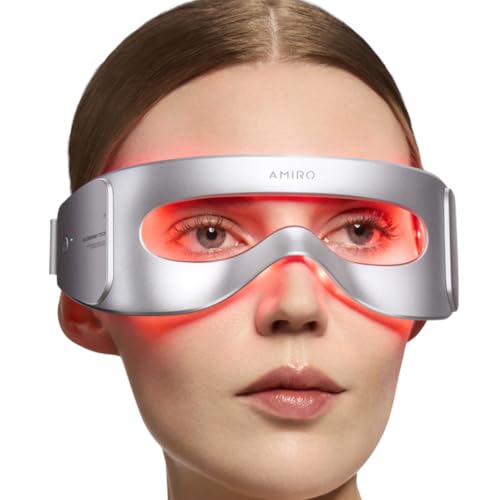
If transparency were the only criterion, AMIRO would win this roundup. It is the only brand here that itemises all four of its wavelengths in nanometres, publishes its LED count and states its session length, which sounds like a low bar until you try to assemble the same three facts for every other device in the category. The spread runs 605 nm amber, 633 nm red, 660 nm deep red and 850 nm infrared, which covers surface tone through to deeper tissue without padding the list with colours that have no evidence behind them.
Ninety-six LEDs across a contoured body gives noticeably more even coverage of the outer canthus, which is where crow’s feet actually form, than the sparser designs on this page manage. Sessions are three minutes, so the commitment is frequency across the week rather than a long sitting.
Its regulatory position needs a careful sentence. AMIRO claims FDA clearance, and model ABYM02 does genuinely appear in FDA’s device listing under product code OHS. But appearing in a device listing means the manufacturer has registered the product with the agency. It does not mean the agency reviewed it, and it is not the same thing as holding a 510(k). The listing blurs that line, as most listings in this category do. The other caveat is the review base, which is small enough that long-term reliability is unproven.
AMIRO Red Light Therapy for Eyes, 4 Wavelengths
by AMIRO
The most transparent listing in the category, and the one I would buy if I wanted to know exactly what wavelengths I was paying for.
Pros
- Publishes the fullest specification sheet in this roundup, itemising all four wavelengths in nanometres instead of naming colours
- The 605 nm amber through 850 nm infrared spread covers surface tone and deeper tissue in one device
- Ninety-six LEDs across a contoured body give more even coverage of the outer canthus than the lower-count designs here
- Model ABYM02 does appear in FDA's device listing under product code OHS, so the regulatory claim has something behind it
Cons
- A small review base, so long-term reliability is not yet established
- Being listed with FDA under a product code is not the same as holding a 510(k) clearance, and the listing blurs that line
- Three-minute sessions demand consistency across the week rather than one longer treatment
Solawave Red Light Eye Mask — Best Verified Clearance
Solawave is the rare case in this category where a clearance claim resolves to a specific, dated, findable record. The Eye Recovery Pro was cleared as K261602, granted to Shenzhen Goodwind in August 2026, and you can pull that up yourself in FDA’s 510(k) database. That does not mean the agency tested the device or found it effective, and I will explain that distinction properly further down. What it does mean is that a named applicant filed a submission for this device and the agency reviewed it, which is more than most of this page can say.
The wavelength set is a well-chosen four, spanning 605 nm amber to 830 nm infrared, and the dual-core LEDs across eighty positions make the effective array denser than a raw diode count suggests. Battery life is quoted at roughly thirteen sessions per charge, so a normal week of use does not mean charging it nightly.
Two things to weigh. The Amazon review base is small relative to how well known Solawave is, because most of the brand’s sales history lives on its own site rather than here, so the ratings on this listing understate what is known about the product. And clearances attach to specific models, not to brands, so confirm that the SKU you receive is the Eye Recovery Pro rather than assuming the clearance travels with the name on the box.

Solawave Red Light Eye Mask
by Solawave
The one device here whose clearance I could locate as a specific, dated 510(k) number rather than as a registration entry.
Pros
- The Eye Recovery Pro holds a real 510(k) clearance, K261602, granted to Shenzhen Goodwind in August 2026, which is verifiable in FDA's own database
- Four bands from 605 nm amber to 830 nm infrared, so it spans surface tone and deeper tissue
- Dual-core LEDs across 80 positions, a denser effective array than the diode count alone suggests
- Roughly thirteen sessions per charge, so a week of use does not mean a nightly recharge
Cons
- A small Amazon review base relative to how well known the brand is off Amazon, because most of its sales history sits on its own site
- The clearance applies to a specific model, so confirm the SKU you receive matches it rather than assuming
- The most expensive device here apart from the iRestore, and the premium buys brand and clearance rather than more light
Dr. Dennis Gross DRx SpectraLite EyeCare Max Pro — Best-Known Brand
This is the most recognisable name in the roundup, from a dermatologist-founded brand with a genuine retail history in LED skincare rather than a marketplace label that appeared last quarter. The hardware reads well on paper: ninety-six LEDs across a contoured shell that seats around the orbital rim, three-minute sessions with an auto shutoff, and USB-C charging with an adapter included.
It is also the lowest-rated device on this page, and I want to be direct about why, because the reason is specific rather than diffuse. Owners repeatedly report units failing within the first week of use. That is not a complaint about results being subtle, which is a fair criticism of every device in this category. It is a complaint about the device stopping. When a reliability pattern is that consistent and that early, it belongs in the first paragraph a buyer reads rather than buried in a review section, and it is the reason this is not a pick.
The specification has a second gap worth knowing. The brand describes four red wavelengths but does not itemise them in nanometres, which makes it impossible to compare its dose against anything else here. And while the listing claims FDA clearance, I could not find a 510(k) under this brand name in FDA’s database. I will qualify that below, because there is an innocent explanation available.

Dr. Dennis Gross DRx SpectraLite EyeCare Max Pro
by Dr. Dennis Gross Skincare
The best-known name in this roundup and the weakest reliability record, which is an uncomfortable combination worth knowing about before you pay for the label.
Pros
- Comes from a dermatologist-founded brand with a long retail history in LED skincare rather than a marketplace label
- Ninety-six LEDs across a contoured shell give good coverage of the orbital rim and outer canthus
- Three-minute sessions with auto shutoff, the shortest realistic commitment in this roundup
- Charges over USB-C with a USB-A adapter included, so it works with whatever you already own
Cons
- The lowest-rated device on this page, and the reason is specific: owners repeatedly report units failing within the first week of use
- The brand does not itemise its four red wavelengths in nanometres, which makes the dose impossible to compare against anything else here
- The listing claims FDA clearance, but I could not find a 510(k) under this brand name in FDA's database
Viconor Red Light Therapy for Eyes — Best for Cold Plus Light
The Viconor is the only device in this roundup built to be used with an ice pack, and that is a more interesting feature than it sounds. Cold and red light address under-eye swelling through entirely different mechanisms: cold causes vasoconstriction and reduces fluid accumulation within minutes, while near-infrared works on local circulation and tissue over weeks. Combining them in one device is the sensible design response to the fact that most people buying an eye mask want both the fast effect and the slow one.
It also ships with a remote, so you can change modes without lifting the mask away from your face partway through a session, and it quotes up to ninety minutes of runtime per charge, comfortably the longest here. The wavelengths are published honestly at 630 nm red and 850 nm infrared.
Now the caution, and I want to state it plainly because the listing invites the opposite reading. A perfect rating sitting on a very small handful of reviews is not evidence of a reliable device. It is an absence of data. Fifteen positive experiences cannot distinguish a genuinely excellent product from one that has simply not been owned long enough by enough people for its failure mode to appear. Read it as unknown rather than as outstanding. Forty-eight LEDs is also the lowest published count on the page, so coverage is less even than the denser arrays.

Viconor Red Light Therapy for Eyes
by Viconor
The one device built to combine cold with light, which is the right combination for morning puffiness even though its review base is too thin to lean on.
Pros
- The only device here designed to work with an ice pack, which matters because cold and light address puffiness through completely different mechanisms
- Ships with a remote, so you can change modes without pulling the mask off your face mid-session
- Pairs a stated 630 nm red band with 850 nm infrared, both published in nanometres
- Up to ninety minutes of runtime per charge, comfortably the longest here, so it tolerates being forgotten on the charger
Cons
- A perfect rating sitting on a very small number of reviews tells you almost nothing about reliability, and should be read as an absence of data rather than as evidence
- Forty-eight LEDs is the lowest published count on this page, so coverage is less even than the denser arrays
- No FDA claim of any kind appears on the listing
Red Light Therapy for Eyes, FSA/HSA Eligible — Best for a Health Account Balance
I will say something about this unbranded device that I cannot say about any premium listing in this roundup: it is the most honest one on the page about who should not use it. Its own listing carries a contraindication list naming eye disease, acute illness, high myopia, pregnancy, recent eye or facial surgery, and use under sedation or alcohol. That is close to what I would write myself. Several brands here charging considerably more say nothing of the kind, and a seller volunteering reasons not to buy its product has earned a degree of credit.
The practical reason to choose it is the health account angle. It is marketed as FSA and HSA eligible, which is the one thing that genuinely changes the arithmetic for a buyer with a balance to spend before year end. Verify eligibility at checkout rather than trusting title text, since that phrasing is used loosely across this category, but the claim is at least front and centre here.
The specification is where it gets loose. Its own title says 650 nm and its own bullets say 630 nm, and the seller has not resolved the contradiction, so I would treat the exact red figure as unconfirmed rather than pick whichever number I preferred. LED count is not disclosed at all, and no session length is stated. What is confirmed is a red band paired with 850 nm infrared and a 900 mAh battery.
Red Light Therapy for Eyes, FSA/HSA Eligible
by Generic
An unbranded device that is more honest about who should not use it than any premium listing here, and the obvious route if you are spending a health account balance.
Pros
- Carries the most complete contraindication list of any listing in this category, naming eye disease, high myopia, pregnancy, recent eye or facial surgery and sedation
- Marketed as FSA and HSA eligible, which is the practical reason to pick it if you have a balance to spend
- Combines a red band with 850 nm infrared rather than relying on red alone
- A 900 mAh battery means it holds a useful number of sessions between charges
Cons
- Its own title says 650 nm and its bullets say 630 nm, an inconsistency the seller has not resolved, so treat the exact figure as unconfirmed
- LED count is not disclosed at all, so coverage density cannot be compared with anything else here
- Unbranded, with no stated session length and a thin review base
Best Red Light Therapy Eye Mask for Under-Eye Bags and Puffiness
Puffiness is a fluid problem before it is a skin problem, which changes what you should look for. Near-infrared around 830 to 850 nm penetrates furthest into tissue and is the band associated with local circulation, so a device running red alone is the wrong tool here. Cold matters at least as much: vasoconstriction reduces morning swelling within minutes, where light works over weeks. The honest version of this recommendation is that you want both mechanisms, and only one device here is built to deliver them together.
| Product | Price | Buy |
|---|---|---|
| Viconor Red Light Therapy for EyesBest for puffiness The only device here built to pair an ice pack with 850 nm infrared, which is the combination puffiness actually responds to | $56.99 | View on Amazon |
| iRestore Red Light Therapy for Eyes, 180 LEDsBest coverage at depth 180 diodes and two separate infrared bands deliver the most light to the deeper tissue under the lower lid | $249.00 | View on Amazon |
| Lumin Luminator LED Eye MaskBest all-round option Open-eye design puts the emitters directly on the cheekbone where under-eye fluid pools | $99.99 | View on Amazon |
Best Red Light Therapy Eye Mask for Wrinkles and Crow’s Feet
Crow’s feet form at the outer canthus, which is the hardest part of the orbital region for a mask to cover evenly, so this is the use case where LED density and body shape decide the outcome. You want red in the 630 to 660 nm band for the collagen effect, ideally with an infrared band alongside it, and enough diodes distributed around the rim that the temple is not receiving a fraction of what the lid gets. Be realistic about scope: these devices soften fine surface lines and improve texture. They do not address deep static folds or a lax lower lid.
| Product | Price | Buy |
|---|---|---|
| iRestore Red Light Therapy for Eyes, 180 LEDsBest for crow's feet The densest array here, which is what gets consistent light all the way out to the temple | $249.00 | View on Amazon |
| AMIRO Red Light Therapy for Eyes, 4 WavelengthsBest documented wavelengths Four itemised wavelengths from 605 to 850 nm across a contoured body that seats on the outer canthus | $194.49 | View on Amazon |
| Dr. Dennis Gross DRx SpectraLite EyeCare Max ProBest-known brand option Good coverage from 96 LEDs, but the early-failure reports are a real risk to weigh | $199.00 | View on Amazon |
Best Red Light Therapy Eye Mask for Dark Circles
Dark circles are the use case where I have to disappoint people, because the term covers three unrelated things and light only helps one of them. Vascular circles, the bluish tint from blood pooling in thin lid skin, can genuinely improve with near-infrared, since circulation is the mechanism. Pigmented circles are melanin in the skin, and red light does not lighten melanin. Structural shadowing from a tear-trough hollow or a prominent orbital rim is an anatomy problem casting a shadow, and no amount of light changes anatomy. Work out which one you have before you spend anything.
| Product | Price | Buy |
|---|---|---|
| Lumin Luminator LED Eye MaskBest for vascular circles Open-eye design plus 850 nm infrared targets the circulation component, which is the only type light addresses | $99.99 | View on Amazon |
| Solawave Red Light Eye MaskBest verified clearance Amber through infrared across four bands, on the one device here with a findable 510(k) number | $174.30 | View on Amazon |
| Red Light Therapy for Eyes, FSA/HSA EligibleBest health-account option Red plus 850 nm infrared, and the practical choice if you are spending an FSA or HSA balance | $89.00 | View on Amazon |
Is Red Light Therapy Safe for Your Eyes?
Start with the anatomy, because it explains everything else. Eyelid skin is roughly half a millimetre thick, the thinnest on the body. Cheek skin is around two millimetres. Red light at 633 nm passes several millimetres into tissue. Put those three numbers together and you can see why the same device is a cosmetic appliance over a cheekbone and a question worth asking over a lid: the globe simply sits much closer to the light source there, with far less tissue in between.
The answer, for the devices in this roundup used as designed, is that closed eyelids are the protection and that is sufficient. A closed lid blocks a substantial fraction of incident visible red light, and these devices run at output levels well below anything the literature associates with retinal injury. Sessions of three to ten minutes with an auto shutoff are part of that safety margin rather than an arbitrary limit, which is why overriding a shutoff to run longer is the one thing I would tell you never to do. Never look directly into the diodes, either, including while you are positioning the device.
Design matters here and it splits the category in two. Open-eye devices like the Lumin rest the emitters on the cheekbone and brow so the light is never directed at the globe at all. Enclosed devices cover the socket and rely on the lid as the barrier, which treats lid skin more evenly but puts more of the responsibility on you to respect the session limits. Neither approach is wrong. If light near your eyes makes you anxious, buy the open design, because the device you are comfortable using is the only one that will produce a result.
Some people should not use these at all without clearing it with a physician first. The list is: anyone taking a photosensitising medication, isotretinoin and doxycycline being the two most common; anyone within a few months of LASIK or any other eye surgery; anyone with active retinal disease or macular degeneration; anyone with advanced cataracts or glaucoma; anyone who is pregnant; and anyone with a seizure disorder that flashing light can trigger. Notably, the most complete version of that warning list I found in this entire category was on an unbranded listing, not on any of the premium ones. If you have any diagnosed eye condition at all, ask your ophthalmologist before you buy rather than after.
What FDA Clearance Actually Means Here
I pulled the following from FDA’s own databases rather than from any product listing, and it is the most useful research I have done on this category.
Many of these “different” eye masks are one device. A single FDA device registration under product code OHS, the code for an LED lamp used in skin treatment, covers this roster of brand names simultaneously: the AMIRO LED Light Eye Mask (ABYM02), LOOKEE ReviveGlow Pro (A20), the Lumin Eye Mask, Amifiy (EY-40M, EY-40N, EY-20RB), the Dogface Red Light Eye Mask, CBG Devices (EY-20R), the Hammacher Schlemmer LED Therapy Eye Mask, the Aduro Eye Mask (EY-20AC), the Solawave Eye Recovery Pro, and the Lumi Boosted Restoration Eye Mask. One contract manufacturer, one chassis, a dozen labels spanning better than a tenfold price range from end to end. The buying lesson is blunt: in this category a higher price often buys you a brand, not a better device.
The clearances that genuinely exist under product code OHS are these three. K233556, granted 4 January 2024 to Shenzhen Kaiyan, covering an “LED Eye mask” in models EY-20R, A20 and EY-20N, which you will recognise as the shared chassis above. K221444, granted 8 December 2022 to Light Tree Ventures, covering the “LED Eye Perfector” in models EY-36A and EY-36B, the CurrentBody device. And K261602, granted 10 August 2026 to Shenzhen Goodwind, covering the “Eye Recovery Pro” model PH-e03, which is a Solawave device. Note the care needed even here: the Solawave unit sold on Amazon is titled simply as a red light eye mask rather than as the Eye Recovery Pro, so I can tell you Solawave holds a cleared eye device, but not that the one you add to your cart is that exact model.
Some clearances are not where the marketing implies. iRestore holds four 510(k) clearances, K151662, K183417, K213094 and K222081, and all four cover hair-growth lasers. None covers an eye mask. Omnilux’s clearances are all for face and acne panels, K030426, K030883, K072459 and K210948, and its Eye Brightener patch is not separately cleared. A search under Dr. Dennis Gross returns nothing, although that listing claims clearance. I want to be careful about how you read all three of those findings: what I am reporting is what the database shows, which is not the same as proof of absence. A device can legitimately be cleared under a contract manufacturer’s name rather than the brand you see on the box, exactly as the Solawave device is. So the accurate statement is that I could not find a clearance for these devices under any applicant name I searched, and a brand that wants to settle the question can simply publish its K number.
There is no recall. A claim circulates in some articles that an LED mask was recalled over eye safety. FDA’s enforcement database for light therapy devices returns pain-relief units and whole-body beds, not any LED eye or face mask. I could not corroborate the claim and I am not going to repeat it as fact.
One last thing, because it underpins all of the above. A 510(k) clearance is a paperwork finding that a device is substantially equivalent to one already legally on the market. It is not FDA testing the device, it is not FDA approval, and it is not evidence that the device works. It tells you a named applicant filed a submission and the agency did not object. That is genuinely worth something, mostly as a signal that a real company with a real regulatory budget stands behind the product, but it is a much smaller something than the badges on these listings imply.
An LED Eye Mask Is Not a Dry Eye Mask
These two products look alike and do unrelated things, and the confusion costs readers money every week. A warm compress eye mask, whether it is a microwavable bead-filled one or an electrically heated one, exists to hold the eyelid at roughly 40 to 45 degrees Celsius so that hardened meibum inside the meibomian glands softens enough to be expressed. That is the first-line treatment for meibomian gland dysfunction and evaporative dry eye, and heat is the entire active ingredient.
A red light therapy eye mask delivers photons to skin. It does not deliver sustained therapeutic heat to the glands, and none of the eight devices in this roundup is cleared or designed to treat dry eye. Clinic-administered intense pulsed light for meibomian gland dysfunction does exist and does have evidence behind it, but that is a professional procedure with a very different energy profile, not a consumer LED headband. If gritty, burning, watery eyes are what brought you here, a warm compress and the right drop will help you and an LED mask will not. Our guide to eye drops for dry eyes is the more useful page for that problem.
Buyer's Guide
Under-eye LED devices are sold on LED counts, colour menus and FDA badges, and none of those three predicts whether the device will do anything. These are the six things that actually separate a useful periorbital mask from an expensive light-up headband.
Wavelength range, published in nanometres
This is the spec that determines what the device can physically do, and it is the one most often hidden behind colour names. Red at roughly 630 to 660 nm reaches the upper dermis and drives the collagen effect. Near-infrared from about 830 nm upward penetrates deeper into tissue and is what you want for fluid and circulation under the eye. Amber near 590 to 605 nm works at the very surface. A listing that advertises colours instead of nanometre figures is withholding the only number that matters, and at least one device in this roundup contradicts itself between its own title and its own bullets.
What an FDA clearance actually covers
There is a large difference between a device listed with FDA under a product code, a device holding its own 510(k) clearance, and a brand that holds clearances for an entirely unrelated product. All three appear in this category and all three get marketed as FDA cleared. A 510(k) is a finding that a device is substantially equivalent to one already on the market. It is not FDA testing the device and it is not evidence the device works. Look up the specific claim at accessdata.fda.gov before you let it move you.
Open-eye or shielded design
Periorbital devices split into two shapes. Open-eye designs rest the emitters on the cheekbone and brow so the light never sits directly over the globe, which removes the main safety question at the cost of treating the lid itself less directly. Enclosed designs cover the socket and rely on closed eyelids as the barrier, which treats the lid skin more evenly but demands that you respect the session limits. Neither is wrong, but if you are at all anxious about light near the eye, the open design is the one that will actually get used.
Session length and realistic frequency
These devices run anywhere from three to ten minutes per session, and shorter is not worse. What determines your result is the total dose across the week, so a three-minute device used five times beats a ten-minute device used once. Be honest with yourself about which pattern you will keep. Auto shutoff is worth having, and one device here does not publish a session length at all, which leaves you guessing at the protocol.
Who should not use one
This category needs a real contraindication list and most listings do not provide one. Skip these devices, or clear them with a physician first, if you have active retinal disease, macular degeneration, advanced cataracts or glaucoma, if you are within a few months of LASIK or other eye surgery, if you take a photosensitising drug such as isotretinoin or doxycycline, if you have a seizure disorder triggered by flashing light, or if you are pregnant. One unbranded listing in this roundup carries a fuller warning list than any of the premium brands, which says something about the category.
Whether you are paying for the device or the label
This is the most useful thing I can tell you about this market. A single FDA device registration under product code OHS covers a long list of separately branded eye masks that span a tenfold price range, because one contract manufacturer supplies many labels from the same chassis. The premium price in this category frequently buys a brand name, packaging and a marketing budget rather than more light or better engineering. Compare the published wavelengths, LED counts and session protocols, and be sceptical of any gap that the specifications do not explain.
How to Choose the Best Red Light Therapy Eye Mask
Start with what you are actually treating, because it determines the specification and nothing else does. Puffiness and fluid mean you want near-infrared around 830 to 850 nm and, ideally, a cold option alongside it. Fine lines at the outer canthus mean you want red in the 630 to 660 nm band plus enough LED density to cover the temple evenly. Vascular dark circles respond to the circulation effect; pigmented ones and structural shadows do not respond to light at all, and knowing which you have will save you the purchase.
Then apply two filters that eliminate most of this market quickly. First, demand nanometre figures. A listing that sells you colours instead of wavelengths is withholding the only number that determines the dose, and one device here cannot even keep its own two figures consistent. Second, treat every FDA badge as a claim to be checked rather than a fact, and remember that a registration under a product code, a genuine 510(k) for this device, and a 510(k) for something unrelated are three different things that all get printed the same way. If you want light therapy for joints, muscles or back pain rather than skin, that is a different form factor entirely and our guide to red light therapy panels, pads and belts covers it.
Final Verdict
The Lumin Luminator is the red light therapy eye mask I would recommend to most people, and the reasoning is design plus history. Its open-eye layout puts the emitters on the cheekbone and orbital rim rather than over the globe, which answers the safety question that dominates this category before you have to ask it, and it carries the deepest owner record here, which is the only way to learn what one of these devices does after a year rather than after a launch week. Its limits are real and I have stated them: owner opinion is split on whether the result justifies the outlay, and its FDA presence is a registration rather than a clearance.
If you are not yet sure this category is for you, the Epinuo is the cheapest route in and it does not cheat on the specification, running a genuine 630 nm red with 850 nm infrared. Use it to find out whether you will stay consistent, and understand that its review base is thin. If you want the densest coverage and can tolerate the battery reports, the iRestore delivers the most light of anything here. If a findable clearance number matters to you, the Solawave is the one device on this page whose 510(k) I could pull up by number and date. Whichever you choose, give it eight to twelve weeks, use it on clean bare skin, never override the shutoff, and if you have any diagnosed eye condition, ask your ophthalmologist first. For whole-face treatment rather than the eye area, our roundup of full-face LED masks is the companion page.
Frequently Asked Questions
Do you need eye protection for a red light therapy mask?
Can a red light therapy eye mask cause eye damage?
What are the benefits of a red light therapy eye mask?
Is a red light therapy eye mask the same as a warm compress dry eye mask?
How long does a red light therapy eye mask take to work?
Related Articles
About the Reviewer

Dr. David Taylor, MD, PhD
Drexel University College of Medicine (MD), Indiana University School of Medicine (PhD)
Dr. David Taylor is a licensed physician and medical researcher who founded BestRatedDocs in 2016. With an MD from Drexel University and a PhD from Indiana University School of Medicine, he combines clinical expertise with a passion for health technology to provide evidence-based product recommendations. Dr. Taylor specializes in health informatics and regularly evaluates medical devices, diagnostic equipment, and therapeutic products to help healthcare professionals and patients make informed decisions.