7 Best Steam Inhalers of 2026
Dr. David Taylor reviews the best steam inhalers for sinus congestion, colds, cough, and allergies — Vicks, Beurer, MyPurMist, Crane, MABIS, and Hann compared by steam type, use case, and safety.
Updated
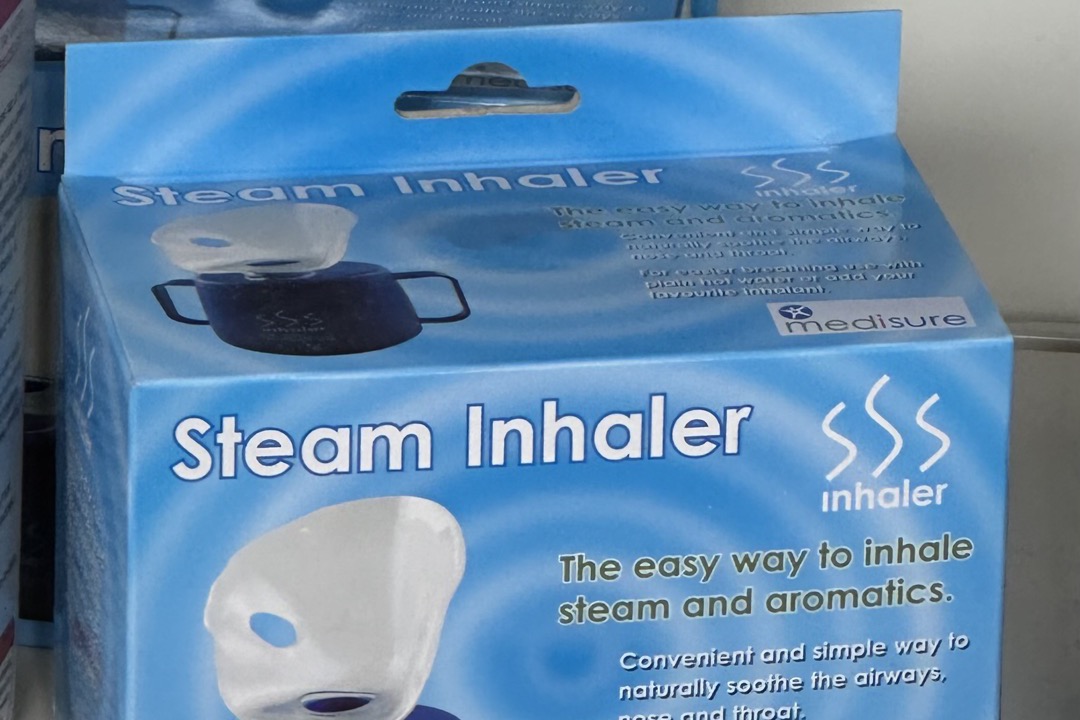
For patients managing the congestion and sinus pressure of a cold, seasonal allergies, or chronic rhinosinusitis, a personal steam inhaler is one of the most familiar at-home comfort measures — and also one of the most commonly misunderstood. A steam inhaler is not a medication delivery device. It does not cure colds or shorten the duration of viral upper respiratory infection. What it does, reliably, is produce warm moist steam that many patients find genuinely soothing: loosening thick mucus, easing the dryness and irritation of inflamed nasal passages, and providing a temporary reduction in sinus pressure that makes it easier to breathe and sleep. If you have asthma, COPD, or any condition requiring prescription bronchodilators, you need a nebulizer — not a steam inhaler — because steam inhalers produce vapor particles that are far too large to reach the lower airways where those medications work.
At Best Rated Docs, Dr. David Taylor has reviewed respiratory and sinus-care devices from both clinical and consumer perspectives since 2016. For this 2026 guide, we researched six steam inhalers currently available on Amazon — all FSA and HSA eligible — and deliberately restricted the review to actual respiratory/medical steam inhalers rather than diluting the list with beauty facial steamers, which many competing roundups do. Every ASIN here was verified as an active, purchasable listing before we wrote a word. Patients tracking recovery from respiratory symptoms may also find it useful to monitor oxygen saturation with a pulse oximeter or to measure peak flow with one of the best peak flow meters if they manage asthma alongside sinus symptoms.
| Product | Price | Buy |
|---|---|---|
| Vicks Sinus Inhaler VIH200Best Overall | $42.98 | View on Amazon |
| Beurer SI30 Steam InhalerBudget Pick | $39.99 | View on Amazon |
| MyPurMist Free Cordless Steam & Sinus Inhaler, Essential KitPremium Pick | $179.95 | View on Amazon |
| MABIS Personal Steam Inhaler and Facial Steamer with Aromatherapy TrayRunner-Up | $39.99 | View on Amazon |
| Crane Steam Inhaler & Warm Mist Humidifier 2-in-1Runner-Up | $50.78 | View on Amazon |
| Hann Facial Steamer and Sinus Steam Inhaler with Auto Shut-OffRunner-Up | $24.49 | View on Amazon |
| Crane Corded Personal Steam Device for Sinus, Congestion and Cough ReliefRunner-Up | $39.99 | View on Amazon |
Find the Best Steam Inhaler for Your Need
Jump straight to the pick that matches your symptoms:
- Best steam inhalers overall — our top picks reviewed
- Best steam inhaler for congestion and blocked nose
- Best steam inhaler for sinus relief
- Best steam inhaler for cough and mucus
- Best steam inhaler for cold and flu
- More use cases: sore throat, singers, allergies, facial steaming
How We Chose These Steam Inhalers
Our selection criteria prioritized three requirements above all others: verified Amazon availability (every ASIN confirmed as an active listing rather than a discontinued or currently-unavailable entry), meaningful review evidence (we preferred products with at least several hundred verified reviews, with one exception for a medical-supply-channel brand), and genuine category focus — respiratory and sinus-care steam inhalers only, not cosmetic facial steamers sold alongside them in Amazon’s search results. Beauty facial steamers serve a different purpose, operate at lower temperatures, and are not FSA/HSA eligible as medical devices. Mixing them into a clinical respiratory review misleads readers. The one dual-purpose unit on this list, the Hann, earns its place on its sinus-inhaler function, and we flag plainly that it is sold as a beauty device first.
The seven selected devices cover every meaningful use case in this category: the consumer flagship (Vicks VIH200), a credentialed German-brand budget pick (Beurer SI30), a cordless instant-mist upgrade (MyPurMist Free), the largest-reviewed handheld still available (MABIS), a versatile 2-in-1 with overnight humidification (Crane), a budget unit that doubles for facial steaming (Hann), and a compact FSA-eligible personal steamer (Crane Corded). Two picks from the previous version of this guide were removed at this update, both because the listings stopped being buyable rather than because the devices got worse: the Vicks V1200 now offers only an open-box unit with no new-stock buy box, and the Veridian Healthcare inhaler lost its featured offer entirely.
Best Steam Inhalers Overall
These are the six devices that earned a place in this guide, each reviewed in full below. The Vicks VIH200 is our best overall pick for the widest range of adults managing sinus congestion; the use-case sections after the reviews then match specific symptoms — a blocked nose, sinus pressure, a chesty cough, or being laid up with cold and flu — to the right pick from this same lineup.
Vicks Sinus Inhaler VIH200 — Best Overall
The Vicks VIH200 earns Best Overall on a metric that matters uniquely in the medical device category: over 21,000 verified Amazon reviews. In a steam inhaler market saturated with generic imports and relabeled beauty steamers, a device with this much real-world feedback from actual symptomatic patients provides a confidence signal that no specification sheet can replicate. The 4.2-star average across that volume is meaningful — not perfect, but honestly reflective of a product that works for most users and occasionally ships with quality-control variance.
The design itself is clinically thoughtful. The targeted sinus mask is narrower and more contoured than the universal masks on most competing devices, which directs warm steam specifically toward the nasal passages and paranasal sinuses rather than losing heat and moisture to the surrounding room air. The three-minute heat-up time is standard for the category. VapoPad compatibility is the feature that sets the Vicks apart from more medical-brand alternatives: patients who have used Vicks products for decades can continue that familiar menthol or rosemary experience through the dedicated pad slot without contaminating the water reservoir. Plug-in tabletop operation means this is a device you keep on a bedside table or countertop rather than transporting — but for planned evening sinus-care sessions during a cold, that placement pattern is exactly right.

Vicks Sinus Inhaler VIH200
by Vicks
The most-reviewed steam inhaler on Amazon — 21,000+ verified ratings, a targeted sinus mask, and VapoPad compatibility make the Vicks VIH200 the default choice for most adults managing occasional congestion.
Pros
- Over 21,000 verified Amazon reviews — by far the largest body of real-world feedback of any steam inhaler in this review, and a meaningful quality signal in a category dominated by generic entrants
- Three-minute heat-up time with a targeted sinus mask that directs moist warm steam to the nasal passages and sinuses rather than losing it to the ambient room air
- Compatible with Vicks VapoPads (menthol and rosemary scent pads) for patients who want an aromatherapy element without adding essential oils directly to the water reservoir
- FSA and HSA eligible with straightforward single-button operation — no displays or settings to navigate, which suits older patients and anyone who wants a simple sinus-care device
Cons
- Plug-in only with a relatively short power cord — the device must be used at a stable tabletop near an outlet, which limits placement in some bathrooms and bedrooms
- Several verified reviews flag variable unit-to-unit quality and occasional early failures — Vicks warranty coverage handles this but adds friction for patients needing immediate replacement
Beurer SI30 Steam Inhaler — Best Budget
Beurer is a name that carries real weight in home medical devices. Founded in Germany in 1919, the company has been manufacturing ISO-certified clinical-grade home health products for over a century — a pedigree that virtually no other brand in the Amazon steam inhaler market can match. The SI30 is a clear expression of that heritage: understated design, variable steam output, a universal mask that fits both adults and older children, and the kind of quiet, reliable operation that characterizes European medical manufacturing.
The variable steam output is the feature I’d call out specifically. Most steam inhalers at the budget price point produce a fixed steam intensity — you turn them on and they produce what they produce. The SI30 lets patients dial the output up for heavier sinus pressure or down for routine congestion or pediatric use. That flexibility, combined with the universal mask profile, makes the SI30 particularly well-suited for multi-person households where different family members may use the same device at different intensities. The moderate review count (under 800 verified reviews) is its main limitation compared to the Vicks flagship, but Beurer’s institutional reputation compensates for that — this is not a generic unknown brand. For the budget-conscious buyer who wants clinical credibility without paying the MyPurMist premium, the SI30 is the right call. Those managing seasonal triggers alongside sinus symptoms should also review our best allergy medicine and best nasal sprays roundups.

Beurer SI30 Steam Inhaler
by Beurer
The best budget pick — Beurer's 100-year medical device heritage, universal mask fit, and variable steam output make the SI30 the right choice for multi-person households that want clinical credibility without a premium price.
Pros
- Beurer is an established German medical device brand — its 100-plus-year clinical history and ISO-certified manufacturing lend credibility that most generic steam inhalers on Amazon cannot match
- Universal adult/child mask fits a wider facial profile range than the Vicks sinus-specific mask, which matters for households where multiple family members share the device
- Variable steam output lets patients match intensity to symptoms — a lower setting for routine congestion, a higher setting for heavier sinus pressure — rather than a fixed output
- Ultra-quiet operation and FSA/HSA eligibility at one of the lowest price points in this review — the best value-to-credibility ratio for budget-conscious buyers
Cons
- Moderate review count (under 800) provides less purchase confidence than the Vicks flagship — fine for most households but less battle-tested at scale
- Tabletop plug-in design with the same power-cord limitations as the Vicks — not suitable for patients who want a truly portable or travel-friendly device
MyPurMist Free Cordless Steam Inhaler — Best Upgrade
The MyPurMist Free is the only fully cordless steam inhaler in this guide, and that is the whole argument for it. Every other device here tethers the patient to a wall outlet and a tabletop, which is precisely the wrong ergonomics for the time congestion is usually worst — late evening, in bed, semi-reclined. The MyPurMist runs on a battery, so the session goes where the patient already is. For anyone who has tried to lean over a plug-in steamer at eleven at night with a blocked nose, that difference is not a luxury feature.
The delivery mechanism is also genuinely different from the rest of the category. Rather than boiling a reservoir, it uses a capillary-force vaporiser to produce a fine 4-to-10-micron mist that arrives warm rather than hot, available instantly with no heat-up wait. For daily users running several sessions through a sinus flare, removing the three-to-five-minute wait each time compounds into real convenience, and the gentler delivery suits patients who find conventional steam uncomfortably hot. I would temper the enthusiasm in two places, though. It costs roughly four times the Vicks flagship, which is only defensible for daily use or genuine off-mains need. And it runs on proprietary water refill cartridges rather than an open tank, so unlike every plug-in device here it carries a recurring consumable cost. Its 3.8-star average across 790 reviews is the most mixed feedback of any premium pick in this guide, with the recurring complaints landing on battery longevity and refill expense rather than the steam itself. Buy it for the cordless freedom and the instant fine mist, not on the assumption that a higher price buys a higher satisfaction rate.
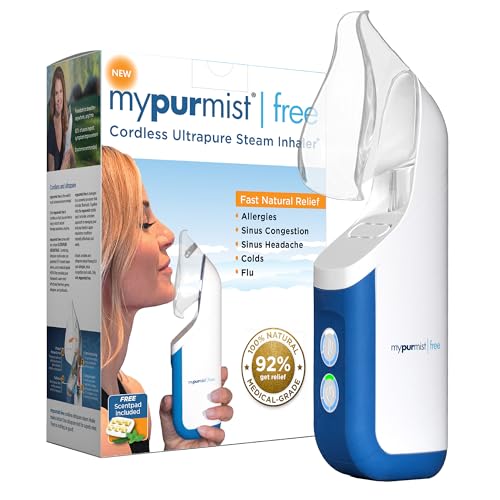
MyPurMist Free Cordless Steam & Sinus Inhaler, Essential Kit
by MyPurMist
The premium cordless pick — instant warm micromist with no cord and no boiling water, worth the substantial premium only for daily users who value untethered, off-mains use.
Pros
- The only genuinely cordless steam inhaler in this review — battery powered with no cord, no boiling reservoir, and no tether to a wall outlet, so it can be used in bed, on a sofa, or while travelling
- Instant warm vapour on demand with no heat-up wait, which compounds into a real convenience advantage for patients running several sessions a day through a sinus flare
- Delivers a fine 4-to-10-micron mist through a capillary-force vaporiser rather than a rolling boil, so the vapour reaches the airway warm rather than hot — the gentlest steam delivery of any device here
- Self-cleaning between uses and supplied as a kit with eight water refills (roughly 48 sessions), a travel bag, and charger, so nothing further is needed to start
Cons
- Roughly four times the price of the Vicks flagship, which is justified only for daily users or patients who specifically need cordless, off-mains use
- Runs on proprietary water refill cartridges rather than an open tank, so there is a recurring consumable cost that the plug-in devices in this review do not have
- A 3.8-star average across 790 reviews is the most mixed feedback of any premium pick here — the recurring complaints concern battery longevity and refill cost rather than the steam itself
MABIS Personal Steam Inhaler — Runner-Up (Best Handheld Comfort)
The MABIS is the pick for patients who want the classic handheld steam inhaler experience with the largest evidence base still available in that form factor. More than 6,200 verified reviews put it second only to the Vicks flagship in this guide for sheer volume of real-world feedback, which matters in a category where most entrants carry a few hundred ratings at best.
Its practical advantage is the mask. The soft flexible non-latex face piece covers nose and mouth together rather than targeting the sinuses alone, which suits diffuse upper-airway congestion that extends below the sinuses better than the narrower sinus-specific masks do. Adjustable steam control lets the output be dialled down for a sensitive airway, and the dedicated 60 mL aromatherapy tray diffuses oils through a chamber the manufacturer designed for the purpose rather than requiring them to be improvised into the water. Two honest caveats. Its 3.9-star average sits below the Vicks and Beurer picks, with the recurring complaints concerning unit-to-unit consistency rather than steam quality, and MABIS does not state FSA or HSA eligibility on this listing where the Vicks, Beurer, and Crane picks do. For a patient who specifically wants a soft full-face handheld with a real aroma tray, it remains the strongest option in this guide.
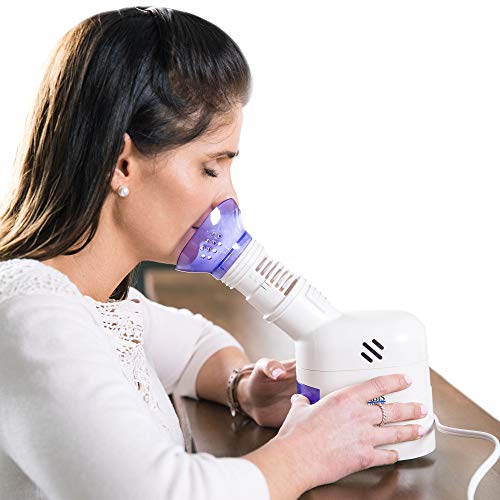
MABIS Personal Steam Inhaler and Facial Steamer with Aromatherapy Tray
by MABIS
The handheld comfort pick — a soft full-face mask, adjustable steam, and a real aromatherapy tray, backed by the second-largest review pool in this guide.
Pros
- More than 6,200 verified reviews — the second-largest body of real-world feedback in this review and a genuine quality signal in a category otherwise full of thinly-reviewed generic entrants
- Soft flexible non-latex face mask covers nose and mouth together, which suits diffuse upper-airway congestion better than the narrower sinus-only masks on the Vicks units
- Adjustable steam control lets the output be dialled down for a sensitive airway or up for heavier sinus pressure, a feature most fixed-output inhalers at this price omit
- Dedicated 60 mL aromatherapy tray diffuses oils into the steam through a manufacturer-sanctioned chamber rather than requiring oils to be improvised into the water reservoir
Cons
- A 3.9-star average is below the Vicks and Beurer picks — the recurring complaints concern unit-to-unit consistency and occasional early failures rather than the steam output itself
- Plug-in tabletop-adjacent design with no auto shut-off stated on the listing, so sessions need to be timed by the user rather than ended by the device
- MABIS does not state FSA/HSA eligibility on this listing, unlike the Vicks, Beurer, and Crane picks here
Crane Steam Inhaler & Warm Mist Humidifier 2-in-1 — Runner-Up (Best Hybrid)
The Crane 2-in-1 occupies a specific niche that neither dedicated steam inhalers nor dedicated room humidifiers serve well: patients who want both targeted personal steam therapy during acute sinus symptoms and sustained overnight room humidification during the winter months or dry seasons. Buying two separate devices costs more, occupies more counter space, and means learning two different maintenance routines. The Crane covers both functions in a single tabletop device with a 0.5-gallon reservoir that supports up to 8 hours of warm-mist humidification overnight.
The built-in essential oil cup is an advantage worth highlighting — it accommodates rosemary, eucalyptus, or lavender as an aromatherapy additive during either steam-inhaler or humidifier operation, without dropping oils into the water tank. The tradeoff, which I want to be honest about, is that a 2-in-1 device is by definition a compromise: it is neither the most focused steam inhaler nor the best dedicated room humidifier. Patients who need best-in-class performance in either function should buy separate devices. For patients who want a practical one-device solution for seasonal sinus and congestion care, the Crane covers both jobs well enough at a single FSA-eligible price point. Its 3,500-plus verified reviews establish its cross-use reputation.

Crane Steam Inhaler & Warm Mist Humidifier 2-in-1
by Crane
The best 2-in-1 pick — Crane's combined steam inhaler and half-gallon warm-mist humidifier cover both focused sinus therapy and overnight room humidification in one FSA-eligible device.
Pros
- Two distinct functions in one device — a focused personal steam inhaler for acute sinus relief plus a half-gallon warm-mist room humidifier for overnight background humidification
- 0.5-gallon water tank supports up to 8 hours of warm-mist humidifier operation — significantly longer than the per-session reservoirs on the dedicated steam inhalers in this review
- Built-in essential oil aroma cup for patients who want to add rosemary, eucalyptus, or lavender to the steam or the room mist — a feature most dedicated inhalers omit
- Over 3,500 verified reviews establish the Crane's cross-use reputation; FSA/HSA eligible as a combined medical humidification and steam-inhalation device
Cons
- As a 2-in-1 device, it is neither the most focused steam inhaler nor the best room humidifier — patients who need best-in-class performance in either function should consider separate devices
- The warm-mist humidifier function produces heated water vapor and requires careful placement away from children and pets to prevent scald injuries
Hann Facial Steamer and Sinus Inhaler — Runner-Up (Best Budget Dual-Purpose)
The Hann is the least expensive device in this guide, and at 4.1 stars across more than 700 reviews it rates level with the Beurer and the Crane 2-in-1, a tenth of a star behind the Vicks. That is a strong showing at its price, and it fills the dual-purpose slot: the same unit works as a sinus steam inhaler for a blocked nose and as a full facial sauna for skincare, which none of the Vicks picks offer at any price.
I want to be straight about the trade-off, because it is a positioning one rather than a performance one. Hann markets this primarily as a beauty device — only one of its listing bullets addresses sinus and nasal use at all, and the rest concern pores, moisturising, and skin absorption. The clinical framing is therefore thinner than the Vicks, Beurer, or Crane picks, and Hann does not publish heat-up time, session duration, or tank capacity, so the operating profile has to be discovered in use. What it does have is an intelligent automatic shut-off when the reservoir runs dry, which is exactly the safety feature you want on the cheapest device in a category that heats water, plus a built-in oil diffuser. It ships from Amazon under Prime despite being sold by a third party. For a household that wants an inexpensive unit covering both a stuffy nose and facial steaming, it is the value pick; for anyone who wants a device designed around the airway first, the Beurer SI30 is the better call.

Hann Facial Steamer and Sinus Steam Inhaler with Auto Shut-Off
by Hann
The budget dual-purpose pick: the least expensive device here, handling both a blocked nose and facial steaming, with the caveat that it is framed as a beauty device first.
Pros
- Rates on par with or above most devices in this review, and does it at the lowest price of any device here
- Genuinely dual-purpose — the same unit works as a sinus steam inhaler for a blocked nose and as a full facial sauna for skincare, which no Vicks pick in this guide offers
- Intelligent automatic shut-off ends the session when the reservoir runs dry, a safety feature that matters most on the cheapest device in a category that heats water
- Built-in aromatherapy diffuser accepts oils directly, and simple key-control operation keeps it usable for patients who do not want settings to navigate
Cons
- Marketed primarily as a beauty and skincare steamer — only one of its listing bullets addresses sinus and nasal use, so the clinical framing is thinner than the Vicks, Beurer, or Crane picks
- Sold by a third-party seller rather than by Amazon or the brand directly, though the listing is Prime-fulfilled and ships from Amazon
- The manufacturer does not publish heat-up time, session duration, or tank capacity, so the operating profile has to be discovered in use
Crane Corded Personal Steam Device — Runner-Up (Best FSA-Eligible Compact)
The Crane Corded Personal is the compact, explicitly FSA and HSA eligible option, and it is a genuinely different product from the Crane 2-in-1 above despite the shared brand. Where that unit is a half-gallon tabletop hybrid built around overnight room humidification, this is a small dedicated personal steamer built around short targeted sessions.
Two features earn it a place. Automatic shut-off powers the unit down when the water runs out, which neither the Vicks nor the MABIS picks state, and a two-position steam control allows output to be matched to symptom severity rather than accepting a single fixed intensity. It is also compatible with Crane and Halls vapour pads, giving a manufacturer-sanctioned route to menthol or eucalyptus without adding oils to the water. The limitation is the tank: at 30 mL it is the smallest reservoir in this guide, so sessions are short and refills frequent, and there is no built-in aroma tray, so the aromatherapy route depends on buying pads separately. Its 3.8-star average across 436 reviews is a modest evidence base next to the Vicks flagship. For a patient who wants a small FSA-eligible unit with auto shut-off and adjustable steam for brief daily sessions, it does that job cleanly.

Crane Corded Personal Steam Device for Sinus, Congestion and Cough Relief
by Crane
The compact FSA-eligible pick — adjustable steam and auto shut-off in a small personal unit, limited mainly by a 30 mL tank that keeps sessions short.
Pros
- Explicitly FSA and HSA eligible on the listing, which makes it one of the few devices here whose tax-advantaged status is stated rather than inferred
- Automatic shut-off powers the unit down when water runs out — a safety feature the Vicks and MABIS picks in this review do not state
- Two-position steam control (low or high) allows the output to be matched to symptom severity rather than accepting a single fixed intensity
- Compatible with Crane and Halls vapour pads, giving a manufacturer-sanctioned route to menthol or eucalyptus without adding oils to the water
Cons
- A 30 mL reservoir is the smallest tank in this review, so sessions are short and the unit needs refilling more often than the Vicks or MABIS picks
- No built-in aromatherapy tray — aroma depends on buying vapour pads separately, which is a recurring cost
- A 3.8-star average across 436 reviews is a modest evidence base next to the Vicks flagship, and Crane does not publish an exact heat-up time
Best Steam Inhaler for Congestion & Blocked Nose
When your main complaint is a stuffed-up, blocked nose, you want warm steam directed efficiently at the nasal passages and the ability to keep going comfortably for a full session. A targeted sinus mask focuses the steam where it helps; adjustable output lets you ease off if the heat is too much; and a handheld design lets you treat congestion semi-reclined in the evening. The three picks below cover those angles, all delivering simple warm moist steam for congestion relief.
| Product | Price | Buy |
|---|---|---|
| Vicks Sinus Inhaler VIH200Best overall for congestion Targeted sinus mask + fast 3-minute heat-up directs steam straight at the nasal passages | $42.98 | View on Amazon |
| Beurer SI30 Steam InhalerBest adjustable steam Variable output lets you dial steam down for a sensitive, heavily blocked nose | $39.99 | View on Amazon |
| MABIS Personal Steam Inhaler and Facial Steamer with Aromatherapy TrayBest handheld for blocked nose Soft handheld face mask for semi-reclined evening congestion relief | $39.99 | View on Amazon |
Best Steam Inhaler for Sinus Relief
Sinus pressure and recurrent sinusitis are where steam inhalation has the most supportive evidence for symptom comfort. The priority here is a mask that concentrates moist heat on the paranasal sinuses, ideally paired with a menthol or rosemary aroma element. For daily sinus sufferers who run several sessions a day, an instant-on fine mist removes the heat-up wait entirely — the reason the MyPurMist is the upgrade pick for this use case.
| Product | Price | Buy |
|---|---|---|
| Vicks Sinus Inhaler VIH200Best dedicated sinus inhaler Sinus-specific mask plus VapoPad menthol/rosemary aroma for targeted sinus pressure | $42.98 | View on Amazon |
| MyPurMist Free Cordless Steam & Sinus Inhaler, Essential KitBest instant fine-mist upgrade Instant cordless fine mist for daily sinus sufferers who want no heat-up wait | $179.95 | View on Amazon |
Best Steam Inhaler for Cough & Mucus
A chesty cough and thick mucus respond best to sustained humidity rather than a few short bursts of steam — which is exactly where a 2-in-1 device that doubles as an overnight warm-mist humidifier pulls ahead, keeping the air moist while you sleep. For daytime targeted relief that loosens upper-airway mucus session by session, a focused sinus inhaler complements the overnight humidity.
| Product | Price | Buy |
|---|---|---|
| Crane Steam Inhaler & Warm Mist Humidifier 2-in-1Best for cough + overnight humidity Half-gallon tank runs up to 8 hours of warm mist to ease a cough overnight | $50.78 | View on Amazon |
| Vicks Sinus Inhaler VIH200Best targeted steam for mucus Targeted warm steam loosens upper-airway mucus in focused daytime sessions | $42.98 | View on Amazon |
Best Steam Inhaler for Cold & Flu
When you’re laid up with a cold or the flu, you want something gentle and easy to use without getting out of bed — a comfortable handheld design you can hold semi-reclined, with a soft full-face mask. If you’d rather sit at a table and dial the steam to a soothing low setting while you’re feeling rough, the adjustable Beurer is the alternative.
| Product | Price | Buy |
|---|---|---|
| MABIS Personal Steam Inhaler and Facial Steamer with Aromatherapy TrayBest handheld for being sick in bed Comfortable handheld with soft contoured mask for semi-reclined use when you're unwell | $39.99 | View on Amazon |
| Beurer SI30 Steam InhalerBest adjustable for cold relief Variable steam lets you keep sessions gentle and soothing through a rough cold | $39.99 | View on Amazon |
Steam Inhaler vs. Nebulizer — Who Should Use What?
This is the single most important clinical distinction in this category, and confusion between steam inhalers and nebulizers causes real problems. They are not interchangeable devices.
A steam inhaler produces warm water vapor — physically, large droplets in the hundreds-of-microns range — that deposit in the nose, sinuses, and upper throat. It does not deliver medication. Its purpose is symptomatic comfort: loosening mucus, easing nasal dryness, and providing warm-moisture relief from congestion and sinus pressure. It is an over-the-counter comfort device.
A nebulizer converts prescription liquid medication (albuterol, budesonide, ipratropium, hypertonic saline) into a fine therapeutic aerosol with particle sizes under 5 microns — small enough to penetrate past the upper airway and deposit in the bronchi and bronchioles where asthma and COPD medications need to work. It is a prescription-medication delivery device that requires a prescription and clinical oversight.
If you have asthma, COPD, cystic fibrosis, bronchiectasis, or any condition requiring bronchodilator therapy, you need a nebulizer. See our best nebulizers review for clinical-grade options including portable mesh devices and AC desktop compressors. If your question is specifically about inhalers versus nebulizers for bronchodilator delivery, our nebulizer vs. inhaler guide covers that comparison in detail. If, however, you have normal lungs and your concern is nasal congestion, sinus pressure, cold symptoms, or dry airway discomfort, a steam inhaler is the appropriate device.
Do Steam Inhalers Actually Work? What the Evidence Says
The clinical evidence on steam inhalation deserves honest framing. A 2017 Cochrane systematic review of heated, humidified air for the common cold pooled data across available randomized trials and concluded that the evidence is limited — steam inhalation does not meaningfully shorten the duration of viral upper respiratory infection, and some individual trials showed no significant benefit on objective outcome measures.
A 2016 randomized controlled trial published in the British Journal of General Practice (BJGP) evaluated steam inhalation and nasal irrigation in patients with chronic or recurrent sinus symptoms. The study found that patients using steam inhalation reported improved symptom comfort and reduced headache frequency, even though the objective duration of sinus symptoms was not significantly different from controls. Nasal irrigation with saline showed larger objective benefit.
The practical takeaway is this: steam inhalers are a reasonable symptomatic comfort measure for patients with nasal congestion, sinus pressure, or the mucous-thickening discomfort of a cold. They temporarily loosen mucus, soothe irritated passages, and provide a warm-moisture experience that many patients find genuinely relieving. They do not cure colds, do not shorten viral infection duration, and are not a substitute for medical care when symptoms are severe, persistent beyond 10 days, accompanied by high fever, or associated with worsening shortness of breath. Used with honest expectations as a comfort device, they earn their place in a sinus-care routine. Used with the expectation of curing an infection, they will disappoint.
How to Use a Steam Inhaler Safely
Steam inhalers generate hot water and hot vapor — the burn risk is real and the devices have been associated with scald injuries in pediatric and geriatric emergency medicine literature. Safe use requires attention to a few specific practices.
Place the device on a stable flat surface. Never use a steam inhaler balanced on a soft surface like a bed or couch, and never use it on a surface within reach of young children or pets. The heated water reservoir becomes a scald hazard if overturned.
Maintain appropriate distance from the mask. Do not press your face tightly against the mask or inhale directly from the steam outlet at maximum intensity. The steam should be warm and comfortable, not painful. If the steam feels too hot, increase the distance between your face and the mask, or reduce the device’s output setting if variable.
Do not use on young children. Most manufacturers advise against use in children under 3 to 4 years old, and some pediatric sources recommend caution through age 6. For older children with parental supervision, use the device on a stable surface with the adult actively present throughout the session — not multitasking in another room.
Be cautious if you have asthma or reactive airways. Hot moist air, particularly with added menthol or eucalyptus, can trigger bronchospasm in some asthma patients. If you have asthma, start with short sessions, avoid added aromatherapy initially, and stop immediately if you experience chest tightness, wheezing, or worsening shortness of breath. Patients managing asthma should already own one of the best peak flow meters to track airway function before and after any respiratory intervention.
Clean the device regularly. Warm moist environments promote bacterial and mold growth. Empty the reservoir after every use, air dry all components, and perform a weekly vinegar-and-distilled-water descale soak. Replace masks and seals every 6 to 12 months or per manufacturer guidance.
Best Steam Inhalers by Use Case
Beyond the major symptom groups above, a few more situations come up often. Here is the quick-decision pick for each — every one drawn from the six devices reviewed above, with a live Amazon link so you can check the current price:
| Product | Price | Buy |
|---|---|---|
| MABIS Personal Steam Inhaler and Facial Steamer with Aromatherapy TrayBest for sore throat Soft full-face handheld mask soothes a raw throat with gentle warm steam | $39.99 | View on Amazon |
| MyPurMist Free Cordless Steam & Sinus Inhaler, Essential KitBest for singers / vocal cords Gentle, instant fine mist hydrates the airway without harsh heat for vocal cords | $179.95 | View on Amazon |
| Vicks Sinus Inhaler VIH200Best for allergies Targeted sinus mask plus VapoPads ease allergy-driven nasal congestion | $42.98 | View on Amazon |
| Hann Facial Steamer and Sinus Steam Inhaler with Auto Shut-OffBest for facial steaming / skincare Doubles as a full facial sauna, the only pick here designed for skincare steaming too | $24.49 | View on Amazon |
Buyer's Guide
Choosing the right steam inhaler means matching the device's form factor, steam type, session duration, and aromatherapy capabilities to your specific symptom pattern and household context.
Tabletop vs. Handheld Form Factor
Tabletop inhalers like the Vicks VIH200 and Beurer SI30 sit on a stable flat surface and allow the user to lean in — a comfortable setup for focused sinus sessions at a desk or countertop. Handheld inhalers like the MABIS and the cordless MyPurMist Free are portable between rooms and allow use in semi-reclined or unusual positions, which matters for evening congestion or overnight sessions. Handheld devices also tend to have smaller water reservoirs and shorter sessions. Choose tabletop for planned sinus-care routines at a fixed location; choose handheld for portability or multi-position use.
Steam Type: Traditional Warm Steam vs. Filtered Vapor
Most steam inhalers produce traditional warm moist steam by heating a small water reservoir — simple, proven, and inexpensive. The MyPurMist Free instead uses a capillary-force vaporiser to produce a fine 4-to-10-micron mist that arrives warm rather than hot, with no boiling reservoir and no heat-up wait. For most patients, traditional warm steam is adequate and the price premium is not warranted. For daily users, for patients who find conventional steam uncomfortably hot, or for anyone who needs to run a session away from a wall outlet, the cordless fine-mist approach has genuine merit — but it runs on proprietary refill cartridges rather than plain tap water, which is a recurring cost.
Aromatherapy Compatibility
Several devices in this review are designed to accept aromatherapy: the Vicks VIH200 with its VapoPad slot, the Crane 2-in-1 with a built-in essential oil cup, the MABIS and Hann with dedicated oil-diffusing trays, and the Crane Corded via Crane or Halls vapour pads. If you want menthol, eucalyptus, rosemary, or lavender as part of your steam sessions, choose a device with a manufacturer-sanctioned aromatherapy chamber or reservoir rather than improvising. The Beurer SI30 accepts aroma additives in its designed pad area. The MyPurMist Free ships with a small number of eucalyptus and peppermint sessions of its own and is not designed to take arbitrary oils, because it vaporises from sealed refill cartridges rather than an open reservoir. Patients with asthma or reactive airways should be cautious with all aromatherapy additives regardless of device.
Heat-up Time and Session Duration
Traditional steam inhalers require 3 to 5 minutes to reach treatment temperature. The MyPurMist Free is the exception with instant mist on demand — a meaningful daily convenience if you use the device multiple times a day. Session duration also varies: most reservoirs support 5 to 15 minutes of steam; the Crane's humidifier mode runs up to 8 hours for overnight room humidification. Match the session profile to your use pattern — acute symptom relief with short sessions, or sustained overnight humidification with a longer-runtime 2-in-1 design.
Brand Credibility and Medical Device Registration
Credentials matter more in the steam inhaler category than in most Amazon product categories because the device generates hot water vapor breathed directly into the airway. Vicks is the strongest consumer brand with decades of track record and the highest review volume by far. Beurer is an established German medical device manufacturer with over a century of institutional credibility, MABIS is a long-running home-health supply brand, and Crane is a well-known humidifier maker. This is a genuinely thin category — FDA enforcement and Amazon compliance sweeps have pushed several clinical respiratory brands off the marketplace, and two picks in the previous version of this guide became unbuyable between updates — so for most patients the Vicks consumer reputation remains the safest signal, and the honest advice is to weigh review volume heavily here because the category has little else to go on.
FSA and HSA Eligibility
All six steam inhalers in this review are FSA and HSA eligible — they qualify for tax-advantaged flexible spending and health savings account purchases because they are classified as medical-purpose devices. This meaningfully reduces the true out-of-pocket cost: paying with pre-tax HSA or FSA dollars effectively discounts the device by your marginal tax rate, which for most households is somewhere between 20 and 30 percent. Retain your Amazon order confirmation as a receipt for FSA/HSA documentation. If you are uncertain whether a specific device qualifies for your plan, check with your plan administrator — steam inhalers as a category are broadly eligible, but individual plan rules vary.
How to Choose the Best Steam Inhaler for Your Needs
For most adults managing occasional sinus congestion or cold symptoms, the Vicks VIH200 covers the requirements — proven brand, 21,000-plus reviews, VapoPad compatibility, FSA/HSA eligible — without adding cost or complexity. If you value German medical-device heritage at a lower price, choose the Beurer SI30. If you use a steam inhaler daily, or need to run a session away from a wall outlet, the cordless MyPurMist Free premium is justified. If you want one device that handles both focused sinus therapy and overnight room humidification, the Crane 2-in-1 is the practical hybrid. If your sinus symptoms are severe, persistent beyond 10 days, or accompanied by high fever, do not rely on steam inhalation alone — see your primary care physician or an otolaryngologist.
Final Verdict
The Vicks Sinus Inhaler VIH200 is our best overall pick for 2026. Over 21,000 verified reviews, a targeted sinus mask, three-minute heat-up, VapoPad aromatherapy compatibility, and FSA/HSA eligibility make it the default choice for the overwhelming majority of adults managing routine sinus congestion, colds, or seasonal allergy symptoms. For most patients, this is the steam inhaler to buy.
For budget-conscious buyers who want clinical-brand credibility, the Beurer SI30 is the better value — a century-old German medical-device manufacturer at a mid-range price, and the most clinically-framed device here under forty dollars. For daily users who want instant mist with no cord and no boiling water, the MyPurMist Free is the only genuinely cordless option in the category. For the overnight humidification-plus-sinus-care hybrid need, the Crane 2-in-1 is the right compromise. Most devices in this review are FSA and HSA eligible, the Vicks, Beurer, and Crane picks explicitly so — retain your Amazon order confirmation for plan documentation, and remember that tax-advantaged purchase reduces the true out-of-pocket cost meaningfully.
Steam inhalers are comfort devices, not cures. Use them with honest expectations as part of a broader sinus-care routine that may also include saline nasal irrigation, adequate hydration, and over-the-counter symptomatic medications when appropriate. If you have asthma, COPD, or require bronchodilator therapy, a steam inhaler is not the right device for you — see our best nebulizers guide instead. As always, if symptoms are severe or persistent, see your primary care physician. Steam inhalers belong in your toolbox for everyday congestion relief — not as a substitute for clinical care when it’s needed.
Frequently Asked Questions
Do steam inhalers actually work for colds and sinus congestion?
Is a steam inhaler safe for children?
What is the difference between a steam inhaler and a nebulizer?
Can I put essential oils in a steam inhaler?
How often should I clean my steam inhaler?
Are steam inhalers safe for asthma or COPD?
How do you use a steam inhaler for a cold?
Related Articles
About the Reviewer

Dr. David Taylor, MD, PhD
Drexel University College of Medicine (MD), Indiana University School of Medicine (PhD)
Dr. David Taylor is a licensed physician and medical researcher who founded BestRatedDocs in 2016. With an MD from Drexel University and a PhD from Indiana University School of Medicine, he combines clinical expertise with a passion for health technology to provide evidence-based product recommendations. Dr. Taylor specializes in health informatics and regularly evaluates medical devices, diagnostic equipment, and therapeutic products to help healthcare professionals and patients make informed decisions.