7 Best Massage Guns of 2026
Dr. David Taylor reviews the best massage guns on Amazon. Compare top percussive therapy devices by stall force, amplitude, noise, and battery for muscle recovery.
Updated
Percussive therapy has moved decisively from professional sports medicine rooms into the mainstream recovery toolkit. In 2026, the market is mature enough that genuinely great massage guns exist at every price tier — but the performance gap between a $50 device and a $300 device is real, specific, and measurable in two key specs: stall force and amplitude. Getting those specs right for your use case is the difference between a tool that transforms your recovery routine and a device that collects dust after three weeks.
On this site, we approach medical devices and recovery tools the way Dr. David Taylor’s clinical background demands: with reference to specifications, mechanism of action, and honest assessment of what the research supports. Percussive therapy has a genuine evidence base for reducing delayed-onset muscle soreness (DOMS), improving pre-activity range of motion, and providing short-term relief from myofascial tension. What it does not do — despite some marketing claims — is treat structural pathology, replace physical therapy, or provide lasting pain relief without addressing the underlying cause. We review these devices in that context.
For this roundup, we evaluated seven massage guns across a spectrum from entry-level to professional-grade, analyzing independent stall force and amplitude measurements, thousands of verified Amazon user reviews, and published clinical guidance on percussive therapy protocols. Whether you are managing post-training DOMS, chronic desk-work neck tension, or daily lower back stiffness, the guide below will help you identify the right tool — and pair it, where relevant, with other recovery modalities like TENS therapy and red light therapy devices.
How We Selected These Massage Guns
Our selection process prioritized products with verified stall force and amplitude specifications, at least 2,500 Amazon reviews, and meaningful differentiation in use case or price tier. We did not include products where the manufacturer’s claimed stall force could not be corroborated through independent testing or detailed user feedback. We evaluated each device against the following criteria: raw percussive performance (stall force and amplitude), noise level at working speeds, battery runtime, handle ergonomics for solo posterior-chain access, connectivity and app quality, and warranty terms. The result is a set of seven devices that collectively span the full purchase landscape — from a clinically effective budget option under $60 to a professional-grade app-integrated flagship.
1. Theragun Prime (5th Generation) — Best Overall
The Theragun Prime 5th Generation represents the most refined version of Therabody’s benchmark mid-range device. The QX65 QuietForce motor is the defining upgrade over the 4th generation: the same 30 lbs of stall force and 16mm amplitude that made the Prime the category standard, now delivered at 40–70 dB rather than the 75+ dB of older models. That noise reduction matters practically — it determines whether you use the device in a shared apartment at 6am before training, during a television commercial break, or in a hotel room without disturbing adjacent guests.
The 16mm amplitude is the specification that separates the Theragun line from nearly everything else at this price tier. Amplitude determines how deeply the percussion penetrates into muscle tissue. At 16mm, the Prime reaches approximately 60% deeper into the muscle belly than a 10mm device — a clinically meaningful difference when treating the gluteus maximus, quadriceps, or thoracic paraspinals. The patented triangle handle is not an aesthetic choice: it allows six distinct grip positions that enable genuine solo access to the mid-back and glutes without the wrist and shoulder contortion that pistol-grip devices require for the same coverage. For users managing lower back tension alongside their recovery routine, combining the Prime with a well-chosen back brace addresses both acute support and tissue recovery simultaneously.
The Therabody app is the best-developed companion ecosystem in the consumer massage gun market. Physical therapist-designed protocols cover pre-workout activation, post-workout recovery, sleep preparation, and targeted treatment for common pain sites including the neck, lower back, IT band, and plantar fascia. The app’s real-time force meter — which requires the device to be connected via Bluetooth — gives users quantitative feedback on applied pressure, which is particularly useful in a rehabilitation context where consistent force application matters.

Theragun Prime (5th Generation) Deep Tissue Percussion Therapy Massage Gun
by Therabody
Theragun's 5th-gen Prime delivers the brand's signature 16mm amplitude and multi-grip handle in a quieter, app-connected package — the benchmark full-size massage gun.
Pros
- QX65 QuietForce motor delivers 30 lbs of stall force at 40–70 dB — professional-grade depth without disruptive noise
- Patented multi-grip triangle handle offers six positioning options, allowing solo access to mid-back, glutes, and hamstrings
- Bluetooth + Therabody app integration unlocks PT-designed guided routines and real-time pressure feedback via the force meter feature
- 120-minute battery with 80-minute USB-C charge time covers a full week of daily 15-minute sessions on one charge
Cons
- No built-in force-meter display on the device itself — pressure feedback requires the companion app
- Proprietary attachment system means Theragun heads are not cross-compatible with competing brand arms
2. RENPHO Active Massage Gun — Budget Pick
The RENPHO Active is the device that changed what “budget massage gun” means. At its price point, most competing devices deliver 20–25 lbs of stall force through a brush motor that will degrade noticeably within 12–18 months of regular use. The RENPHO Active uses a 16.8V brushless motor — the same motor architecture as premium devices — that RENPHO rates at 40 lbs of stall force. That figure has been corroborated in independent testing and translates to a device that maintains percussion through firm pressure on most major muscle groups, not just light surface contact.
The sub-45 dB noise profile is the other standout specification. At this power output, most manufacturers accept 60–65 dB operating noise as the engineering trade-off. RENPHO’s brushless motor design and housing achieve quiet-gun performance at budget-gun pricing. The practical implication is that the RENPHO Active works in environments where louder budget guns do not — apartment buildings with thin walls, shared offices, and late-night recovery sessions.
The 10mm amplitude is the genuine limitation. It is effective for the upper trapezius, calves, forearms, and other surface muscle groups. It is less effective for deep quadriceps, glute maximus, and thoracic paraspinal work where the larger muscle mass requires greater percussive depth to feel the therapeutic effect. If deep posterior chain treatment is your primary use case, the Ekrin B37 or Theragun Prime deliver meaningfully different results. For the majority of users managing desk-work tension, light training soreness, and routine maintenance, the RENPHO Active covers the clinical territory adequately and leaves significant budget headroom for other recovery tools.

RENPHO Active Massage Gun Deep Tissue Percussion Handheld Muscle Massager
by RENPHO
RENPHO's Active delivers surprising stall force and genuine quiet operation at a fraction of the cost of flagship devices — the best value entry point on Amazon.
Pros
- 40 lbs of stall force from a 16.8V brushless motor — substantially more than most sub-$60 massage guns on the market
- ≤45 dB operating noise keeps the device usable in shared living spaces, offices, and hotel rooms without drawing attention
- Five interchangeable heads cover ball, flat, fork, bullet, and air cushion applications in a single compact carry case
- USB-C charging and 10-minute auto-off make the device travel-ready without a proprietary adapter
Cons
- 10mm amplitude is shallower than premium full-size guns — adequate for surface muscles, less effective for deep glute or hamstring work
- 2.5-hour battery life requires more frequent charging than mid-tier competitors with larger battery packs
3. Hyperice Hypervolt 2 Pro — Upgrade Pick
The Hypervolt 2 Pro occupies the top tier of the mainstream massage gun market and justifies that position primarily through its app ecosystem and HyperSmart motor technology. The 90-watt motor produces stall force in the 60-lb range with 14mm amplitude — competitive with the best-performing devices at any price — but what distinguishes the Hypervolt 2 Pro from raw-spec competitors is the HyperSmart system’s ability to automatically increase motor speed when increased resistance is detected. In practice, this means the gun maintains consistent percussive depth as you press into dense muscle belly tissue, rather than requiring manual speed adjustment mid-treatment.
The Quiet Glide Technology operates at 53–65 dB across the full five-speed range, which is notably quiet for a 90-watt motor. The performance envelope — maximum depth, adaptive speed, professional noise profile — positions the Hypervolt 2 Pro as the appropriate choice for licensed massage therapists, sports medicine practitioners, and serious athletes who use a massage gun as a primary professional or training tool rather than an occasional recovery accessory.
The five-speed range from 1,700 to 3,200 percussions per minute covers clinical treatment speeds at the low end and activation work at the high end. The removable lithium-ion battery is a practical advantage for users who train in facilities where charging is available, as a spare battery allows uninterrupted use. The Hyperice app’s professional protocol library is comparable to Therabody’s in depth and clinical rigor. At this tier, the choice between the Hypervolt 2 Pro and the Theragun Pro (at a higher price point) comes down largely to app preference and handle ergonomics — both are professional-grade tools.
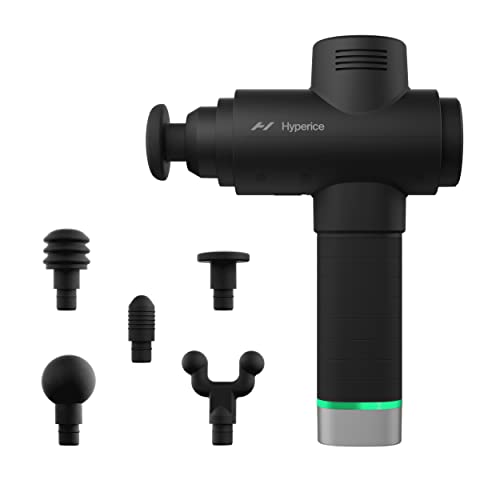
Hyperice Hypervolt 2 Pro Percussion Massage Gun with Quiet Glide Technology
by Hyperice
The Hypervolt 2 Pro is the benchmark for app-integrated premium massage guns — 90-watt motor, auto-adjusting speed, and the deepest stroke outside clinical devices.
Pros
- 90-watt high-torque motor with 14mm amplitude and five speed settings provides the deepest percussion stroke in the mainstream massage gun market
- HyperSmart Bluetooth technology automatically adjusts speed in real time based on muscle tension detected through the Hyperice app
- Quiet Glide Technology reduces operating noise to 53–65 dB — quieter than most competitors at equivalent power output
- Five interchangeable head attachments include fork, ball, cushion, flat, and bullet for targeted tissue treatment across all major muscle groups
Cons
- At nearly three times the price of the RENPHO Active, the performance premium requires a genuine high-frequency use case to justify
- Removable battery adds flexibility but also means tracking an additional component compared to integrated-battery designs
4. Ekrin Athletics B37v2 — Runner-Up
The Ekrin B37v2 challenges the conventional price-performance hierarchy in the massage gun market. Its 56-lb stall force — independently verified across multiple review sources — matches or exceeds flagship devices at twice the price. The commercial-grade brushless motor that produces that force figure is built to a durability standard more commonly associated with professional gym equipment than consumer wellness devices, which is reflected in Ekrin’s lifetime warranty — a commitment that is rare in a category where most warranties run 1–2 years.
The 8-hour battery life is the specification that most distinguishes the B37v2 from every other mainstream massage gun. No Therabody, Hyperice, or RENPHO device approaches that runtime. For athletes who train daily and use their device for multiple sessions across a day, travelers who cannot guarantee consistent charging access, and physical therapy patients who use percussive therapy as part of a structured rehabilitation protocol, the runtime advantage translates to genuine daily convenience rather than a spec-sheet distinction.
The angled handle geometry — a consistent feature across the Ekrin line — addresses the solo-access problem that standard pistol grips create. The 15-degree angle reduces wrist extension when treating the posterior chain from a standing position, enabling self-treatment of the mid-back and glutes that would otherwise require an awkward grip on a straight-handle device. The B37v2 adds a new silicone ball attachment and USB-C PD fast charging over the original B37 — meaningful upgrades for a modest price increase over the v1.
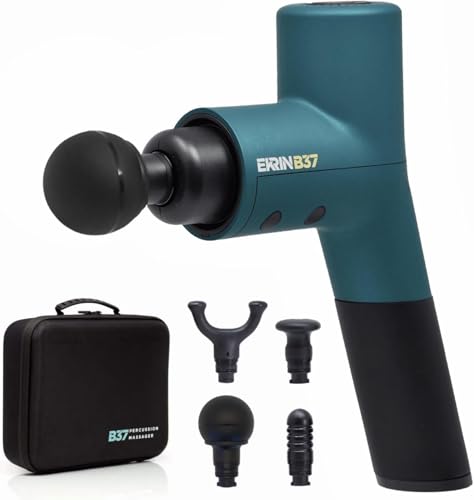
Ekrin Athletics B37v2 Massage Gun Deep Tissue with High-Powered Brushless Motor
by Ekrin Athletics
Ekrin's B37v2 delivers class-leading stall force and an 8-hour battery with a lifetime warranty — the strongest value proposition in the $150–$200 tier.
Pros
- 56 lbs of stall force from a commercial-grade brushless motor — the highest in this price tier and competitive with devices at twice the cost
- 8-hour battery life on a single charge is by far the longest runtime in the mainstream massage gun category
- Ergonomic angled handle reduces wrist strain during self-treatment on the lower back and posterior chain
- Lifetime warranty from a US-based company that manufactures exclusively in fitness recovery equipment
Cons
- 12mm amplitude is respectable but trails the Theragun Prime's 16mm for users who need maximum tissue depth
- Fewer brand recognition and retail availability than Therabody or Hyperice — warranty service requires shipping to the manufacturer
5. Theragun Relief — Best for Everyday Maintenance and Older Adults
The Theragun Relief occupies a deliberate clinical niche within the Therabody product line: it is designed for users who need the therapeutic benefit of percussive massage without the power, weight, or interface complexity of full-size professional devices. The 20-lb stall force and 10mm amplitude position it below the Prime and Pro in raw capability but within the range appropriate for everyday muscle maintenance, moderate tension relief, and the management of non-acute musculoskeletal discomfort.
The design decisions throughout the Relief reflect its intended user. One-button operation with three hardware-selected speeds eliminates the app, Bluetooth, and interface navigation that are barriers for older adults or users unfamiliar with connected wellness devices. The 1.3-lb weight — substantially lighter than the 2.2-lb Prime — reduces fatigue during the extended hold times that self-treatment of the neck and upper trapezius requires. The patented triangle grip appears on the Relief as well as the Prime and Pro, ensuring that the ergonomic posterior-chain access benefit is available at the entry level.
For users who have been recommended percussive therapy by a physical therapist or physician but are uncertain about the appropriate power level for their condition, the Theragun Relief is the appropriate starting point. It delivers genuine therapeutic percussion — not vibration — within a power envelope that is unlikely to aggravate sensitive or recovering tissue. For users managing conditions where deeper treatment is appropriate — athletic soreness, chronic lower back tension, or post-training recovery — the Prime offers meaningfully greater capability.

Theragun Relief by Therabody Easy-to-Use Handheld Percussion Massage Gun
by Therabody
Theragun's entry-level device strips away app complexity for a lighter, quieter gun designed for everyday maintenance, older adults, and first-time percussive therapy users.
Pros
- 20 lbs of stall force with 10mm amplitude provides genuinely therapeutic percussion without the intimidating power of full-size devices
- Three-speed one-button control requires no app, no Bluetooth, and no learning curve — pick up and use immediately
- 1.3-lb weight and patented triangle grip enable comfortable extended use for older adults and those managing limited hand strength
- Dampener, Standard Ball, and Thumb attachments cover the three most clinically useful application types without overwhelming choice
Cons
- No Bluetooth and no app connectivity — intentional for simplicity, but limits guided protocol access
- 20 lbs stall force is sufficient for maintenance work but inadequate for athletes, heavy-tissue treatment, or post-surgical rehab
6. Bob and Brad D5 Pro — Best for Athletes and Heavy Users
Bob and Brad’s D5 Pro is the massage gun market’s most underrated performance device. The YouTube physical therapy duo built a brand around accessible clinical education before entering the massage gun market, and the D5 Pro reflects that background in its design priorities. The 55-lb stall force and 13mm amplitude match the performance envelope of devices at two to three times the price. The OLED display and four dynamic modes — Constant, Pulse, Auto, and Gradually — add programmable clinical versatility that most competing devices at this price do not offer.
The noise specification deserves particular attention. At 40–51 dB across all five speed settings, the D5 Pro is quieter than most devices with half its stall force. The engineering achievement — 55 lbs of stall force at under 52 dB — is genuinely unusual in the massage gun market and reflects a motor and housing design that competitors at similar power levels have not matched. For users who train early in the morning, live in apartments, or travel frequently for work and need a high-performance device that will not disturb hotel neighbors, the D5 Pro’s noise-to-power ratio is the decisive advantage.
The FSA and HSA eligibility adds practical value for users managing documented musculoskeletal conditions. Many percussive therapy devices are FSA/HSA eligible, but the D5 Pro’s combination of FSA eligibility, clinical-grade stall force, and sub-$100 street pricing makes it the most cost-effective option for users who can pay with pre-tax healthcare funds. Pairing the D5 Pro with red light therapy for a comprehensive tissue recovery protocol gives athletes a clinical-quality toolkit at a fraction of the cost of branded recovery systems.

BOB AND BRAD D5 Pro Massage Gun with 13mm Amplitude FSA-HSA Eligible
by Bob and Brad
Bob and Brad's D5 Pro is the under-the-radar performance pick — 55 lbs of stall force and OLED multi-mode control at a price that beats everything in its power class.
Pros
- 55 lbs of stall force — matching or exceeding devices at three times the price — drives the 13mm amplitude into dense muscle and fascia without stalling
- OLED display with four dynamic massage modes (Constant, Pulse, Auto, Gradually) adds clinical versatility not found on standard single-mode guns
- 40–51 dB operating noise at all five speeds is among the quietest for a 55-lb stall force device; competing guns in this power class often reach 65+ dB
- FSA/HSA eligible with 20W USB-C fast charging and a 4-hour runtime makes this a practical clinical-level tool for frequent users
Cons
- D-handle design is ergonomically effective but takes adjustment for users accustomed to the pistol-grip form factor of most competitors
- Bob and Brad's primary brand identity is YouTube physical therapy content — massage gun retail presence and service network are smaller than Therabody or Hyperice
7. Ekrin Athletics B37 — Best Value with Lifetime Warranty
The original Ekrin B37 remains a compelling purchase in 2026, even with the B37v2 available. The core specifications — 56-lb stall force, 12mm amplitude, 8-hour battery, angled handle — are identical to the v2. The difference is in the accessories (standard ball vs. silicone ball) and charging speed (standard USB-C vs. PD fast charge). For users who charge their device overnight and are not pressing the accessories with specialized application requirements, the v1 provides the identical therapeutic performance at a lower price point.
The 8-hour battery deserves emphasis in the context of the full market. The nearest competitor in mainstream massage guns runs approximately 3 hours. For daily athletic use, the Ekrin B37 requires charging roughly once per week versus daily or every-other-day for Therabody and Hyperice devices. That difference in charging frequency is practically meaningful over months of use.
The lifetime warranty — a commitment Ekrin has honored consistently based on user feedback — is a meaningful differentiator from both Amazon-only brands with limited warranty service and from Therabody and Hyperice, whose standard warranties run 1–2 years on consumer devices. For buyers who view a massage gun as a long-term recovery tool rather than a consumer electronics replacement purchase, the Ekrin warranty structure changes the value calculation materially. Whether you choose the B37 or the B37v2, you are getting a device built to a quality standard that Ekrin is prepared to stand behind indefinitely.
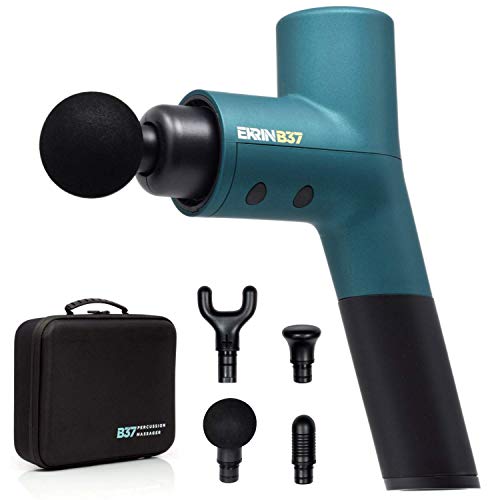
Ekrin Athletics B37 Massage Gun Percussion Massager for Sore Muscles and Recovery
by Ekrin Athletics
The original B37 delivers the same 56-lb stall force and 8-hour battery as its successor at a lower price — the smart buy if you don't need USB-C PD fast charging.
Pros
- 56 lbs of stall force from the same commercial brushless motor platform as the B37v2 — full deep-tissue capability at a lower price point
- 8-hour battery life substantially outlasts Therabody, Hyperice, and RENPHO models at any price tier
- Angled handle reduces wrist extension during posterior chain self-treatment — ergonomically superior to straight-grip pistol designs for solo users
- Lifetime warranty with direct US-based customer service distinguishes Ekrin from most Amazon-only massage gun brands
Cons
- Original B37 lacks the silicone ball attachment and USB-C PD fast-charging upgrade found in the B37v2
- 12mm amplitude is meaningful but still trails the Theragun Prime's 16mm for users who require maximum percussive depth
How to Choose the Best Massage Gun
The six buyer’s guide factors above are the core decision framework. One additional clinical consideration worth addressing separately is the distinction between percussive therapy and vibration therapy. These terms are sometimes used interchangeably in marketing copy, but they describe meaningfully different mechanisms. True percussive therapy — as delivered by all seven devices in this guide — uses the rapid back-and-forth stroke of the head to deliver rapid mechanical impulses into tissue at a defined depth. Vibration therapy devices, which include cheaper “massage guns” that stall under minimal pressure, produce surface vibration that stimulates cutaneous mechanoreceptors without meaningfully reaching the muscle belly. The stall force specification is the reliable proxy for distinguishing between them: devices with under 20 lbs of stall force are vibration tools; devices with 40+ lbs are percussive.
For users with specific clinical diagnoses — frozen shoulder, fibromyalgia, nerve impingement, or post-surgical scarring — the appropriate percussion settings, duration, and treatment sites differ from standard athletic recovery protocols. A physical therapist familiar with your condition is the appropriate resource for a personalized percussive therapy protocol. The general recovery protocols in the Therabody and Hyperice apps are well-designed for healthy users managing normal training load; they are not designed to replace individualized clinical guidance for pathological presentations.
Buyer's Guide
Choosing the right massage gun requires matching the device's motor power, amplitude, and form factor to your specific use case — the best gun for an elite athlete is not the same as the best gun for an office worker managing daily neck tension.
Stall Force
Stall force is the most important specification to evaluate and the most frequently misrepresented in marketing materials. Look for at least 40 lbs for general use and 50+ lbs if you train regularly or want genuine deep-tissue capability. A gun that stalls under body-weight pressure cannot deliver therapeutic percussion to large muscle groups — it delivers vibration, which has a different and less potent physiological effect. Budget devices often claim high stall force without independent testing; Ekrin and Therabody both publish verified figures.
Amplitude
Amplitude (stroke length) determines percussive depth. Budget devices at 10mm are effective for surface muscle work and minor soreness. Mid-tier devices at 12–13mm reach into most muscle bellies adequately. Theragun's 16mm is the clinical benchmark for deep tissue penetration, particularly for the large posterior chain muscles. Choosing by amplitude is most important for users treating chronic deep-muscle tension, athletic recovery, and fascia work — less so for casual daily use.
Noise Level
Noise level (measured in decibels) determines where and when you can comfortably use the device. Under 50 dB is quiet enough for shared living spaces and office environments. 55–65 dB is typical for mid-range devices and comparable to normal conversation. Over 65 dB is intrusive and generally associated with high-stall-force motors that have not invested in noise-dampening technology. The RENPHO Active and Bob and Brad D5 Pro both achieve sub-52 dB performance while delivering meaningful stall force — a rare combination.
Battery Life
Battery life requirements depend entirely on usage frequency and charging access. Casual users running 10–15 minute sessions a few times per week will find any 2-hour battery more than adequate. Athletes using the device daily and travelers who cannot guarantee charging access benefit significantly from the Ekrin B37 and B37v2's 8-hour battery — no other mainstream massage gun comes close. Consider how often you will charge the device and whether you plan to use it during travel where outlet access may be inconsistent.
App and Connectivity
Bluetooth connectivity with a companion app adds guided protocol access, real-time pressure feedback, and speed customization beyond hardware presets. Therabody and Hyperice both offer well-developed app ecosystems with physical therapist-designed routines. However, app connectivity also introduces dependency on a smartphone and the continued support of the app. If you want a device that works predictably without software, the Theragun Relief and RENPHO Active both deliver excellent standalone performance. App integration adds the most value for users who are new to percussive therapy and want structured guidance.
Form Factor and Ergonomics
The handle design determines how effectively you can reach key areas without a second person's help. Straight pistol grips are intuitive but limit posterior chain access — the upper back, mid-back, and glutes require awkward wrist positions. Triangle handles (Theragun) and angled handles (Ekrin) are specifically designed to allow single-user access to posterior muscles. If solo self-treatment of the back and hamstrings is a primary use case, prioritize angled handle geometry over pistol-grip devices, regardless of motor specifications.
Final Verdict
After evaluating seven devices across the full price and performance spectrum, the Theragun Prime (5th Generation) remains the best overall massage gun for most buyers in 2026. The combination of 16mm amplitude, 30-lb stall force, genuine QuietForce noise reduction, and the most mature app ecosystem in the category makes it the appropriate choice for anyone willing to invest in a professional-quality recovery tool. Its multi-grip handle solves the solo posterior-chain access problem that no pistol-grip device fully resolves, and its Bluetooth force meter provides the kind of quantitative feedback that turns percussive therapy from guesswork into a repeatable protocol.
For cost-conscious buyers, the RENPHO Active is a genuinely good massage gun — not a compromise. Its 40-lb stall force and sub-45 dB noise level deliver clinical-quality performance for surface and mid-depth muscle treatment at a fraction of flagship pricing. Buyers who train heavily and need maximum stall force without the Theragun price premium should look closely at the Ekrin B37v2 or the Bob and Brad D5 Pro — both deliver 55+ lbs of verified stall force with excellent noise profiles at $90–$160. And for older adults or anyone beginning percussive therapy for the first time, the Theragun Relief provides a properly therapeutic — if gentler — entry point backed by Therabody’s clinical credibility. As always, consult your healthcare provider before beginning any new recovery modality if you have an existing musculoskeletal condition.
Frequently Asked Questions
What is stall force and why does it matter for a massage gun?
What amplitude should I look for in a massage gun?
How often should I use a massage gun for muscle recovery?
Is a massage gun safe to use after surgery or injury?
Can a massage gun replace professional massage therapy?
What is the difference between a massage gun and a TENS unit for pain relief?
Related Articles
About the Reviewer

Dr. David Taylor, MD, PhD
Drexel University College of Medicine (MD), Indiana University School of Medicine (PhD)
Dr. David Taylor is a licensed physician and medical researcher who founded BestRatedDocs in 2016. With an MD from Drexel University and a PhD from Indiana University School of Medicine, he combines clinical expertise with a passion for health technology to provide evidence-based product recommendations. Dr. Taylor specializes in health informatics and regularly evaluates medical devices, diagnostic equipment, and therapeutic products to help healthcare professionals and patients make informed decisions.