7 Best Home ECG Monitors of 2026
Dr. David Taylor reviews the best FDA-cleared home ECG monitors. Compare KardiaMobile, OMRON, EMAY standalone, KardiaMobile Card, and more for AFib detection, leads, and subscription costs.
Updated
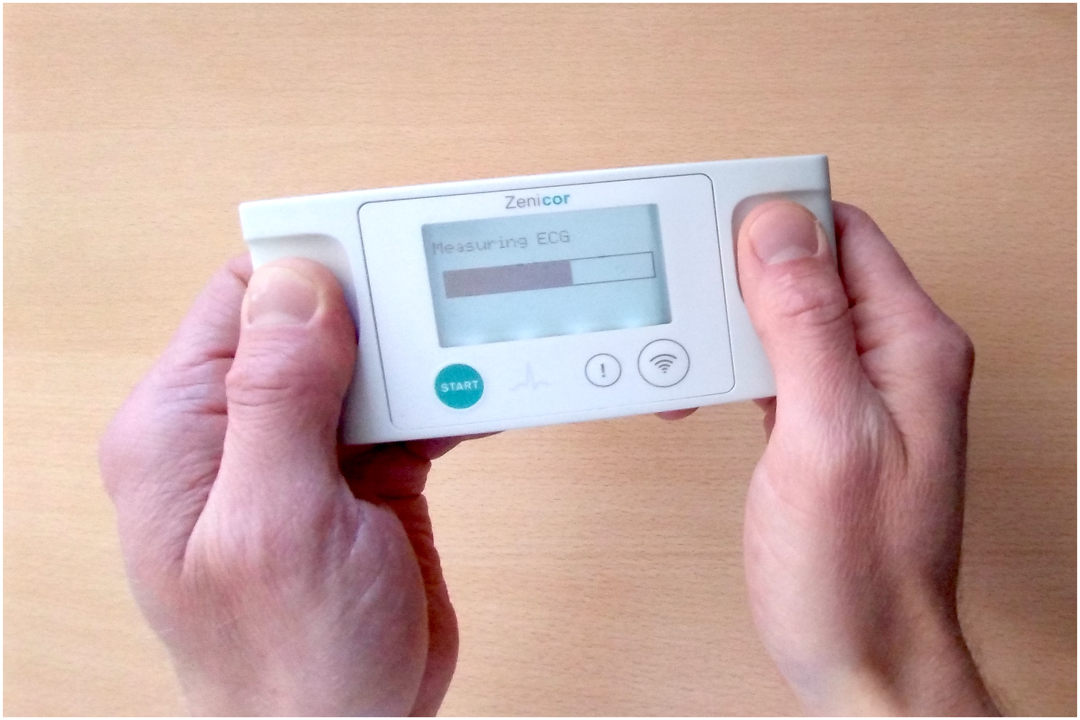
Atrial fibrillation now affects an estimated 10.5 million US adults — substantially higher than the long-cited 6 million figure, after 2024 American Heart Association modeling revised the prevalence upward — and it remains the leading single cause of preventable stroke. The challenge has always been detection: AFib is frequently paroxysmal, occurring in episodes that last minutes to hours before reverting to normal sinus rhythm spontaneously. By the time a patient reaches a clinic or emergency department, the episode may have resolved — and the standard 10-second 12-lead ECG captures nothing. Home ECG monitors exist precisely to close this gap, allowing patients to record a clinical-quality electrocardiogram the moment symptoms appear and share the timestamped result directly with their cardiologist.
In clinical practice, Dr. Taylor recommends home ECG monitoring for patients with documented paroxysmal AFib who have been cardioverted or placed on antiarrhythmic therapy, patients who report palpitation symptoms that have not been captured on standard monitoring, and higher-risk patients — particularly those over 65 with hypertension or diabetes — who have a clinical indication for increased surveillance. The critical requirement for any device used in this context is FDA clearance. Over-the-counter wearables that display a “heart rate graph” are not ECG monitors. The devices reviewed here are FDA-cleared electrocardiogram recorders with validated accuracy for rhythm analysis.
ECG vs EKG: The Same Test
Both abbreviations refer to an electrocardiogram — a recording of the heart’s electrical activity across time. ECG is derived from the English term; EKG comes from the original German word Elektrokardiogramm. Clinicians and cardiologists use both interchangeably, and consumer devices are marketed under both labels. There is no clinical or technical difference between an ECG monitor and an EKG monitor. When evaluating products in this category, the distinction that matters is between consumer-grade ECG devices cleared for rhythm detection and hospital-grade 12-lead systems used for full cardiac evaluation — not the acronym.
Consumer ECG vs Clinical ECG: Understanding the Limits
A home ECG monitor is a powerful screening and monitoring tool, not a replacement for hospital-grade cardiac evaluation. Single-lead and 6-lead devices capture rhythm information with high accuracy — atrial fibrillation, tachycardia, bradycardia, and some conduction abnormalities are detectable. The structural, ischemic, and wall-motion findings visible on a 12-lead interpretation performed by a cardiologist require more leads, more precise electrode placement, and clinical context. Treat a home ECG recording as a high-quality data point to share with your physician, not a self-diagnostic result. Any recording that shows an abnormal result, produces symptoms, or is interpreted by the device algorithm as abnormal should be reviewed by a qualified healthcare provider.
We evaluated seven FDA-cleared home ECG monitors representing the most clinically validated options currently available to consumers, comparing lead count, connectivity, subscription model, build quality, and real-world review depth.
| Product | Price | Buy |
|---|---|---|
| KardiaMobile Personal EKG MonitorBest Overall | $79.00 | View on Amazon |
| KardiaMobile 6L Personal EKG MonitorPremium Pick | $129.00 | View on Amazon |
| EMAY 6L Portable ECG MonitorRunner-Up | $169.00 | View on Amazon |
| OMRON Complete Blood Pressure Monitor + EKGRunner-Up | $139.00 | View on Amazon |
| Beurer Cardio Companion EKG Monitor ME75Budget Pick | $60.27 | View on Amazon |
| EMAY Portable ECG MonitorRunner-Up | $109.00 | View on Amazon |
| KardiaMobile Card Personal EKG MonitorRunner-Up | $109.00 | View on Amazon |
Find the Right ECG Monitor for Your Situation
Jump to the pick that matches how you’ll use it:
A note on scope: consumer handheld/pad monitors like these are for spot-checking rhythm (AFib, brady/tachycardia). Smartwatch EKG, prescription Holter patches, and 12-lead clinical machines are a different category and aren’t covered here.
How We Selected These ECG Monitors
Our selection criteria required FDA clearance as a hard filter — no uncleared devices were considered regardless of price or features. We then evaluated clinical validation depth (peer-reviewed studies, adoption in cardiology practice), Amazon review volume and rating as a proxy for real-world reliability, lead count relative to typical patient needs, total cost of ownership including subscription fees, and the practical considerations of connectivity and standalone operation. Products were selected to represent the full range of use cases: the validated standard, the clinical upgrade, the no-subscription alternative, the combined monitoring device, and the accessible entry point.
Best ECG & EKG Monitors Overall
1. KardiaMobile Personal EKG Monitor — Best Overall
The KardiaMobile is the benchmark against which every other consumer ECG device is measured. More than 67,000 Amazon reviews and a 4.7-star rating represent a depth of real-world validation that no other home ECG device approaches — and the clinical validation history behind the platform is equally unmatched. AliveCor has published multiple peer-reviewed studies demonstrating AFib detection accuracy above 93%, and the Kardia platform is recognized and accepted by cardiologists at major health systems as a legitimate remote monitoring tool.
The device itself is remarkably simple: two electrodes, a coin cell battery lasting roughly a year, and 18 grams of weight. A patient experiencing palpitations presses two fingers to the electrodes, and within 30 seconds has a clinical-quality single-lead ECG trace visible on their phone with an automated algorithm interpretation. The PDF is shareable to any physician immediately. For most patients whose monitoring need is AFib detection or symptom capture, this is all that is required.
The subscription model deserves transparent discussion. The base KardiaMobile records ECGs and produces PDF reports at no ongoing cost. The KardiaCare subscription adds algorithm-detected classifications beyond normal/possible AFib — useful for patients whose cardiologist wants automated flagging of tachycardia, bradycardia, or unclassified findings. Patients who will share all recordings with a cardiologist for human interpretation do not necessarily need the subscription. Patients who want the algorithm to sort their recordings automatically will find value in it.

KardiaMobile Personal EKG Monitor
by AliveCor
The most doctor-recommended consumer ECG with 67,000+ reviews and unmatched clinical validation.
Pros
- FDA-cleared with 95% AFib detection accuracy — the most clinically validated consumer ECG available
- Over 67,000 Amazon reviews make this the most trusted home ECG monitor at any price point
- Pocket-sized at 18 grams with a CR2016 battery lasting approximately 12 months between replacements
- FSA/HSA eligible with no mandatory subscription required for core ECG recording and PDF export
Cons
- Requires a smartphone to operate — no built-in display for standalone viewing
- Advanced AI detections (tachycardia, bradycardia, normal/possible AFib) require $100/year KardiaCare subscription
- Sound-based ultrasonic connection can fail in loud environments or with older phone speakers
2. KardiaMobile 6L Personal EKG Monitor — Upgrade Pick
The 6L upgrade is justified when your cardiologist has specifically requested multi-lead home recordings, or when your cardiac history involves conduction abnormalities — bundle branch blocks, accessory pathways, pre-excitation syndromes — that a single-lead trace cannot adequately characterize. Six simultaneous lead vectors provide the spatial information needed to localize electrical events within the heart, and cardiologists who are experienced with remote ECG review increasingly prefer 6-lead recordings for anything beyond basic rhythm confirmation.
The switch from ultrasonic to Bluetooth connectivity in the 6L is a meaningful practical improvement. The 1-lead KardiaMobile transmits data via the phone’s microphone using an ultrasonic signal, which can fail in loud environments, with older phone speakers, or for users with hearing aids that interfere with the microphone. The 6L’s Bluetooth connection is more robust and completely independent of the phone’s audio hardware. For patients who have experienced the occasional connection failure with the standard model, this alone is worth the upgrade cost.
The movement sensitivity of the 6L requires acknowledgment. Six-lead recordings demand that the user keep both hands and both legs stable during the 30-second recording. Patients with essential tremor, Parkinson’s disease, or significant anxiety during recording may produce more failed results than with the 1-lead device. Practice and a stable seated position improve success rates considerably.

KardiaMobile 6L Personal EKG Monitor
by AliveCor
Six leads give cardiologists the diagnostic detail they need — the upgrade for serious cardiac monitoring.
Pros
- 6-lead output (I, II, III, aVR, aVL, aVF) provides the diagnostic detail cardiologists increasingly request
- Bluetooth connectivity eliminates microphone interference that affects the 1-lead ultrasonic model
- Compatible with hearing aid users — Bluetooth removes the audio-signal dependency of the standard model
- Same compact form factor as 1-lead KardiaMobile at only 6 grams heavier
Cons
- Movement-sensitive — even slight hand tremor during recording can produce a failed or noisy result
- $50 price premium over the 1-lead model requires justification; most users do not need 6-lead at home
- Still requires a smartphone — no standalone operation without the Kardia app
3. EMAY 6L Portable ECG Monitor — Runner-Up
The EMAY 6L occupies an important position in this category: it delivers 6-lead capability, a built-in display for standalone operation, and a permanent zero-subscription model. For patients who resent recurring fees, or who want to know their total cost of ownership at the moment of purchase, this combination is genuinely attractive and not available in the AliveCor lineup.
The built-in 2.4-inch color display changes the use scenario meaningfully. A patient who wakes at night with palpitations can pick up the device from the nightstand and see their ECG trace immediately — no phone unlock, no app launch, no Bluetooth pairing sequence. For elderly patients or those who are less technology-comfortable, this immediacy and self-contained operation removes the friction points that can cause patients to delay recording during an actual symptomatic episode.
The honest caveat is review depth. With approximately 1,100 reviews compared to 67,000 for the KardiaMobile, the EMAY has a fraction of the real-world validation data. The device is FDA-cleared and the individual reviews are positive, but the statistical confidence that comes from 67,000 user experiences simply does not exist yet. For patients whose cardiologist is specifically familiar with and requests Kardia-format recordings, the EMAY may not fit their workflow. For patients whose primary need is reliable personal monitoring with no ongoing cost, it is a strong option worth considering.

EMAY 6L Portable ECG Monitor
by EMAY
The best 6-lead ECG for subscription-averse buyers — FDA-cleared with no recurring costs.
Pros
- Zero subscription ever — all features and PDF export included at purchase with no recurring cost
- Built-in 2.4-inch color display shows the ECG trace immediately without requiring a smartphone
- Standalone operation via built-in display or Bluetooth app gives maximum flexibility
- Supports 2 user profiles with PDF export — suitable for couples or caregiver-monitored patients
Cons
- Heavier at 85 grams versus the KardiaMobile 6L at 24 grams — less pocket-friendly for daily carry
- Fewer than 1,200 reviews compared to tens of thousands for KardiaMobile, limiting real-world validation depth
- App interface less polished and feature-rich than the mature Kardia platform
4. OMRON Complete Blood Pressure Monitor + EKG — Runner-Up
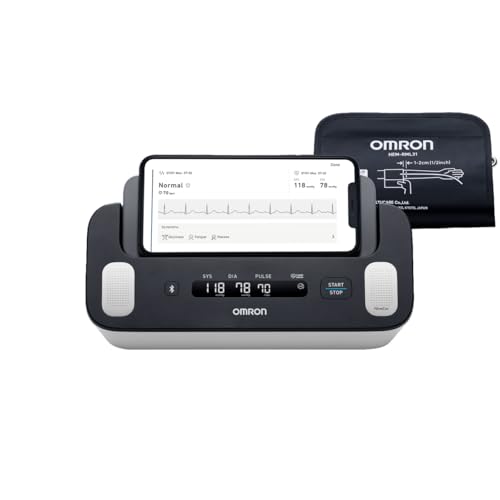
The OMRON Complete is unique in this review: it is the only FDA-cleared device that measures blood pressure and records an EKG in the same reading. For patients managing hypertension alongside a cardiac arrhythmia — a very common combination in patients over 60 — this integration eliminates the need for two separate devices, two separate apps, and two separate monitoring routines.
The first EKG interpretation by a cardiologist is included at purchase and represents a clinically meaningful benefit. Many patients have never had their home recordings reviewed by a specialist, and the included interpretation provides an immediate quality check on the device’s accuracy for that individual patient. OMRON’s 5-year warranty, the longest in this category, reflects confidence in the device’s durability and provides protection that no other reviewed device offers.
The Bluetooth reliability issues documented in reviews are the primary concern. When a blood pressure reading is combined with an EKG and neither can be retrieved because the app will not connect, the device’s core value proposition fails. Patients who rely on connected health apps without frustration tolerance for occasional pairing issues should consider whether the 1-lead KardiaMobile’s more robust connectivity is a better fit.
OMRON Complete Blood Pressure Monitor + EKG
by Omron
The only FDA-cleared device combining BP monitoring with EKG — ideal for patients managing both.
Pros
- The only FDA-cleared device that combines blood pressure measurement with single-lead EKG in one reading
- First EKG recording includes a free cardiologist interpretation — unusual for a consumer device at any price
- 5-year warranty is the longest in the home ECG category by a wide margin
- OMRON is the #1 doctor-recommended blood pressure brand, lending clinical credibility to the EKG capability
Cons
- Bluetooth pairing failures reported frequently — connectivity issues are the top complaint across reviews
- Single-user limitation after a post-release app update restricts household sharing
- Powered by 4 AA batteries rather than rechargeable — ongoing battery cost at a premium price point
5. Beurer Cardio Companion EKG Monitor ME75 — Budget Pick
The Beurer ME75 is a legitimate newcomer from a German medical device manufacturer with decades of European market history in blood pressure monitors, scales, and diagnostic devices. The combination of FDA clearance, 3-lead capability, a built-in display, USB rechargeable battery, and no subscription at a budget price point is genuinely competitive — particularly for patients who want more than single-lead capability but do not need the full 6-lead output of more expensive alternatives.
The 4 flexible measurement positions accommodate patients who cannot comfortably maintain the standard finger-to-electrode position used by KardiaMobile devices. Patients with upper extremity mobility limitations, post-stroke arm weakness, or significant tremor may find the positional flexibility practically useful.
The limited review count is the unavoidable caveat. With fewer than 100 reviews, the Beurer ME75 has not yet accumulated the real-world reliability data that would allow confident long-term recommendation. The device earns a position in this review as a promising budget-accessible entry with the right specifications on paper. Patients who are comfortable being early adopters of a well-credentialed product may find it excellent value. Patients who want proven reliability validated across thousands of users should begin with the KardiaMobile.

Beurer Cardio Companion EKG Monitor ME75
by Beurer
Promising FDA-cleared newcomer — 3-lead at budget pricing from a trusted German medical brand.
Pros
- FDA-cleared 3-lead ECG at under $90 with no subscription — strong value for a multi-lead device
- 4 flexible measurement positions (seated, standing, lying down, and chest) accommodate varied user mobility
- USB-B rechargeable battery eliminates the need for coin cells or disposable batteries
- Built-in color display provides standalone operation without requiring a smartphone; FSA/HSA eligible
Cons
- Very new product with fewer than 100 reviews — real-world reliability and longevity unproven at scale
- Beurer brand has limited recognition in the US market compared to AliveCor or OMRON
- App ecosystem less established than the mature Kardia platform with years of clinical iteration
6. EMAY Portable ECG Monitor — Runner-Up
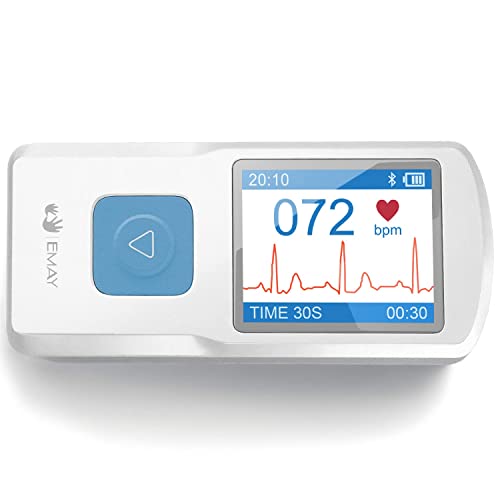
The EMAY Portable ECG Monitor (single-lead, not to be confused with the 6-channel EMAY 6L at position 3) is the current #1 Best Seller in its Amazon subcategory, and it earns that distinction by solving the one limitation that the KardiaMobile and KardiaMobile Card both share: it has a real screen. A 1.8-inch LCD displays the ECG trace and heart rate reading the instant you complete your measurement — no smartphone, no Bluetooth pairing, no app launch. Pick it up, hold it, get your reading in 30 seconds, and put it down.
The four measurement modes — hand-to-hand, hand-to-chest, hand-to-wrist, and hand-to-leg — accommodate patients who cannot maintain the standard two-finger electrode grip that the KardiaMobile requires. For patients with upper extremity weakness, arthritis, or limited hand strength, the positional flexibility makes a meaningful practical difference. The device stores up to 100 readings on its internal memory, and the Bluetooth app (iOS and Android) allows PDF export at no subscription cost for patients who do want to share results digitally.
At $89.99 with a rechargeable battery and zero subscription fees, this EMAY model occupies a distinct niche: the patient who wants FDA-cleared AFib detection without a smartphone dependency, without a subscription, and without paying for 6-lead capability they do not need.
EMAY Portable ECG Monitor
by EMAY
The #1 Best Seller in consumer ECG — FDA-cleared standalone with on-device LCD and no subscription.
Pros
- Works fully standalone with on-device LCD — no smartphone needed to view results
- FDA-cleared to detect AFib and arrhythmias; generates shareable PDF reports at no subscription cost
- Four measurement modes (hand-to-hand, hand-to-chest, hand-to-wrist, hand-to-leg) for varied mobility
- Stores up to 100 readings on-device with no subscription required for any feature
Cons
- Single-lead only — less diagnostic detail than 6-lead monitors for complex arrhythmias
- App pairing can require troubleshooting on some Android devices
7. KardiaMobile Card Personal EKG Monitor — Runner-Up
The KardiaMobile Card is the most innovative form factor in this category: a credit-card-sized ECG monitor that is exactly 85.6mm × 54.0mm × 1.2mm and weighs 7.4 grams — the precise dimensions of a standard payment card. It goes in your wallet, it stays there, and it never needs to be charged. The non-rechargeable lithium battery lasts approximately two years under normal use, eliminating the device management friction that affects rechargeable products.
AliveCor’s algorithm — the same platform behind the KardiaMobile devices reviewed above — detects AFib, bradycardia, tachycardia, and three additional arrhythmia types via Bluetooth connection to the Kardia app. The FDA clearance history and clinical validation behind the Kardia platform applies here identically. For patients who already carry a KardiaMobile or who are familiar with the Kardia app workflow, the Card adds the form-factor advantage of wallet portability with no relearning required.
The critical limitation must be stated clearly: there is no display on the device. Every result requires a smartphone running the Kardia app. If your phone is dead, unavailable, or incompatible, the Card cannot show you your ECG. For most working-age adults who carry their phone constantly, this is a non-issue. For older adults or patients who sometimes go without their phone, the EMAY standalone or standard KardiaMobile may be more appropriate.

KardiaMobile Card Personal EKG Monitor
by AliveCor
The world's thinnest FDA-cleared ECG — wallet-sized, never needs charging, and backed by AliveCor's proven algorithm.
Pros
- Exact credit-card size at 7.4 grams — fits in any wallet, always with you without adding bulk
- No charging ever required; 2-year non-rechargeable lithium battery is fully maintenance-free
- Detects AFib, bradycardia, tachycardia, and 3 additional arrhythmias via AliveCor's validated algorithm
- First-ever FDA-cleared credit-card-sized ECG device; FSA/HSA eligible
Cons
- No built-in display — completely dependent on a paired smartphone to view any results
- Thin form factor can cause motion artifact if card is not held steady during recording
Best Home ECG Monitor
For keeping tabs on your heart at home — a quick reading when you feel a flutter, or tracking rhythm alongside blood pressure — these three cover the main home use cases.
| Product | Price | Buy |
|---|---|---|
| KardiaMobile Personal EKG MonitorBest home ECG overall The most clinically validated personal EKG — a 30-second single-lead reading on your phone that flags AFib, bradycardia and tachycardia, with thousands of ratings | $79.00 | View on Amazon |
| OMRON Complete Blood Pressure Monitor + EKGBest home BP + EKG combo Pairs a validated upper-arm blood-pressure cuff with single-lead EKG, so home users tracking hypertension and rhythm get both in one device | $139.00 | View on Amazon |
| Beurer Cardio Companion EKG Monitor ME75Best budget home EKG A standalone FDA-cleared monitor with its own color screen — no subscription or phone needed for a straightforward home check | $60.27 | View on Amazon |
Best Portable ECG Monitor
For an EKG you can take anywhere — travel, work, the car — a pocketable standalone device that doesn’t depend on your phone is the priority.
| Product | Price | Buy |
|---|---|---|
| EMAY Portable ECG MonitorBest portable overall A pocket standalone recorder with a built-in screen and storage that works without a phone — the travel-friendly pick with thousands of 4.9-star ratings | $109.00 | View on Amazon |
| KardiaMobile Card Personal EKG MonitorBest wallet-carry portable As thin as a credit card and FDA-cleared for six arrhythmias, it slips into a wallet for an EKG literally anywhere | $109.00 | View on Amazon |
| EMAY 6L Portable ECG MonitorBest portable 6-lead Adds six-lead depth in a still-portable form for users who want more than a single-lead strip while away from home | $169.00 | View on Amazon |
How to Choose the Best Home ECG Monitor
The buyer’s guide factors above cover the six most important variables. One practical consideration that deserves additional emphasis is physician workflow compatibility. If you have an established cardiologist, ask before purchasing which ECG format they prefer for remote review. Many cardiologists are enrolled in the AliveCor physician portal and receive Kardia recordings directly into their workflow. Some health systems have integrated Kardia into their patient portals. Choosing a device whose output format is already familiar to your care team reduces friction in the most important step: getting your recordings reviewed by someone qualified to interpret them.
For patients who have not yet been evaluated for a suspected arrhythmia, a home ECG monitor should supplement — not replace — a formal cardiac workup. If you are experiencing new palpitations, dizziness, shortness of breath, or chest discomfort, these symptoms warrant a direct evaluation before self-monitoring with a home device.
Buyer's Guide
Choosing a home ECG monitor means matching the device's lead count, connectivity, and subscription model to your clinical situation and how you plan to use the recordings.
FDA Clearance
FDA 510(k) clearance is non-negotiable for any device you intend to use for cardiac monitoring. A cleared device has been independently evaluated for safety and accuracy against a predicate device. Every product reviewed here carries FDA clearance. Avoid devices marketed as ECG monitors that carry only FDA registration (a basic listing requirement) rather than clearance — registration does not validate clinical accuracy. FDA clearance is also a prerequisite for FSA/HSA reimbursement at most plan administrators.
Number of Leads
A 1-lead device records from a single electrical perspective and is well-suited for AFib detection and basic rhythm monitoring. A 6-lead device captures the heart from six angles, providing the spatial information cardiologists need to evaluate conduction abnormalities beyond simple rhythm. Most patients monitoring for AFib or general palpitation episodes do not need more than 1-lead. Patients with complex arrhythmias, prior ablation, accessory pathways, or whose cardiologist specifically requests multi-lead recordings should consider the KardiaMobile 6L or EMAY 6L.
Subscription Costs
The KardiaMobile base device records and stores ECGs and generates PDF reports at no ongoing cost. The KardiaCare subscription at approximately $100 per year adds AI-powered detections beyond normal and AFib — including tachycardia, bradycardia, and additional rhythm classifications. If you need those advanced detections, factor the subscription into the total cost of ownership. The EMAY 6L and Beurer ME75 have no subscription at any level — every feature is included at purchase. If predictable total cost is a priority, the no-subscription options may be more economical over a multi-year ownership horizon.
Standalone vs Smartphone Required
The KardiaMobile devices require a smartphone running the Kardia app to display and record the ECG trace — there is no screen on the device itself. This is adequate for most users but creates a dependency on a charged, compatible smartphone. The EMAY 6L and Beurer ME75 both include built-in displays that show the ECG trace immediately without a phone, enabling recording in any setting. For patients who are older, less technology-comfortable, or who want to record ECGs in situations where smartphone access is inconvenient, a device with a built-in display is meaningfully more practical.
Clinical Validation
AliveCor's KardiaMobile platform has the deepest body of published clinical evidence of any consumer ECG device — multiple peer-reviewed studies, FDA clearances across multiple generations, and widespread adoption in cardiology practices as a recognized patient monitoring tool. This validation history matters when sharing recordings with physicians: cardiologists are familiar with the Kardia format and algorithm outputs. Newer devices like the EMAY and Beurer carry FDA clearance but lack the multi-year clinical track record. For patients whose recordings will be reviewed in specialist cardiology settings, the KardiaMobile platform's established credibility is a practical advantage.
FSA/HSA Eligibility
All FDA-cleared ECG monitors reviewed here are generally eligible for FSA and HSA reimbursement as medical devices. Using pre-tax funds reduces the effective purchase price by 20 to 35% depending on your tax bracket — a $79 KardiaMobile becomes effectively $50 to $63 for a qualifying buyer. The AliveCor product pages explicitly confirm FSA/HSA eligibility. Confirm with your plan administrator before purchasing and retain documentation. For patients with cardiologist-documented arrhythmia, a letter of medical necessity further strengthens a reimbursement claim.
Final Verdict
For the overwhelming majority of patients seeking a clinically validated home ECG monitor, the KardiaMobile Personal EKG Monitor is the best overall choice in 2026. Its 67,000+ reviews, FDA-cleared 95% AFib detection accuracy, 18-gram form factor, and compatibility with cardiologist workflows represent a combination no other device in this category currently matches. For patients whose cardiologist requests multi-lead recordings or who want to avoid any subscription cost, the KardiaMobile 6L or EMAY 6L are appropriate upgrades depending on whether standalone operation or Bluetooth reliability is the higher priority. For patients managing both hypertension and cardiac arrhythmia, the OMRON Complete remains the only device that addresses both in a single daily reading. As always, share your recordings with your cardiologist and follow their guidance for interpretation — home ECG monitoring is a powerful tool most effective when integrated into an ongoing relationship with your healthcare provider.
Frequently Asked Questions
What is the difference between ECG and EKG?
How accurate are home ECG monitors compared to hospital equipment?
Can a home ECG monitor detect atrial fibrillation (AFib)?
Do I need a prescription for a home ECG monitor?
Are home ECG monitors FSA or HSA eligible?
What is the difference between 1-lead and 6-lead ECG?
Can I share my home ECG readings with my doctor?
How often should I use my home ECG monitor?
Related Articles
About the Reviewer

Dr. David Taylor, MD, PhD
Drexel University College of Medicine (MD), Indiana University School of Medicine (PhD)
Dr. David Taylor is a licensed physician and medical researcher who founded BestRatedDocs in 2016. With an MD from Drexel University and a PhD from Indiana University School of Medicine, he combines clinical expertise with a passion for health technology to provide evidence-based product recommendations. Dr. Taylor specializes in health informatics and regularly evaluates medical devices, diagnostic equipment, and therapeutic products to help healthcare professionals and patients make informed decisions.