7 Best Neck Traction Devices of 2026
Dr. David Taylor reviews the best neck traction devices for cervical pain, disc compression, and tension headaches — from foam stretchers to clinical-grade home traction kits.
Updated
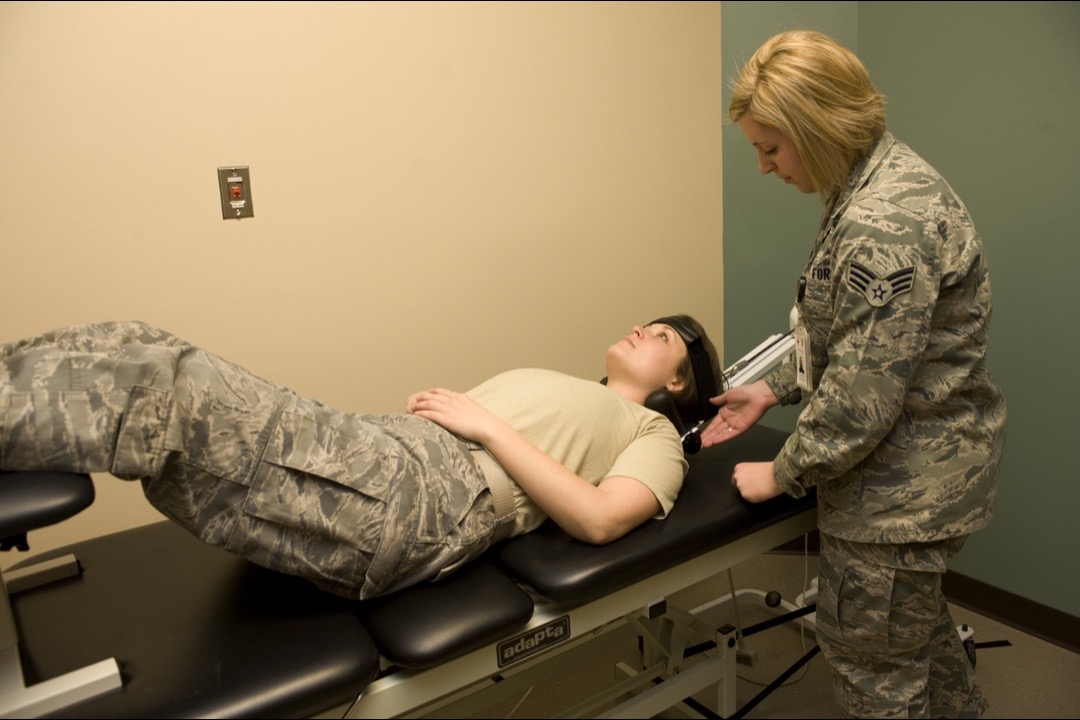
Neck pain is one of the most common reasons patients walk into a primary care office, and it is also one of the most under-treated. Roughly one in three American adults experiences clinically significant neck pain each year, and a substantial fraction of those cases trace back to mechanical compression of the cervical spine — disc bulges, facet joint irritation, narrowed neural foramina, and chronic muscle tension from desk work and screen time. Cervical traction is one of the few home interventions with peer-reviewed clinical evidence behind it: a 2017 meta-analysis published in Spine (Yang et al.) concluded that intermittent cervical traction provides short-term symptom relief for cervical radiculopathy when used as an adjunct to physical therapy. The catch is that “cervical traction” covers a wide range of mechanically different devices that do not all do the same thing — and most consumers buy the wrong category for their condition.
The single most important distinction is between passive foam stretchers (which support the head in extension under its own weight, about 8 to 10 pounds of gentle muscle stretch) and true axial traction devices (which apply a measurable separating force of 15 to 50 pounds along the long axis of the cervical spine). Foam stretchers are excellent for tech-neck tension and tension-type headaches; they do not, however, decompress a herniated disc. True traction can decompress a disc when prescribed and applied correctly; it is overkill, and sometimes harmful, when used for ordinary muscle tightness. Buying the highest-rated product on Amazon without understanding which category you need is the most common reason patients tell us their home traction device “didn’t work” — they bought the wrong tool.
In this review, Dr. David Taylor evaluated seven of the most well-supported home cervical traction products on the US market in 2026, spanning all five major device categories: foam cradles, Y-strap over-door hammocks, pneumatic inflatable collars, over-door head halters, and clinical supine mechanical units. We weighted clinical appropriateness, build quality, user safety, and the breadth of indications each device legitimately addresses. Several common products on this SERP were excluded for safety or quality concerns, including units with documented strap or clip failure patterns. If you are weighing a cervical pillow alongside daytime traction, our companion guide to the best cervical neck pillows covers nighttime positional support that complements any of the devices below.
| Product | Price | Buy |
|---|---|---|
| RESTCLOUD Neck and Shoulder RelaxerBest Overall | $19.99 | View on Amazon |
| WIDREST Neck Stretcher Strap with Chin BeltBudget Pick | $25.99 | View on Amazon |
| S (Siwei) Cervical Neck Traction Device | $21.97 | View on Amazon |
| DMI Over the Door Cervical Traction Set | $29.99 | View on Amazon |
| Hybodies Electric Pneumatic Cervical Traction Device | $119.99 | View on Amazon |
| iSTIM WeTrac Cervical Neck Traction DeviceRunner-Up | $328.36 | View on Amazon |
| ComforTrac Deluxe Home Cervical Traction Kit 2.0Premium Pick | $369.00 | View on Amazon |
Foam Stretchers vs True Cervical Traction: What’s the Difference?
This is the question that determines which device you should buy, and it is also the question almost no review site addresses honestly. A foam cervical stretcher — the RESTCLOUD is the canonical example — is a molded foam cradle you lie on for 10 to 15 minutes. The weight of your head (roughly 8 to 10 pounds in most adults) provides a gentle posterior extension force that stretches the anterior cervical muscles, decompresses the facet joints to a small degree, and reinforces the natural lordotic curve of the neck. It does not produce measurable separation of the cervical vertebrae. It does not, mechanically speaking, perform “traction” in the rehabilitation sense of the word. What it does very well is relieve the muscular component of neck pain — the tight upper trapezius, the shortened sternocleidomastoid, the strained suboccipital muscles — that drives most office-worker neck complaints and most tension-type headaches.
A true cervical traction device applies a measurable axial force, typically 15 to 50 pounds in home units and up to 200 pounds in the ComforTrac, along the long axis of the cervical spine. That force separates the cervical vertebrae a small amount (typically a few millimeters under appropriate load), opens the intervertebral foramina where nerve roots exit, and reduces compressive load on degenerated or herniated discs. The mechanism is fundamentally different from passive extension: a foam cradle bends the neck backward; a true traction unit pulls the head away from the shoulders along the spinal axis. The conditions they help are correspondingly different. Cervical disc herniation, radiculopathy with arm symptoms, foraminal stenosis, and post-PT maintenance for these conditions are responsive to true traction. Muscle tension, postural fatigue, and tension headaches are responsive to foam extension. A patient with a confirmed C6 radiculopathy will not get meaningful relief from a foam cradle; a patient with tech-neck tightness does not need a 200-pound mechanical unit.
There is a third category — anterior pneumatic collars like the Siwei and Hybodies — that occupies an awkward middle ground. They inflate to push the chin upward and away from the chest, producing anterior cervical extension and some incidental posterior separation. They are convenient for upright use during the workday and can provide symptomatic relief for muscle tension. They do not, however, produce the controlled axial force of mechanical units, and they cannot reliably reproduce the protocols studied in the clinical literature for disc decompression. We include them in this review because they are popular and useful for the specific indication of office-day muscle tension, but they should not be confused with the supine mechanical category.
The clinical evidence map is straightforward: if your pain is primarily muscular and postural, a foam stretcher and a cervical pillow at night will likely solve the problem. If your pain involves a confirmed disc, nerve root involvement (radiating pain, numbness, tingling in the arm), or has not responded to conservative care, you need either an over-door halter system or a supine mechanical unit, and ideally a physical therapist involved in the protocol. The biggest mistake we see in clinic is patients who skip a level — they buy a 200-pound mechanical unit for muscle tension (overkill, sometimes painful) or a foam cradle for radiculopathy (not enough force to reach the disc).
How We Chose These Neck Traction Devices
We started with the full set of cervical traction products on Amazon with at least 300 verified reviews, then filtered for clinical appropriateness across the major device categories. Each product was evaluated against the published indications it can legitimately serve, the force range it delivers, the body position required, the documented complication or failure rate where data exists, and the consistency of user-reported outcomes across thousands of reviews. We deliberately included one representative product from each of the five major device categories so readers can map their condition to the right format rather than choosing only between variants of the same approach.
Several otherwise popular products were excluded. We excluded any device with a documented pattern of structural failure (rope breakage, anchor clip failure, strap detachment) because the consequences of a failure during cervical traction can be serious. We excluded products that market themselves as “cervical traction” but deliver only superficial massage or vibration without producing meaningful extension or axial force. And we excluded ultra-budget over-door units with fewer than 1,500 reviews because the failure-rate signal at low review counts is not reliable enough to recommend for a device that the user is anchoring around their head and neck. Where two products in the same category were close on quality, we preferred the one with the larger review base and clearer FSA/HSA eligibility — both because volume validates durability and because FSA eligibility makes the device accessible to more readers.
1. RESTCLOUD Neck and Shoulder Relaxer — Best Overall
The RESTCLOUD is the most-reviewed cervical decompression product on Amazon by a wide margin, and the design rationale is straightforward: a molded foam cradle with raised contours that support the cervical curve while the weight of the head produces a gentle posterior extension. There is no pump, no strap, no door anchor — you lie on the floor or your bed for 10 minutes, you stand up, you are done. For the majority of users whose neck pain comes from muscle tension, postural fatigue, and tech neck rather than from disc compression, this is the right tool for the job.
What the RESTCLOUD is honest about — and what we are honest about — is that it is a passive extension device, not a true axial traction device. The force it generates is the weight of your head: roughly 8 to 10 pounds depending on your size. That is enough to stretch shortened anterior cervical muscles, gently open the facet joints, and reinforce the natural cervical lordosis. It is not enough to produce measurable separation of a compressed disc or to open a narrowed neural foramen against significant compressive load. If you have confirmed cervical radiculopathy, a herniated disc with arm symptoms, or have been told by your physician that you have foraminal stenosis, the RESTCLOUD is not the right tool — skip down to the iSTIM or ComforTrac in this review.
For everyone else — the office worker with afternoon neck tightness, the parent with tension headaches that wake them at night, the runner whose neck stiffens after long days — the RESTCLOUD does exactly what 92,000 reviewers report: it relieves muscular neck tension in 10 minutes with no setup, no learning curve, and no cost beyond a single sub-twenty-dollar purchase. The adaptation period is real — most users need one to two weeks of consistent use before the foam profile feels natural rather than excessive — but the floor is low and the ceiling is sufficient for the most common indication. We pair it routinely with heating pads applied to the upper trapezius before a session and a massage gun for trigger-point work afterward.
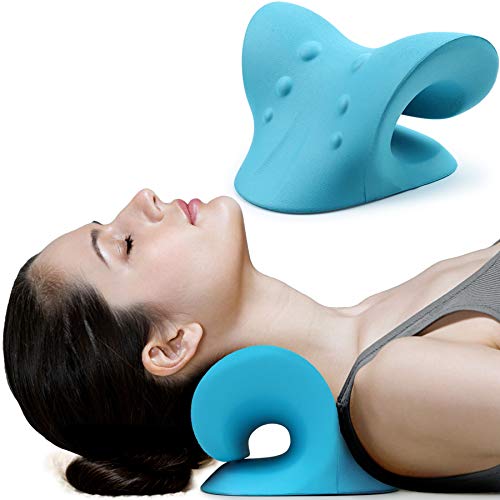
RESTCLOUD Neck and Shoulder Relaxer
by RESTCLOUD
Most-reviewed cervical relaxer on Amazon — a passive foam cradle that delivers gentle extension for muscle-tension neck pain at the lowest possible price and setup friction.
Pros
- Over 92,000 verified reviews represent the largest user validation base of any cervical decompression product on Amazon
- Passive foam cradle requires zero setup — lie down for 10 minutes, no straps or pumps to manage
- Targets the most common indication (tech-neck muscle tension, cervicogenic headaches, mild stiffness) where active traction is unnecessary
- Sub-twenty-dollar price point with no consumables makes it the lowest-risk entry to home cervical decompression
Cons
- Provides only passive cervical extension under head weight (roughly 8 to 10 pounds) — not true axial traction
- Not appropriate for diagnosed cervical disc herniation or radiculopathy where measurable separating force is needed
- Firm foam profile requires a one to two week adaptation period for most users
2. WIDREST Neck Stretcher Strap with Chin Belt — Best Budget
The WIDREST occupies a category most consumers do not know exists: a Y-strap chin halter system that delivers actual axial traction for a fraction of what a mechanical unit costs. Where the RESTCLOUD relies on head weight for passive extension, the WIDREST anchors over a sturdy door and uses your seated body weight as the counter-force, pulling the head upward along the cervical axis through a neoprene chin and occipital halter. The user controls the amount of force by leaning into or away from the strap, allowing a meaningful range from very gentle (5-pound effective load) to moderate (15- to 20-pound effective load). The DMI over-door set below costs less, but it rates 3.7 stars against the WIDREST’s 4.4, and almost all of that gap is setup frustration. For someone who needs more than passive extension, cannot justify the price of a mechanical unit, and wants the version of this mechanism users actually get along with, the WIDREST is the one to start with.
The 4.4-star rating across 1,124 reviews is the highest in this review and reflects two qualities: the device works as advertised, and the brand has been responsive to early complaints about the original chin pad (the current version uses a wider, padded chin halter that distributes load better than the original). The Y-strap design is also the only product in this review you can travel with — it packs flat, weighs less than a pound, and can be used in any hotel room with a door that latches. We routinely recommend it to patients who travel for work and whose neck pain reliably flares after long flights and hotel pillows.
The honest limitation is the chin strap itself. Any device that anchors at the chin places compressive force on the mandible and the temporomandibular joint, and patients with TMJ dysfunction, recent dental work, or jaw pain of any cause should not use this category of device. The Y-strap also requires a sturdy door and a few minutes to set up correctly the first few times — there is a learning curve to positioning the chin halter so that the force pulls cleanly along the spinal axis rather than tilting the head laterally. Once dialed in, sessions take 10 minutes and the setup becomes routine. For patients managing tech-neck tension that has progressed beyond what foam extension can relieve, this is the right next step before stepping up to a mechanical unit, and it pairs naturally with daytime use of a posture corrector to address the underlying postural driver.

WIDREST Neck Stretcher Strap with Chin Belt
by WIDREST
Best budget option that delivers actual axial traction — Y-strap chin halter system at a fraction of the cost of mechanical units, with the highest user rating in its price tier.
Pros
- Amazon's Choice with a 4.4-star rating — the highest user satisfaction score in the active-traction category at this price
- Provides actual axial traction force via the chin and occipital strap system, not just passive extension
- Portable enough to fit in a desk drawer and use anywhere with a door — no installation, no consumables
- Adjustable resistance lets users start at low force and progress as muscles adapt over days and weeks
Cons
- Chin strap places pressure on the temporomandibular joint and is not appropriate for users with TMJ disorder
- Setup requires a sturdy door and a few minutes to position correctly — less intuitive than a foam cradle
3. Siwei Cervical Neck Traction Device — Most Popular Inflatable Collar
The Siwei is the number two best-seller in Amazon’s Traction Equipment category and the most-purchased inflatable cervical collar on the platform by a wide margin. Its appeal is convenience: you wrap the collar around your neck, pump it up with the attached hand bulb, and wear it upright while sitting at a desk or watching TV. The collar’s expansion pushes the chin away from the chest and produces anterior cervical extension, which can relieve the forward-head posture that drives much office-worker neck pain. For office use in particular — where you cannot reasonably lie down on the floor for 10 minutes — the inflatable collar fills a niche that none of the other devices in this review can.
The honest assessment, reflected in the 3.8-star rating across more than 11,000 reviews, is that the Siwei is a useful but imperfect tool. The anterior extension it produces is not the same as the posterior axial separation produced by mechanical traction units; it provides some symptomatic relief for muscle tension and forward-head posture but is unlikely to meaningfully decompress a posteriorly herniated disc or open a narrowed neural foramen. Reviews show a recurring pattern of quality control inconsistency — some units arrive with weak air valves, some develop leaks within months of regular use — which is a known limitation of budget pneumatic products in this category.
The other consideration is jaw pressure. The collar’s expansion drives the chin upward, and patients with TMJ dysfunction or jaw pain frequently report aggravation of symptoms. If you have any history of jaw clicking, locking, or pain, this is not the right device. For desk-bound office workers without TMJ involvement who want a convenient daytime tool for cervical extension, the Siwei works well enough at a low price point to justify the purchase — just go in understanding that it is supplemental to, not a replacement for, daily foam-cradle sessions or true axial traction when needed. Combining it with a TENS unit for the upper trapezius can address the muscular component of the same complaint.

S (Siwei) Cervical Neck Traction Device
by Siwei
Most-purchased inflatable cervical collar — convenient for upright use during the workday but delivers anterior extension rather than true axial traction.
Pros
- Number two best-seller in Traction Equipment with over 10,800 reviews — the most-purchased inflatable collar on Amazon
- Hand pump inflation is intuitive and gives precise user control over the amount of cervical extension
- Worn upright while sitting at a desk or watching TV — fits naturally into a workday or evening routine
- Lowest price in the inflatable collar category with the largest review history for the format
Cons
- Provides anterior-dominant extension rather than true axial separation — limited use for posterior disc compression
- 3.8-star rating reflects inconsistent quality control and durability complaints across thousands of reviews
- Inflation can place pressure on the jaw and chin that mimics or aggravates TMJ symptoms
4. DMI Over the Door Cervical Traction Set — Classic PT Halter
The DMI over-door system is the most traditional design in this review — a vinyl head halter, a rope-and-pulley system, and a water bag that the user fills to dial in the desired traction weight. This is essentially the same equipment that physical therapy clinics have used for decades, scaled and packaged for home use. The user sits facing the door, places the halter under the chin and around the occiput, fills the water bag to the prescribed weight, and lets the bag’s gravity pull the head upward along the cervical axis. The water bag design is the key feature: by adjusting fill level, the user can produce traction force from a gentle 5 pounds up to roughly 20 pounds in fine increments.
The 3.7-star rating across 6,175 reviews requires honest interpretation. The complaints are almost uniformly about setup difficulty and the fiddliness of positioning the halter so the pull is clean rather than lateral — not about the underlying mechanism, which is sound and has been used in clinical settings for generations. For users who have worked with a physical therapist and know how the halter should sit, the DMI delivers genuine axial traction at the lowest price in the true-traction category. For users buying it without prior PT exposure and trying to figure it out from the included instructions alone, the learning curve is real and the early experience is frustrating. We recommend either having your physical therapist demonstrate the setup once or watching a few clinical videos before the first session.
The FSA and HSA eligibility is a meaningful differentiator. Most consumer cervical traction products are classified as wellness items and are not eligible for pre-tax health spending; the DMI’s PT-equipment lineage qualifies it as a medical product. For patients with FSA dollars at year-end or for those on high-deductible plans with HSAs, this matters. The mandible pressure caveat applies — if you have TMJ disorder, do not use chin-anchored devices. For everyone else with confirmed mechanical neck pain who wants a low-cost true-traction option and is willing to invest in learning the setup, the DMI is a defensible choice.

DMI Over the Door Cervical Traction Set
by Duro-Med
FSA-eligible clinical head-halter design — the traditional over-door system used in physical therapy clinics, at the lowest entry price for a true axial-traction product.
Pros
- Traditional clinical head-halter design used in physical therapy clinics for decades — not a novel consumer product
- FSA and HSA eligible, which clinical-grade pneumatic collars and foam stretchers usually are not
- Includes water bag for variable resistance — users can dial weight from very light to 20 pounds plus
- Over 6,100 reviews provide a long-term durability signal at the lowest price in the over-door category
Cons
- 3.7-star rating reflects the inherent finickiness of DIY over-door halter setup, not a product defect
- Mandible pressure can be significant — not appropriate for TMJ disorder or recent dental work
- Requires a sturdy door and proper positioning to deliver clean axial force without lateral pull
5. Hybodies Electric Pneumatic Cervical Traction Device — Programmable Office Option
The Hybodies is the right step up from a budget inflatable collar for users who want repeatable, clinic-style session protocols at home. Where the Siwei requires manual hand-pumping that varies session to session, the Hybodies uses an electric pump with an LCD touch controller to deliver consistent, programmable inflation cycles. Users can set session duration (typically 10 to 15 minutes), inflation level, and intermittent versus sustained modes — the intermittent mode mimics the pulsed traction protocols shown effective in the published cervical traction literature, where alternating periods of force and release appear to produce better outcomes than sustained traction.
The mechanism is still pneumatic, which means the Hybodies shares the limitations of its category: it produces anterior cervical extension and some incidental posterior separation, but it does not deliver the controlled axial force of a supine mechanical unit. It is the wrong tool for confirmed disc decompression at therapeutic forces. It is the right tool for users whose primary indication is forward-head postural strain and who want a programmable, repeatable session experience rather than the variable hand-pumping of a budget collar. The build quality reflects the price: better materials, a quieter pump, a more responsive air-release valve. The 352 reviews are a moderate sample size — fewer than we typically prefer — but the consistency of the feedback is high.
For users running a structured home protocol for ongoing muscle tension or postural neck pain, the programmability is the key feature. Setting a 12-minute session with intermittent 60-seconds-on, 10-seconds-off cycles and starting the device with one button press is meaningfully different from pumping a bulb by hand and trying to remember how many squeezes you did yesterday. Combine this with daytime posture corrector use and weekly check-ins on session-to-session symptom changes and you have a real home program.

Hybodies Electric Pneumatic Cervical Traction Device
by Hybodies
Programmable electric pneumatic collar with LCD touch control — the right step up from a hand-pump inflatable for users who want repeatable, clinic-style session protocols at home.
Pros
- Electric pump with LCD touch controller delivers consistent, repeatable inflation cycles without manual effort
- Programmable session length and pressure means users can replicate a clinically prescribed protocol at home
- Intermittent inflation mode mimics the pulsed traction protocol shown effective in the published cervical traction literature
- Higher build quality than budget inflatable collars — better materials, quieter pump, longer service life
Cons
- Still a pneumatic collar — produces anterior extension rather than the true posterior axial separation that mechanical units achieve
- 352 reviews is a moderate sample size — less long-term durability data than the higher-volume budget collars
6. iSTIM WeTrac Cervical Neck Traction Device — Runner-Up Clinical Unit
The iSTIM WeTrac is the runner-up to the ComforTrac in the clinical-grade supine mechanical category and is a legitimate alternative for patients who want true axial traction at a measured therapeutic force range without the ComforTrac’s price. The user lies supine on the unit with the head cradled in a padded headrest, and a knob-crank mechanism applies controlled axial force up to 50 pounds along the cervical axis. Force is measured and repeatable session to session — when your physical therapist prescribes 15 pounds for the first two weeks progressing to 25 pounds, the iSTIM allows you to deliver that protocol precisely.
The four adjustable angle settings are a meaningful clinical feature. The cervical spine is curved, and traction force directed at different angles preferentially affects different levels — a flatter angle targets the upper cervical spine (occiput through C2), while increasingly inclined angles target the mid and lower cervical levels. For patients whose imaging has identified a specific level as the primary pain generator (most commonly C5-C6 or C6-C7 in degenerative disc disease), the ability to direct force at the relevant level is a genuine therapeutic advantage that single-angle units and pneumatic collars cannot match.
The honest caveat is the learning curve. The iSTIM is not a plug-and-play consumer device; it is clinic-grade equipment in home form factor, and users who have never had cervical traction performed in a PT clinic should book at least one session with a physical therapist before using it at home. The PT can demonstrate the setup, identify the appropriate angle for the user’s specific anatomy and pathology, and prescribe the force progression. With that one-time clinical setup, the iSTIM becomes a powerful at-home tool that delivers prescribed protocols without the recurring cost of clinic visits. It is bulky for storage and is not portable — this is dedicated home equipment that lives in a spare bedroom or therapy corner, not something you travel with. Patients with cervical radiculopathy who are also experiencing referred shoulder symptoms should pair this with appropriate shoulder brace support for the irritated shoulder girdle during the rehabilitation period.

iSTIM WeTrac Cervical Neck Traction Device
by iSTIM
Clinical-tier supine mechanical traction with measured force up to 50 pounds — the runner-up to ComforTrac in the prescribed-protocol category, with four angle settings and a lower price.
Pros
- True mechanical axial traction with knob-crank precision — measured force up to 50 pounds suitable for prescribed disc decompression
- Four adjustable angle settings let the user target specific cervical levels (upper, mid, lower cervical spine)
- Supine use position eliminates the body weight and posture confounders that limit upright pneumatic devices
- Lower price than the ComforTrac at the same therapeutic force range — competitive clinical-tier alternative
Cons
- Steep learning curve — users without prior PT exposure should book a session with a physical therapist before initial home use
- Bulky for storage and not portable — this is dedicated home equipment, not a travel device
- 3.8-star average on a comparatively thin review base — the weakest rating of the two clinical-tier units here, and the ComforTrac's larger sample is the better durability signal
7. ComforTrac Deluxe Home Cervical Traction Kit 2.0 — Upgrade Pick
The ComforTrac is the gold-standard home cervical traction device and the only unit in this review that is widely prescribed by physical therapists as part of structured home rehabilitation programs for cervical disc disease and radiculopathy. The hand-pump hydraulic mechanism delivers smooth, controlled, measured force up to 200 pounds, with a safety quick-release valve that allows the user to abort a session in under a second if symptoms change. The unit is HCPCS-coded as durable medical equipment under E0849, which means it may qualify for insurance coverage under Medicare Part B and most commercial plans with a physician prescription and documented medical necessity.
The 1,500-plus reviews on the ComforTrac are the largest review base of any clinical-grade home cervical traction unit on Amazon, and the consistency of outcomes is the highest in the clinical category. Users with diagnosed cervical disc herniation, cervical radiculopathy, foraminal stenosis, and post-cervical-surgery rehabilitation report meaningful symptom relief when the unit is used as part of a PT-guided protocol. The hand-pump hydraulic mechanism is more controllable than knob-crank designs — small pump strokes produce small force increments, making it easier to dial in the precise force the user’s PT has prescribed and to back off quickly if symptoms increase.
The safety quick-release valve is a feature that should not be underestimated. Cervical traction at 25 to 50 pounds is a meaningful mechanical load, and symptoms can change quickly during a session — a sudden increase in radiating arm pain, dizziness, or vision change requires immediate force reduction. The quick-release allows that in a fraction of a second, where knob-crank designs require several seconds to unwind force. For prescribed protocols at therapeutic force ranges, this safety design is the right engineering choice and is part of why the ComforTrac is the most-recommended clinical-grade home unit.
The price is the limiting factor. At three hundred fifty dollars, the ComforTrac is not an exploratory purchase — it makes sense as part of a prescribed home program, ideally with insurance or FSA assistance to defray cost. For patients with confirmed cervical disc disease who have been told by their PT to “continue traction at home between sessions,” this is the unit that delivers the same protocol the clinic uses, in the same body position, with the same safety design. For patients without a confirmed mechanical diagnosis, the ComforTrac is overkill, and one of the lower-tier devices in this review will likely serve them better.
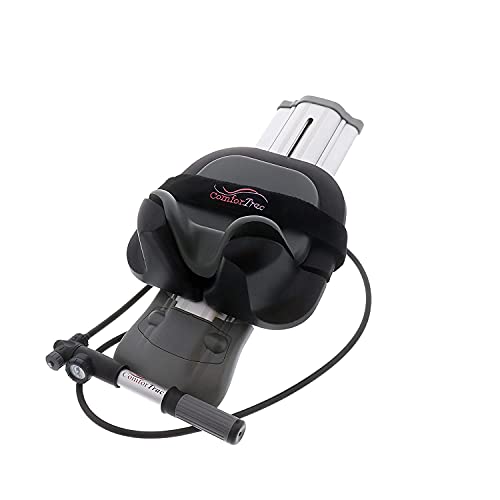
ComforTrac Deluxe Home Cervical Traction Kit 2.0
by ComforTrac
PT-community recognized clinical cervical traction kit — hand-pump hydraulic force up to 200 pounds with quick-release safety, the gold-standard home traction device for prescribed disc decompression.
Pros
- Widely recognized in physical therapy practice and HCPCS-coded as durable medical equipment under E0849
- Hand-pump hydraulic mechanism delivers smooth, controlled force up to 200 pounds with safety quick-release valve
- Over 1,500 reviews — by far the largest review base of any clinical-grade home traction unit on Amazon
- Carrying case included; quick-release safety design lets users abort a session in under a second if symptoms change
Cons
- Highest price in this review — appropriate as a prescribed home program, not as a try-it-out purchase
- Requires physician or physical therapist guidance for force prescription and session protocol
Buyer's Guide
Choosing a neck traction device requires matching the mechanism to the pathology, not picking the highest-rated product on Amazon — a foam stretcher and a 50-pound mechanical unit are different categories of medical product, and selecting the wrong one for your condition can produce no benefit or actively worsen symptoms.
Device Type and Body Position
The five major device categories — foam cradles, Y-strap door hammocks, inflatable collars, over-door head halters, and supine mechanical units — produce fundamentally different forces and fit different use cases. Foam cradles deliver passive extension under head weight and are best for muscle tension. Y-straps and over-door halters deliver active axial traction in an upright position. Inflatable collars deliver anterior extension (chin away from chest) but limited true axial separation. Supine mechanical units (ComforTrac, iSTIM) deliver the strongest, most controlled axial force and are the right choice for prescribed disc decompression. Match the device to the diagnosis, not the price tag or review count.
Maximum Traction Force
Force range matters more than any other spec for matching the device to the indication. Muscle tension and headaches respond to gentle force in the 7 to 10 pound range — anything heavier is overkill. Mild disc compression typically responds to 15 to 25 pounds under clinical supervision. Confirmed radiculopathy or moderate disc herniation often requires 25 to 45 pounds, and this force range should be reached only with a physical therapist's prescription and progression plan. Home units in the 50-to-200-pound range exist because clinicians sometimes prescribe higher forces — that doesn't mean home users should self-administer them. A foam cradle that maxes at 10 pounds is not inferior to a mechanical unit that delivers 200 pounds; they are appropriate for different patients.
Jaw and TMJ Pressure
Most traction devices that anchor at the chin — Y-straps, over-door head halters, and many inflatable collars — place compressive force on the mandible. This force is the mechanism by which they transmit traction to the cervical spine, so it cannot simply be engineered out. If you have temporomandibular joint dysfunction, recent dental surgery, jaw pain of any cause, or a history of TMJ-related headaches, chin-anchored devices are inappropriate. Choose a supine mechanical unit that anchors at the occiput instead, or a foam cradle that places no jaw load at all. A device that fixes your neck pain but triggers chronic jaw pain has not improved your life.
Adjustability and Angle Settings
The cervical spine has seven vertebrae arranged in a forward (lordotic) curve, and traction force directed at different angles will preferentially affect different levels. Supine mechanical units like the iSTIM WeTrac offer four adjustable angle settings that let the user target the upper cervical (occiput-C2), mid-cervical (C3-C5), or lower cervical (C6-T1) regions — useful when imaging has identified a specific level as the pain generator. Foam cradles, simple inflatable collars, and most over-door systems offer no angle control. For most muscle-tension cases this does not matter, but for level-specific radiculopathy it matters considerably.
Portability and Setup
A device that requires 10 minutes to set up gets used dramatically less often than one that takes 30 seconds. Foam cradles win on this dimension by a wide margin — you lie down and you are using it. Y-straps and over-door halters require 2 to 5 minutes of setup but are travel-friendly. Inflatable collars take a minute of pumping but no installation. Supine mechanical units like the ComforTrac take 5 minutes to set up the first time and 2 minutes after, but they are bulky and not portable. Pick a device whose setup friction is low enough that you will actually use it daily — consistent low-grade use beats occasional ideal use for most cervical conditions.
Insurance and Prescription Considerations
Clinical-grade traction units (ComforTrac, iSTIM WeTrac) are classified as durable medical equipment under HCPCS code E0849 and may qualify for insurance or Medicare Part B coverage with a physician prescription and documented medical necessity. Most consumer devices are wellness products and are paid out of pocket, though many are FSA and HSA eligible and can be purchased with pre-tax dollars. None of the home traction devices in this review have FDA clearance for the treatment of specific cervical conditions; the clinical-grade units are classified as Class II medical devices (the regulatory pathway, not a clinical claim). If you intend to use a home traction unit as part of a structured rehabilitation program, involve your physician or physical therapist in device selection before purchasing — both for clinical reasons and for reimbursement reasons.
Who Should NOT Use Cervical Traction
Cervical traction is contraindicated — meaning it should not be used at all — in several specific conditions. This list is not optional, and it is the single most important section of this review for any reader considering home traction without prior clinical guidance. If you have any of these conditions, do not start home cervical traction without explicit physician clearance.
Rheumatoid arthritis can produce atlanto-axial instability — laxity of the ligaments that stabilize the joint between the first and second cervical vertebrae. Applying traction force across an unstable atlanto-axial joint can produce catastrophic spinal cord injury. RA patients require cervical imaging before any traction is considered.
Acute disc herniation with myelopathy (spinal cord involvement) or significant motor weakness is a surgical consideration, not a traction one. Symptoms like progressive arm or hand weakness, loss of fine motor control, gait disturbance, or bowel and bladder changes require immediate medical evaluation, not home traction.
Vertebral artery disease or prior vertebral artery dissection makes the head and neck positioning required for traction risky for stroke. Patients with a history of vertebral artery dissection should not use any chin-anchored or angle-adjustable device without specialist clearance.
Spinal infection, spinal tumor, recent cervical fracture, or postoperative cervical fusion require physician clearance before any home traction. The mechanical stress of traction across infected, neoplastic, fractured, or recently fused tissue is contraindicated.
Severe osteoporosis carries a fracture risk under traction loads, particularly at the higher force ranges. Bone density should be known before clinical-grade traction is initiated.
Cervical instability of any cause — congenital, post-traumatic, post-surgical — is an absolute contraindication. The whole point of traction is to apply force across spinal segments; an unstable segment can shift catastrophically under that force.
Untreated significant hypertension can be worsened by the body position and exertion of certain traction devices, particularly upright systems. Get blood pressure under control before beginning traction protocols.
Active TMJ disorder is a relative contraindication specifically for chin-anchored devices (Y-straps, over-door halters, inflatable collars). These devices place compressive force on the mandible; patients with TMJ should choose a supine mechanical unit that anchors at the occiput instead, or a foam cradle that places no jaw load.
If you are uncertain whether any of these apply to you, talk to your physician before starting home traction. The downside risk of applying traction to a contraindicated condition far exceeds the upside benefit of any home device.
How to Use Cervical Traction Safely at Home
The general protocol for home cervical traction is 10 to 15 minutes per session, one to two times daily, at the lowest force that produces symptom relief. Start at 7 to 10 pounds for muscle tension and tension-type headaches. Progress to 15 to 25 pounds for mild disc-related pain only under clinical supervision. Higher force ranges of 25 to 45 pounds belong to a PT-prescribed program, not self-administered experimentation. Never exceed 30 minutes in a single session, and never fall asleep wearing any traction device. Do not use traction while driving, watching demanding video, or doing any task that requires you to be away from the quick-release mechanism.
Progress force gradually. The cervical structures need the same kind of progressive loading that strength training uses — going from 10 pounds to 30 pounds in a single jump is a common cause of post-session soreness and symptom flare. A typical safe progression is to add 2 to 5 pounds per week and to stay at each force level for several sessions before progressing further. If a force level produces increased symptoms, drop back to the previous level and stay there longer.
Stop immediately and consult your physician if you experience dizziness during or after a session, increased pain rather than relief, new numbness or tingling that worsens with the device, any change in vision or hearing, headache that develops during traction, or jaw pain that did not exist before starting chin-anchored devices. These are signals that the protocol is wrong for your anatomy or pathology, and continuing through them is the most common cause of home-traction-related complications we see in clinic.
Final Verdict
For the vast majority of readers — office workers with tech-neck tension, parents with tension headaches, anyone whose neck pain comes from muscle tightness and postural fatigue rather than from a confirmed disc problem — the RESTCLOUD Neck and Shoulder Relaxer is the right place to start. It delivers what 92,000 reviewers report: meaningful muscular relief in 10 minutes with no setup, no learning curve, and almost no cost. It is honest about being a passive extension device rather than a true axial traction unit, and for the most common indication that honesty is a feature rather than a limitation.
If you need actual axial traction at a budget price — because foam extension has not been enough, because you travel for work and need a portable option, or because you want a real-traction tool before investing in a clinical-grade unit — the WIDREST Y-strap is the best-rated true-traction device in the affordable tier, at 4.4 stars against 3.7 for the cheaper DMI over-door set. For patients with confirmed cervical disc disease or radiculopathy whose physical therapist has prescribed home traction as part of a structured rehabilitation program, the ComforTrac Deluxe Home Cervical Traction Kit 2.0 is the gold-standard home device and is HCPCS-coded for potential insurance coverage. For everyone in between, this review has covered the four other major device categories — pneumatic collars, over-door halters, programmable electric units, and supine mechanical alternatives — so that the format you choose matches the pathology you are treating.
A cervical traction device is one component of a comprehensive approach to neck pain. It works best in combination with proper daytime ergonomics, targeted strengthening exercises for the deep cervical flexors and scapular stabilizers, nighttime positional support from a quality cervical pillow, and clinical guidance for any diagnosed condition. If your neck pain is accompanied by arm symptoms, weakness, coordination changes, or has not responded to several weeks of conservative care, consult your physician — imaging and clinical evaluation may be appropriate before adding home traction to your routine.
Frequently Asked Questions
Do neck traction devices actually work?
Who should not use a cervical traction device?
What is the difference between a foam neck stretcher and a cervical traction device?
How long should I use a cervical traction device per session?
Does insurance cover cervical traction devices?
Related Articles
About the Reviewer

Dr. David Taylor, MD, PhD
Drexel University College of Medicine (MD), Indiana University School of Medicine (PhD)
Dr. David Taylor is a licensed physician and medical researcher who founded BestRatedDocs in 2016. With an MD from Drexel University and a PhD from Indiana University School of Medicine, he combines clinical expertise with a passion for health technology to provide evidence-based product recommendations. Dr. Taylor specializes in health informatics and regularly evaluates medical devices, diagnostic equipment, and therapeutic products to help healthcare professionals and patients make informed decisions.