7 Best EMS Devices of 2026
Dr. David Taylor reviews the best EMS devices on Amazon. Compare top muscle stimulators by channels, modes, clinical grade, and FDA clearance for recovery and rehab.
Updated
Muscle recovery, rehabilitation, and athletic performance conditioning have converged on a common tool in 2026: electrical muscle stimulation. EMS devices have moved from exclusive clinical environments into mainstream home use, and the Amazon marketplace now offers a range spanning from under $25 budget devices to professional-grade stimulators used in sports medicine. Whether you are a weekend athlete managing DOMS after training, a post-surgical patient working through physical therapy homework, or a clinician researching OTC options to recommend to patients, the right EMS device depends heavily on which of these three goals you are actually trying to achieve.
This matters more than it might appear. An EMS device optimized for athletic recovery operates at different frequencies and produces different muscle responses than a clinical NMES unit prescribed for post-ACL atrophy. Understanding those differences before purchasing is the single most important thing a buyer can do — and it is the differentiation that separates this review from the generalist comparisons that dominate search results. If you are primarily looking to relieve pain rather than stimulate muscles, our dedicated review of the best TENS units covers devices optimized specifically for that goal, including several at lower price points.
We reviewed seven EMS and NMES devices on Amazon, analyzing clinical specifications, real-world review patterns across tens of thousands of buyer experiences, and the underlying physiological principles that determine whether a device will actually serve your specific use case. What follows is a clinically grounded guide to the best EMS devices available without a prescription in 2026.
EMS, TENS, NMES, and FES: What the Terminology Actually Means
The EMS category is plagued by inconsistent terminology that obscures meaningful differences in device capability. Here is a brief clinical lexicon:
EMS (electrical muscle stimulation) is the broadest term — any device that uses electrical current to stimulate muscle tissue. NMES (neuromuscular electrical stimulation) is a more precise subset that specifically targets motor neurons to produce functional muscle contractions, the mechanism used in clinical rehabilitation. TENS (transcutaneous electrical nerve stimulation) targets sensory nerves to block pain signals — it does not produce significant muscle contractions. FES (functional electrical stimulation) is a specialized clinical technology that uses electrical stimulation to assist actual movement in patients with neurological deficits; it requires prescription and clinical oversight and is not covered here.
Most consumer devices marketed as “EMS” include TENS functionality as well, which is why you will see “TENS + EMS” in the specifications throughout this review. The distinction that matters for purchasing is whether you need pain signal modulation (TENS function), actual muscle stimulation (EMS/NMES function), or both. The Balego reviewed here is the only true NMES-first device in this selection — its clinical parameters are designed around motor neuron activation rather than pain relief.
After reviewing all seven devices and analyzing thousands of user reviews, here are our top picks. The summary table below provides a quick comparison across key specifications.
| Product | Price | Buy |
|---|---|---|
| Belifu Dual Channel TENS EMS Unit 24 Modes Muscle StimulatorBest Overall | $35.99 | View on Amazon |
| AVCOO 3-in-1 TENS Unit Muscle Stimulator with 30 ModesBudget Pick | $23.99 | View on Amazon |
| Balego EMS Digital Neuromuscular NMES Stimulator OTCRunner-Up | $61.95 | View on Amazon |
| iReliev TENS Unit + EMS Muscle Stimulator with 14 Therapy ModesRunner-Up | $99.90 | View on Amazon |
| Kongzee 4-in-1 DIY + TENS + EMS + Massage Muscle Stimulator | $76.97 | View on Amazon |
| Compex Performance 3.0 Muscle Stimulator with TENS KitPremium Pick | $150.72 | View on Amazon |
| Chirp Halo Wireless Muscle Stimulator (Double) | $179.99 | View on Amazon |
How We Selected These EMS Devices
Our selection criteria combined clinical relevance with real-world Amazon performance data. We required a minimum of 191 reviews for inclusion (the Compex floor), with most selections exceeding 1,000 reviews. We assessed stimulation type (TENS-primary vs EMS-primary vs true NMES), channel configuration, frequency programmability, battery design, and FDA clearance status. We excluded devices with documented systemic reliability failures — notably, several Bluetooth-dependent wireless EMS devices with persistent connectivity issues were removed from consideration despite high review counts. Seven devices survived the process: one for budget buyers, one for clinical rehabilitation, two mid-range FDA-cleared options, one professional-grade upgrade, one DIY-programmable option, and one wireless option for mobile use.
1. Belifu Dual Channel TENS EMS Unit — Best Overall
The Belifu earns the best overall designation through a combination that no competitor in this price range can match: more than 61,000 Amazon reviews validating consistent performance, independent dual channels, a rechargeable battery, and coverage of both TENS pain relief and EMS muscle stimulation in a single unit. At under $40, it represents the strongest evidence-to-price ratio in the EMS category.
The dual independent channels are a meaningful clinical feature. Each channel operates completely separately — you can run different modes at different intensities on different body areas simultaneously. For a patient managing both lumbar muscle soreness and knee weakness, or an athlete treating bilateral shoulder fatigue, this eliminates the need for two sequential sessions. The rechargeable lithium polymer battery is better suited to daily use than disposable-battery competitors, and the included storage bag keeps leads and pads organized between sessions.
The 24-mode library warrants a note of clinical realism: not all 24 modes represent clinically distinct stimulation parameters. Several modes produce subtle waveform variations that may feel different but produce similar physiological effects. For most users, a handful of modes — typically the EMS muscle programs and one or two TENS pain relief patterns — will become default selections. The mode breadth is a feature, not a liability, but buyers should not expect 24 meaningfully different therapeutic experiences. For complementary recovery, pairing the Belifu with a heating pad before a session can improve electrode-skin conductance and tissue receptivity to stimulation.

Belifu Dual Channel TENS EMS Unit 24 Modes Muscle Stimulator
by Belifu
The most battle-tested TENS+EMS device on Amazon with 61K reviews — exceptional value for muscle recovery and pain relief.
Pros
- Most-reviewed EMS device on Amazon with over 61,000 reviews providing exceptional real-world validation
- Independent dual channels treat two separate muscle groups simultaneously — back and legs, or both shoulders
- Rechargeable lithium polymer battery with indicator eliminates recurring disposable battery cost
- Consistent relief confirmed across back, neck, shoulder, and leg muscle groups in user review patterns
Cons
- 24 modes can feel overwhelming without clear clinical differentiation between stimulation patterns
- TENS functions are primary — not a dedicated EMS unit for users with pure muscle conditioning goals
- Replacement pads must be sourced separately when included supply is exhausted
2. AVCOO 3-in-1 TENS Unit Muscle Stimulator — Best Budget
The AVCOO stands out in the budget segment on a specific specification that matters more than mode count or marketing language: 40 intensity levels. Most budget EMS devices offer 20 intensity steps, meaning each increment represents a 5% jump in output. At 40 levels, each step is half that size — a clinically meaningful difference for users who find the therapeutic window sits between two steps on a 20-level device, or who need to titrate intensity carefully due to skin sensitivity.
The 30-mode library is the largest of any device reviewed here and covers TENS pain relief, EMS muscle stimulation, and relaxation-category programs in a single unit. USB-C charging is a practical quality-of-life feature increasingly absent from budget medical devices that still use proprietary or micro-USB connectors. For a buyer who wants maximum adjustability without a clinical grade device, the AVCOO’s feature set at this price is difficult to argue against.
The honest limitation is review depth. With just over 2,000 reviews compared to the Belifu’s 61,000, the AVCOO’s long-term daily-use reliability is less established. For occasional or moderate users, this is an acceptable trade-off. For patients who plan to use the device twice daily for months, the additional evidence base supporting the Belifu justifies the modest price difference.

AVCOO 3-in-1 TENS Unit Muscle Stimulator with 30 Modes
by AVCOO
Amazon's Choice with the highest mode count and finest intensity adjustment in the budget segment.
Pros
- Amazon's Choice ranking with 5,000+ units sold monthly validates real-world demand at this price point
- 40 intensity levels provide the finest adjustment granularity in the budget segment — critical for finding comfortable therapeutic threshold
- 30 modes cover full TENS, EMS, and relaxation spectrum in a single device
- USB-C charging with sustainable packaging reflects modern design attention uncommon at under $25
Cons
- Smaller review base than Belifu limits long-term reliability data for daily heavy users
- Mode documentation in the manual could be clearer for first-time EMS users
3. Balego EMS Digital Neuromuscular NMES Stimulator — Clinical Rehab
The Balego occupies a distinct category from every other device reviewed here because it is not primarily a consumer wellness product — it is a clinical rehabilitation tool that happens to be available OTC. The distinction is technical: the Balego is designed around NMES (neuromuscular electrical stimulation) principles, with fully adjustable parameters including stimulation frequency (2–150 Hz), pulse width (50–300 µs), and output amplitude (0–80 mA), along with configurable on/off cycling ratios and ramp times. These are the parameters physical therapists and occupational therapists adjust when designing NMES protocols for specific clinical goals.
The device is recommended by PTs and OTs for post-surgical muscle re-education following ACL reconstruction, total knee replacement, shoulder surgery, and stroke rehabilitation. The 40-plus-year history of Balego as a US-based family company in the neuromuscular stimulation space gives it a clinical credibility track record that no recent Amazon-native brand can approach. Made in the USA is a meaningful signal in a category where most devices are produced to cost in overseas contract manufacturing.
The 9V battery dependency is the significant practical drawback, and it is worth quantifying: with daily 30-minute sessions, expect to replace the battery roughly every week. For patients in an active rehabilitation program, this is a real ongoing cost. The parameter complexity also means the Balego is not appropriate for users who want a simple plug-and-play device — the clinical parameter flexibility is only valuable if you have clinical guidance on how to use it, either from your own PT or from the Balego documentation.

Balego EMS Digital Neuromuscular NMES Stimulator OTC
by Balego
The only true clinical-grade NMES unit widely available OTC — US-made, PT-recommended, built for muscle re-education after surgery or stroke.
Pros
- True NMES device producing actual muscle contractions — clinically distinct from consumer TENS devices that only block pain signals
- Fully adjustable clinical parameters including Hz frequency, pulse width, and on/off ramp for PT/OT-guided protocols
- US-made by a family company with 40+ years in neuromuscular rehabilitation — the longest track record of any device reviewed
- OTC FDA Cleared with PT and OT recommendation for post-surgical recovery including ACL, stroke, and muscle atrophy
Cons
- 9V battery drains in approximately one week of regular use — ongoing replacement cost compared to rechargeable competitors
- Steep learning curve for non-clinical users unfamiliar with NMES parameter selection
4. iReliev TENS Unit + EMS Muscle Stimulator — Mid-Range
The iReliev’s defining organizational feature is a mode library cleanly divided between 8 TENS programs and 6 EMS programs — a separation that eliminates a common frustration with multi-function devices where pain relief and muscle conditioning modes are interleaved without clear labeling. This structural clarity matters particularly for users who have a specific therapeutic goal and do not want to scroll through irrelevant programs. The FDA clearance designation adds medical credibility that supports FSA/HSA reimbursement documentation.
The 25 intensity levels represent a middle ground between the fine granularity of the AVCOO’s 40 levels and the coarser 20-level steps on most budget alternatives. The large backlit LCD is a practical feature that improves usability in the early morning or evening hours when most recovery sessions occur. The belt clip and tote bag reflect attention to real-world portability that many technically capable devices overlook.
The intensity ceiling concern raised in user reviews is honest and worth acknowledging: users with high stimulation tolerance — typically athletes or individuals accustomed to deep tissue massage — occasionally find the maximum output insufficient for large lower-body muscle groups like the gluteus maximus or quadriceps. For most users and most body areas, the intensity range is adequate. For high-tolerance users with a specific focus on large lower-body muscles, the Compex’s 999-level output is the appropriate step up. This device also pairs well with a massage gun session post-workout, with EMS providing active recovery blood flow and the percussive treatment addressing superficial myofascial tension.
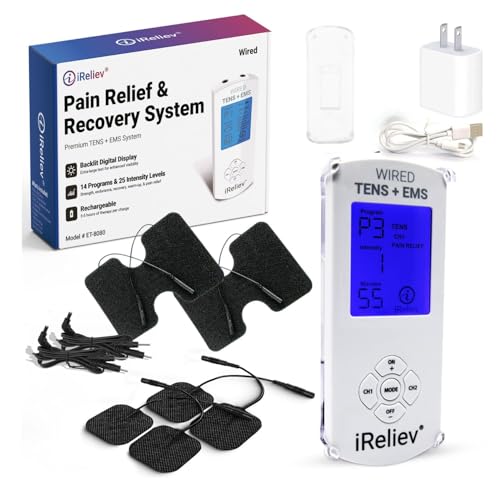
iReliev TENS Unit + EMS Muscle Stimulator with 14 Therapy Modes
by iReliev
FDA-cleared mid-range with cleanly separated TENS pain and EMS muscle programs — the most organized mode library in this price tier.
Pros
- FDA Cleared with 8 TENS and 6 EMS programs cleanly separated — no mode confusion between pain relief and muscle conditioning goals
- Large backlit LCD is easy to navigate in low-light settings and for users with visual limitations
- 74% five-star reviews with strong functionality scores across rehab and athletic recovery use cases
- Tote bag and belt clip included for portable hands-free use during light activity
Cons
- Intensity may feel insufficient for large muscle groups like glutes and quadriceps in users with higher stimulation tolerance
- Lower review count versus budget alternatives at a comparable price point limits confidence for first-time buyers
5. Kongzee 4-in-1 DIY + TENS + EMS + Massage Muscle Stimulator
The Kongzee’s differentiating feature is its DIY custom programming mode — the ability to manually set stimulation frequency, pulse width, and intensity parameters outside the preset program library. This is an uncommon capability at this price point and serves a specific user: someone who has received a specific NMES or EMS protocol from a physical therapist and wants to replicate those exact parameters at home between clinic sessions. Rather than approximating the prescribed protocol with a preset mode, the DIY function allows precise parameter matching.
The 4-in-1 framework — TENS pain relief, EMS muscle stimulation, massage-pattern stimulation, and custom programming — provides more functional breadth than most competitors in this price range. The FDA clearance designation and sustained monthly sales volume indicate a device that has found a real user base beyond initial novelty purchasing. The independent dual channels with per-channel intensity control are particularly relevant for asymmetric rehabilitation: a patient recovering from a unilateral knee injury can run higher intensity on the affected side without changing the contralateral treatment.
The learning curve for DIY programming is genuine — using the feature effectively requires at least basic familiarity with EMS parameters and ideally some clinical guidance on the target values. Buyers who purchase this device for the DIY capability and do not know what parameter values to enter will not find the feature useful. For buyers who do have a specific protocol to replicate, it is the most relevant feature in this price range.

Kongzee 4-in-1 DIY + TENS + EMS + Massage Muscle Stimulator
by Kongzee
The most versatile mid-range option with FDA clearance and rare DIY custom programming for replicating PT-prescribed protocols.
Pros
- FDA Cleared with unique DIY custom parameter programming — rare at this price point and valued by users who want to replicate PT-prescribed protocols at home
- 4-in-1 versatility covers pain relief, muscle stimulation, relaxation, and custom therapy in a single device
- Independent dual channel with per-channel intensity control allows asymmetric treatment for unilateral injuries
- 1,000+ units sold monthly with a 4.4-star rating across 2,500+ reviews confirms sustained real-world performance
Cons
- DIY programming can be difficult to configure for comfort without clinical guidance on appropriate parameters
- All-manual button control with no app — complex parameter adjustment requires consulting the manual
6. Compex Performance 3.0 Muscle Stimulator — Best for Athletes
Compex is the professional EMS brand with the strongest established relationship with elite sports medicine. Used by professional sports teams, Olympic training programs, and sports medicine clinics, the Compex brand represents a level of clinical validation that consumer Amazon-native brands cannot claim. The Performance 3.0 is the entry point to the professional Compex lineup available on Amazon — below the top-tier Sport Elite but above the consumer-grade products that carry the Compex name without the sports-science methodology.
The 999-intensity levels are not marketing hyperbole — the fine-grained output control allows truly precise titration for trained athletes who have built up stimulation tolerance over months of use and need incremental increases that are genuinely below the threshold of noticeable jump. The 8-hour rechargeable battery is the longest runtime of any wired device reviewed here, supporting extended training or rehabilitation days without mid-session recharging. The water-resistant silicone sleeve addresses a real problem for athletes: EMS use around sweat or post-shower moisture is unavoidable, and water ingress is the most common cause of premature device failure.
The micro-USB charging port failure is documented clearly enough in reviews to warrant upfront acknowledgment. This is not a theoretical concern — it is a recurring failure mode that Compex has not resolved in the Performance 3.0’s production run. Buyers should treat the charging port as a consumable component and avoid mechanical stress at the connection point. At the premium price, this design choice is a legitimate disappointment.

Compex Performance 3.0 Muscle Stimulator with TENS Kit
by Compex
Professional-grade Compex EMS trusted by sports medicine — 8-hour battery, water resistance, and periodized training programs for serious athletes.
Pros
- Professional brand used by elite athletes and sports medicine practitioners — the most clinically credentialed EMS brand available on Amazon
- 8-hour battery life is the longest of any wired EMS device reviewed — ideal for extended multi-session days
- Water-resistant silicone sleeve survives post-workout sweat and gym environments without protective cases
- Scientifically designed periodization programs structured for progressive muscle loading over training cycles
Cons
- Proprietary micro-USB charging port is a documented failure point noted repeatedly in long-term user reviews
- Large standard electrode pads are reported ineffective by users for targeted treatment — many cut them in half
7. Chirp Halo Wireless Muscle Stimulator (Double)
The Chirp Halo addresses a genuine limitation of all wired EMS devices: lead wires restrict movement, tangle, and develop connector failures with repeated daily use. For users whose recovery protocol involves mobility — walking, light stretching, dynamic warm-up activities — a wired device is simply incompatible with the movement pattern. The Halo’s pod-based wireless design allows the user to apply the pads, attach the magnetic pods, and move freely throughout the session without a device hanging from leads.
The magnetic attachment mechanism is the most practical innovation in this product: setup time under 30 seconds eliminates the friction that causes users to skip recovery sessions when pressed for time. The deliberate decision to avoid app and Bluetooth dependency is a direct response to a well-documented failure mode in competing wireless EMS products — Bluetooth connectivity failures are the leading complaint in negative reviews of several wireless competitors, including one popular device that was excluded from this review for exactly that reason.
The honest evaluation requires acknowledging the limited review base. At 244 reviews, the Chirp Halo does not yet have the evidence depth needed to make confident long-term reliability claims. It is included because the design approach is sound, the early review sentiment is positive, and the use case it fills — reliable wireless EMS without app dependency — is not served by any other device in this review. Buyers who prioritize wireless convenience and can accept the limited track record will find it the best available option. Those who want a more established review record should choose any of the wired alternatives above.

Chirp Halo Wireless Muscle Stimulator (Double)
by Chirp
The only reliable fully wireless EMS option — cordless with magnetic pads and zero app dependency.
Pros
- Completely wireless with no lead wires — pods attach directly to adhesive pads for unrestricted movement during use
- Magnetic pad attachment speeds setup to under 30 seconds — the fastest connection mechanism of any device reviewed
- No app or Bluetooth required, eliminating the connectivity failures that have plagued other wireless EMS devices
- Quick-charge battery and compact pods fit discreetly under clothing for use during low-impact activity
Cons
- Only 244 reviews — the smallest evidence base of any device reviewed, limiting long-term reliability data
- Proprietary pad format cannot use generic TENS replacement pads, raising long-term supply cost
How to Choose the Best EMS Device
The most important purchase decision in this category is made before you look at any specific device: clarifying your primary goal. The three EMS use cases — post-workout recovery, muscle conditioning and strength, and clinical rehabilitation — are not fully served by the same device specifications.
Post-workout recovery is the most accessible use case and is served by virtually any device reviewed here. Low-frequency stimulation (1–10 Hz) promotes blood flow and lactate clearance without additional muscle fatigue. The Belifu or AVCOO handle this use case at their respective price points without any features being wasted. If you are primarily pairing EMS with other recovery modalities such as heat therapy, the session structure matters more than device sophistication.
Muscle conditioning and strength requires higher-frequency programs (35–80 Hz) and sufficient intensity output to recruit fast-twitch motor units. The Compex’s 999-level output is designed specifically for this use case. Budget devices can provide conditioning stimulation, but their intensity ceilings may limit effectiveness for trained athletes with high neuromuscular tolerance.
Clinical rehabilitation — post-surgical atrophy reversal, stroke recovery, ACL or shoulder reconstruction rehab — requires either a true NMES device like the Balego with adjustable clinical parameters, or guidance from a physical therapist on which consumer device preset modes approximate the required stimulation protocol. Self-directed use of a consumer EMS device for serious clinical rehabilitation without PT guidance is not recommended; the parameters that produce therapeutic muscle contraction for atrophy reversal are more specific than consumer preset libraries suggest.
One practical consideration that applies across all use cases: electrode placement. EMS effectiveness depends heavily on pad placement over the motor point of the target muscle — the location where the motor nerve enters the muscle belly, where the lowest current intensity produces the strongest muscle response. For most major muscle groups, motor point maps are available in the device documentation or through a physical therapist. Incorrect pad placement is the most common reason users report that an EMS device “doesn’t work” — the device is often functioning correctly but the electrodes are not positioned to engage the target muscle efficiently.
Contraindications deserve explicit mention. EMS devices should not be used by individuals with implanted cardiac devices (pacemakers, defibrillators), during pregnancy, by individuals with active epilepsy, or over areas of active thrombosis, malignancy, or broken skin. Patients with peripheral neuropathy should use EMS only under clinical supervision. Consult your physician before beginning EMS therapy if any of these conditions apply to you.
Buyer's Guide
Choosing the right EMS device requires matching stimulation technology, channel configuration, and programmability to your specific goal — whether that is post-workout recovery, post-surgical muscle re-education, or athletic performance conditioning.
Goal Alignment
EMS devices serve three distinct purposes that require different specifications. For post-workout recovery, any device with low-frequency modes (1–10 Hz) is adequate. For strength training or muscle conditioning, look for higher frequency programs (35–80 Hz) and higher intensity outputs. For clinical rehabilitation — post-surgical atrophy, stroke recovery, or ACL rehab — a true NMES device like the Balego with fully adjustable clinical parameters is the appropriate choice. Buying a device designed for a different goal than yours is the most common EMS purchasing mistake.
Channels and Electrode Count
A dual-channel device allows simultaneous treatment of two separate muscle groups — both quadriceps, bilateral shoulders, or lower back and hamstrings in a single session. Most devices reviewed here are dual-channel. The Compex Performance offers 4 ports supporting up to 4 pads simultaneously. For athletes or patients treating multiple areas per session, channel count directly determines treatment efficiency. Each channel should be independently adjustable for intensity to accommodate asymmetric strength deficits common in unilateral injury rehabilitation.
Frequency Range and Modes
EMS efficacy is highly frequency-dependent. Recovery protocols typically use 1–10 Hz to promote circulation without fatiguing the muscle. Strength and endurance conditioning programs use 35–80 Hz to recruit fast-twitch motor units. Clinical NMES for atrophy reversal typically uses 30–50 Hz with specific on/off cycling ratios. Consumer devices with preset modes have these parameters built in, but devices like the Kongzee with DIY programmability allow you to replicate specific frequencies prescribed by a physical therapist. Verify that the device's frequency range covers the Hz values appropriate for your goal before purchasing.
Wired vs Wireless Design
Wired EMS devices are more reliable, less expensive, and offer more mode and intensity options — they are the right choice for most users. Wireless devices like the Chirp Halo eliminate lead wire tangles and allow use during movement, which is valuable for sports rehabilitation and active recovery protocols that require mobility. The trade-off is higher cost, proprietary pad formats, and — in Bluetooth-dependent alternatives — connectivity failures. For stationary recovery or clinical use, wired is the practical choice. For athletes who move during treatment or want to wear devices during low-impact activity, wireless offers genuine functional advantages.
Battery Life and Power Source
Rechargeable devices with USB-C or micro-USB charging are strongly preferred over 9V alkaline battery units for daily users. A 9V battery lasts approximately one week with regular use, adding $50 or more in annual battery cost and significant inconvenience. Most rechargeable devices reviewed provide 6 to 10 hours per charge — sufficient for multiple daily sessions before recharging is needed. The exception is the Balego NMES unit, which uses a 9V battery because the clinical hardware design predates rechargeable consumer electronics standards. If you choose the Balego, budget for battery replacement as part of your operating cost.
FDA Clearance and HSA/FSA Eligibility
FDA 510(k) clearance — distinct from simple FDA registration — means the device has been reviewed and found substantially equivalent to an established medical device in terms of safety and effectiveness. FDA-cleared devices carry more credibility for insurance documentation and HSA/FSA reimbursement claims. Four devices in this review carry explicit FDA clearance: the Balego, iReliev, Kongzee, and Compex. All seven are marketed as FSA/HSA eligible, but clearance status strengthens the medical necessity argument for plan administrators who require documentation.
Final Verdict
For most buyers seeking a reliable, well-validated EMS device for daily muscle recovery and pain management, the Belifu Dual Channel TENS EMS Unit is the best overall choice in 2026. Its combination of 61,000+ real-world reviews, independent dual channels, rechargeable battery, and FSA/HSA eligibility at under $40 makes it the most defensible recommendation across the broadest range of use cases. For budget-conscious buyers, the AVCOO’s 40 intensity levels and Amazon’s Choice ranking at under $25 represent the strongest entry-level option in the category.
For buyers with specific needs, the right answer diverges. Post-surgical patients or those following a PT-prescribed rehabilitation protocol should seriously evaluate the Balego NMES unit — its clinical parameter adjustability is simply not replicated by any consumer device. Serious athletes who use EMS as part of a structured performance program will find the Compex Performance 3.0 the most credible choice despite its price premium. And for buyers who need wireless freedom of movement, the Chirp Halo is the only reliable option that does not depend on an app or Bluetooth. As with any medical device, consult your healthcare provider before beginning EMS therapy, particularly if you are managing a diagnosed condition or recovering from surgery.
Frequently Asked Questions
Does EMS actually build muscle?
What is the difference between EMS and TENS?
Is EMS good for muscle recovery after workouts?
Are EMS devices HSA or FSA eligible?
Who should not use an EMS device?
Related Articles
About the Reviewer

Dr. David Taylor, MD, PhD
Drexel University College of Medicine (MD), Indiana University School of Medicine (PhD)
Dr. David Taylor is a licensed physician and medical researcher who founded BestRatedDocs in 2016. With an MD from Drexel University and a PhD from Indiana University School of Medicine, he combines clinical expertise with a passion for health technology to provide evidence-based product recommendations. Dr. Taylor specializes in health informatics and regularly evaluates medical devices, diagnostic equipment, and therapeutic products to help healthcare professionals and patients make informed decisions.